

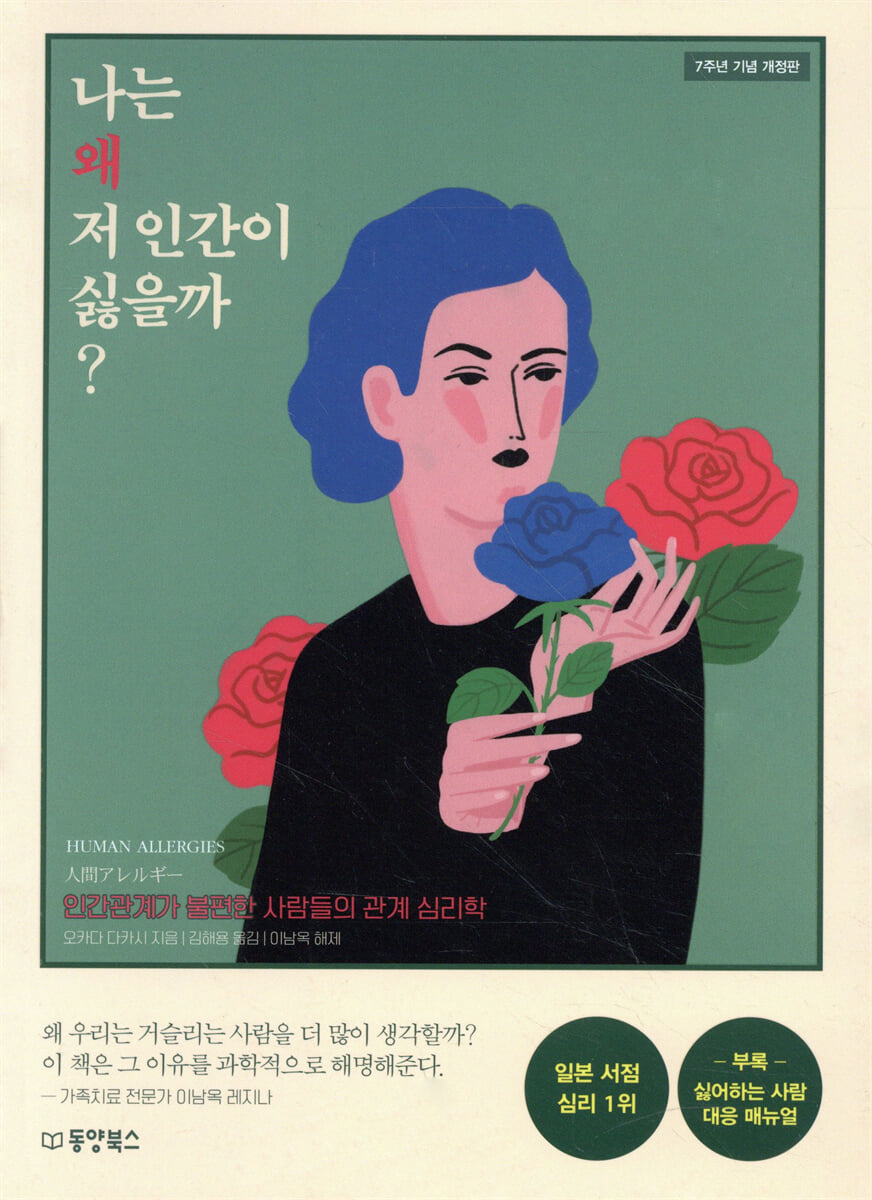
Why do I hate that person?
 |
Description
Book Introduction
Why than the person you love
Should I think more about the person who annoys me?
*Domestic Bookstore Psychology Steady Seller*
*#1 in Japanese bookstore psychology*
*Recommended books by family therapist Namok Lee and Regina*
*Appendix_Manual for Dealing with People You Hate*
The latest revised edition of the psychology classic 『Why Do I Hate That Person?』 (original title: Human Allergy) which has been consistently loved by domestic readers along with 『Why Do I Feel Better Alone?』 which created the buzzword 'Avoidant Person' has been published.
People who think of negative things before positive ones, people who show even the slightest discomfort on their faces, people who get stressed out because they think about people they dislike rather than people who don't have enough time to think about people they like.
A person who ultimately eats away at himself because of his hatred for humanity.
"Why Do I Hate That Person?" is a book that analyzes the reasons why these people struggle and suggests solutions.
In this book, Japanese psychiatrist Takashi Okada likens the phenomenon of feeling anger and disgust towards people to an allergic reaction in the body, calling it "human allergy."
A person you can never forgive, a person you can never understand, a person you can never like no matter how hard you try… … .
As you go through life, it is perhaps inevitable that you will meet people like this.
Of course, if you're uncomfortable with someone, you can just quickly cut them off and cut off contact.
But the problem is that some people are prone to 'human allergies' and others are prone to them as well.
In other words, no matter how many times you change partners or move companies, the same thing happens again.
The author analyzes the causes of human allergies through 'attachment theory' and seeks solutions by sharing numerous clinical cases and celebrity cases with readers.
It is also quite interesting to read about the interpersonal relationships of famous people we are already familiar with, such as Saint-Exupéry, Nietzsche, Schopenhauer, Natsume Soseki, Harry Harlow, and Somerset Maugham.
Additionally, the 'Manual for Dealing with People You Hate' included in the appendix is practical enough to be followed as is.
This book has been ranked #1 in the psychology category on Amazon since its publication in Japan in 2015, and has been loved for a long time since its introduction in Korea in 2016, where it ranked as a bestseller in the self-development and human relations categories.
This 2023 revised edition includes an explanatory note by Professor Nam-ok Lee, a family therapist, and has streamlined the manuscript to unify psychological terminology and make it more relevant to the 2023 reality.
Should I think more about the person who annoys me?
*Domestic Bookstore Psychology Steady Seller*
*#1 in Japanese bookstore psychology*
*Recommended books by family therapist Namok Lee and Regina*
*Appendix_Manual for Dealing with People You Hate*
The latest revised edition of the psychology classic 『Why Do I Hate That Person?』 (original title: Human Allergy) which has been consistently loved by domestic readers along with 『Why Do I Feel Better Alone?』 which created the buzzword 'Avoidant Person' has been published.
People who think of negative things before positive ones, people who show even the slightest discomfort on their faces, people who get stressed out because they think about people they dislike rather than people who don't have enough time to think about people they like.
A person who ultimately eats away at himself because of his hatred for humanity.
"Why Do I Hate That Person?" is a book that analyzes the reasons why these people struggle and suggests solutions.
In this book, Japanese psychiatrist Takashi Okada likens the phenomenon of feeling anger and disgust towards people to an allergic reaction in the body, calling it "human allergy."
A person you can never forgive, a person you can never understand, a person you can never like no matter how hard you try… … .
As you go through life, it is perhaps inevitable that you will meet people like this.
Of course, if you're uncomfortable with someone, you can just quickly cut them off and cut off contact.
But the problem is that some people are prone to 'human allergies' and others are prone to them as well.
In other words, no matter how many times you change partners or move companies, the same thing happens again.
The author analyzes the causes of human allergies through 'attachment theory' and seeks solutions by sharing numerous clinical cases and celebrity cases with readers.
It is also quite interesting to read about the interpersonal relationships of famous people we are already familiar with, such as Saint-Exupéry, Nietzsche, Schopenhauer, Natsume Soseki, Harry Harlow, and Somerset Maugham.
Additionally, the 'Manual for Dealing with People You Hate' included in the appendix is practical enough to be followed as is.
This book has been ranked #1 in the psychology category on Amazon since its publication in Japan in 2015, and has been loved for a long time since its introduction in Korea in 2016, where it ranked as a bestseller in the self-development and human relations categories.
This 2023 revised edition includes an explanatory note by Professor Nam-ok Lee, a family therapist, and has streamlined the manuscript to unify psychological terminology and make it more relevant to the 2023 reality.
- You can preview some of the book's contents.
Preview
index
Revised Edition Release: Why Do We Think More About Those Who Annoy Us Than Those We Love? 009
Introduction: Why do people suddenly become hateful? 018
{Chapter 1}
"Am I allergic to humans?" 023
The reason why I liked it until yesterday but now I hate it
{Chapter 2}
"Why Can't People Trust Each Other?" 045
History of Human Allergies
{Chapter 3}
“Why did I start to hate you?” 071
Mechanisms of human allergy
{Chapter 4}
“I don’t like it, but what can I do?” 141
Human allergies and the attachment system
{Chapter 5}
“I can control myself!” 195
The moment you know the reason, the seal on your relationships is lifted.
Outgoing Words: Is the person I hate truly a villain? 251
Translator's Note: Where did those friends disappear to back then? 254
Appendix 1 - Glossary of Key Terms 257
Appendix 2 - Handling People You Hate 259
Introduction: Why do people suddenly become hateful? 018
{Chapter 1}
"Am I allergic to humans?" 023
The reason why I liked it until yesterday but now I hate it
{Chapter 2}
"Why Can't People Trust Each Other?" 045
History of Human Allergies
{Chapter 3}
“Why did I start to hate you?” 071
Mechanisms of human allergy
{Chapter 4}
“I don’t like it, but what can I do?” 141
Human allergies and the attachment system
{Chapter 5}
“I can control myself!” 195
The moment you know the reason, the seal on your relationships is lifted.
Outgoing Words: Is the person I hate truly a villain? 251
Translator's Note: Where did those friends disappear to back then? 254
Appendix 1 - Glossary of Key Terms 257
Appendix 2 - Handling People You Hate 259
Detailed image

Into the book
Most of the problems we experience in social life arise from interpersonal relationships.
---p.21
While research on allergic reactions in the body has been actively conducted and much has been elucidated, research on allergic reactions in the mind is very limited in both quantity and quality.
---p.21
Human relationships are reciprocal.
When I ignore someone, they soon realize my feelings and ignore me too.
Even people who have feelings for or are interested in you will give up on approaching you and leave if you show your wariness and keep a frown on your face.
---p.29
This reaction occurs because they are unable to express their emotions appropriately.
---p.32
Recently, it has been revealed that affection is an essential nutrient for the healthy growth and development of children, as well as for the health and longevity of adults and the elderly.
---p.33
Oxytocin is secreted when we are gently hugged or stroked, so people who have grown up being hugged and spoken to affectionately by their parents since childhood have an abundance of oxytocin receptors.
---p.33
When the instinct to be loved is not fully satisfied, there are many cases of destructive behavior.
This is because, if a person's basic instincts are not met, neither the ability to empathize and care for others, nor the ability to reflect on oneself and control impulses, can develop nor function normally.
---p.56
Polymorphism exists to reduce risk and avoid extinction.
From that perspective, it could be said that any mutation survived because it had an aspect that helped the survival of the entire species.
---p.94
Just as a clean environment free of germs can cause allergies, an environment with limited human contact and isolation can promote human allergies.
---p.197
Much of our everyday concern also tends to revolve around who the 'bad guy' is and condemning that person.
But the real problem is that we try to shift all the blame onto the 'evil' and attack and eliminate it.
---p.21
While research on allergic reactions in the body has been actively conducted and much has been elucidated, research on allergic reactions in the mind is very limited in both quantity and quality.
---p.21
Human relationships are reciprocal.
When I ignore someone, they soon realize my feelings and ignore me too.
Even people who have feelings for or are interested in you will give up on approaching you and leave if you show your wariness and keep a frown on your face.
---p.29
This reaction occurs because they are unable to express their emotions appropriately.
---p.32
Recently, it has been revealed that affection is an essential nutrient for the healthy growth and development of children, as well as for the health and longevity of adults and the elderly.
---p.33
Oxytocin is secreted when we are gently hugged or stroked, so people who have grown up being hugged and spoken to affectionately by their parents since childhood have an abundance of oxytocin receptors.
---p.33
When the instinct to be loved is not fully satisfied, there are many cases of destructive behavior.
This is because, if a person's basic instincts are not met, neither the ability to empathize and care for others, nor the ability to reflect on oneself and control impulses, can develop nor function normally.
---p.56
Polymorphism exists to reduce risk and avoid extinction.
From that perspective, it could be said that any mutation survived because it had an aspect that helped the survival of the entire species.
---p.94
Just as a clean environment free of germs can cause allergies, an environment with limited human contact and isolation can promote human allergies.
---p.197
Much of our everyday concern also tends to revolve around who the 'bad guy' is and condemning that person.
But the real problem is that we try to shift all the blame onto the 'evil' and attack and eliminate it.
---p.252~253
Publisher's Review
Why than the person you love
Should I think more about the person who annoys me?
★Domestic Bookstore Psychology Steady Seller★
★#1 in Japanese Bookstore Psychology★
★Recommended books by family therapist Namok Lee and Regina★
★Appendix_Manual for Dealing with People You Dislike★
In an era where even the slightest inconvenience can lead to a breakup,
Is there no other way besides cutting ties?
The latest revised edition of the psychology classic 『Why Do I Hate That Person?』 (original title: Human Allergy) which has been consistently loved by domestic readers along with 『Why Do I Feel Better Alone?』 which created the buzzword 'Avoidant Person' has been published.
People who think of negative things before positive ones, people who show even the slightest discomfort on their faces, people who get stressed out because they think about people they dislike rather than people who don't have enough time to think about people they like.
A person who ultimately eats away at himself because of his hatred for humanity.
"Why Do I Hate That Person?" is a book that analyzes the reasons why these people struggle and suggests solutions.
Takashi Okada, a psychiatrist who has enjoyed continued popularity since causing a stir in Japanese society by suggesting the fundamental causes and solutions to juvenile delinquency through his 'attachment theory'.
In this book, he describes the phenomenon of feeling anger and disgust towards people as 'human allergy', comparing it to an allergic reaction in the body.
A person you can never forgive, a person you can never understand, a person who makes you feel repulsive, a person you can never like no matter how hard you try, a person you just hate for no reason… … .
As you go through life, it is perhaps inevitable that you will meet people like this.
Of course, as is the trend these days, if someone makes you feel a little uncomfortable, you can just quickly cut them off and cut off contact.
But the problem is that some people are prone to 'human allergies' and others are prone to them as well.
In other words, no matter how many times you change partners or move companies, the same thing happens again.
Moreover, if the person you feel dislike is a family member, the problem becomes even more serious.
Not only is it difficult to break ties, but you can't help but feel skeptical about your own existence.
The author analyzes the causes of human allergies through 'attachment theory' and seeks solutions by sharing numerous clinical cases and celebrity cases with readers.
It is also quite interesting to read about the interpersonal relationships of famous people we are already familiar with, such as Saint-Exupéry, Nietzsche, Schopenhauer, Natsume Soseki, Harry Harlow, and Somerset Maugham.
Additionally, the 'Manual for Dealing with People You Hate' included in the appendix is practical enough to be followed as is.
This book has been ranked #1 in the psychology category on Amazon since its publication in Japan in 2015, and has been loved for a long time since its introduction in Korea in 2016, where it ranked as a bestseller in the self-development and human relations categories.
This 2023 revised edition includes an explanatory note by Professor Nam-ok Lee, a family therapist, and has streamlined the manuscript to unify psychological terminology and make it more relevant to the 2023 reality.
What should I do when I suddenly start to dislike someone?
A masterpiece that delves into the root of human relationships and their suffering!
The author says that, just as with the body's allergic reactions, accurately analyzing the mechanisms within which the mind's allergic reactions operate can help resolve many problems that arise in human relationships.
Also, the book's most powerful strength is that it very persuasively organizes, based on solid theory and specific examples, how to organize your body and mind when you meet someone you dislike, and what to do when you suddenly dislike someone you had a good relationship with until yesterday.
Although 7-8 years have passed since its publication, it is still receiving favorable reviews from many readers, saying that it is the first book among the countless human relationship psychology books published so far to present a proper alternative.
This book, which fully reflects the author's background of studying philosophy before entering medical school, is filled with a vast amount of knowledge about human psychology and philosophy.
Also, the hidden anecdotes and psychological analyses of famous people we are familiar with provide the enjoyment of reading each novel.
Readers will also have the fascinating experience of discovering their own stories among the case studies of various people based on 27 years of clinical experience.
Saint-Exupéry, Nietzsche, Schopenhauer, Natsume Soseki, Somerset Maugham…
Analyzing their interpersonal relationships with human allergies
Human Allergy #Saint-Exupéry
Our eternal little prince, Saint-Exupéry.
In fact, he was a child who had all the characteristics of attention deficit hyperactivity disorder, or ADHD, since he was young.
No one could control him because he was always running around and couldn't stay still for a moment.
He was easily distracted and terrible at organizing.
He was clumsy at work, restless, and had poor grades, so he was treated as a problem child at school and grew up to be an even more rebellious child.
He was also unfamiliar with piloting an airplane and even made a fatal mistake that resulted in a crash. However, he ignored this and traveled the world in search of work as a pilot. Eventually, he lost contact over the Mediterranean during World War II and never returned.
Perhaps he longed for the blue sky to escape his human allergy. (See pages 137-139)
Human Allergy #Nietzsche
Nietzsche, the philosopher who gave the name 'resentment' to the jealousy and unhappiness in the human heart.
He suffered from Asperger's disorder, a type of autism, since he was young.
Although he could not speak a word by the age of three, he began reading at the age of four and showed his genius. He was a tragic philosopher who was mentally unstable and hypersensitive, but had excellent grades.
Having become a professor at the University of Basel at the very young age of twenty-five, he followed a path very similar to Schopenhauer in that he was lonely and awkward in interpersonal relationships.
Ten years later, he dropped out of college and began a life of seclusion, completely severing contact with people. (See pp. 50-51, 107-108, and 132-135.)
Human Allergy #Schopenhauer
Schopenhauer, the epitome of pessimistic philosophy.
He is famous for hating his mother his entire life.
His mother, although interested in social life and the arts, was indifferent to her son's upbringing and often neglected him.
It was only natural that he had always been depressed and neurotic since childhood.
He hated his mother for putting her own pleasure before his own.
When his mother became depressed because of her relationship with a lover who was not much older than him, he finally couldn't hold it in anymore and said what had been on his mind.
“It’s all your fault that my father committed suicide!”
From that day on, the two broke up and never met again. (See page 172)
Human Allergy #Natsume Soseki
Natsume Soseki, Japan's national author, famous for "Master," "I Am a Cat," and "Kokoro."
He was adopted by a family as soon as he was born, then returned, and when he was one and a half years old, he was adopted by another family again, where he lived until he was seven.
The relationship between his adoptive parents deteriorated, so he had no choice but to return home, but he felt no affection for his biological parents, who treated him like a plaything.
A dispute arose between his parents' family and his main family over the issue of retrieving his family register, and Soseki grew up feeling intimidated.
He suffered from loneliness and self-denial throughout his life. (See pp. 161-162)
Human Allergy #Somerset Body
Somerset Maugham, a writer well known to us for masterpieces such as 『The Human Bondage』 and 『The Moon and Sixpence』.
He lost his parents at an early age and was raised by his uncle from the age of 10.
His uncle was a pastor in a rural village, a man who lacked empathy and enforced strict rules.
His body was bullied at the public school where he lived in a dormitory and had a severe stutter.
He was always tormented by children who treated him like an idiot, so he developed an allergy to humans and was fascinated by Schopenhauer's pessimistic philosophy.
After graduating from medical school, he felt aversion to interacting with others, so he gave up on becoming a doctor and chose the path of a writer, living a life of solitude. (See pages 188-193)
*****This book is a valuable treasure in that it made me seriously consider whether I really was allergic to humans before I started hating them.
*****I read it in an instant without realizing how much time had passed.
Through this book, I was able to properly understand the many difficult emotions I experienced while working and getting married.
*****This is a masterpiece that delves into the complex, contradictory, and profound inner workings of human relationships!
*****I was so shocked after reading Takashi Okada's previous work that I looked for this book and read it, and it is truly excellent.
I was relieved to realize that I couldn't get along with everyone, and that I didn't have to be kind to everyone.
*****The suffering that appears in human relationships is analyzed in detail.
I now clearly understand why it had to be difficult.
It's a book you can read while nodding your head over and over.
*****No matter what book Takashi Okada reads, it flows smoothly.
I wanted to give the author's previous work, "I Became an Adult with Scars," as a gift to a relative who seemed to have "attachment disorder," but I couldn't bring myself to do so. However, I think I can give him "Why Do I Hate That Person?"
*****'Human allergy' is not an incurable disease like body allergy.
It is said that many people are seeing improvement in their pollen allergy because treatments have been developed.
This book details the 'self-healing mechanism' within the human body.
*****I don't attend company dinners.
I don't have anyone I can call a true friend.
Through this book, I feel like I've come to understand why I have become such a person who avoids socializing.
Now that I've clearly recognized that I have a 'human allergy', I feel like I can change myself somehow.
Should I think more about the person who annoys me?
★Domestic Bookstore Psychology Steady Seller★
★#1 in Japanese Bookstore Psychology★
★Recommended books by family therapist Namok Lee and Regina★
★Appendix_Manual for Dealing with People You Dislike★
In an era where even the slightest inconvenience can lead to a breakup,
Is there no other way besides cutting ties?
The latest revised edition of the psychology classic 『Why Do I Hate That Person?』 (original title: Human Allergy) which has been consistently loved by domestic readers along with 『Why Do I Feel Better Alone?』 which created the buzzword 'Avoidant Person' has been published.
People who think of negative things before positive ones, people who show even the slightest discomfort on their faces, people who get stressed out because they think about people they dislike rather than people who don't have enough time to think about people they like.
A person who ultimately eats away at himself because of his hatred for humanity.
"Why Do I Hate That Person?" is a book that analyzes the reasons why these people struggle and suggests solutions.
Takashi Okada, a psychiatrist who has enjoyed continued popularity since causing a stir in Japanese society by suggesting the fundamental causes and solutions to juvenile delinquency through his 'attachment theory'.
In this book, he describes the phenomenon of feeling anger and disgust towards people as 'human allergy', comparing it to an allergic reaction in the body.
A person you can never forgive, a person you can never understand, a person who makes you feel repulsive, a person you can never like no matter how hard you try, a person you just hate for no reason… … .
As you go through life, it is perhaps inevitable that you will meet people like this.
Of course, as is the trend these days, if someone makes you feel a little uncomfortable, you can just quickly cut them off and cut off contact.
But the problem is that some people are prone to 'human allergies' and others are prone to them as well.
In other words, no matter how many times you change partners or move companies, the same thing happens again.
Moreover, if the person you feel dislike is a family member, the problem becomes even more serious.
Not only is it difficult to break ties, but you can't help but feel skeptical about your own existence.
The author analyzes the causes of human allergies through 'attachment theory' and seeks solutions by sharing numerous clinical cases and celebrity cases with readers.
It is also quite interesting to read about the interpersonal relationships of famous people we are already familiar with, such as Saint-Exupéry, Nietzsche, Schopenhauer, Natsume Soseki, Harry Harlow, and Somerset Maugham.
Additionally, the 'Manual for Dealing with People You Hate' included in the appendix is practical enough to be followed as is.
This book has been ranked #1 in the psychology category on Amazon since its publication in Japan in 2015, and has been loved for a long time since its introduction in Korea in 2016, where it ranked as a bestseller in the self-development and human relations categories.
This 2023 revised edition includes an explanatory note by Professor Nam-ok Lee, a family therapist, and has streamlined the manuscript to unify psychological terminology and make it more relevant to the 2023 reality.
What should I do when I suddenly start to dislike someone?
A masterpiece that delves into the root of human relationships and their suffering!
The author says that, just as with the body's allergic reactions, accurately analyzing the mechanisms within which the mind's allergic reactions operate can help resolve many problems that arise in human relationships.
Also, the book's most powerful strength is that it very persuasively organizes, based on solid theory and specific examples, how to organize your body and mind when you meet someone you dislike, and what to do when you suddenly dislike someone you had a good relationship with until yesterday.
Although 7-8 years have passed since its publication, it is still receiving favorable reviews from many readers, saying that it is the first book among the countless human relationship psychology books published so far to present a proper alternative.
This book, which fully reflects the author's background of studying philosophy before entering medical school, is filled with a vast amount of knowledge about human psychology and philosophy.
Also, the hidden anecdotes and psychological analyses of famous people we are familiar with provide the enjoyment of reading each novel.
Readers will also have the fascinating experience of discovering their own stories among the case studies of various people based on 27 years of clinical experience.
Saint-Exupéry, Nietzsche, Schopenhauer, Natsume Soseki, Somerset Maugham…
Analyzing their interpersonal relationships with human allergies
Human Allergy #Saint-Exupéry
Our eternal little prince, Saint-Exupéry.
In fact, he was a child who had all the characteristics of attention deficit hyperactivity disorder, or ADHD, since he was young.
No one could control him because he was always running around and couldn't stay still for a moment.
He was easily distracted and terrible at organizing.
He was clumsy at work, restless, and had poor grades, so he was treated as a problem child at school and grew up to be an even more rebellious child.
He was also unfamiliar with piloting an airplane and even made a fatal mistake that resulted in a crash. However, he ignored this and traveled the world in search of work as a pilot. Eventually, he lost contact over the Mediterranean during World War II and never returned.
Perhaps he longed for the blue sky to escape his human allergy. (See pages 137-139)
Human Allergy #Nietzsche
Nietzsche, the philosopher who gave the name 'resentment' to the jealousy and unhappiness in the human heart.
He suffered from Asperger's disorder, a type of autism, since he was young.
Although he could not speak a word by the age of three, he began reading at the age of four and showed his genius. He was a tragic philosopher who was mentally unstable and hypersensitive, but had excellent grades.
Having become a professor at the University of Basel at the very young age of twenty-five, he followed a path very similar to Schopenhauer in that he was lonely and awkward in interpersonal relationships.
Ten years later, he dropped out of college and began a life of seclusion, completely severing contact with people. (See pp. 50-51, 107-108, and 132-135.)
Human Allergy #Schopenhauer
Schopenhauer, the epitome of pessimistic philosophy.
He is famous for hating his mother his entire life.
His mother, although interested in social life and the arts, was indifferent to her son's upbringing and often neglected him.
It was only natural that he had always been depressed and neurotic since childhood.
He hated his mother for putting her own pleasure before his own.
When his mother became depressed because of her relationship with a lover who was not much older than him, he finally couldn't hold it in anymore and said what had been on his mind.
“It’s all your fault that my father committed suicide!”
From that day on, the two broke up and never met again. (See page 172)
Human Allergy #Natsume Soseki
Natsume Soseki, Japan's national author, famous for "Master," "I Am a Cat," and "Kokoro."
He was adopted by a family as soon as he was born, then returned, and when he was one and a half years old, he was adopted by another family again, where he lived until he was seven.
The relationship between his adoptive parents deteriorated, so he had no choice but to return home, but he felt no affection for his biological parents, who treated him like a plaything.
A dispute arose between his parents' family and his main family over the issue of retrieving his family register, and Soseki grew up feeling intimidated.
He suffered from loneliness and self-denial throughout his life. (See pp. 161-162)
Human Allergy #Somerset Body
Somerset Maugham, a writer well known to us for masterpieces such as 『The Human Bondage』 and 『The Moon and Sixpence』.
He lost his parents at an early age and was raised by his uncle from the age of 10.
His uncle was a pastor in a rural village, a man who lacked empathy and enforced strict rules.
His body was bullied at the public school where he lived in a dormitory and had a severe stutter.
He was always tormented by children who treated him like an idiot, so he developed an allergy to humans and was fascinated by Schopenhauer's pessimistic philosophy.
After graduating from medical school, he felt aversion to interacting with others, so he gave up on becoming a doctor and chose the path of a writer, living a life of solitude. (See pages 188-193)
*****This book is a valuable treasure in that it made me seriously consider whether I really was allergic to humans before I started hating them.
*****I read it in an instant without realizing how much time had passed.
Through this book, I was able to properly understand the many difficult emotions I experienced while working and getting married.
*****This is a masterpiece that delves into the complex, contradictory, and profound inner workings of human relationships!
*****I was so shocked after reading Takashi Okada's previous work that I looked for this book and read it, and it is truly excellent.
I was relieved to realize that I couldn't get along with everyone, and that I didn't have to be kind to everyone.
*****The suffering that appears in human relationships is analyzed in detail.
I now clearly understand why it had to be difficult.
It's a book you can read while nodding your head over and over.
*****No matter what book Takashi Okada reads, it flows smoothly.
I wanted to give the author's previous work, "I Became an Adult with Scars," as a gift to a relative who seemed to have "attachment disorder," but I couldn't bring myself to do so. However, I think I can give him "Why Do I Hate That Person?"
*****'Human allergy' is not an incurable disease like body allergy.
It is said that many people are seeing improvement in their pollen allergy because treatments have been developed.
This book details the 'self-healing mechanism' within the human body.
*****I don't attend company dinners.
I don't have anyone I can call a true friend.
Through this book, I feel like I've come to understand why I have become such a person who avoids socializing.
Now that I've clearly recognized that I have a 'human allergy', I feel like I can change myself somehow.
GOODS SPECIFICS
- Date of issue: March 28, 2023
- Page count, weight, size: 264 pages | 764g | 152*210*20mm
- ISBN13: 9791157688609
- ISBN10: 1157688608
You may also like
카테고리
korean


korean

![GQ KOREA Mark (Monthly): December [2025]](http://librairie.coreenne.fr/cdn/shop/files/8ef265dbbfbf186523ed75ba7319009d.jpg?v=1765340328&width=3840)


