

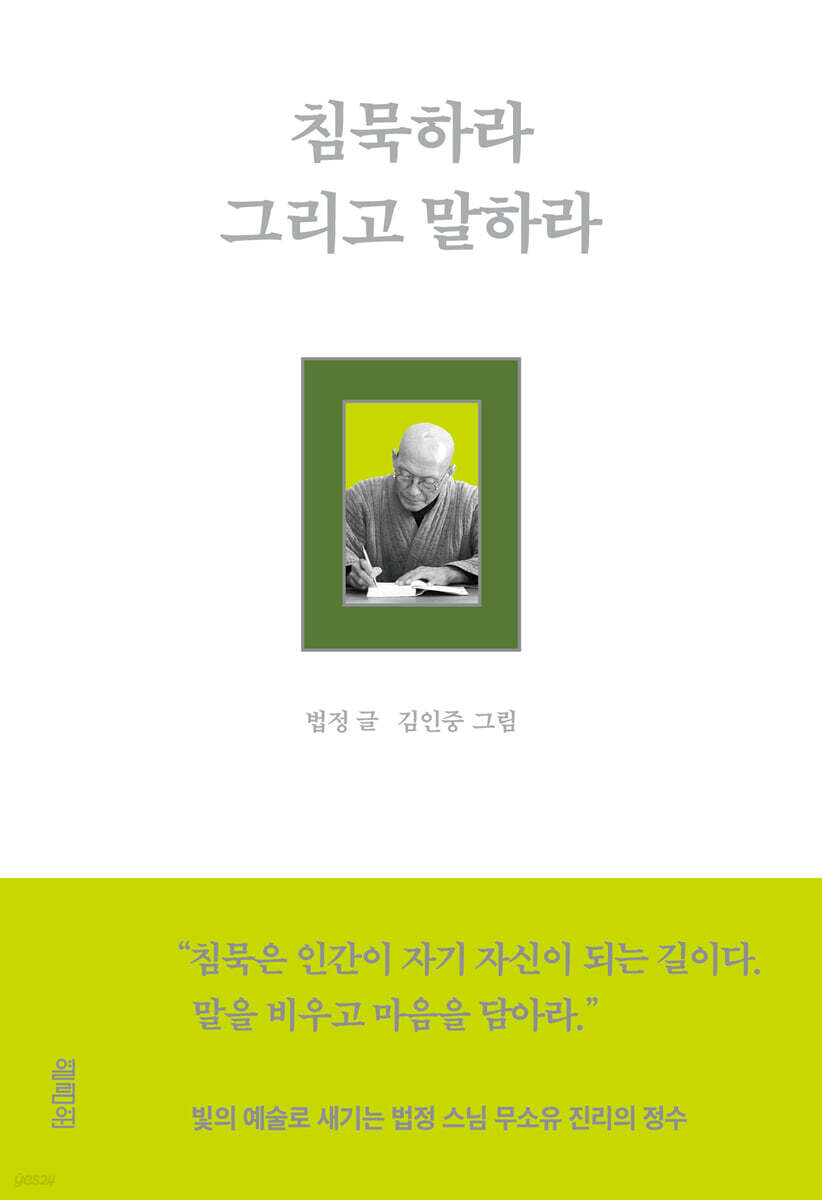
Be silent and speak
 |
Description
Book Introduction
“Silence is the way for man to become himself.
“Empty your words and fill your heart.”
The essence of the truth of non-possession, engraved with the art of light by the monk Beopjeong
Includes unpublished works by Father Kim In-joong, a world-renowned master painter of light.
To celebrate Buddha's birthday, a book titled "Be Silent and Speak," a compilation of the writings of Venerable Beopjeong, who was called the last great sage of our time, has been published.
This book contains a selection of the writings of the Venerable Beopjeong, which still resonate deeply despite the passage of time, delivering a weighty message to modern people living in an overabundance of words and noise.
The 'silence' mentioned in 'Be Silent and Speak' goes beyond simply reducing the number of words.
The monk Beopjeong says, “Silence is the way for humans to become themselves,” and emphasizes that through silence, we can reflect on the weight of words and approach the truth in our relationships with others.
The monk Beopjeong emphasizes 'simplicity' as a life attitude that is in line with this attitude of silence, and says that it is the path to true abundance through emptiness and moderation.
And nature is considered a quiet teacher who awakens humans to the essence of life by existing silently.
This book contains approximately 30 previously unpublished works by Father Kim In-joong, a world-renowned artist known as the “Painter of Light.”
He deeply sympathized with the spirit of the Buddhist monk Beopjeong, and he carefully selected and participated in the work to convey that meaning.
Each work contains the stillness, flow of life, and inner light hidden within material civilization, and resonates deeply with the writings of the Venerable Beopjeong.
This book, where art and meditation meet, will provide us with a healing time that goes beyond simple reading and touches the soul.
“Be Silent and Speak” is not just a simple meditation book.
It offers profound insight to those who pursue sincerity and simplicity, and guides them to rediscover spiritual values and true happiness through an attitude of "silent diligence."
As we journey toward spiritual recovery and a true life, the messages of Venerable Beopjeong and the works of Father Kim In-joong will gently illuminate our inner selves.
“Empty your words and fill your heart.”
The essence of the truth of non-possession, engraved with the art of light by the monk Beopjeong
Includes unpublished works by Father Kim In-joong, a world-renowned master painter of light.
To celebrate Buddha's birthday, a book titled "Be Silent and Speak," a compilation of the writings of Venerable Beopjeong, who was called the last great sage of our time, has been published.
This book contains a selection of the writings of the Venerable Beopjeong, which still resonate deeply despite the passage of time, delivering a weighty message to modern people living in an overabundance of words and noise.
The 'silence' mentioned in 'Be Silent and Speak' goes beyond simply reducing the number of words.
The monk Beopjeong says, “Silence is the way for humans to become themselves,” and emphasizes that through silence, we can reflect on the weight of words and approach the truth in our relationships with others.
The monk Beopjeong emphasizes 'simplicity' as a life attitude that is in line with this attitude of silence, and says that it is the path to true abundance through emptiness and moderation.
And nature is considered a quiet teacher who awakens humans to the essence of life by existing silently.
This book contains approximately 30 previously unpublished works by Father Kim In-joong, a world-renowned artist known as the “Painter of Light.”
He deeply sympathized with the spirit of the Buddhist monk Beopjeong, and he carefully selected and participated in the work to convey that meaning.
Each work contains the stillness, flow of life, and inner light hidden within material civilization, and resonates deeply with the writings of the Venerable Beopjeong.
This book, where art and meditation meet, will provide us with a healing time that goes beyond simple reading and touches the soul.
“Be Silent and Speak” is not just a simple meditation book.
It offers profound insight to those who pursue sincerity and simplicity, and guides them to rediscover spiritual values and true happiness through an attitude of "silent diligence."
As we journey toward spiritual recovery and a true life, the messages of Venerable Beopjeong and the works of Father Kim In-joong will gently illuminate our inner selves.
- You can preview some of the book's contents.
Preview
index
1 The moment when the heart blooms
The virtue of water
My human value
Life is a game
The joy of work
An encounter that is not followed by longing
Conditions of Happiness
Beautiful finish
Love without discrimination
Be grateful for the time and health given to you.
Birth and death
peace of mind
Swamp of inertia
offshoot
Time to spare
A person who smells like heaven
The greatest treasure in life
A person who lives alone
My neighbor's happiness is my happiness.
The scent of life
human happiness
2 Sounds heard in silence
World of Silence
Be silent and speak
Love silence
Eyes of Silence
sounds of nature
What do we believe?
Background of Silence
The less you say, the deeper it becomes
Words and Silence
Silence is the way for humans to become themselves.
Soundless sound
Don't follow your heart, be the master of your heart.
If you don't listen, there will be no meeting.
Listen and look with an open mind
The meaning of silence
To walk is to traverse silence
The Age of Noise
Open ears will hear
The mystery of cosmic life conveyed in silence
Words and writing
3. Planting flowers in your heart
kindness
The life given
What is a good book?
Heavy work
Free yourself from suffering and bondage
Source of life
good friend
true religion
It's right now, there's no time like this again.
Echoes of the Heart
Rich Prison
One thought
World of Wisdom
For a person to be healthy
A world where things are common
As I thought
self-care
change of mind
apartment
How Flowers Feel Each Other
4. Practice leaving lightly
Living things are always new
Within one's own circumstances and means
About death
Chain of reincarnation
Humans and Nature
A human life
empty mind
When sharing
Wisdom and virtue
human desires
The value of life
The earth is sick now
Wear it late, take it off late
Cleaning service
Another year passes by
Everyone once
a single drop of water
The mystery of life
happy person
No possessions
Source of the text
The virtue of water
My human value
Life is a game
The joy of work
An encounter that is not followed by longing
Conditions of Happiness
Beautiful finish
Love without discrimination
Be grateful for the time and health given to you.
Birth and death
peace of mind
Swamp of inertia
offshoot
Time to spare
A person who smells like heaven
The greatest treasure in life
A person who lives alone
My neighbor's happiness is my happiness.
The scent of life
human happiness
2 Sounds heard in silence
World of Silence
Be silent and speak
Love silence
Eyes of Silence
sounds of nature
What do we believe?
Background of Silence
The less you say, the deeper it becomes
Words and Silence
Silence is the way for humans to become themselves.
Soundless sound
Don't follow your heart, be the master of your heart.
If you don't listen, there will be no meeting.
Listen and look with an open mind
The meaning of silence
To walk is to traverse silence
The Age of Noise
Open ears will hear
The mystery of cosmic life conveyed in silence
Words and writing
3. Planting flowers in your heart
kindness
The life given
What is a good book?
Heavy work
Free yourself from suffering and bondage
Source of life
good friend
true religion
It's right now, there's no time like this again.
Echoes of the Heart
Rich Prison
One thought
World of Wisdom
For a person to be healthy
A world where things are common
As I thought
self-care
change of mind
apartment
How Flowers Feel Each Other
4. Practice leaving lightly
Living things are always new
Within one's own circumstances and means
About death
Chain of reincarnation
Humans and Nature
A human life
empty mind
When sharing
Wisdom and virtue
human desires
The value of life
The earth is sick now
Wear it late, take it off late
Cleaning service
Another year passes by
Everyone once
a single drop of water
The mystery of life
happy person
No possessions
Source of the text
Detailed image

Into the book
The me of today is not the me of yesterday.
Being here now is a new me.
The stream always flows like that there.
It's the same water as always, but it's like new water every moment.
Our own ‘being’ is also like that.
So, we must be able to live anew, like flowing water.
--- p.14 From “The Virtue of Water”
Life is like a game.
When you are happy, don't cling to happiness.
When you are unhappy, don't try to avoid it, just accept it.
--- p.18 From “Life is a Game”
An encounter that is not accompanied by longing is either a very businesslike encounter or a routine passing.
Encounters and passings leave no echo in the soul.
If there is no echo in the soul, even if we meet, it is not a meeting.
--- p.25 From “An Encounter That Is Not Followed by Longing”
A beautiful ending is returning to the original state of mind.
It is asking, 'Who am I?'
At every moment of life, the question, 'Where am I going?' is asked and the conclusion is reached at that moment.
That question is an important awareness that does not lose its original form.
--- p.31 From “Beautiful Ending”
Humans are beings who are inherently destined to be alone.
A person who lives alone may be lonely, but he should not be isolated.
Solitude leads to relationships, but isolation does not.
All living beings are formed over and over again through relationships.
--- pp.60-61 From "A Person Who Lives Alone"
How many times do we regret not saying something, rather than saying it?
--- p.74 From "The World of Silence"
It was the silent eyes that had been there since a distant past life.
Those eyes were not the excited eyes of a modern woman who only looks outward, but the clear and calm eyes of a practitioner who disciplines herself inwardly.
The eyes of a true practitioner are open inward.
Through the inner path, one can see far beyond things and phenomena.
--- p.88 From "Eyes of Silence"
Beautiful music is a melody found in silence, and excellent sculpture is a shape carved from the stone of silence.
Silence is the way for humans to become themselves.
--- p.102 From “Silence is the way for humans to become themselves”
As we watch the things that swell in the sea of our hearts, we empty ourselves completely, and only then can new echoes resonate.
That's when I meet my true self.
--- p.108 From “Don’t follow your heart, be the master of your heart”
In fact, words (and writing as well) are noisy and empty.
If we look closely at the reality of the words we exchange, they are just a bunch of dregs of ideas we've heard or picked up here and there.
But true knowledge begins in the silence that precedes words.
--- p.114 From “Listening and Looking with an Open Mind”
When you can read yourself through books, you can also read the open world.
You must learn to read books, not be read by books.
Being here now is a new me.
The stream always flows like that there.
It's the same water as always, but it's like new water every moment.
Our own ‘being’ is also like that.
So, we must be able to live anew, like flowing water.
--- p.14 From “The Virtue of Water”
Life is like a game.
When you are happy, don't cling to happiness.
When you are unhappy, don't try to avoid it, just accept it.
--- p.18 From “Life is a Game”
An encounter that is not accompanied by longing is either a very businesslike encounter or a routine passing.
Encounters and passings leave no echo in the soul.
If there is no echo in the soul, even if we meet, it is not a meeting.
--- p.25 From “An Encounter That Is Not Followed by Longing”
A beautiful ending is returning to the original state of mind.
It is asking, 'Who am I?'
At every moment of life, the question, 'Where am I going?' is asked and the conclusion is reached at that moment.
That question is an important awareness that does not lose its original form.
--- p.31 From “Beautiful Ending”
Humans are beings who are inherently destined to be alone.
A person who lives alone may be lonely, but he should not be isolated.
Solitude leads to relationships, but isolation does not.
All living beings are formed over and over again through relationships.
--- pp.60-61 From "A Person Who Lives Alone"
How many times do we regret not saying something, rather than saying it?
--- p.74 From "The World of Silence"
It was the silent eyes that had been there since a distant past life.
Those eyes were not the excited eyes of a modern woman who only looks outward, but the clear and calm eyes of a practitioner who disciplines herself inwardly.
The eyes of a true practitioner are open inward.
Through the inner path, one can see far beyond things and phenomena.
--- p.88 From "Eyes of Silence"
Beautiful music is a melody found in silence, and excellent sculpture is a shape carved from the stone of silence.
Silence is the way for humans to become themselves.
--- p.102 From “Silence is the way for humans to become themselves”
As we watch the things that swell in the sea of our hearts, we empty ourselves completely, and only then can new echoes resonate.
That's when I meet my true self.
--- p.108 From “Don’t follow your heart, be the master of your heart”
In fact, words (and writing as well) are noisy and empty.
If we look closely at the reality of the words we exchange, they are just a bunch of dregs of ideas we've heard or picked up here and there.
But true knowledge begins in the silence that precedes words.
--- p.114 From “Listening and Looking with an Open Mind”
When you can read yourself through books, you can also read the open world.
You must learn to read books, not be read by books.
--- p.139 From “What is a Good Book”
Publisher's Review
“Silence is the root of speech,
“True words wither in silence.”
A message to modern people living in an age overflowing with words
The quiet echo of the monks of the court
The title of Beopjeong Seunim's book, "Be Silent and Speak," gives us deep thoughts.
This paradoxical phrase, “Be silent and then speak,” urges modern people living in an age overflowing with words to reflect on the stillness before words and the essence of existence.
This book does not simply talk about the virtue of silence.
The monk Beopjeong says that we must reflect on ourselves through silence, practice a simple life, and regain our original place as human beings through a life in harmony with nature.
The monk defines silence not simply as a state of not speaking, but as “the way to become oneself.”
Silence is a practice that silences the noise of life and allows us to move inward. We live in a world overflowing with words—social media, YouTube, news, advertisements—and constantly being stimulated.
But we rarely ask where all those words are actually leading us.
The monk reminds us of the value of silence, saying, “There are far more things we regret from speaking than from not speaking.”
The more we talk, the less true communication we have, and the more empty our hearts become.
Silence allows for reflection and becomes a space where true words can grow.
The monk emphasizes, “Silence is the root of speech, and true speech withers in silence.”
Words born in silence remain as echoes, not noise.
Silence is the process of turning one's gaze inward from the outward, and clearing away unnecessary noise in the mind.
In that silence, new thoughts and feelings blossom, and words become fewer but deeper.
Silence serves as a mirror that quietly reflects ourselves, slowing down the pace of life and guiding us to live as true beings.
"Be Silent and Speak" is a book that asks "How to exist" and "How to live" rather than "How to speak," and is the deep and quiet response of the monk Beopjeong to those questions.
True freedom begins with 'letting go'
Purify your mind and focus on the essence.
The monk Beopjeong, along with 'silence', makes us look back on our simple attitude towards life.
The monk emphasizes that many of the things we cling to can actually become chains that bind our lives, and that true freedom comes from 'letting go.'
His words, “Less is more,” pose a fundamental question to today’s life, which constantly strives to fill something.
Modern people live busy lives, surrounded by complex human relationships, an abundance of possessions, and constant information and stimulation.
The monk Beopjeong calls this the 'swamp of inertia' and warns against a life driven by unconscious habits and desires.
The monk says, “You should see less, hear less, read less, and eat less.”
The more you simplify your life, the clearer your mind becomes and the more you can focus on the essentials.
This simplicity ultimately leads to self-sufficiency.
The monk's words, "We can be happy enough with what we have now," resonate deeply with us as we endlessly strive for more.
We run tirelessly toward the future, dreaming of a higher status and a better environment, but the monk Beopjeong says that true happiness lies not in gaining, but in 'letting go and emptying.'
Even in a simple home, a simple meal, or an ordinary day, we can find abundant joy and quiet peace.
The monk emphasizes that even the last moments of life should be kept in simplicity.
As he said, “A beautiful ending is letting go,” the end of life should be completed through emptiness, not greed and obsession.
Only when we organize our complicated lives and let go of unnecessary desires can we truly face the essence of life.
This philosophy of simplicity is not mere asceticism or escapism.
Rather, it is a conscious choice to regain the center of life.
It is a process of asking myself what I truly need, getting rid of unnecessary things, and making my life lighter.
Only when we take things out one by one and organize them like this can humans get closer to the essence and truth.
“Nature is the teacher of silence.”
Teachings that lead to a life of stopping, emptying, listening, and gratitude
The teachings of the Venerable Beopjeong arise from a deep, silent communion with nature, and only within this do they fully shine.
For the monk, nature is not simply a concept of background or resource.
Nature is a living being, a teacher who conveys the message of life in silence.
There are no words, but in that silence lies the great lesson of the order of the universe and the cycle of life.
The monk often quotes elements of nature such as water, trees, flowers, birds, wind, and sky, and conveys the wisdom of life contained within them.
For example, he says that the ideal life is one that stays in a low place like water, does not fight, and quietly benefits all living things.
Nature is constantly changing, but never loses its order.
Humans, too, are part of that cycle and must remain humble before nature.
The monk says:
“We must kneel before nature again and be humble.” Loving nature is not a simple sentiment, but a profound philosophical attitude that recognizes the roots of existence and humbles oneself before the source of life.
A life close to nature purifies humans and restores a sense of awe for existence.
Walking along mountain paths, watching fireflies in the forest, and listening to the sound of the wind, the monk lived in harmony with nature.
Nature was a space for meditation and a scripture of enlightenment for the monk Beopjeong, and above all, it was a teacher of silence that transcended language.
"Be Silent and Speak" poses numerous questions to us, but ultimately leads to only one answer.
To let go, to stop, and to listen.
Only when we regain the peace we have lost and step back from the complexities of life can we begin to hear the voice of nature.
And at that moment, we finally get closer to the true meaning of life.
Life grows in quiet silence, not in noisy language; it blossoms in simple self-sufficiency, not in excessive desire; it is fulfilled in the embrace of nature, not in the artificial world.
In today's world, where words are overflowing, material is overflowing, and speed is the rule, "Be Silent and Speak" leads us to a life that is the exact opposite.
To a life of stopping, emptying, listening, and being grateful.
“True words wither in silence.”
A message to modern people living in an age overflowing with words
The quiet echo of the monks of the court
The title of Beopjeong Seunim's book, "Be Silent and Speak," gives us deep thoughts.
This paradoxical phrase, “Be silent and then speak,” urges modern people living in an age overflowing with words to reflect on the stillness before words and the essence of existence.
This book does not simply talk about the virtue of silence.
The monk Beopjeong says that we must reflect on ourselves through silence, practice a simple life, and regain our original place as human beings through a life in harmony with nature.
The monk defines silence not simply as a state of not speaking, but as “the way to become oneself.”
Silence is a practice that silences the noise of life and allows us to move inward. We live in a world overflowing with words—social media, YouTube, news, advertisements—and constantly being stimulated.
But we rarely ask where all those words are actually leading us.
The monk reminds us of the value of silence, saying, “There are far more things we regret from speaking than from not speaking.”
The more we talk, the less true communication we have, and the more empty our hearts become.
Silence allows for reflection and becomes a space where true words can grow.
The monk emphasizes, “Silence is the root of speech, and true speech withers in silence.”
Words born in silence remain as echoes, not noise.
Silence is the process of turning one's gaze inward from the outward, and clearing away unnecessary noise in the mind.
In that silence, new thoughts and feelings blossom, and words become fewer but deeper.
Silence serves as a mirror that quietly reflects ourselves, slowing down the pace of life and guiding us to live as true beings.
"Be Silent and Speak" is a book that asks "How to exist" and "How to live" rather than "How to speak," and is the deep and quiet response of the monk Beopjeong to those questions.
True freedom begins with 'letting go'
Purify your mind and focus on the essence.
The monk Beopjeong, along with 'silence', makes us look back on our simple attitude towards life.
The monk emphasizes that many of the things we cling to can actually become chains that bind our lives, and that true freedom comes from 'letting go.'
His words, “Less is more,” pose a fundamental question to today’s life, which constantly strives to fill something.
Modern people live busy lives, surrounded by complex human relationships, an abundance of possessions, and constant information and stimulation.
The monk Beopjeong calls this the 'swamp of inertia' and warns against a life driven by unconscious habits and desires.
The monk says, “You should see less, hear less, read less, and eat less.”
The more you simplify your life, the clearer your mind becomes and the more you can focus on the essentials.
This simplicity ultimately leads to self-sufficiency.
The monk's words, "We can be happy enough with what we have now," resonate deeply with us as we endlessly strive for more.
We run tirelessly toward the future, dreaming of a higher status and a better environment, but the monk Beopjeong says that true happiness lies not in gaining, but in 'letting go and emptying.'
Even in a simple home, a simple meal, or an ordinary day, we can find abundant joy and quiet peace.
The monk emphasizes that even the last moments of life should be kept in simplicity.
As he said, “A beautiful ending is letting go,” the end of life should be completed through emptiness, not greed and obsession.
Only when we organize our complicated lives and let go of unnecessary desires can we truly face the essence of life.
This philosophy of simplicity is not mere asceticism or escapism.
Rather, it is a conscious choice to regain the center of life.
It is a process of asking myself what I truly need, getting rid of unnecessary things, and making my life lighter.
Only when we take things out one by one and organize them like this can humans get closer to the essence and truth.
“Nature is the teacher of silence.”
Teachings that lead to a life of stopping, emptying, listening, and gratitude
The teachings of the Venerable Beopjeong arise from a deep, silent communion with nature, and only within this do they fully shine.
For the monk, nature is not simply a concept of background or resource.
Nature is a living being, a teacher who conveys the message of life in silence.
There are no words, but in that silence lies the great lesson of the order of the universe and the cycle of life.
The monk often quotes elements of nature such as water, trees, flowers, birds, wind, and sky, and conveys the wisdom of life contained within them.
For example, he says that the ideal life is one that stays in a low place like water, does not fight, and quietly benefits all living things.
Nature is constantly changing, but never loses its order.
Humans, too, are part of that cycle and must remain humble before nature.
The monk says:
“We must kneel before nature again and be humble.” Loving nature is not a simple sentiment, but a profound philosophical attitude that recognizes the roots of existence and humbles oneself before the source of life.
A life close to nature purifies humans and restores a sense of awe for existence.
Walking along mountain paths, watching fireflies in the forest, and listening to the sound of the wind, the monk lived in harmony with nature.
Nature was a space for meditation and a scripture of enlightenment for the monk Beopjeong, and above all, it was a teacher of silence that transcended language.
"Be Silent and Speak" poses numerous questions to us, but ultimately leads to only one answer.
To let go, to stop, and to listen.
Only when we regain the peace we have lost and step back from the complexities of life can we begin to hear the voice of nature.
And at that moment, we finally get closer to the true meaning of life.
Life grows in quiet silence, not in noisy language; it blossoms in simple self-sufficiency, not in excessive desire; it is fulfilled in the embrace of nature, not in the artificial world.
In today's world, where words are overflowing, material is overflowing, and speed is the rule, "Be Silent and Speak" leads us to a life that is the exact opposite.
To a life of stopping, emptying, listening, and being grateful.
GOODS SPECIFICS
- Date of issue: April 30, 2025
- Format: Hardcover book binding method guide
- Page count, weight, size: 256 pages | 440g | 128*190*20mm
- ISBN13: 9791170403234
- ISBN10: 1170403239
You may also like
카테고리
korean


korean

![GQ KOREA Mark (Monthly): December [2025]](http://librairie.coreenne.fr/cdn/shop/files/8ef265dbbfbf186523ed75ba7319009d.jpg?v=1765340328&width=3840)


