

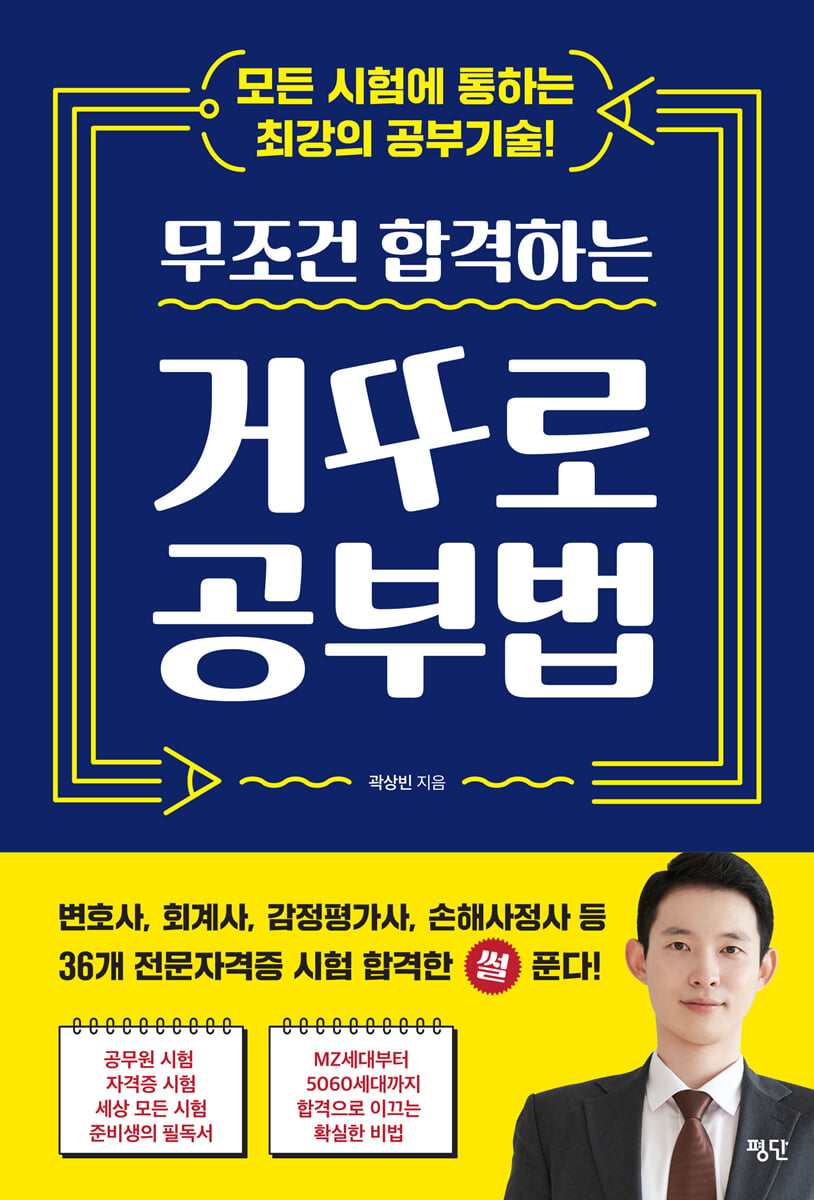
The reverse study method that guarantees you pass
 |
Description
Book Introduction
Studying to pass is different! Kwak Sang-bin's secret to passing the exam, discovered after countless trials and errors! Kwak Sang-bin, the author of this book, is a true "master of qualifications" who started with a 6th grade score on the college entrance exam, graduated with the highest honors from Yonsei University's Department of Economics, and achieved the "5 crowns of professionalism" by becoming a lawyer, certified public accountant, real estate appraiser, loss adjuster, and management consultant. Could there be a secret to earning 36 certifications, which others struggle to obtain even one or two? This book focuses on the author's unique "reverse study method," which has helped him pass various exams, and includes study methods, along with accompanying notes. This book contains the author's secret to passing all exams, including professional certifications such as lawyer, certified public accountant, tax accountant, real estate appraiser, and patent attorney, as well as the real estate agent exam and civil service exam, using the reverse study method he himself discovered. The author asks the essential reason for studying and meticulously organizes the know-how for passing all exams, including study methods, schedule management, and study methods for multiple-choice and subjective tests, from the first step to the final exam day. From beginners who have just decided to take the exam and are preparing to veterans who have experienced failure and are determined to try again, all test takers who aspire to pass any exam in the world will use this book, a study guide for all the exams in the world, as their guide to achieve their ultimate goal of 'passing.' |
- You can preview some of the book's contents.
Preview
index
prolog
Chapter 1: Why You Should Study
Entering - To young people who are concerned about their qualifications and career path
Why should we study?
Reality is as intense as studying for exams.
If you don't have a strategy in life, you'll fail the test.
The more you fail, the better
Studying is just a means to a dream.
Passing the exam is the beginning of another study.
Metacognition: The Key to Studying and Success
Poverty is another opportunity to study
If you do anything a lot, it will grow?
The more you study, the more creative you become
Passing Insights - An Investment Approach to Studying
Chapter 2: The First Step to the Exam
As we go in - everyone has times when they want to study.
Things you absolutely must not do if you want to pass the exam quickly
Calculating the cost of living as a test taker
How to Get the Most Out of Your Study Group
Solve a lot of workbooks vs. look at one book multiple times
Things to check before starting to prepare for the exam
Things to keep in mind as you prepare for the exam
Exam Preparation Advice for Office Workers and College Students
Keep your study plan as simple as possible.
How to secure study time
Create your own study space
Passing Insights - The Shortcut to Passing, the Backwards Study Method
Chapter 3: Know-how for all exams
Entering the Reading Room - Do you want to become a caveman?
The formula for passing, the three keys to studying!
If you think about it the other way around, you'll pass faster.
Let's repeat the part that comes out 10 times
How to speed up your study
How to read past exam questions and textbooks
Speak out what you've learned
Where is a good place to study?
Can I study in different locations?
Let's focus on the deadline
The more mock exams you take, the better.
Practice understanding the examiner's intentions and memorizing frequently appearing passages.
Various attempts to produce memories
Practice in a state that is as similar as possible to when taking the test
Bulk study to improve memorization
The secret to memorization, the horse tribe
Studying with images
Study during your break with your smartphone
The secret to getting a good night's sleep the night before your exam
Things to do one month before the exam
Things to do a week before the exam
Things to do the day before the exam
Things to watch out for in the exam room
Chapter 4 Multiple Choice Test
Entering - What is the essence of objective tests?
Choose a book with a good summary and problem-solving skills.
Memorization methods for multiple-choice tests
Simply seeing a lot is meaningless
View subjects one by one
Never create subnotes
Tips for choosing and taking online lectures
Reduce your academy and focus on reading comprehension.
Underline the workbook so much that it becomes tattered
Techniques for raising your score in multiple-choice tests
Problem-solving strategies for passing the exam
Study Experiment - One-Week Study Method Verification
Chapter 5 Subjective Test
As we enter, what is the essence of subjective tests?
Find the best-organized study guide with answers
Principles of conducting studies
Study method for subjective exams by reading
If you are self-studying, be sure to do individual study.
Let's take advantage of the academy's rotating lecture system.
Know-how for solving case-based problems
How to organize your notes well
Try a new solution every time you repeat a previous exam question.
Create keyword and table of contents notes
Tips for writing answers that will raise your score by 10 points or more
Chapter 6 Civil Service Examination
Introduction to the Civil Service Appointment System
Special advice for civil service exam candidates
Civil Service Exam Subject-by-Subject Preparation
A Complete Analysis of the Most Popular Study Methods for Civil Service Exam Prep Students
Study tips from those who passed the 9th-grade civil service exam
Chapter 7 Certification Exam
Entering - The first step to the certification exam: building a strong language score and utilizing the academy's rotational lectures. The CPA exam and subject-by-subject study strategies.
Real Estate Appraiser Exam and Subject-Specific Study Strategies
Customs Broker Exam and Subject-Specific Study Strategies
Certified Public Labor Attorney Exam and Subject-Specific Study Strategies
Tax Accountant Exam and Subject-Specific Study Strategies
Patent Bar Exam and Subject-Specific Study Strategies
Insurance Actuary Exam and Subject-Specific Study Strategies
Bar Exam and Study Strategies
Bar Exam and Study Strategies
Certified Real Estate Agent Exam and Study Strategies
Loss Adjuster Exam and Study Strategies
Epilogue
supplement
Chapter 1: Why You Should Study
Entering - To young people who are concerned about their qualifications and career path
Why should we study?
Reality is as intense as studying for exams.
If you don't have a strategy in life, you'll fail the test.
The more you fail, the better
Studying is just a means to a dream.
Passing the exam is the beginning of another study.
Metacognition: The Key to Studying and Success
Poverty is another opportunity to study
If you do anything a lot, it will grow?
The more you study, the more creative you become
Passing Insights - An Investment Approach to Studying
Chapter 2: The First Step to the Exam
As we go in - everyone has times when they want to study.
Things you absolutely must not do if you want to pass the exam quickly
Calculating the cost of living as a test taker
How to Get the Most Out of Your Study Group
Solve a lot of workbooks vs. look at one book multiple times
Things to check before starting to prepare for the exam
Things to keep in mind as you prepare for the exam
Exam Preparation Advice for Office Workers and College Students
Keep your study plan as simple as possible.
How to secure study time
Create your own study space
Passing Insights - The Shortcut to Passing, the Backwards Study Method
Chapter 3: Know-how for all exams
Entering the Reading Room - Do you want to become a caveman?
The formula for passing, the three keys to studying!
If you think about it the other way around, you'll pass faster.
Let's repeat the part that comes out 10 times
How to speed up your study
How to read past exam questions and textbooks
Speak out what you've learned
Where is a good place to study?
Can I study in different locations?
Let's focus on the deadline
The more mock exams you take, the better.
Practice understanding the examiner's intentions and memorizing frequently appearing passages.
Various attempts to produce memories
Practice in a state that is as similar as possible to when taking the test
Bulk study to improve memorization
The secret to memorization, the horse tribe
Studying with images
Study during your break with your smartphone
The secret to getting a good night's sleep the night before your exam
Things to do one month before the exam
Things to do a week before the exam
Things to do the day before the exam
Things to watch out for in the exam room
Chapter 4 Multiple Choice Test
Entering - What is the essence of objective tests?
Choose a book with a good summary and problem-solving skills.
Memorization methods for multiple-choice tests
Simply seeing a lot is meaningless
View subjects one by one
Never create subnotes
Tips for choosing and taking online lectures
Reduce your academy and focus on reading comprehension.
Underline the workbook so much that it becomes tattered
Techniques for raising your score in multiple-choice tests
Problem-solving strategies for passing the exam
Study Experiment - One-Week Study Method Verification
Chapter 5 Subjective Test
As we enter, what is the essence of subjective tests?
Find the best-organized study guide with answers
Principles of conducting studies
Study method for subjective exams by reading
If you are self-studying, be sure to do individual study.
Let's take advantage of the academy's rotating lecture system.
Know-how for solving case-based problems
How to organize your notes well
Try a new solution every time you repeat a previous exam question.
Create keyword and table of contents notes
Tips for writing answers that will raise your score by 10 points or more
Chapter 6 Civil Service Examination
Introduction to the Civil Service Appointment System
Special advice for civil service exam candidates
Civil Service Exam Subject-by-Subject Preparation
A Complete Analysis of the Most Popular Study Methods for Civil Service Exam Prep Students
Study tips from those who passed the 9th-grade civil service exam
Chapter 7 Certification Exam
Entering - The first step to the certification exam: building a strong language score and utilizing the academy's rotational lectures. The CPA exam and subject-by-subject study strategies.
Real Estate Appraiser Exam and Subject-Specific Study Strategies
Customs Broker Exam and Subject-Specific Study Strategies
Certified Public Labor Attorney Exam and Subject-Specific Study Strategies
Tax Accountant Exam and Subject-Specific Study Strategies
Patent Bar Exam and Subject-Specific Study Strategies
Insurance Actuary Exam and Subject-Specific Study Strategies
Bar Exam and Study Strategies
Bar Exam and Study Strategies
Certified Real Estate Agent Exam and Study Strategies
Loss Adjuster Exam and Study Strategies
Epilogue
supplement
Detailed image

Into the book
I sometimes hear people say that test-taking skills are of no use in society.
But this is a big mistake.
People who do well on exams and pass are also good at sales and work.
Sales is a kind of test of persuading others, and work is also a task of creating products or services that meet the expectations of superiors and customers and passing those standards.
All of this is a kind of test.
I am confident that if you apply similar effort and skills to other fields as you did to pass the exam, you will succeed in anything.
---p.27
Studying is a long process in which an individual develops knowledge and problem-solving skills.
In the process, the possibility of creating new solutions also increases.
This process of self-growth is called studying.
In economics, the process of becoming a high-yield talent is also a form of study.
Some say that the more you study, the more trapped you become in your existing framework. However, I believe that studying more and enriching your knowledge actually frees you, as you can find various possible solutions.
---p.55
There are cases where the reverse study method is misunderstood.
It is a mistake to think that memorizing only past exam questions and taking the test is the wrong way to study.
The reverse study method is to increase your reading of past exam questions, extract important parts, listen to basic lectures or key summary lectures, and study the parts that will be on the exam in more depth.
Ultimately, the point is not to ignore the basics and fundamentals, but to properly study the fundamentals that actually appear on the exam.
---p.104~105
The test is a test where you print out what you studied.
There are several ways to train this output.
A typical method is to recall the knowledge you have accumulated while solving multiple-choice questions from your head at every moment.
And writing by hand is also a traditional method of printing.
The method I primarily use to output is by mouth.
Strangely, I remember things I talk about longer than things I hear from others.
I still remember the content covered in the lectures when I was an academy instructor so vividly that I can recite it today.
---p.134
The week before the exam should be set aside for studying.
College students should postpone plans with friends until after their exams as much as possible, and working people should secure time even if it means taking vacation days.
The week before an exam is more important than the entire year before.
It is a time to engrave in your mind what you have studied so far, and to manage your condition and reduce the possibility of making mistakes in the exam room.
That's why, by any means necessary, you must create an environment where you can focus solely on studying for the week before the exam.
---p.171
When preparing for an objective test, the biggest waste of time is creating sub-notes or organizing notes.
If you can borrow notes organized by friends around you, it's better to copy them.
Unlike subjective tests, objective tests do not test your writing skills.
That's why there's no study more inefficient than systematically organizing a table of contents and creating sub-notes.
If you're still thinking of making one, it's best to make it simple enough that you can carry it around and look at it like a terminology card.
You should never invest too much time here.
---p.193
Students preparing for subjective exams will likely be concerned about whether or not they should attend an academy.
I think I need an academy to prepare for subjective tests.
If you can't attend an on-site lecture, it's a good idea to take an online lecture.
I rarely used academies to attend basic lectures for anything other than the CPA exam, but I think the problem-solving and mock exam lectures were quite helpful.
The reason for going to an academy is to study with competitors and get motivated, and to be able to organize the content more efficiently.
For subjective exams, it is very important to organize what you are going to write, but it is not easy to pick out the important content from the beginning.
So, it is necessary to go through a process of compressing the content with the help of others.
---p.236
In the case of civil service exams, I have often seen people who study smartly pass faster than those who studied well in the past.
It is important to first thoroughly review the basic subjects and then repeat the subjects divided into series as much as possible to get even scores in the exam.
In the early stages of the exam preparation process, those who have some level of Korean or English skills and some knowledge of Korean history have about a 50% advantage.
However, if you become complacent and only believe in that, you may end up failing in other subjects.
---p.265~266
If you only collect materials (so-called flyers) provided by the academy without even understanding the basic books or concepts and organize them based on that, you will only prolong the exam period and actually hinder building fundamentals.
The examiner asks whether the candidate can accurately understand and apply the principles of basic textbooks and various case laws, or the core concepts of economics and accounting.
Therefore, I hope that you will not be fooled by superficial information as much as possible.
During the first cycle, it is important to check the key keywords and concept explanations and look at them frequently to become familiar with them.
---p.308
Civil law is a subject with a large volume.
There are many types of laws, including general laws, property laws, debt laws, and contract laws, and the case law is enormous.
If you want to organize all of this and go to the exam room, you will have to digest almost 2,000 pages.
So, when preparing for the qualification exam, the best way to study civil law is to solve many problems and become familiar with the frequently asked case law and logic.
If you solve a lot of past exam questions or mock exam questions, you will naturally come to understand the position and logic of case law.
And since important precedents and articles are naturally included in the problem, you can save time.
---p.379
As explained above, the second real estate agent exam is divided into four parts and three subjects.
Among them, the Real Estate Brokerage Act is a subject where you can get a high score.
The content is easy and the questions are structured and easy to understand.
Real estate law is the most difficult and requires a lot of preparation because it involves a lot of minor issues.
So, you need to maximize your test scores in the Certified Real Estate Brokerage Act and make up for any points you may have missed in the Real Estate Act.
And since the real estate law section appears repeatedly, you must master it thoroughly before solving it.
But this is a big mistake.
People who do well on exams and pass are also good at sales and work.
Sales is a kind of test of persuading others, and work is also a task of creating products or services that meet the expectations of superiors and customers and passing those standards.
All of this is a kind of test.
I am confident that if you apply similar effort and skills to other fields as you did to pass the exam, you will succeed in anything.
---p.27
Studying is a long process in which an individual develops knowledge and problem-solving skills.
In the process, the possibility of creating new solutions also increases.
This process of self-growth is called studying.
In economics, the process of becoming a high-yield talent is also a form of study.
Some say that the more you study, the more trapped you become in your existing framework. However, I believe that studying more and enriching your knowledge actually frees you, as you can find various possible solutions.
---p.55
There are cases where the reverse study method is misunderstood.
It is a mistake to think that memorizing only past exam questions and taking the test is the wrong way to study.
The reverse study method is to increase your reading of past exam questions, extract important parts, listen to basic lectures or key summary lectures, and study the parts that will be on the exam in more depth.
Ultimately, the point is not to ignore the basics and fundamentals, but to properly study the fundamentals that actually appear on the exam.
---p.104~105
The test is a test where you print out what you studied.
There are several ways to train this output.
A typical method is to recall the knowledge you have accumulated while solving multiple-choice questions from your head at every moment.
And writing by hand is also a traditional method of printing.
The method I primarily use to output is by mouth.
Strangely, I remember things I talk about longer than things I hear from others.
I still remember the content covered in the lectures when I was an academy instructor so vividly that I can recite it today.
---p.134
The week before the exam should be set aside for studying.
College students should postpone plans with friends until after their exams as much as possible, and working people should secure time even if it means taking vacation days.
The week before an exam is more important than the entire year before.
It is a time to engrave in your mind what you have studied so far, and to manage your condition and reduce the possibility of making mistakes in the exam room.
That's why, by any means necessary, you must create an environment where you can focus solely on studying for the week before the exam.
---p.171
When preparing for an objective test, the biggest waste of time is creating sub-notes or organizing notes.
If you can borrow notes organized by friends around you, it's better to copy them.
Unlike subjective tests, objective tests do not test your writing skills.
That's why there's no study more inefficient than systematically organizing a table of contents and creating sub-notes.
If you're still thinking of making one, it's best to make it simple enough that you can carry it around and look at it like a terminology card.
You should never invest too much time here.
---p.193
Students preparing for subjective exams will likely be concerned about whether or not they should attend an academy.
I think I need an academy to prepare for subjective tests.
If you can't attend an on-site lecture, it's a good idea to take an online lecture.
I rarely used academies to attend basic lectures for anything other than the CPA exam, but I think the problem-solving and mock exam lectures were quite helpful.
The reason for going to an academy is to study with competitors and get motivated, and to be able to organize the content more efficiently.
For subjective exams, it is very important to organize what you are going to write, but it is not easy to pick out the important content from the beginning.
So, it is necessary to go through a process of compressing the content with the help of others.
---p.236
In the case of civil service exams, I have often seen people who study smartly pass faster than those who studied well in the past.
It is important to first thoroughly review the basic subjects and then repeat the subjects divided into series as much as possible to get even scores in the exam.
In the early stages of the exam preparation process, those who have some level of Korean or English skills and some knowledge of Korean history have about a 50% advantage.
However, if you become complacent and only believe in that, you may end up failing in other subjects.
---p.265~266
If you only collect materials (so-called flyers) provided by the academy without even understanding the basic books or concepts and organize them based on that, you will only prolong the exam period and actually hinder building fundamentals.
The examiner asks whether the candidate can accurately understand and apply the principles of basic textbooks and various case laws, or the core concepts of economics and accounting.
Therefore, I hope that you will not be fooled by superficial information as much as possible.
During the first cycle, it is important to check the key keywords and concept explanations and look at them frequently to become familiar with them.
---p.308
Civil law is a subject with a large volume.
There are many types of laws, including general laws, property laws, debt laws, and contract laws, and the case law is enormous.
If you want to organize all of this and go to the exam room, you will have to digest almost 2,000 pages.
So, when preparing for the qualification exam, the best way to study civil law is to solve many problems and become familiar with the frequently asked case law and logic.
If you solve a lot of past exam questions or mock exam questions, you will naturally come to understand the position and logic of case law.
And since important precedents and articles are naturally included in the problem, you can save time.
---p.379
As explained above, the second real estate agent exam is divided into four parts and three subjects.
Among them, the Real Estate Brokerage Act is a subject where you can get a high score.
The content is easy and the questions are structured and easy to understand.
Real estate law is the most difficult and requires a lot of preparation because it involves a lot of minor issues.
So, you need to maximize your test scores in the Certified Real Estate Brokerage Act and make up for any points you may have missed in the Real Estate Act.
And since the real estate law section appears repeatedly, you must master it thoroughly before solving it.
---p.399
Publisher's Review
Graduated with the highest honors from Yonsei University's Department of Economics with a grade of 6 on the CSAT
The secret to achieving the "5 crowns of professionals": lawyer, certified public accountant, real estate appraiser, and loss adjuster!
'God of passing exams,' 'Master of qualifications,' 'Study genius.' These are the words that follow the author of this book, Kwak Sang-bin.
Looking at his accomplishments, such as graduating with the highest honors from Yonsei University's Department of Economics and becoming a five-time professional certified public accountant, certified real estate appraiser, loss adjuster, and management consultant, it is easy to understand why he is given such titles.
So, did the author study hard from the beginning and become an honor student to achieve these results?
The author was a poor student from a young age and was not very smart.
He spent his childhood unable to receive a proper education due to his poor family circumstances and his father's business failing during the IMF financial crisis.
I worked part-time since elementary school, ran a business in middle school, and experienced the challenge and failure of starting a venture business after entering a vocational high school.
Then, by pure chance, I started studying and thought hard about how to pass the exam quickly.
As a result, I went beyond the 'lump memorization method' of memorizing in chunks, 'maljok' of memorizing by giving special meaning, and the 'two-letter memorization method' of red, orange, yellow, green, blue, indigo, and violet to try my own study method of starting with past exam questions, the 'reverse study method', and achieved the honor of passing many exams with good scores.
Of course, this result was possible because of the extraordinary effort and concentration, but the secret to passing various exams in a short period of time was a change in thinking, the 'reverse study method'.
Professional certifications, civil service exams… A study guide for every exam in the world.
If you meet the God of Passing, you will pass 100%!
As the competition for the exam is fierce, the students' desire to pass is also high.
'Passing the exam, turning your life around' is not something new, so to pass the exam, people go to cram schools, get counseling, and read various study books.
Although there are many study books on the market, it is difficult to find one that contains content that can be applied to all exams and to all people.
The author of this book achieved two goals: passing the exam, which was immediately in front of him, and achieving his life's dream as an extension of that goal.
In the process, I felt regretful, thinking, 'If I had done this earlier, I would have passed the exam a little faster,' so I revealed all the secrets to passing the exam in this book, focusing on the 'reverse study method,' which is the most effective method I have learned.
Chapter 1 provides motivation by examining the reasons for studying, Chapter 2 outlines things to keep in mind before taking the exam, and Chapter 3 provides specific tips for all exams.
Next, we provide guidance on the essence of objective and subjective tests, how to prepare for them, and then thoroughly analyze the study methods for the civil service exam. Then, we thoroughly organize the test subjects and study strategies for each certification exam to provide practical help to test takers in their studies.
The appendix also includes tips for quickly passing the science and engineering certification exam.
Just as the author found his way through the 'reverse study method' and passed all the exams he wanted, the only way to find his own study method is to first try studying.
But since you don't have time for trial and error, you need guidance, and this book will be just that.
I hope that everyone preparing for the exam will achieve the results they desire with this book, which begins with the essential questions that must be answered and thoroughly covers specific study methods.
*Author Kwak Sang-bin's main qualifications
Lawyer, Certified Public Accountant, Tax Accountant, Real Estate Appraiser, Loss Adjuster, Management Consultant, Certified International Investment Analyst (CIIA), Level 1 Accountant, Level 2 Accountant, Financial Manager, Corporate Finance Manager, International Financial Reporting Standards (IFRS), Fund Investment Consultant, Securities Investment Consultant, Securities Analyst, FRM (Certified International Financial Risk Manager), AFPK (Certified International Comprehensive Personal Financial Planner), Financial Investment Analyst, Insurance Broker, Corporate Technology Valuation Specialist, M&A Consultant Certification, Corporate Accounting Level 1, and 10 IT Certifications, etc.
The secret to achieving the "5 crowns of professionals": lawyer, certified public accountant, real estate appraiser, and loss adjuster!
'God of passing exams,' 'Master of qualifications,' 'Study genius.' These are the words that follow the author of this book, Kwak Sang-bin.
Looking at his accomplishments, such as graduating with the highest honors from Yonsei University's Department of Economics and becoming a five-time professional certified public accountant, certified real estate appraiser, loss adjuster, and management consultant, it is easy to understand why he is given such titles.
So, did the author study hard from the beginning and become an honor student to achieve these results?
The author was a poor student from a young age and was not very smart.
He spent his childhood unable to receive a proper education due to his poor family circumstances and his father's business failing during the IMF financial crisis.
I worked part-time since elementary school, ran a business in middle school, and experienced the challenge and failure of starting a venture business after entering a vocational high school.
Then, by pure chance, I started studying and thought hard about how to pass the exam quickly.
As a result, I went beyond the 'lump memorization method' of memorizing in chunks, 'maljok' of memorizing by giving special meaning, and the 'two-letter memorization method' of red, orange, yellow, green, blue, indigo, and violet to try my own study method of starting with past exam questions, the 'reverse study method', and achieved the honor of passing many exams with good scores.
Of course, this result was possible because of the extraordinary effort and concentration, but the secret to passing various exams in a short period of time was a change in thinking, the 'reverse study method'.
Professional certifications, civil service exams… A study guide for every exam in the world.
If you meet the God of Passing, you will pass 100%!
As the competition for the exam is fierce, the students' desire to pass is also high.
'Passing the exam, turning your life around' is not something new, so to pass the exam, people go to cram schools, get counseling, and read various study books.
Although there are many study books on the market, it is difficult to find one that contains content that can be applied to all exams and to all people.
The author of this book achieved two goals: passing the exam, which was immediately in front of him, and achieving his life's dream as an extension of that goal.
In the process, I felt regretful, thinking, 'If I had done this earlier, I would have passed the exam a little faster,' so I revealed all the secrets to passing the exam in this book, focusing on the 'reverse study method,' which is the most effective method I have learned.
Chapter 1 provides motivation by examining the reasons for studying, Chapter 2 outlines things to keep in mind before taking the exam, and Chapter 3 provides specific tips for all exams.
Next, we provide guidance on the essence of objective and subjective tests, how to prepare for them, and then thoroughly analyze the study methods for the civil service exam. Then, we thoroughly organize the test subjects and study strategies for each certification exam to provide practical help to test takers in their studies.
The appendix also includes tips for quickly passing the science and engineering certification exam.
Just as the author found his way through the 'reverse study method' and passed all the exams he wanted, the only way to find his own study method is to first try studying.
But since you don't have time for trial and error, you need guidance, and this book will be just that.
I hope that everyone preparing for the exam will achieve the results they desire with this book, which begins with the essential questions that must be answered and thoroughly covers specific study methods.
*Author Kwak Sang-bin's main qualifications
Lawyer, Certified Public Accountant, Tax Accountant, Real Estate Appraiser, Loss Adjuster, Management Consultant, Certified International Investment Analyst (CIIA), Level 1 Accountant, Level 2 Accountant, Financial Manager, Corporate Finance Manager, International Financial Reporting Standards (IFRS), Fund Investment Consultant, Securities Investment Consultant, Securities Analyst, FRM (Certified International Financial Risk Manager), AFPK (Certified International Comprehensive Personal Financial Planner), Financial Investment Analyst, Insurance Broker, Corporate Technology Valuation Specialist, M&A Consultant Certification, Corporate Accounting Level 1, and 10 IT Certifications, etc.
GOODS SPECIFICS
- Date of issue: April 3, 2023
- Page count, weight, size: 416 pages | 608g | 152*224*21mm
- ISBN13: 9788973435524
- ISBN10: 8973435523
You may also like
카테고리
korean


korean

![GQ KOREA Mark (Monthly): December [2025]](http://librairie.coreenne.fr/cdn/shop/files/8ef265dbbfbf186523ed75ba7319009d.jpg?v=1765340328&width=3840)


