

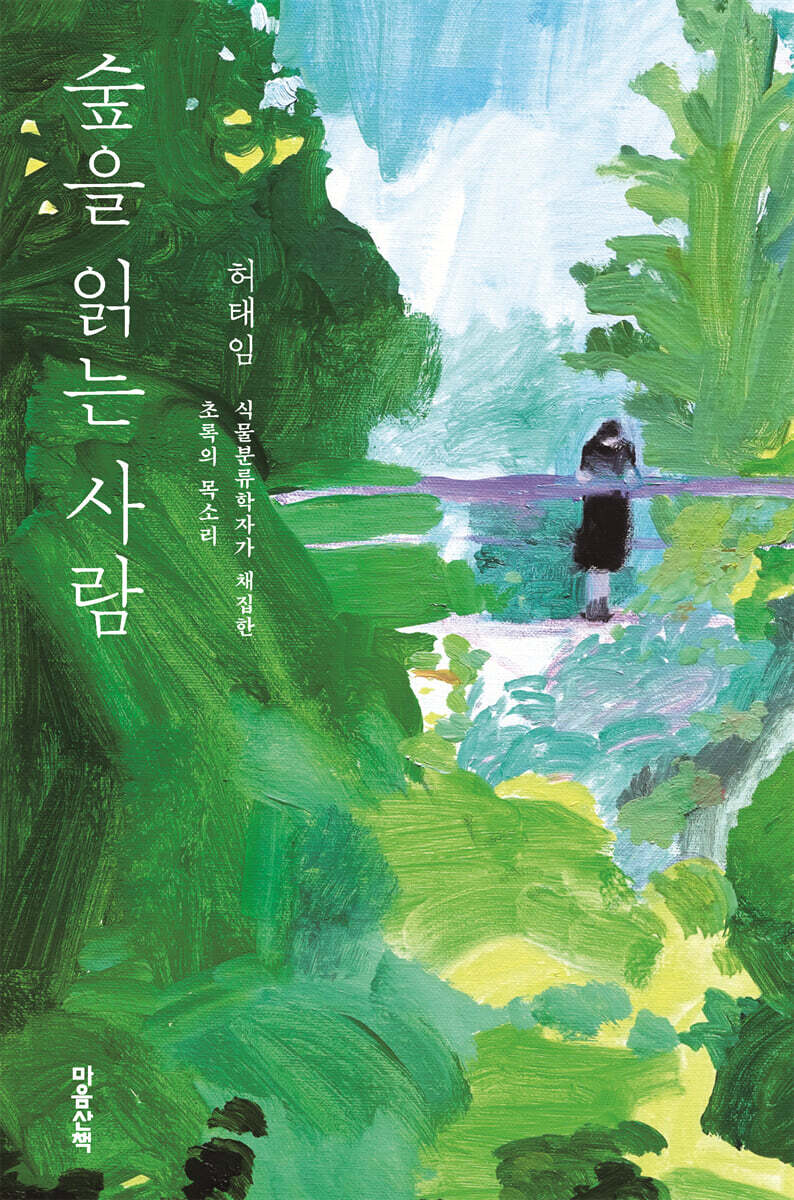
The Forest Reader
 |
Description
Book Introduction
- A word from MD
-
A world read through the language of plantsAn essay by Tae-im Heo, who works at the Baekdudaegan National Arboretum.
It tells the life of a plant taxonomist who conserves endangered plants and restores forests.
A journey to find the warmth of green, even in rugged nature, sparsely populated places, and places without roads.
The story of plants and people sharing their hearts conveys the values of consideration and respect that the world needs.
April 15, 2025. Essay PD Lee Ju-eun
A person who reads the world through the language of plants
The work and life of a plant taxonomist who protects disappearing vegetation
★ Recommended by poet Na Hee-deok and former director of the National Science Museum in Gwacheon, Lee Jeong-mo
A new collection of essays, “The Person Who Reads the Forest,” by Heo Tae-im, a plant taxonomist working at the National Baekdudaegan Arboretum, has been published.
In this book, the author tells the story of his work as a plant taxonomist and the plants he encountered along the way.
When you think of a plant taxonomist, you might picture them sitting in a quiet laboratory, examining plant specimens. However, the author's work is often in the rugged mountains, where they must take on many risks.
The book depicts a journey to restore nature by tracking and recording plants that are in danger of disappearing.
As poet Na Hee-deok wrote in his recommendation, author Heo Tae-im is a “vegetative human” who reads the world through the language of plants.
Through his meticulous gaze, plants such as thistles, pine trees, red maples, chestnut trees, and beech trees come back to life.
Photos of mountains and plants taken directly add vividness.
Every time I look at a plant, I think of something like a string of love.
The string that connects us to each other.
The seeds buried in the snow all winter will sprout into new shoots with a good mix of genes the next spring.
The sprouts continue the generations by adding strength to the colony and expanding its territory.
- From "The One Who Reads the Forest"
The work and life of a plant taxonomist who protects disappearing vegetation
★ Recommended by poet Na Hee-deok and former director of the National Science Museum in Gwacheon, Lee Jeong-mo
A new collection of essays, “The Person Who Reads the Forest,” by Heo Tae-im, a plant taxonomist working at the National Baekdudaegan Arboretum, has been published.
In this book, the author tells the story of his work as a plant taxonomist and the plants he encountered along the way.
When you think of a plant taxonomist, you might picture them sitting in a quiet laboratory, examining plant specimens. However, the author's work is often in the rugged mountains, where they must take on many risks.
The book depicts a journey to restore nature by tracking and recording plants that are in danger of disappearing.
As poet Na Hee-deok wrote in his recommendation, author Heo Tae-im is a “vegetative human” who reads the world through the language of plants.
Through his meticulous gaze, plants such as thistles, pine trees, red maples, chestnut trees, and beech trees come back to life.
Photos of mountains and plants taken directly add vividness.
Every time I look at a plant, I think of something like a string of love.
The string that connects us to each other.
The seeds buried in the snow all winter will sprout into new shoots with a good mix of genes the next spring.
The sprouts continue the generations by adding strength to the colony and expanding its territory.
- From "The One Who Reads the Forest"
- You can preview some of the book's contents.
Preview
index
Entering
That dark forest night
A dream to create the forest of the future
Don't try to decorate
Dangerous and scary things in the forest
The magnificent instep of the beech tree
Making a way where there is no way
The mysterious charm that colors the highlands
A job that translates the language of plants into human language
It's possible because we're together
A zoologist I know
Plants that cats love
Bonghwa Forest Interpreter Association
Resonance of the Quiet Forest
Hoya and Bishop Dubong
Cloud Flower Self-Preservation Master
About ankles that know how to walk slowly but for a long time
Windflowers swaying on a mountaintop in midsummer
Along National Highway 59 that connects me and the pine tree
Appeal for the Rabbit Grass
A seed vault that holds everything in the world
Standing on the border of seasons
dyed in late summer
Red tree heralding autumn
The safety of the trees and the well-being of the grass
The survival method of the mistletoe
Even if the flowers don't bloom, my heart still beats fast
Park Ju-ga-ri's Diaspora
Even unrequited love is a disease
That dark forest night
A dream to create the forest of the future
Don't try to decorate
Dangerous and scary things in the forest
The magnificent instep of the beech tree
Making a way where there is no way
The mysterious charm that colors the highlands
A job that translates the language of plants into human language
It's possible because we're together
A zoologist I know
Plants that cats love
Bonghwa Forest Interpreter Association
Resonance of the Quiet Forest
Hoya and Bishop Dubong
Cloud Flower Self-Preservation Master
About ankles that know how to walk slowly but for a long time
Windflowers swaying on a mountaintop in midsummer
Along National Highway 59 that connects me and the pine tree
Appeal for the Rabbit Grass
A seed vault that holds everything in the world
Standing on the border of seasons
dyed in late summer
Red tree heralding autumn
The safety of the trees and the well-being of the grass
The survival method of the mistletoe
Even if the flowers don't bloom, my heart still beats fast
Park Ju-ga-ri's Diaspora
Even unrequited love is a disease
Detailed image
Into the book
Every time I look at a plant, I think of something like a string of love.
The string that connects us to each other.
The seeds buried in the snow all winter will sprout into new shoots with a good mix of genes the next spring.
The sprouts continue the generations by adding strength to the colony and expanding its territory.
--- p.8
Wiping away my tears, I asked the tree, "Aren't you afraid of the night that comes every day?"
The answer that the sun rises because it has passed through the darkness, that light comes to us like that, that it is completely natural, sounded like a hallucination.
--- p.39
Taxonomy, which defines the boundaries between species, is not a fixed and unchanging truth, but rather an ongoing effort by finite humans to scientifically bring hypotheses closer to the truth in the face of changing nature.
--- pp.44-45
My work area is mostly the unmarked sections beyond the official hiking trails provided by various map apps.
That's about the extent of the digital benefits I can get.
Instead, from then on, I no longer need to be anxious about exceeding the expected time.
There is no need to worry about taking the wrong path.
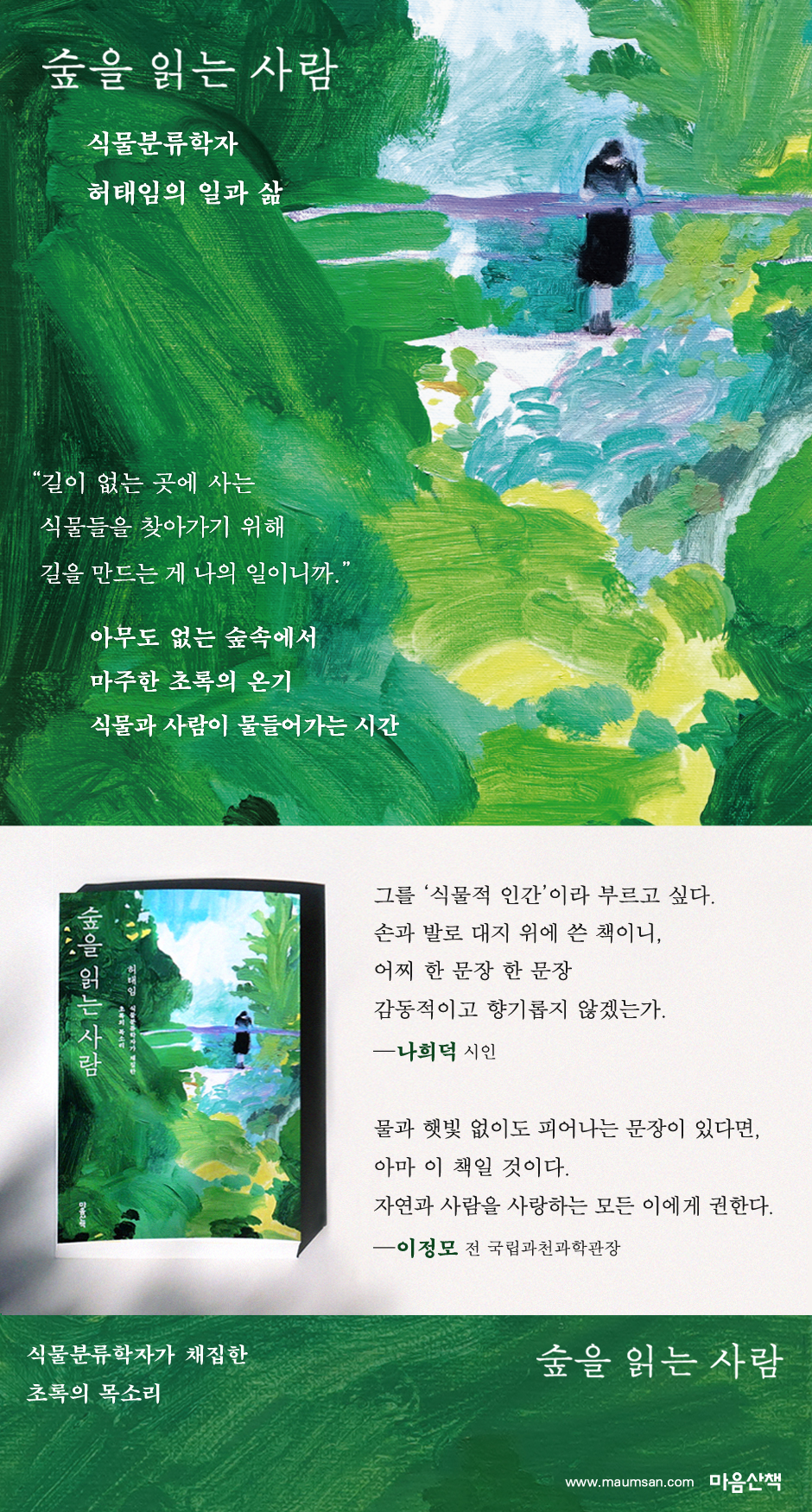
Because my job is to make paths to find plants that live in places where there are no paths.
--- p.53
Just because the leaves of plants dry up in the fall doesn't mean the plants stop developing.
Plants prepare for winter by building more densely packed cells.
Taking care of one's inner self, such as by thinking deeply or immersing oneself in something.
The trees put so much effort into making winter buds.
Only after the winter snow has been safely made can we enter the season of fallen leaves.
Then the tree gains the strength to endure the harsh times to come.
--- pp.64-65
In physics, resonance refers to vibration caused by an external force.
It does not mean the action of brute force, but rather a reaction to the beat.
The phenomenon in which the sound of a violin string vibrating by being scratched with a bow reaches the resonating chamber and spreads out into a louder sound.
If so, wouldn't it also be resonance to sympathize with and follow someone's thoughts or actions?
The ever-increasing density of the spruce forest in June resonates with me that the compassionate heart of a person can create waves that transform the surroundings into a compassionate energy, and that this is karma and a profound resonance.
--- p.98
Hoyas are generally kind and gentle-natured.
Don't whine for water too often.
This is because it stores moisture in its thick leaves.
Unlike normal plants, they do not grow tall to compete for light.
Instead, they live more widely spread out sideways under other plants.
He seems like a bishop who is short but has a generous heart.
There is a unique brilliance that comes from the bishop and Hoya.
--- p.111
I didn't stop along the many roads connected by National Route 59.
Meeting the pine tree, understanding its language, and calling its name correctly.
Meanwhile, my ambitions turned into awe for them.
It seems that the vague notion of clarifying taxonomic entities or correcting errors has now taken on a different form than before.
Something like hope and expectation that we should learn the wisdom of the pine tree, the great ancestor of our planet.
I want to continue to encounter pine trees on the road.
I still want to dream.
--- p.142
Now autumn seems to be arriving particularly slowly.
Some people may be worried that fall will disappear like this.
As if oblivious to such worries, the maple tree continues to drop its leaves, dripping with water, from its body.
I put aside the fears that come with words like climate crisis and war, and embrace the deepening autumn and the approaching winter as they are.
A tree will only reveal its true form when it loses all its leaves.
The tree will have no weapons, no decorations, and no concealment.
So, the tree will more clearly reveal that it is not mine.
--- p.188
How about calling the movement of the seeds of the Park Ju-ga-ri ‘leaving home’?
True renunciation is not limited to a specific practitioner, and true renunciation is about breaking free from all attachments and entanglements, just like the Buddhist monk Beopjeong's sermon, the Park Ju-ga-ri seed speaks while spreading its thin, long, and dense feathers.
True freedom lies in inner self-control.
To embrace it, repeated self-examination is necessary.
And it happens.
The holy work of going to a truly distant place and settling in a wider land.
The string that connects us to each other.
The seeds buried in the snow all winter will sprout into new shoots with a good mix of genes the next spring.
The sprouts continue the generations by adding strength to the colony and expanding its territory.
--- p.8
Wiping away my tears, I asked the tree, "Aren't you afraid of the night that comes every day?"
The answer that the sun rises because it has passed through the darkness, that light comes to us like that, that it is completely natural, sounded like a hallucination.
--- p.39
Taxonomy, which defines the boundaries between species, is not a fixed and unchanging truth, but rather an ongoing effort by finite humans to scientifically bring hypotheses closer to the truth in the face of changing nature.
--- pp.44-45
My work area is mostly the unmarked sections beyond the official hiking trails provided by various map apps.
That's about the extent of the digital benefits I can get.
Instead, from then on, I no longer need to be anxious about exceeding the expected time.
There is no need to worry about taking the wrong path.
Because my job is to make paths to find plants that live in places where there are no paths.
--- p.53
Just because the leaves of plants dry up in the fall doesn't mean the plants stop developing.
Plants prepare for winter by building more densely packed cells.
Taking care of one's inner self, such as by thinking deeply or immersing oneself in something.
The trees put so much effort into making winter buds.
Only after the winter snow has been safely made can we enter the season of fallen leaves.
Then the tree gains the strength to endure the harsh times to come.
--- pp.64-65
In physics, resonance refers to vibration caused by an external force.
It does not mean the action of brute force, but rather a reaction to the beat.
The phenomenon in which the sound of a violin string vibrating by being scratched with a bow reaches the resonating chamber and spreads out into a louder sound.
If so, wouldn't it also be resonance to sympathize with and follow someone's thoughts or actions?
The ever-increasing density of the spruce forest in June resonates with me that the compassionate heart of a person can create waves that transform the surroundings into a compassionate energy, and that this is karma and a profound resonance.
--- p.98
Hoyas are generally kind and gentle-natured.
Don't whine for water too often.
This is because it stores moisture in its thick leaves.
Unlike normal plants, they do not grow tall to compete for light.
Instead, they live more widely spread out sideways under other plants.
He seems like a bishop who is short but has a generous heart.
There is a unique brilliance that comes from the bishop and Hoya.
--- p.111
I didn't stop along the many roads connected by National Route 59.
Meeting the pine tree, understanding its language, and calling its name correctly.
Meanwhile, my ambitions turned into awe for them.
It seems that the vague notion of clarifying taxonomic entities or correcting errors has now taken on a different form than before.
Something like hope and expectation that we should learn the wisdom of the pine tree, the great ancestor of our planet.
I want to continue to encounter pine trees on the road.
I still want to dream.
--- p.142
Now autumn seems to be arriving particularly slowly.
Some people may be worried that fall will disappear like this.
As if oblivious to such worries, the maple tree continues to drop its leaves, dripping with water, from its body.
I put aside the fears that come with words like climate crisis and war, and embrace the deepening autumn and the approaching winter as they are.
A tree will only reveal its true form when it loses all its leaves.
The tree will have no weapons, no decorations, and no concealment.
So, the tree will more clearly reveal that it is not mine.
--- p.188
How about calling the movement of the seeds of the Park Ju-ga-ri ‘leaving home’?
True renunciation is not limited to a specific practitioner, and true renunciation is about breaking free from all attachments and entanglements, just like the Buddhist monk Beopjeong's sermon, the Park Ju-ga-ri seed speaks while spreading its thin, long, and dense feathers.
True freedom lies in inner self-control.
To embrace it, repeated self-examination is necessary.
And it happens.
The holy work of going to a truly distant place and settling in a wider land.
--- pp.204-205
Publisher's Review
Alone and together
How Plant Taxonomists Work
The author's workplace is in a remote mountain where a bear might appear, a tick might bite, or the sun might set and it would become dark at any moment.
The author, with a love for plants, takes each step forward, creating a path where there is no path.
The author climbs the mountain peak to see the windflowers that bloom only at altitudes above 1,300 meters, and travels here and there along National Route 59 to find yellow pine trees.
We also explore the beech forest of Taeharyeong, Ulleungdo, to record the beech trees that can only be found on Ulleungdo.
Sometimes he gets bitten by ticks, gets lost in the mountains and gets trapped in the darkness, but his love for plants overcomes his fears and he moves forward.
Like a plant that takes root in the ground and actively communicates with its surroundings, the author does not stop at exploring the forest alone, but works with colleagues, sharing his heart.
Dr. Woo Dong-geol, a zoologist who tracks endangered animals, conducts ecological surveys on the flora and fauna of areas affected by forest fires, and manages the Baekdudaegan National Arboretum Seed Vault, one of only two Seed Vaults in the world.
A warm tone of voice beginning with 'you too' implies understanding and empathy for the other person.
These are words that bind you and me together, that tell us not to be lonely because we are connected somewhere, that tell us to stay strong and live wherever that place is, that have the power to sustain someone's existence. ― From "The One Who Reads the Forest"
The warmth of green encountered in the empty forest
The time when plants and people become colored
『The Forest Reader』 contains the voices of plants collected in the mountains.
The story of the thistle, which is often hidden by the gorgeous roses but is said to be sufficient in its simple form; the dogwood tree, which plants toxic substances in its seeds to protect itself; the nightingale, which gives wings to its seeds to enable them to fly; and the mistletoe, which coexists with other beings, continue on in a whisper.
A unique feature of this book is that it juxtaposes writings about my work as a plant taxonomist with writings about plants.
The structure of the book is also connected to its content.
The warm stories the author receives from plants expand into affectionate experiences with the people around him.
The memories of the grandmother who first awakened in me a love for plants as a child, the mother who still delights in the scent of the hollyhock flowers like a little girl, Bishop Dubong who gave me a potted hoya as a gift, and the documentary director who shared a friendship while walking side by side in the demilitarized zone harmonize with the story of plants and resonate deeply with the reader.
We humans living on Earth are still imperfect, deficient, and insufficient creatures.
The power to supplement and perfect it is not an absolute single share.
I think it was called grafting.
By doing science in nature, I feel like I'm learning to communicate with the other, plants. ― From "The One Who Reads the Forest"
Climate crisis, war, wildfires, and unchecked development are increasingly destroying forests.
"The Man Who Reads the Forest" is the story of a plant taxonomist who, despite constantly encountering scenes of destruction, never gives up on the possibility of recovery.
If you follow the author's voice, you will fully encounter the coming of spring, like a plant sprouting new buds where its leaves have fallen.
How Plant Taxonomists Work
The author's workplace is in a remote mountain where a bear might appear, a tick might bite, or the sun might set and it would become dark at any moment.
The author, with a love for plants, takes each step forward, creating a path where there is no path.
The author climbs the mountain peak to see the windflowers that bloom only at altitudes above 1,300 meters, and travels here and there along National Route 59 to find yellow pine trees.
We also explore the beech forest of Taeharyeong, Ulleungdo, to record the beech trees that can only be found on Ulleungdo.
Sometimes he gets bitten by ticks, gets lost in the mountains and gets trapped in the darkness, but his love for plants overcomes his fears and he moves forward.
Like a plant that takes root in the ground and actively communicates with its surroundings, the author does not stop at exploring the forest alone, but works with colleagues, sharing his heart.
Dr. Woo Dong-geol, a zoologist who tracks endangered animals, conducts ecological surveys on the flora and fauna of areas affected by forest fires, and manages the Baekdudaegan National Arboretum Seed Vault, one of only two Seed Vaults in the world.
A warm tone of voice beginning with 'you too' implies understanding and empathy for the other person.
These are words that bind you and me together, that tell us not to be lonely because we are connected somewhere, that tell us to stay strong and live wherever that place is, that have the power to sustain someone's existence. ― From "The One Who Reads the Forest"
The warmth of green encountered in the empty forest
The time when plants and people become colored
『The Forest Reader』 contains the voices of plants collected in the mountains.
The story of the thistle, which is often hidden by the gorgeous roses but is said to be sufficient in its simple form; the dogwood tree, which plants toxic substances in its seeds to protect itself; the nightingale, which gives wings to its seeds to enable them to fly; and the mistletoe, which coexists with other beings, continue on in a whisper.
A unique feature of this book is that it juxtaposes writings about my work as a plant taxonomist with writings about plants.
The structure of the book is also connected to its content.
The warm stories the author receives from plants expand into affectionate experiences with the people around him.
The memories of the grandmother who first awakened in me a love for plants as a child, the mother who still delights in the scent of the hollyhock flowers like a little girl, Bishop Dubong who gave me a potted hoya as a gift, and the documentary director who shared a friendship while walking side by side in the demilitarized zone harmonize with the story of plants and resonate deeply with the reader.
We humans living on Earth are still imperfect, deficient, and insufficient creatures.
The power to supplement and perfect it is not an absolute single share.
I think it was called grafting.
By doing science in nature, I feel like I'm learning to communicate with the other, plants. ― From "The One Who Reads the Forest"
Climate crisis, war, wildfires, and unchecked development are increasingly destroying forests.
"The Man Who Reads the Forest" is the story of a plant taxonomist who, despite constantly encountering scenes of destruction, never gives up on the possibility of recovery.
If you follow the author's voice, you will fully encounter the coming of spring, like a plant sprouting new buds where its leaves have fallen.
GOODS SPECIFICS
- Date of issue: April 5, 2025
- Page count, weight, size: 212 pages | 306g | 133*201*14mm
- ISBN13: 9788960909274
You may also like
카테고리
korean


korean

![GQ KOREA Mark (Monthly): December [2025]](http://librairie.coreenne.fr/cdn/shop/files/8ef265dbbfbf186523ed75ba7319009d.jpg?v=1765340328&width=3840)


