

Don't forget that life loves you
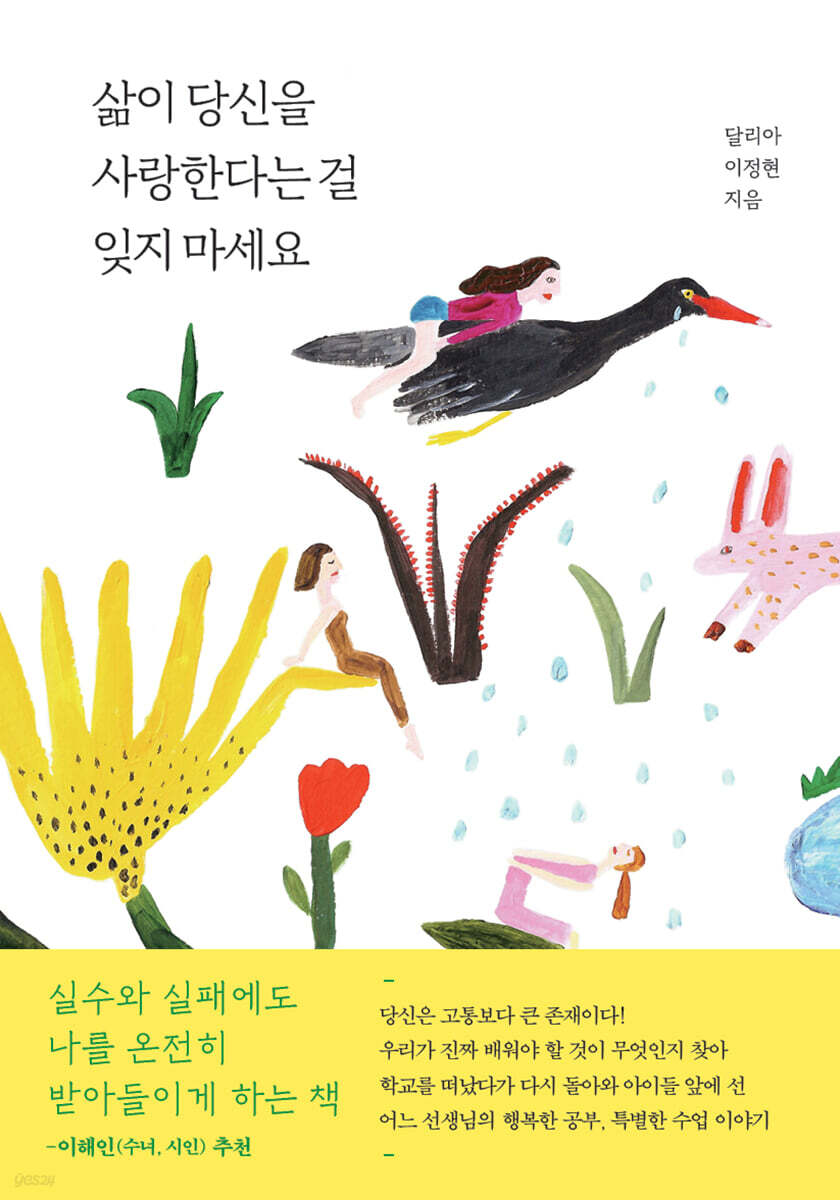 |
Description
Book Introduction
"A book that helps me fully accept myself, even with my mistakes and failures." (Lee Hae-in, Sister, Poet)
"Dahlia looks like a barnacle who has come looking for the elixir of life." (Somewhere, Kim Hyun-ah, author)
From the 'swamp of depression' to becoming a 'smiling teacher'!
What is it that we truly need to learn and teach in this one life?
After leaving the school where he was teaching and becoming a student at Earth School, he went on a journey.
Now, a teacher returns to stand before the children again, telling the story of a happy study and a special class.
“Teacher, I want to die.” The shocking words of a twelve-year-old fifth grader.
It wasn't just that kid.
In the classroom, the number of children suffering from tic disorders, depression, and ADHD is increasing.
Behind them were sick parents and a sick society.
Even if I wanted to help, all I could do was hold the children and cry.
The teacher, who was wondering, 'How can I escape this shackle?', quit school and took to the road.
During the 13 years since I left school, I searched for meaning in life and the path to happiness.
I learned mindfulness in the Himalayas, Thailand, and France, and volunteered at places like Mother Teresa House.
After meeting the Dalai Lama, Thich Nhat Hanh, Bernard Werber, and others, I asked them questions directly, and after receiving hospice training, I stayed by the side of the dying and reflected on life and death.
I majored in psychological counseling in graduate school and studied psychological theories and healing methods.
What I learned in this way was developed into programs such as ‘Cultivating the Forest of the Mind,’ ‘Communication Camp,’ and ‘Life Retreat,’ and I have met over 10,000 people through hundreds of lectures at places such as Seoul National University of Education, Seoul Metropolitan Office of Education, and Gyeonggi Provincial Office of Education Peace Education Center.
Having deeply experienced the power of love that saves lives, I now return to where I left off and teach children at school to share this experience.
Moments of crying, laughing, learning, and teaching to my heart's content on the path from depression to joy, from darkness to light, and from disconnection to connection.
37 stories of love armed with constant effort and utmost patience.
"Dahlia looks like a barnacle who has come looking for the elixir of life." (Somewhere, Kim Hyun-ah, author)
From the 'swamp of depression' to becoming a 'smiling teacher'!
What is it that we truly need to learn and teach in this one life?
After leaving the school where he was teaching and becoming a student at Earth School, he went on a journey.
Now, a teacher returns to stand before the children again, telling the story of a happy study and a special class.
“Teacher, I want to die.” The shocking words of a twelve-year-old fifth grader.
It wasn't just that kid.
In the classroom, the number of children suffering from tic disorders, depression, and ADHD is increasing.
Behind them were sick parents and a sick society.
Even if I wanted to help, all I could do was hold the children and cry.
The teacher, who was wondering, 'How can I escape this shackle?', quit school and took to the road.
During the 13 years since I left school, I searched for meaning in life and the path to happiness.
I learned mindfulness in the Himalayas, Thailand, and France, and volunteered at places like Mother Teresa House.
After meeting the Dalai Lama, Thich Nhat Hanh, Bernard Werber, and others, I asked them questions directly, and after receiving hospice training, I stayed by the side of the dying and reflected on life and death.
I majored in psychological counseling in graduate school and studied psychological theories and healing methods.
What I learned in this way was developed into programs such as ‘Cultivating the Forest of the Mind,’ ‘Communication Camp,’ and ‘Life Retreat,’ and I have met over 10,000 people through hundreds of lectures at places such as Seoul National University of Education, Seoul Metropolitan Office of Education, and Gyeonggi Provincial Office of Education Peace Education Center.
Having deeply experienced the power of love that saves lives, I now return to where I left off and teach children at school to share this experience.
Moments of crying, laughing, learning, and teaching to my heart's content on the path from depression to joy, from darkness to light, and from disconnection to connection.
37 stories of love armed with constant effort and utmost patience.
- You can preview some of the book's contents.
Preview
index
preface.
In search of the water of life
1.
What keeps us alive
I want to dry my wet heart
There is no such child
Encouragement of Light
Teacher, spring rain is like a vacuum cleaner.
To ask questions is to love
2.
The order in which wounds become flowers
Are you a stone or a seed?
From thorns to flowers
Embrace your weaknesses and blossom your talents
How can you hate yourself?
Teacher, what is self-esteem?
3.
The teacher who went to the Himalayas
Teacher, what was your dream?
What is more important than money?
Teacher, I want to die
You can exhale as much as you inhale.
This is how we looked after breaking up
4.
Can happiness be taught?
I've arrived, I'm home
What do you really want?
Weighing a grain of rice
Finding Joy in Every Season
Hope for the flowers
5.
Disconnection is pain, connection is love
The miracle of eye contact
Anyone who can move their ears?
No one is there to tease and harass you.
Teacher, my child has ADHD.
I wish my teacher was my mom
Love is for everyone
6.
There is no second time
The last remaining potato chips
The death of a tattooed grandfather
Strange teacher
You disappear.
Therefore it is beautiful
If the end of the world comes
7.
To teach is to sing of hope
Teacher's story of advancing to National Singing Contest
Is this a class or an art?
If life is a piece of music
Frog living in the butt
Poems written in science class
Life is a school where you learn love
Conclusion.
What remains after love
Appendix 1.
Teacher Dahlia's Sweet Class Tips
Appendix 2.
Class Reference Materials
Appendix 3.
Introduction to character terms
main
In search of the water of life
1.
What keeps us alive
I want to dry my wet heart
There is no such child
Encouragement of Light
Teacher, spring rain is like a vacuum cleaner.
To ask questions is to love
2.
The order in which wounds become flowers
Are you a stone or a seed?
From thorns to flowers
Embrace your weaknesses and blossom your talents
How can you hate yourself?
Teacher, what is self-esteem?
3.
The teacher who went to the Himalayas
Teacher, what was your dream?
What is more important than money?
Teacher, I want to die
You can exhale as much as you inhale.
This is how we looked after breaking up
4.
Can happiness be taught?
I've arrived, I'm home
What do you really want?
Weighing a grain of rice
Finding Joy in Every Season
Hope for the flowers
5.
Disconnection is pain, connection is love
The miracle of eye contact
Anyone who can move their ears?
No one is there to tease and harass you.
Teacher, my child has ADHD.
I wish my teacher was my mom
Love is for everyone
6.
There is no second time
The last remaining potato chips
The death of a tattooed grandfather
Strange teacher
You disappear.
Therefore it is beautiful
If the end of the world comes
7.
To teach is to sing of hope
Teacher's story of advancing to National Singing Contest
Is this a class or an art?
If life is a piece of music
Frog living in the butt
Poems written in science class
Life is a school where you learn love
Conclusion.
What remains after love
Appendix 1.
Teacher Dahlia's Sweet Class Tips
Appendix 2.
Class Reference Materials
Appendix 3.
Introduction to character terms
main
Detailed image
.jpg)
Into the book
What saved me from the depths of despair were the people who truly empathized with my pain and personally showed me that “you are not alone” and “you are greater than your pain.”
--- p.5 From the “Preface”
I have witnessed countless instances of pain embracing pain, loneliness soothing loneliness, and suffering comforting pain, and I have come to realize the power of love that flows between us.
I learned that there is no such thing as one-sided healing or teaching, that reaching out and embracing another person is ultimately embracing myself, and that teaching is learning.
--- p.7 From the “Preface”
“Dahlia looks like a bard who has come looking for the water of life.”
--- p.7 From the “Preface”
Just as a flower needs the encouragement of sunlight, the support of the earth, the comfort of the wind, and the encouragement of rain to bloom and grow, there are beings who sometimes help us stand up when our lives are crumbling and who shed light even in the darkness.
I too have survived thanks to the encouragement of light.
--- p.28 From “Encouragement of Light”
"What if someone followed you around 24 hours a day, watching you, evaluating you, judging you, criticizing you, and telling you what to do?" "It would be suffocating." "Just thinking about it makes me feel that way. But did you know that there's such a watcher inside you?
--- p.54 From "From Thorn to Flower"
“At times like these, please take care of yourself, hug yourself, and love yourself.
Even a flower bud can bloom only after it has embraced itself tightly.
“The dahlia is currently in its bud stage.”
--- p.63 From “Embracing Weaknesses and Blossoming Talents”
After reaching such rock bottom in life, I realized how important it is to respect myself.
It was an impossible formula to expect others to respect me while I disrespected myself and treated myself as worthless.
--- p.75 From “Teacher, what is self-esteem?”
After going around and around like that, I came back to the place I left.
I feel like I've traveled as far as I can to see the nearest light, just like the main character in the fairy tale "The Blue Bird."
--- p.104 From "The Way We Broke Up"
I felt like I had been completely fooled.
The happiness that was guaranteed if you studied hard and went to a good university was a lie.
Instead, other conditions were added, such as a good job or marriage.
I was confused and impatient, running frantically in pursuit of happiness that was as elusive as a rainbow.
I lived with the belief that I had to do better than others, or at least as well as others, to be happy, following established standards and schedules as milestones.
I tried to climb higher, trying to keep up, but I was thrown to the ground.
And I fell into the swamp of depression.
--- p.110 From "I've Arrived, It's Home"
Even these days, whenever I feel tense or anxious, I repeat these words to myself.
“I’ve arrived, I’m home!” Every time I say that, my body and mind relax, and a smile comes to my face.
Truly, this is a magical spell that can bring back the happiness of this very moment.
--- p.116 From "I've Arrived, It's Home"
I believe that children who have learned from the classroom how closely connected we are, children who can sense the weight of the universe in a single grain of rice, children who understand that everything in the world leans on each other, will create a happier world together. Today, I anchor myself deeper and find my center.
--- pp.128-129 From "Weighing a Grain of Rice"
When we look at each other through those eyes, the windows of our souls, we are confronted with the truth that 'we all want to avoid suffering and be happy.'
And when we discover that truth, we can choose understanding over misunderstanding, love over hate.
--- p.149 From “The Miracle of Eye Contact”
Just as rocks break and become soil, just as fallen leaves crumble and become nutrients, I hope that true love can bloom in the places where the countless fake loves that have taken root within me have broken, and that the words I speak, the writings I write, and the actions I take are no different from love. To not forget this wish, to remember it, and to engrave it in my mind, I write this piece that is both a reflection and a pledge.
--- p.183 From “Love is for Everyone”
“How can Seungjun be so happy every day?” Seungjun slowly but accurately answered, “I thought the world suddenly went dark and I would never see my sister, mom, dad, and friends again, but I woke up again.
“I’m happy to see you all again, and I’m watching you a lot now because I don’t know when it’ll get dark again,” he said, and then he smiled with a pure and bright expression.
Seungjun had recently suffered a seizure and lost consciousness for a moment, so he was taken to the emergency room and underwent a thorough examination.
Looking at the dazzling smile of the child who was on the verge of death, I felt as if I was seeing the face of life shining transparently under the bright sunlight.
--- pp.187~188) From “The Last Remaining Potato Chips”
In the face of death, it becomes clear and unmistakable how much we have laughed and how much pain we have endured in life.
No one could hide the trajectory of the life they had lived.
--- p.198 From “The Last Remaining Potato Chips”
Children grow up accepting the contradictions and confusion of pain and happiness, sadness and joy, life and death.
Only after we accept death as a part of life do we encounter the dazzling life of the present, which, like day and night, always shines on the other side of death.
All the moments of life that don't happen twice.
--- p.209 “You disappear.
Therefore, it is beautiful"
Someone said life is a stage.
I will continue to try, experience, enjoy, and share freely any role that comes my way on the stage of life without regret.
Because the world's most wonderful audience is always waiting for me in the classroom.
--- p.223 From "The Teacher's Story of Advancing to the National Singing Contest"
The ice-like wounds embedded in the body and mind melt away, and love naturally overflows in the place where the clots that were blocking the flow of body and mind are removed.
Just as dark clouds part to reveal the ever-shining blue sky and sunlight behind them, so too does the pain of separation disappear in deep connection, and light bursts forth.
I look at that moment with admiration, as if I were looking at the rising sun, cutting through the darkness.
After witnessing this for a long time, I became convinced that love is something that can be seen with the eyes.
--- pp.253-254 From “Life is a School to Learn Love”
Love is a warm hand held together, a gentle gaze, a touch, an open ear and heart.
And these are words and actions that make each other happy.
It is clear that the love that transforms one another is something that is visible, felt, and conveyed to the heart.
Living as a witness to the power of love, I have come to think of life as a school to learn love.
If there is one subject that we must learn before anything else in life, it must be love.
That's why life, people, love and words are so similar.
If life is something that is created through love, then I want to live this life embracing it more deeply.
Remembering and sharing the love life has shown me.
--- p.5 From the “Preface”
I have witnessed countless instances of pain embracing pain, loneliness soothing loneliness, and suffering comforting pain, and I have come to realize the power of love that flows between us.
I learned that there is no such thing as one-sided healing or teaching, that reaching out and embracing another person is ultimately embracing myself, and that teaching is learning.
--- p.7 From the “Preface”
“Dahlia looks like a bard who has come looking for the water of life.”
--- p.7 From the “Preface”
Just as a flower needs the encouragement of sunlight, the support of the earth, the comfort of the wind, and the encouragement of rain to bloom and grow, there are beings who sometimes help us stand up when our lives are crumbling and who shed light even in the darkness.
I too have survived thanks to the encouragement of light.
--- p.28 From “Encouragement of Light”
"What if someone followed you around 24 hours a day, watching you, evaluating you, judging you, criticizing you, and telling you what to do?" "It would be suffocating." "Just thinking about it makes me feel that way. But did you know that there's such a watcher inside you?
--- p.54 From "From Thorn to Flower"
“At times like these, please take care of yourself, hug yourself, and love yourself.
Even a flower bud can bloom only after it has embraced itself tightly.
“The dahlia is currently in its bud stage.”
--- p.63 From “Embracing Weaknesses and Blossoming Talents”
After reaching such rock bottom in life, I realized how important it is to respect myself.
It was an impossible formula to expect others to respect me while I disrespected myself and treated myself as worthless.
--- p.75 From “Teacher, what is self-esteem?”
After going around and around like that, I came back to the place I left.
I feel like I've traveled as far as I can to see the nearest light, just like the main character in the fairy tale "The Blue Bird."
--- p.104 From "The Way We Broke Up"
I felt like I had been completely fooled.
The happiness that was guaranteed if you studied hard and went to a good university was a lie.
Instead, other conditions were added, such as a good job or marriage.
I was confused and impatient, running frantically in pursuit of happiness that was as elusive as a rainbow.
I lived with the belief that I had to do better than others, or at least as well as others, to be happy, following established standards and schedules as milestones.
I tried to climb higher, trying to keep up, but I was thrown to the ground.
And I fell into the swamp of depression.
--- p.110 From "I've Arrived, It's Home"
Even these days, whenever I feel tense or anxious, I repeat these words to myself.
“I’ve arrived, I’m home!” Every time I say that, my body and mind relax, and a smile comes to my face.
Truly, this is a magical spell that can bring back the happiness of this very moment.
--- p.116 From "I've Arrived, It's Home"
I believe that children who have learned from the classroom how closely connected we are, children who can sense the weight of the universe in a single grain of rice, children who understand that everything in the world leans on each other, will create a happier world together. Today, I anchor myself deeper and find my center.
--- pp.128-129 From "Weighing a Grain of Rice"
When we look at each other through those eyes, the windows of our souls, we are confronted with the truth that 'we all want to avoid suffering and be happy.'
And when we discover that truth, we can choose understanding over misunderstanding, love over hate.
--- p.149 From “The Miracle of Eye Contact”
Just as rocks break and become soil, just as fallen leaves crumble and become nutrients, I hope that true love can bloom in the places where the countless fake loves that have taken root within me have broken, and that the words I speak, the writings I write, and the actions I take are no different from love. To not forget this wish, to remember it, and to engrave it in my mind, I write this piece that is both a reflection and a pledge.
--- p.183 From “Love is for Everyone”
“How can Seungjun be so happy every day?” Seungjun slowly but accurately answered, “I thought the world suddenly went dark and I would never see my sister, mom, dad, and friends again, but I woke up again.
“I’m happy to see you all again, and I’m watching you a lot now because I don’t know when it’ll get dark again,” he said, and then he smiled with a pure and bright expression.
Seungjun had recently suffered a seizure and lost consciousness for a moment, so he was taken to the emergency room and underwent a thorough examination.
Looking at the dazzling smile of the child who was on the verge of death, I felt as if I was seeing the face of life shining transparently under the bright sunlight.
--- pp.187~188) From “The Last Remaining Potato Chips”
In the face of death, it becomes clear and unmistakable how much we have laughed and how much pain we have endured in life.
No one could hide the trajectory of the life they had lived.
--- p.198 From “The Last Remaining Potato Chips”
Children grow up accepting the contradictions and confusion of pain and happiness, sadness and joy, life and death.
Only after we accept death as a part of life do we encounter the dazzling life of the present, which, like day and night, always shines on the other side of death.
All the moments of life that don't happen twice.
--- p.209 “You disappear.
Therefore, it is beautiful"
Someone said life is a stage.
I will continue to try, experience, enjoy, and share freely any role that comes my way on the stage of life without regret.
Because the world's most wonderful audience is always waiting for me in the classroom.
--- p.223 From "The Teacher's Story of Advancing to the National Singing Contest"
The ice-like wounds embedded in the body and mind melt away, and love naturally overflows in the place where the clots that were blocking the flow of body and mind are removed.
Just as dark clouds part to reveal the ever-shining blue sky and sunlight behind them, so too does the pain of separation disappear in deep connection, and light bursts forth.
I look at that moment with admiration, as if I were looking at the rising sun, cutting through the darkness.
After witnessing this for a long time, I became convinced that love is something that can be seen with the eyes.
--- pp.253-254 From “Life is a School to Learn Love”
Love is a warm hand held together, a gentle gaze, a touch, an open ear and heart.
And these are words and actions that make each other happy.
It is clear that the love that transforms one another is something that is visible, felt, and conveyed to the heart.
Living as a witness to the power of love, I have come to think of life as a school to learn love.
If there is one subject that we must learn before anything else in life, it must be love.
That's why life, people, love and words are so similar.
If life is something that is created through love, then I want to live this life embracing it more deeply.
Remembering and sharing the love life has shown me.
--- p.255 From “Life is a School to Learn Love”
Publisher's Review
What is it that we truly need to learn and teach in this one life?
After leaving the school where he taught and becoming a student at Earth School, he went on a journey.
Now, a teacher returns to the classroom and tells the story of a happy study and special class.
“Teacher, I want to die.” These are the shocking words the author heard from a twelve-year-old fifth grader.
It wasn't just the child who suffered.
In the classroom, the number of children suffering from tic disorder, depression, ADHD, etc. was increasing day by day.
Behind every sick child, there are sick parents and a sick society.
The pain was so great that the author seemed to be swept away along with it.
The pain grew and it seemed like there was nothing I could do but hold the children and cry.
The teacher often became listless and exhausted.
The teacher, who was wondering, 'How can I escape this shackle?', heard the story of Tenzin Palmo, a British nun who practiced asceticism in a cave in the Himalayas for 12 years, and left school and home to set out on the road.
I believe that in order to help someone in pain, you must first learn how to free yourself from pain.
I vowed to no longer be sad, to move beyond the days of shedding tears with my children and find a way out of the shackles of pain.
I decided that I would see the end of suffering even if I had to become a monk.
The next day, I went to Gilsangsa Temple in Seongbuk-dong, Seoul, and made a resolution by doing 3,000 prostrations all night long.
My legs were shaking, but my heart was strong.
After asking my parents' permission, I resigned from the school.
I donated most of my belongings and clothes that I no longer needed.
The teacher told the children he was teaching that they would become students at Earth School and learn more.
The children sincerely cheered me on.
(Page 98)
During the 13 years since leaving school, the author traveled to many countries, seeking answers to the meaning of life, the true nature of existence, and the path to happiness.
I practiced mindfulness at meditation centers and peace communities in the Himalayas, Thailand, and France, and also volunteered at Mother Teresa House and Kkotdongne in Kolkata, India.
I met people I had only read about in books, such as the Dalai Lama, Thich Nhat Hanh, Tenzin Palmo, and Bernard Werber, and asked them questions directly. After receiving hospice training, I stayed by the side of the dying and reflected on life and death.
While majoring in psychological counseling in graduate school, I studied various psychological theories and healing techniques, received discipleship training at church, and read the Bible and prayed every day.
To embody and practice what we have learned in our daily lives, we planned and implemented various programs such as ‘Cultivating the Forest of the Mind,’ ‘All Flowers Are Beautiful,’ ‘Communication Camp,’ and ‘Life Retreat.’
I shared what I learned by giving hundreds of lectures at Seoul National University, Seoul Metropolitan Office of Education, Gyeonggi Provincial Office of Education Peace Education Center, Environmental Foundation, Cultural Space Sumdo, Space Sallim, and other institutions, meeting over 10,000 people.
Through this, I have witnessed countless instances of pain embracing pain, loneliness soothing loneliness, and suffering comforting pain, and I have truly felt the power of love flowing between us.
I learned that there is no such thing as one-sided healing or teaching, that reaching out and embracing another person is ultimately embracing myself, and that teaching is learning.
(Page 7)
The author, who went through a journey of growth, moving from depression to love, from pain to freedom, and finally, through lectures and programs he personally developed, has now returned to his former position and is teaching children at school again.
To never forget and to convey the countless love that life has given you.
The author, who returned to the place he had left after going around and around like that, says this.
I feel like I've traveled as far as I can to see the light closest to me, like the protagonist in the fairy tale "The Blue Bird."
After returning to school, I ponder how I can better convey to my children what I have learned through various experiences and encounters in the world.
(Pages 104-105)
This book contains the questions, feelings, and realizations of a teacher who set out on a journey to discover what we truly need to learn and teach in this one life.
And I'm sharing what I've learned along the way, and I'm telling the story of what I'm learning and how I'm learning along the way.
The process of moving from depression to laughter, from death to life, from darkness to light.
About the power of connection that transformed the pain you were experiencing into love.
“To extend one’s arms and embrace another is to embrace oneself.”
The author himself suffered from severe mental illness in the past.
When I was a student, I cried every day before an exam.
I was always anxious because I was afraid of failing the test and felt pressured to maintain my good grades.
Because the grades were determined by grades, I trembled at even a single mistake.
Failure in the college entrance exam, which did not turn out as desired, was felt as a failure in life.
And during my college years, I fell into a deep depression and barely managed to breathe.
Then I went to Dharamsala, India.
I was curious about the Dalai Lama, who answered “Yes” without hesitation to the question “Are you happy?”
And on the way, I get this question from a Tibetan monk I meet.
“How can you hate yourself?”
“Actually, I suffered from severe depression before coming here.” “What is depression?”
“It’s a disease of hating yourself.
And it's a disease where everything becomes difficult as the depressed feelings continue." "Poor thing." The monk shook his head and clicked his tongue as he listened to my explanation.
The monk's subsequent questions left me stunned for a while.
“How can you hate yourself?” I suddenly felt like I had been hit hard on the head.
The monk said that in Tibet there are no words for 'self-reproach' or 'guilt'.
(Pages 69-70)
A time of despair when I considered myself a monstrous, horrible person and thought I would never be able to return to a normal life.
The people who saved him were those who sympathized with his pain and told him, "You are not alone," and "You are bigger than your pain."
They were strangers who fed and gave lodging to the author who had nowhere to go.
One late night, after spending a few days in an unfamiliar place, I went out to the living room and met her.
He said he was out for tea and asked if I would like a cup too.
As the water boiled and I drank the herbal tea she was given, she began to tell me her story.
Marriage, domestic violence, divorce, and the great fear that has kept me from putting down my weapon of self-defense since then…
He calmly shared his pain and days of healing, including that he is receiving psychiatric counseling to overcome anxiety and depression and is gradually getting better by taking medication.
As I listened quietly to her story, a small light began to seep into the darkness within me.
The person in front of me was simply honest about his or her pain, but the pain inside me, which had been as hard as a rock, was touched and broken, and a thin light began to seep through the cracks.
Until then, it seemed like everyone in the world except me was living well… .
Through her, I was able to see that I was not the only one who was hurting and having a hard time.
I began to feel how closely connected our suffering is.
Only in the midst of the suffering was I able to let out my pent-up breath and breathe in again.
That connection helped me get back on my feet and start on the path to healing.
(Page 84)
When I feel inadequate in a difficult situation and feel completely withdrawn, I remember the advice of Bae Gyu-ja, a choreographer from Norway, who said, “In times like these, take care of yourself, hug yourself, and love yourself.
Even a flower bud can bloom only after it has embraced itself tightly.
The words, “Dahlias are currently in their bud phase” (page 63), and on days when I was struggling with depression and self-reproach, the words, “Don’t forget that life loves you” (page 6) from Suga, who lives in Kona Island, Hawaii, breathed life into my weary heart.
The author says:
Just as a flower needs the encouragement of sunlight, the support of the earth, the comfort of the wind, and the encouragement of rain to bloom and grow, there are beings who sometimes help us stand up when our lives are crumbling and who shed light even in the darkness.
I too have survived thanks to the encouragement of light.
(Page 28)
And in order to share this experience of comfort and healing with everyone he meets, the author plans and practices to love even more fervently in this precious life he has received.
"Dahlia looks like a barnacle that has come back from searching for the water of life." (Somewhere, Kim Hyun-ah, author)
“A book that helps me fully accept myself, even with my mistakes and failures.” (Lee Hae-in, Sister and Poet)
You are bigger than your pain.
37 Stories of Love Armed with Relentless Effort and Extreme Patience
The author, who wanted to truly experience and realize 'what we should truly learn and teach' for herself and her children, left home and first arrived at the Buddhist nunnery of Tenzin Palmo in the Himalayas of northern India.
It was a 10-hour flight including a layover to Delhi, India, followed by a 12-hour bus ride and then another 1-2 hour taxi ride.
A small room in a temple reached after passing through a high and rugged mountain path.
In response to the monk's question, "How did you come this far?" the author shared a story of how he had been overwhelmed by the pain of children and the suffering of the world.
As I spoke, tears kept falling, and I began to feel out of breath as I poured out my story.
The monk listened to my story from beginning to end, looking deeply into my eyes. When I finished, he said, “Take a breath.”
Following those words, I tried to focus only on breathing.
As I continued to talk about many things in one breath, my shallow and quick breathing gradually became deeper and slower.
“We can only exhale as much as we inhale.” In that moment, I felt the meaning of those words with my whole body.
Just as the balance of inhalation and exhalation is a constant, the realization that only when I am filled with love can I convey love to someone else came to me like a wave of bells.
(Page 100)
Afterwards, the author stayed at a nearby meditation center for several years, following the monk's teachings for periods ranging from a month to several months, listening to the monk's sermons and learning various meditation techniques from various Tibetan masters, such as the Tonglen method of breathing in and exhaling the suffering of other beings.
At the Vipassana Meditation Center in the forest near Chiang Mai, Thailand, we learn the meta-practice of extending love from ourselves to all beings in the world.
“What if someone followed you around 24 hours a day, watching you, evaluating you, judging you, criticizing you, and telling you what to do?”
“You must be suffocating.”
“Just thinking about it makes me wonder, right? But did you know that there's such a watcher inside you?”
…
“Tell yourself sincerely, ‘I wish you health, happiness, and peace.’” I closed my eyes, took a deep breath, and then said the words softly to myself.
“I wish you health, happiness, and peace.” It was strange and awkward, but deep within me, I felt a sense of peace and joy welling up.
(Pages 54-55)
The author arrived at the 'Mother Teresa House' in Kolkata, India, with the grand goal of practicing love, sharing love, and doing volunteer work.
The moment I encountered patients who were unable to move, sitting in chairs, groaning in agony, patients whose faces had melted to the point where you couldn't even see their eyes, nose, or mouth, and patients whose minds were clearly visible, the author felt like running away.
However, as he sees the patients who came as volunteers to comfort and help him, and the monks and volunteers busily moving among the patients, he feels the power of true love and changes.
A few days later, when a woman whose face was distorted and whose eyes, nose, and mouth were almost gone came running her hands over my face and body and called my name, I was so surprised and happy that I jumped up from my seat.
It was truly a happy thing to be able to remember and call each other's names, ask about each other's well-being, and share our hearts by filling each other's needs.
(Pages 181-182)
And study and practice at Plum Village, a peace community led by Venerable Thich Nhat Hanh.
Suddenly, I remembered the saying I once heard: “The moment you stop running, you’ve arrived.”
I felt like the brakes were working inside me.
Where I stopped running at full speed, I could feel the sunlight shining down on me from outside the window, the solidity of the ground I was standing on, the wind passing by me, and the fragrance carried by the wind.
It was the feeling that I was alive.
(Page 113)
The author embarked on a journey of learning, and returned to where he had left off, on a journey of growth from separation to connection, from pain to joy, from suffering to freedom, from the “swamp of depression” to being reborn as a “smiling teacher.”
And I am applying the realization and study I gained from asking myself, "What do we really need to learn and teach in this one life?" to my life and classroom.
And as you teach, you learn.
“How can Seungjun be so happy every day?” Seungjun slowly but accurately answered, “I thought the world suddenly went dark and I would never see my sister, mom, dad, and friends again, but I woke up again.
“I’m happy to see you all again, and I’m watching you a lot now because I don’t know when it’ll get dark again,” he said, and then he smiled with a pure and bright expression.
Seungjun had lost consciousness for a while a while ago and was taken to the emergency room for a thorough examination.
Looking at the dazzling smile of the child who was on the verge of death, I felt as if I was seeing the face of life shining transparently under the bright sunlight.
(Pages 187-188)
Over the next four years, I taught children with incurable diseases every day, and I sent several more children to heaven.
That's why I teach with the mindset that each of my classes could be the last class in someone's life.
Every time I see children with infinitely bright and clear faces trying their best to learn as much as possible, my habit of trying to live comfortably is awakened.
Children were also my teachers who made me more aware of every moment and guided me to live a more valuable life.
I wanted to teach with more sincerity and touch the hearts of children, and to be remembered as a “strange teacher” for a long time.
(Pages 203-204)
Children have always expressed their feelings through small notes, letters, and carefully folded pieces of colored paper.
He embraced me with open arms, smiled brightly, and listened to what I had to say.
Being with children who share their love so purely and bravely has helped me not to forget that life loves me.
I wanted to share the meaning of life and the mysteries of the world with these children, so I set out to find ways to learn more and grow.
Every time the children I met on that road had a hardened expression, a smile spread across their faces, their hunched bodies straightened, and light sparkled in their eyes again, I felt an overwhelming sense of gratitude that I was alive.
(Page 256)
“If I could make you bloom with the love that saved me.”
Pain embraces pain, loneliness soothes loneliness, and suffering speaks while caressing pain.
“You did your best.
great job.
You've done well.
are you okay."
The teacher's class, which returns to the place where he started after going through such a long learning journey, is special.
Asking questions means you're interested, and you ask a lot of questions.
As a teacher, when I meet children, the thing I consider important is to cultivate the 'power to ask questions' and the 'courage to ask questions'.
So, from the first class, I ask the children a lot of questions.
Connecting it to a class subject or topic, “What am I?” “When am I the happiest?” “What is my favorite style of clothing?”… .
Sometimes abstract, sometimes concrete, asking questions big and small.
And I also give the kids homework.
“What is the thing I am most curious about around me?” (pp. 35-36)
Sometimes we ask children to become seeds.
Imagine curling up into a ball, making yourself small, and being buried in the dirt, wrapped in a shell.
Turn off all the lights in the classroom and draw the blinds to create a dark atmosphere. Then, read a short story you wrote yourself to the children, guiding them to dive deeper into their imaginations.
(Page 43)
Asking how much a grain of rice weighs
Only then do the children say, “Ah~” and look at the grain of rice again from a perspective they had not thought of.
One child, who had been concentrating and enjoying the song until the end, dropped the palm of his hand that was holding a grain of rice onto the floor under the desk and said,
"Wow, space is heavy! The rice suddenly feels heavy." (p. 124)
Practice listening and invite the seasons into the classroom.
To help children hear even the smallest, most subtle sounds that they normally can't hear, I "prepare to listen" with them.
…Listening is such an important skill that it can be said to be the beginning and end of every conversation.
However, when we are exposed to too much media and stimulation on a daily basis, our concentration becomes scattered and it becomes difficult to listen carefully.
I practice and train listening with my children in stages, as if playing a game.
(Pages 152-153)
We invite the seasons into the classroom by going out to the playground each season and feeling the change of seasons, decorating the classroom with natural objects that can be felt in the season, such as flowers or autumn leaves, and reading picture books and poems about the seasons, listening to music, or drawing pictures.
(Page 134)
Classes are filled with laughter and fun.
When I teach my children about attention and listening, I pull out my secret weapon.
It's just moving my ears like an elephant.
When you set the mood and start moving your ears, the children become quiet in an instant.
Everyone's eyes are focused on the movement of my ears.
“Wow! That’s amazing.”
Sometimes elasticity comes out.
At times like that, I secretly tell them the secret(?) in a whispering voice as if I have supernatural powers.
“When the teacher consistently listened to other people, his ear muscles developed and his ears began to move.”
But sometimes there are hidden dangers.
“Teacher, I can move my ears too!” A child raises his hand, and, oh my, the child who was flapping his ears as if he was a little proud was the one who usually disobeyed the teacher and his friends the most in the class.
I was a little nervous inside, wondering, 'How can I explain this variable?' when another kid raised his hand and said,
“Teacher, my scalp is moving!” Before the child could even finish speaking, he jumped up from his seat and showed me that his scalp was moving.
As the eyebrows rise and fall and the hair dangles, a wave of refreshing laughter spreads throughout the classroom.
(Pages 151-152)
We read and write poetry in science class.
I hope that children who have written poetry in science class will, through that experience, deeply and long-lastingly grasp the mystery of our existence in the infinite universe, the wonder of meeting and sharing life with each other through miraculous odds.
As I write this, summarizing a class that was deeply meaningful to me, Carl Sagan's words, "The only way for beings as small as we are to endure this vastness is through love," brighten my heart like a full moon (pp. 247-248).
The know-how of a teacher who came from National Singing Contest is also featured.
Since then, whenever I want to lighten the mood or change the atmosphere during a class or lecture, I often shout “All over the country~”, echoing the nuance of Professor Song Hae’s words that I had seen on stage.
Then, students and audience members unconsciously and subconsciously start to follow the rhythm (this shows how powerful the national longevity program is).
“Singing Contest~ Bbam papa papa papa~ Parapara parapara para baam baam~.”
When teaching, add one more phrase with the same rhythm.
“Fun~” “Class time~”
Sometimes, on days when I want to make class more exciting, I sing the beginning and chorus of singer Song Dae-kwan's "Good Mood" back and forth.
"The atmosphere is good (me), good (students)!" "I'm getting a feeling (me), I'm getting it (students)!" "I'm ready (me), I'm ready (students)!" "Ome, let's do it together (together)"
At that time, there were no students left.
As if by some magic spell, when I tell the story of how I advanced to the National Singing Contest and shout out the slogan, the children who usually just lie down seem to be possessed, and like soldiers sitting in the audience of the 'Stage of Friendship', they straighten their backs and sing the chorus with sparkling eyes in a 'knife beat'.
(Pages 221-222)
This is what children say about the author's classes:
"I've never had a class like this before! Is this a class or art?" (p. 224), "Your art class feels like a philosophy class." (p. 230), "Wow, the whole world is music!" (p. 232), "Anyway, you're the most extraordinary teacher I've ever had." (p. 202)…
The author said, “On the stage called the classroom, sometimes I become a host, sometimes a singer, sometimes an actor, and sometimes a storyteller.” The children, the author said, “no matter what they look like, even if they are sometimes awkward or not good at singing, they respond and laugh and cheer more enthusiastically than anyone else.
“The moments when we make eye contact with children, connect with each other, laugh together, and cry together are truly happy.” (p. 223)
Having personally experienced and witnessed countless instances of love transforming one another on the journey of learning and teaching, the author has come to believe that “life is a school where we learn about love.”
And I am convinced that “if there is one subject that must be learned before any other subject in life, it is love” (p. 254).
And this is what we really need to teach in schools:
If there's one thing that schools must teach children, it's to make them realize how valuable their very existence is.
And learning to respect and love yourself.
I learn and practice every day to teach this properly.
To cherish, love, and respect you and me, the one and only in the world.
(Pages 76-77)
[Reference] The author's study and lessons on death
Doesn't everything die eventually, and too quickly?
How to live in this one life you only have.
The author encountered the deaths of many people while volunteering at a hospice.
While teaching children with incurable diseases for four years, I felt the power of life through the children who did not lose their smiles and hope even in the midst of great pain and suffering.
Through him, we think about the meaning of life before death and how we should live.
And he also talks about how we can teach students about death.
During my hospice internship and subsequent volunteer work, I witnessed the deaths of many people.
Some people just died cold, leaving behind only bones, while others left in complete peace and quiet.
In the face of death, everyone's laughter and pain in life become clearly and unmistakably apparent.
No one could hide the trajectory of the life they had lived.
(Page 198)
Over the next four years, I taught children with incurable diseases every day, and I sent several more children to heaven.
That's why I teach with the mindset that each of my classes could be the last class in someone's life.
Every time I see children with infinitely bright and clear faces trying their best to learn as much as possible, my habit of trying to live comfortably is awakened.
Children were also my teachers who made me more aware of every moment and guided me to live a more valuable life.
I wanted to teach with more sincerity and touch the hearts of children, and to be remembered as a “strange teacher” for a long time.
(Pages 203-204)
To taboo and hide death as if it will never come only increases fear and anxiety.
When we remember that we are going to die, every moment that will never return becomes even more precious.
And only when we become aware of death do we realize what is truly precious.
It is also necessary to provide children with opportunities to think about death naturally through various materials that are appropriate for their level.
You can read good picture books or works that deal with death together and share your thoughts, or write about deaths you have personally experienced around you and your thoughts on death itself.
Children grow up accepting the contradictions and confusion of pain and happiness, sadness and joy, life and death.
Only after we accept death as a part of life do we encounter the dazzling life of the present, which, like day and night, always shines on the other side of death.
All the moments of life that don't happen twice.
(Pages 208-209)
After leaving the school where he taught and becoming a student at Earth School, he went on a journey.
Now, a teacher returns to the classroom and tells the story of a happy study and special class.
“Teacher, I want to die.” These are the shocking words the author heard from a twelve-year-old fifth grader.
It wasn't just the child who suffered.
In the classroom, the number of children suffering from tic disorder, depression, ADHD, etc. was increasing day by day.
Behind every sick child, there are sick parents and a sick society.
The pain was so great that the author seemed to be swept away along with it.
The pain grew and it seemed like there was nothing I could do but hold the children and cry.
The teacher often became listless and exhausted.
The teacher, who was wondering, 'How can I escape this shackle?', heard the story of Tenzin Palmo, a British nun who practiced asceticism in a cave in the Himalayas for 12 years, and left school and home to set out on the road.
I believe that in order to help someone in pain, you must first learn how to free yourself from pain.
I vowed to no longer be sad, to move beyond the days of shedding tears with my children and find a way out of the shackles of pain.
I decided that I would see the end of suffering even if I had to become a monk.
The next day, I went to Gilsangsa Temple in Seongbuk-dong, Seoul, and made a resolution by doing 3,000 prostrations all night long.
My legs were shaking, but my heart was strong.
After asking my parents' permission, I resigned from the school.
I donated most of my belongings and clothes that I no longer needed.
The teacher told the children he was teaching that they would become students at Earth School and learn more.
The children sincerely cheered me on.
(Page 98)
During the 13 years since leaving school, the author traveled to many countries, seeking answers to the meaning of life, the true nature of existence, and the path to happiness.
I practiced mindfulness at meditation centers and peace communities in the Himalayas, Thailand, and France, and also volunteered at Mother Teresa House and Kkotdongne in Kolkata, India.
I met people I had only read about in books, such as the Dalai Lama, Thich Nhat Hanh, Tenzin Palmo, and Bernard Werber, and asked them questions directly. After receiving hospice training, I stayed by the side of the dying and reflected on life and death.
While majoring in psychological counseling in graduate school, I studied various psychological theories and healing techniques, received discipleship training at church, and read the Bible and prayed every day.
To embody and practice what we have learned in our daily lives, we planned and implemented various programs such as ‘Cultivating the Forest of the Mind,’ ‘All Flowers Are Beautiful,’ ‘Communication Camp,’ and ‘Life Retreat.’
I shared what I learned by giving hundreds of lectures at Seoul National University, Seoul Metropolitan Office of Education, Gyeonggi Provincial Office of Education Peace Education Center, Environmental Foundation, Cultural Space Sumdo, Space Sallim, and other institutions, meeting over 10,000 people.
Through this, I have witnessed countless instances of pain embracing pain, loneliness soothing loneliness, and suffering comforting pain, and I have truly felt the power of love flowing between us.
I learned that there is no such thing as one-sided healing or teaching, that reaching out and embracing another person is ultimately embracing myself, and that teaching is learning.
(Page 7)
The author, who went through a journey of growth, moving from depression to love, from pain to freedom, and finally, through lectures and programs he personally developed, has now returned to his former position and is teaching children at school again.
To never forget and to convey the countless love that life has given you.
The author, who returned to the place he had left after going around and around like that, says this.
I feel like I've traveled as far as I can to see the light closest to me, like the protagonist in the fairy tale "The Blue Bird."
After returning to school, I ponder how I can better convey to my children what I have learned through various experiences and encounters in the world.
(Pages 104-105)
This book contains the questions, feelings, and realizations of a teacher who set out on a journey to discover what we truly need to learn and teach in this one life.
And I'm sharing what I've learned along the way, and I'm telling the story of what I'm learning and how I'm learning along the way.
The process of moving from depression to laughter, from death to life, from darkness to light.
About the power of connection that transformed the pain you were experiencing into love.
“To extend one’s arms and embrace another is to embrace oneself.”
The author himself suffered from severe mental illness in the past.
When I was a student, I cried every day before an exam.
I was always anxious because I was afraid of failing the test and felt pressured to maintain my good grades.
Because the grades were determined by grades, I trembled at even a single mistake.
Failure in the college entrance exam, which did not turn out as desired, was felt as a failure in life.
And during my college years, I fell into a deep depression and barely managed to breathe.
Then I went to Dharamsala, India.
I was curious about the Dalai Lama, who answered “Yes” without hesitation to the question “Are you happy?”
And on the way, I get this question from a Tibetan monk I meet.
“How can you hate yourself?”
“Actually, I suffered from severe depression before coming here.” “What is depression?”
“It’s a disease of hating yourself.
And it's a disease where everything becomes difficult as the depressed feelings continue." "Poor thing." The monk shook his head and clicked his tongue as he listened to my explanation.
The monk's subsequent questions left me stunned for a while.
“How can you hate yourself?” I suddenly felt like I had been hit hard on the head.
The monk said that in Tibet there are no words for 'self-reproach' or 'guilt'.
(Pages 69-70)
A time of despair when I considered myself a monstrous, horrible person and thought I would never be able to return to a normal life.
The people who saved him were those who sympathized with his pain and told him, "You are not alone," and "You are bigger than your pain."
They were strangers who fed and gave lodging to the author who had nowhere to go.
One late night, after spending a few days in an unfamiliar place, I went out to the living room and met her.
He said he was out for tea and asked if I would like a cup too.
As the water boiled and I drank the herbal tea she was given, she began to tell me her story.
Marriage, domestic violence, divorce, and the great fear that has kept me from putting down my weapon of self-defense since then…
He calmly shared his pain and days of healing, including that he is receiving psychiatric counseling to overcome anxiety and depression and is gradually getting better by taking medication.
As I listened quietly to her story, a small light began to seep into the darkness within me.
The person in front of me was simply honest about his or her pain, but the pain inside me, which had been as hard as a rock, was touched and broken, and a thin light began to seep through the cracks.
Until then, it seemed like everyone in the world except me was living well… .
Through her, I was able to see that I was not the only one who was hurting and having a hard time.
I began to feel how closely connected our suffering is.
Only in the midst of the suffering was I able to let out my pent-up breath and breathe in again.
That connection helped me get back on my feet and start on the path to healing.
(Page 84)
When I feel inadequate in a difficult situation and feel completely withdrawn, I remember the advice of Bae Gyu-ja, a choreographer from Norway, who said, “In times like these, take care of yourself, hug yourself, and love yourself.
Even a flower bud can bloom only after it has embraced itself tightly.
The words, “Dahlias are currently in their bud phase” (page 63), and on days when I was struggling with depression and self-reproach, the words, “Don’t forget that life loves you” (page 6) from Suga, who lives in Kona Island, Hawaii, breathed life into my weary heart.
The author says:
Just as a flower needs the encouragement of sunlight, the support of the earth, the comfort of the wind, and the encouragement of rain to bloom and grow, there are beings who sometimes help us stand up when our lives are crumbling and who shed light even in the darkness.
I too have survived thanks to the encouragement of light.
(Page 28)
And in order to share this experience of comfort and healing with everyone he meets, the author plans and practices to love even more fervently in this precious life he has received.
"Dahlia looks like a barnacle that has come back from searching for the water of life." (Somewhere, Kim Hyun-ah, author)
“A book that helps me fully accept myself, even with my mistakes and failures.” (Lee Hae-in, Sister and Poet)
You are bigger than your pain.
37 Stories of Love Armed with Relentless Effort and Extreme Patience
The author, who wanted to truly experience and realize 'what we should truly learn and teach' for herself and her children, left home and first arrived at the Buddhist nunnery of Tenzin Palmo in the Himalayas of northern India.
It was a 10-hour flight including a layover to Delhi, India, followed by a 12-hour bus ride and then another 1-2 hour taxi ride.
A small room in a temple reached after passing through a high and rugged mountain path.
In response to the monk's question, "How did you come this far?" the author shared a story of how he had been overwhelmed by the pain of children and the suffering of the world.
As I spoke, tears kept falling, and I began to feel out of breath as I poured out my story.
The monk listened to my story from beginning to end, looking deeply into my eyes. When I finished, he said, “Take a breath.”
Following those words, I tried to focus only on breathing.
As I continued to talk about many things in one breath, my shallow and quick breathing gradually became deeper and slower.
“We can only exhale as much as we inhale.” In that moment, I felt the meaning of those words with my whole body.
Just as the balance of inhalation and exhalation is a constant, the realization that only when I am filled with love can I convey love to someone else came to me like a wave of bells.
(Page 100)
Afterwards, the author stayed at a nearby meditation center for several years, following the monk's teachings for periods ranging from a month to several months, listening to the monk's sermons and learning various meditation techniques from various Tibetan masters, such as the Tonglen method of breathing in and exhaling the suffering of other beings.
At the Vipassana Meditation Center in the forest near Chiang Mai, Thailand, we learn the meta-practice of extending love from ourselves to all beings in the world.
“What if someone followed you around 24 hours a day, watching you, evaluating you, judging you, criticizing you, and telling you what to do?”
“You must be suffocating.”
“Just thinking about it makes me wonder, right? But did you know that there's such a watcher inside you?”
…
“Tell yourself sincerely, ‘I wish you health, happiness, and peace.’” I closed my eyes, took a deep breath, and then said the words softly to myself.
“I wish you health, happiness, and peace.” It was strange and awkward, but deep within me, I felt a sense of peace and joy welling up.
(Pages 54-55)
The author arrived at the 'Mother Teresa House' in Kolkata, India, with the grand goal of practicing love, sharing love, and doing volunteer work.
The moment I encountered patients who were unable to move, sitting in chairs, groaning in agony, patients whose faces had melted to the point where you couldn't even see their eyes, nose, or mouth, and patients whose minds were clearly visible, the author felt like running away.
However, as he sees the patients who came as volunteers to comfort and help him, and the monks and volunteers busily moving among the patients, he feels the power of true love and changes.
A few days later, when a woman whose face was distorted and whose eyes, nose, and mouth were almost gone came running her hands over my face and body and called my name, I was so surprised and happy that I jumped up from my seat.
It was truly a happy thing to be able to remember and call each other's names, ask about each other's well-being, and share our hearts by filling each other's needs.
(Pages 181-182)
And study and practice at Plum Village, a peace community led by Venerable Thich Nhat Hanh.
Suddenly, I remembered the saying I once heard: “The moment you stop running, you’ve arrived.”
I felt like the brakes were working inside me.
Where I stopped running at full speed, I could feel the sunlight shining down on me from outside the window, the solidity of the ground I was standing on, the wind passing by me, and the fragrance carried by the wind.
It was the feeling that I was alive.
(Page 113)
The author embarked on a journey of learning, and returned to where he had left off, on a journey of growth from separation to connection, from pain to joy, from suffering to freedom, from the “swamp of depression” to being reborn as a “smiling teacher.”
And I am applying the realization and study I gained from asking myself, "What do we really need to learn and teach in this one life?" to my life and classroom.
And as you teach, you learn.
“How can Seungjun be so happy every day?” Seungjun slowly but accurately answered, “I thought the world suddenly went dark and I would never see my sister, mom, dad, and friends again, but I woke up again.
“I’m happy to see you all again, and I’m watching you a lot now because I don’t know when it’ll get dark again,” he said, and then he smiled with a pure and bright expression.
Seungjun had lost consciousness for a while a while ago and was taken to the emergency room for a thorough examination.
Looking at the dazzling smile of the child who was on the verge of death, I felt as if I was seeing the face of life shining transparently under the bright sunlight.
(Pages 187-188)
Over the next four years, I taught children with incurable diseases every day, and I sent several more children to heaven.
That's why I teach with the mindset that each of my classes could be the last class in someone's life.
Every time I see children with infinitely bright and clear faces trying their best to learn as much as possible, my habit of trying to live comfortably is awakened.
Children were also my teachers who made me more aware of every moment and guided me to live a more valuable life.
I wanted to teach with more sincerity and touch the hearts of children, and to be remembered as a “strange teacher” for a long time.
(Pages 203-204)
Children have always expressed their feelings through small notes, letters, and carefully folded pieces of colored paper.
He embraced me with open arms, smiled brightly, and listened to what I had to say.
Being with children who share their love so purely and bravely has helped me not to forget that life loves me.
I wanted to share the meaning of life and the mysteries of the world with these children, so I set out to find ways to learn more and grow.
Every time the children I met on that road had a hardened expression, a smile spread across their faces, their hunched bodies straightened, and light sparkled in their eyes again, I felt an overwhelming sense of gratitude that I was alive.
(Page 256)
“If I could make you bloom with the love that saved me.”
Pain embraces pain, loneliness soothes loneliness, and suffering speaks while caressing pain.
“You did your best.
great job.
You've done well.
are you okay."
The teacher's class, which returns to the place where he started after going through such a long learning journey, is special.
Asking questions means you're interested, and you ask a lot of questions.
As a teacher, when I meet children, the thing I consider important is to cultivate the 'power to ask questions' and the 'courage to ask questions'.
So, from the first class, I ask the children a lot of questions.
Connecting it to a class subject or topic, “What am I?” “When am I the happiest?” “What is my favorite style of clothing?”… .
Sometimes abstract, sometimes concrete, asking questions big and small.
And I also give the kids homework.
“What is the thing I am most curious about around me?” (pp. 35-36)
Sometimes we ask children to become seeds.
Imagine curling up into a ball, making yourself small, and being buried in the dirt, wrapped in a shell.
Turn off all the lights in the classroom and draw the blinds to create a dark atmosphere. Then, read a short story you wrote yourself to the children, guiding them to dive deeper into their imaginations.
(Page 43)
Asking how much a grain of rice weighs
Only then do the children say, “Ah~” and look at the grain of rice again from a perspective they had not thought of.
One child, who had been concentrating and enjoying the song until the end, dropped the palm of his hand that was holding a grain of rice onto the floor under the desk and said,
"Wow, space is heavy! The rice suddenly feels heavy." (p. 124)
Practice listening and invite the seasons into the classroom.
To help children hear even the smallest, most subtle sounds that they normally can't hear, I "prepare to listen" with them.
…Listening is such an important skill that it can be said to be the beginning and end of every conversation.
However, when we are exposed to too much media and stimulation on a daily basis, our concentration becomes scattered and it becomes difficult to listen carefully.
I practice and train listening with my children in stages, as if playing a game.
(Pages 152-153)
We invite the seasons into the classroom by going out to the playground each season and feeling the change of seasons, decorating the classroom with natural objects that can be felt in the season, such as flowers or autumn leaves, and reading picture books and poems about the seasons, listening to music, or drawing pictures.
(Page 134)
Classes are filled with laughter and fun.
When I teach my children about attention and listening, I pull out my secret weapon.
It's just moving my ears like an elephant.
When you set the mood and start moving your ears, the children become quiet in an instant.
Everyone's eyes are focused on the movement of my ears.
“Wow! That’s amazing.”
Sometimes elasticity comes out.
At times like that, I secretly tell them the secret(?) in a whispering voice as if I have supernatural powers.
“When the teacher consistently listened to other people, his ear muscles developed and his ears began to move.”
But sometimes there are hidden dangers.
“Teacher, I can move my ears too!” A child raises his hand, and, oh my, the child who was flapping his ears as if he was a little proud was the one who usually disobeyed the teacher and his friends the most in the class.
I was a little nervous inside, wondering, 'How can I explain this variable?' when another kid raised his hand and said,
“Teacher, my scalp is moving!” Before the child could even finish speaking, he jumped up from his seat and showed me that his scalp was moving.
As the eyebrows rise and fall and the hair dangles, a wave of refreshing laughter spreads throughout the classroom.
(Pages 151-152)
We read and write poetry in science class.
I hope that children who have written poetry in science class will, through that experience, deeply and long-lastingly grasp the mystery of our existence in the infinite universe, the wonder of meeting and sharing life with each other through miraculous odds.
As I write this, summarizing a class that was deeply meaningful to me, Carl Sagan's words, "The only way for beings as small as we are to endure this vastness is through love," brighten my heart like a full moon (pp. 247-248).
The know-how of a teacher who came from National Singing Contest is also featured.
Since then, whenever I want to lighten the mood or change the atmosphere during a class or lecture, I often shout “All over the country~”, echoing the nuance of Professor Song Hae’s words that I had seen on stage.
Then, students and audience members unconsciously and subconsciously start to follow the rhythm (this shows how powerful the national longevity program is).
“Singing Contest~ Bbam papa papa papa~ Parapara parapara para baam baam~.”
When teaching, add one more phrase with the same rhythm.
“Fun~” “Class time~”
Sometimes, on days when I want to make class more exciting, I sing the beginning and chorus of singer Song Dae-kwan's "Good Mood" back and forth.
"The atmosphere is good (me), good (students)!" "I'm getting a feeling (me), I'm getting it (students)!" "I'm ready (me), I'm ready (students)!" "Ome, let's do it together (together)"
At that time, there were no students left.
As if by some magic spell, when I tell the story of how I advanced to the National Singing Contest and shout out the slogan, the children who usually just lie down seem to be possessed, and like soldiers sitting in the audience of the 'Stage of Friendship', they straighten their backs and sing the chorus with sparkling eyes in a 'knife beat'.
(Pages 221-222)
This is what children say about the author's classes:
"I've never had a class like this before! Is this a class or art?" (p. 224), "Your art class feels like a philosophy class." (p. 230), "Wow, the whole world is music!" (p. 232), "Anyway, you're the most extraordinary teacher I've ever had." (p. 202)…
The author said, “On the stage called the classroom, sometimes I become a host, sometimes a singer, sometimes an actor, and sometimes a storyteller.” The children, the author said, “no matter what they look like, even if they are sometimes awkward or not good at singing, they respond and laugh and cheer more enthusiastically than anyone else.
“The moments when we make eye contact with children, connect with each other, laugh together, and cry together are truly happy.” (p. 223)
Having personally experienced and witnessed countless instances of love transforming one another on the journey of learning and teaching, the author has come to believe that “life is a school where we learn about love.”
And I am convinced that “if there is one subject that must be learned before any other subject in life, it is love” (p. 254).
And this is what we really need to teach in schools:
If there's one thing that schools must teach children, it's to make them realize how valuable their very existence is.
And learning to respect and love yourself.
I learn and practice every day to teach this properly.
To cherish, love, and respect you and me, the one and only in the world.
(Pages 76-77)
[Reference] The author's study and lessons on death
Doesn't everything die eventually, and too quickly?
How to live in this one life you only have.
The author encountered the deaths of many people while volunteering at a hospice.
While teaching children with incurable diseases for four years, I felt the power of life through the children who did not lose their smiles and hope even in the midst of great pain and suffering.
Through him, we think about the meaning of life before death and how we should live.
And he also talks about how we can teach students about death.
During my hospice internship and subsequent volunteer work, I witnessed the deaths of many people.
Some people just died cold, leaving behind only bones, while others left in complete peace and quiet.
In the face of death, everyone's laughter and pain in life become clearly and unmistakably apparent.
No one could hide the trajectory of the life they had lived.
(Page 198)
Over the next four years, I taught children with incurable diseases every day, and I sent several more children to heaven.
That's why I teach with the mindset that each of my classes could be the last class in someone's life.
Every time I see children with infinitely bright and clear faces trying their best to learn as much as possible, my habit of trying to live comfortably is awakened.
Children were also my teachers who made me more aware of every moment and guided me to live a more valuable life.
I wanted to teach with more sincerity and touch the hearts of children, and to be remembered as a “strange teacher” for a long time.
(Pages 203-204)
To taboo and hide death as if it will never come only increases fear and anxiety.
When we remember that we are going to die, every moment that will never return becomes even more precious.
And only when we become aware of death do we realize what is truly precious.
It is also necessary to provide children with opportunities to think about death naturally through various materials that are appropriate for their level.
You can read good picture books or works that deal with death together and share your thoughts, or write about deaths you have personally experienced around you and your thoughts on death itself.
Children grow up accepting the contradictions and confusion of pain and happiness, sadness and joy, life and death.
Only after we accept death as a part of life do we encounter the dazzling life of the present, which, like day and night, always shines on the other side of death.
All the moments of life that don't happen twice.
(Pages 208-209)
GOODS SPECIFICS
- Date of issue: March 5, 2025
- Page count, weight, size: 296 pages | 444g | 140*200*18mm
- ISBN13: 9791193166871
- ISBN10: 119316687X
You may also like
카테고리
korean


korean

![GQ KOREA Mark (Monthly): December [2025]](http://librairie.coreenne.fr/cdn/shop/files/8ef265dbbfbf186523ed75ba7319009d.jpg?v=1765340328&width=3840)


