

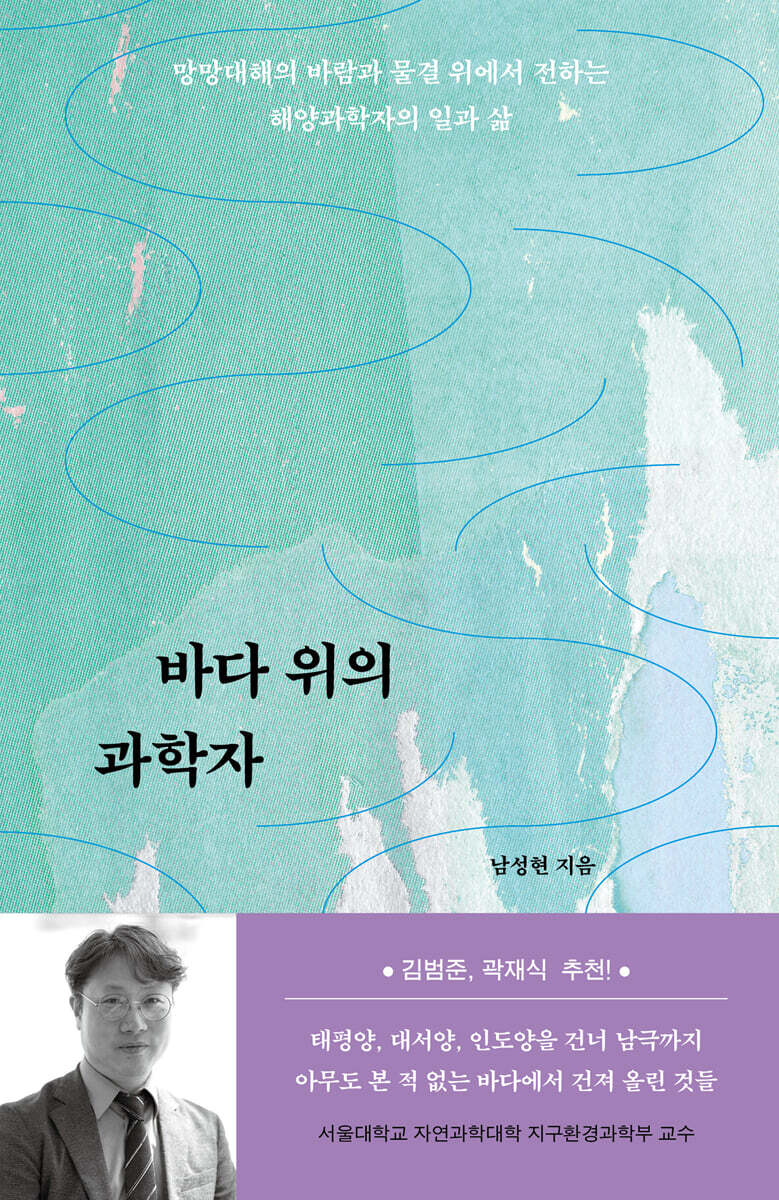
Scientists on the Sea
 |
Description
Book Introduction
*Recommended by Professor Kim Beom-jun and author Kwak Jae-sik!
“Humanity does not yet know even a single drop of the ocean completely.”
The true face of the ocean revealed by a marine scientist with 75 years of experience in shipboard research!
Carl Sagan described the photo of Earth taken by Voyager 1 with its camera rotated 180 degrees as a "Pale Blue Dot."
The reason we can call Earth the 'blue' planet is because blue oceans cover more than 70 percent of the Earth's surface.
But unlike the footprints left on the moon, 384,000 kilometers away, only recently did humans succeed in diving to a depth of 10,000 meters.
The ocean circulates around the globe, regulating climate and exchanging materials.
From microbes to giant whales, the oceans are home to a rich ecosystem, yet we don't really understand how all this happens.
There is a scientist who went directly to the sea to uncover the secrets of the sea.
Professor Nam Seong-hyeon, a professor of Earth and Environmental Sciences at Seoul National University and a marine physicist, goes out on a boat and conducts field observations to uncover the secrets of the ocean.
《Scientist on the Sea》 introduces the author's sailing experiences and marine science research like an exploration journal.
The author, who spends several months a year at sea, experiences the wonders of nature with his whole body, being chased by typhoons and wrestling with ocean currents on the vast ocean.
The author, who feels the saying, "Life is like waves," more deeply as he learns more about the ocean through research, literally tells us the true story of the ocean.
“Humanity does not yet know even a single drop of the ocean completely.”
The true face of the ocean revealed by a marine scientist with 75 years of experience in shipboard research!
Carl Sagan described the photo of Earth taken by Voyager 1 with its camera rotated 180 degrees as a "Pale Blue Dot."
The reason we can call Earth the 'blue' planet is because blue oceans cover more than 70 percent of the Earth's surface.
But unlike the footprints left on the moon, 384,000 kilometers away, only recently did humans succeed in diving to a depth of 10,000 meters.
The ocean circulates around the globe, regulating climate and exchanging materials.
From microbes to giant whales, the oceans are home to a rich ecosystem, yet we don't really understand how all this happens.
There is a scientist who went directly to the sea to uncover the secrets of the sea.
Professor Nam Seong-hyeon, a professor of Earth and Environmental Sciences at Seoul National University and a marine physicist, goes out on a boat and conducts field observations to uncover the secrets of the ocean.
《Scientist on the Sea》 introduces the author's sailing experiences and marine science research like an exploration journal.
The author, who spends several months a year at sea, experiences the wonders of nature with his whole body, being chased by typhoons and wrestling with ocean currents on the vast ocean.
The author, who feels the saying, "Life is like waves," more deeply as he learns more about the ocean through research, literally tells us the true story of the ocean.
- You can preview some of the book's contents.
Preview
index
prolog
Starting the voyage
Part 1: Scientists on the Waves
Folks, this is not the sea
Being in the same boat means
Sleeping on the waves
unexpected guests
Water drop
The Sea of Legends
Relaxing on deck
How to avoid a typhoon
Unforgettable ports
People who move the boat
An emergency patient was found in the vast ocean.
Dinner on board
Part 2: Laboratory on the Sea
Maybe it's fate
Detective or profiler of the sea
Life is a wave
Observer of Mother Nature
A race against time with the sea
Antarctica
The sea you can't go to
The seasons of the sea are changing
We're just scratching the tip of the iceberg.
Fishmonger Moon Sun-deuk
The Final Frontier
Epilogue
On land
Starting the voyage
Part 1: Scientists on the Waves
Folks, this is not the sea
Being in the same boat means
Sleeping on the waves
unexpected guests
Water drop
The Sea of Legends
Relaxing on deck
How to avoid a typhoon
Unforgettable ports
People who move the boat
An emergency patient was found in the vast ocean.
Dinner on board
Part 2: Laboratory on the Sea
Maybe it's fate
Detective or profiler of the sea
Life is a wave
Observer of Mother Nature
A race against time with the sea
Antarctica
The sea you can't go to
The seasons of the sea are changing
We're just scratching the tip of the iceberg.
Fishmonger Moon Sun-deuk
The Final Frontier
Epilogue
On land
Detailed image

Into the book
When I felt my breath catch in my throat, I thought of the sea.
Planning a boarding schedule and packing for a long stay on board is like preparing for a trip.
When I set sail for the distant seas to conduct research, I naturally become distant from the world, and only experiments and research remain for me.
After immersing my equipment in the water and taking it out, and immersing myself in interpreting the ocean's movements as numbers and graphs, I take a break from my busy work on land.
On the ship traveling for research, I binge-watched old dramas from the first episode to the last, enjoyed delicately distinguishing between different flavors of coffee, and occasionally played table tennis.
Once we reached our destination, we were so busy that we had to take turns sleeping among our team members, but the limited communication with the outside world forced us to rest.
So, for me, sea experiments are a rest in a different sense.
--- From "Starting the Voyage"
Considering that countless people have been to the beach at least once, the ocean isn't completely inaccessible.
People relax while looking out at the sea.
In summer, we play in the water at the beach.
Some people are amazed as soon as they see the seascape.
“Wow, the sea!”
There is actually a bit of a misunderstanding in this phrase that people often shout out.
Sorry to break the ice, but I often set the record straight like this.
“But, everyone, this is not the sea.
“It’s just the beach.”
What we see with our eyes on the beach is only a very small area close to the shore, less than 10 kilometers from the shoreline.
The sea is too vast to be called a sea except for this small area on the border between the sea and the land.
What we see is not the sea, but only the beach, which is the boundary of the sea.
The 'real sea' is a much larger area that extends beyond the horizon, starting from the farthest point visible from the shore, and cannot be seen from the shore.
The area visible from the coast corresponds to an extremely narrow border of the ocean's edge.
--- From "This is not the sea, folks"
How long did I sleep? My body swayed from side to side, and then I was suddenly thrown to the floor.
I suddenly woke up as I hit the floor, but I was so tired that I didn't even notice the pain and was about to climb back into bed when I noticed my fellow researcher sleeping in the compartment below me, still sleeping soundly.
Looking closely, I saw that he was holding me to the bed with a belt.
It was the moment I realized that not only objects but also people had to be properly secured while sleeping.
After climbing up to the bunk bed, I was able to sleep well only after properly securing my body to the bed like my colleague in the lower bunk.
--- From "Sleeping on the Waves"
A night of sailing across the vast ocean, without even a hint of land.
Standing on the deck, with no other ships around and even the lights of my ship dimmed, I look up at the sky and see unusually bright stars (all the lights at the front of the ship are turned off so that the navigators can see well at night).
People go out to the mountains and fields in search of stars and talk about their beauty, but the fact that the starlight seen from the dark sea is so splendid, even wondrous, is a privilege that only those who have gone out to the open sea can enjoy.
--- From "The Sea in Legend"
As I conduct long-term measurements in the deep sea, where it is difficult to even install and retrieve equipment, analyze the data obtained, and write papers on new discoveries about the deep-sea environment, I sometimes feel like a doctor examining a patient at a hospital with a stethoscope, CT scan, MRI, and other equipment.
Or, the process of formulating a hypothesis based on a story to figure out what environmental changes have occurred in the deep sea and then verifying the hypothesis with the collected data is similar to a detective or profiler searching for a criminal based on the suspect's alibi and some data collected at the crime scene.
Planning a boarding schedule and packing for a long stay on board is like preparing for a trip.
When I set sail for the distant seas to conduct research, I naturally become distant from the world, and only experiments and research remain for me.
After immersing my equipment in the water and taking it out, and immersing myself in interpreting the ocean's movements as numbers and graphs, I take a break from my busy work on land.
On the ship traveling for research, I binge-watched old dramas from the first episode to the last, enjoyed delicately distinguishing between different flavors of coffee, and occasionally played table tennis.
Once we reached our destination, we were so busy that we had to take turns sleeping among our team members, but the limited communication with the outside world forced us to rest.
So, for me, sea experiments are a rest in a different sense.
--- From "Starting the Voyage"
Considering that countless people have been to the beach at least once, the ocean isn't completely inaccessible.
People relax while looking out at the sea.
In summer, we play in the water at the beach.
Some people are amazed as soon as they see the seascape.
“Wow, the sea!”
There is actually a bit of a misunderstanding in this phrase that people often shout out.
Sorry to break the ice, but I often set the record straight like this.
“But, everyone, this is not the sea.
“It’s just the beach.”
What we see with our eyes on the beach is only a very small area close to the shore, less than 10 kilometers from the shoreline.
The sea is too vast to be called a sea except for this small area on the border between the sea and the land.
What we see is not the sea, but only the beach, which is the boundary of the sea.
The 'real sea' is a much larger area that extends beyond the horizon, starting from the farthest point visible from the shore, and cannot be seen from the shore.
The area visible from the coast corresponds to an extremely narrow border of the ocean's edge.
--- From "This is not the sea, folks"
How long did I sleep? My body swayed from side to side, and then I was suddenly thrown to the floor.
I suddenly woke up as I hit the floor, but I was so tired that I didn't even notice the pain and was about to climb back into bed when I noticed my fellow researcher sleeping in the compartment below me, still sleeping soundly.
Looking closely, I saw that he was holding me to the bed with a belt.
It was the moment I realized that not only objects but also people had to be properly secured while sleeping.
After climbing up to the bunk bed, I was able to sleep well only after properly securing my body to the bed like my colleague in the lower bunk.
--- From "Sleeping on the Waves"
A night of sailing across the vast ocean, without even a hint of land.
Standing on the deck, with no other ships around and even the lights of my ship dimmed, I look up at the sky and see unusually bright stars (all the lights at the front of the ship are turned off so that the navigators can see well at night).
People go out to the mountains and fields in search of stars and talk about their beauty, but the fact that the starlight seen from the dark sea is so splendid, even wondrous, is a privilege that only those who have gone out to the open sea can enjoy.
--- From "The Sea in Legend"
As I conduct long-term measurements in the deep sea, where it is difficult to even install and retrieve equipment, analyze the data obtained, and write papers on new discoveries about the deep-sea environment, I sometimes feel like a doctor examining a patient at a hospital with a stethoscope, CT scan, MRI, and other equipment.
Or, the process of formulating a hypothesis based on a story to figure out what environmental changes have occurred in the deep sea and then verifying the hypothesis with the collected data is similar to a detective or profiler searching for a criminal based on the suspect's alibi and some data collected at the crime scene.
--- From "The Detective or Profiler of the Sea"
Publisher's Review
Scientists head to the sea, not the lab
The work and life of a scientist at sea, introduced for the first time
Professor Nam Seong-hyeon, who has conducted marine research at the Agency for Defense Development and the Scripps Institution of Oceanography, the world's leading marine science research institute, is a veteran marine scientist who has conducted approximately 75 onboard surveys and traveled to the Pacific, Indian, Atlantic, and even Antarctica.
The author goes on a boat three to four times a year, and each time he goes on a survey, he lives at sea for a short period of one week or a long period of two months.
Even among observational oceanographers, it is rare to find a marine scientist who conducts onboard surveys.
Rather than using satellites or modeling, the author installs observation equipment directly in the ocean, collects field data, and analyzes it to discover scientific principles of the ocean.
This book unfolds a fascinating story about the work and life of marine scientists, a previously unknown phenomenon that takes place far out in the open sea, away from easily accessible tidal flats or coastlines.
The author introduces various marine science research methods and shows what the work of a marine scientist is.
After 20 years of research on typhoons, I discovered the changes in the marine environment created by typhoons and the sea, and I felt a sense of being an observer of Mother Nature. I also felt a sense of surprise and joy when I discovered the legendary 'milky' sea, previously only known through records, through the distribution of bioluminescent bacteria.
This book introduces the scientist who is sometimes a doctor examining the sea, an explorer seeking treasure, a detective uncovering secrets, and a profiler.
However, while studying internal waves in Indonesian waters, we happened to discover a 'milky' sea in the satellite image signals we were observing, a completely unintended result of ocean-atmosphere-biological interactions.
Data recorded by satellite sensors capable of precisely measuring signals reflected from moonlight showed that areas with particularly prominent moonlight reflection characteristics were distributed over time in very limited areas of waters off Indonesia and Somalia.
Having confirmed through comparative analysis with other satellite signals and field observation data that there was no plankton bloom in the area, we were surprised to learn that this was due to bacterial bloom.
This is because the milky blue sea that was passed down as a legend was actually confirmed.
- From "The Sea in Legend"
75 shipboard surveys on various ships, including fishing boats, cruise ships, and icebreakers.
An exploration journal written on the vast ocean without even a single ant
Everyone has probably been on a ship at least once in their life, but the experience of spending months on the vast ocean is not something that everyone can experience.
Although the author is a scientist, he confesses that his numerous experiences on board ships have given him a vague understanding of the feelings of sailors.
This book contains the author's experiences on the vast ocean.
The author has experienced a variety of vessels, from small octopus fishing boats in fishing villages to the Chamsuri-class high-speed patrol boat, the 209-class submarine, the defense science research vessels Seonjin-ho and Cheonghae-ho, and the icebreaker research vessel Araon-ho.
He gained global marine research experience by boarding not only domestic vessels but also ships from many countries around the world, including the Russian R/V Pavel Gordienko, the American R/V Melville, and the German R/V Meteor.
The book is also full of funny and romantic stories that happened on board.
It contains special daily life that you can only understand if you spend a long time on a ship at sea, such as packing before boarding, how to sleep safely on a rocking ship, a barbecue party held to avoid a typhoon, and the marine life encountered on board.
The experience of receiving help from fishing village residents when designing experiments, assisting fishing activities with research data, and the welcoming atmosphere of the port as a ship returns to its home port after six years—all of these connect the lives of scientists with the everyday lives of ordinary people, adding to the importance and meaning of scientific research.
In particular, the fact that the people on board the ship literally help and care for each other's research and work as a 'community of shared destiny on the same boat' shows the mindset we should have in the larger community called Earth.
Even after the last sensor, which was located at a depth of 500 meters, was recovered by pulling it up to the deck of the research vessel, the rope attached to the buoy was continued to be wound and pulled up.
The idea was to raise it until the cut part of the rope came out.
But suddenly the captain shouted in a startled voice.
“It’s a shark!”
A shark was wrapped around the end of the severed rope.
The rope got caught in the three rows of teeth, and the teeth could not be removed, so it was dragged from a depth of 1,000 meters to the sea surface.
As everyone rushed towards the stern to see the shark, the captain took control of them.
The shark kept moving its mouth and blinking its eyes.
- From "Unexpected Guests"
Life is all like waves
How to think like a marine scientist, something you can't imagine on land.
Sometimes, waves crash so high that it is difficult to keep one's balance, and after a typhoon passes, the author looks at the sea, wrinkle-free as if it had been ironed, and naturally reflects on his life.
The question the author heard most frequently from people around him while conducting boarding investigations was, "What should I do if a typhoon comes?"
The author calmly replies, "If a typhoon comes, just avoid it."
Because unlike on land where there are already established paths, you can move anywhere at sea.
Through the author's experience, we can learn a flexible attitude toward life that allows us to deal with bad situations without getting stuck in them.
As a marine physicist, the author compares life to waves.
Waves rise most strongly at the boundary between sky and sea, between different seawaters, and only subside when the two substances fuse and become one.
The author says that this does not necessarily happen only between matter and matter.
I always remember that people can have different personalities and wavelengths, and I try not to forget this when forming relationships with others.
The world we live in is no different.
When people say that each person has their own unique wave length, if you meet someone whose wave length matches well with yours, you can communicate well and get along well, but if your wave length doesn't match well, the gap deepens and your relationship becomes like rough waves.
Every time I meet someone who I either get along with or don't, I draw a picture of my wavelength and the other person's.
I'm also thinking about the slightly unscientific idea that it might actually be true that people don't have matching frequencies.
- From "Life is a Wave"
The author, who draws his entire life as waves, like drawing a graph of the movement of the ocean, also counts the waves he has.
I ponder the cycles and wavelengths of my life's waves, whether as a marine scientist, a friend, a husband, or a father, and whether I fall into the upswing or downswing.
The perspective that observes life as if observing the movement of the sea suggests another perspective and attitude toward life.
The Earth's climate regulator, the treasure trove of ecosystems, our territory that must be protected.
The precious values held by the sea
The author, who went on a survey of the same sea area in 2022 and 2024, experienced the abnormal weather firsthand on board the ship.
It rained unusually much more in 2024 than in 2022.
The author mentions the importance of the oceans as a climate regulator on Earth.
The exchange of fresh water, heat, and gases between the ocean and the atmosphere all have a tremendous impact on climate.
The work of a marine scientist also includes diagnosing whether the ocean is functioning properly.
Ocean research must be more active than ever before, as uncovering the scientific workings of the ocean could provide crucial clues to solving the climate crisis.
What the author emphasizes as much as the importance of marine science research is our country's maritime sovereignty.
Our country's maritime territory covers approximately 438,000 square kilometers, more than four times the land area.
In an era where marine resources are a key competitive advantage, it is crucial to take an interest in our maritime territory for active marine research.
The author emphasizes the importance of interest in maritime research and maritime sovereignty, citing the example of Moon Sun-deuk, a fishmonger from the Joseon Dynasty.
The story of Moon Sun-deok, who encountered storms at sea and returned to Hanyang after three years via the Ryukyu Kingdom, Luzon in the Philippines, Macau, and China, clearly shows how sea breezes and ocean currents influence culture, politics, and the economy.
In particular, given that the political, economic, and military policies of the U.S., China, and Russia, including the recent controversy surrounding Greenland, are being planned around the Northern Sea Route, we should pay attention not only to the seas surrounding our country on three sides, but to all the oceans of the Earth.
The work and life of a scientist at sea, introduced for the first time
Professor Nam Seong-hyeon, who has conducted marine research at the Agency for Defense Development and the Scripps Institution of Oceanography, the world's leading marine science research institute, is a veteran marine scientist who has conducted approximately 75 onboard surveys and traveled to the Pacific, Indian, Atlantic, and even Antarctica.
The author goes on a boat three to four times a year, and each time he goes on a survey, he lives at sea for a short period of one week or a long period of two months.
Even among observational oceanographers, it is rare to find a marine scientist who conducts onboard surveys.
Rather than using satellites or modeling, the author installs observation equipment directly in the ocean, collects field data, and analyzes it to discover scientific principles of the ocean.
This book unfolds a fascinating story about the work and life of marine scientists, a previously unknown phenomenon that takes place far out in the open sea, away from easily accessible tidal flats or coastlines.
The author introduces various marine science research methods and shows what the work of a marine scientist is.
After 20 years of research on typhoons, I discovered the changes in the marine environment created by typhoons and the sea, and I felt a sense of being an observer of Mother Nature. I also felt a sense of surprise and joy when I discovered the legendary 'milky' sea, previously only known through records, through the distribution of bioluminescent bacteria.
This book introduces the scientist who is sometimes a doctor examining the sea, an explorer seeking treasure, a detective uncovering secrets, and a profiler.
However, while studying internal waves in Indonesian waters, we happened to discover a 'milky' sea in the satellite image signals we were observing, a completely unintended result of ocean-atmosphere-biological interactions.
Data recorded by satellite sensors capable of precisely measuring signals reflected from moonlight showed that areas with particularly prominent moonlight reflection characteristics were distributed over time in very limited areas of waters off Indonesia and Somalia.
Having confirmed through comparative analysis with other satellite signals and field observation data that there was no plankton bloom in the area, we were surprised to learn that this was due to bacterial bloom.
This is because the milky blue sea that was passed down as a legend was actually confirmed.
- From "The Sea in Legend"
75 shipboard surveys on various ships, including fishing boats, cruise ships, and icebreakers.
An exploration journal written on the vast ocean without even a single ant
Everyone has probably been on a ship at least once in their life, but the experience of spending months on the vast ocean is not something that everyone can experience.
Although the author is a scientist, he confesses that his numerous experiences on board ships have given him a vague understanding of the feelings of sailors.
This book contains the author's experiences on the vast ocean.
The author has experienced a variety of vessels, from small octopus fishing boats in fishing villages to the Chamsuri-class high-speed patrol boat, the 209-class submarine, the defense science research vessels Seonjin-ho and Cheonghae-ho, and the icebreaker research vessel Araon-ho.
He gained global marine research experience by boarding not only domestic vessels but also ships from many countries around the world, including the Russian R/V Pavel Gordienko, the American R/V Melville, and the German R/V Meteor.
The book is also full of funny and romantic stories that happened on board.
It contains special daily life that you can only understand if you spend a long time on a ship at sea, such as packing before boarding, how to sleep safely on a rocking ship, a barbecue party held to avoid a typhoon, and the marine life encountered on board.
The experience of receiving help from fishing village residents when designing experiments, assisting fishing activities with research data, and the welcoming atmosphere of the port as a ship returns to its home port after six years—all of these connect the lives of scientists with the everyday lives of ordinary people, adding to the importance and meaning of scientific research.
In particular, the fact that the people on board the ship literally help and care for each other's research and work as a 'community of shared destiny on the same boat' shows the mindset we should have in the larger community called Earth.
Even after the last sensor, which was located at a depth of 500 meters, was recovered by pulling it up to the deck of the research vessel, the rope attached to the buoy was continued to be wound and pulled up.
The idea was to raise it until the cut part of the rope came out.
But suddenly the captain shouted in a startled voice.
“It’s a shark!”
A shark was wrapped around the end of the severed rope.
The rope got caught in the three rows of teeth, and the teeth could not be removed, so it was dragged from a depth of 1,000 meters to the sea surface.
As everyone rushed towards the stern to see the shark, the captain took control of them.
The shark kept moving its mouth and blinking its eyes.
- From "Unexpected Guests"
Life is all like waves
How to think like a marine scientist, something you can't imagine on land.
Sometimes, waves crash so high that it is difficult to keep one's balance, and after a typhoon passes, the author looks at the sea, wrinkle-free as if it had been ironed, and naturally reflects on his life.
The question the author heard most frequently from people around him while conducting boarding investigations was, "What should I do if a typhoon comes?"
The author calmly replies, "If a typhoon comes, just avoid it."
Because unlike on land where there are already established paths, you can move anywhere at sea.
Through the author's experience, we can learn a flexible attitude toward life that allows us to deal with bad situations without getting stuck in them.
As a marine physicist, the author compares life to waves.
Waves rise most strongly at the boundary between sky and sea, between different seawaters, and only subside when the two substances fuse and become one.
The author says that this does not necessarily happen only between matter and matter.
I always remember that people can have different personalities and wavelengths, and I try not to forget this when forming relationships with others.
The world we live in is no different.
When people say that each person has their own unique wave length, if you meet someone whose wave length matches well with yours, you can communicate well and get along well, but if your wave length doesn't match well, the gap deepens and your relationship becomes like rough waves.
Every time I meet someone who I either get along with or don't, I draw a picture of my wavelength and the other person's.
I'm also thinking about the slightly unscientific idea that it might actually be true that people don't have matching frequencies.
- From "Life is a Wave"
The author, who draws his entire life as waves, like drawing a graph of the movement of the ocean, also counts the waves he has.
I ponder the cycles and wavelengths of my life's waves, whether as a marine scientist, a friend, a husband, or a father, and whether I fall into the upswing or downswing.
The perspective that observes life as if observing the movement of the sea suggests another perspective and attitude toward life.
The Earth's climate regulator, the treasure trove of ecosystems, our territory that must be protected.
The precious values held by the sea
The author, who went on a survey of the same sea area in 2022 and 2024, experienced the abnormal weather firsthand on board the ship.
It rained unusually much more in 2024 than in 2022.
The author mentions the importance of the oceans as a climate regulator on Earth.
The exchange of fresh water, heat, and gases between the ocean and the atmosphere all have a tremendous impact on climate.
The work of a marine scientist also includes diagnosing whether the ocean is functioning properly.
Ocean research must be more active than ever before, as uncovering the scientific workings of the ocean could provide crucial clues to solving the climate crisis.
What the author emphasizes as much as the importance of marine science research is our country's maritime sovereignty.
Our country's maritime territory covers approximately 438,000 square kilometers, more than four times the land area.
In an era where marine resources are a key competitive advantage, it is crucial to take an interest in our maritime territory for active marine research.
The author emphasizes the importance of interest in maritime research and maritime sovereignty, citing the example of Moon Sun-deuk, a fishmonger from the Joseon Dynasty.
The story of Moon Sun-deok, who encountered storms at sea and returned to Hanyang after three years via the Ryukyu Kingdom, Luzon in the Philippines, Macau, and China, clearly shows how sea breezes and ocean currents influence culture, politics, and the economy.
In particular, given that the political, economic, and military policies of the U.S., China, and Russia, including the recent controversy surrounding Greenland, are being planned around the Northern Sea Route, we should pay attention not only to the seas surrounding our country on three sides, but to all the oceans of the Earth.
GOODS SPECIFICS
- Date of issue: February 20, 2025
- Page count, weight, size: 224 pages | 272g | 130*200*15mm
- ISBN13: 9788965966982
- ISBN10: 8965966981
You may also like
카테고리
korean


korean

![GQ KOREA Mark (Monthly): December [2025]](http://librairie.coreenne.fr/cdn/shop/files/8ef265dbbfbf186523ed75ba7319009d.jpg?v=1765340328&width=3840)


