

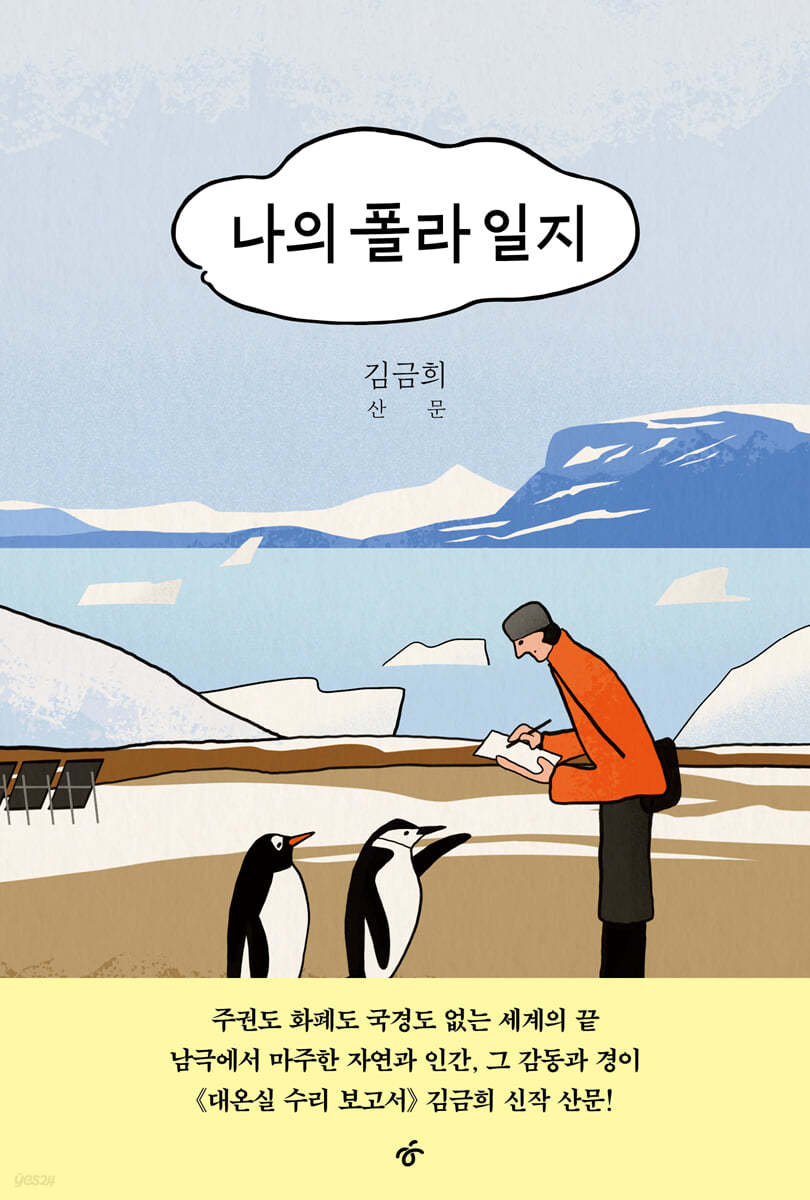
My Polar Diary
 |
Description
Book Introduction
- A word from MD
-
Nature, humans, and the world encountered in AntarcticaThe first Korean novelist, Kim Geum-hee's travelogue to Antarctica.
The feeling of liberation in a place without any boundaries and the wonders of nature encountered at the end of the world are expressed with a transparent and delicate gaze.
Humility as a human being who observes and realizes each and every existence.
Let's encounter the message the author lovingly conveys during this dazzling journey.
February 4, 2025. Essay PD Lee Ju-eun
“Everything was visible there at a glance.
“I think this might be the moment I’ve looked the furthest in my life.”
“As long as there is an Antarctic on this planet called Earth, humans
And the world can heal.”
Standing before the purest and simplest beginning of life
A transparent record of a sensitive novelist
Since beginning her career in 2009, author Kim Geum-hee has delicately depicted the topography of the human mind with deep insights and refreshing wit gleaned from everyday moments, and now publishes her third collection of prose.
With the publication of his third full-length novel, "The Great Greenhouse Repair Report," in 2024, he has achieved a remarkable leap forward as a writer, and is now receiving a lot of trust for his future endeavors. He has now returned with a story about his Antarctic sojourn, the first ever by a Korean novelist.
Why did it have to be Antarctica?
And what did the author see, hear, and record in that polar region?
A place without sovereignty, currency, or borders, the end of the world, the furthest point on Earth imaginable to humans, a land of ice that exists as faintly as a white light.
A place where ice replaces stakes, where when you wake up in the morning, drift ice comes rushing to the shore, and the sound of ice walls collapsing can be heard from afar.
A place where penguins, whales, moss, rocks, and permafrost remain in their original places.
The author confesses that he wanted to feel an overwhelming sense of wonder in nature, free from humans and the civilization it has created.
Rather than just a quick 'tour', I wanted to stay as long as possible and experience the process of becoming small, simple, and humble as a human species.
Visiting the Antarctic base, which I had dreamed of even before becoming a writer, was not an easy opportunity to obtain.
I tried many different routes, but always failed, and finally, I was granted the privilege of being a special reporter for [Hankyoreh], which made it possible in a dramatic way.
After being appointed as a correspondent, he completed a survival and safety training course throughout the summer, similar to the training received by summer research team members dispatched by the Polar Research Institute, and finally set foot on Antarctic soil on February 1, 2024.
The journey began on January 27th from Korea and ended with a stopover in Punta Arenas, Chile, the gateway to Antarctica.
For nearly a month, I stayed at the King Sejong Station in Antarctica, not only encountering the flora and fauna living there, but also meticulously reporting on the research being conducted in the polar regions and the people from around the world who are conducting it, and recording my insights in 'My Polar Journal.'
This was serialized in [Hankyoreh] for 10 months, then completely revised and compiled into this collection of essays.
"My Polar Diary" is "a traveler's thrilling impression of a place he's long dreamed of, a novelist's diary of exploring among scientists, fueled by boundless curiosity like a baby chinstrap penguin that unexpectedly finds itself among gentoo penguins, and a diary of the small, simple, and bright days of living as one species in nature."
Not only has the pleasure of seeing vivid illustrations added through collaboration with artist Kwak Myeong-ju been enhanced, but the many local photos taken by the artist himself are included in the appendix, doubling the emotion of nature.
When I woke up in the morning, the drift ice had come all the way to the base's shoreline.
Ice filling the shore with white foam, chunks that momentarily rise to the ground and settle, tossed by the force of the waves pushing forward.
My room had a clear view of the floes, and every morning, looking out at that view, I felt like I was becoming transparent.
If the ability to empathize with other beings is a human ability, I thought that humans become most beautiful and generous when they turn to nature.
_In the text
“I think this might be the moment I’ve looked the furthest in my life.”
“As long as there is an Antarctic on this planet called Earth, humans
And the world can heal.”
Standing before the purest and simplest beginning of life
A transparent record of a sensitive novelist
Since beginning her career in 2009, author Kim Geum-hee has delicately depicted the topography of the human mind with deep insights and refreshing wit gleaned from everyday moments, and now publishes her third collection of prose.
With the publication of his third full-length novel, "The Great Greenhouse Repair Report," in 2024, he has achieved a remarkable leap forward as a writer, and is now receiving a lot of trust for his future endeavors. He has now returned with a story about his Antarctic sojourn, the first ever by a Korean novelist.
Why did it have to be Antarctica?
And what did the author see, hear, and record in that polar region?
A place without sovereignty, currency, or borders, the end of the world, the furthest point on Earth imaginable to humans, a land of ice that exists as faintly as a white light.
A place where ice replaces stakes, where when you wake up in the morning, drift ice comes rushing to the shore, and the sound of ice walls collapsing can be heard from afar.
A place where penguins, whales, moss, rocks, and permafrost remain in their original places.
The author confesses that he wanted to feel an overwhelming sense of wonder in nature, free from humans and the civilization it has created.
Rather than just a quick 'tour', I wanted to stay as long as possible and experience the process of becoming small, simple, and humble as a human species.
Visiting the Antarctic base, which I had dreamed of even before becoming a writer, was not an easy opportunity to obtain.
I tried many different routes, but always failed, and finally, I was granted the privilege of being a special reporter for [Hankyoreh], which made it possible in a dramatic way.
After being appointed as a correspondent, he completed a survival and safety training course throughout the summer, similar to the training received by summer research team members dispatched by the Polar Research Institute, and finally set foot on Antarctic soil on February 1, 2024.
The journey began on January 27th from Korea and ended with a stopover in Punta Arenas, Chile, the gateway to Antarctica.
For nearly a month, I stayed at the King Sejong Station in Antarctica, not only encountering the flora and fauna living there, but also meticulously reporting on the research being conducted in the polar regions and the people from around the world who are conducting it, and recording my insights in 'My Polar Journal.'
This was serialized in [Hankyoreh] for 10 months, then completely revised and compiled into this collection of essays.
"My Polar Diary" is "a traveler's thrilling impression of a place he's long dreamed of, a novelist's diary of exploring among scientists, fueled by boundless curiosity like a baby chinstrap penguin that unexpectedly finds itself among gentoo penguins, and a diary of the small, simple, and bright days of living as one species in nature."
Not only has the pleasure of seeing vivid illustrations added through collaboration with artist Kwak Myeong-ju been enhanced, but the many local photos taken by the artist himself are included in the appendix, doubling the emotion of nature.
When I woke up in the morning, the drift ice had come all the way to the base's shoreline.
Ice filling the shore with white foam, chunks that momentarily rise to the ground and settle, tossed by the force of the waves pushing forward.
My room had a clear view of the floes, and every morning, looking out at that view, I felt like I was becoming transparent.
If the ability to empathize with other beings is a human ability, I thought that humans become most beautiful and generous when they turn to nature.
_In the text
- You can preview some of the book's contents.
Preview
index
1 Book, Carrier, and Angels
To the 'None' Planet / That Summer, Buddy Line / Are You Okay? / I'm a Non-Penguin Human
2 The World of Little Snowmen
Penguins of Summer Hill / The Strange Observer / Don't Tread on That Carpet / Plant Lesson
3 Rivers of Atmosphere
Antarctic Autodidact / Sister's "Air Field" / No Plastic / Golden Moss Forest / Happy New Year
4 The World of Naming
Those Who Leave First / Walking the Antarctic Ocean / Ghosts / Warmly, Warmer
5 Into My Polar
Even Angels Lie Sometimes / The Whale's First Breath / The Upside-Down Face of the Moon / Hello, Penguin
Epilogue The Best Thing I've Ever Done
Appendix My Antarctic Photo Journal
To the 'None' Planet / That Summer, Buddy Line / Are You Okay? / I'm a Non-Penguin Human
2 The World of Little Snowmen
Penguins of Summer Hill / The Strange Observer / Don't Tread on That Carpet / Plant Lesson
3 Rivers of Atmosphere
Antarctic Autodidact / Sister's "Air Field" / No Plastic / Golden Moss Forest / Happy New Year
4 The World of Naming
Those Who Leave First / Walking the Antarctic Ocean / Ghosts / Warmly, Warmer
5 Into My Polar
Even Angels Lie Sometimes / The Whale's First Breath / The Upside-Down Face of the Moon / Hello, Penguin
Epilogue The Best Thing I've Ever Done
Appendix My Antarctic Photo Journal
Detailed image

Into the book
I wanted to feel an overwhelming sense of wonder in nature, free from humans and the civilization it created.
Rather than just a brief 'tour', I wanted to stay as long as possible and experience the process of becoming smaller, simpler, and more humble as a human species.
--- p.14
At the end of the world, in the farthest corner of the Earth that humans can imagine, in a land of ice that exists like a hazy white light, my book is there.
--- p.32
The process of putting down the harpoon and gun and choosing the wonder and love of life shows that this change of heart that the human species achieves is progress and development.
--- p.39
As soon as I landed in Antarctica, I saw a mountain ridge that stretched smoothly like the long body of a deer.
It was summer, so the snow had melted and the rocks and pebbles were exposed, giving it a beautiful dark brown color.
And the permafrost shone like a white pattern.
--- p.44
“What are you most looking forward to in Antarctica?”
One day Vector asked in Punta Arenas.
“The blue of ice.
“The incredible blue light from ice compressed under high pressure and density.”
--- p.47
As important as cutting was collecting the remaining cable ties.
The basic rule of Antarctica was to ensure that what was not there in the first place would not be there in the future.
Because you never know what kind of domino effect a carelessly discarded piece of plastic might cause on this blank continent.
Dr. L picked up trash as he moved, and I soon followed suit.
It was a kind of Antarctic 'plogging'.
--- pp.82-83
When I woke up in the morning, the drift ice had come all the way to the base's shoreline.
Ice filling the shore with white foam, chunks that momentarily rise to the ground and settle, tossed by the force of the waves pushing forward.
My room had a clear view of the floes, and every morning, looking out at that view, I felt like I was becoming transparent.
If the ability to empathize with other beings is a human ability, I thought that humans become most beautiful and generous when they turn to nature.
--- p.99
The scythe moss grows by using its own dead body as fertilizer, and the new body that grows later becomes the base for another stem.
Moss, which creates the most basic ecosystem, is the most common and insignificant thing in Antarctica, but on the other hand, it is also something that deserves to be welcomed with kneeling.
Because without moss, the world of Antarctica itself would not exist.
--- pp.135-136
In any world, knowing a name was crucial. (...) It was an act of pinning down existence and 'fixing' it, and by doing so, placing the form before one's eyes under human perception.
--- p.181
Antarctica sounds like a faraway place, but when I actually came here, I realized that everything in Antarctica was governing life.
The North and South Poles, the two extremes of the Earth, are huge hands that move the world's atmosphere and ocean currents.
The changes here have shaken the Earth and shaped our daily lives.
Amidst the countless uncertainties surrounding the word "climate"—change, crisis, and sometimes war and invasion—the fact that scientists around the world were sending up balloons at the same time every day to scan the sky felt like a small ray of optimism.
--- p.200
Clouds, sea, wind, and plants came into me, erasing some and filling others.
I erased my thoughts and stubbornness and breathed in the power and light of nature.
--- p.210
Marian Soman was the closest ice barrier to the Sejong Station and a witness to the station's past and present.
This ice wall, splitting and breaking apart to form ice floes, always felt like a living organism.
--- pp.247-248
Before I turned my head to where the fireman was pointing, I heard the whale's breathing.
It was a very loud, rough breathing sound, as if a layer of the Earth was being peeled away.
He was swimming, rising from the sea, breathing, and then diving back into the water.
I couldn't believe it when I saw the whale's shiny black back, tail, and fins.
The movement of the whale leaping between the white ice floes was 'alive' itself.
--- p.250
The ‘naturalness’ of the continent itself took precedence over ‘humans’, and within it, all humans were no different ‘species’.
I imagined that this Antarctic friendship might be a new hint for the future.
--- p.252
My time in Antarctica was not about traveling, reporting, or research, but about living.
Building relationships, having conversations, and going through each day with fleeting emotions like kindness, joy, excitement and wonder, tension, and sometimes anxiety and discomfort.
So the longing would only increase.
--- pp.276-277
The wonder and peace of nature, the dreamlike daily life created by all living beings, including humans.
I came back here with it in my possession.
Rather than just a brief 'tour', I wanted to stay as long as possible and experience the process of becoming smaller, simpler, and more humble as a human species.
--- p.14
At the end of the world, in the farthest corner of the Earth that humans can imagine, in a land of ice that exists like a hazy white light, my book is there.
--- p.32
The process of putting down the harpoon and gun and choosing the wonder and love of life shows that this change of heart that the human species achieves is progress and development.
--- p.39
As soon as I landed in Antarctica, I saw a mountain ridge that stretched smoothly like the long body of a deer.
It was summer, so the snow had melted and the rocks and pebbles were exposed, giving it a beautiful dark brown color.
And the permafrost shone like a white pattern.
--- p.44
“What are you most looking forward to in Antarctica?”
One day Vector asked in Punta Arenas.
“The blue of ice.
“The incredible blue light from ice compressed under high pressure and density.”
--- p.47
As important as cutting was collecting the remaining cable ties.
The basic rule of Antarctica was to ensure that what was not there in the first place would not be there in the future.
Because you never know what kind of domino effect a carelessly discarded piece of plastic might cause on this blank continent.
Dr. L picked up trash as he moved, and I soon followed suit.
It was a kind of Antarctic 'plogging'.
--- pp.82-83
When I woke up in the morning, the drift ice had come all the way to the base's shoreline.
Ice filling the shore with white foam, chunks that momentarily rise to the ground and settle, tossed by the force of the waves pushing forward.
My room had a clear view of the floes, and every morning, looking out at that view, I felt like I was becoming transparent.
If the ability to empathize with other beings is a human ability, I thought that humans become most beautiful and generous when they turn to nature.
--- p.99
The scythe moss grows by using its own dead body as fertilizer, and the new body that grows later becomes the base for another stem.
Moss, which creates the most basic ecosystem, is the most common and insignificant thing in Antarctica, but on the other hand, it is also something that deserves to be welcomed with kneeling.
Because without moss, the world of Antarctica itself would not exist.
--- pp.135-136
In any world, knowing a name was crucial. (...) It was an act of pinning down existence and 'fixing' it, and by doing so, placing the form before one's eyes under human perception.
--- p.181
Antarctica sounds like a faraway place, but when I actually came here, I realized that everything in Antarctica was governing life.
The North and South Poles, the two extremes of the Earth, are huge hands that move the world's atmosphere and ocean currents.
The changes here have shaken the Earth and shaped our daily lives.
Amidst the countless uncertainties surrounding the word "climate"—change, crisis, and sometimes war and invasion—the fact that scientists around the world were sending up balloons at the same time every day to scan the sky felt like a small ray of optimism.
--- p.200
Clouds, sea, wind, and plants came into me, erasing some and filling others.
I erased my thoughts and stubbornness and breathed in the power and light of nature.
--- p.210
Marian Soman was the closest ice barrier to the Sejong Station and a witness to the station's past and present.
This ice wall, splitting and breaking apart to form ice floes, always felt like a living organism.
--- pp.247-248
Before I turned my head to where the fireman was pointing, I heard the whale's breathing.
It was a very loud, rough breathing sound, as if a layer of the Earth was being peeled away.
He was swimming, rising from the sea, breathing, and then diving back into the water.
I couldn't believe it when I saw the whale's shiny black back, tail, and fins.
The movement of the whale leaping between the white ice floes was 'alive' itself.
--- p.250
The ‘naturalness’ of the continent itself took precedence over ‘humans’, and within it, all humans were no different ‘species’.
I imagined that this Antarctic friendship might be a new hint for the future.
--- p.252
My time in Antarctica was not about traveling, reporting, or research, but about living.
Building relationships, having conversations, and going through each day with fleeting emotions like kindness, joy, excitement and wonder, tension, and sometimes anxiety and discomfort.
So the longing would only increase.
--- pp.276-277
The wonder and peace of nature, the dreamlike daily life created by all living beings, including humans.
I came back here with it in my possession.
--- p.283
Publisher's Review
“I feel like I’ve become the warmest person on this continent.”
Antarctic autodidacts armed with intense curiosity and a sense of adventure
Part 1, “Books, Carriers, and Angels,” contains the arduous preparations and journey to the South Pole before the long-awaited dream of visiting the Antarctic base comes true.
Thorough preparations began in the summer to go to Antarctica, a place that exists as if it were a non-existent planet, not part of the national system.
While waiting in Punta Arenas via Santiago, I met with the scientists who would be joining me and received a warm offer to become part of the 'Vegetation Team'.
Entering Antarctica, where ice replaces stakes, you begin to read the base and its people as a 'non-penguin human'.
Part 2, “The World of Little Snowmen,” introduces a visit to the Aspine Penguin Village, the first Antarctic Special Protection Area established by Korea.
At the base, where only two people can move, you and Buddy encounter the penguins and seals you've been wanting to see so badly.
As a 'vegetation team', the plant class continues in a fluffy moss plant field that looks like a carpet.
I am amazed by the outstanding appearance of Usnea, one of the lichens of Antarctica.
We also learn about the senses of symbiosis through lichens, which are living organisms that have survived in extreme regions such as polar regions and deserts, as well as in space.
In Part 3, "The River of Atmosphere," we witness the peaceful daily life of a chef at the Sejong Base cafeteria, who accumulates fat day by day thanks to his outstanding cooking skills, as well as the tension flowing before a seminar where each person presents their research.
We meet several team members full of mission and passion, including Camilla, who observes the atmosphere, Researcher Ahn, who is obsessed with shrimp, Cloudy, aka Mr. Cloud, an atmospheric scientist, and Vector, who is looking for new business items in the field of science.
You can also find golden moss at the Haepyo Village shelter.
Soon, on the Lunar New Year in Antarctica, everyone gathers to eat tteokguk (rice cake soup) and play yutnori (Korean traditional game) to truly celebrate the new year.
'Atmospheric rivers' that form in mid-latitude regions are phenomena that influence Earth's climate system, carrying moisture and heat and flowing for thousands of kilometers.
To understand this, large weather observation balloons called 'radiosondes' are launched every day to observe atmospheric conditions.
In our country, we also launch balloons, and the fact that all these tasks are connected feels like a sign of optimism for humanity.
Part 4, “The World of Naming,” emphasizes the nobility of the act of recognizing existence by naming it.
After touring the base history museum, I was overwhelmed by the 'humanity' of the first members.
On Sunday, I will celebrate my first ever Antarctic Mass with my sister Camilla.
The 'bones' frequently seen throughout the base played a major role in helping me, who had been afraid of witnessing the cruel and ruthless deaths of nature in the polar regions, to accept life and death with peace.
I learned a sense of equanimity that was neither cold nor indifferent from the traces of death, such as whales and penguins.
I will never forget the experience of walking on foot in the Antarctic Ocean in summer with Researcher Ahn to collect the 'unreported species' of shrimp.
In Part 5, "Into My Polar," the journey to the observatory known as the scenic restaurant and then up to Baekdubong Peak is featured.
Will he go down as the first writer (and perhaps the one who took the longest) to reach the highest peak?
We also witness the first breath of a whale, the very essence of life, alongside researchers diving underwater to observe and collect the birds.
Visit the Chinese Great Wall base to see research facilities in other countries and build camaraderie.
I imagine that this friendship in Antarctica, where the 'naturalness' of the continent itself takes precedence over 'humanity' and where all humans are no different species, might be a new hint for the future.
Before leaving Sejong Station, I stop by Penguin Village for the last time and say goodbye to the guy.
As I descend through the village, I think I understand why I wanted to come to Antarctica so badly.
“It was because I wanted to live in the world with a different mindset.”
Antarctica sounds like a faraway place, but when I actually came here, I realized that everything in Antarctica was governing life.
The North and South Poles, the two extremes of the Earth, are huge hands that move the world's atmosphere and ocean currents.
The changes here have shaken the Earth and shaped our daily lives.
Amidst the countless uncertainties surrounding the word "climate"—change, crisis, and sometimes war and invasion—the fact that scientists around the world were sending up balloons at the same time every day to scan the sky felt like a small ray of optimism.
_In the text
“We are all connected.”
A beautiful journey to understand the order of nature
What does Antarctica mean to us?
Antarctica is not simply a distant continent, but a closely connected part of the Earth, an important space we must carefully observe, and ultimately a record of the future we will write together.
Only a keen awareness of the changes our daily choices will bring about, and a close connection to the planet and to humanity as a species, will provide the strategies to navigate the crises that lie ahead.
“My time in Antarctica was not about traveling, reporting, or research, but about ‘living.’
The author says, “It was about creating relationships, having conversations, and living each day with fleeting emotions such as kindness, joy, excitement, wonder, tension, and sometimes anxiety and discomfort.”
As you read this heartwarming account of a man who becomes a "strange observer" in Antarctica, where the moon's pattern is exactly the opposite, and who fully experiences and enjoys the everyday life he has never experienced before, you will ultimately come to realize the self-evident truth that no being is separate from the universe.
Just as the moss, which grows using its own dead body as seed, and the new body that grows becomes the foundation for another stem, even the most common and insignificant existence is an important element in the survival of Antarctica.
This book affectionately states that the natural order is one in which beings with different strengths and speeds, each witnessing and providing evidence for the other, struggle and coexist.
Why am I so grateful that, like humans, there are some penguins who are a bit late bloomers?
The fact that the natural order is that not only the strongest survive, but beings with different strengths and speeds coexist. _From the text
Author's Note
“I guess the good thing about coming to Korea is that even if there are no seals, there are dogs,” I said cynically, but I managed to overcome the difficulties quite well.
Maybe I thought that going to Antarctica was the best thing I ever did.
That good work will continue to be another form of 'good work' in the future.
The white and blue of the continent that can be called upon at any time without closing your eyes, the sleek black of living penguins and whales, and the light of people walking in step with you in red uniforms.
As I walk with all of that in my heart, I can always step into my Polar Journal and take a step forward with a new heart.
To tell us about that regeneration and cycle, there is an Antarctic point on this planet called Earth.
Antarctic autodidacts armed with intense curiosity and a sense of adventure
Part 1, “Books, Carriers, and Angels,” contains the arduous preparations and journey to the South Pole before the long-awaited dream of visiting the Antarctic base comes true.
Thorough preparations began in the summer to go to Antarctica, a place that exists as if it were a non-existent planet, not part of the national system.
While waiting in Punta Arenas via Santiago, I met with the scientists who would be joining me and received a warm offer to become part of the 'Vegetation Team'.
Entering Antarctica, where ice replaces stakes, you begin to read the base and its people as a 'non-penguin human'.
Part 2, “The World of Little Snowmen,” introduces a visit to the Aspine Penguin Village, the first Antarctic Special Protection Area established by Korea.
At the base, where only two people can move, you and Buddy encounter the penguins and seals you've been wanting to see so badly.
As a 'vegetation team', the plant class continues in a fluffy moss plant field that looks like a carpet.
I am amazed by the outstanding appearance of Usnea, one of the lichens of Antarctica.
We also learn about the senses of symbiosis through lichens, which are living organisms that have survived in extreme regions such as polar regions and deserts, as well as in space.
In Part 3, "The River of Atmosphere," we witness the peaceful daily life of a chef at the Sejong Base cafeteria, who accumulates fat day by day thanks to his outstanding cooking skills, as well as the tension flowing before a seminar where each person presents their research.
We meet several team members full of mission and passion, including Camilla, who observes the atmosphere, Researcher Ahn, who is obsessed with shrimp, Cloudy, aka Mr. Cloud, an atmospheric scientist, and Vector, who is looking for new business items in the field of science.
You can also find golden moss at the Haepyo Village shelter.
Soon, on the Lunar New Year in Antarctica, everyone gathers to eat tteokguk (rice cake soup) and play yutnori (Korean traditional game) to truly celebrate the new year.
'Atmospheric rivers' that form in mid-latitude regions are phenomena that influence Earth's climate system, carrying moisture and heat and flowing for thousands of kilometers.
To understand this, large weather observation balloons called 'radiosondes' are launched every day to observe atmospheric conditions.
In our country, we also launch balloons, and the fact that all these tasks are connected feels like a sign of optimism for humanity.
Part 4, “The World of Naming,” emphasizes the nobility of the act of recognizing existence by naming it.
After touring the base history museum, I was overwhelmed by the 'humanity' of the first members.
On Sunday, I will celebrate my first ever Antarctic Mass with my sister Camilla.
The 'bones' frequently seen throughout the base played a major role in helping me, who had been afraid of witnessing the cruel and ruthless deaths of nature in the polar regions, to accept life and death with peace.
I learned a sense of equanimity that was neither cold nor indifferent from the traces of death, such as whales and penguins.
I will never forget the experience of walking on foot in the Antarctic Ocean in summer with Researcher Ahn to collect the 'unreported species' of shrimp.
In Part 5, "Into My Polar," the journey to the observatory known as the scenic restaurant and then up to Baekdubong Peak is featured.
Will he go down as the first writer (and perhaps the one who took the longest) to reach the highest peak?
We also witness the first breath of a whale, the very essence of life, alongside researchers diving underwater to observe and collect the birds.
Visit the Chinese Great Wall base to see research facilities in other countries and build camaraderie.
I imagine that this friendship in Antarctica, where the 'naturalness' of the continent itself takes precedence over 'humanity' and where all humans are no different species, might be a new hint for the future.
Before leaving Sejong Station, I stop by Penguin Village for the last time and say goodbye to the guy.
As I descend through the village, I think I understand why I wanted to come to Antarctica so badly.
“It was because I wanted to live in the world with a different mindset.”
Antarctica sounds like a faraway place, but when I actually came here, I realized that everything in Antarctica was governing life.
The North and South Poles, the two extremes of the Earth, are huge hands that move the world's atmosphere and ocean currents.
The changes here have shaken the Earth and shaped our daily lives.
Amidst the countless uncertainties surrounding the word "climate"—change, crisis, and sometimes war and invasion—the fact that scientists around the world were sending up balloons at the same time every day to scan the sky felt like a small ray of optimism.
_In the text
“We are all connected.”
A beautiful journey to understand the order of nature
What does Antarctica mean to us?
Antarctica is not simply a distant continent, but a closely connected part of the Earth, an important space we must carefully observe, and ultimately a record of the future we will write together.
Only a keen awareness of the changes our daily choices will bring about, and a close connection to the planet and to humanity as a species, will provide the strategies to navigate the crises that lie ahead.
“My time in Antarctica was not about traveling, reporting, or research, but about ‘living.’
The author says, “It was about creating relationships, having conversations, and living each day with fleeting emotions such as kindness, joy, excitement, wonder, tension, and sometimes anxiety and discomfort.”
As you read this heartwarming account of a man who becomes a "strange observer" in Antarctica, where the moon's pattern is exactly the opposite, and who fully experiences and enjoys the everyday life he has never experienced before, you will ultimately come to realize the self-evident truth that no being is separate from the universe.
Just as the moss, which grows using its own dead body as seed, and the new body that grows becomes the foundation for another stem, even the most common and insignificant existence is an important element in the survival of Antarctica.
This book affectionately states that the natural order is one in which beings with different strengths and speeds, each witnessing and providing evidence for the other, struggle and coexist.
Why am I so grateful that, like humans, there are some penguins who are a bit late bloomers?
The fact that the natural order is that not only the strongest survive, but beings with different strengths and speeds coexist. _From the text
Author's Note
“I guess the good thing about coming to Korea is that even if there are no seals, there are dogs,” I said cynically, but I managed to overcome the difficulties quite well.
Maybe I thought that going to Antarctica was the best thing I ever did.
That good work will continue to be another form of 'good work' in the future.
The white and blue of the continent that can be called upon at any time without closing your eyes, the sleek black of living penguins and whales, and the light of people walking in step with you in red uniforms.
As I walk with all of that in my heart, I can always step into my Polar Journal and take a step forward with a new heart.
To tell us about that regeneration and cycle, there is an Antarctic point on this planet called Earth.
GOODS SPECIFICS
- Date of issue: January 30, 2025
- Page count, weight, size: 320 pages | 422g | 127*188*20mm
- ISBN13: 9791172132057
- ISBN10: 1172132054
You may also like
카테고리
korean


korean

![GQ KOREA Mark (Monthly): December [2025]](http://librairie.coreenne.fr/cdn/shop/files/8ef265dbbfbf186523ed75ba7319009d.jpg?v=1765340328&width=3840)


