

What a secret
 |
Description
Book Introduction
“I postponed my hatred. “To love more.” It took twenty years to start writing seasonal letters. There is nothing that would have happened if we had not met. Life is only once and we met Novelist Choi Jin-young, author of "Proof of the Sphere," has published his first prose collection, "A Certain Secret," which contains the "secrets" of all the novels he has written, through Nanda Publishing. I completed the letters to be sent to the 24 solar terms from Gyeongchip to Usu and added prose to each letter. In Ongpo-ri, on the west side of Jeju Island, where the calm Geumneung Sea and Biyangdo Island can be seen through wide windows, novelist Choi Jin-young wrote letters to his lover who runs the cozy roastery cafe 'Infinite Book' every season and delivered them to those who visited. To farm, you need to know the flow of the seasons, and since this is expressed as 'knowing the seasons', knowing the seasons can also mean becoming an adult. What happens to adults? (Hanro, p. 237). When everything that needs to be experienced must be experienced, and even if you sleep for a long time, you cannot skip a day, and the pain is only postponed for that amount of time. The author can now think that it was because he endured the winter in that way that he was given an ordinary day today (Sohan, p. 331). This book is filled with such stories. Misunderstanding and loneliness, delusion and prejudice, hatred and longing, sadness and foolishness, wounds and recovery, the story that connects me and you, and therefore, the heart of love (Author's Note, p. 16). “Why do I get sick when you get sick? “Why does that pain feel like mine?” (Sohan, p. 335) Love is something that is better not to do if you can avoid it. But if I have to do it, I want to do it well (Soseo, p. 152). This book subtly reveals the secret that when you want to love one person in various ways rather than wanting to love others (Woo-soo, p. 376), the scenery always shows different aspects in the same place (Woo-soo, p. 382). The author asks: Last summer, what new memories did you gain? As the clear autumn continues, I become curious. Where did the rainwater that filled the dry streams of last summer go? (Sanggang, p. 248) I hope that in the distant future, when you suddenly smile and ask, “Do you remember that summer?” our expressions will be similar (Baekro, p. 204). I am writing this letter with a longing heart for that affectionate greeting asking, "How have you been?" (Author's Note, p. 17). |
- You can preview some of the book's contents.
Preview
Into the book
One day I thrust a piece of paper at Gwisun and said,
Mom, draw a tree, a house, and a person here.
Because I learned about the HTP test in psychology class.
Guisun answered in confusion.
I can't draw.
Why can't you draw?
Kids are all drawing too.
There are trees and houses here… …
I have never drawn a picture.
Guisun's expression showed that she meant what she said.
Only then did I truly realize it.
The true meaning of life, having worked day and night shifts in a factory since I was fourteen.
Until then, the life of Guisun, which I believed I 'knew', was nothing more than a story I had heard.
A story about someone else that you think you know and have heard a lot about, but have never really imagined.
Would a girl born in the 1950s have her own drawing paper or crayons? Maybe not even a pencil.
Guisun has never drawn a picture.
No one ever asked Guisun to see your paintings.
But one day, my older daughter suddenly thrust a piece of paper at me and told me to draw a tree.
At that time, Gwisun was going through menopause and I was going through the last tunnel of a long adolescence.
--- pp.97~98 From “Gwisun, My Beloved Mother”
At my heart is a love like lava on the verge of exploding.
Because it is the first love in my life, it is at the very bottom, innocent, and heavy.
That love was so dark that sometimes I blamed everything on my mother.
I denied it because it was too much to handle and I thought it couldn't be love.
Because I couldn't get rid of that feeling, I tried to get rid of myself.
But that's my center of gravity.
That love was so strong at the bottom that even when it fell, it rose again.
If I have the strength to endure, it is because my mother showed me the strength first.
If my love were to explode, it would surge from the bottom.
Love for one's mother will be the last to be revealed and will last the longest.
I have diligently collected love throughout my life.
I have love now.
Now my mom doesn't have to love me.
Now I can love my mom.
--- p.100 From “Gwisun, My Beloved Mother”
You are beautiful when you say something cool or do something great, when you receive recognition and love from many people, when you achieve and succeed.
It shines.
It doesn't matter if I'm not by your side then.
It's okay if there's no love there.
Your lonely profile, your powerless back, you walking alone there, your hunched shoulders, when you are weak, when you cannot stand up and step back, when you cry alone, when you sigh quietly, I love you.
I can't help but love you.
I feel sad when you look out the window alone.
I want to be by your side.
I want to be there when you, who have been alone enough, finally turn your gaze.
--- pp.141~142 From “My Love is an Involuntary Root”
As with other novels, I began writing 『Proof of the Sphere』 without knowing anything.
I thought I'd find out as I wrote.
I was absorbed in the dam and loved the ball.
They didn't worry about whether the emotion that gripped them was love, obsession, madness, or pity.
I only thought about the feelings that could not be broken.
In the latter half of the novel, Dam says:
I'm not saying we should be together so we can be happy.
It's okay to be unhappy, so let's stay together.
It was a sentence I wrote, but it wasn't in my head.
It was a sentence I came across while following the wall.
After writing that sentence, I surrendered.
Until now, I tried to be happy by loving.
After that, I wanted to love someone who embraces misfortune together.
The love that the gall bladder taught me.
--- p.245 From “When it rains, only one person’s shoulder gets wet”
Whenever I feel sad and lonely, I look into the little mirror in my heart.
A small mirror cannot capture an adult's entire face.
I ask, looking at a part of a face whose identity I cannot identify.
Who could it be?
Who is secretly living in my heart and making me so unbearable?
The mirror speaks.
The child had a round, solid strength that loved him.
All that strength melted away as I received warm love.
That's why I keep wanting love.
To try to love myself again.
--- p.295 From "Letter from the Great Snow"
When I was a child, my maternal grandmother ran a street stall near my elementary school.
He attached two fire pits to a cart and sold fried chips and hot dogs and boiled fish cakes.
After class, I would go to my grandmother's house and get some chips or hot dogs.
The sight of Punggi's five-way street, where I sat next to my grandmother, is still vivid.
The smell of oil that filled the cart and the taste of fried, rolled up octopus.
At that time, my grandmother's hair was black.
--- p.306 From “My Only Oldest Person”
There was a time when I was covered in stains like a stain on a good person.
I thought that if I buried it, I would become like that too.
Yeah, maybe I wanted to be remembered.
--- pp.344~345 From "Letter from Korea"
The day when the people I was happy to meet came all the way to Jeju to see me, we had a great time hanging out together until late at night, and as I was leaving with a heavy heart, I left a text message for them.
Now go home.
You will receive a reply right away.
I'll go pick you up.
Walking along a spring night road with loving people.
They soon arrive in front of the hotel where they are staying, and they decide to keep walking until they meet him.
We walk some more.
I see him walking from far away across the street.
It's late at night, the road is dark, and he's wearing black clothes, but I recognize him at a glance.
Tell your loved ones.
There he is coming.
From a distance, he waves his hand.
But people can't find him.
It is only after some time has passed and he passes under a streetlight that people notice him.
I feel a strange sense of pride.
I can recognize you from a great distance.
I can see you even when others can't see you.
I'll find out in the distant future.
Even if I become a butterfly.
Even if it blooms into a flower.
Even if it stays for a while with the wind.
Even if I become a star that fades away in the darkness
Mom, draw a tree, a house, and a person here.
Because I learned about the HTP test in psychology class.
Guisun answered in confusion.
I can't draw.
Why can't you draw?
Kids are all drawing too.
There are trees and houses here… …
I have never drawn a picture.
Guisun's expression showed that she meant what she said.
Only then did I truly realize it.
The true meaning of life, having worked day and night shifts in a factory since I was fourteen.
Until then, the life of Guisun, which I believed I 'knew', was nothing more than a story I had heard.
A story about someone else that you think you know and have heard a lot about, but have never really imagined.
Would a girl born in the 1950s have her own drawing paper or crayons? Maybe not even a pencil.
Guisun has never drawn a picture.
No one ever asked Guisun to see your paintings.
But one day, my older daughter suddenly thrust a piece of paper at me and told me to draw a tree.
At that time, Gwisun was going through menopause and I was going through the last tunnel of a long adolescence.
--- pp.97~98 From “Gwisun, My Beloved Mother”
At my heart is a love like lava on the verge of exploding.
Because it is the first love in my life, it is at the very bottom, innocent, and heavy.
That love was so dark that sometimes I blamed everything on my mother.
I denied it because it was too much to handle and I thought it couldn't be love.
Because I couldn't get rid of that feeling, I tried to get rid of myself.
But that's my center of gravity.
That love was so strong at the bottom that even when it fell, it rose again.
If I have the strength to endure, it is because my mother showed me the strength first.
If my love were to explode, it would surge from the bottom.
Love for one's mother will be the last to be revealed and will last the longest.
I have diligently collected love throughout my life.
I have love now.
Now my mom doesn't have to love me.
Now I can love my mom.
--- p.100 From “Gwisun, My Beloved Mother”
You are beautiful when you say something cool or do something great, when you receive recognition and love from many people, when you achieve and succeed.
It shines.
It doesn't matter if I'm not by your side then.
It's okay if there's no love there.
Your lonely profile, your powerless back, you walking alone there, your hunched shoulders, when you are weak, when you cannot stand up and step back, when you cry alone, when you sigh quietly, I love you.
I can't help but love you.
I feel sad when you look out the window alone.
I want to be by your side.
I want to be there when you, who have been alone enough, finally turn your gaze.
--- pp.141~142 From “My Love is an Involuntary Root”
As with other novels, I began writing 『Proof of the Sphere』 without knowing anything.
I thought I'd find out as I wrote.
I was absorbed in the dam and loved the ball.
They didn't worry about whether the emotion that gripped them was love, obsession, madness, or pity.
I only thought about the feelings that could not be broken.
In the latter half of the novel, Dam says:
I'm not saying we should be together so we can be happy.
It's okay to be unhappy, so let's stay together.
It was a sentence I wrote, but it wasn't in my head.
It was a sentence I came across while following the wall.
After writing that sentence, I surrendered.
Until now, I tried to be happy by loving.
After that, I wanted to love someone who embraces misfortune together.
The love that the gall bladder taught me.
--- p.245 From “When it rains, only one person’s shoulder gets wet”
Whenever I feel sad and lonely, I look into the little mirror in my heart.
A small mirror cannot capture an adult's entire face.
I ask, looking at a part of a face whose identity I cannot identify.
Who could it be?
Who is secretly living in my heart and making me so unbearable?
The mirror speaks.
The child had a round, solid strength that loved him.
All that strength melted away as I received warm love.
That's why I keep wanting love.
To try to love myself again.
--- p.295 From "Letter from the Great Snow"
When I was a child, my maternal grandmother ran a street stall near my elementary school.
He attached two fire pits to a cart and sold fried chips and hot dogs and boiled fish cakes.
After class, I would go to my grandmother's house and get some chips or hot dogs.
The sight of Punggi's five-way street, where I sat next to my grandmother, is still vivid.
The smell of oil that filled the cart and the taste of fried, rolled up octopus.
At that time, my grandmother's hair was black.
--- p.306 From “My Only Oldest Person”
There was a time when I was covered in stains like a stain on a good person.
I thought that if I buried it, I would become like that too.
Yeah, maybe I wanted to be remembered.
--- pp.344~345 From "Letter from Korea"
The day when the people I was happy to meet came all the way to Jeju to see me, we had a great time hanging out together until late at night, and as I was leaving with a heavy heart, I left a text message for them.
Now go home.
You will receive a reply right away.
I'll go pick you up.
Walking along a spring night road with loving people.
They soon arrive in front of the hotel where they are staying, and they decide to keep walking until they meet him.
We walk some more.
I see him walking from far away across the street.
It's late at night, the road is dark, and he's wearing black clothes, but I recognize him at a glance.
Tell your loved ones.
There he is coming.
From a distance, he waves his hand.
But people can't find him.
It is only after some time has passed and he passes under a streetlight that people notice him.
I feel a strange sense of pride.
I can recognize you from a great distance.
I can see you even when others can't see you.
I'll find out in the distant future.
Even if I become a butterfly.
Even if it blooms into a flower.
Even if it stays for a while with the wind.
Even if I become a star that fades away in the darkness
--- pp.379~380 From “Cry Today, Buy Olive Oil Tomorrow”
Publisher's Review
It's a made-up story, but it's true.
My future hope is to continue writing
After entering college, instead of making friends, I read books in the library.
I borrowed and read books from various fields that caught my interest, and then I became absorbed in novels.
I liked that the novel featured people who had no dreams, people who failed, people who were cowardly and timid, lonely people, poor people, people who made mistakes, people who were worried—in other words, ordinary people like me.
After graduating from college, I worked as a private academy instructor.
During the day, I taught Korean to middle school students and at night, I wrote.
Although I maintained the general framework of my life of reading or writing something every night, there were some changes.
I decided to put my sentences into a vessel called a ‘novel.’
To write a novel, I needed coffee, a laptop, some alone time, and the will to write.
That was really all there was to it.
If it required expensive tools, a special space, or instruction from an experienced person, I probably wouldn't have tried it.
_「Sentences I Need」, page 125
Choi Jin-young, a novelist in his 18th year since debuting, has published eight full-length novels and four short story collections, setting an example for diligent writing.
"A Certain Secret" is his first collection of prose, a gift to readers who have followed his work. It is no exaggeration to say that it is an epilogue to all the novels he has written so far.
A writer who writes novels that are not read but experienced (Jeong Yong-jun), going beyond the feeling of understanding, nodding in understanding, and even sympathy and empathy, with 'sentences that pass through the heart of the character' (Jo Hae-jin).
A novelist (Song Jong-won) who targets readers' pain and change with stories that 'leave a lingering impression as if they had deeply connected with a single person' (Jeon Seong-tae) and involves them in the narrative of the novel, making them rewrite their lives.
'A truly significant and important achievement for the feminist narrative of our time' (Baek Ji-yeon), this description is preceded by the novelist's first experience of opening the Hangul window on her laptop and writing.
A time when I didn't know how to start, and couldn't ask anyone for permission to write a suitable first sentence, so I just wrote and erased.
Then, finally, I would finish a sentence, leave it, and move on to the next sentence, filling the blank page little by little with sentences (「Author's Note」, p. 15).
Author Jinyoung Choi says:
A novel is a photo album made of sentences.
It's a made-up story, but it's filled with the sincerity of that time.
As I write novels, I become more curious about my own life and want to live it more.
Therefore, Jinyoung Choi's future hope is to continue to be a writer.
You gave me light, I will give you darkness.
You gave me darkness, so I'll give you a secret.
The cover of 『A Certain Secret』 was made of eco-friendly linen paper that gives the feeling of a delicate and tightly woven fabric.
By not coating it with vinyl and treating it with special chemicals, we were able to preserve the characteristics of the fragile paper that can stain, get wet, and tear easily.
The dense texture of the skin, which feels like someone's unique fingerprint when touched with the tip of a finger, and the thick volume of the story it holds.
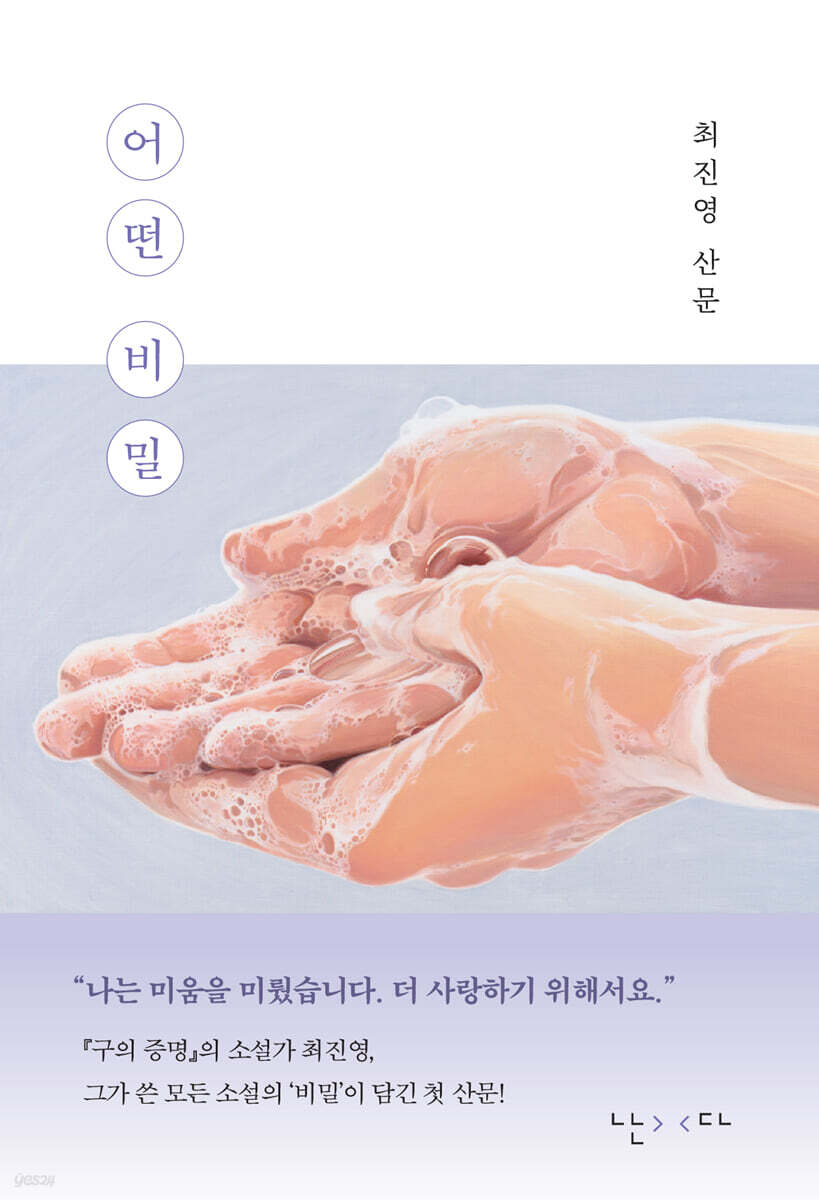
The cover image is a work by artist Lee Su-jin titled [Mistake].
The hand in the painting, lathering and thoroughly washing something, makes us imagine something beyond the story.
In a conversation, author Jinyoung Choi expressed his realization that this world and he are so similar, and that the ruthlessness and violence of this world are precisely his own characteristics ("A Sentence That Raises Another Question," Impossible Conversations 2).
No one can wash their hands only once in their life.
As long as we live, our hands become dirty again and again, and we must wash them repeatedly.
Perhaps this is the world of the novel that I, a ‘being who keeps making mistakes’ (Comrade, p. 313), am trying to approach.
We keep writing that we can try hard, that we must try hard, that we must do so because we are human (Autumn Equinox, p. 231).
I think of the word pain now.
I think about the frustration of being trapped in letters.
Like New Year's Eve, I think "that's not everything."
I sometimes imagine.
An imagination of emotions trapped in letters exploding and breaking out of the letters.
It seems like I'm writing to make it happen.
It seems like something is being deliberately trapped in the letters.
I wish my sentences would be destroyed.
I hope the polite sentences shatter into pieces and the meaning and emotion surge out of the book.
I hope it reaches you.
In an interview after publication, I said:
'This novel may be uncomfortable, but I hope many people read it.'
I regret it now.
I shouldn't have said, 'This novel might be uncomfortable.'
I wanted to look at the world from the same perspective as Jeya, so I wrote a novel, but at the interview, I first thought about the people who would be uncomfortable with Jeya's story.
(…) If it were New Year’s Eve, I might have said something like this.
Reading my story may be painful for you.
I want to believe you feel pain.
_From “We can try hard like this, we must try hard, because we are human”
My future hope is to continue writing
After entering college, instead of making friends, I read books in the library.
I borrowed and read books from various fields that caught my interest, and then I became absorbed in novels.
I liked that the novel featured people who had no dreams, people who failed, people who were cowardly and timid, lonely people, poor people, people who made mistakes, people who were worried—in other words, ordinary people like me.
After graduating from college, I worked as a private academy instructor.
During the day, I taught Korean to middle school students and at night, I wrote.
Although I maintained the general framework of my life of reading or writing something every night, there were some changes.
I decided to put my sentences into a vessel called a ‘novel.’
To write a novel, I needed coffee, a laptop, some alone time, and the will to write.
That was really all there was to it.
If it required expensive tools, a special space, or instruction from an experienced person, I probably wouldn't have tried it.
_「Sentences I Need」, page 125
Choi Jin-young, a novelist in his 18th year since debuting, has published eight full-length novels and four short story collections, setting an example for diligent writing.
"A Certain Secret" is his first collection of prose, a gift to readers who have followed his work. It is no exaggeration to say that it is an epilogue to all the novels he has written so far.
A writer who writes novels that are not read but experienced (Jeong Yong-jun), going beyond the feeling of understanding, nodding in understanding, and even sympathy and empathy, with 'sentences that pass through the heart of the character' (Jo Hae-jin).
A novelist (Song Jong-won) who targets readers' pain and change with stories that 'leave a lingering impression as if they had deeply connected with a single person' (Jeon Seong-tae) and involves them in the narrative of the novel, making them rewrite their lives.
'A truly significant and important achievement for the feminist narrative of our time' (Baek Ji-yeon), this description is preceded by the novelist's first experience of opening the Hangul window on her laptop and writing.
A time when I didn't know how to start, and couldn't ask anyone for permission to write a suitable first sentence, so I just wrote and erased.
Then, finally, I would finish a sentence, leave it, and move on to the next sentence, filling the blank page little by little with sentences (「Author's Note」, p. 15).
Author Jinyoung Choi says:
A novel is a photo album made of sentences.
It's a made-up story, but it's filled with the sincerity of that time.
As I write novels, I become more curious about my own life and want to live it more.
Therefore, Jinyoung Choi's future hope is to continue to be a writer.
You gave me light, I will give you darkness.
You gave me darkness, so I'll give you a secret.
The cover of 『A Certain Secret』 was made of eco-friendly linen paper that gives the feeling of a delicate and tightly woven fabric.
By not coating it with vinyl and treating it with special chemicals, we were able to preserve the characteristics of the fragile paper that can stain, get wet, and tear easily.
The dense texture of the skin, which feels like someone's unique fingerprint when touched with the tip of a finger, and the thick volume of the story it holds.
The cover image is a work by artist Lee Su-jin titled [Mistake].
The hand in the painting, lathering and thoroughly washing something, makes us imagine something beyond the story.
In a conversation, author Jinyoung Choi expressed his realization that this world and he are so similar, and that the ruthlessness and violence of this world are precisely his own characteristics ("A Sentence That Raises Another Question," Impossible Conversations 2).
No one can wash their hands only once in their life.
As long as we live, our hands become dirty again and again, and we must wash them repeatedly.
Perhaps this is the world of the novel that I, a ‘being who keeps making mistakes’ (Comrade, p. 313), am trying to approach.
We keep writing that we can try hard, that we must try hard, that we must do so because we are human (Autumn Equinox, p. 231).
I think of the word pain now.
I think about the frustration of being trapped in letters.
Like New Year's Eve, I think "that's not everything."
I sometimes imagine.
An imagination of emotions trapped in letters exploding and breaking out of the letters.
It seems like I'm writing to make it happen.
It seems like something is being deliberately trapped in the letters.
I wish my sentences would be destroyed.
I hope the polite sentences shatter into pieces and the meaning and emotion surge out of the book.
I hope it reaches you.
In an interview after publication, I said:
'This novel may be uncomfortable, but I hope many people read it.'
I regret it now.
I shouldn't have said, 'This novel might be uncomfortable.'
I wanted to look at the world from the same perspective as Jeya, so I wrote a novel, but at the interview, I first thought about the people who would be uncomfortable with Jeya's story.
(…) If it were New Year’s Eve, I might have said something like this.
Reading my story may be painful for you.
I want to believe you feel pain.
_From “We can try hard like this, we must try hard, because we are human”
GOODS SPECIFICS
- Date of issue: October 25, 2024
- Page count, weight, size: 384 pages | 474g | 128*188*22mm
- ISBN13: 9791194171140
- ISBN10: 1194171141
You may also like
카테고리
korean


korean

![GQ KOREA Mark (Monthly): December [2025]](http://librairie.coreenne.fr/cdn/shop/files/8ef265dbbfbf186523ed75ba7319009d.jpg?v=1765340328&width=3840)


