

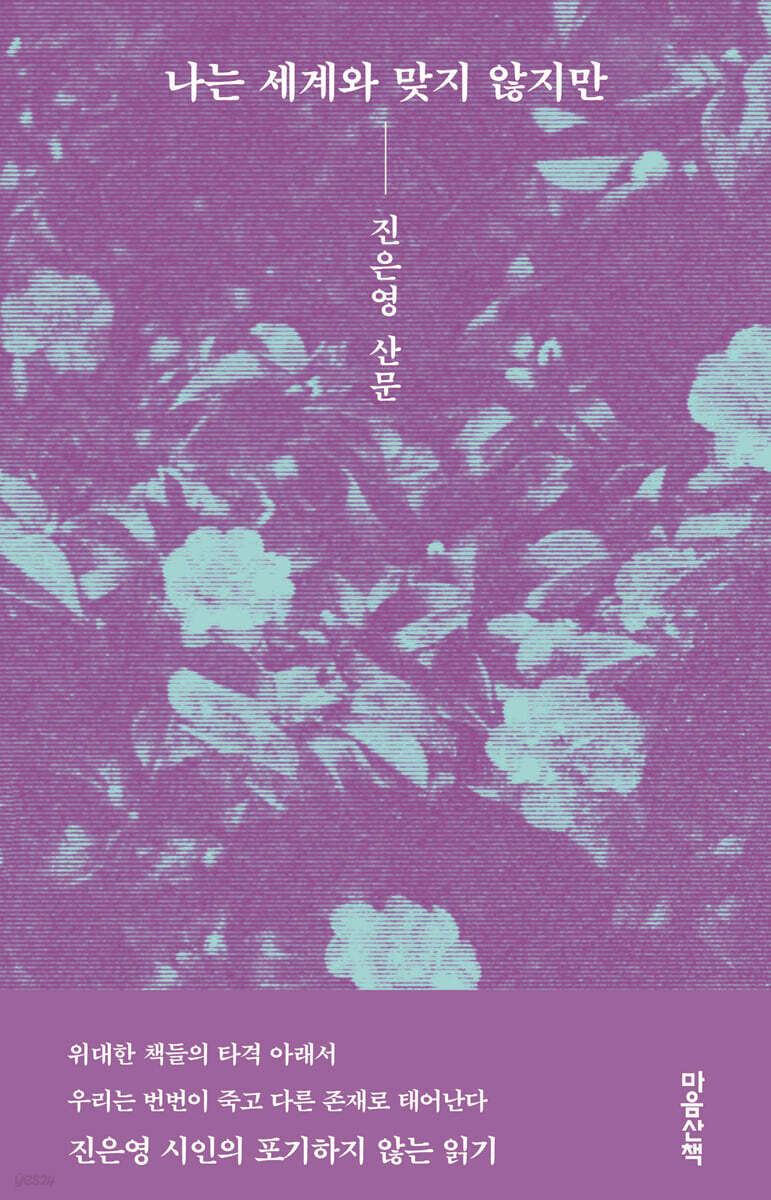
I don't fit in with the world
 |
Description
Book Introduction
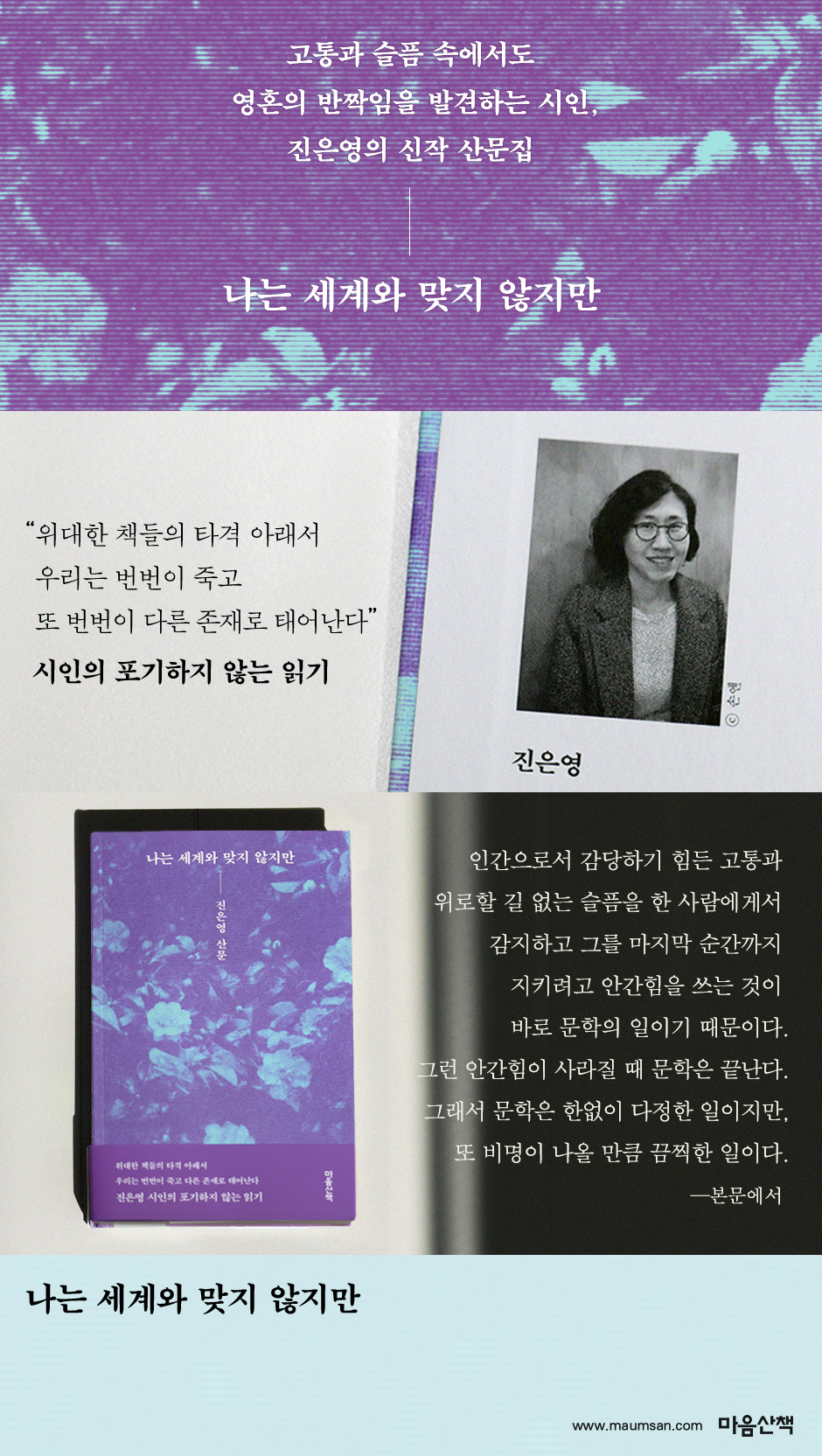
“Under the blows of great books we die again and again, “I am reborn again and again as a different being.” A poet who finds the sparkle of the soul even in pain and sorrow, Jin Eun-young's new prose collection Poet Jin Eun-young, who has published four poetry collections over the past 24 years and has been loved for her sensuous and intense language and keen social awareness, is publishing a new collection of prose, “I Don’t Fit in with the World.” In the preface to the book, the poet says, “My red notebook and my head are full of sentences from other people, the origins of which are unclear.” There were sentences that saved him on nights when he couldn't fall asleep easily and in moments when he wanted to die, and the poet endured the difficult times by reading and underlining them without rest. Even as time passes and the memories of pain and recovery fade, I never forget that there was a book that kept me alive. The authors Jin Eun-young calls out are powerful and fascinating just by their names. Kafka, Wolf, Bachmann, Camus, Weil, Plath, Arendt… … These are writers who wrote with all their might, aware that life is full of unavoidable suffering and that victory may not come no matter how hard they try. Those who struggled to maintain their uniqueness in a world that did not fit them did not disappear into the back alleys of history, but rather rose to the ranks of great writers. Their books also survive without becoming worn out, and they also strike a chord in the souls of modern readers. The poet examines the books and sentences of his beloved authors and talks about the power that keeps people alive. It also writes about the struggles of literature to care for just one person until the end, even in the midst of unbearable sorrow. A good writer doesn't flatter. He speaks briefly and indifferently, as if to an old friend, telling us to take a deep breath of the cold chill of truth. Kafka, Wolf, Camus, Weil, Tolstoy, Plath, Nietzsche, Arendt… …all the authors discussed here are like that. For them, life is a continuous lawsuit, a wish that can only be achieved after four hundred years of struggle, a boulder that rolls back down, a love that goes without reward, a winter forest that leads to endless wandering and then back to where it started. (…) They don’t say that if you read my book, you will be happy in the evening even if you are sad in the morning. Instead, it tells you that you will go through all the pain, but you will not give up your own life and uniqueness. Writers truly believe in their readers. If they didn't have that kind of faith, we wouldn't be able to present a narrator who never gives up on life, no matter how sad it may be, or a protagonist who constantly fights to carve out his own unique place in a world that doesn't quite fit him. (…) Like Rilke’s poem, we read in books things that are drenched in our own shadows. _From "Preface" |
- You can preview some of the book's contents.
Preview
index
Preface | I Don't Fit Into the World - Reading Without Giving Up
Even if arrested, K is free… … What about Korea without an anti-discrimination law? - Franz Kafka, "The Trial"
Both Orlando and Virginia wanted diverse lives, free from gender constraints. - Virginia Woolf, Orlando
A leader who claims to be the bearer of truth... that is not charisma, but delusion. - Hannah Arendt, The Human Condition
A philosophy that feared Jews produced Jewish geniuses - Martin Heidegger, Being and Time
Literature, a place teeming with the experience of constant death and rebirth - Maurice Blanchot's "The Space of Literature"
The Literary Courage to Contemplate the Sorrow of the Victim - Ingeborg Bachmann's "Resume"
Anna Akhmatova, the Russian national poet who could not stop living or trying - "Requiem - An Anthology of Russian Women Poets of the Revolutionary Era"
Sylvia's poetry is too ecstatic and intense to be illuminated solely by her tragic life - Sylvia Plath's "Airial"
Dickinson, who met the world after her death because she existed as 'herself' - Emily Dickinson, 'Solitude is a Thing That Cannot Be Measured'
"Grandmother Poet" Who Offered Reflection with Cool Intellect, Not an Artist's Life - Wisława Szymborska's "Ends and Beginnings"
Parents who hope their children are screaming somewhere… … A tragic hope written in poetry - Ariel Dorfman's "The Last Waltz in Santiago"
Warning Against Militarism Through the Voices of Ordinary People - Noriko Ibaragi's "The First Town I Visited"
A Poem Created with the Affection that Calls Out Everything Without Forgetting a Thing - Baek Seok's "Baek Seok's Poems, 100 Pieces"
The thorns of life become new stories in poetry… …like Paterson, the bus driver. - William Carlos Williams, Paterson
A world where I can only win by pushing you away and revealing myself… … The poet answered with “disappearance” - Rainer Kunze, “The Silver Thistle”
Is fairness truly fair? ... 'Didion-style writing' that resists vagueness - Joan Didion, Crouching toward Bethlehem
Camus says, "Tragedy is a destiny we must recognize." - Albert Camus, The Myth of Sisyphus
Ripping humanity from the gravity of fate and lifting it into eternity… Simone Weil's 'Love' - Simone Weil's 'Gravity and Grace' and 'The Iliad, or the Poem of Power'
Come, free home… A dream of hope for the powerless - Gaston Bachelard, The Poetics of Space
A desperate message in a violent reality - John Berger's "A to X"
Photography: On the Mystery of Coexistence Between Past and Present - Roland Barthes, The Bright Room
A 192-page memoir for my departed brother… Love is memory - Anne Carson, Knox
Is the "gift" of art simply a naive, ancient notion? - Lewis Hyde, "The Gift"
A human being who saves others through his habits of life… …Captured through the eyes of a fox - "Master and Servant" by Lev Nikolayevich Tolstoy
O impatient modern man who deifies money and happiness… “God is dead” - Friedrich Nietzsche, Thus Spoke Zarathustra
The young Rilke became a mentor because he was a colleague, not a teacher - Rainer Maria Rilke, Letters to a Young Poet
A true teacher does not explain - Jacques Rancière, The Ignorant Teacher
Greek Philosophers Brought to Life Through Critical Quotations from Later Scholars - Selected Fragments of the Presocratics
Even if arrested, K is free… … What about Korea without an anti-discrimination law? - Franz Kafka, "The Trial"
Both Orlando and Virginia wanted diverse lives, free from gender constraints. - Virginia Woolf, Orlando
A leader who claims to be the bearer of truth... that is not charisma, but delusion. - Hannah Arendt, The Human Condition
A philosophy that feared Jews produced Jewish geniuses - Martin Heidegger, Being and Time
Literature, a place teeming with the experience of constant death and rebirth - Maurice Blanchot's "The Space of Literature"
The Literary Courage to Contemplate the Sorrow of the Victim - Ingeborg Bachmann's "Resume"
Anna Akhmatova, the Russian national poet who could not stop living or trying - "Requiem - An Anthology of Russian Women Poets of the Revolutionary Era"
Sylvia's poetry is too ecstatic and intense to be illuminated solely by her tragic life - Sylvia Plath's "Airial"
Dickinson, who met the world after her death because she existed as 'herself' - Emily Dickinson, 'Solitude is a Thing That Cannot Be Measured'
"Grandmother Poet" Who Offered Reflection with Cool Intellect, Not an Artist's Life - Wisława Szymborska's "Ends and Beginnings"
Parents who hope their children are screaming somewhere… … A tragic hope written in poetry - Ariel Dorfman's "The Last Waltz in Santiago"
Warning Against Militarism Through the Voices of Ordinary People - Noriko Ibaragi's "The First Town I Visited"
A Poem Created with the Affection that Calls Out Everything Without Forgetting a Thing - Baek Seok's "Baek Seok's Poems, 100 Pieces"
The thorns of life become new stories in poetry… …like Paterson, the bus driver. - William Carlos Williams, Paterson
A world where I can only win by pushing you away and revealing myself… … The poet answered with “disappearance” - Rainer Kunze, “The Silver Thistle”
Is fairness truly fair? ... 'Didion-style writing' that resists vagueness - Joan Didion, Crouching toward Bethlehem
Camus says, "Tragedy is a destiny we must recognize." - Albert Camus, The Myth of Sisyphus
Ripping humanity from the gravity of fate and lifting it into eternity… Simone Weil's 'Love' - Simone Weil's 'Gravity and Grace' and 'The Iliad, or the Poem of Power'
Come, free home… A dream of hope for the powerless - Gaston Bachelard, The Poetics of Space
A desperate message in a violent reality - John Berger's "A to X"
Photography: On the Mystery of Coexistence Between Past and Present - Roland Barthes, The Bright Room
A 192-page memoir for my departed brother… Love is memory - Anne Carson, Knox
Is the "gift" of art simply a naive, ancient notion? - Lewis Hyde, "The Gift"
A human being who saves others through his habits of life… …Captured through the eyes of a fox - "Master and Servant" by Lev Nikolayevich Tolstoy
O impatient modern man who deifies money and happiness… “God is dead” - Friedrich Nietzsche, Thus Spoke Zarathustra
The young Rilke became a mentor because he was a colleague, not a teacher - Rainer Maria Rilke, Letters to a Young Poet
A true teacher does not explain - Jacques Rancière, The Ignorant Teacher
Greek Philosophers Brought to Life Through Critical Quotations from Later Scholars - Selected Fragments of the Presocratics
Detailed image
Into the book
In fact, life can be said to be a long litigation process.
The moment we are born, we are thrown into sociocultural norms such as gender, race, and class.
Society is always on the lookout to see if those rules are being properly followed, and is always waiting to issue an arrest warrant for us.
Even if you follow one rule, lawsuits can still arise due to other rules.
So, everyone is constantly forced to prove their innocence or plead guilty before the law, which dictates that they remain in a state of social 'normality' throughout their lives.
Therefore, complete acquittal is impossible.
--- p.22
While loving and being loved is precious, Orlando has the aspect of an existentialist who loves solitude in that he does not believe that the patterns of life he weaves are all reduced to relationships.
--- p.34
The world, stained by war and violence, is infinitely dark.
In such a world, love flashes like lightning for a brief moment, illuminating the darkness.
In the red, short light like a rose, Bachmann does not only depict flowers dreamily.
I stare intently at the thorns of historical error that are brightly lit beneath the blooming flowers.
--- p.67
Some poets capture the gasping breaths of the dying in their poetry.
These are noble poems that tear at the hearts of those who read them.
However, in Baek Seok's poetry, there are no screams or painful groans loud enough to startle the reader.
But he writes as if whispering and muttering beside a dying person, a person lying in a state of exhaustion, pain, and despair.
There is no deep reflection on life or promise of paradise in those mutterings.
--- p.117
A sad child always goes to a corner and crouches.
Corners are also places where frightened animals seek refuge.
When we feel abandoned by the world, we hide in a corner.
According to Bachelard, the corner is the true home that fulfills the dream of safety.
Because the place where we can say we live comfortably must be a place where we can hide and have a secret hideaway in times of hurt.
Perhaps it would be more accurate to say that home is “our corner of the world.”
--- p.156
Love is always like this.
The darkness of the times, fateful misfortune, the plot of a third party, mutual suspicion, misunderstandings, mistakes, and other obstacles that interfere with the delivery process prevent the true measure of love I sent from being properly conveyed.
The novel tells of repeated delivery accidents, as if to ask you to examine the prison of your lover's heart.
--- pp.175~176
His appearance resembles those whose lives have been completely shattered by social disaster and violence from others, and their families.
They set a table with no one to eat and obsessively polish shoes with no one to wear.
Those who have suffered the pain of having their world completely destroyed cannot stop trying to somehow restore their lives through this relentless repetition.
Like a bird flapping endlessly on the ground with broken wings.
--- p.177
The essence of photography lies in the individual uniqueness that pierces each of us in the photograph.
It's about time.
The 'click' sound of the shutter is not a sound that proves that things 'exist', but rather that they 'were'.
Because the moment captured in a photo becomes the past as soon as the 'click' is taken.
The anxiety of the mind about the fact that all things disappear and change is translated into mechanical sounds.
--- p.182
Whether by custom or religion, or by the way we make books, the core of every offering we make for mourning is this.
When we deliver the news of a loved one's passing, we call their name, think of their face, and talk with others about what their life was like.
By doing so, we are making the history of the deceased's life known to the world and saying goodbye to him or her respectfully and slowly.
--- p.188
Among the philosophers I studied in regular classes during my college years, there were no women.
How refreshing it was when I later encountered feminist theory.
Even before I opened the first page, the names of the female authors on the cover spoke volumes.
You too can write a philosophy book! The signs whispered that you no longer need to peek into the arena of thought like the women who disguised themselves as men and visited the ancient Olympic stadium, where there were no female athletes (and were said to face death if caught).
More women will experience similar hope as they read the philosophical works of Hannah Arendt and Martha Nussbaum, who shed new light on Greek thought, and the beautiful novels of Anne Carson, a specialist in Greek classics.
Of course, the ones who will be most excited about this news, yet also most nervous, are the philosophers of the Anthology of Short Stories.
Soon they will meet more women, the most passionate and satirical quoters since Plato.
The moment we are born, we are thrown into sociocultural norms such as gender, race, and class.
Society is always on the lookout to see if those rules are being properly followed, and is always waiting to issue an arrest warrant for us.
Even if you follow one rule, lawsuits can still arise due to other rules.
So, everyone is constantly forced to prove their innocence or plead guilty before the law, which dictates that they remain in a state of social 'normality' throughout their lives.
Therefore, complete acquittal is impossible.
--- p.22
While loving and being loved is precious, Orlando has the aspect of an existentialist who loves solitude in that he does not believe that the patterns of life he weaves are all reduced to relationships.
--- p.34
The world, stained by war and violence, is infinitely dark.
In such a world, love flashes like lightning for a brief moment, illuminating the darkness.
In the red, short light like a rose, Bachmann does not only depict flowers dreamily.
I stare intently at the thorns of historical error that are brightly lit beneath the blooming flowers.
--- p.67
Some poets capture the gasping breaths of the dying in their poetry.
These are noble poems that tear at the hearts of those who read them.
However, in Baek Seok's poetry, there are no screams or painful groans loud enough to startle the reader.
But he writes as if whispering and muttering beside a dying person, a person lying in a state of exhaustion, pain, and despair.
There is no deep reflection on life or promise of paradise in those mutterings.
--- p.117
A sad child always goes to a corner and crouches.
Corners are also places where frightened animals seek refuge.
When we feel abandoned by the world, we hide in a corner.
According to Bachelard, the corner is the true home that fulfills the dream of safety.
Because the place where we can say we live comfortably must be a place where we can hide and have a secret hideaway in times of hurt.
Perhaps it would be more accurate to say that home is “our corner of the world.”
--- p.156
Love is always like this.
The darkness of the times, fateful misfortune, the plot of a third party, mutual suspicion, misunderstandings, mistakes, and other obstacles that interfere with the delivery process prevent the true measure of love I sent from being properly conveyed.
The novel tells of repeated delivery accidents, as if to ask you to examine the prison of your lover's heart.
--- pp.175~176
His appearance resembles those whose lives have been completely shattered by social disaster and violence from others, and their families.
They set a table with no one to eat and obsessively polish shoes with no one to wear.
Those who have suffered the pain of having their world completely destroyed cannot stop trying to somehow restore their lives through this relentless repetition.
Like a bird flapping endlessly on the ground with broken wings.
--- p.177
The essence of photography lies in the individual uniqueness that pierces each of us in the photograph.
It's about time.
The 'click' sound of the shutter is not a sound that proves that things 'exist', but rather that they 'were'.
Because the moment captured in a photo becomes the past as soon as the 'click' is taken.
The anxiety of the mind about the fact that all things disappear and change is translated into mechanical sounds.
--- p.182
Whether by custom or religion, or by the way we make books, the core of every offering we make for mourning is this.
When we deliver the news of a loved one's passing, we call their name, think of their face, and talk with others about what their life was like.
By doing so, we are making the history of the deceased's life known to the world and saying goodbye to him or her respectfully and slowly.
--- p.188
Among the philosophers I studied in regular classes during my college years, there were no women.
How refreshing it was when I later encountered feminist theory.
Even before I opened the first page, the names of the female authors on the cover spoke volumes.
You too can write a philosophy book! The signs whispered that you no longer need to peek into the arena of thought like the women who disguised themselves as men and visited the ancient Olympic stadium, where there were no female athletes (and were said to face death if caught).
More women will experience similar hope as they read the philosophical works of Hannah Arendt and Martha Nussbaum, who shed new light on Greek thought, and the beautiful novels of Anne Carson, a specialist in Greek classics.
Of course, the ones who will be most excited about this news, yet also most nervous, are the philosophers of the Anthology of Short Stories.
Soon they will meet more women, the most passionate and satirical quoters since Plato.
--- p.232
Publisher's Review
Endlessly affectionate and scream-worthy
The truth that great literature elevates
Herbert, the poet Jin Eun-young loved, was a person who always read books.
He also spoke about the futility of reading books, confessing that he was “just surviving.”
Jin Eun-young sympathizes with Herbert.
He recalls a time when he too was able to survive because he could read, and talks about the numerous sentences that became part of the poet's life.
These are sentences that confront unavoidable pain, sentences that testify that failure is never foolish, and sentences that make us love those who begin a fight they might lose just to survive as humans.
Writers who use sentences like these, such as Camus, Bachmann, and Weil, do not easily comfort their readers.
By simply telling the cold truth, it makes us realize how noble those who fight to secure their own uniqueness in a cruel world are.
No matter what we dream and fight for, achieving that dream is difficult.
I felt like I had made some progress, but then I realized I was back to square one.
Humans may be 'damaged creatures' born to fail.
But thanks to Camus, instead of calling those who continue to fight difficult battles foolish, we can now say that they have great courage.
We also learned that those we truly love are not those who win, but those who embark on a potentially losing battle to preserve truth and human dignity.
_In the text
Jin Eun-young reads Kafka's "The Trial," which makes her realize that life is a process of litigation, and thinks of the Brontë sisters, who had to live as writers and "defendants" in a time when women were not allowed to write.
It talks about minorities in Korean society who are oppressed in their daily lives the moment their minority status is revealed, and also writes about the reality that the enactment of the anti-discrimination law is being delayed.
Reading Woolf's "Orlando," I find myself wishing for a society where everyone lives the way they want to live, through Orlando, who lived as a man, a woman, a diplomat, a gypsy, and later became the "poet" he aspired to be for 400 years.
Reading Ariel Dorfman's poem "Hope," I am reminded of the tragedy and sacrifice that occurred in Korea, as well as the suffering of the bereaved families that continues to this day.
Excellent writers and their works transcend time and place.
It raises powerful and valid questions and exposes injustices that many try to ignore.
And as the poet says, brave readers recognize these brave works.
Through my work, I gauge my own unique position, receive precise comfort, and resolve not to give up on life easily.
“As our love begins with small things,
“Salvation and revolution will be like that.”
Poet Kim So-yeon wrote of Jin Eun-young, “She is a poet who accurately understands where the power to recover comes from in humans.”
Jin Eun-young focuses on the small gestures and low voices of those who endure life with all their might even in sorrow, and writes about their beauty in careful sentences.
Capture the subtle changes in the greedy master Brekhnov in Tolstoy's "Master and Servant" and read with a delicate eye the mournful sentences written by Roland Barthes and Anne Carson.
It specifically describes how courageous Rainer Kunze was as a poet who showed consideration for others and resisted the system by not revealing himself.
Poet Jin Eun-young said that reading great books did not bring about a revolution or save humanity, but it did enable her to survive.
As I look at the list of authors and works he treasured, having always been a good reader before becoming a poet, I can't help but imagine the themes he must have been deeply absorbed in and the sentences that must have left a mark on his soul.
But keeping one person alive is by no means a trivial task.
It's truly remarkable to constantly shine a light on someone's life, and we can bask in that light by reading books.
I am fortunate to discover sentences like 'axe' and I keep moving forward without giving up even when I feel like I don't fit in with the world.
Reading the beautiful prose of poet Jin Eun-young, I realize that there is a life in which reading leads to true salvation.
This is both a personal confession and a literary confession.
Because the job of literature is to sense in a person the pain that is too much for a human to bear and the sorrow that cannot be comforted, and to do everything in one's power to protect that person until the very end.
When that effort disappears, literature ends.
_In the text
Jin Eun-young (author)'s words
Writers truly believe in their readers.
If they didn't have that kind of faith, we wouldn't be able to present a narrator who never gives up on life, no matter how sad it may be, or a protagonist who constantly fights to carve out his own unique place in a world that doesn't quite fit him.
Only with the belief that such a voice can be understood, and with the certainty that there exists at least one person in this world who desires such a life and that he or she will surely read the book, can a writer portray a character who does not give up and unfold a philosophy about the ability to not give up even when there is no hope.
If so, then a book that talks about a life without giving up does not create readers who don't give up, but rather the opposite.
Or perhaps a brave reader and a brave book recognize each other.
Like Rilke's poem, we read in books things that are drenched in our own shadows.
- From "Preface"
The truth that great literature elevates
Herbert, the poet Jin Eun-young loved, was a person who always read books.
He also spoke about the futility of reading books, confessing that he was “just surviving.”
Jin Eun-young sympathizes with Herbert.
He recalls a time when he too was able to survive because he could read, and talks about the numerous sentences that became part of the poet's life.
These are sentences that confront unavoidable pain, sentences that testify that failure is never foolish, and sentences that make us love those who begin a fight they might lose just to survive as humans.
Writers who use sentences like these, such as Camus, Bachmann, and Weil, do not easily comfort their readers.
By simply telling the cold truth, it makes us realize how noble those who fight to secure their own uniqueness in a cruel world are.
No matter what we dream and fight for, achieving that dream is difficult.
I felt like I had made some progress, but then I realized I was back to square one.
Humans may be 'damaged creatures' born to fail.
But thanks to Camus, instead of calling those who continue to fight difficult battles foolish, we can now say that they have great courage.
We also learned that those we truly love are not those who win, but those who embark on a potentially losing battle to preserve truth and human dignity.
_In the text
Jin Eun-young reads Kafka's "The Trial," which makes her realize that life is a process of litigation, and thinks of the Brontë sisters, who had to live as writers and "defendants" in a time when women were not allowed to write.
It talks about minorities in Korean society who are oppressed in their daily lives the moment their minority status is revealed, and also writes about the reality that the enactment of the anti-discrimination law is being delayed.
Reading Woolf's "Orlando," I find myself wishing for a society where everyone lives the way they want to live, through Orlando, who lived as a man, a woman, a diplomat, a gypsy, and later became the "poet" he aspired to be for 400 years.
Reading Ariel Dorfman's poem "Hope," I am reminded of the tragedy and sacrifice that occurred in Korea, as well as the suffering of the bereaved families that continues to this day.
Excellent writers and their works transcend time and place.
It raises powerful and valid questions and exposes injustices that many try to ignore.
And as the poet says, brave readers recognize these brave works.
Through my work, I gauge my own unique position, receive precise comfort, and resolve not to give up on life easily.
“As our love begins with small things,
“Salvation and revolution will be like that.”
Poet Kim So-yeon wrote of Jin Eun-young, “She is a poet who accurately understands where the power to recover comes from in humans.”
Jin Eun-young focuses on the small gestures and low voices of those who endure life with all their might even in sorrow, and writes about their beauty in careful sentences.
Capture the subtle changes in the greedy master Brekhnov in Tolstoy's "Master and Servant" and read with a delicate eye the mournful sentences written by Roland Barthes and Anne Carson.
It specifically describes how courageous Rainer Kunze was as a poet who showed consideration for others and resisted the system by not revealing himself.
Poet Jin Eun-young said that reading great books did not bring about a revolution or save humanity, but it did enable her to survive.
As I look at the list of authors and works he treasured, having always been a good reader before becoming a poet, I can't help but imagine the themes he must have been deeply absorbed in and the sentences that must have left a mark on his soul.
But keeping one person alive is by no means a trivial task.
It's truly remarkable to constantly shine a light on someone's life, and we can bask in that light by reading books.
I am fortunate to discover sentences like 'axe' and I keep moving forward without giving up even when I feel like I don't fit in with the world.
Reading the beautiful prose of poet Jin Eun-young, I realize that there is a life in which reading leads to true salvation.
This is both a personal confession and a literary confession.
Because the job of literature is to sense in a person the pain that is too much for a human to bear and the sorrow that cannot be comforted, and to do everything in one's power to protect that person until the very end.
When that effort disappears, literature ends.
_In the text
Jin Eun-young (author)'s words
Writers truly believe in their readers.
If they didn't have that kind of faith, we wouldn't be able to present a narrator who never gives up on life, no matter how sad it may be, or a protagonist who constantly fights to carve out his own unique place in a world that doesn't quite fit him.
Only with the belief that such a voice can be understood, and with the certainty that there exists at least one person in this world who desires such a life and that he or she will surely read the book, can a writer portray a character who does not give up and unfold a philosophy about the ability to not give up even when there is no hope.
If so, then a book that talks about a life without giving up does not create readers who don't give up, but rather the opposite.
Or perhaps a brave reader and a brave book recognize each other.
Like Rilke's poem, we read in books things that are drenched in our own shadows.
- From "Preface"
GOODS SPECIFICS
- Date of issue: September 15, 2024
- Page count, weight, size: 232 pages | 398g | 130*204*17mm
- ISBN13: 9788960908949
You may also like
카테고리
korean


korean

![GQ KOREA Mark (Monthly): December [2025]](http://librairie.coreenne.fr/cdn/shop/files/8ef265dbbfbf186523ed75ba7319009d.jpg?v=1765340328&width=3840)


