

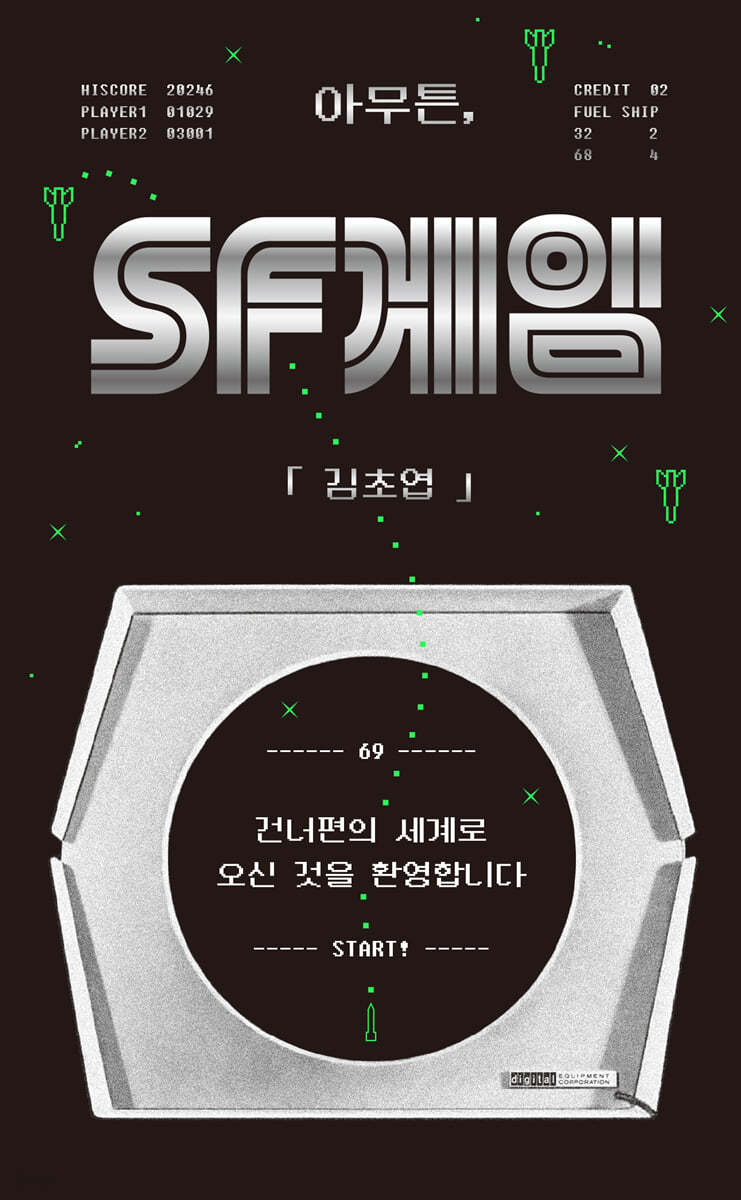
Anyway, SF game
 |
Description
Book Introduction
“I hold my breath and wait for the strange and unfamiliar world to unfold before my eyes.”
“Unreadable English letters on a black screen.
Ding, you hear the booting sound and after a while, the 'Windows 98' logo appears against a blue sky.
The arrow-shaped mouse cursor changes into an hourglass and then back into an arrow several times.
The world inside the monitor, with a dull gray background filling the window.
“I hold my breath and wait for the strange and unfamiliar world that will unfold before my eyes.”
The 69th in the Anyway series is Kim Cho-yeop's "Anyway, SF Game."
For seven-year-old Kim Cho-yeop, the first child in the neighborhood to own a computer, the computer was a gateway to another world.
Compared to the complex world of unfamiliar rules and incomprehensible things, the world inside the monitor seemed clear and simple, and above all, comfortable and relaxing.
He fell into that world like that, and after logging into "The Land of Wind", he started playing a game with his friend as an incongruous combination of characters, a shaman and a Taoist, and since then, he has been traveling around all kinds of game worlds.
I didn't know it then.
I never thought this trip would last this long.
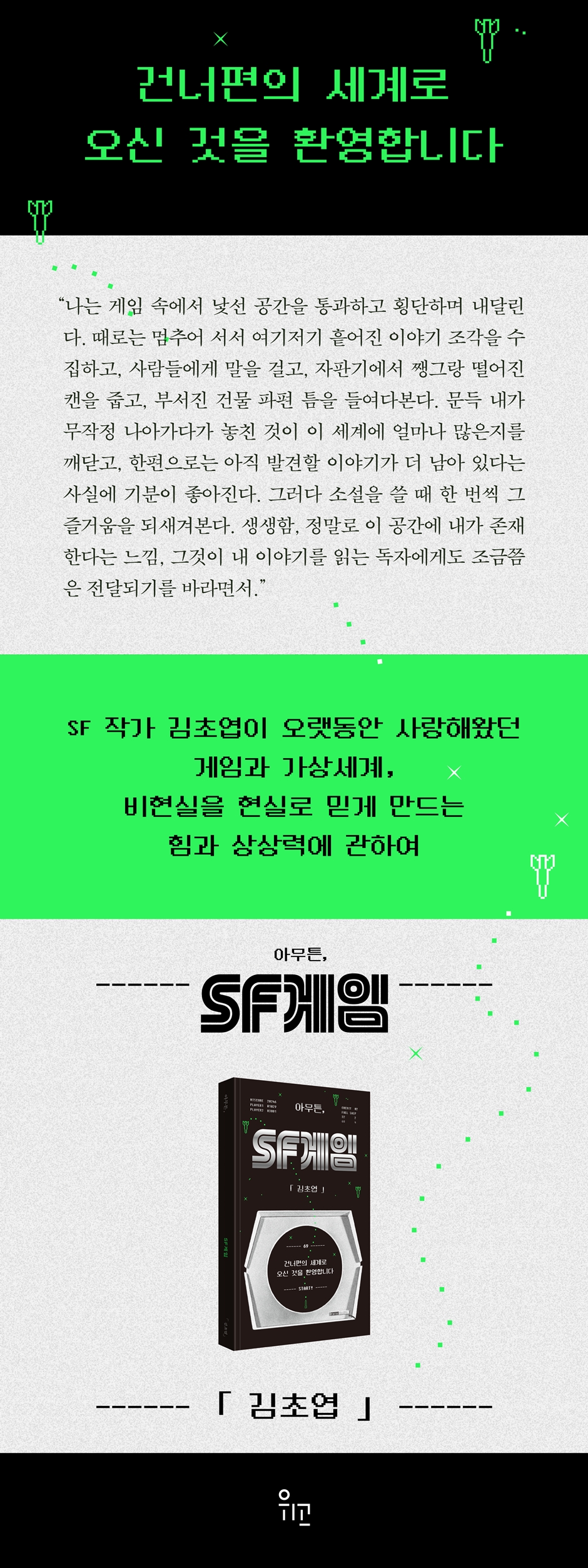
"Anyway, SF Game" is a confession of love for the virtual world that author Kim Cho-yeop has loved for a long time.
When he was young, he thought the world of games was inside the monitor, but now he believes that the worlds he experienced (in games) are layered on top of reality.
It's not that this is strict reality and that is a vain fiction, or that the game is real and this is reality where you have to log out right away, but that these various worlds can overlap and then disperse at will.
With that belief, he gradually unravels why the worlds in the games he has played so far have captivated him, how each one is uniquely attractive, and how they are connected to his life.
“Unreadable English letters on a black screen.
Ding, you hear the booting sound and after a while, the 'Windows 98' logo appears against a blue sky.
The arrow-shaped mouse cursor changes into an hourglass and then back into an arrow several times.
The world inside the monitor, with a dull gray background filling the window.
“I hold my breath and wait for the strange and unfamiliar world that will unfold before my eyes.”
The 69th in the Anyway series is Kim Cho-yeop's "Anyway, SF Game."
For seven-year-old Kim Cho-yeop, the first child in the neighborhood to own a computer, the computer was a gateway to another world.
Compared to the complex world of unfamiliar rules and incomprehensible things, the world inside the monitor seemed clear and simple, and above all, comfortable and relaxing.
He fell into that world like that, and after logging into "The Land of Wind", he started playing a game with his friend as an incongruous combination of characters, a shaman and a Taoist, and since then, he has been traveling around all kinds of game worlds.
I didn't know it then.
I never thought this trip would last this long.
"Anyway, SF Game" is a confession of love for the virtual world that author Kim Cho-yeop has loved for a long time.
When he was young, he thought the world of games was inside the monitor, but now he believes that the worlds he experienced (in games) are layered on top of reality.
It's not that this is strict reality and that is a vain fiction, or that the game is real and this is reality where you have to log out right away, but that these various worlds can overlap and then disperse at will.
With that belief, he gradually unravels why the worlds in the games he has played so far have captivated him, how each one is uniquely attractive, and how they are connected to his life.
- You can preview some of the book's contents.
Preview
index
I feel like I've been here a long time ago
The resurrection of the protagonist who lost his memory
Experiencing the world
All of this is a lie, yet this world is vividly beautiful.
Select Select Select
Rediscovering Addiction
A pacifist who enjoys war games
Can I love a lizard alien?
Giving up on completion
The resurrection of the protagonist who lost his memory
Experiencing the world
All of this is a lie, yet this world is vividly beautiful.
Select Select Select
Rediscovering Addiction
A pacifist who enjoys war games
Can I love a lizard alien?
Giving up on completion
Detailed image
Into the book
Unreadable English letters on a black screen.
Ding, you hear the booting sound and after a while, the 'Windows 98' logo appears against a blue sky.
The arrow-shaped mouse cursor changes into an hourglass and then back into an arrow several times.
The world inside the monitor, with a dull gray background filling the window.
I hold my breath and wait for the strange and unfamiliar world to unfold before my eyes.
--- p.7
So I fell back into the world of gaming.
Because I've been away from the gaming world for a while (or maybe because of it), I've found myself with a plethora of games to enjoy.
Borderlands, Fallout, BioShock, XCOM, Mass Effect, Assassin's Creed... most of these games were actually part of a series! These unfamiliar worlds that suddenly appeared before me were all different, each vivid and new.
It was full of surprises.
When you get tired of playing one game, the next one is waiting, and when you see the ending, the previous game in the series is waiting.
--- p.13
As I drove through the Mojave Desert back to my hotel in Las Vegas that day, I gazed out the window at the setting sun and lost myself in thought.
I thought of the suspicious AI that knew everything, the companion robot that followed me around, and the delivery man running through the wasteland.
I never thought the world inside a game could be real, it was a strange feeling.
Of course, the Mojave Wasteland, New Vegas, and Hoover Dam in "Fallout: New Vegas" were very different from the real thing.
But I felt a distinct sense of foreboding.
It felt like I had not only witnessed these places, but experienced them vividly.
It felt like I had been here a long time ago.
--- pp.16-17
I look closely at the lies planted in that virtual world.
We are captivated by the small pieces that are somewhat connected to reality, and we give our hearts to that world even though we know it is unreal.
And then I imagine.
In some other universe, this human civilization would literally vanish in an instant, be overrun by plants, and only self-assembled mechanical beasts would leisurely roam the earth.
There will not even be any humans left who feel regret for the civilization they destroyed with their own hands.
But that world would definitely be beautiful.
Is this similar to the view from this tall neck right now?
The dream blinks and scatters when you press the end button, but it still exists on a single layer of the world.
--- pp.40-41
In that sense, isn't the medium of games the one that provides the most similar experience to 'experiencing the world'?
If you watch a novel or movie and say, "I have no idea what happened," you might get criticized for saying, "Did you see it correctly?"
But no one would criticize a player who sees the ending with an incomplete understanding of the game's story.
Games are a medium that prioritizes experience over narrative.
Players can experience that life (world) without understanding the game's story.
Once you have experienced it, you can think about it again.
When you complete a given mission, talk to passing NPCs, or collect diaries and audio logs, you may not know the meaning of those actions at the time, but you may understand it later when you look through the diaries.
On the other hand, after the game is over, you may not even notice all of that and just forget about it.
Then, one day, many years later, you might hear someone talking about the game and realize that those pieces were actually part of a story.
--- pp.51-52
I run through and traverse unfamiliar spaces in the game.
Sometimes I stop and collect scattered pieces of stories, talk to people, pick up cans that clatter from vending machines, and peer through the debris of broken buildings.
Suddenly, I realize how much I've missed in this world by blindly moving forward, and on the other hand, I feel good knowing that there are still more stories to discover.
Then, when I write a novel, I recall that joy from time to time.
I hope that the vividness, the feeling that I really exist in this space, will be conveyed to the readers of my story, even if only a little.
--- p.55
Following the "To the Moon" series for ten years has been a joyous experience that has given me the opportunity to think about the power of story, the possibilities of games, and above all, the meaning of fiction.
In "Finding Paradise," Dr. Neil Watts says:
“Sometimes I think that our memories and everything in them are just fictions we tell ourselves.” The story fiercely questions fiction and truth.
We are faced with another question that inevitably arises from the question of whether manipulating memory is deception or not.
But I felt that this story was defending fiction.
Sometimes in our memories, fiction and truth are indistinguishable, and so fiction may have just as much meaning as truth.
--- p.68
So I thought Disco Elysium was asking:
In this world, a ruin of ideology shrouded in apocalyptic thought, where you feel so helpless and helpless, where what you believed to be choices are in fact meaningless, will you still pursue absurd ideals? The game doesn't say it's right.
It just gives you a choice.
In any case, fixed events do not change, there is nothing great that Harry can do, and he can only have a minor influence through internal monologue and speech.
But even so, if Harry, the player, takes the side of those pursuing their ideals, even for a moment, something happens.
That doesn't change the world.
But something changes in Harry's and the player's mind as they look at the world.
--- p.89
But if you can control yourself, if you've thought long and hard about what makes a "good game," that immersion can still be a great joy.
I want to rediscover the meaning of addiction.
When I play a game that I want to keep playing, I become very simple.
The countless thoughts that were confusing me disappeared.
At that moment, there is nothing in my world but the goal in the game, and even the consciousness of moving towards that goal gradually disappears.
I'm so detached from reality that I could almost call it a kind of meditation, immersed in a different world, a different goal, only to be pulled back by the realities of life—tomorrow's deadline, dry eyes, back pain, thirst, hunger, etc.
As I move through these dimensions, my way of thinking, my thinking mode, shifts.
I can't completely wash and dry your mind, but at least it feels like the dust has been blown off your mind.
--- p.108
You can't live life like a game.
Games tolerate failure, and sometimes even actively encourage it.
But the real world is much harsher on failure, and once you fall, it's over.
A broken arm never mends, an opportunity that has passed will never return, and a choice made cannot be undone.
It's okay to fail in a game because there's replay and I believe that failure and immaturity help me grow.
We cannot have such faith in the failures and immaturity of reality.
But if, even though it won't be easy, I borrow just a little bit of that faith, maybe something will change.
Ding, you hear the booting sound and after a while, the 'Windows 98' logo appears against a blue sky.
The arrow-shaped mouse cursor changes into an hourglass and then back into an arrow several times.
The world inside the monitor, with a dull gray background filling the window.
I hold my breath and wait for the strange and unfamiliar world to unfold before my eyes.
--- p.7
So I fell back into the world of gaming.
Because I've been away from the gaming world for a while (or maybe because of it), I've found myself with a plethora of games to enjoy.
Borderlands, Fallout, BioShock, XCOM, Mass Effect, Assassin's Creed... most of these games were actually part of a series! These unfamiliar worlds that suddenly appeared before me were all different, each vivid and new.
It was full of surprises.
When you get tired of playing one game, the next one is waiting, and when you see the ending, the previous game in the series is waiting.
--- p.13
As I drove through the Mojave Desert back to my hotel in Las Vegas that day, I gazed out the window at the setting sun and lost myself in thought.
I thought of the suspicious AI that knew everything, the companion robot that followed me around, and the delivery man running through the wasteland.
I never thought the world inside a game could be real, it was a strange feeling.
Of course, the Mojave Wasteland, New Vegas, and Hoover Dam in "Fallout: New Vegas" were very different from the real thing.
But I felt a distinct sense of foreboding.
It felt like I had not only witnessed these places, but experienced them vividly.
It felt like I had been here a long time ago.
--- pp.16-17
I look closely at the lies planted in that virtual world.
We are captivated by the small pieces that are somewhat connected to reality, and we give our hearts to that world even though we know it is unreal.
And then I imagine.
In some other universe, this human civilization would literally vanish in an instant, be overrun by plants, and only self-assembled mechanical beasts would leisurely roam the earth.
There will not even be any humans left who feel regret for the civilization they destroyed with their own hands.
But that world would definitely be beautiful.
Is this similar to the view from this tall neck right now?
The dream blinks and scatters when you press the end button, but it still exists on a single layer of the world.
--- pp.40-41
In that sense, isn't the medium of games the one that provides the most similar experience to 'experiencing the world'?
If you watch a novel or movie and say, "I have no idea what happened," you might get criticized for saying, "Did you see it correctly?"
But no one would criticize a player who sees the ending with an incomplete understanding of the game's story.
Games are a medium that prioritizes experience over narrative.
Players can experience that life (world) without understanding the game's story.
Once you have experienced it, you can think about it again.
When you complete a given mission, talk to passing NPCs, or collect diaries and audio logs, you may not know the meaning of those actions at the time, but you may understand it later when you look through the diaries.
On the other hand, after the game is over, you may not even notice all of that and just forget about it.
Then, one day, many years later, you might hear someone talking about the game and realize that those pieces were actually part of a story.
--- pp.51-52
I run through and traverse unfamiliar spaces in the game.
Sometimes I stop and collect scattered pieces of stories, talk to people, pick up cans that clatter from vending machines, and peer through the debris of broken buildings.
Suddenly, I realize how much I've missed in this world by blindly moving forward, and on the other hand, I feel good knowing that there are still more stories to discover.
Then, when I write a novel, I recall that joy from time to time.
I hope that the vividness, the feeling that I really exist in this space, will be conveyed to the readers of my story, even if only a little.
--- p.55
Following the "To the Moon" series for ten years has been a joyous experience that has given me the opportunity to think about the power of story, the possibilities of games, and above all, the meaning of fiction.
In "Finding Paradise," Dr. Neil Watts says:
“Sometimes I think that our memories and everything in them are just fictions we tell ourselves.” The story fiercely questions fiction and truth.
We are faced with another question that inevitably arises from the question of whether manipulating memory is deception or not.
But I felt that this story was defending fiction.
Sometimes in our memories, fiction and truth are indistinguishable, and so fiction may have just as much meaning as truth.
--- p.68
So I thought Disco Elysium was asking:
In this world, a ruin of ideology shrouded in apocalyptic thought, where you feel so helpless and helpless, where what you believed to be choices are in fact meaningless, will you still pursue absurd ideals? The game doesn't say it's right.
It just gives you a choice.
In any case, fixed events do not change, there is nothing great that Harry can do, and he can only have a minor influence through internal monologue and speech.
But even so, if Harry, the player, takes the side of those pursuing their ideals, even for a moment, something happens.
That doesn't change the world.
But something changes in Harry's and the player's mind as they look at the world.
--- p.89
But if you can control yourself, if you've thought long and hard about what makes a "good game," that immersion can still be a great joy.
I want to rediscover the meaning of addiction.
When I play a game that I want to keep playing, I become very simple.
The countless thoughts that were confusing me disappeared.
At that moment, there is nothing in my world but the goal in the game, and even the consciousness of moving towards that goal gradually disappears.
I'm so detached from reality that I could almost call it a kind of meditation, immersed in a different world, a different goal, only to be pulled back by the realities of life—tomorrow's deadline, dry eyes, back pain, thirst, hunger, etc.
As I move through these dimensions, my way of thinking, my thinking mode, shifts.
I can't completely wash and dry your mind, but at least it feels like the dust has been blown off your mind.
--- p.108
You can't live life like a game.
Games tolerate failure, and sometimes even actively encourage it.
But the real world is much harsher on failure, and once you fall, it's over.
A broken arm never mends, an opportunity that has passed will never return, and a choice made cannot be undone.
It's okay to fail in a game because there's replay and I believe that failure and immaturity help me grow.
We cannot have such faith in the failures and immaturity of reality.
But if, even though it won't be easy, I borrow just a little bit of that faith, maybe something will change.
--- p.152
Publisher's Review
“These strange worlds were all different, each fresh and vivid.”
The author, who had been wandering around all kinds of game worlds as a child, was suddenly thrown back into reality.
Preparing for the entrance exam.
After that, I thought I had graduated from gaming as I entered the busy college life, but then… the variable of taking a leave of absence came into play.
In a strange situation where there is nothing to do right away compared to the grand plan for a vacation, the author encounters "Borderland."
After that, he gets sucked back into the world of gaming and when he comes to, he finds himself in a miserable situation where he has wasted an entire semester.
That winter, the author visits Las Vegas.
The name is science museum tour, but I wanted to see the game scenes from "Fallout: New Vegas" with my own eyes.
The Mojave Wasteland and Hoover Dam in the game were very different from their real-life counterparts.
But he felt a distinct sense of unease.
It felt like I had not only witnessed these places, but experienced them vividly.
Strangely enough, he didn't regret the break he'd wasted on gaming since that day.
I didn't even feel sorry for myself for being so absorbed in games.
I thought it was a good thing if games “added another layer to life, giving you a sense of having been there, even to places you’ve never been.”
Just like the Pokémon that suddenly appeared on the streets one day, those various worlds could overlap and then scatter at any time.
On the power of carefully planted lies in virtual worlds and the power to make the unreal seem real.
"Anyway, SF Game" is a story about video games and virtual worlds.
It's a story about the unique experience of a space that 'actually' exists, but 'actually' doesn't exist.
The game's worldview, which pursues internal consistency while meticulously establishing its own order to achieve a sense of realism, fascinates the writer.
The power that makes us believe the unreal is real is another name for imagination or creation, and within that power lies the power to make our present life feel more vivid.
"Anyway, SF Game" is a story about the process of creating an imagination that makes you lose yourself in a world that you know is unreal, a "lie planted in a virtual world."
“I run through and traverse unfamiliar spaces in the game.
Sometimes I stop and collect scattered pieces of stories, talk to people, pick up cans that clatter from vending machines, and peer through the debris of broken buildings.
Suddenly, I realize how much I've missed in this world by blindly moving forward, and on the other hand, I feel good knowing that there are still more stories to discover.
Then, when I write a novel, I recall that joy from time to time.
“I hope that vividness, the feeling that I really exist in this space, will be conveyed to the readers of my story, even if only a little.”
Special creative notes from a science fiction writer
In addition to these stories, the author uses his extensive knowledge of games to tell interesting stories that even a layman who is not familiar with SF games can fully understand and enjoy with just a little bit of adventurous spirit, starting from the history of SF games and going on to talk about the backgrounds of the creation of masterpieces such as "Borderlands", "Fallout", "BioShock", "XCOM", and "Mass Effect", as well as game mechanics, storytelling methods, reality and fiction, and globality.
The author says that he wants to rediscover and discuss the magic that makes up the worlds of the games introduced in the book, whether they are unfamiliar or familiar.
I hope that this will be an opportunity for someone to finally open that door, albeit with some hesitation.
The author, who had been wandering around all kinds of game worlds as a child, was suddenly thrown back into reality.
Preparing for the entrance exam.
After that, I thought I had graduated from gaming as I entered the busy college life, but then… the variable of taking a leave of absence came into play.
In a strange situation where there is nothing to do right away compared to the grand plan for a vacation, the author encounters "Borderland."
After that, he gets sucked back into the world of gaming and when he comes to, he finds himself in a miserable situation where he has wasted an entire semester.
That winter, the author visits Las Vegas.
The name is science museum tour, but I wanted to see the game scenes from "Fallout: New Vegas" with my own eyes.
The Mojave Wasteland and Hoover Dam in the game were very different from their real-life counterparts.
But he felt a distinct sense of unease.
It felt like I had not only witnessed these places, but experienced them vividly.
Strangely enough, he didn't regret the break he'd wasted on gaming since that day.
I didn't even feel sorry for myself for being so absorbed in games.
I thought it was a good thing if games “added another layer to life, giving you a sense of having been there, even to places you’ve never been.”
Just like the Pokémon that suddenly appeared on the streets one day, those various worlds could overlap and then scatter at any time.
On the power of carefully planted lies in virtual worlds and the power to make the unreal seem real.
"Anyway, SF Game" is a story about video games and virtual worlds.
It's a story about the unique experience of a space that 'actually' exists, but 'actually' doesn't exist.
The game's worldview, which pursues internal consistency while meticulously establishing its own order to achieve a sense of realism, fascinates the writer.
The power that makes us believe the unreal is real is another name for imagination or creation, and within that power lies the power to make our present life feel more vivid.
"Anyway, SF Game" is a story about the process of creating an imagination that makes you lose yourself in a world that you know is unreal, a "lie planted in a virtual world."
“I run through and traverse unfamiliar spaces in the game.
Sometimes I stop and collect scattered pieces of stories, talk to people, pick up cans that clatter from vending machines, and peer through the debris of broken buildings.
Suddenly, I realize how much I've missed in this world by blindly moving forward, and on the other hand, I feel good knowing that there are still more stories to discover.
Then, when I write a novel, I recall that joy from time to time.
“I hope that vividness, the feeling that I really exist in this space, will be conveyed to the readers of my story, even if only a little.”
Special creative notes from a science fiction writer
In addition to these stories, the author uses his extensive knowledge of games to tell interesting stories that even a layman who is not familiar with SF games can fully understand and enjoy with just a little bit of adventurous spirit, starting from the history of SF games and going on to talk about the backgrounds of the creation of masterpieces such as "Borderlands", "Fallout", "BioShock", "XCOM", and "Mass Effect", as well as game mechanics, storytelling methods, reality and fiction, and globality.
The author says that he wants to rediscover and discuss the magic that makes up the worlds of the games introduced in the book, whether they are unfamiliar or familiar.
I hope that this will be an opportunity for someone to finally open that door, albeit with some hesitation.
GOODS SPECIFICS
- Date of issue: June 13, 2024
- Page count, weight, size: 162 pages | 188g | 110*178*14mm
- ISBN13: 9791193044179
- ISBN10: 1193044170
You may also like
카테고리
korean


korean

![GQ KOREA Mark (Monthly): December [2025]](http://librairie.coreenne.fr/cdn/shop/files/8ef265dbbfbf186523ed75ba7319009d.jpg?v=1765340328&width=3840)


