

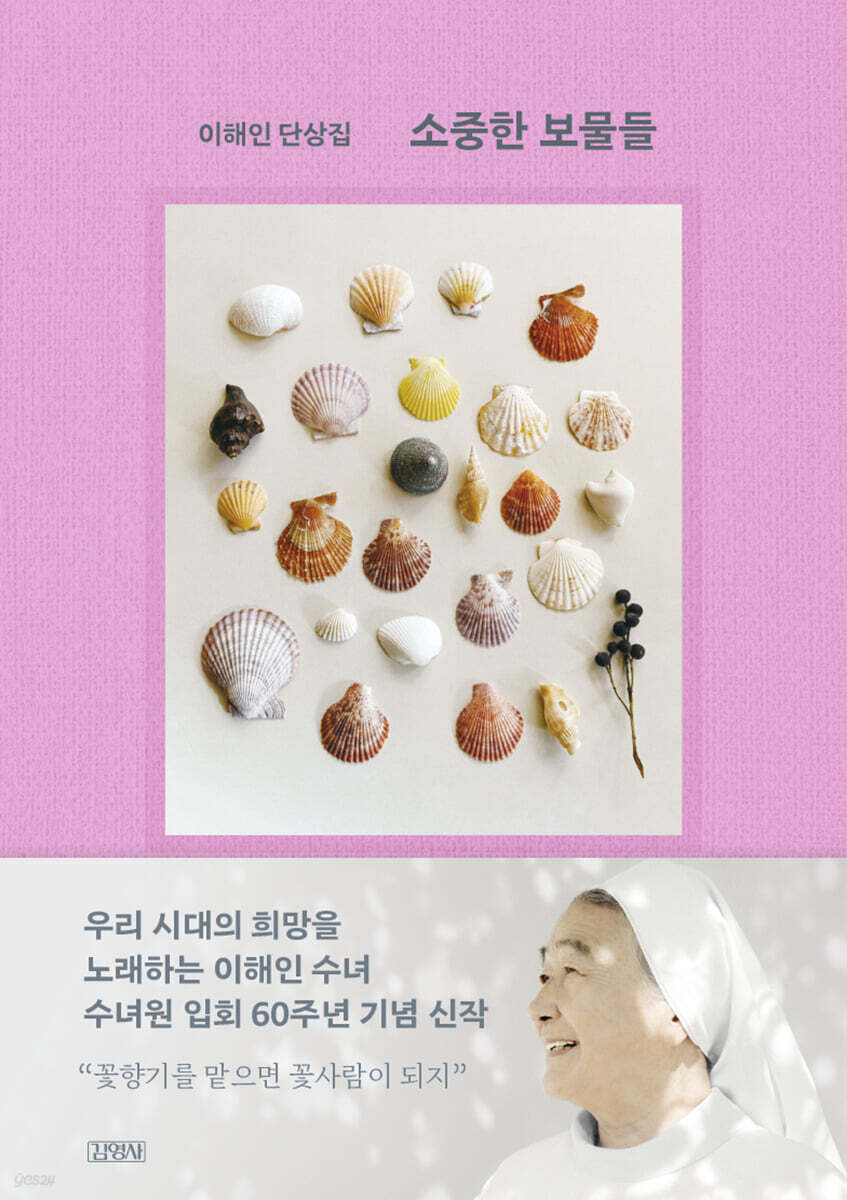
Precious treasures
 |
Description
Book Introduction
“If you smell the scent of flowers, you become a flower person.” Sister Hae-in Lee, who sings of small hope A collection of essays commemorating the 60th anniversary of entering the convent The book "Precious Treasures," which contains the stories of Sister Hae-in Lee, a poet of our time, who opened the doors of the convent in 1964 and has been cherished for 60 years until 2024, has been published by Kim Young-sa. From her mother's letters to postcards from death row inmates, from her first vows to poems written while seeing off her friend's nun, from the quiet garden of the convent to the cathedral where she clasped her hands to form a round heart, from the passionate camellias to the evergreen pine trees, she tells the stories behind them. This book is a compilation of short essays, columns, and ten new poems written by Sister Hae-in Lee as she organizes her thoughts on her twilight journey through life. Anecdotes with the monk Beopjeong, letters from Cardinal Kim Su-hwan, and calligraphy from Shin Yeong-bok, as well as memories of people who have passed away, convey a gentle emotion. It also unfolds the stories of virtue shared across all generations, from elementary school students in their teens to seniors in their nineties, the heartfelt conversations shared embracing joy and sorrow from communities of nuns to readers, and the sincere conversations exchanged through thousands of letters and small gifts. Photographer Jeongmelmel, who beautifully captures the light and shadow of her subjects, invites readers into the sparkling daily life of the convent by publishing photos taken while accompanying Sister Haein Lee from November 2022 to April 2024. It is difficult to fully appreciate the fragrance contained in a single flower seed until it blooms. The same goes for the first collection of essays presented by Sister Lee Hae-in. Only when you open the book can you truly feel the fragrance within. Opening and reading this book will be like watering a gloomy heart, gently instilling hope into a life once thought hopeless, and a clear experience that will help you realize the preciousness of the person who stays quietly by your side and pats you on the back. |
- You can preview some of the book's contents.
Preview
index
First Words / What is precious to us?
1 The warmth of the study room
Little Poet's Little Joy
Haein Publishing House
Bookmark
lamplight
Tools of Love
new watch
About hospitality
Flower clouds
The poet's share
Letter Alley and Letter Warehouse
Word drawing box
Peace of mind
Twelve Letters
Guestbook
Growing plants
Welcoming guests
With just a little effort
Joy Discovery Research Institute
Writing room thoughts
2 The Mystery of Life
If you smell the scent of flowers, you become a flower person
I love camellias
Magnolia
Dandelion seeds
pine cone
a flower garden of one pyeong
vegetable garden
The trees move
The old nun's exclamation
I want to become a bird and start anew
leaves
Manse cactus
succulents
cotton
Life fragments
3 The fragrance of the capital
Always with a round heart
Statue of the Virgin Mary
Our house
Become a student at Farewell School
Jangdokdae
belfry
Back view
Hillside room
Corridors and stairs of the monastery
Cloud bridge over the stairs
window
cathedral
small bell
Capital stage
4 The Softness of Life
hug, love
Looking at the horizon
shell
parrot doll
Back scratch
The many things books give us
Calling names
Humility learned while wearing shoes
a piece of wood
cane
pebbles
A stone picked up on the road
Life stories
5 The Beauty of Memories
As if washed and shaved in clear water
Good Words Notebook
Mother's letter
Broom Card
Sister Sister's Letter
Cardinal Kim Soo-hwan's postcard
pharynx
Flower thimble
button
Handkerchief No. 88
When I look at my father's picture
First Vow Diary
The chief sent by my brother
Professor Jang Young-hee's watch
Wood carving of a death row inmate
Postcard from a Death Row Inmate
Dandelion Territory
passport photo
ring
Memories
The person who will become the end / poem
Appendix / Ten Poems
1 The warmth of the study room
Little Poet's Little Joy
Haein Publishing House
Bookmark
lamplight
Tools of Love
new watch
About hospitality
Flower clouds
The poet's share
Letter Alley and Letter Warehouse
Word drawing box
Peace of mind
Twelve Letters
Guestbook
Growing plants
Welcoming guests
With just a little effort
Joy Discovery Research Institute
Writing room thoughts
2 The Mystery of Life
If you smell the scent of flowers, you become a flower person
I love camellias
Magnolia
Dandelion seeds
pine cone
a flower garden of one pyeong
vegetable garden
The trees move
The old nun's exclamation
I want to become a bird and start anew
leaves
Manse cactus
succulents
cotton
Life fragments
3 The fragrance of the capital
Always with a round heart
Statue of the Virgin Mary
Our house
Become a student at Farewell School
Jangdokdae
belfry
Back view
Hillside room
Corridors and stairs of the monastery
Cloud bridge over the stairs
window
cathedral
small bell
Capital stage
4 The Softness of Life
hug, love
Looking at the horizon
shell
parrot doll
Back scratch
The many things books give us
Calling names
Humility learned while wearing shoes
a piece of wood
cane
pebbles
A stone picked up on the road
Life stories
5 The Beauty of Memories
As if washed and shaved in clear water
Good Words Notebook
Mother's letter
Broom Card
Sister Sister's Letter
Cardinal Kim Soo-hwan's postcard
pharynx
Flower thimble
button
Handkerchief No. 88
When I look at my father's picture
First Vow Diary
The chief sent by my brother
Professor Jang Young-hee's watch
Wood carving of a death row inmate
Postcard from a Death Row Inmate
Dandelion Territory
passport photo
ring
Memories
The person who will become the end / poem
Appendix / Ten Poems
Detailed image

Into the book
A good poem is one that is read a thousand times by one person, rather than one that is read once by a thousand people.
Monastic life, the life of an ascetic, is itself similar to poetry.
To me, poetry is a prayer of love that encapsulates the life of a monk.
It is a song that expresses life in the four seasons through language.
Reading readers' letters, I get the feeling that poetry is like a small comfort, a small joy, a small love letter.
A good poet is an angel of language who fills life with poetry and exerts a positive influence on others.
He is an artist who lives a life of beautiful effort like a priest.
Observing keenly and seeing things that others do not notice.
That is the poet's job.
I write poetry in the cathedral, in my bedroom, in the garden, and in my study.
I wish I could die like a poem.
--- p.33 From “The Poet’s Share”
Who said.
“I think you’re good at growing plants, Sister,” I replied.
“The sunlight and wind come into the study room, so it grows well.
“It’s just a little bit of a loving glance added to the good conditions of the studio.” A person with strong attachment wouldn’t give the plants they have grown to other people, but when I grow a plant, I branch it out and give it to someone as a gift.
One day, I gave some seeds from a flower pot in front of my library to my reader, Hoe-rim, who lives in Atlanta, USA.
He planted some primrose seeds at his house and sent me a photo of the pink primroses blooming.
Sharing plants is sharing life.
The joy of giving is greater than the joy of having.
--- p.45 From "Growing Plants"
As a joy discovery researcher, my hobbies are truly abundant.
Thinking specifically about 'who will please me with my words?'
Collecting good poems and phrases, savoring them, and sharing them with people you meet.
Collect leaves, flower petals, stones, shells, empty bottles, pine cones, and handkerchiefs to create small, artistic gifts.
Create a beautiful card by arranging various stickers here and there.
Writing down beautiful scenery or kind words from people so that you don't forget them and then reflecting on them.
Studying the names of flower trees.
When you can't find the name of a flower or tree in a plant guide, find out by asking.
When someone expresses to me that they want something, I remember it well and then give it to them as a surprise gift at some point.
Sharing my joy so that everyone can find joy.
--- p.51 From “The Joy Discovery Research Institute”
How pure are the pine cones that fall into the convent! Is it because they pray with us, listening to the bells? Pine cones are gathered on the hill at the convent entrance.
I am holding a basket and picking up pine cones while patting my sore legs.
I put a pine cone to my nose and smell the scent of the pine forest.
If you have a seashell, it's like having the sea, and if you have a pine cone, it's like having a mountain.
--- p.67 From "Pine Cone"
The school of life's farewells teaches us:
That everything will eventually pass, that we must do our best in the moment given to us, feeling the finiteness of life moment by moment, that doing our best ultimately means being very grateful and forgiving often, and that even when things don't go well, we must learn to love deeply and broadly, consciously considering those around us first.
That is the way to gently welcome the true and final farewell that will come one day.
--- p.101 From “Becoming a Student at Farewell School”
The hardest thing in life is reconciliation and forgiveness.
While harboring a grievance
or say I forgive you
Say something nice to hear
Praying is hypocrisy.
Something to forgive today
Peace comes when you forgive today.
--- p.121 From “Capital Thoughts”
Sometimes I go to the white sand beach and pick up seashells.
After drying seashells soaked in seawater in the sun, poems, words, prayers, or drawings are written on them and given as gifts to guests who visit the studio.
Also, some people put pretty stickers on the shells and give them as gifts by attaching Bible verses to the shells.
With the same mindset as picking up seashells, I will find hidden treasures on the beach of my daily life today.
--- p.131 From "Chogabi"
I look at the heart clock and think about the time.
Living today is ultimately about breathing eternity within the moment.
It is humbling to realize that one day we will have to end our journey on earth.
Finite humans are pilgrims walking towards infinite love.
--- p.181 From "Professor Jang Young-hee's Watch"
After all, it is a place where people live
That it's more important
That is the place of salvation
Why did I find out so late?
Monastic life, the life of an ascetic, is itself similar to poetry.
To me, poetry is a prayer of love that encapsulates the life of a monk.
It is a song that expresses life in the four seasons through language.
Reading readers' letters, I get the feeling that poetry is like a small comfort, a small joy, a small love letter.
A good poet is an angel of language who fills life with poetry and exerts a positive influence on others.
He is an artist who lives a life of beautiful effort like a priest.
Observing keenly and seeing things that others do not notice.
That is the poet's job.
I write poetry in the cathedral, in my bedroom, in the garden, and in my study.
I wish I could die like a poem.
--- p.33 From “The Poet’s Share”
Who said.
“I think you’re good at growing plants, Sister,” I replied.
“The sunlight and wind come into the study room, so it grows well.
“It’s just a little bit of a loving glance added to the good conditions of the studio.” A person with strong attachment wouldn’t give the plants they have grown to other people, but when I grow a plant, I branch it out and give it to someone as a gift.
One day, I gave some seeds from a flower pot in front of my library to my reader, Hoe-rim, who lives in Atlanta, USA.
He planted some primrose seeds at his house and sent me a photo of the pink primroses blooming.
Sharing plants is sharing life.
The joy of giving is greater than the joy of having.
--- p.45 From "Growing Plants"
As a joy discovery researcher, my hobbies are truly abundant.
Thinking specifically about 'who will please me with my words?'
Collecting good poems and phrases, savoring them, and sharing them with people you meet.
Collect leaves, flower petals, stones, shells, empty bottles, pine cones, and handkerchiefs to create small, artistic gifts.
Create a beautiful card by arranging various stickers here and there.
Writing down beautiful scenery or kind words from people so that you don't forget them and then reflecting on them.
Studying the names of flower trees.
When you can't find the name of a flower or tree in a plant guide, find out by asking.
When someone expresses to me that they want something, I remember it well and then give it to them as a surprise gift at some point.
Sharing my joy so that everyone can find joy.
--- p.51 From “The Joy Discovery Research Institute”
How pure are the pine cones that fall into the convent! Is it because they pray with us, listening to the bells? Pine cones are gathered on the hill at the convent entrance.
I am holding a basket and picking up pine cones while patting my sore legs.
I put a pine cone to my nose and smell the scent of the pine forest.
If you have a seashell, it's like having the sea, and if you have a pine cone, it's like having a mountain.
--- p.67 From "Pine Cone"
The school of life's farewells teaches us:
That everything will eventually pass, that we must do our best in the moment given to us, feeling the finiteness of life moment by moment, that doing our best ultimately means being very grateful and forgiving often, and that even when things don't go well, we must learn to love deeply and broadly, consciously considering those around us first.
That is the way to gently welcome the true and final farewell that will come one day.
--- p.101 From “Becoming a Student at Farewell School”
The hardest thing in life is reconciliation and forgiveness.
While harboring a grievance
or say I forgive you
Say something nice to hear
Praying is hypocrisy.
Something to forgive today
Peace comes when you forgive today.
--- p.121 From “Capital Thoughts”
Sometimes I go to the white sand beach and pick up seashells.
After drying seashells soaked in seawater in the sun, poems, words, prayers, or drawings are written on them and given as gifts to guests who visit the studio.
Also, some people put pretty stickers on the shells and give them as gifts by attaching Bible verses to the shells.
With the same mindset as picking up seashells, I will find hidden treasures on the beach of my daily life today.
--- p.131 From "Chogabi"
I look at the heart clock and think about the time.
Living today is ultimately about breathing eternity within the moment.
It is humbling to realize that one day we will have to end our journey on earth.
Finite humans are pilgrims walking towards infinite love.
--- p.181 From "Professor Jang Young-hee's Watch"
After all, it is a place where people live
That it's more important
That is the place of salvation
Why did I find out so late?
--- p.215 From "Some Thoughts"
Publisher's Review
A story that has been kept with a warm heart for 60 years
Everyone has a secret drawer.
However, the author's secret drawer is never closed and is always open.
Inside the drawer are things that can be used as gifts to be given to guests, such as shells, stones, stationery, colored pencils, postcards, and handkerchiefs.
“I believe that gifts shine only when they go around and eventually return to those who need them” (p. 9), so he repeatedly empties and fills his drawers in order to share what he has throughout his life.
A death row inmate received a letter from him and wrote back, “Auntie, everyone tells me to repent, but you are the first person to tell me to bring out the pure heart within me” (p. 35), and a reader planted the “flower seeds in front of the study” (p. 45) he received from him in his yard, and pink flowers bloomed.
People cry, laugh, and gain strength to live again from the small gifts he gives them.
It's not because it's an expensive jewel, but because it's not cold, and because it's made with precious sincerity, it gives off a warm feeling.
And so the world says that the traces of his life and the look he gave are poetry, and that the single line he wrote with his bent fingers is poetry that leads lonely hope to a place where it is not lonely.
Kim Jin-suk, the author of “Salt Flower Tree,” was comforted by reading his poetry when she “felt lonely and helpless, as if she were standing alone in a field after being fired at the age of 26” (p. 43), and an elementary school student, after reading his book, vowed to “be grateful for the things that make me sad” (p. 53).
A book titled “Precious Treasures” has been published, containing stories collected over 60 years by Sister Hae-in Lee, a poet who does her best for everyone with a sincere heart.
I compiled together pieces written while looking through old diaries while organizing my life's journey, poems written after returning to my bedroom after saying my final farewell to a friend, notes taken from a memo I kept in my apron, and excerpts from columns I serialized in daily newspapers.
He entered the convent in 1964 and wanted to be “a kind-hearted ‘child’ who always lives with a poor heart, chewing on the starlight and breathing in the wind” (p. 193). Now, as a great adult of our time, he humbly hopes to become “a little mother who gives small comfort to someone with poetry, however inadequate, and who never stops praying” (p. 191). These are the first words he spoke.
“What is precious to us?” (page 8)
A list of precious things we may have forgotten
The book's table of contents reflects on the precious things we may have missed.
Since it would be impossible to list them all, I have divided them into 5 parts.
The photos in the book were taken by author Jeong Mel-Mel while accompanying Sister Hae-In Lee from November 2022 to April 2024.
Part 1, “The Warmth of the Study Room,” tells the stories of the people Sister Hae-in Lee, who has spent her days in the 10-pyeong Haein Study Room since it first opened in the fall of 1997, and the stories of the objects in the study room.
He calls himself a “researcher of joy discovery” (p. 51), and remembers “the sound of happiness blossoming quietly with just a little effort” (p. 49), telling us about the small joys of living as a small poet.
Part 2, “The Mystery of Life,” shares the wisdom learned and acquired from nature, from a one-pyeong flower garden cultivated by Sister Hwanwoo to magnolia trees, cacti, and cotton.
The sentences that say, “Holding a pine cone is like holding a mountain” (page 67), “Smelling the scent of flowers makes you a flower person” (page 91), and whispering to a white butterfly, “Thank you for remembering even a small blade of grass” (page 191) are like a cozy shade spread over the heavy daily life, leading us to meditate.
Part 3, “The Fragrance of the Capital,” depicts the convent’s landscape, from the hillside room where the late novelist Park Wan-seo experienced emotional recovery after losing her son, to the cathedral, cloud bridge, and bell tower, drawing a round heart.
Even in convent life, there are unpleasant things that happen because of human relationships, but at those times, it is said, “Peace comes when you forgive today what needs to be forgiven today” (p. 121).
“To become a little angel, you must know how to make big sacrifices” (p. 121). This will help you avoid the breathless climbs up and down the hills of life.
Part 4, “The Gentleness of Life,” recounts the joy of embracing and loving my day, from picking up seashells at Gwangalli Beach to putting on my shoes with a humble heart every day.
“I think again that being alive means calling someone’s name and being called by that name” (page 139), and it makes me think about the beauty of the heart that wishes well-being while thinking of the names of the people around me.
Part 5, “The Beauty of Memories,” tells the story of how memories become more beautiful over time, like stones being carved and polished by clear water, from the mother’s belongings to anecdotes with writers.
The final part of Part 5, “Memories,” unfolds his life in chronological order from his days in the capital, his period of illness, and his later years, leaving a lingering impression.
“Encounters are always short, and partings are always long.” (p. 197)
A book of hospitality that embraces pain without pain
Sister Lee Hae-in said in her final remarks, “Was the score given generously simply because it was written by a nun?
So that's why it got the attention, the spotlight, and the recognition it deserved.
He wrote that he once asked himself, “Is it true that my colleagues said that if I had stayed outside the monastery, I would not have enjoyed the love of readers for so long?”
In one of the new poems included in this book, “Longing,” he says, “Because the theme of my life/ has always been longing/ my life has never been boring/ and I have been able to be happy all the time.”
What kind of business card or title would a poet who writes poems that replace ‘longing’ with ‘happiness’ need?
His attitude towards people is 'hospitality', his way of overcoming pain is 'cheerfulness', and the theme of his poetry is 'small comfort'.
So what can we add to what he wrote?
Through his poetry and prose, he brought warmth to our hearts that were thirsty for a little love.
Through his writing, we learned that love has weight, just as a single flower petal has weight, and so we were able to willingly endure the weight of love and strengthen our muscles in life.
So he will be a strong pillar of our times.
Just as there are moments when the sound of a bell struck once resonates deeper in the heart than the sound of a bell struck a hundred times, a single sentence from “Precious Treasures” may resonate with the reader.
His honest confession that “I sometimes envy those who cry loudly without any shame, as I only quietly swallow my extremely restrained tears” (p. 191) will probably be heartbreaking.
Then, you might even raise the corners of your mouth when you read the sentence, “We need a cheerful chatterbox who brightens the atmosphere as much as the silence of the flowers that practice silence” (page 88).
The reader will find out in the end as he reads this book like a treasure hunt.
“Pain is also a precious gift” (page 121).
Everyone has a secret drawer.
However, the author's secret drawer is never closed and is always open.
Inside the drawer are things that can be used as gifts to be given to guests, such as shells, stones, stationery, colored pencils, postcards, and handkerchiefs.
“I believe that gifts shine only when they go around and eventually return to those who need them” (p. 9), so he repeatedly empties and fills his drawers in order to share what he has throughout his life.
A death row inmate received a letter from him and wrote back, “Auntie, everyone tells me to repent, but you are the first person to tell me to bring out the pure heart within me” (p. 35), and a reader planted the “flower seeds in front of the study” (p. 45) he received from him in his yard, and pink flowers bloomed.
People cry, laugh, and gain strength to live again from the small gifts he gives them.
It's not because it's an expensive jewel, but because it's not cold, and because it's made with precious sincerity, it gives off a warm feeling.
And so the world says that the traces of his life and the look he gave are poetry, and that the single line he wrote with his bent fingers is poetry that leads lonely hope to a place where it is not lonely.
Kim Jin-suk, the author of “Salt Flower Tree,” was comforted by reading his poetry when she “felt lonely and helpless, as if she were standing alone in a field after being fired at the age of 26” (p. 43), and an elementary school student, after reading his book, vowed to “be grateful for the things that make me sad” (p. 53).
A book titled “Precious Treasures” has been published, containing stories collected over 60 years by Sister Hae-in Lee, a poet who does her best for everyone with a sincere heart.
I compiled together pieces written while looking through old diaries while organizing my life's journey, poems written after returning to my bedroom after saying my final farewell to a friend, notes taken from a memo I kept in my apron, and excerpts from columns I serialized in daily newspapers.
He entered the convent in 1964 and wanted to be “a kind-hearted ‘child’ who always lives with a poor heart, chewing on the starlight and breathing in the wind” (p. 193). Now, as a great adult of our time, he humbly hopes to become “a little mother who gives small comfort to someone with poetry, however inadequate, and who never stops praying” (p. 191). These are the first words he spoke.
“What is precious to us?” (page 8)
A list of precious things we may have forgotten
The book's table of contents reflects on the precious things we may have missed.
Since it would be impossible to list them all, I have divided them into 5 parts.
The photos in the book were taken by author Jeong Mel-Mel while accompanying Sister Hae-In Lee from November 2022 to April 2024.
Part 1, “The Warmth of the Study Room,” tells the stories of the people Sister Hae-in Lee, who has spent her days in the 10-pyeong Haein Study Room since it first opened in the fall of 1997, and the stories of the objects in the study room.
He calls himself a “researcher of joy discovery” (p. 51), and remembers “the sound of happiness blossoming quietly with just a little effort” (p. 49), telling us about the small joys of living as a small poet.
Part 2, “The Mystery of Life,” shares the wisdom learned and acquired from nature, from a one-pyeong flower garden cultivated by Sister Hwanwoo to magnolia trees, cacti, and cotton.
The sentences that say, “Holding a pine cone is like holding a mountain” (page 67), “Smelling the scent of flowers makes you a flower person” (page 91), and whispering to a white butterfly, “Thank you for remembering even a small blade of grass” (page 191) are like a cozy shade spread over the heavy daily life, leading us to meditate.
Part 3, “The Fragrance of the Capital,” depicts the convent’s landscape, from the hillside room where the late novelist Park Wan-seo experienced emotional recovery after losing her son, to the cathedral, cloud bridge, and bell tower, drawing a round heart.
Even in convent life, there are unpleasant things that happen because of human relationships, but at those times, it is said, “Peace comes when you forgive today what needs to be forgiven today” (p. 121).
“To become a little angel, you must know how to make big sacrifices” (p. 121). This will help you avoid the breathless climbs up and down the hills of life.
Part 4, “The Gentleness of Life,” recounts the joy of embracing and loving my day, from picking up seashells at Gwangalli Beach to putting on my shoes with a humble heart every day.
“I think again that being alive means calling someone’s name and being called by that name” (page 139), and it makes me think about the beauty of the heart that wishes well-being while thinking of the names of the people around me.
Part 5, “The Beauty of Memories,” tells the story of how memories become more beautiful over time, like stones being carved and polished by clear water, from the mother’s belongings to anecdotes with writers.
The final part of Part 5, “Memories,” unfolds his life in chronological order from his days in the capital, his period of illness, and his later years, leaving a lingering impression.
“Encounters are always short, and partings are always long.” (p. 197)
A book of hospitality that embraces pain without pain
Sister Lee Hae-in said in her final remarks, “Was the score given generously simply because it was written by a nun?
So that's why it got the attention, the spotlight, and the recognition it deserved.
He wrote that he once asked himself, “Is it true that my colleagues said that if I had stayed outside the monastery, I would not have enjoyed the love of readers for so long?”
In one of the new poems included in this book, “Longing,” he says, “Because the theme of my life/ has always been longing/ my life has never been boring/ and I have been able to be happy all the time.”
What kind of business card or title would a poet who writes poems that replace ‘longing’ with ‘happiness’ need?
His attitude towards people is 'hospitality', his way of overcoming pain is 'cheerfulness', and the theme of his poetry is 'small comfort'.
So what can we add to what he wrote?
Through his poetry and prose, he brought warmth to our hearts that were thirsty for a little love.
Through his writing, we learned that love has weight, just as a single flower petal has weight, and so we were able to willingly endure the weight of love and strengthen our muscles in life.
So he will be a strong pillar of our times.
Just as there are moments when the sound of a bell struck once resonates deeper in the heart than the sound of a bell struck a hundred times, a single sentence from “Precious Treasures” may resonate with the reader.
His honest confession that “I sometimes envy those who cry loudly without any shame, as I only quietly swallow my extremely restrained tears” (p. 191) will probably be heartbreaking.
Then, you might even raise the corners of your mouth when you read the sentence, “We need a cheerful chatterbox who brightens the atmosphere as much as the silence of the flowers that practice silence” (page 88).
The reader will find out in the end as he reads this book like a treasure hunt.
“Pain is also a precious gift” (page 121).
GOODS SPECIFICS
- Date of issue: June 18, 2024
- Format: Hardcover book binding method guide
- Page count, weight, size: 232 pages | 440g | 142*204*20mm
- ISBN13: 9788934916925
- ISBN10: 8934916923
You may also like
카테고리
korean


korean

![GQ KOREA Mark (Monthly): December [2025]](http://librairie.coreenne.fr/cdn/shop/files/8ef265dbbfbf186523ed75ba7319009d.jpg?v=1765340328&width=3840)


