

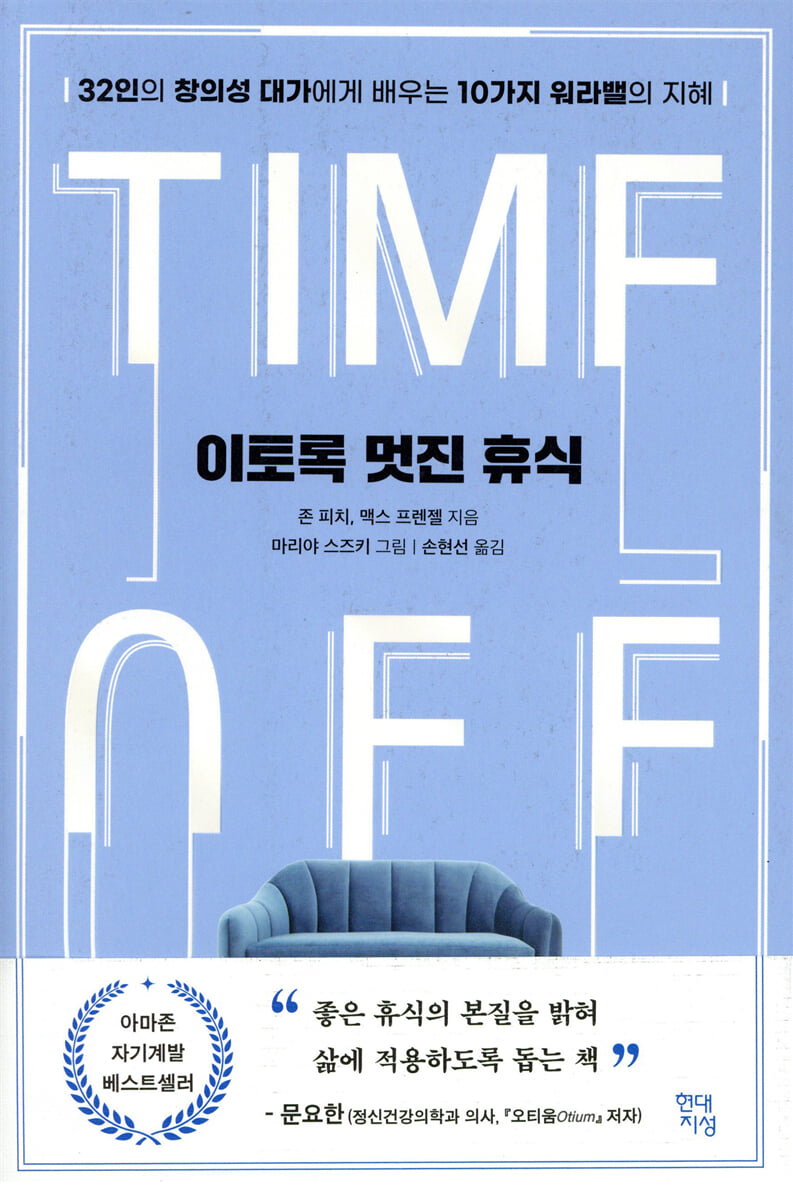
Such a wonderful break
 |
Description
Book Introduction
Aristotle, Seth Godin, LeBron James, Hermann Hesse… …
32 creative masters in life and work
The secret to success and peak performance together
Amazon Self-Improvement Bestseller
Highly recommended by Moon Yohan (psychiatrist, author of "Otium")!
- Why did Henry Ford introduce the first 40-hour workweek in the United States in 1926, even though he doubled wages?
- Why Einstein sometimes went out to sea in a boat
- The secret of Henri Poincaré, who made great achievements in mathematics and science by working only 4 hours a day.
- Why did Beethoven take long walks every afternoon and stop by a tavern to read the newspaper?
How to boost productivity and creativity while still enjoying life's leisure.
In an era where artificial intelligence is spreading across all industries, how to secure creative spaces that AI cannot grasp.
- How to get flashes of insight from the unconscious
Leadership skills for organizations that grow without burnout
Insights on how to take time off at work and in everyday life
Timeoff is “a time consciously set aside to fill your inner self with positive energy,” and it is an insight moment that opens a breakthrough in a blocked life.
Discover the time-off principles that work for you, as told by 32 creative minds who have maintained happy, productive lives without burnout or pressure.
You will find yourself with a wealth of new ideas and a constant stream of applicationable ideas for your daily life.
32 creative masters in life and work
The secret to success and peak performance together
Amazon Self-Improvement Bestseller
Highly recommended by Moon Yohan (psychiatrist, author of "Otium")!
- Why did Henry Ford introduce the first 40-hour workweek in the United States in 1926, even though he doubled wages?
- Why Einstein sometimes went out to sea in a boat
- The secret of Henri Poincaré, who made great achievements in mathematics and science by working only 4 hours a day.
- Why did Beethoven take long walks every afternoon and stop by a tavern to read the newspaper?
How to boost productivity and creativity while still enjoying life's leisure.
In an era where artificial intelligence is spreading across all industries, how to secure creative spaces that AI cannot grasp.
- How to get flashes of insight from the unconscious
Leadership skills for organizations that grow without burnout
Insights on how to take time off at work and in everyday life
Timeoff is “a time consciously set aside to fill your inner self with positive energy,” and it is an insight moment that opens a breakthrough in a blocked life.
Discover the time-off principles that work for you, as told by 32 creative minds who have maintained happy, productive lives without burnout or pressure.
You will find yourself with a wealth of new ideas and a constant stream of applicationable ideas for your daily life.
- You can preview some of the book's contents.
Preview
index
Recommendation
Introductory text_
A philosophy of relaxation that you can use for a lifetime once you learn it.
Chapter 1.
The only way to increase the density of life
The emergence of a new concept of time
- Work-Life Balance Master 1_ Aristotle
“Why am I doing this?”
Changes in perception of leisure
Time 1.0: Productivity is King
-Work-Life Balance Price 2_ Kairos and Chronos
Produce quality results with less work
Labor, a modern-day sacrificial rite
People who own your time
- Work-Life Balance Master 3_ Bertrand Russell
We work too much
Time 2.0: Busy is King
-Work-Life Balance Master 4_ Arianna Huffington
Vacation and time off are not synonymous.
To escape from stress and burnout
Chapter 2.
creativity
Creative Process and Time Off
-Work-Life Balance Masters 5_ Beethoven, Tchaikovsky
Nature as your time-off partner
Slow motion multitasking
-Work-Life Balance Master 6_ Tim Harford
How to Make the Most of Multitasking
-Work-Life Balance Master 7_ Brandon Torrey
There is no boundary between science and art.
Get some distance to get a new perspective
Chapter 3.
Rest
10,000 hours or 4 hours?
Rest is productive
-Work-Life Balance Master 8_ Henri Poincaré
The man who worked only 4 hours a day
Rest is active
Four Elements of Recovery
-Work-Life Balance Master 9_ Søren Kierkegaard
Apply the principle of crop rotation to your life.
Protect your rest
Chapter 4.
sleep
- Work-Life Balance Master 10_ Matthew Walker
The Ultimate Energy Recharger: The Praise of Sleep
The power of dreams
miracle drug
How to get more sleep
-Work-Life Balance Masters 11_ LeBron James and Mike Mancias
A competitive advantage recognized by all hyperformers
Chapter 5.
work out
Slim body, agile mind
-Work-Life Balance Master 12_ Firas Zahavi
Constantly upgrading in a zone of ecstatic immersion
A solid pension for the brain
-Work-Life Balance Master 13_ Terry Rudolph
Entering meditation mode through running
Chapter 6.
solitude
Artists work best alone.
- Work-Life Balance Master 14_ Ed 'Woody' Allen
My own space for inspiration
Connectivity: A Double-Edged Sword
-Work-Life Balance Master 15_ Derek Sivers
Make time for your own solitude.
The ability to be happy alone
Chapter 7.
Reflection
Effective action comes from quiet reflection.
-Work-Life Balance Master 16_ Marcus Aurelius
Composure is an inexhaustible resource.
-Work-Life Balance Master 17_ Seth Godin
You can't do everything
-Work-Life Balance Master 18_ Marie Kondo
Giving back more time and energy
- Work-Life Balance Master 19_ St. Thomas Aquinas
The satisfaction that comes from enjoying leisure itself
Chapter 8.
play
Playground sensibility
-Work-Life Balance Master 20_ Alan Watts
Accepting play and leisure as the essence of life
Lantern Ceremony, Spotlight Ceremony
- Work-Life Balance Master 21_ Alice Waters
How to Make Work Play
A stupid idea can lead to a breakthrough.
-Work-Life Balance Master 22_ Hermann Hesse
Don't let the joys of everyday life deprive you.
Chapter 9.
travel
Become a curious traveler
-Work-Life Balance Master 23_ Stefan Sagmeister
A business that doesn't lose money
A journey that helped me rediscover myself
-Work-Life Balance Master 24_ Lupita Nyong'o
A rich experience of traveling with myself
Chapter 10.
Technology
The most powerful weapon of the mind
Appeal to instinct and reflexes
-Work-Life Balance Master 25_ Tristan Harris
Choosing Good Technologies in the Attention Economy
An era where information is no longer precious
Attention Deficit Society
How to practice de-connection and digital minimalism?
-Work-Life Balance Master 26_ Tiffany Schrain
As one world closes, another opens.
How to Use Technology to Fill the Void
- Work-Life Balance Master 27_ Brunello Cucinelli
The ability to sit blankly for hours
Chapter 11.
The future of work
-Work-Life Balance Master 28_ Lee Kai-Fu
A golden opportunity for humanity to restore its noble leisure.
An era where humans and AI grow together
Humans can think big
Humans can empathize
Humans can curate
In an era where soft skills are profitable
-Work-Life Balance Master 29_ Stefan Arstol
Things You Need to Change to Work Only 5 Hours a Day
A culture rebuilt on noble leisure
-Work-Life Balance Master 30_ Pete Adney
The Art of Voluntary Early Retirement
- Work-Life Balance Master 31_ Richard Branson
A leader who brings out the best creativity
- Work-Life Balance Master 32_ Komuro Yoshie, Sara Arai
The longer you work, the lower your productivity becomes.
Become the protagonist of 'Noble Leisure'
Chapter 12.
Our Story
Why a Workaholic Became an Evangelist for "Intentional Living"
The world's most powerful relaxation technique, Time Off
Your time off
Acknowledgements
References
Introductory text_
A philosophy of relaxation that you can use for a lifetime once you learn it.
Chapter 1.
The only way to increase the density of life
The emergence of a new concept of time
- Work-Life Balance Master 1_ Aristotle
“Why am I doing this?”
Changes in perception of leisure
Time 1.0: Productivity is King
-Work-Life Balance Price 2_ Kairos and Chronos
Produce quality results with less work
Labor, a modern-day sacrificial rite
People who own your time
- Work-Life Balance Master 3_ Bertrand Russell
We work too much
Time 2.0: Busy is King
-Work-Life Balance Master 4_ Arianna Huffington
Vacation and time off are not synonymous.
To escape from stress and burnout
Chapter 2.
creativity
Creative Process and Time Off
-Work-Life Balance Masters 5_ Beethoven, Tchaikovsky
Nature as your time-off partner
Slow motion multitasking
-Work-Life Balance Master 6_ Tim Harford
How to Make the Most of Multitasking
-Work-Life Balance Master 7_ Brandon Torrey
There is no boundary between science and art.
Get some distance to get a new perspective
Chapter 3.
Rest
10,000 hours or 4 hours?
Rest is productive
-Work-Life Balance Master 8_ Henri Poincaré
The man who worked only 4 hours a day
Rest is active
Four Elements of Recovery
-Work-Life Balance Master 9_ Søren Kierkegaard
Apply the principle of crop rotation to your life.
Protect your rest
Chapter 4.
sleep
- Work-Life Balance Master 10_ Matthew Walker
The Ultimate Energy Recharger: The Praise of Sleep
The power of dreams
miracle drug
How to get more sleep
-Work-Life Balance Masters 11_ LeBron James and Mike Mancias
A competitive advantage recognized by all hyperformers
Chapter 5.
work out
Slim body, agile mind
-Work-Life Balance Master 12_ Firas Zahavi
Constantly upgrading in a zone of ecstatic immersion
A solid pension for the brain
-Work-Life Balance Master 13_ Terry Rudolph
Entering meditation mode through running
Chapter 6.
solitude
Artists work best alone.
- Work-Life Balance Master 14_ Ed 'Woody' Allen
My own space for inspiration
Connectivity: A Double-Edged Sword
-Work-Life Balance Master 15_ Derek Sivers
Make time for your own solitude.
The ability to be happy alone
Chapter 7.
Reflection
Effective action comes from quiet reflection.
-Work-Life Balance Master 16_ Marcus Aurelius
Composure is an inexhaustible resource.
-Work-Life Balance Master 17_ Seth Godin
You can't do everything
-Work-Life Balance Master 18_ Marie Kondo
Giving back more time and energy
- Work-Life Balance Master 19_ St. Thomas Aquinas
The satisfaction that comes from enjoying leisure itself
Chapter 8.
play
Playground sensibility
-Work-Life Balance Master 20_ Alan Watts
Accepting play and leisure as the essence of life
Lantern Ceremony, Spotlight Ceremony
- Work-Life Balance Master 21_ Alice Waters
How to Make Work Play
A stupid idea can lead to a breakthrough.
-Work-Life Balance Master 22_ Hermann Hesse
Don't let the joys of everyday life deprive you.
Chapter 9.
travel
Become a curious traveler
-Work-Life Balance Master 23_ Stefan Sagmeister
A business that doesn't lose money
A journey that helped me rediscover myself
-Work-Life Balance Master 24_ Lupita Nyong'o
A rich experience of traveling with myself
Chapter 10.
Technology
The most powerful weapon of the mind
Appeal to instinct and reflexes
-Work-Life Balance Master 25_ Tristan Harris
Choosing Good Technologies in the Attention Economy
An era where information is no longer precious
Attention Deficit Society
How to practice de-connection and digital minimalism?
-Work-Life Balance Master 26_ Tiffany Schrain
As one world closes, another opens.
How to Use Technology to Fill the Void
- Work-Life Balance Master 27_ Brunello Cucinelli
The ability to sit blankly for hours
Chapter 11.
The future of work
-Work-Life Balance Master 28_ Lee Kai-Fu
A golden opportunity for humanity to restore its noble leisure.
An era where humans and AI grow together
Humans can think big
Humans can empathize
Humans can curate
In an era where soft skills are profitable
-Work-Life Balance Master 29_ Stefan Arstol
Things You Need to Change to Work Only 5 Hours a Day
A culture rebuilt on noble leisure
-Work-Life Balance Master 30_ Pete Adney
The Art of Voluntary Early Retirement
- Work-Life Balance Master 31_ Richard Branson
A leader who brings out the best creativity
- Work-Life Balance Master 32_ Komuro Yoshie, Sara Arai
The longer you work, the lower your productivity becomes.
Become the protagonist of 'Noble Leisure'
Chapter 12.
Our Story
Why a Workaholic Became an Evangelist for "Intentional Living"
The world's most powerful relaxation technique, Time Off
Your time off
Acknowledgements
References
Detailed image

Into the book
We usually think of 'rest' as the opposite of 'work'.
It's either rest or be productive.
When I hear the word 'time-off', I automatically think of weekends or work vacations.
I picture myself curled up on the couch playing video games or sitting on the beach sipping a cocktail.
But this book is not about vacations.
At least not the main topic.
It is not a guide to encouraging laziness or teaching you how to waste time.
Rather, this book tells us that a happy and fulfilling life is possible without overwork and pressure.
Guides you to your most productive and creative state.
Isn't this a time when such a 'change in perception' is more urgent than ever?
---From the "Introductory Note"
People have long known that to be fully engaged at work, you need to switch off from work mode and strike a balance between quality rest and work.
But these days, there are many people wandering in the middle.
They have no way of fully immersing themselves in or concentrating on their work.
They are unable to completely distance themselves from work even while resting.
It's neither completely on nor completely off.
The problem with this state is that the effort doesn't accumulate.
There is no comparison between working two hours at 50 percent efficiency and working one hour at almost 100 percent efficiency.
This is especially true for jobs that require creativity (more and more jobs require creativity).
The era of simple, repetitive factory work is almost over.
Fortunately, there are a select few who have kept the knowledge of time-off alive.
They are people who run venture businesses while exerting influence on society just like the great men of old.
And more and more people
We are rediscovering the value of practicing time off.
---「Chapter 1.
From "The Only Way to Increase the Density of Life"
Kairos looks at the quality of time, not the quantity.
Have you ever had days where you worked for hours and still couldn't produce anything worthwhile? And then there were days where you worked much less and still produced something satisfying? Kairos aligns with this type of "flow state."
Kairos time occurs when we suddenly have a breakthrough while showering or taking a walk, when a light bulb goes on in our head.
There is no way to know when Kairos will appear.
But if you are too strict about the clock time, you may miss Kairos even though it is right in front of you, like a blind person with open eyes.
During our time off, we are more likely to encounter Kairos opportunities.
---「Work-life balance price 2.
From “Working Less and Producing Quality Results”
The creative four-stage model—prepare, hatch, manifest, and verify—has stood the test of time.
It is as relevant today as it was when it was first introduced in 1926.
This shows that less than half of truly creative work is what we commonly consider "work."
The other half, equally important, happens when we take time off and are not consciously involved in the problem.
Just because hatching and manifestation are unconscious processes doesn't mean we can't control them.
That process too must be treated as a technique.
…creativity is a constant collaboration between time-on (preparation, verification) and time-off (incubation, manifestation).
The key is to find the right balance between the two states, letting go of the force and moving naturally between time-on and time-off.
Many people think that hatching needs time to occur, but in reality, they don't give it enough time.
We need to take time for hatching.
…
If we choose the path of diversification rather than specialization, we must integrate a variety of diverse experiences.
To do that, you need time for rest and quiet.
Aldous Huxley, a classical music lover, explained in his essay titled “Rest is Silence” that the silence of sound is the essence of classical music.
“Silence is the essence of all great music.
Compared to the music of Beethoven or Mozart, Wagner's music, with its endless stream of notes, is far inferior in terms of silence.
Perhaps this is one reason why Wagner's music seems so much less meaningful than Beethoven's or Mozart's.
Wagner's music speaks without pause, so it speaks less.” We must expose ourselves to the vast beauty the world has to offer, and then step back and absorb it all.
If we sprinkle quality silence called time off between our activities, the creativity and meaning of those activities will increase significantly.
---「Chapter 2.
From “Creativity”
Charles Darwin worked three 90-minute sessions a day, and spent the rest of the time taking long walks, napping, or lost in thought.
Henri Poincaré, a prolific writer and thinker, worked on his first draft from 10 a.m. to noon, and then on his second draft from 5 p.m. to 7 p.m. (a perfect time to wrap your head around a problem and then hand the baton over to your unconscious mind).
Likewise, mathematician G.
H. Hardy believed that conscious work could be done for a maximum of 'four hours a day', and that filling the remaining time with too much 'busy work' would be highly unproductive.
Come to think of it, Darwin, Poincaré, and Hardy are all telling the same story.
If you focus properly and exercise true concentration, and back this up with quality rest, you can achieve great things in just four hours a day.
This idea flies in the face of our busy culture.
The '10,000-hour rule' that creates greatness has been cited countless times since its creation through joint research by Anders Ericsson and his colleagues, and gained significant public attention through Malcolm Gladwell's book 'Outliers'.
This law states that it takes 10,000 hours of deliberate practice to reach expert level in any field.
A world that regards busyness, stress, and overwork as virtues rather than vices welcomed this law with open arms, and many people still believe in it as if it were a dogma.
However, Ericsson's actual research also suggests that daily deliberate practice should be limited to an effective level.
And he suggested 4 hours as the ideal amount of time to invest per day.
---「Chapter 3.
From "Rest"
During World War II, Dwight D.
Eisenhower spent his time holed up in a secret cabin, playing golf, bridge, taking long walks, and reading cowboy novels.
There, any talk about 'work', that is, war, was strictly forbidden.
If, at the height of World War II, the Supreme Commander of the Allied Powers decided that the benefits of disconnecting and enjoying solitude outweighed the potential risks, shouldn't most senior executives, let alone ordinary knowledge workers, rediscover the benefits of solitude?
---「Chapter 6.
From "Solitude"
Anyone with a PhD can tell you how much they dreaded writing a thesis, how arduous the process was, how stressed they were by deadlines, and how they struggled for months, only being able to write a few lines a day.
But that wasn't the case for me, Max.
The process was quite enjoyable for him, and it took less than six weeks from the time he wrote the first word to the completion of the paper.
That process was the most productive, relaxing, and stress-free time of my life.
In fact, the whole time I was writing the thesis, I felt like I was on vacation, and in a way, I was.
…
After a few days exploring the island, Max quickly settled into a routine of short but intense writing sessions, solitary reflection, and intentional rest.
He would wake up around 9 or 10 a.m., which is quite early by his usual standards, meditate and stretch, then go for a short run in the mountains, swim at a beautiful beach, or ride a rented scooter.
And I enjoyed a leisurely, hearty breakfast, and usually read for an hour or two.
Then, in the early afternoon, I had my first writing session of the day (60-90 minutes) at a small cafe in town.
Although my writing time was short, thanks to my morning routine, I was able to focus calmly, and the words flowed out smoothly for the most part.
There was never a time when the writing was blocked during that time.
After finishing my writing, I would have a light lunch at the cafe and then usually go home to take a nap.
Napping was the time when my brain digested what I had written.
Afterwards, we went out and explored the island a bit, bought groceries, played in the water, walked on the beach, read a book, etc.
While doing all these activities, I had no conscious thoughts about 'work'.
Max, inspired by Henry David Thoreau's Walden, which he had just started reading again, spent several days baking bread.
Baking bread was a hobby he enjoyed (and still enjoys) not only because it produced delicious results but also because it was effective for meditation and reflection.
---「Chapter 9.
From "Travel"
Until the early 21st century, we thought only drugs caused true addiction.
However, over the past 10 to 20 years, we have begun to realize that behavioral addictions are the same thing.
A key driver of technology's addictive nature is the rewards it provides—"intermittent positive reinforcement"—on a variable and unpredictable schedule.
Research shows that random rewards trigger a much greater dopamine release than predictable rewards (as any casino operator or compulsive gambler will attest to).
Every time we post something online, we're playing the lottery, not knowing how many people will like it, comment on it, or gain followers.
The impatience to immediately check one's phone when one feels even slightly bored can be explained by this randomness.
---「Chapter 10.
Among the “technology”
Younger generations may think they multitask better (and actually multitask more often), but the negative cognitive impact of multitasking remains.
The negative effects may be even more severe given that they are at a stage in life when they should be focusing on learning and growth.
When you're learning a new skill or trying to wrap your head around a complex concept, long, uninterrupted bursts of concentration are essential.
Only deliberate, focused practice leads to strengthening of neural circuits, but when attention is divided, too many circuits fire simultaneously, so none of them are properly strengthened.
Even if becoming a multitasker seems like a superior skill, it's a path to long-term inferiority (unless you practice Tim Harford's slow, deliberate "slow-motion multitasking" or Søren Kierkegaard's crop rotation).
Constantly switching attention takes a lasting toll on the brain.
You become unable to do truly deep work or deep thinking.
It's either rest or be productive.
When I hear the word 'time-off', I automatically think of weekends or work vacations.
I picture myself curled up on the couch playing video games or sitting on the beach sipping a cocktail.
But this book is not about vacations.
At least not the main topic.
It is not a guide to encouraging laziness or teaching you how to waste time.
Rather, this book tells us that a happy and fulfilling life is possible without overwork and pressure.
Guides you to your most productive and creative state.
Isn't this a time when such a 'change in perception' is more urgent than ever?
---From the "Introductory Note"
People have long known that to be fully engaged at work, you need to switch off from work mode and strike a balance between quality rest and work.
But these days, there are many people wandering in the middle.
They have no way of fully immersing themselves in or concentrating on their work.
They are unable to completely distance themselves from work even while resting.
It's neither completely on nor completely off.
The problem with this state is that the effort doesn't accumulate.
There is no comparison between working two hours at 50 percent efficiency and working one hour at almost 100 percent efficiency.
This is especially true for jobs that require creativity (more and more jobs require creativity).
The era of simple, repetitive factory work is almost over.
Fortunately, there are a select few who have kept the knowledge of time-off alive.
They are people who run venture businesses while exerting influence on society just like the great men of old.
And more and more people
We are rediscovering the value of practicing time off.
---「Chapter 1.
From "The Only Way to Increase the Density of Life"
Kairos looks at the quality of time, not the quantity.
Have you ever had days where you worked for hours and still couldn't produce anything worthwhile? And then there were days where you worked much less and still produced something satisfying? Kairos aligns with this type of "flow state."
Kairos time occurs when we suddenly have a breakthrough while showering or taking a walk, when a light bulb goes on in our head.
There is no way to know when Kairos will appear.
But if you are too strict about the clock time, you may miss Kairos even though it is right in front of you, like a blind person with open eyes.
During our time off, we are more likely to encounter Kairos opportunities.
---「Work-life balance price 2.
From “Working Less and Producing Quality Results”
The creative four-stage model—prepare, hatch, manifest, and verify—has stood the test of time.
It is as relevant today as it was when it was first introduced in 1926.
This shows that less than half of truly creative work is what we commonly consider "work."
The other half, equally important, happens when we take time off and are not consciously involved in the problem.
Just because hatching and manifestation are unconscious processes doesn't mean we can't control them.
That process too must be treated as a technique.
…creativity is a constant collaboration between time-on (preparation, verification) and time-off (incubation, manifestation).
The key is to find the right balance between the two states, letting go of the force and moving naturally between time-on and time-off.
Many people think that hatching needs time to occur, but in reality, they don't give it enough time.
We need to take time for hatching.
…
If we choose the path of diversification rather than specialization, we must integrate a variety of diverse experiences.
To do that, you need time for rest and quiet.
Aldous Huxley, a classical music lover, explained in his essay titled “Rest is Silence” that the silence of sound is the essence of classical music.
“Silence is the essence of all great music.
Compared to the music of Beethoven or Mozart, Wagner's music, with its endless stream of notes, is far inferior in terms of silence.
Perhaps this is one reason why Wagner's music seems so much less meaningful than Beethoven's or Mozart's.
Wagner's music speaks without pause, so it speaks less.” We must expose ourselves to the vast beauty the world has to offer, and then step back and absorb it all.
If we sprinkle quality silence called time off between our activities, the creativity and meaning of those activities will increase significantly.
---「Chapter 2.
From “Creativity”
Charles Darwin worked three 90-minute sessions a day, and spent the rest of the time taking long walks, napping, or lost in thought.
Henri Poincaré, a prolific writer and thinker, worked on his first draft from 10 a.m. to noon, and then on his second draft from 5 p.m. to 7 p.m. (a perfect time to wrap your head around a problem and then hand the baton over to your unconscious mind).
Likewise, mathematician G.
H. Hardy believed that conscious work could be done for a maximum of 'four hours a day', and that filling the remaining time with too much 'busy work' would be highly unproductive.
Come to think of it, Darwin, Poincaré, and Hardy are all telling the same story.
If you focus properly and exercise true concentration, and back this up with quality rest, you can achieve great things in just four hours a day.
This idea flies in the face of our busy culture.
The '10,000-hour rule' that creates greatness has been cited countless times since its creation through joint research by Anders Ericsson and his colleagues, and gained significant public attention through Malcolm Gladwell's book 'Outliers'.
This law states that it takes 10,000 hours of deliberate practice to reach expert level in any field.
A world that regards busyness, stress, and overwork as virtues rather than vices welcomed this law with open arms, and many people still believe in it as if it were a dogma.
However, Ericsson's actual research also suggests that daily deliberate practice should be limited to an effective level.
And he suggested 4 hours as the ideal amount of time to invest per day.
---「Chapter 3.
From "Rest"
During World War II, Dwight D.
Eisenhower spent his time holed up in a secret cabin, playing golf, bridge, taking long walks, and reading cowboy novels.
There, any talk about 'work', that is, war, was strictly forbidden.
If, at the height of World War II, the Supreme Commander of the Allied Powers decided that the benefits of disconnecting and enjoying solitude outweighed the potential risks, shouldn't most senior executives, let alone ordinary knowledge workers, rediscover the benefits of solitude?
---「Chapter 6.
From "Solitude"
Anyone with a PhD can tell you how much they dreaded writing a thesis, how arduous the process was, how stressed they were by deadlines, and how they struggled for months, only being able to write a few lines a day.
But that wasn't the case for me, Max.
The process was quite enjoyable for him, and it took less than six weeks from the time he wrote the first word to the completion of the paper.
That process was the most productive, relaxing, and stress-free time of my life.
In fact, the whole time I was writing the thesis, I felt like I was on vacation, and in a way, I was.
…
After a few days exploring the island, Max quickly settled into a routine of short but intense writing sessions, solitary reflection, and intentional rest.
He would wake up around 9 or 10 a.m., which is quite early by his usual standards, meditate and stretch, then go for a short run in the mountains, swim at a beautiful beach, or ride a rented scooter.
And I enjoyed a leisurely, hearty breakfast, and usually read for an hour or two.
Then, in the early afternoon, I had my first writing session of the day (60-90 minutes) at a small cafe in town.
Although my writing time was short, thanks to my morning routine, I was able to focus calmly, and the words flowed out smoothly for the most part.
There was never a time when the writing was blocked during that time.
After finishing my writing, I would have a light lunch at the cafe and then usually go home to take a nap.
Napping was the time when my brain digested what I had written.
Afterwards, we went out and explored the island a bit, bought groceries, played in the water, walked on the beach, read a book, etc.
While doing all these activities, I had no conscious thoughts about 'work'.
Max, inspired by Henry David Thoreau's Walden, which he had just started reading again, spent several days baking bread.
Baking bread was a hobby he enjoyed (and still enjoys) not only because it produced delicious results but also because it was effective for meditation and reflection.
---「Chapter 9.
From "Travel"
Until the early 21st century, we thought only drugs caused true addiction.
However, over the past 10 to 20 years, we have begun to realize that behavioral addictions are the same thing.
A key driver of technology's addictive nature is the rewards it provides—"intermittent positive reinforcement"—on a variable and unpredictable schedule.
Research shows that random rewards trigger a much greater dopamine release than predictable rewards (as any casino operator or compulsive gambler will attest to).
Every time we post something online, we're playing the lottery, not knowing how many people will like it, comment on it, or gain followers.
The impatience to immediately check one's phone when one feels even slightly bored can be explained by this randomness.
---「Chapter 10.
Among the “technology”
Younger generations may think they multitask better (and actually multitask more often), but the negative cognitive impact of multitasking remains.
The negative effects may be even more severe given that they are at a stage in life when they should be focusing on learning and growth.
When you're learning a new skill or trying to wrap your head around a complex concept, long, uninterrupted bursts of concentration are essential.
Only deliberate, focused practice leads to strengthening of neural circuits, but when attention is divided, too many circuits fire simultaneously, so none of them are properly strengthened.
Even if becoming a multitasker seems like a superior skill, it's a path to long-term inferiority (unless you practice Tim Harford's slow, deliberate "slow-motion multitasking" or Søren Kierkegaard's crop rotation).
Constantly switching attention takes a lasting toll on the brain.
You become unable to do truly deep work or deep thinking.
---「Chapter 10.
Among the “technology”
Among the “technology”
Publisher's Review
Bringing a turning point to an ordinary life
Philosophy of Rest
Charles Darwin worked three 90-minute sessions a day, and spent the rest of the time taking long walks, napping, or lost in thought.
Henri Poincaré, a prolific writer, mathematician, and thinker, worked on his first set of problems from 10 a.m. to noon, and then on his second set from 5 p.m. to 7 p.m. (a perfect time to pass the baton to your subconscious after being wrapped up in a problem).
Likewise, mathematician G.
H. Hardy believed that conscious work could be done for a maximum of 'four hours a day', and that filling the remaining time with too much 'busy work' would be highly unproductive.
It's all a similar story.
If you focus properly and exercise true concentration, and back up your other hours with quality rest, you can achieve great things in as little as four hours a day.
Even the “10,000-hour rule,” which claims that 10,000 hours of deliberate practice are needed to reach expert level in any field, suggests four hours as the “ideal amount of time to invest per day.”
Although not particularly well known to the outside world, the core of this law is that research has shown that the way "top performers" rest differs from the way average participants rest.
They not only practiced intentionally, but also 'rested' intentionally.
When we talk about productivity, creativity, efficiency, and results, we often talk about how to 'focus and immerse ourselves' (TIME-ON).
However, in the long run, how you spend your time 'off' from work has a huge impact on your productivity, efficiency, and happiness.
The point to note here is not how many hours you should work, but that for best performance, “work and rest should be viewed as one.”
Increasing productivity in life and work
Proven Ways to Achieve Work-Life Balance
TIME-OFF is the original title of this book and a word that concisely expresses its theme.
Although the dictionary definition of “free time without work, temporary suspension (of activity), rest” suggests, this book does not use it to mean how to spend a good vacation, being lazy, or even a leisurely life.
Time off is essentially about being conscious of your own time.
Beyond simply taking a few days off or enjoying beautiful scenery in a nice place, it can be understood as using time 'consciously' and setting clear boundaries in life.
This includes being mindful of the small moments and filling them with small joys.
In other words, time-off is “a time consciously set aside to fill one’s inner self with good energy,” and it is an insight moment that opens a breakthrough in a blocked life.
This book isn't a pie-in-the-sky story about how you need to rest well to succeed. Instead, it shares the stories of 32 creative masters who practiced time-off in 10 different fields with colorful and novel habits and their own know-how, helping you discover the time-off principles that fit your life.
It is also a proven way for even ordinary people to achieve work-life balance while increasing productivity in their lives and work.
We also introduce methods that authors and experts have personally experienced and proven effective, such as “quick transitions between work and rest, slow-motion multitasking, and distancing for disconnection” (creativity), “4-hour day, two-shift immersion system, application of crop rotation principle” (rest), “7-hour day sleep technique” (sleep), and “how to practice digital minimalism, Tech Shabat” (technology).
Learn the secrets to living a happy and productive life without overwork or pressure, and the skills to maximize your productivity while enjoying life to the fullest.
After a good rest
A leap forward occurs in your life.
“Stress levels worldwide have reached ‘the highest level ever recorded’” (American Psychological Association).
Many people still think of rest as a spare moment to “get things done better.”
However, just as we need specific skills, philosophies, and ethics to do our work better, we have entered an era where we need skills, philosophies, and ethics to 'rest better.'
Just as we must learn 'how to work', we must also learn 'how to rest'.
Just as we must diligently secure time for immersion to achieve results, we must thoroughly secure time for relaxation to live a happy life.
Just as you should set aside time in advance for meetings or important tasks, you should also set aside time for rest and time off.
Are you still tired even after getting plenty of sleep? Are you focused for hours but the results are lackluster and your skills are no longer improving? Even on vacation, are you so consumed by work that you can't fully relax? Do you believe "work-life balance" is a fantasy, something unrelated to you? If you're looking to learn the philosophy of rest that can bring about a turning point in your life, this book will provide you with valuable, lifelong knowledge.
“A good rest can be followed by a leap forward, and life becomes stronger and sharper through it.” _Seneca (4 BC - 65 AD)
Philosophy of Rest
Charles Darwin worked three 90-minute sessions a day, and spent the rest of the time taking long walks, napping, or lost in thought.
Henri Poincaré, a prolific writer, mathematician, and thinker, worked on his first set of problems from 10 a.m. to noon, and then on his second set from 5 p.m. to 7 p.m. (a perfect time to pass the baton to your subconscious after being wrapped up in a problem).
Likewise, mathematician G.
H. Hardy believed that conscious work could be done for a maximum of 'four hours a day', and that filling the remaining time with too much 'busy work' would be highly unproductive.
It's all a similar story.
If you focus properly and exercise true concentration, and back up your other hours with quality rest, you can achieve great things in as little as four hours a day.
Even the “10,000-hour rule,” which claims that 10,000 hours of deliberate practice are needed to reach expert level in any field, suggests four hours as the “ideal amount of time to invest per day.”
Although not particularly well known to the outside world, the core of this law is that research has shown that the way "top performers" rest differs from the way average participants rest.
They not only practiced intentionally, but also 'rested' intentionally.
When we talk about productivity, creativity, efficiency, and results, we often talk about how to 'focus and immerse ourselves' (TIME-ON).
However, in the long run, how you spend your time 'off' from work has a huge impact on your productivity, efficiency, and happiness.
The point to note here is not how many hours you should work, but that for best performance, “work and rest should be viewed as one.”
Increasing productivity in life and work
Proven Ways to Achieve Work-Life Balance
TIME-OFF is the original title of this book and a word that concisely expresses its theme.
Although the dictionary definition of “free time without work, temporary suspension (of activity), rest” suggests, this book does not use it to mean how to spend a good vacation, being lazy, or even a leisurely life.
Time off is essentially about being conscious of your own time.
Beyond simply taking a few days off or enjoying beautiful scenery in a nice place, it can be understood as using time 'consciously' and setting clear boundaries in life.
This includes being mindful of the small moments and filling them with small joys.
In other words, time-off is “a time consciously set aside to fill one’s inner self with good energy,” and it is an insight moment that opens a breakthrough in a blocked life.
This book isn't a pie-in-the-sky story about how you need to rest well to succeed. Instead, it shares the stories of 32 creative masters who practiced time-off in 10 different fields with colorful and novel habits and their own know-how, helping you discover the time-off principles that fit your life.
It is also a proven way for even ordinary people to achieve work-life balance while increasing productivity in their lives and work.
We also introduce methods that authors and experts have personally experienced and proven effective, such as “quick transitions between work and rest, slow-motion multitasking, and distancing for disconnection” (creativity), “4-hour day, two-shift immersion system, application of crop rotation principle” (rest), “7-hour day sleep technique” (sleep), and “how to practice digital minimalism, Tech Shabat” (technology).
Learn the secrets to living a happy and productive life without overwork or pressure, and the skills to maximize your productivity while enjoying life to the fullest.
After a good rest
A leap forward occurs in your life.
“Stress levels worldwide have reached ‘the highest level ever recorded’” (American Psychological Association).
Many people still think of rest as a spare moment to “get things done better.”
However, just as we need specific skills, philosophies, and ethics to do our work better, we have entered an era where we need skills, philosophies, and ethics to 'rest better.'
Just as we must learn 'how to work', we must also learn 'how to rest'.
Just as we must diligently secure time for immersion to achieve results, we must thoroughly secure time for relaxation to live a happy life.
Just as you should set aside time in advance for meetings or important tasks, you should also set aside time for rest and time off.
Are you still tired even after getting plenty of sleep? Are you focused for hours but the results are lackluster and your skills are no longer improving? Even on vacation, are you so consumed by work that you can't fully relax? Do you believe "work-life balance" is a fantasy, something unrelated to you? If you're looking to learn the philosophy of rest that can bring about a turning point in your life, this book will provide you with valuable, lifelong knowledge.
“A good rest can be followed by a leap forward, and life becomes stronger and sharper through it.” _Seneca (4 BC - 65 AD)
GOODS SPECIFICS
- Date of issue: July 8, 2021
- Page count, weight, size: 384 pages | 572g | 150*225*23mm
- ISBN13: 9791166817830
- ISBN10: 1166817830
You may also like
카테고리
korean


korean

![ELLE 엘르 스페셜 에디션 A형 : 12월 [2025]](http://librairie.coreenne.fr/cdn/shop/files/b8e27a3de6c9538896439686c6b0e8fb.jpg?v=1766436872&width=3840)


