

Wiseman's Children's Science Dictionary
 |
Description
Book Introduction
Integrated science and play activity book tailored to children's level
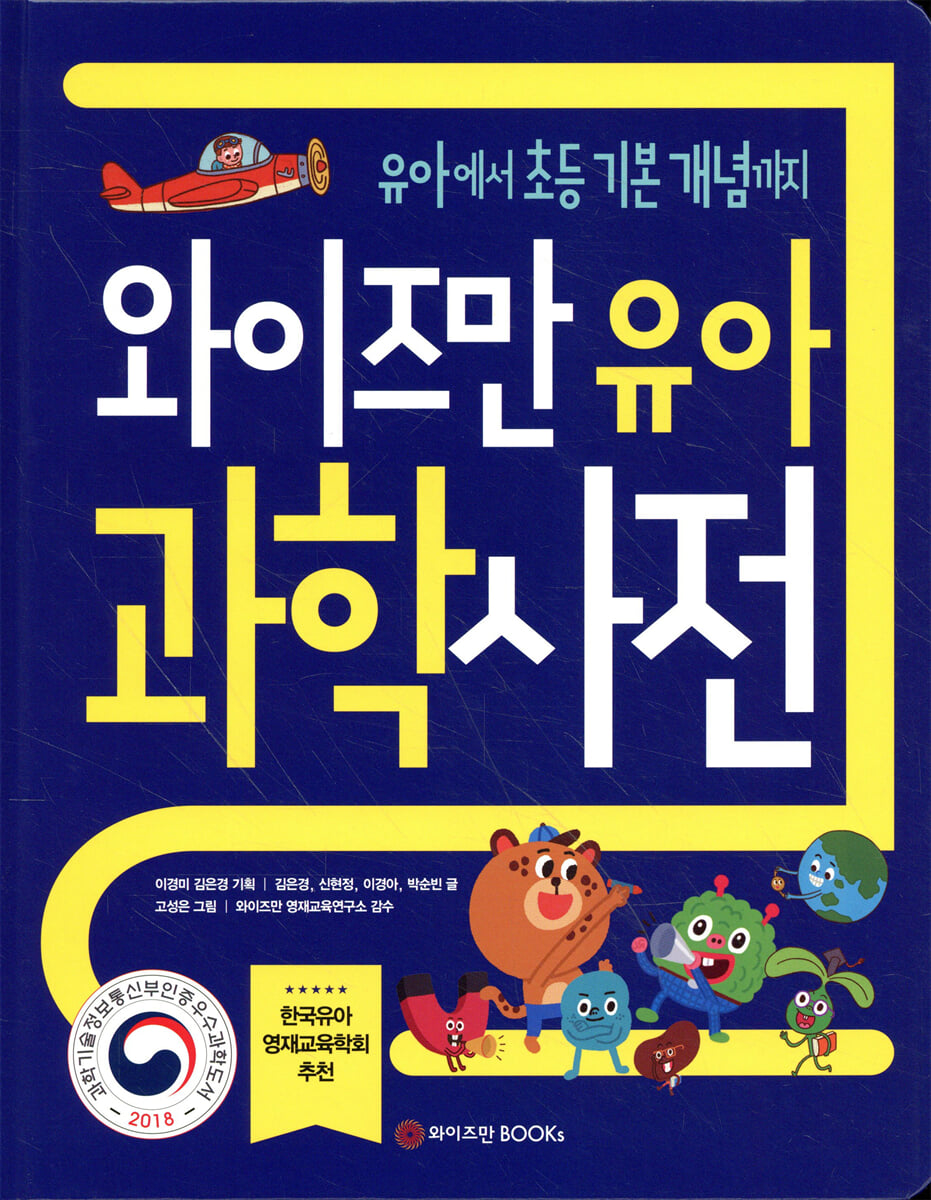
The "Wizmann Young Children's Science Dictionary" is the "Science" section of the "Wizmann Young Children's Dictionary Series." It is a new concept young children's dictionary that allows children to acquire basic background knowledge about science by selecting concepts that cover basic areas such as life, matter, motion and energy, and the Earth and space in line with the kindergarten curriculum and elementary science curriculum, and comprehensively encompassing recently emerging computer science technologies such as the Internet of Things (IoT), 3D printers, and virtual reality.
From planning to production, experts in early childhood education created the product from the perspective of a child and with the heart of a parent, tailored to the developmental characteristics of children at this stage.
This book is designed to match the characteristics of children's thinking development at this age, from the concrete to the abstract, from the whole to the part, and from the objects and phenomena commonly seen around us to invisible principles, taking into account the conceptual sequence and expandability, allowing children to gradually learn, build knowledge, and feel the satisfaction of growing their thoughts.
In addition, we structure science integration activities such as drawing, imitating, and coloring to match the developmental characteristics of children at this age who perceive the world through direct touching and manipulation, so that they can experience the world of science in a more interesting and familiar way through direct touching and manipulation.
The "Wizmann Young Children's Science Dictionary" is the "Science" section of the "Wizmann Young Children's Dictionary Series." It is a new concept young children's dictionary that allows children to acquire basic background knowledge about science by selecting concepts that cover basic areas such as life, matter, motion and energy, and the Earth and space in line with the kindergarten curriculum and elementary science curriculum, and comprehensively encompassing recently emerging computer science technologies such as the Internet of Things (IoT), 3D printers, and virtual reality.
From planning to production, experts in early childhood education created the product from the perspective of a child and with the heart of a parent, tailored to the developmental characteristics of children at this stage.
This book is designed to match the characteristics of children's thinking development at this age, from the concrete to the abstract, from the whole to the part, and from the objects and phenomena commonly seen around us to invisible principles, taking into account the conceptual sequence and expandability, allowing children to gradually learn, build knowledge, and feel the satisfaction of growing their thoughts.
In addition, we structure science integration activities such as drawing, imitating, and coloring to match the developmental characteristics of children at this age who perceive the world through direct touching and manipulation, so that they can experience the world of science in a more interesting and familiar way through direct touching and manipulation.
- You can preview some of the book's contents.
Preview
index
1.
life
animal
How are living things different? Animals and plants.
Where do animals live? Where do animals live?
What do animals eat? Herbivores and carnivores.
Why do they look different? Mating
Do the offspring resemble their mothers? Animal life cycle
What do puppies eat to grow? Mammals
How do birds fly? Birds
What animal does a crocodile resemble? Reptile
Where do frogs live? Amphibians
How do fish live in water? Fish
Do all animals have bones? Invertebrates
What do bugs look like? Insects
How do bugs grow? Metamorphosis
Thinking Science Play Animal Play
How was I born? Reproduction
Who do I resemble? Genetics
Will height continue to grow? Growth
Thinking Science Play Optical Illusion Play
2.
substance
What are blocks made of? Objects, substances
Can an apple change shape? Solid
Does water have a shape? Liquid
What's in the balloon? Gas
What happens when you mix them together? A mixture
Where did the sugar go? Solution
How does water change shape? Physical changes
Will bread turn back into flour? Chemical changes.
Why does it taste sour? Acids and bases
What do you need to start a fire? Combustion, extinguishment
Thinking Science Play Taste Play
plant
Are ginkgo and dogwood different? Trees, Grasses
How do plants stand? Do they grow upright or lying down? Stems
How do plants eat and live? Leaves
Why do plants bloom? Flowers, pollination
What do plant babies look like? Seeds
Why do plants release seeds? Seed dispersal
How do plants grow? The life cycle of a plant
How do plants survive the cold? Wintering
How do lotus flowers survive in water? Aquatic plants
What is similar to humans? Living things
Are molds alive? Microorganisms
What kinds of things get along well? Symbiosis, parasitism
Why do they look different? Adaptation
What to do when an enemy appears? Defensive action
Who will eat whom? Food chain
What kind of things live together? Ecosystem
Thinking Science Play Plant Play
3.
Exercise and Energy
What makes a bicycle move? Force
How do I change seats? Exercise
Why can't we stop right away? Inertia
Why do balls fall? Gravity
How to easily pull objects? Friction
How to use less force? Levers
Why are there winding roads? If it's sloped
How to lift objects easily? Pulley
What is the force that makes iron stick to itself? Magnetic force
What powers a fan? Electricity, current
Why can't we see in the dark? Light, shadows
How does a mirror reflect my appearance? Reflection of light
How to see through glasses? The refraction of light.
How does color arise? Dispersion of light
Why does it get hot or cold? Heat
How can I convey sound well? Sound
What heats an iron? Energy
Thinking Science Play Shadow Play
anatomy
What does my body look like? Body
Why do we get sunburned? Skin
Can you tell without seeing? Skin sensation
What is that hard thing to the touch? A bone
How can something be so hard that it bends? Joints (bone joints)
How does the body move? Muscles
What gives orders to the body? The brain
How are commands transmitted from the brain? Nerves
Why do eyes blink? Vision
How do ears hear sound? Hearing
How do we smell? The sense of smell
How do we know what it tastes like? Taste
How does the voice come out? Vocal cords (throat)
Why do we breathe?
Why does blood flow? Blood
Why are the shapes different for each tooth?
What happens to the cookies? Digestion
What happens if you don't eat? Nutrients
How do body wastes come out? Sweat, urine.
What protects our bodies? Immunity
4.
Earth and Space
How was soil formed? The surface
Is the shape of the land always the same? Topography
Are there layers on the ground? Strata
Where does the water flow? To the sea
Why is there smoke coming from the top of a volcano?
Why does the ground shake? Earthquakes
Did dinosaurs really live? Fossils
How are stones made? Rocks
What are gems made of? Minerals
Thinking Science Play Nature Play
What are those floating in the sky? Clouds
Why do water droplets fall from the sky? Rain, snow
What makes a kite fly? The wind
Will it be cold or hot tomorrow? Weather
Can we breathe in the sky? Atmosphere (air)
5.
computer
How to Command a Computer? Coding (Programming)
How smart are machines? Robots, artificial intelligence
Is it the same as the real world? Virtual reality, augmented reality
Can objects be created from just a drawing? 3D printers.
How will computers connect to each other? The Internet of Things
Thinking Science Play Computer Play
Publisher's Review
From infants to elementary school students,
From basic to advanced areas,
From scientific knowledge to an attitude of inquiry,
From conceptual principles to play activities
"The first science dictionary for everyday life that introduces the joy of science."
★Winner of the Republic of Korea Education Brand Award in the Gifted Education category for 14 consecutive years
★Recommended by the Korean Society for Gifted Early Childhood Education
★The second series of children's dictionary picture books created by Wiseman, a brand specializing in math/science gifted education.
A science dictionary for enjoying science in everyday life
Science is always close to us.
The apple I ate contains the seed of life, the insects and microorganisms I passed by without a second thought live alongside us, and the ripe apple falls to the ground—all of this is science.
The Weizmann Encyclopedia of Science for Young Children is the first guide to exploring science in everyday life, helping children discover and explore scientific concepts, phenomena, and principles found everywhere in our lives, thereby fostering their scientific abilities.
We help children prepare for their first encounter with science to encounter more enjoyable, more exciting, and more fun science.
A dictionary picture book that fosters a worldview and scientific attitude.
The child is a natural scientist.
I just stare at the ants I find on the road, and I look at my own reflection in the spoon I use to eat with wonder.
Such curiosity leads to questions, and questions naturally lead to a process of inquiry: observation, prediction, and experimentation.
The Wiseman Dictionary of Science for Young Children reminds us that the world we live in is a world of science, and that our lives are objects of scientific inquiry.
Furthermore, it helps children who are new to science to discover the joy of discovery and the fun of exploration, thereby revealing their innate scientific nature and opening their eyes to the exciting world of science.
A science language book that develops communication skills through conversations with childlike characters.
In line with the psychological development characteristics of children at this age, who easily identify with and become attached to those they feel close to, we have representative characters for each area who speak, think, and act like children, sometimes acting as friends and sometimes as teachers, thereby making it easier for children to immerse themselves in the book.
Characters appear at the right places to answer questions children might have while looking at the pictures and explanations, and even express what the child intuitively feels from the child's perspective.
Also, in line with the characteristics of language development in this period when children acquire communication skills through everyday conversations rather than writing, we move away from the conventional method of explaining terms and appropriately utilize conversational writing, questions and answers, examples and analogies as if talking to the child, so that language expression skills are naturally developed while enjoying the book.
A future-ready guide to the new ecological environment in the era of the Fourth Industrial Revolution.
The world is now entering the era of the 'Fourth Industrial Revolution', where artificial intelligence robots are at the forefront.
In these times when our lives are changing so rapidly that it can be called revolutionary, scientific knowledge and skills have become essential, not optional.
The best gift parents can give their children, who will live lives completely different from those of the 20th century, is to cultivate scientific knowledge, skills, and an attitude of scientific inquiry from an early age.
This is because, rather than memorizing fragmented knowledge or explaining facts, it is important to have an attitude that encourages inner curiosity, problem solving, and creative thinking.
The Wiseman Encyclopedia of Science for Young Children will provide a solid foundation for children growing up in the era of the Fourth Industrial Revolution, helping them to establish themselves in a new ecological environment.
1.
Essential basic concepts that young children and elementary school students need to know are organized by area and concept.
To facilitate clear concept acquisition and contextual understanding, this dictionary breaks away from the traditional alphabetical ordering method and adopts a field-based editing system that allows for the acquisition of related concepts together.
Science is a very structured discipline.
Concepts learned previously have connections to subsequent concepts.
Accordingly, in line with the early childhood curriculum and elementary science curriculum, we divided it into five areas by adding cutting-edge computer science technology, which has recently been attracting attention, to the basic areas of life (animals, plants, and the human body), matter, movement, and the earth.
Within that area, we have designed the concepts to progress from easy to advanced.
2.
Pictures and everyday language that children can understand at their level (text/picture aspects)
We present abstract concepts in a visually engaging way to make them easy to understand.
The principles of how leaves create nutrients through photosynthesis, the process by which blood circulates through our body, and the process by which volcanoes are created are all visualized at a level suitable for toddlers and younger children.
Just looking at the illustrations, which are sometimes cute and sometimes humorous, will make you smile, and if your child reads along naturally as if he or she were looking at a picture book on his or her own, he or she will be able to understand the concepts within the book as a whole.
Also, rather than defining concepts right away, we selected common questions that children have, such as “How do plants tolerate the cold?” and “What happens if they don’t eat?” as headings and structured the book so that children can find the answers themselves through introductory texts that open their minds.
The book is primarily written in a dialogue format, with appropriate use of metaphorical explanations, to make it feel like the child is having a conversation with the book.
3.
Play is linked to a scientific approach to everything around us.
From the introduction of the concept to the practice of looking at a dictionary and practicing it right away, we introduce experiments and activities in everyday life to naturally stimulate scientific curiosity and encourage reading.
In addition, after learning each area, we have included play activities such as finding, decorating, drawing, and following, so that you can experience the world of science in a more interesting and friendly way.
〈Tip Mom, Dad! Use it like this!〉
- Identify what the concept word is and ask your child what thoughts or questions come to mind related to it.
- Please try simple activities or everyday experiments introduced in the dictionary together.
- Read along with specific, realistic pictures and friendly explanations to help you understand scientific principles and get closer to the concepts.
- Please define the words and summarize them one last time.
- Keep it nearby and read it to your child like a picture book whenever he or she is bored.
From basic to advanced areas,
From scientific knowledge to an attitude of inquiry,
From conceptual principles to play activities
"The first science dictionary for everyday life that introduces the joy of science."
★Winner of the Republic of Korea Education Brand Award in the Gifted Education category for 14 consecutive years
★Recommended by the Korean Society for Gifted Early Childhood Education
★The second series of children's dictionary picture books created by Wiseman, a brand specializing in math/science gifted education.
A science dictionary for enjoying science in everyday life
Science is always close to us.
The apple I ate contains the seed of life, the insects and microorganisms I passed by without a second thought live alongside us, and the ripe apple falls to the ground—all of this is science.
The Weizmann Encyclopedia of Science for Young Children is the first guide to exploring science in everyday life, helping children discover and explore scientific concepts, phenomena, and principles found everywhere in our lives, thereby fostering their scientific abilities.
We help children prepare for their first encounter with science to encounter more enjoyable, more exciting, and more fun science.
A dictionary picture book that fosters a worldview and scientific attitude.
The child is a natural scientist.
I just stare at the ants I find on the road, and I look at my own reflection in the spoon I use to eat with wonder.
Such curiosity leads to questions, and questions naturally lead to a process of inquiry: observation, prediction, and experimentation.
The Wiseman Dictionary of Science for Young Children reminds us that the world we live in is a world of science, and that our lives are objects of scientific inquiry.
Furthermore, it helps children who are new to science to discover the joy of discovery and the fun of exploration, thereby revealing their innate scientific nature and opening their eyes to the exciting world of science.
A science language book that develops communication skills through conversations with childlike characters.
In line with the psychological development characteristics of children at this age, who easily identify with and become attached to those they feel close to, we have representative characters for each area who speak, think, and act like children, sometimes acting as friends and sometimes as teachers, thereby making it easier for children to immerse themselves in the book.
Characters appear at the right places to answer questions children might have while looking at the pictures and explanations, and even express what the child intuitively feels from the child's perspective.
Also, in line with the characteristics of language development in this period when children acquire communication skills through everyday conversations rather than writing, we move away from the conventional method of explaining terms and appropriately utilize conversational writing, questions and answers, examples and analogies as if talking to the child, so that language expression skills are naturally developed while enjoying the book.
A future-ready guide to the new ecological environment in the era of the Fourth Industrial Revolution.
The world is now entering the era of the 'Fourth Industrial Revolution', where artificial intelligence robots are at the forefront.
In these times when our lives are changing so rapidly that it can be called revolutionary, scientific knowledge and skills have become essential, not optional.
The best gift parents can give their children, who will live lives completely different from those of the 20th century, is to cultivate scientific knowledge, skills, and an attitude of scientific inquiry from an early age.
This is because, rather than memorizing fragmented knowledge or explaining facts, it is important to have an attitude that encourages inner curiosity, problem solving, and creative thinking.
The Wiseman Encyclopedia of Science for Young Children will provide a solid foundation for children growing up in the era of the Fourth Industrial Revolution, helping them to establish themselves in a new ecological environment.
1.
Essential basic concepts that young children and elementary school students need to know are organized by area and concept.
To facilitate clear concept acquisition and contextual understanding, this dictionary breaks away from the traditional alphabetical ordering method and adopts a field-based editing system that allows for the acquisition of related concepts together.
Science is a very structured discipline.
Concepts learned previously have connections to subsequent concepts.
Accordingly, in line with the early childhood curriculum and elementary science curriculum, we divided it into five areas by adding cutting-edge computer science technology, which has recently been attracting attention, to the basic areas of life (animals, plants, and the human body), matter, movement, and the earth.
Within that area, we have designed the concepts to progress from easy to advanced.
2.
Pictures and everyday language that children can understand at their level (text/picture aspects)
We present abstract concepts in a visually engaging way to make them easy to understand.
The principles of how leaves create nutrients through photosynthesis, the process by which blood circulates through our body, and the process by which volcanoes are created are all visualized at a level suitable for toddlers and younger children.
Just looking at the illustrations, which are sometimes cute and sometimes humorous, will make you smile, and if your child reads along naturally as if he or she were looking at a picture book on his or her own, he or she will be able to understand the concepts within the book as a whole.
Also, rather than defining concepts right away, we selected common questions that children have, such as “How do plants tolerate the cold?” and “What happens if they don’t eat?” as headings and structured the book so that children can find the answers themselves through introductory texts that open their minds.
The book is primarily written in a dialogue format, with appropriate use of metaphorical explanations, to make it feel like the child is having a conversation with the book.
3.
Play is linked to a scientific approach to everything around us.
From the introduction of the concept to the practice of looking at a dictionary and practicing it right away, we introduce experiments and activities in everyday life to naturally stimulate scientific curiosity and encourage reading.
In addition, after learning each area, we have included play activities such as finding, decorating, drawing, and following, so that you can experience the world of science in a more interesting and friendly way.
〈Tip Mom, Dad! Use it like this!〉
- Identify what the concept word is and ask your child what thoughts or questions come to mind related to it.
- Please try simple activities or everyday experiments introduced in the dictionary together.
- Read along with specific, realistic pictures and friendly explanations to help you understand scientific principles and get closer to the concepts.
- Please define the words and summarize them one last time.
- Keep it nearby and read it to your child like a picture book whenever he or she is bored.
GOODS SPECIFICS
- Date of issue: August 10, 2017
- Format: Hardcover book binding method guide
- Page count, weight, size: 264 pages | 752g | 193*244*19mm
- ISBN13: 9791187513261
- ISBN10: 1187513261
- KC Certification: Certification Type: Conformity Confirmation
You may also like
카테고리
korean


korean

![GQ KOREA Mark (Monthly): December [2025]](http://librairie.coreenne.fr/cdn/shop/files/8ef265dbbfbf186523ed75ba7319009d.jpg?v=1765340328&width=3840)


