

Report Presentation Practice Lecture
 |
Description
Book Introduction
Knowing your reporting patterns makes reporting much easier!
The art of reporting: delivering well-written reports effectively
At the beginning and end of every task, there is a ‘report.’
First, you have to write a good report and then deliver the well-written report properly.
Reporting is the most basic communication tool for performing work, and it is no exaggeration to say that it is the completion of work.
Even if you spend several nights writing a well-written report, if it doesn't move the hearts of your boss or clients, it can't be considered a successful report.
Reporting is always a difficult and often avoided task for office workers, but if you properly understand and learn the process from report preparation to presentation, reporting becomes much easier.
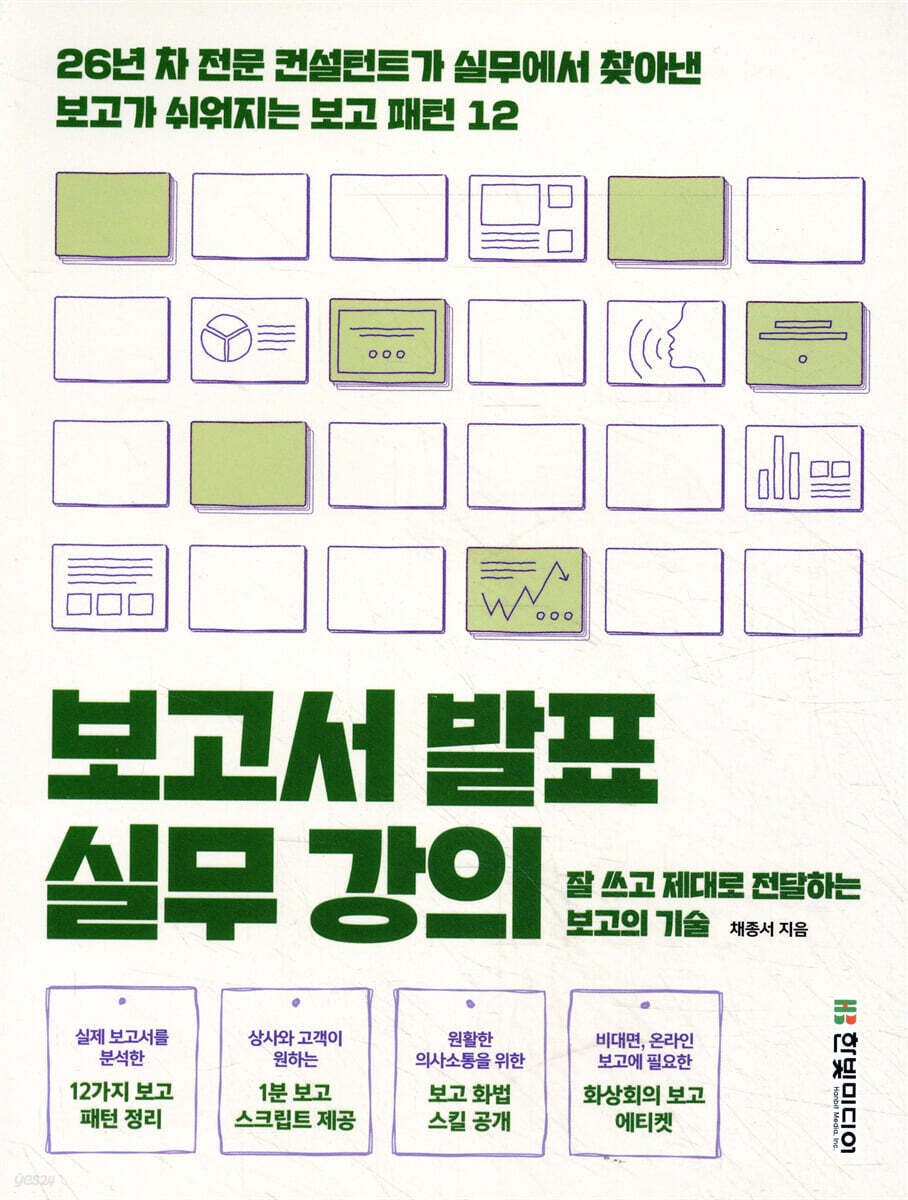
This book broadly divides reports into four types: planning, request, analysis, and explanation, and further categorizes these into 12 subtypes.
By mastering the 12 types of reports, you can learn the technique of business reporting using the 5-step (questions and answers → table of contents composition → message extraction → pattern selection → script writing) '3-step logical structure' that can convey the core message most logically.
If you learn the '1-minute reporting technique' that covers everything in detail so that you can immediately apply it in practice, as well as the speaking skills and posture required for a proper report, you will no longer be afraid of reporting.
The art of reporting: delivering well-written reports effectively
At the beginning and end of every task, there is a ‘report.’
First, you have to write a good report and then deliver the well-written report properly.
Reporting is the most basic communication tool for performing work, and it is no exaggeration to say that it is the completion of work.
Even if you spend several nights writing a well-written report, if it doesn't move the hearts of your boss or clients, it can't be considered a successful report.
Reporting is always a difficult and often avoided task for office workers, but if you properly understand and learn the process from report preparation to presentation, reporting becomes much easier.
This book broadly divides reports into four types: planning, request, analysis, and explanation, and further categorizes these into 12 subtypes.
By mastering the 12 types of reports, you can learn the technique of business reporting using the 5-step (questions and answers → table of contents composition → message extraction → pattern selection → script writing) '3-step logical structure' that can convey the core message most logically.
If you learn the '1-minute reporting technique' that covers everything in detail so that you can immediately apply it in practice, as well as the speaking skills and posture required for a proper report, you will no longer be afraid of reporting.
- You can preview some of the book's contents.
Preview
index
PART 01.
Basics of work performance, reporting skills
[Report Presentation Skills 01] Understanding Reports
What is a report?
Why reporting is difficult
Beginning of reporting, receiving work instructions
Reports must be logical.
3 Elements of Report Preparation
[Report Presentation Skills 02] Report Classification and Patterns
Examining the Four Types of Reports
Examining Five Patterns of Reporting
[Report Presentation Skills 03] Starting a 1-Minute Report Using a 3-Step Structure
Examining the 3-stage configuration
The three-stage speech method of [subtopic-main text-summary]
The 3-step EOB method of [Example-Key Summary-Benefits]
3-tier horizontal/vertical reporting structure
Take a look at the 1-minute report
The optimal time to convey the core message is 1 minute.
A 5-Step Process for Report Preparation
PART 02.
Planning report
[Report Presentation Skills 04] Proposal Reports that Present Opinions: The Purpose and Solution Must Be Revealed
Step 1.
Organizing questions and answers that properly define the intent of the directive
Step 2.
Organizing a table of contents that reveals problem solving
Step 3.
Deriving a lead message that continues the argument
Step 4.
Selecting a 3-step pattern of [Symptom-Cause-Solution]
Step 5.
Write a 1-minute report script
Read the script
[Report Presentation Skills 05] Improvement Reports that Present Solutions: The cause of the problem and the solution must be revealed.
Step 1.
Construct questions and answers by linking keywords
Step 2.
Organizing a table of contents that reveals problem solving
Step 3.
Identifying commonalities and differences as lead messages
Step 4.
Selecting a 3-step pattern: [Definition-Phenomena Analysis-Solution]
Step 5.
Write a 1-minute report script
Read the script
[Report Presentation Skills 06] Policy Reports that Provide Direction: The work direction and tasks to be promoted must be clearly stated.
Step 1.
Organize questions and answers with explanatory text
Step 2.
Organizing a table of contents that reveals your execution plan
Step 3.
Creating a lead message that demonstrates your commitment to action
Step 4.
Selecting a 3-step pattern: [Promotion Performance - Promotion Direction - Promotion Task]
Step 5.
Write a 1-minute report script
Read the script
Learning Summary
PART 03.
Explanation Report
[Report Presentation Skills 07] Reporting a Plan to Communicate Implementation: The operational objectives and specific actions must be clearly stated.
Step 1.
Organizing questions and answers that properly define the intent of the directive
Step 2.
Organizing a table of contents that reveals your plan
Step 3.
Deriving messages with clear steps
Step 4.
Selecting a 3-step pattern: [Background - Operational Plan - Operational Method]
Step 5.
Write a 1-minute report script
Read the script
[Report Presentation Skills 08] Results Reporting: Communicating Results and Implications
Step 1.
Structure questions and answers with your boss (customer) in mind.
Step 2.
Creating a table of contents that reveals the curriculum
Step 3.
Deriving messages that include improvements
Step 4.
Select the 3-step pattern of [Overview-Results-Improvements]
Step 5.
Write a 1-minute report script
Read the script
[Report Presentation Skills 09] Product/Service Reporting that Delivers Benefits: Attributes and Benefits Must Be Properly Presented
Step 1.
Organizing questions and answers from a user perspective
Step 2.
Create a table of contents that highlights key elements
Step 3.
Generating lead messages about specific elements
Step 4.
Choose a 3-step pattern that shows your storytelling.
Step 5.
Write a 1-minute report script
Read the script
Learning Summary
PART 04.
Request Report
[Report Presentation Skill 10] Collaborative Reporting that Urges Action: The Reasons for Collaboration and the Collaborative Actions Must Be Revealed
Step 1.
Explain the purpose and background of the project at the opening.
Step 2.
Provide a plan of action for what to do
Step 3.
Providing evidence for 'why'
Step 4.
Provide detailed action instructions on how to do it
Step 5.
End with words of encouragement and commitment
[Report Presentation Technique 11] Review Report to Confirm Validity: The purpose and content of the review must be disclosed.
Step 1.
Deriving answers to the questions you need to review
Step 2.
Create a table of contents that reveals the purpose of the review.
Step 3.
Using a checklist to derive messages
Step 4.
Choosing a classification pattern that suits your review report
Step 5.
Write a 1-minute report script
Read the script
[Report Presentation Skill 12] Response Reporting: Developing Countermeasures: Response methods and practical actions must be revealed.
Step 1.
Structure your questions and answers based on what your boss (customer) expects you to do.
Step 2.
Create a table of contents that includes a description of market changes and a detailed plan.
Step 3.
Eliciting messages to connect in the form of oral reports
Step 4.
Selecting patterns in multiple classification formats
Step 5.
Write a 1-minute report script
Read the script
Learning Summary
PART 05.
Analysis Report
[Report Presentation Skill 13] Reporting a Phenomenon to Confirm Facts: Revealing Implications Based on the Phenomenon
Step 1.
Organizing a table of contents appropriate for your report
Step 2.
Create a mandala block and write details
Step 3.
Creating messages that align with changing and policy demands
Step 4.
Write a 1-minute report script
Read the script
[Report Presentation Skill 14] Issue Reporting: Summarizing the Issues: Providing Policy Directions or Alternatives
Step 1.
Creating a table of contents appropriate for issue analysis
Step 2.
Deriving implications of environmental changes into lead messages
Step 3.
Write a 1-minute report script
Read the script
[Report Presentation Skill 15] Trend Reporting: Analyzing and Properly Sharing Social Change
Step 1.
Generating lead messages based on trend analysis data
Step 2.
Sort the report in 3-stage configuration
Step 3.
Write a 1-minute report script
Read the script
Learning Summary
PART 06.
Reporting skills
[Report Presentation Skills 16] Reporting Techniques for Creating Effective Reports
Reports that cause difficulties for bosses or customers
Bridging skills that go hand in hand
Mention the headline first
Using numbers
[Report Presentation Skills 17] The Right Voice Creates the Right Report
Change your voice and report
It's better to have a loud voice (Power = Volume)
Emphasize a point by changing the tone (Pitch = Emphasis)
Emphasize points with changes in speed (Pace = Rate)
[Report Presentation Skills 18] Proper Posture Makes for a Proper Report
Correct posture for reporting
Bad reporting posture
Confident reporting posture
[Report Presentation Skills 19] Expressing Your Intentions Properly Through Body Language
Body language speaks louder than words
Hands are a better means of communication than words.
Master your own hand gestures
[Report Presentation Skill 20] Look into their eyes and speak.
Look into the eyes and you will see the heart.
Why You Should Make Eye Contact
Make eye contact like this
[Report Presentation Skill 21] Report while understanding the other person's body language.
Hear what is not said with the mouth
Identify negative body language
If you hesitate, make it my side.
Non-face-to-face video conference reporting know-how
Search
Basics of work performance, reporting skills
[Report Presentation Skills 01] Understanding Reports
What is a report?
Why reporting is difficult
Beginning of reporting, receiving work instructions
Reports must be logical.
3 Elements of Report Preparation
[Report Presentation Skills 02] Report Classification and Patterns
Examining the Four Types of Reports
Examining Five Patterns of Reporting
[Report Presentation Skills 03] Starting a 1-Minute Report Using a 3-Step Structure
Examining the 3-stage configuration
The three-stage speech method of [subtopic-main text-summary]
The 3-step EOB method of [Example-Key Summary-Benefits]
3-tier horizontal/vertical reporting structure
Take a look at the 1-minute report
The optimal time to convey the core message is 1 minute.
A 5-Step Process for Report Preparation
PART 02.
Planning report
[Report Presentation Skills 04] Proposal Reports that Present Opinions: The Purpose and Solution Must Be Revealed
Step 1.
Organizing questions and answers that properly define the intent of the directive
Step 2.
Organizing a table of contents that reveals problem solving
Step 3.
Deriving a lead message that continues the argument
Step 4.
Selecting a 3-step pattern of [Symptom-Cause-Solution]
Step 5.
Write a 1-minute report script
Read the script
[Report Presentation Skills 05] Improvement Reports that Present Solutions: The cause of the problem and the solution must be revealed.
Step 1.
Construct questions and answers by linking keywords
Step 2.
Organizing a table of contents that reveals problem solving
Step 3.
Identifying commonalities and differences as lead messages
Step 4.
Selecting a 3-step pattern: [Definition-Phenomena Analysis-Solution]
Step 5.
Write a 1-minute report script
Read the script
[Report Presentation Skills 06] Policy Reports that Provide Direction: The work direction and tasks to be promoted must be clearly stated.
Step 1.
Organize questions and answers with explanatory text
Step 2.
Organizing a table of contents that reveals your execution plan
Step 3.
Creating a lead message that demonstrates your commitment to action
Step 4.
Selecting a 3-step pattern: [Promotion Performance - Promotion Direction - Promotion Task]
Step 5.
Write a 1-minute report script
Read the script
Learning Summary
PART 03.
Explanation Report
[Report Presentation Skills 07] Reporting a Plan to Communicate Implementation: The operational objectives and specific actions must be clearly stated.
Step 1.
Organizing questions and answers that properly define the intent of the directive
Step 2.
Organizing a table of contents that reveals your plan
Step 3.
Deriving messages with clear steps
Step 4.
Selecting a 3-step pattern: [Background - Operational Plan - Operational Method]
Step 5.
Write a 1-minute report script
Read the script
[Report Presentation Skills 08] Results Reporting: Communicating Results and Implications
Step 1.
Structure questions and answers with your boss (customer) in mind.
Step 2.
Creating a table of contents that reveals the curriculum
Step 3.
Deriving messages that include improvements
Step 4.
Select the 3-step pattern of [Overview-Results-Improvements]
Step 5.
Write a 1-minute report script
Read the script
[Report Presentation Skills 09] Product/Service Reporting that Delivers Benefits: Attributes and Benefits Must Be Properly Presented
Step 1.
Organizing questions and answers from a user perspective
Step 2.
Create a table of contents that highlights key elements
Step 3.
Generating lead messages about specific elements
Step 4.
Choose a 3-step pattern that shows your storytelling.
Step 5.
Write a 1-minute report script
Read the script
Learning Summary
PART 04.
Request Report
[Report Presentation Skill 10] Collaborative Reporting that Urges Action: The Reasons for Collaboration and the Collaborative Actions Must Be Revealed
Step 1.
Explain the purpose and background of the project at the opening.
Step 2.
Provide a plan of action for what to do
Step 3.
Providing evidence for 'why'
Step 4.
Provide detailed action instructions on how to do it
Step 5.
End with words of encouragement and commitment
[Report Presentation Technique 11] Review Report to Confirm Validity: The purpose and content of the review must be disclosed.
Step 1.
Deriving answers to the questions you need to review
Step 2.
Create a table of contents that reveals the purpose of the review.
Step 3.
Using a checklist to derive messages
Step 4.
Choosing a classification pattern that suits your review report
Step 5.
Write a 1-minute report script
Read the script
[Report Presentation Skill 12] Response Reporting: Developing Countermeasures: Response methods and practical actions must be revealed.
Step 1.
Structure your questions and answers based on what your boss (customer) expects you to do.
Step 2.
Create a table of contents that includes a description of market changes and a detailed plan.
Step 3.
Eliciting messages to connect in the form of oral reports
Step 4.
Selecting patterns in multiple classification formats
Step 5.
Write a 1-minute report script
Read the script
Learning Summary
PART 05.
Analysis Report
[Report Presentation Skill 13] Reporting a Phenomenon to Confirm Facts: Revealing Implications Based on the Phenomenon
Step 1.
Organizing a table of contents appropriate for your report
Step 2.
Create a mandala block and write details
Step 3.
Creating messages that align with changing and policy demands
Step 4.
Write a 1-minute report script
Read the script
[Report Presentation Skill 14] Issue Reporting: Summarizing the Issues: Providing Policy Directions or Alternatives
Step 1.
Creating a table of contents appropriate for issue analysis
Step 2.
Deriving implications of environmental changes into lead messages
Step 3.
Write a 1-minute report script
Read the script
[Report Presentation Skill 15] Trend Reporting: Analyzing and Properly Sharing Social Change
Step 1.
Generating lead messages based on trend analysis data
Step 2.
Sort the report in 3-stage configuration
Step 3.
Write a 1-minute report script
Read the script
Learning Summary
PART 06.
Reporting skills
[Report Presentation Skills 16] Reporting Techniques for Creating Effective Reports
Reports that cause difficulties for bosses or customers
Bridging skills that go hand in hand
Mention the headline first
Using numbers
[Report Presentation Skills 17] The Right Voice Creates the Right Report
Change your voice and report
It's better to have a loud voice (Power = Volume)
Emphasize a point by changing the tone (Pitch = Emphasis)
Emphasize points with changes in speed (Pace = Rate)
[Report Presentation Skills 18] Proper Posture Makes for a Proper Report
Correct posture for reporting
Bad reporting posture
Confident reporting posture
[Report Presentation Skills 19] Expressing Your Intentions Properly Through Body Language
Body language speaks louder than words
Hands are a better means of communication than words.
Master your own hand gestures
[Report Presentation Skill 20] Look into their eyes and speak.
Look into the eyes and you will see the heart.
Why You Should Make Eye Contact
Make eye contact like this
[Report Presentation Skill 21] Report while understanding the other person's body language.
Hear what is not said with the mouth
Identify negative body language
If you hesitate, make it my side.
Non-face-to-face video conference reporting know-how
Search
Detailed image

Publisher's Review
What kind of readers is this book for?
-Workers who have a lot of document (report) writing and reporting work (civil service, public institutions, various research institutes, planning work, etc.)
- Employees who must convey their work, progress direction, and objectives to superiors and customers, starting with oral work reports.
- Personnel in charge of tasks that require persuading collaborating and related departments or frequent coordination of opinions with superiors, customers, and team members
Use the '12 Reporting Patterns' discovered in practice!
The author, a professional HRD consultant, has divided practical reports into four types based on his field experience and know-how accumulated over 26 years of experience with various reports.
Based on the purpose of the report and the decision-making form, it was divided into planning report, request report, explanation report, and analysis report, and then further divided into 12 detailed types to create a pattern.
The 12 reporting patterns are derived from patterns frequently used in actual reports. By using these patterns to organize reports, you will be able to present proper reports to your superiors and customers without any problems.
Follow the '1-minute report technique' through a 3-step logic structure!
The key to reporting is to repeat important information so that it is memorable and to convey it logically and concisely.
This book utilizes a three-step logical structure that can most logically convey the core message through five steps: questions and answers → table of contents structure → message derivation → pattern selection → script writing.
Then, practice reporting the derived key points within one minute.
One minute is the optimal amount of time to convey your message concisely and without unnecessary details.
After understanding the 12 reporting patterns introduced above and repeating the 1-minute reporting technique using the 3-step logic structure several times, you will no longer be afraid of reporting.
Master the 'perfect reporting skills' your boss and clients want!
In order for office workers to communicate smoothly, they must acquire reporting skills.
This book presents various reporting situations and compares and analyzes good and bad reporting.
At this time, we presented reporting skills that can be utilized in reporting situations, such as reporting style, voice, posture, body language, eye contact, and gestures, so that readers can acquire proper reporting skills.
Furthermore, it includes reporting etiquette for non-face-to-face, online, and video conferences applicable to the COVID-19 situation, helping you deliver the reports your superiors and clients want.
-Workers who have a lot of document (report) writing and reporting work (civil service, public institutions, various research institutes, planning work, etc.)
- Employees who must convey their work, progress direction, and objectives to superiors and customers, starting with oral work reports.
- Personnel in charge of tasks that require persuading collaborating and related departments or frequent coordination of opinions with superiors, customers, and team members
Use the '12 Reporting Patterns' discovered in practice!
The author, a professional HRD consultant, has divided practical reports into four types based on his field experience and know-how accumulated over 26 years of experience with various reports.
Based on the purpose of the report and the decision-making form, it was divided into planning report, request report, explanation report, and analysis report, and then further divided into 12 detailed types to create a pattern.
The 12 reporting patterns are derived from patterns frequently used in actual reports. By using these patterns to organize reports, you will be able to present proper reports to your superiors and customers without any problems.
Follow the '1-minute report technique' through a 3-step logic structure!
The key to reporting is to repeat important information so that it is memorable and to convey it logically and concisely.
This book utilizes a three-step logical structure that can most logically convey the core message through five steps: questions and answers → table of contents structure → message derivation → pattern selection → script writing.
Then, practice reporting the derived key points within one minute.
One minute is the optimal amount of time to convey your message concisely and without unnecessary details.
After understanding the 12 reporting patterns introduced above and repeating the 1-minute reporting technique using the 3-step logic structure several times, you will no longer be afraid of reporting.
Master the 'perfect reporting skills' your boss and clients want!
In order for office workers to communicate smoothly, they must acquire reporting skills.
This book presents various reporting situations and compares and analyzes good and bad reporting.
At this time, we presented reporting skills that can be utilized in reporting situations, such as reporting style, voice, posture, body language, eye contact, and gestures, so that readers can acquire proper reporting skills.
Furthermore, it includes reporting etiquette for non-face-to-face, online, and video conferences applicable to the COVID-19 situation, helping you deliver the reports your superiors and clients want.
GOODS SPECIFICS
- Date of issue: May 31, 2021
- Page count, weight, size: 232 pages | 170*225*20mm
- ISBN13: 9791162244388
- ISBN10: 1162244380
You may also like
카테고리
korean


korean

![ELLE 엘르 스페셜 에디션 A형 : 12월 [2025]](http://librairie.coreenne.fr/cdn/shop/files/b8e27a3de6c9538896439686c6b0e8fb.jpg?v=1766436872&width=3840)


