

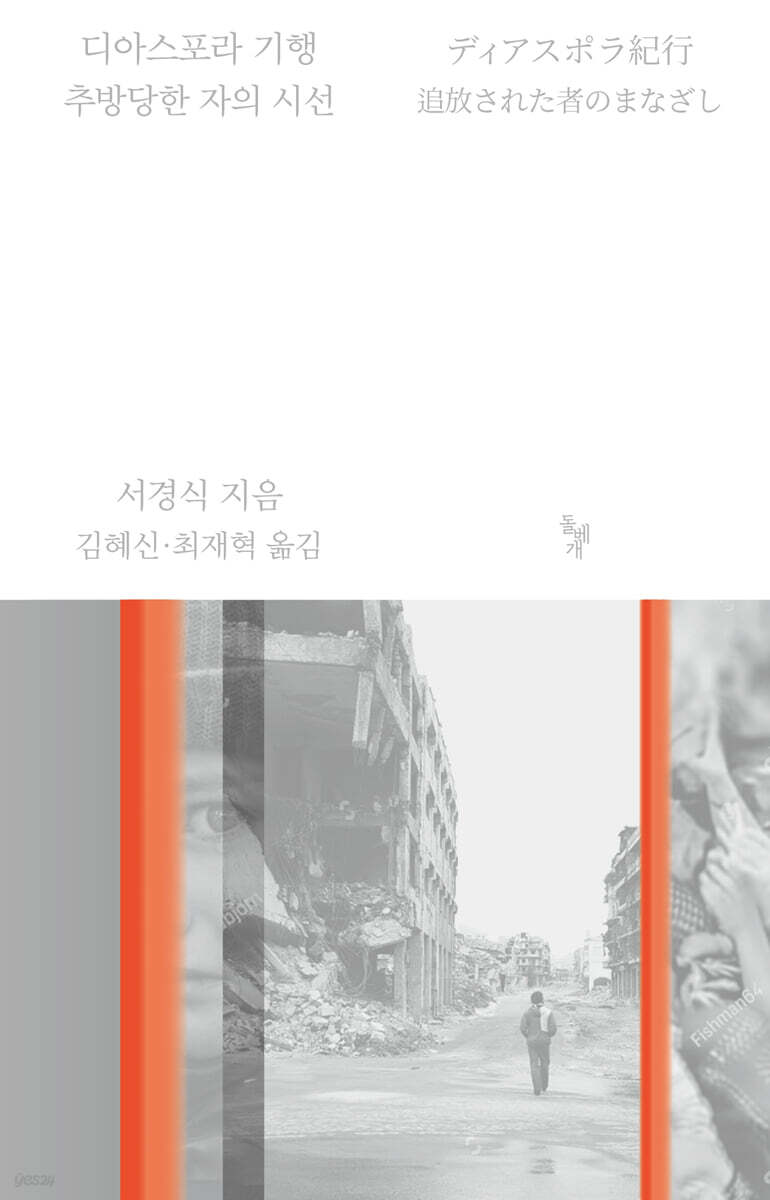
Diaspora Travelogue
 |
Description
Book Introduction
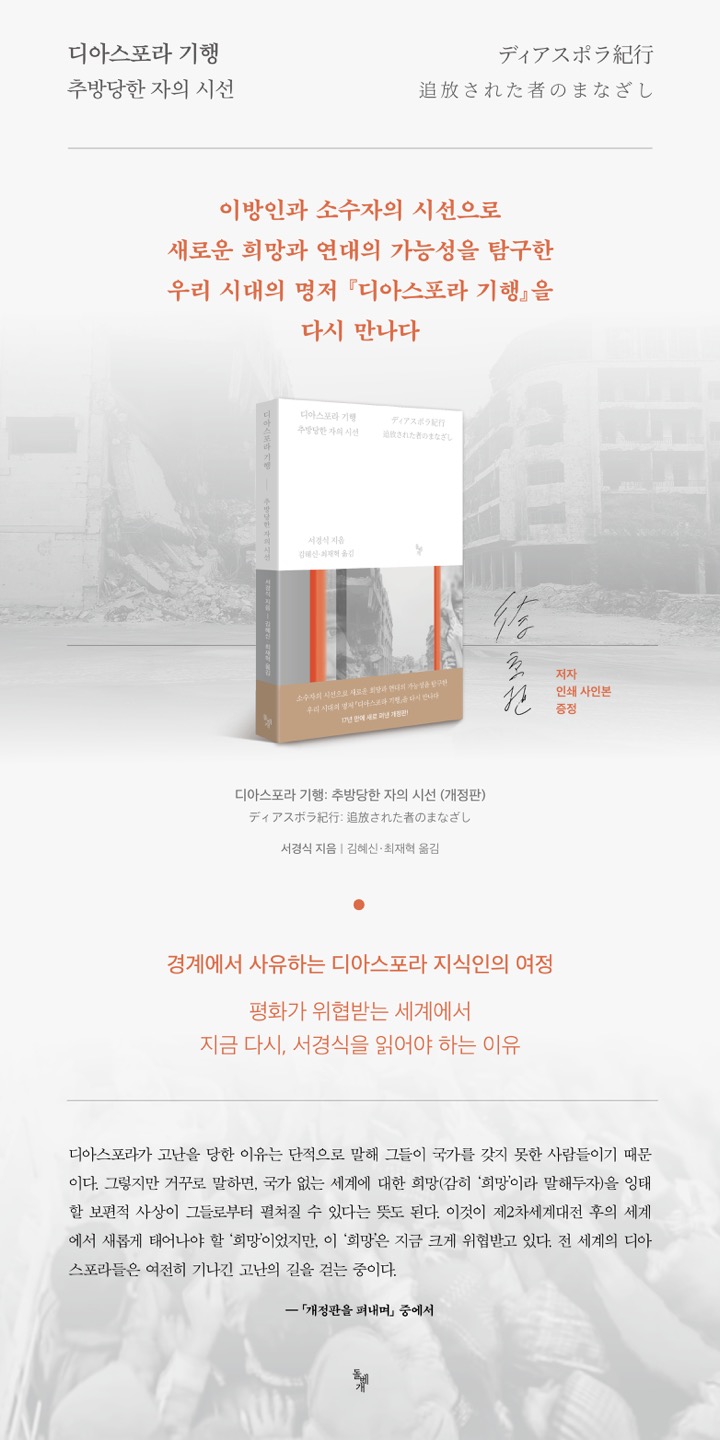
Exploring the possibilities of new hope and solidarity through the perspectives of minorities
Revisiting the masterpiece of our time, "Diaspora Travels"
Author Seo Kyung-sik's "Diaspora Travels," which has consistently enjoyed the support of readers for over 30 years, is reunited with readers in a revised edition.
This book, along with “My Pilgrimage to Western Art,” which first introduced him to Korea in 1992, is a representative work that left a deep resonance in Korean society, and is being republished after 17 years.
Even after the publication of the first edition, the book is even more meaningful because it includes a "Preface to the Revised Edition," which critically diagnoses the difficulties we face amidst the ceaseless war and violence around the world, and the ever-increasing threat of military force even at this very moment, and looks ahead to the future.
Revisiting the masterpiece of our time, "Diaspora Travels"
Author Seo Kyung-sik's "Diaspora Travels," which has consistently enjoyed the support of readers for over 30 years, is reunited with readers in a revised edition.
This book, along with “My Pilgrimage to Western Art,” which first introduced him to Korea in 1992, is a representative work that left a deep resonance in Korean society, and is being republished after 17 years.
Even after the publication of the first edition, the book is even more meaningful because it includes a "Preface to the Revised Edition," which critically diagnoses the difficulties we face amidst the ceaseless war and violence around the world, and the ever-increasing threat of military force even at this very moment, and looks ahead to the future.
- You can preview some of the book's contents.
Preview
index
In publishing the revised edition
Publishing the Korean edition
Prologue | A Carp in the Water Stagnant in a Wheel Rut
Ⅰ.
A Day to Think About Death: London, December 2001
Marx's Grave | The Self-Destructing World | Primo Levi | The Daily Life of Self-Destruction | The Eleventh Floor Window | We, the Exiles | The Japanese Mind | The Nationalization of the Dead | The Immortal Community | Parsifal | The People of the Holy Grail
Ⅱ.
Memories of Violence: Gwangju, March 1990 and May 2000
Mangwol-dong | A certain older sister | A grass-covered grave | Gwangju, forever! | Biennale | Who am I? | Shirin Neshat | Red high heels | To the vast sea | Sleeper | Manhole | Human Rights Exhibition for Koreans in Japan | Hwajagu
Ⅲ.
The Great Distortion: Kassel, August 2002
Out of the Blue | Documenta | Disgusting Feelings | Double Diaspora | Beautiful Tropical Landscapes
Ⅳ.
The Exiled
1.
Self-Portrait of a Refugee: Brussels, Osnabrück, May 2002
Breindonk Fortress | Osnabrück | Life as a Refugee | The Wall of Death | Self-Portrait of an Exile
2.
Yesterday's World: Salzburg, Summer 2002, Summer 2004
Danae's Love | Yesterday's World | Paper and Stamps | The City of Death
3.
Three Jews
Force and Impossibility | Exiled from Culture | Only Language as Mother Tongue | The Graveyard of Thie
Epilogue | Korean Diaspora Art
Publishing the Korean edition
Prologue | A Carp in the Water Stagnant in a Wheel Rut
Ⅰ.
A Day to Think About Death: London, December 2001
Marx's Grave | The Self-Destructing World | Primo Levi | The Daily Life of Self-Destruction | The Eleventh Floor Window | We, the Exiles | The Japanese Mind | The Nationalization of the Dead | The Immortal Community | Parsifal | The People of the Holy Grail
Ⅱ.
Memories of Violence: Gwangju, March 1990 and May 2000
Mangwol-dong | A certain older sister | A grass-covered grave | Gwangju, forever! | Biennale | Who am I? | Shirin Neshat | Red high heels | To the vast sea | Sleeper | Manhole | Human Rights Exhibition for Koreans in Japan | Hwajagu
Ⅲ.
The Great Distortion: Kassel, August 2002
Out of the Blue | Documenta | Disgusting Feelings | Double Diaspora | Beautiful Tropical Landscapes
Ⅳ.
The Exiled
1.
Self-Portrait of a Refugee: Brussels, Osnabrück, May 2002
Breindonk Fortress | Osnabrück | Life as a Refugee | The Wall of Death | Self-Portrait of an Exile
2.
Yesterday's World: Salzburg, Summer 2002, Summer 2004
Danae's Love | Yesterday's World | Paper and Stamps | The City of Death
3.
Three Jews
Force and Impossibility | Exiled from Culture | Only Language as Mother Tongue | The Graveyard of Thie
Epilogue | Korean Diaspora Art
Detailed image
Into the book
As Russia's invasion of Ukraine continues, destruction is widespread and a vast number of casualties and refugees are created, but there is no sign of an end to the war.
The United Nations, which had somehow managed to sustain the international order during World War II, fell into a state of complete dysfunction.
It feels like the use of nuclear weapons is becoming a reality.
The agony of those who have been driven out of their hometowns and have lost their homes is deepening.
It is truly a harsh 'midwinter' for the diaspora.
Even in Europe, or even in East Asia where we live, I have a terrible premonition that the day may come when nuclear weapons, which have been sealed for decades, will be used.
(…)
The reason the diaspora suffers is simply because they are a people without a state.
But conversely, it also means that they can unfold a universal idea that will conceive of hope (let's dare to say 'hope') for a world without a state.
This was the 'hope' that had to be reborn in the post-World War II world, but this 'hope' is now under great threat.
Diaspora around the world still face a long and difficult journey.
--- p.7-9, from “Preparing the Revised Edition”
The reason I made such an attempt was because I was strongly drawn to the thoughts of European Jewish diaspora intellectuals, including Primo Levi, Paul Celan, Jean Améry, and Stefan Zweig, who are also discussed in this book.
Their ideological actions contain universal appeals and lessons that should be pondered not only by the narrow circle of Jews, but also by many people around the world living in difficult times since the modern era (this includes, of course, our own "Joseon people").
We need to learn their thoughts so that we can understand ourselves from a broader perspective and on a longer scale.
--- p.9-10, from “Preparing the Revised Edition”
In this book, we look not only at written texts but also at various works of art to understand the diaspora.
This is because I believed that in order to understand the diaspora more deeply, we need to rely not only on written texts, but also on the imagination stimulated by non-written texts.
The title "Travelogue" was chosen, and the author's position as a writer observing and describing the subject was kept in a state of constant flux. Furthermore, the author chose to refer to numerous works of art and, so to speak, to narrate the work through dialogue with the works, all stemmed from the concerns discussed so far.
--- p.10-11, from “Preparing the Revised Edition”
Even objects that appear fixed and stable appear different when the person viewing them moves unsteadily.
Things or ideas that the majority believes to be fixed and stable are actually fluid and unstable in the eyes of the minority.
This article is an attempt by a single diaspora person, 'I', to explore the origins and significance of modern diasporic life through the social aspects and works of art I encountered in each place while traveling to London, Salzburg, Kassel, and Gwangju.
If the existence of the diaspora is a historical artifact unique to the modern era, this attempt is to revisit the "modern era" through the diaspora's perspective and to explore the possibilities of humanity "after the modern era."
The United Nations, which had somehow managed to sustain the international order during World War II, fell into a state of complete dysfunction.
It feels like the use of nuclear weapons is becoming a reality.
The agony of those who have been driven out of their hometowns and have lost their homes is deepening.
It is truly a harsh 'midwinter' for the diaspora.
Even in Europe, or even in East Asia where we live, I have a terrible premonition that the day may come when nuclear weapons, which have been sealed for decades, will be used.
(…)
The reason the diaspora suffers is simply because they are a people without a state.
But conversely, it also means that they can unfold a universal idea that will conceive of hope (let's dare to say 'hope') for a world without a state.
This was the 'hope' that had to be reborn in the post-World War II world, but this 'hope' is now under great threat.
Diaspora around the world still face a long and difficult journey.
--- p.7-9, from “Preparing the Revised Edition”
The reason I made such an attempt was because I was strongly drawn to the thoughts of European Jewish diaspora intellectuals, including Primo Levi, Paul Celan, Jean Améry, and Stefan Zweig, who are also discussed in this book.
Their ideological actions contain universal appeals and lessons that should be pondered not only by the narrow circle of Jews, but also by many people around the world living in difficult times since the modern era (this includes, of course, our own "Joseon people").
We need to learn their thoughts so that we can understand ourselves from a broader perspective and on a longer scale.
--- p.9-10, from “Preparing the Revised Edition”
In this book, we look not only at written texts but also at various works of art to understand the diaspora.
This is because I believed that in order to understand the diaspora more deeply, we need to rely not only on written texts, but also on the imagination stimulated by non-written texts.
The title "Travelogue" was chosen, and the author's position as a writer observing and describing the subject was kept in a state of constant flux. Furthermore, the author chose to refer to numerous works of art and, so to speak, to narrate the work through dialogue with the works, all stemmed from the concerns discussed so far.
--- p.10-11, from “Preparing the Revised Edition”
Even objects that appear fixed and stable appear different when the person viewing them moves unsteadily.
Things or ideas that the majority believes to be fixed and stable are actually fluid and unstable in the eyes of the minority.
This article is an attempt by a single diaspora person, 'I', to explore the origins and significance of modern diasporic life through the social aspects and works of art I encountered in each place while traveling to London, Salzburg, Kassel, and Gwangju.
If the existence of the diaspora is a historical artifact unique to the modern era, this attempt is to revisit the "modern era" through the diaspora's perspective and to explore the possibilities of humanity "after the modern era."
--- p.27, from "Prologue"
Publisher's Review
The Journey of a Diaspora Intellectual Thinking at the Border
In a world where peace is threatened
Why You Should Read Seo Kyung-sik Again Now
As is well known, Seo Kyung-sik is a second-generation Korean-Japanese born in Kyoto, Japan in 1951.
In 1971, he contributed to the Korean democracy movement by participating in the rescue activities of his older brothers, Seo Seung and Seo Jun-sik, who were arrested in connection with the "Korean-Japanese Student Spy Ring Incident."
This experience became the foundation for his subsequent writing, and he has written articles that reflect the perspective of a minority, both as a Zainichi Korean and as a member of the diaspora.
『Diaspora Travels』 is a humanities essay in which Seo Kyung-sik reflects on ‘modern times’ and explores the possibilities of humanity ‘after modern times’ while traveling to London, Salzburg, Kassel, Gwangju, and other places.
The word 'diaspora' originally comes from a Greek word meaning 'dispersion', and refers to the Diaspora Jews and their communities who left the land of Palestine and are living around the world.
However, in this book, the author expands the scope of his thinking and redefines the concept of 'deconstruction' by referring to all people who were forced to leave the communities and lands they belonged to.
In this book, he not only attempts to deconstruct the term diaspora, but also expands his perspective to various works of art, including written texts, in order to more deeply understand the existence of diaspora.
In addition, by introducing the format of ‘travelogue’, the author, who describes the subject, positions himself in a fluid position.
Living as an outsider and a minority in a society, as a Zainichi Korean speaking the language of the one who once ruled my people as my mother tongue, means living a life in which I must constantly ask myself who I am and why I am different from others.
As a diasporic intellectual who thinks on the border, his journey delicately captures truths that only a few layers of minorities can perceive.
Seo Kyung-sik's prose, which portrays the "exiled" living with an unstable identity, resonates even more profoundly when combined with his own life, which has confronted the twists and turns of modern history.
In an age where force threatens hope,
Thinking about the hopes of the powerless
Reading the stories of the diaspora, people who have been forced to live 'outside' by others and who have no choice but to live with confusion about their identity as a given condition, calls for reflection and introspection from the majority who have lived without knowing the pain due to ignorance.
Seo Kyung-sik vividly portrays the lives of the diaspora on the border through his own experiences, and helps readers realize that the wounds of the diaspora are not just theirs.
Instead of trying to ignore the other person's pain with dull words of sympathy, he takes a step closer to embracing it as his own.
Therefore, only through the experience of reading his writing can readers resonate with the world seen through the eyes of a diaspora intellectual named Seo Kyung-sik.
From the first edition to the revised edition, international peace remains a distant prospect, but in the meantime, Korean society's understanding of the diaspora has made some progress.
Attention is focused on the new waves that 『Diaspora Travels』, rereading between what has changed and what has not, will create.
In particular, we are very much looking forward to the response from long-time readers who have cherished Seo Kyung-sik's works, as well as from the next generation of readers who are encountering his thoughts for the first time through this revised edition.
In the main text of the book, Seo Kyung-sik introduces the metaphor of ‘throw-in communication’ (投?通信) by quoting Paul Celan’s lecture commemorating the Bremen Literature Prize in 1958.
“It means that it is an attempt at communication with a glimmer of hope that it might be delivered to future readers in an unfamiliar land, like throwing a bottle containing a letter into the sea” (pp. 259-260).
He reflected on Celan's words in his essay, Eyes of the Diaspora (Hankyoreh Publishing, 2012), saying, "Writing is like putting a letter in an empty bottle and letting it float away to the sea, or throwing a stone into the darkness." (Eyes of the Diaspora, p. 274)
A diaspora intellectual, entering his prime, has once again presented us with a piece of writing that, like throwing stones at the darkness, seeks not to give up on the possibility of hope through solidarity between 'pain' and 'memory.'
Now it's your turn to open that desperate letter.
In a world where peace is threatened
Why You Should Read Seo Kyung-sik Again Now
As is well known, Seo Kyung-sik is a second-generation Korean-Japanese born in Kyoto, Japan in 1951.
In 1971, he contributed to the Korean democracy movement by participating in the rescue activities of his older brothers, Seo Seung and Seo Jun-sik, who were arrested in connection with the "Korean-Japanese Student Spy Ring Incident."
This experience became the foundation for his subsequent writing, and he has written articles that reflect the perspective of a minority, both as a Zainichi Korean and as a member of the diaspora.
『Diaspora Travels』 is a humanities essay in which Seo Kyung-sik reflects on ‘modern times’ and explores the possibilities of humanity ‘after modern times’ while traveling to London, Salzburg, Kassel, Gwangju, and other places.
The word 'diaspora' originally comes from a Greek word meaning 'dispersion', and refers to the Diaspora Jews and their communities who left the land of Palestine and are living around the world.
However, in this book, the author expands the scope of his thinking and redefines the concept of 'deconstruction' by referring to all people who were forced to leave the communities and lands they belonged to.
In this book, he not only attempts to deconstruct the term diaspora, but also expands his perspective to various works of art, including written texts, in order to more deeply understand the existence of diaspora.
In addition, by introducing the format of ‘travelogue’, the author, who describes the subject, positions himself in a fluid position.
Living as an outsider and a minority in a society, as a Zainichi Korean speaking the language of the one who once ruled my people as my mother tongue, means living a life in which I must constantly ask myself who I am and why I am different from others.
As a diasporic intellectual who thinks on the border, his journey delicately captures truths that only a few layers of minorities can perceive.
Seo Kyung-sik's prose, which portrays the "exiled" living with an unstable identity, resonates even more profoundly when combined with his own life, which has confronted the twists and turns of modern history.
In an age where force threatens hope,
Thinking about the hopes of the powerless
Reading the stories of the diaspora, people who have been forced to live 'outside' by others and who have no choice but to live with confusion about their identity as a given condition, calls for reflection and introspection from the majority who have lived without knowing the pain due to ignorance.
Seo Kyung-sik vividly portrays the lives of the diaspora on the border through his own experiences, and helps readers realize that the wounds of the diaspora are not just theirs.
Instead of trying to ignore the other person's pain with dull words of sympathy, he takes a step closer to embracing it as his own.
Therefore, only through the experience of reading his writing can readers resonate with the world seen through the eyes of a diaspora intellectual named Seo Kyung-sik.
From the first edition to the revised edition, international peace remains a distant prospect, but in the meantime, Korean society's understanding of the diaspora has made some progress.
Attention is focused on the new waves that 『Diaspora Travels』, rereading between what has changed and what has not, will create.
In particular, we are very much looking forward to the response from long-time readers who have cherished Seo Kyung-sik's works, as well as from the next generation of readers who are encountering his thoughts for the first time through this revised edition.
In the main text of the book, Seo Kyung-sik introduces the metaphor of ‘throw-in communication’ (投?通信) by quoting Paul Celan’s lecture commemorating the Bremen Literature Prize in 1958.
“It means that it is an attempt at communication with a glimmer of hope that it might be delivered to future readers in an unfamiliar land, like throwing a bottle containing a letter into the sea” (pp. 259-260).
He reflected on Celan's words in his essay, Eyes of the Diaspora (Hankyoreh Publishing, 2012), saying, "Writing is like putting a letter in an empty bottle and letting it float away to the sea, or throwing a stone into the darkness." (Eyes of the Diaspora, p. 274)
A diaspora intellectual, entering his prime, has once again presented us with a piece of writing that, like throwing stones at the darkness, seeks not to give up on the possibility of hope through solidarity between 'pain' and 'memory.'
Now it's your turn to open that desperate letter.
GOODS SPECIFICS
- Date of issue: September 15, 2023
- Page count, weight, size: 280 pages | 430g | 135*210*20mm
- ISBN13: 9791192836270
- ISBN10: 1192836278
You may also like
카테고리
korean


korean

![GQ KOREA Mark (Monthly): December [2025]](http://librairie.coreenne.fr/cdn/shop/files/8ef265dbbfbf186523ed75ba7319009d.jpg?v=1765340328&width=3840)


