

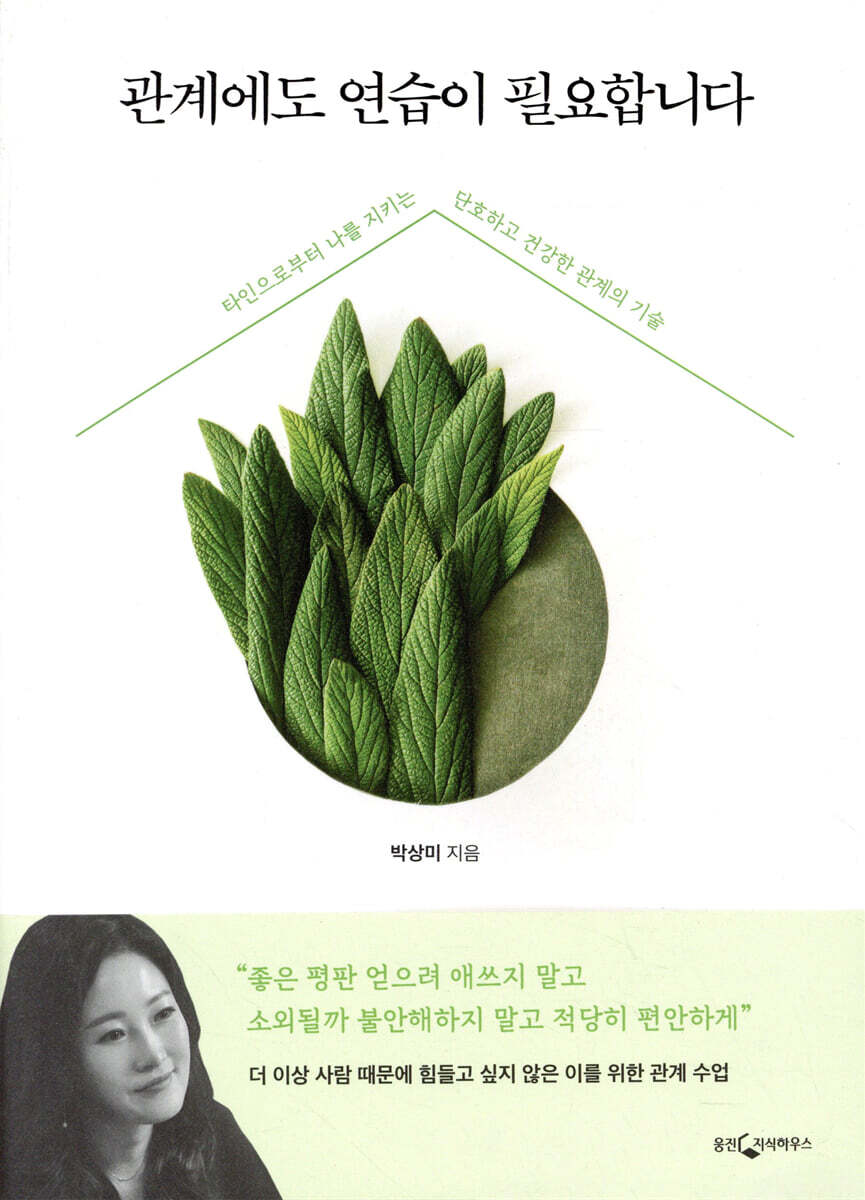
Relationships also require practice
 |
Description
Book Introduction
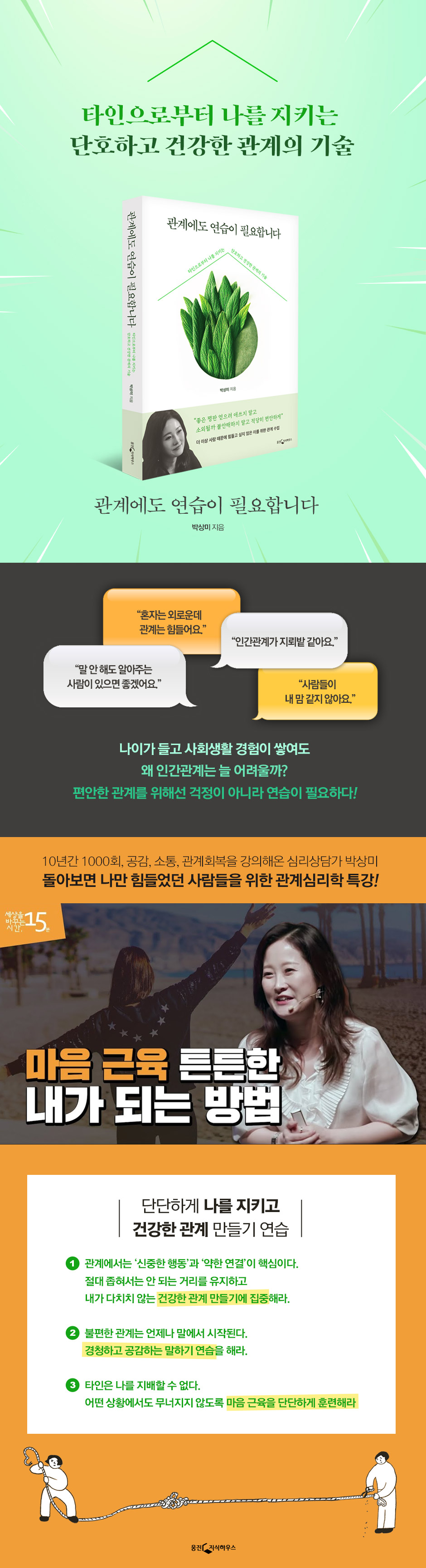
Relationship classes for those who don't want to be bothered by people anymore. I have lectured on empathy, communication, and relationship recovery more than 1,000 times over the past 10 years. A special lecture on relationship psychology by psychologist Sangmi Park! “When I communicate via email, I have to be more careful with my expressions than when I talk face-to-face, and I feel more nervous about misunderstandings.” “Working from home, I find myself fighting with my family so much, it’s like we’re having a tantrum.” “As the time spent not meeting people increases, I feel depressed, lethargic, and even develop social phobia.” We can no longer go back to the pre-COVID-19 situation. Even after the COVID-19 pandemic ends, the rapidly changing communication system will not revert to an offline-centric approach. To become more flexible in building relationships and communicating without boundaries between offline and online, we need more 'relationship practice' than before. Even as we grow older and gain experience, interpersonal relationships remain difficult and our emotions remain uncomfortable. The stress and hurt that comes from relationships with others can become a bomb that destroys our daily lives if we are not prepared for it. The author, who has taught over 1,000 relationship classes over the past 10 years, introduces proven, practical methods that anyone can use, practice, and put into practice. "Relationships Require Practice" not only provides techniques for dealing with others with dignity, but also provides friendly guidance on how to maintain healthy relationships in this new era. |
- You can preview some of the book's contents.
Preview
index
Prologue We all want to be connected, actually 4
Chapter 1: Interpersonal Relationship Practice for a Free Life
Is Hell Other People? 15
Everyone is afraid of human relationships 22
Why am I always hurt? 30
37 Relationship Wisdom Lessons from the Classics
46 Reasons Why You're Stifled in a Relationship
Stop being a good person 55
Ignorant people hurt people 59
Colleagues Can't Be Friends 67
Relationships also grow 76
Building Relationships That Help You Grow Together 83
Friends are my future 88
[Relationship Counseling Center] For those who are having a hard time because of people
“I want to get along with everyone” 100
“I’m scared of standing in front of people.” 103
“Why does that person always act so smart whenever he opens his mouth?” 106
“How should I deal with a boss who gets angry the first time?” 109
"I'm having a hard time because of my team leader who's like a rascal." 112
"I want to quit my job because my boss is always picking on me." 116
“I feel uncomfortable because of my very unique coworker” 120
Chapter 2: Empathetic Conversation to Build Relationships
The Power of Empathy 125
Speaking Your Wishes, Not Your Thoughts 137
How to Express Empathy 144
Listening is all about attitude, empathy is all about expression. 157
164 Conversation Techniques for Growing Relationships
No one can know another's true feelings 175
How to Express Your Feelings in Words 185
Nonverbal cues are more powerful than words 189
Conversational Skills That Lead to Positive Reactions 195
200 to avoid being a benevolent racist
206 Ways to Praise Your Relationship
Chapter 3: Practicing the Mind to Protect Myself Resolutely
A strong mind is also made through training 217
221 How to avoid being swayed by others' words
Others Cannot Control Me 232
Mind Reading Exercise 243
How to Overcome Depression and Apathy 252
Practice Living Your Way 259
274 Good Habits That Help Me Grow
Practice 287: Becoming Happier Now
Chapter 1: Interpersonal Relationship Practice for a Free Life
Is Hell Other People? 15
Everyone is afraid of human relationships 22
Why am I always hurt? 30
37 Relationship Wisdom Lessons from the Classics
46 Reasons Why You're Stifled in a Relationship
Stop being a good person 55
Ignorant people hurt people 59
Colleagues Can't Be Friends 67
Relationships also grow 76
Building Relationships That Help You Grow Together 83
Friends are my future 88
[Relationship Counseling Center] For those who are having a hard time because of people
“I want to get along with everyone” 100
“I’m scared of standing in front of people.” 103
“Why does that person always act so smart whenever he opens his mouth?” 106
“How should I deal with a boss who gets angry the first time?” 109
"I'm having a hard time because of my team leader who's like a rascal." 112
"I want to quit my job because my boss is always picking on me." 116
“I feel uncomfortable because of my very unique coworker” 120
Chapter 2: Empathetic Conversation to Build Relationships
The Power of Empathy 125
Speaking Your Wishes, Not Your Thoughts 137
How to Express Empathy 144
Listening is all about attitude, empathy is all about expression. 157
164 Conversation Techniques for Growing Relationships
No one can know another's true feelings 175
How to Express Your Feelings in Words 185
Nonverbal cues are more powerful than words 189
Conversational Skills That Lead to Positive Reactions 195
200 to avoid being a benevolent racist
206 Ways to Praise Your Relationship
Chapter 3: Practicing the Mind to Protect Myself Resolutely
A strong mind is also made through training 217
221 How to avoid being swayed by others' words
Others Cannot Control Me 232
Mind Reading Exercise 243
How to Overcome Depression and Apathy 252
Practice Living Your Way 259
274 Good Habits That Help Me Grow
Practice 287: Becoming Happier Now
Detailed image
Into the book
We have a desire to be recognized as good people by others.
So, even though I want to act as I please, I act cautiously and cautiously, conscious of other people's opinions.
But among those who are always known to be kind to others, it is rare to find someone who takes good care of themselves.
To always be good to others, you must often be bad to yourself.
Me, who can't say anything at work because I'm worried about what my colleagues, juniors, and boss think; Me, who can't put my phone down even after work because I'm afraid I'll miss a single word people say in the group chat; Me, who ends up taking on work I hate because I'm worried about what my family thinks...
You must free me from the hell that is trapped by other people's standards.
--- p.17
I can't change what other people say or do that bothers me, but I can change how I react to it.
If we want to connect with empathy and respect, we must first focus on our own hearts.
A person who cannot empathize with his own heart cannot empathize with the hearts of others.
You may feel self-conscious, tired of the relationship, or want to end it.
Viktor Frankl, psychiatrist and author of Man's Search for Meaning, says that we must become the subjects of our own emotions.
"There is a space between stimulus and response.
In that space there is freedom and power to choose one's own response.
And our growth and happiness depend on our responses."
The space Frankl speaks of is a buffer zone between stimulus and response.
I have the freedom and power to choose how I react.
If we can calmly focus our minds, we can create a safe space between stimulus and response.
You can choose words and actions that will save your relationship.
--- p.22-23
If you can't tell the difference between colleagues and friends, you'll suffer a lot of psychological drain in your interpersonal relationships at work.
The more empathy and communication skills among colleagues are improved, the higher the work performance.
But teamwork and friendship are different.
Trying to befriend your colleagues, build friendships, and even establish personal emotional connections can actually hinder your work.
The saying, "Colleagues can't be friends" doesn't mean you shouldn't try to empathize deeply with your colleagues, but rather that you should focus on building wise relationships that focus on working collaboratively.
--- p.67
Words that we consider comforting may be 'emotional violence' to the listener.
The best comfort can be found in Counting the Age of the Dead Child, reminiscing about the memories of the deceased, and holding the hand of the grieving person.
First, you need to practice listening carefully to what the other person is saying.
It's easy to say, but hard to listen.
Empathy is understanding the other person's feelings through your own.
Look into the other person's eyes, nod, and hold their hand.
Empathy begins with actions, not words.
--- p.131
‘Empathetic conversation’ is a key element in maintaining relationships.
To have an empathetic conversation, just remember this one sentence.
“Don’t say what you think, say what you want.” This one rule is enough.
It is the principle of empathetic dialogue that saves people and relationships.
Of course, it's not easy.
The closer the relationship, the more likely it is that you will express your thoughts and judgments, hurting the other person's feelings, and the relationship may become distant as you exchange unwanted words.
Try practicing saying the same thing differently.
Instead of saying, “Don’t do that,” say, “I would really like it if you did this.”
It's not about ordering the other person, it's about asking them for something.
When given an order, we tend to want to refuse, but when given a request, we become more generous and want to comply.
It is very important to rephrase what you say in a way that will create positive feelings in the other person.
--- p.138
Have you ever watched a divorce trial in family court? Both parties accuse each other of "not being able to communicate."
Even when I do family counseling, the thing I hear most often is, “I can’t communicate with this person.”
We speak the same Korean, so why can't we communicate?
Because communication is emotional communication.
The reason we can't communicate is because we can't communicate emotionally.
If I express why I'm angry, what's upsetting me, or what I said that made me feel bad, the other person will understand and apologize or make excuses, but I often don't express my feelings and just close my heart.
Good feelings are conveyed more through facial expressions, eye contact, and gestures than through words.
However, when negative feelings arise between you and the other person, you need to express them verbally.
--- p.151-153
"It's not something you deserve to be hurt by, so why are you suffering? How can you live with such a weak heart?"
“You are so sensitive that I can’t say anything.
“I never intended to hurt you.”
The other person may not have intended to hurt you, or they may not even know they hurt you and feel no guilt. Even if they do know, they may proudly say they didn't mean to.
The 'intensity of the wound' is such that you can't just blame the other person.
Are you particularly vulnerable? If you're particularly sensitive, you may have many unhealed wounds inside.
It's hard for you, but it's also hard for people around you to be careful, so it's difficult to build comfortable relationships.
To have good relationships, you also need to train your mind.
As your heart muscles become stronger, the frequency and severity of your injuries decreases.
I can protect myself, I can speak up, and I can be less hurt.
--- p.217-218
A healthy relationship is one of equals and mutual respect.
However, there are people who suppress their own desires and emotions, and whoever they meet, they give the other person power in the relationship and are manipulated.
They tend to think that 'other people's evaluation = me'.
Other people's evaluations are simply their subjective thoughts.
Therefore, we must accept others' evaluations 'selectively'.
Then the other person can't manipulate me as they please.
“You are too slow in your actions.
“Move faster!”
“Sangmi, you lack creativity in planning.
“Watch carefully and learn when other team members present.”
Don't be swayed by such words, but accept them selectively.
The important thing is to objectively examine myself to see why I am so swayed by other people's words, hurt, blame myself, get angry, and feel sad.
--- p.229
I counsel many people who have suffered great pain.
It seems like the deeper the wound, the less likely it is that a person will have the strength to overcome it on their own, but surprisingly, that is not the case.
He already had the strength within him to overcome his pain.
When your self-esteem is low, your mental muscles are weak and you just can't find the strength to do it.
If just one person in a family or company steps forward and says something that boosts the self-esteem of those around them, it becomes contagious and the self-esteem of those around them also rises.
So, even though I want to act as I please, I act cautiously and cautiously, conscious of other people's opinions.
But among those who are always known to be kind to others, it is rare to find someone who takes good care of themselves.
To always be good to others, you must often be bad to yourself.
Me, who can't say anything at work because I'm worried about what my colleagues, juniors, and boss think; Me, who can't put my phone down even after work because I'm afraid I'll miss a single word people say in the group chat; Me, who ends up taking on work I hate because I'm worried about what my family thinks...
You must free me from the hell that is trapped by other people's standards.
--- p.17
I can't change what other people say or do that bothers me, but I can change how I react to it.
If we want to connect with empathy and respect, we must first focus on our own hearts.
A person who cannot empathize with his own heart cannot empathize with the hearts of others.
You may feel self-conscious, tired of the relationship, or want to end it.
Viktor Frankl, psychiatrist and author of Man's Search for Meaning, says that we must become the subjects of our own emotions.
"There is a space between stimulus and response.
In that space there is freedom and power to choose one's own response.
And our growth and happiness depend on our responses."
The space Frankl speaks of is a buffer zone between stimulus and response.
I have the freedom and power to choose how I react.
If we can calmly focus our minds, we can create a safe space between stimulus and response.
You can choose words and actions that will save your relationship.
--- p.22-23
If you can't tell the difference between colleagues and friends, you'll suffer a lot of psychological drain in your interpersonal relationships at work.
The more empathy and communication skills among colleagues are improved, the higher the work performance.
But teamwork and friendship are different.
Trying to befriend your colleagues, build friendships, and even establish personal emotional connections can actually hinder your work.
The saying, "Colleagues can't be friends" doesn't mean you shouldn't try to empathize deeply with your colleagues, but rather that you should focus on building wise relationships that focus on working collaboratively.
--- p.67
Words that we consider comforting may be 'emotional violence' to the listener.
The best comfort can be found in Counting the Age of the Dead Child, reminiscing about the memories of the deceased, and holding the hand of the grieving person.
First, you need to practice listening carefully to what the other person is saying.
It's easy to say, but hard to listen.
Empathy is understanding the other person's feelings through your own.
Look into the other person's eyes, nod, and hold their hand.
Empathy begins with actions, not words.
--- p.131
‘Empathetic conversation’ is a key element in maintaining relationships.
To have an empathetic conversation, just remember this one sentence.
“Don’t say what you think, say what you want.” This one rule is enough.
It is the principle of empathetic dialogue that saves people and relationships.
Of course, it's not easy.
The closer the relationship, the more likely it is that you will express your thoughts and judgments, hurting the other person's feelings, and the relationship may become distant as you exchange unwanted words.
Try practicing saying the same thing differently.
Instead of saying, “Don’t do that,” say, “I would really like it if you did this.”
It's not about ordering the other person, it's about asking them for something.
When given an order, we tend to want to refuse, but when given a request, we become more generous and want to comply.
It is very important to rephrase what you say in a way that will create positive feelings in the other person.
--- p.138
Have you ever watched a divorce trial in family court? Both parties accuse each other of "not being able to communicate."
Even when I do family counseling, the thing I hear most often is, “I can’t communicate with this person.”
We speak the same Korean, so why can't we communicate?
Because communication is emotional communication.
The reason we can't communicate is because we can't communicate emotionally.
If I express why I'm angry, what's upsetting me, or what I said that made me feel bad, the other person will understand and apologize or make excuses, but I often don't express my feelings and just close my heart.
Good feelings are conveyed more through facial expressions, eye contact, and gestures than through words.
However, when negative feelings arise between you and the other person, you need to express them verbally.
--- p.151-153
"It's not something you deserve to be hurt by, so why are you suffering? How can you live with such a weak heart?"
“You are so sensitive that I can’t say anything.
“I never intended to hurt you.”
The other person may not have intended to hurt you, or they may not even know they hurt you and feel no guilt. Even if they do know, they may proudly say they didn't mean to.
The 'intensity of the wound' is such that you can't just blame the other person.
Are you particularly vulnerable? If you're particularly sensitive, you may have many unhealed wounds inside.
It's hard for you, but it's also hard for people around you to be careful, so it's difficult to build comfortable relationships.
To have good relationships, you also need to train your mind.
As your heart muscles become stronger, the frequency and severity of your injuries decreases.
I can protect myself, I can speak up, and I can be less hurt.
--- p.217-218
A healthy relationship is one of equals and mutual respect.
However, there are people who suppress their own desires and emotions, and whoever they meet, they give the other person power in the relationship and are manipulated.
They tend to think that 'other people's evaluation = me'.
Other people's evaluations are simply their subjective thoughts.
Therefore, we must accept others' evaluations 'selectively'.
Then the other person can't manipulate me as they please.
“You are too slow in your actions.
“Move faster!”
“Sangmi, you lack creativity in planning.
“Watch carefully and learn when other team members present.”
Don't be swayed by such words, but accept them selectively.
The important thing is to objectively examine myself to see why I am so swayed by other people's words, hurt, blame myself, get angry, and feel sad.
--- p.229
I counsel many people who have suffered great pain.
It seems like the deeper the wound, the less likely it is that a person will have the strength to overcome it on their own, but surprisingly, that is not the case.
He already had the strength within him to overcome his pain.
When your self-esteem is low, your mental muscles are weak and you just can't find the strength to do it.
If just one person in a family or company steps forward and says something that boosts the self-esteem of those around them, it becomes contagious and the self-esteem of those around them also rises.
--- p.243-244
Publisher's Review
In human relationships, 'careful action' and 'weak ties' are key!
Maintaining a reasonable distance also requires practice.
We are currently facing an unprecedented global pandemic.
The novel coronavirus has completely changed our daily lives and is causing a lot of anxiety and concern.
Many companies are encouraging employees to work from home and using video conferencing, voice calls, email, and messengers to keep work flowing.
However, as people communicate through text messages such as emails, they are becoming more cautious in their expressions and more nervous about misunderstandings than when speaking face to face.
It is the stress in human relationships that comes from new communication methods.
We never received any education about human relations in school.
I never learned how to interact with others to have healthy relationships.
My teacher said, 'Be polite to adults, get along with friends, be the first to give in, and be kind to others,' but in reality, human relationships are like a minefield, and if you take care of adults, friends, and others first, you will end up in 'Gwantaegi.'
In September 2020, the UK introduced a mandatory 'relationship' curriculum in primary and secondary schools.
In an increasingly complex world, we teach children and young people how to build safe and healthy relationships, enabling them to thrive both online and offline.
Learn how to take care of yourself safely, respectful relationships, friendships, caring families, different types of families, safe relationships online and in the media, sex education, and more.
This kind of education won't completely avoid the minefield of interpersonal relationships, but it's important to be aware of it.
If we learn and grow to build happy relationships without hurting or being hurt by each other, wouldn't our relationships be moving in a more comfortable and growing direction than they are now?
The author, a psychotherapist and mind healer, has counseled and educated people who are struggling to build a good reputation, burn out, and are anxious about being left out. Through this experience, he has come to realize that only "relationship practice" can guarantee our growth and happiness.
Through relationship training on how to empathize, how to communicate, and how to train emotions, the trainees learned how to protect themselves and began to change.
Human relationships should be based on 'careful actions' and 'weak relationships'.
It may seem easy, but it takes 'relationship practice' to avoid harming or hurting the other person.
Uncomfortable relationships always start with words!
Learn empathetic conversation skills for comfortable relationships.
The point where relationships begin to fall apart always begins with words.
This is what adults say to young people who fail the exam they prepared for for years.
“When you live, one year is nothing special.
“Time flies.”
This is how to console parents who have lost their young children in an accident and are so heartbroken that they cannot eat or drink.
“The living must live.
“You can have another child.”
For those who are grieving the loss of a loved one, here is some advice:
“You can find someone better.”
If you don't listen to the other person's story and empathize with them, words of comfort can actually become 'emotional violence.'
So, first, you need to practice listening to the other person's story, that is, practice empathizing by listening to not only the facts of the story but also the emotions contained within it.
As you practice speaking as if you were learning to walk, at some point you will feel that the burden of the relationship has become much lighter.
The author has documented and easily explained conversation methods that have proven effective through counseling countless people for 10 years.
It presents various examples of words that kill relationships and words that save relationships, and also introduces a method of conversation by choosing a 'good response' through 'selective acceptance' in any situation.
Additionally, we have made it possible for students to write and practice relationship-building words.
Changing your conversation style can reconnect distant hearts and revive relationships.
The power to revive a relationship also lies in words.
Even words spoken with good intentions cannot be communicated properly if they are not conveyed properly.
The author says that in order for relationships to become comfortable, we must first develop empathy and learn how to express it. He suggests how to easily learn how to say what we want rather than what automatically comes to mind, and how to change from 'words that kill' to 'words that save' relationships through vivid examples and practical exercises.
Others cannot control me.
Train your mental muscles to be strong so that you won't break down in any situation.
“The hope of all the workers, students, and acquaintances I met was not ‘disconnection,’ but ‘communication and connection.’”
The author has conducted human relations training at numerous large corporations, listening to the concerns of employees and providing email counseling.
Most of them were saying that they were so hurt by a team leader who was like a thug, a boss who made them do unfair things, and a coworker who gossiped and spoke badly to them that they were having a hard time and wanted to quit the company because of the pain.
However, when I looked deep into their hearts during counseling, I realized that what they truly wanted was not revenge or avoidance, but connection through 'empathy' and 'communication'.
We all actually want to be connected.
Goethe said, “One can only hear what one knows.”
Everyone thinks from their own standards and accepts others.
There are words and actions that can cause great harm to others, despite their intentions.
That person may have been rude and had bad intentions.
But the real reason I get hurt is because of my own 'interpretation'.
To build a proper and comfortable relationship, you need to train your mind to respond at this time.
As your mental muscles become stronger, the frequency and intensity of your injuries will decrease.
I have lectured on empathy, communication, and relationship recovery more than 1,000 times over the past 10 years.
A special lecture on relationship psychology by psychologist Sangmi Park!
To have good relationships, you must also train your mind.
As your mental muscles become stronger, you will be less likely to get hurt and the severity of your injuries will decrease, allowing you to speak your mind and be less likely to get hurt.
If I practice mind training that allows me to read my own heart first, live true to myself without being swayed by what others say, and grow, I will no longer expect anything from others and get hurt alone.
The outstanding empathy and compassionate healing power of author Sangmi Park, a psychological counselor and mind healer, shines even brighter in this book.
Based on psychological theory, it suggests specific response methods and solutions for each situation, and comforts those who have been betrayed, disappointed, and hurt in relationships.
And again, it gives us the courage to find comfort and strength in relationships.
Maintaining a reasonable distance also requires practice.
We are currently facing an unprecedented global pandemic.
The novel coronavirus has completely changed our daily lives and is causing a lot of anxiety and concern.
Many companies are encouraging employees to work from home and using video conferencing, voice calls, email, and messengers to keep work flowing.
However, as people communicate through text messages such as emails, they are becoming more cautious in their expressions and more nervous about misunderstandings than when speaking face to face.
It is the stress in human relationships that comes from new communication methods.
We never received any education about human relations in school.
I never learned how to interact with others to have healthy relationships.
My teacher said, 'Be polite to adults, get along with friends, be the first to give in, and be kind to others,' but in reality, human relationships are like a minefield, and if you take care of adults, friends, and others first, you will end up in 'Gwantaegi.'
In September 2020, the UK introduced a mandatory 'relationship' curriculum in primary and secondary schools.
In an increasingly complex world, we teach children and young people how to build safe and healthy relationships, enabling them to thrive both online and offline.
Learn how to take care of yourself safely, respectful relationships, friendships, caring families, different types of families, safe relationships online and in the media, sex education, and more.
This kind of education won't completely avoid the minefield of interpersonal relationships, but it's important to be aware of it.
If we learn and grow to build happy relationships without hurting or being hurt by each other, wouldn't our relationships be moving in a more comfortable and growing direction than they are now?
The author, a psychotherapist and mind healer, has counseled and educated people who are struggling to build a good reputation, burn out, and are anxious about being left out. Through this experience, he has come to realize that only "relationship practice" can guarantee our growth and happiness.
Through relationship training on how to empathize, how to communicate, and how to train emotions, the trainees learned how to protect themselves and began to change.
Human relationships should be based on 'careful actions' and 'weak relationships'.
It may seem easy, but it takes 'relationship practice' to avoid harming or hurting the other person.
Uncomfortable relationships always start with words!
Learn empathetic conversation skills for comfortable relationships.
The point where relationships begin to fall apart always begins with words.
This is what adults say to young people who fail the exam they prepared for for years.
“When you live, one year is nothing special.
“Time flies.”
This is how to console parents who have lost their young children in an accident and are so heartbroken that they cannot eat or drink.
“The living must live.
“You can have another child.”
For those who are grieving the loss of a loved one, here is some advice:
“You can find someone better.”
If you don't listen to the other person's story and empathize with them, words of comfort can actually become 'emotional violence.'
So, first, you need to practice listening to the other person's story, that is, practice empathizing by listening to not only the facts of the story but also the emotions contained within it.
As you practice speaking as if you were learning to walk, at some point you will feel that the burden of the relationship has become much lighter.
The author has documented and easily explained conversation methods that have proven effective through counseling countless people for 10 years.
It presents various examples of words that kill relationships and words that save relationships, and also introduces a method of conversation by choosing a 'good response' through 'selective acceptance' in any situation.
Additionally, we have made it possible for students to write and practice relationship-building words.
Changing your conversation style can reconnect distant hearts and revive relationships.
The power to revive a relationship also lies in words.
Even words spoken with good intentions cannot be communicated properly if they are not conveyed properly.
The author says that in order for relationships to become comfortable, we must first develop empathy and learn how to express it. He suggests how to easily learn how to say what we want rather than what automatically comes to mind, and how to change from 'words that kill' to 'words that save' relationships through vivid examples and practical exercises.
Others cannot control me.
Train your mental muscles to be strong so that you won't break down in any situation.
“The hope of all the workers, students, and acquaintances I met was not ‘disconnection,’ but ‘communication and connection.’”
The author has conducted human relations training at numerous large corporations, listening to the concerns of employees and providing email counseling.
Most of them were saying that they were so hurt by a team leader who was like a thug, a boss who made them do unfair things, and a coworker who gossiped and spoke badly to them that they were having a hard time and wanted to quit the company because of the pain.
However, when I looked deep into their hearts during counseling, I realized that what they truly wanted was not revenge or avoidance, but connection through 'empathy' and 'communication'.
We all actually want to be connected.
Goethe said, “One can only hear what one knows.”
Everyone thinks from their own standards and accepts others.
There are words and actions that can cause great harm to others, despite their intentions.
That person may have been rude and had bad intentions.
But the real reason I get hurt is because of my own 'interpretation'.
To build a proper and comfortable relationship, you need to train your mind to respond at this time.
As your mental muscles become stronger, the frequency and intensity of your injuries will decrease.
I have lectured on empathy, communication, and relationship recovery more than 1,000 times over the past 10 years.
A special lecture on relationship psychology by psychologist Sangmi Park!
To have good relationships, you must also train your mind.
As your mental muscles become stronger, you will be less likely to get hurt and the severity of your injuries will decrease, allowing you to speak your mind and be less likely to get hurt.
If I practice mind training that allows me to read my own heart first, live true to myself without being swayed by what others say, and grow, I will no longer expect anything from others and get hurt alone.
The outstanding empathy and compassionate healing power of author Sangmi Park, a psychological counselor and mind healer, shines even brighter in this book.
Based on psychological theory, it suggests specific response methods and solutions for each situation, and comforts those who have been betrayed, disappointed, and hurt in relationships.
And again, it gives us the courage to find comfort and strength in relationships.
GOODS SPECIFICS
- Date of issue: September 15, 2020
- Page count, weight, size: 296 pages | 510g | 152*210*20mm
- ISBN13: 9788901244532
- ISBN10: 8901244535
You may also like
카테고리
korean


korean

![ELLE 엘르 스페셜 에디션 A형 : 12월 [2025]](http://librairie.coreenne.fr/cdn/shop/files/b8e27a3de6c9538896439686c6b0e8fb.jpg?v=1766436872&width=3840)


