

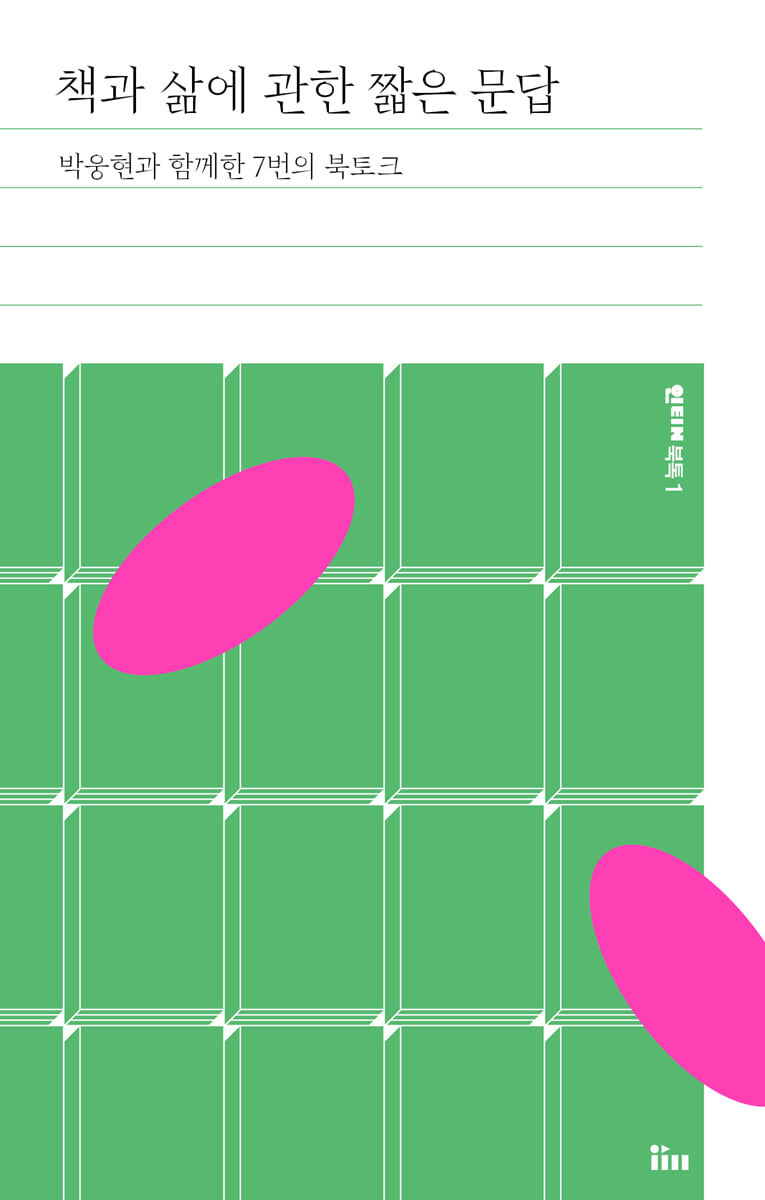
A short Q&A about books and life
 |
Description
Book Introduction
Seven meetings to talk about books and life,
We ask, and Park Woong-hyun answers.
『Short Q&A on Books and Life』 is a compilation of the contents of seven book talks held after the publication of 『Sentences and Moments』, a book by Park Woong-hyun, director of the Organizational Culture Research Institute at TBWA KOREA.
Most of the book talk was conducted as a Q&A session with readers, and readers ranging from their teens to their fifties asked Director Park Woong-hyun questions about the new book and shared their current concerns.
Many people in the room sympathized with stories like, “Choosing books is difficult.” “It’s hard to communicate with my teenager.” “I don’t know how to deal with the MZ generation.” “I feel like I’m experiencing burnout.” “How do I deal with relationships I don’t like?” “It’s hard to express my opinion at work.” “Middle age seems to be more difficult.” The author reflected on his own experiences and answered sincerely.
Director Park Woong-hyun's stories sometimes connected with his own books, such as "Sentences and Moments" and "Eight Words," and sometimes reflected his past experiences.
It was the author's story, but it was also a suggestion, advice, comfort, encouragement and support for the readers.
IntiN, who hosted or participated in all of these book talks, thought it would be a good idea to compile and organize the stories from the 'Book Talk' scene, so he planned the 'IntiN Book Talk' series and compiled the stories shared between Park Woong-hyun and readers into the first book in the series, 'Short Questions and Answers about Books and Life.'
We ask, and Park Woong-hyun answers.
『Short Q&A on Books and Life』 is a compilation of the contents of seven book talks held after the publication of 『Sentences and Moments』, a book by Park Woong-hyun, director of the Organizational Culture Research Institute at TBWA KOREA.
Most of the book talk was conducted as a Q&A session with readers, and readers ranging from their teens to their fifties asked Director Park Woong-hyun questions about the new book and shared their current concerns.
Many people in the room sympathized with stories like, “Choosing books is difficult.” “It’s hard to communicate with my teenager.” “I don’t know how to deal with the MZ generation.” “I feel like I’m experiencing burnout.” “How do I deal with relationships I don’t like?” “It’s hard to express my opinion at work.” “Middle age seems to be more difficult.” The author reflected on his own experiences and answered sincerely.
Director Park Woong-hyun's stories sometimes connected with his own books, such as "Sentences and Moments" and "Eight Words," and sometimes reflected his past experiences.
It was the author's story, but it was also a suggestion, advice, comfort, encouragement and support for the readers.
IntiN, who hosted or participated in all of these book talks, thought it would be a good idea to compile and organize the stories from the 'Book Talk' scene, so he planned the 'IntiN Book Talk' series and compiled the stories shared between Park Woong-hyun and readers into the first book in the series, 'Short Questions and Answers about Books and Life.'
- You can preview some of the book's contents.
Preview
index
IntiN Book Talk, starting the first story
Park Woong-hyun's Notes: Reflection
1.
Park Woong-hyun's Books and Life: "A Life That Moves From Sentence to Moment"
- [Now, here]
What does it mean to “read with your body” or “press your consciousness and raise your feelings”?
- [If you become the master of every place you go, then everywhere you stay will be true]
“Teacher, what efforts do you make to live in the present?”
- [Aha dot, aha line]
“What do you think happiness is?”
- [Desire, Delusion, and Hope]
“Isn’t it difficult to be happy in a society that encourages desire?”
- [A life of having what you like, a life of liking what you have]
“Isn’t ‘living a life of joy’ something you can say only if you’ve succeeded?”
- [Attitude toward life]
“What is the meaning of ‘pure solitude, pure joy, and refreshing falling flowers’?”
- [On the phrase 'an era where people don't read books']
“What do you think about the phenomenon of books being put on the back burner?”
- [Criteria for selecting books]
“Do you have your own criteria for selecting books?”
- [The Joy of Opening a Book]
“What does it mean when you say ‘the book opens’?”
- [The meeting of the authority of books and the authority of the nation]
“Teacher, do you ever have to close a book before you can finish reading it?”
2.
Life: We Ask, and Park Woong-hyun Answers
- [Necessary and sufficient conditions for happiness]
“Are money and happiness equivalent?”
- [When answering life's questions, use your whole body and mind fiercely]
“Teacher, have you ever felt anxious?”
- [Don't look back on the road not taken]
“Where does Park Woong-hyun’s unwavering strength come from?
- [Attitudes toward burnout]
“I feel like I’m suffering from burnout. What should I do?”
- [Take care of me first]
“Should I continue a relationship that doesn’t suit me?”
- [A person with a big soundboard]
“What criteria do you use to select new employees?”
- [Why you should read the context of the times]
“Do you also feel that the MZ generation is different?”
- [Listening more than speaking]
“I’m curious about how to communicate with the MZ generation.”
- [1~5 years, when you need to become a sponge]
“I want to do well, but I get nervous and intimidated by a single word from my superiors.”
- [The Importance of a Teacher]
“What was your anti-teacher?”
- [10 years of fighting, 20 years of retreat]
“How can I become a good senior and colleague?”
- [If a new organizational culture is needed]
“Is there a way to change an organizational culture that doesn’t change?”
- [Basis for confidence in my opinion]
“How do you build confidence in yourself while working?”
- [Indigenous Peoples and Immigrants in the Digital Age]
“Are you keeping up with the trends of the digital age?”
- [Time Spending Standard]
“How do you manage your time, teacher?”
- [The organism called human]
“I feel anxious because it seems like my child is falling behind.”
- [A task that requires watching the back, not the front]
“How do I overcome conflict with my adolescent child?”
- [Choice and Responsibility]
“Even though I’m an adult, my parents’ heavy involvement is still difficult.”
- [Determination to love at all costs]
“What does it take to have a good marriage?”
- [Declaration comes first]
“Is there a way to be honest with myself?”
- [This too shall pass]
“How should I deal with unpleasant moments?”
- [Life is a repetition of refreshing]
“I feel like I’ve become more unstable since I got middle-aged.”
- [Things you must find as you get older]
“Are there any good things about getting older?”
Park Woong-hyun's Notes: Reflection
1.
Park Woong-hyun's Books and Life: "A Life That Moves From Sentence to Moment"
- [Now, here]
What does it mean to “read with your body” or “press your consciousness and raise your feelings”?
- [If you become the master of every place you go, then everywhere you stay will be true]
“Teacher, what efforts do you make to live in the present?”
- [Aha dot, aha line]
“What do you think happiness is?”
- [Desire, Delusion, and Hope]
“Isn’t it difficult to be happy in a society that encourages desire?”
- [A life of having what you like, a life of liking what you have]
“Isn’t ‘living a life of joy’ something you can say only if you’ve succeeded?”
- [Attitude toward life]
“What is the meaning of ‘pure solitude, pure joy, and refreshing falling flowers’?”
- [On the phrase 'an era where people don't read books']
“What do you think about the phenomenon of books being put on the back burner?”
- [Criteria for selecting books]
“Do you have your own criteria for selecting books?”
- [The Joy of Opening a Book]
“What does it mean when you say ‘the book opens’?”
- [The meeting of the authority of books and the authority of the nation]
“Teacher, do you ever have to close a book before you can finish reading it?”
2.
Life: We Ask, and Park Woong-hyun Answers
- [Necessary and sufficient conditions for happiness]
“Are money and happiness equivalent?”
- [When answering life's questions, use your whole body and mind fiercely]
“Teacher, have you ever felt anxious?”
- [Don't look back on the road not taken]
“Where does Park Woong-hyun’s unwavering strength come from?
- [Attitudes toward burnout]
“I feel like I’m suffering from burnout. What should I do?”
- [Take care of me first]
“Should I continue a relationship that doesn’t suit me?”
- [A person with a big soundboard]
“What criteria do you use to select new employees?”
- [Why you should read the context of the times]
“Do you also feel that the MZ generation is different?”
- [Listening more than speaking]
“I’m curious about how to communicate with the MZ generation.”
- [1~5 years, when you need to become a sponge]
“I want to do well, but I get nervous and intimidated by a single word from my superiors.”
- [The Importance of a Teacher]
“What was your anti-teacher?”
- [10 years of fighting, 20 years of retreat]
“How can I become a good senior and colleague?”
- [If a new organizational culture is needed]
“Is there a way to change an organizational culture that doesn’t change?”
- [Basis for confidence in my opinion]
“How do you build confidence in yourself while working?”
- [Indigenous Peoples and Immigrants in the Digital Age]
“Are you keeping up with the trends of the digital age?”
- [Time Spending Standard]
“How do you manage your time, teacher?”
- [The organism called human]
“I feel anxious because it seems like my child is falling behind.”
- [A task that requires watching the back, not the front]
“How do I overcome conflict with my adolescent child?”
- [Choice and Responsibility]
“Even though I’m an adult, my parents’ heavy involvement is still difficult.”
- [Determination to love at all costs]
“What does it take to have a good marriage?”
- [Declaration comes first]
“Is there a way to be honest with myself?”
- [This too shall pass]
“How should I deal with unpleasant moments?”
- [Life is a repetition of refreshing]
“I feel like I’ve become more unstable since I got middle-aged.”
- [Things you must find as you get older]
“Are there any good things about getting older?”
Detailed image

Into the book
● What does it mean to “read with the body” and “press consciousness and raise feelings”?
- There is a saying, ‘Seeking freedom from fear.’
It means finding the lost heart, and this is the first step in self-cultivation.
You have to bring the heart that left home with you.
It is similar to the answer given by a Zen master to the question, “What is the Tao?”, who said, “It is the pine tree in front of the yard.”
(...) .
So, to feel something means to sense the wind that surrounds me, the sound of birds passing by, the scent, everything.
It's something you put into your body.
Like Nikos Kazantzakis, who wrote Zorba the Greek.
To live as a person whose whole body is made of tentacles, you have to raise your feelings, not your consciousness.
● “Isn’t it difficult to be happy in a society that encourages desire?”
- The thought of wanting to improve the conditions of one's current life would be part of this 'immaturity'.
The desire at this time is connected to ‘hope’ rather than delusion.
The desire itself, such as 'I want to go to that university, I want to work at that company, I want to have that job', may be a desire, but when 'effort' is added to it, it becomes 'hope'.
However, if you want this wish to come true without effort, it is a 'delusion'.
You need to be able to distinguish between these.
● “What does it mean when you say ‘the book opens’?”
- When the book is opened, it feels like the letters lying still on the page are suddenly jumping up.
I had read James Joyce's books four or five times before, but at the time I just understood them as 'black letters on white paper'.
But then at some point the letters suddenly jumped up.
It wasn't until I was in my fifties that the meaning of the words in the sentences really dawned on me.
Only then could I discover the devices that James Joyce had hidden in his writing.
I also discovered Kafka and Camus in it.
In fact, James Joyce once said this:
“I have hidden so many devices in my book that critics will not be able to ignore it.” The thrill of seeing the numerous devices he has hidden is indescribable.
● “Isn’t ‘living a life of joy’ something you can say only because you’ve succeeded?”
- I'm not saying you should ignore money, but I want to tell you that a person with a clear mind can find moments of happiness under any circumstances.
It's important to think about what you're good at and what you have, and start from there.
● “I think I’m suffering from burnout. What should I do?”
- In Korea, there is an overemphasis on the saying, “It ain’t over until it’s over.”
It's a necessary posture when working, but it's not everything.
There is a sentence that says, 'What has passed is passed, and what cannot be reached is not reached.'
If you hold the phrase "It ain't over till it's over" in one hand, you should hold the phrase "What's done is done, and what's unreachable is unreachable" in the other hand.
Try your best, but if it's out of reach, it's out of reach, so you have to let it go.
● “Should I continue a relationship that doesn’t suit me?”
- Just because we met physically doesn't mean we met.
In other words, a 'real encounter' is not proportional to physical time.
Even if we have worked together in the same space for 20 years, if our worldviews are too different, we have never met.
We've only worked together for 20 years.
On the contrary, one day I met someone for the first time with a friend and we had a cup of tea and it was a great time.
Then you met that person.
I don't think it's necessary to keep trying to meet people you don't want to meet.
● “I feel like I’ve become more unstable since I got middle-aged.”
- It is said that those who come respond, and those who leave forget.
It means that those who come are welcomed and those who leave are forgotten.
I don't think that coming and going only refers to people.
I just need to let go of the things that need to go away and welcome back the things that come to me.
I'm now trying to let go of things I need to let go of and thinking about what interesting things might come my way in the future, or if I can make them come to me.
- There is a saying, ‘Seeking freedom from fear.’
It means finding the lost heart, and this is the first step in self-cultivation.
You have to bring the heart that left home with you.
It is similar to the answer given by a Zen master to the question, “What is the Tao?”, who said, “It is the pine tree in front of the yard.”
(...) .
So, to feel something means to sense the wind that surrounds me, the sound of birds passing by, the scent, everything.
It's something you put into your body.
Like Nikos Kazantzakis, who wrote Zorba the Greek.
To live as a person whose whole body is made of tentacles, you have to raise your feelings, not your consciousness.
● “Isn’t it difficult to be happy in a society that encourages desire?”
- The thought of wanting to improve the conditions of one's current life would be part of this 'immaturity'.
The desire at this time is connected to ‘hope’ rather than delusion.
The desire itself, such as 'I want to go to that university, I want to work at that company, I want to have that job', may be a desire, but when 'effort' is added to it, it becomes 'hope'.
However, if you want this wish to come true without effort, it is a 'delusion'.
You need to be able to distinguish between these.
● “What does it mean when you say ‘the book opens’?”
- When the book is opened, it feels like the letters lying still on the page are suddenly jumping up.
I had read James Joyce's books four or five times before, but at the time I just understood them as 'black letters on white paper'.
But then at some point the letters suddenly jumped up.
It wasn't until I was in my fifties that the meaning of the words in the sentences really dawned on me.
Only then could I discover the devices that James Joyce had hidden in his writing.
I also discovered Kafka and Camus in it.
In fact, James Joyce once said this:
“I have hidden so many devices in my book that critics will not be able to ignore it.” The thrill of seeing the numerous devices he has hidden is indescribable.
● “Isn’t ‘living a life of joy’ something you can say only because you’ve succeeded?”
- I'm not saying you should ignore money, but I want to tell you that a person with a clear mind can find moments of happiness under any circumstances.
It's important to think about what you're good at and what you have, and start from there.
● “I think I’m suffering from burnout. What should I do?”
- In Korea, there is an overemphasis on the saying, “It ain’t over until it’s over.”
It's a necessary posture when working, but it's not everything.
There is a sentence that says, 'What has passed is passed, and what cannot be reached is not reached.'
If you hold the phrase "It ain't over till it's over" in one hand, you should hold the phrase "What's done is done, and what's unreachable is unreachable" in the other hand.
Try your best, but if it's out of reach, it's out of reach, so you have to let it go.
● “Should I continue a relationship that doesn’t suit me?”
- Just because we met physically doesn't mean we met.
In other words, a 'real encounter' is not proportional to physical time.
Even if we have worked together in the same space for 20 years, if our worldviews are too different, we have never met.
We've only worked together for 20 years.
On the contrary, one day I met someone for the first time with a friend and we had a cup of tea and it was a great time.
Then you met that person.
I don't think it's necessary to keep trying to meet people you don't want to meet.
● “I feel like I’ve become more unstable since I got middle-aged.”
- It is said that those who come respond, and those who leave forget.
It means that those who come are welcomed and those who leave are forgotten.
I don't think that coming and going only refers to people.
I just need to let go of the things that need to go away and welcome back the things that come to me.
I'm now trying to let go of things I need to let go of and thinking about what interesting things might come my way in the future, or if I can make them come to me.
--- From the text
Publisher's Review
Seven Book Talks with Advertiser Park Woong-hyun
Park Woong-hyun's attitude toward books and life
"Short Q&A on Books and Life" is a compilation of the contents of seven book talks held in the fall of 2022 following the publication of "Sentences and Moments," a book by Park Woong-hyun, director of the TBWA KOREA Organizational Culture Research Institute.
The book talk scenes included in this book are book talks held at Danginri Book Power Plant, Yes24 Gangseo Branch, Busan Suyeong Branch, Daegu Banwoldang Branch, Choi In-a Bookstore, Bookstore Sori Somun, and book talks held at the non-profit organization 'Dream Puzzle Show' that creates a book donation culture.
In his new work, 『Sentences and Moments』, his first solo work in six years since 『Again, Books Are Axes』, Director Park Woong-hyun expresses his profound perspectives and attitudes toward life through refined sentences and handwriting.
The implied meanings in sentences like “reading with the body,” “suppressing consciousness and raising feelings,” and “pure solitude, pure joy, refreshing falling flowers” that the author spoke of at the book talk resonated with Director Park Woong-hyun’s attitude toward life, and his story of constantly reflecting and striving to focus on the “present” and live the moment to the fullest made us think again about our attitude toward life.
“It’s been about five times since I was in my forties when I started thinking about ‘focusing on the present’ through books.
Now, I want to increase those moments and live every moment like that.
In that sense, the phrase ‘reading with the body’ that I wrote in ‘Sentences and Moments’ was a phrase that contained my wish to live by putting into practice the good sentences and realizations I discovered in books with my body, not my head, and my will to live that way.” (p. 23)
“I believe that happiness should be an attitude toward life, and I try to live that way.
So, no matter what the situation, I find happiness there.
Once you've made your choice, you don't want to look back.
“I’m trying to focus on what I have in my current situation.” (pp. 28-29)
“I will continue to strive to interact with the world, but life may leave me alone at some point, against my will.
There will definitely be moments in life when you feel lonely, both mentally and physically.
It's up to you whether you embrace that moment purely or not.
So, ‘pure solitude’ is about starting life by standing upright with just one spine.” (p. 41)
Moreover, as the author talked about reading books with his own reading method through 『Books are Axes』 and 『Again, Books are Axes』, readers also confided their concerns about 'reading books' to him.
Questions followed about Park Woong-hyun's unique method for selecting books, how to relieve the burden of reading, and what the author thinks in an age where books are being put on the back burner.
Director Park Woong-hyun shared his own experience of reading books here, and urged readers to put aside the burden of reading and open the book lightly until the end.
“You have to read the book as ‘me.’
No matter how great a book is, if it doesn't resonate with me, it's over.
It's just a piece of paper.
So if I put down a book while reading it, it just means that I was not in touch with the book at that time.
You don't have to feel guilty or burdened about putting a book down while reading it.
So, I hope you will open any book with a slightly lighter heart.” (Page 54)
Our concerns about life,
Park Woong-hyun's sincere encouragement and support
The book talk was attended by readers of various ages, from teenagers to those in their fifties and sixties, and as they belonged to various occupations such as students, housewives, office workers, and freelancers, the readers' questions were not limited to books.
During the 7th North Talk, questions about all aspects of life, including work, social life, interpersonal relationships, generational differences, marriage, childcare, and education, continued unabated.
One reader's opening line, "I'm in my 40s and working," drew sympathetic looks, while others nodded in agreement at comments like, "I'm curious about how to communicate with the MZ generation," "I'm worried about whether I should continue a relationship that doesn't suit me," "How should I overcome conflict with my adolescent child," and "Middle age is more anxious and difficult."
Director Park Woong-hyun answered all these questions with sincerity, reflecting on his own experiences.
“When my daughter was going through puberty late in life, I thought about this.
We are now passing by the fireplace, the place closest to the fireplace.
Think about it.
How hot would it be to pass so close to the fire?
It will be so hot that it will burn your flesh.
But after that moment, you will enter the warm and cozy atmosphere again.
“Everything must pass.” (p. 124)
The author's answers to readers' individual questions were not directed at one person.
It was like a message of sympathy, encouragement, and support to all readers as someone living in the same era and someone who has already experienced those concerns.
'IntiN Book Talk' series
Capturing the 'words' that would otherwise scatter into the air and leaving them as 'writings'
In this way, there were many things that were regrettable in the conversations between the author and readers at the book talk site that could not be left to disappear into mere words.
IntiN, who published 『Sentences and Moments』 and hosted or participated in these 7 book talks, noticed that the nature of 'book talks' allows for deeper or more in-depth discussions about books when meeting with readers. He also thought that it would be meaningful to organize and write down the conversations between authors and readers on site, and planned the 'IntiN Book Talk' series.
This book, "Short Questions and Answers about Books and Life," is the first book in the "IntiN Book Talk" series, created with that purpose.
Park Woong-hyun's attitude toward books and life
"Short Q&A on Books and Life" is a compilation of the contents of seven book talks held in the fall of 2022 following the publication of "Sentences and Moments," a book by Park Woong-hyun, director of the TBWA KOREA Organizational Culture Research Institute.
The book talk scenes included in this book are book talks held at Danginri Book Power Plant, Yes24 Gangseo Branch, Busan Suyeong Branch, Daegu Banwoldang Branch, Choi In-a Bookstore, Bookstore Sori Somun, and book talks held at the non-profit organization 'Dream Puzzle Show' that creates a book donation culture.
In his new work, 『Sentences and Moments』, his first solo work in six years since 『Again, Books Are Axes』, Director Park Woong-hyun expresses his profound perspectives and attitudes toward life through refined sentences and handwriting.
The implied meanings in sentences like “reading with the body,” “suppressing consciousness and raising feelings,” and “pure solitude, pure joy, refreshing falling flowers” that the author spoke of at the book talk resonated with Director Park Woong-hyun’s attitude toward life, and his story of constantly reflecting and striving to focus on the “present” and live the moment to the fullest made us think again about our attitude toward life.
“It’s been about five times since I was in my forties when I started thinking about ‘focusing on the present’ through books.
Now, I want to increase those moments and live every moment like that.
In that sense, the phrase ‘reading with the body’ that I wrote in ‘Sentences and Moments’ was a phrase that contained my wish to live by putting into practice the good sentences and realizations I discovered in books with my body, not my head, and my will to live that way.” (p. 23)
“I believe that happiness should be an attitude toward life, and I try to live that way.
So, no matter what the situation, I find happiness there.
Once you've made your choice, you don't want to look back.
“I’m trying to focus on what I have in my current situation.” (pp. 28-29)
“I will continue to strive to interact with the world, but life may leave me alone at some point, against my will.
There will definitely be moments in life when you feel lonely, both mentally and physically.
It's up to you whether you embrace that moment purely or not.
So, ‘pure solitude’ is about starting life by standing upright with just one spine.” (p. 41)
Moreover, as the author talked about reading books with his own reading method through 『Books are Axes』 and 『Again, Books are Axes』, readers also confided their concerns about 'reading books' to him.
Questions followed about Park Woong-hyun's unique method for selecting books, how to relieve the burden of reading, and what the author thinks in an age where books are being put on the back burner.
Director Park Woong-hyun shared his own experience of reading books here, and urged readers to put aside the burden of reading and open the book lightly until the end.
“You have to read the book as ‘me.’
No matter how great a book is, if it doesn't resonate with me, it's over.
It's just a piece of paper.
So if I put down a book while reading it, it just means that I was not in touch with the book at that time.
You don't have to feel guilty or burdened about putting a book down while reading it.
So, I hope you will open any book with a slightly lighter heart.” (Page 54)
Our concerns about life,
Park Woong-hyun's sincere encouragement and support
The book talk was attended by readers of various ages, from teenagers to those in their fifties and sixties, and as they belonged to various occupations such as students, housewives, office workers, and freelancers, the readers' questions were not limited to books.
During the 7th North Talk, questions about all aspects of life, including work, social life, interpersonal relationships, generational differences, marriage, childcare, and education, continued unabated.
One reader's opening line, "I'm in my 40s and working," drew sympathetic looks, while others nodded in agreement at comments like, "I'm curious about how to communicate with the MZ generation," "I'm worried about whether I should continue a relationship that doesn't suit me," "How should I overcome conflict with my adolescent child," and "Middle age is more anxious and difficult."
Director Park Woong-hyun answered all these questions with sincerity, reflecting on his own experiences.
“When my daughter was going through puberty late in life, I thought about this.
We are now passing by the fireplace, the place closest to the fireplace.
Think about it.
How hot would it be to pass so close to the fire?
It will be so hot that it will burn your flesh.
But after that moment, you will enter the warm and cozy atmosphere again.
“Everything must pass.” (p. 124)
The author's answers to readers' individual questions were not directed at one person.
It was like a message of sympathy, encouragement, and support to all readers as someone living in the same era and someone who has already experienced those concerns.
'IntiN Book Talk' series
Capturing the 'words' that would otherwise scatter into the air and leaving them as 'writings'
In this way, there were many things that were regrettable in the conversations between the author and readers at the book talk site that could not be left to disappear into mere words.
IntiN, who published 『Sentences and Moments』 and hosted or participated in these 7 book talks, noticed that the nature of 'book talks' allows for deeper or more in-depth discussions about books when meeting with readers. He also thought that it would be meaningful to organize and write down the conversations between authors and readers on site, and planned the 'IntiN Book Talk' series.
This book, "Short Questions and Answers about Books and Life," is the first book in the "IntiN Book Talk" series, created with that purpose.
GOODS SPECIFICS
- Date of issue: March 27, 2023
- Page count, weight, size: 144 pages | 168g | 120*188*20mm
- ISBN13: 9791197977039
- ISBN10: 1197977031
You may also like
카테고리
korean


korean

![GQ KOREA Mark (Monthly): December [2025]](http://librairie.coreenne.fr/cdn/shop/files/8ef265dbbfbf186523ed75ba7319009d.jpg?v=1765340328&width=3840)


