

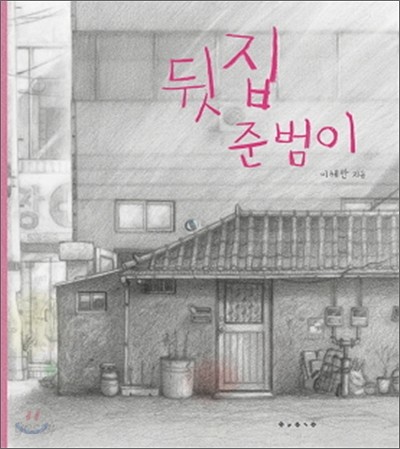
Junbeom from the house behind me
 |
Description
Book Introduction
Junbeom, who just moved in,
But I don't even try to make friends and I'm alone all day.
This is the story of Junbeom, the boy from the house next door who has just moved in and is strangely timid.
Junbeom doesn't talk much and doesn't really try to get along with the kids in the house next door.
On the other hand, the kids from the house across the street seem to want to be friends with Junbeom.
That doesn't mean the kids in the house next door look special.
He doesn't seem like he'd be particularly kind, nor does he seem to have anything particularly good about him.
They are just children without any emotional barriers.
Kids know that playing together is the real fun.
Now that I think about it, living together in a world doesn't seem that difficult.
A fairy tale that makes you feel happy when you play together
These days, children spend a lot of time alone.
After going to school, I play computer games and just imagine things by myself, so I have very little time to hang out with friends.
This picture book uses pictures to show that you and I are the same people, no different.
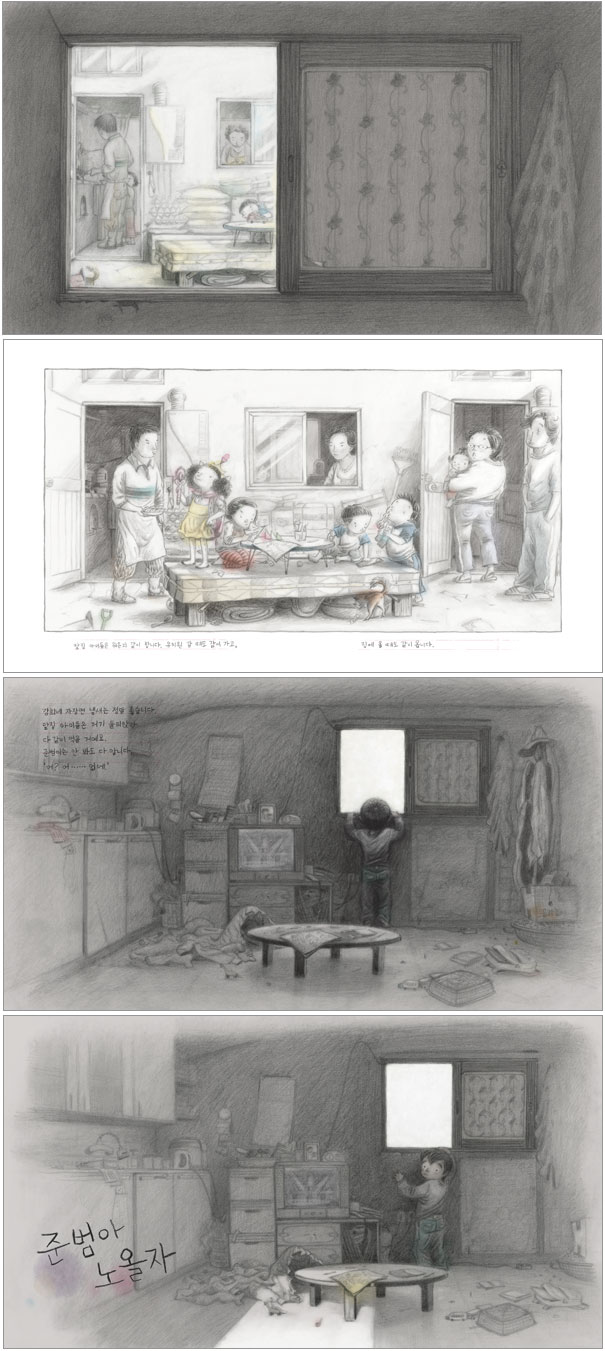
The small details of everyday life in a neighborhood are captured in meticulous pencil drawings.
The illustrations are drawn honestly without being flashy, the crooked handwriting that looks like it was written by a child, and the warm dots of color spreading across the gray tones blend well with the story.
It is worth noting the contrast between the two worlds of a bright yard and a dark room, as well as the active use of square frames reminiscent of windows and changes in perspective.
The view of the house in front, drawn from Junbeom's perspective, gradually expands as if a window is opening, providing variation to the screen and adding to the enjoyment of viewing the picture.
From the middle part, the viewpoint changes and Junbeom enters the screen.
It is interesting that the change in perspective reveals the process of the protagonist, who had been watching from outside the boundary, entering the boundary and becoming one.
But I don't even try to make friends and I'm alone all day.
This is the story of Junbeom, the boy from the house next door who has just moved in and is strangely timid.
Junbeom doesn't talk much and doesn't really try to get along with the kids in the house next door.
On the other hand, the kids from the house across the street seem to want to be friends with Junbeom.
That doesn't mean the kids in the house next door look special.
He doesn't seem like he'd be particularly kind, nor does he seem to have anything particularly good about him.
They are just children without any emotional barriers.
Kids know that playing together is the real fun.
Now that I think about it, living together in a world doesn't seem that difficult.
A fairy tale that makes you feel happy when you play together
These days, children spend a lot of time alone.
After going to school, I play computer games and just imagine things by myself, so I have very little time to hang out with friends.
This picture book uses pictures to show that you and I are the same people, no different.
The small details of everyday life in a neighborhood are captured in meticulous pencil drawings.
The illustrations are drawn honestly without being flashy, the crooked handwriting that looks like it was written by a child, and the warm dots of color spreading across the gray tones blend well with the story.
It is worth noting the contrast between the two worlds of a bright yard and a dark room, as well as the active use of square frames reminiscent of windows and changes in perspective.
The view of the house in front, drawn from Junbeom's perspective, gradually expands as if a window is opening, providing variation to the screen and adding to the enjoyment of viewing the picture.
From the middle part, the viewpoint changes and Junbeom enters the screen.
It is interesting that the change in perspective reveals the process of the protagonist, who had been watching from outside the boundary, entering the boundary and becoming one.
- You can preview some of the book's contents.
Preview
Detailed image
Publisher's Review
The children from the house next door who run, play, laugh, fight, and chatter together.
And the kid from the house behind who watches those kids.
A child who looks out the window all day
Junbeom looks out the window all day long.
In an unfamiliar neighborhood where he had just moved, the only thing Junbeom could do alone in the empty room while his grandmother was out working was watch TV or look out the window.
The house in front, visible through the window, has a beauty salon, a supermarket, and a Chinese restaurant all under one roof.
Eat, I'm back from delivering, look after your little brother... ... Yelling, soothing, laughing, talking... ... The store is attached to a house, so the house in front is always bustling.
There are also children around Junbeom's age in the house in front.
The always-pretty-dressed princess of the beauty salon, the gluttonous Chungwon and the rascal Yewon of the supermarket, Kanghee and Kangwoo of the Chinese restaurant who eat only delicious food every day, and even Kanghee's dog Ddaeng-i, Junbeom has already memorized all the children's names.
Discovering the children in the house in front and the house behind
Princess, Chungwon, Kanghee, and Kangwoo always play together in the yard.
We draw, we play princess, we have gun fights, and of course we fight sometimes.
Today, as usual, Kang-hee was playing in the yard when an unfamiliar face caught his eye.
A face sticking out through the crack in the window of the house behind.
I think that's the kid who just moved in next door.
A strange child is watching Kanghee play.
Then, Kanghee's eyes met mine.
Kanghee gestures and speaks to them, suggesting that they play together.
But the child says he doesn't like it and soon disappears.
My grandmother told me not to go out and to stay home and play.
Why did Junbeom do that?
In fact, Junbeom doesn't really know why he did that.
It was a great opportunity to make friends, so why did he do that? Anyway, Junbeom steeled himself and decided to play alone.
He said he could play well by himself until grandma came home.
But I don't know why the kids in the house across the street are so noisy today.
My ears keep pricking up at the sound of children chattering and asking for jajangmyeon.
Eventually, Junbeom leans out the window again.
But the children had forgotten about Junbeom and went off to somewhere on their own.
There is no one outside the window.
It's really fun when we all play together
This book is a follow-up work by Lee Hye-ran, the author of the picture book “This is Our Family.”
Like the previous work, it is the story of a neighborhood where working class people live together.
This time, we focused on the children's daily lives.
The children in the house in front readily give their side to the child in the house behind who has just moved in and is somehow timid.
That doesn't mean the kids in the house next door look special.
He doesn't seem like he'd be particularly kind, nor does he seem to have anything particularly good about him.
They are just children without any emotional barriers.
Kids know that playing together is the real fun.
Now that I think about it, living together in a world doesn't seem that difficult.
A picture that brings the story to life
The small details of everyday life in a neighborhood are captured in meticulous pencil drawings.
The illustrations are drawn honestly without being flashy, the crooked handwriting that looks like it was written by a child, and the warm dots of color spreading across the gray tones blend well with the story.
It is worth noting the contrast between the two worlds of a bright yard and a dark room, as well as the active use of square frames reminiscent of windows and changes in perspective.
The view of the house in front, drawn from Junbeom's perspective, gradually expands as if a window is opening, providing variation to the screen and adding to the enjoyment of viewing the picture.
From the middle part, the viewpoint changes and Junbeom enters the screen.
It is interesting that the change in perspective reveals the process of the protagonist, who had been watching from outside the boundary, entering the boundary and becoming one.
And the kid from the house behind who watches those kids.
A child who looks out the window all day
Junbeom looks out the window all day long.
In an unfamiliar neighborhood where he had just moved, the only thing Junbeom could do alone in the empty room while his grandmother was out working was watch TV or look out the window.
The house in front, visible through the window, has a beauty salon, a supermarket, and a Chinese restaurant all under one roof.
Eat, I'm back from delivering, look after your little brother... ... Yelling, soothing, laughing, talking... ... The store is attached to a house, so the house in front is always bustling.
There are also children around Junbeom's age in the house in front.
The always-pretty-dressed princess of the beauty salon, the gluttonous Chungwon and the rascal Yewon of the supermarket, Kanghee and Kangwoo of the Chinese restaurant who eat only delicious food every day, and even Kanghee's dog Ddaeng-i, Junbeom has already memorized all the children's names.
Discovering the children in the house in front and the house behind
Princess, Chungwon, Kanghee, and Kangwoo always play together in the yard.
We draw, we play princess, we have gun fights, and of course we fight sometimes.
Today, as usual, Kang-hee was playing in the yard when an unfamiliar face caught his eye.
A face sticking out through the crack in the window of the house behind.
I think that's the kid who just moved in next door.
A strange child is watching Kanghee play.
Then, Kanghee's eyes met mine.
Kanghee gestures and speaks to them, suggesting that they play together.
But the child says he doesn't like it and soon disappears.
My grandmother told me not to go out and to stay home and play.
Why did Junbeom do that?
In fact, Junbeom doesn't really know why he did that.
It was a great opportunity to make friends, so why did he do that? Anyway, Junbeom steeled himself and decided to play alone.
He said he could play well by himself until grandma came home.
But I don't know why the kids in the house across the street are so noisy today.
My ears keep pricking up at the sound of children chattering and asking for jajangmyeon.
Eventually, Junbeom leans out the window again.
But the children had forgotten about Junbeom and went off to somewhere on their own.
There is no one outside the window.
It's really fun when we all play together
This book is a follow-up work by Lee Hye-ran, the author of the picture book “This is Our Family.”
Like the previous work, it is the story of a neighborhood where working class people live together.
This time, we focused on the children's daily lives.
The children in the house in front readily give their side to the child in the house behind who has just moved in and is somehow timid.
That doesn't mean the kids in the house next door look special.
He doesn't seem like he'd be particularly kind, nor does he seem to have anything particularly good about him.
They are just children without any emotional barriers.
Kids know that playing together is the real fun.
Now that I think about it, living together in a world doesn't seem that difficult.
A picture that brings the story to life
The small details of everyday life in a neighborhood are captured in meticulous pencil drawings.
The illustrations are drawn honestly without being flashy, the crooked handwriting that looks like it was written by a child, and the warm dots of color spreading across the gray tones blend well with the story.
It is worth noting the contrast between the two worlds of a bright yard and a dark room, as well as the active use of square frames reminiscent of windows and changes in perspective.
The view of the house in front, drawn from Junbeom's perspective, gradually expands as if a window is opening, providing variation to the screen and adding to the enjoyment of viewing the picture.
From the middle part, the viewpoint changes and Junbeom enters the screen.
It is interesting that the change in perspective reveals the process of the protagonist, who had been watching from outside the boundary, entering the boundary and becoming one.
GOODS SPECIFICS
- Date of publication: March 28, 2011
- Format: Hardcover book binding method guide
- Page count, weight, size: 38 pages | 361g | 225*250*15mm
- ISBN13: 9788943308629
- ISBN10: 8943308620
You may also like
카테고리
korean


korean

![GQ KOREA Mark (Monthly): December [2025]](http://librairie.coreenne.fr/cdn/shop/files/8ef265dbbfbf186523ed75ba7319009d.jpg?v=1765340328&width=3840)


