

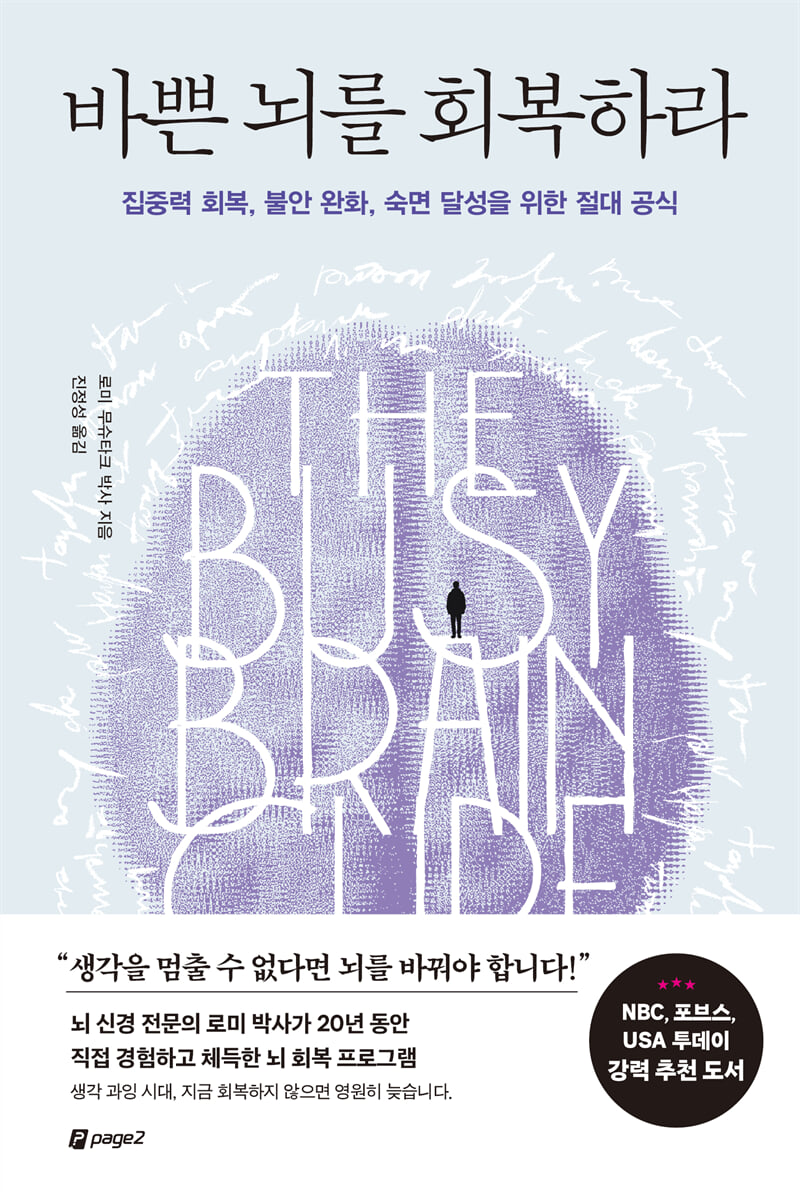
Recover your busy brain
 |
Description
Book Introduction
“Why can’t we concentrate, why are we easily anxious,
“Can’t you sleep deeply?”
An 8-week brain recovery program directly experienced and learned by a neurosurgeon.
Insomnia, anxiety disorder, and lack of concentration have emerged as emerging diseases for modern people.
We have been treating these as individual problems and using various drug treatments and folk remedies to solve them.
However, Dr. Romi Mushtaq, a renowned American neurosurgeon, says that these three symptoms stem from one underlying condition.
It is the 'busy brain'.
A brain that is overly sensitive to external stimuli and constantly activated is the result of a neurological and physiological imbalance, not a result of an individual's will.
And a busy brain can cause not only simple neurological disorders but also physical illnesses.
Many people try digital detoxes and meditation to calm their busy brains, but these mental practices can never address the root cause.
This book presents fundamental solutions to treat the busy brain, based on the latest medical cases and clinical research results.
“Can’t you sleep deeply?”
An 8-week brain recovery program directly experienced and learned by a neurosurgeon.
Insomnia, anxiety disorder, and lack of concentration have emerged as emerging diseases for modern people.
We have been treating these as individual problems and using various drug treatments and folk remedies to solve them.
However, Dr. Romi Mushtaq, a renowned American neurosurgeon, says that these three symptoms stem from one underlying condition.
It is the 'busy brain'.
A brain that is overly sensitive to external stimuli and constantly activated is the result of a neurological and physiological imbalance, not a result of an individual's will.
And a busy brain can cause not only simple neurological disorders but also physical illnesses.
Many people try digital detoxes and meditation to calm their busy brains, but these mental practices can never address the root cause.
This book presents fundamental solutions to treat the busy brain, based on the latest medical cases and clinical research results.
- You can preview some of the book's contents.
Preview
index
prolog
Part 1: The Busy Brain Stuck in the Stress-Success Cycle
01 Am I stuck in a stress-success cycle?
02 Symptoms of Busy Brain Syndrome Caused by Stress
03 There is no panacea for busy brain syndrome.
04 How to Cure Busy Brain Syndrome
Part 2: Medical Causes of Busy Brain Syndrome and Brain Recovery
05 Busy Brain Syndrome and Sleep and Circadian Rhythms
06 The Correlation Between Busy Brain Syndrome and Hormones
07 Busy Brain Syndrome and Inflammation, Sugar, and Caffeine
08 Busy Brain Syndrome and Brain Fuel: Food and Fat
09 Busy Brain Syndrome and Electronic Devices
Part 3: 8-Week Brain Recovery Protocol
Week 10 Focus on your goals instead of self-criticism.
11 Let's challenge ourselves to sleep regularly for 7 days in the second week.
Let's start the 3rd week of social distancing from electronic devices.
13 Week 4: Let's practice turning off the brain
Week 14: Biohack Your Diet
Week 15: Let's review fuel, energy, and focus.
Week 16: Let's check out the super hormones of the super brain.
Completing the 8th week puzzle
supplement
Acknowledgements
References
Part 1: The Busy Brain Stuck in the Stress-Success Cycle
01 Am I stuck in a stress-success cycle?
02 Symptoms of Busy Brain Syndrome Caused by Stress
03 There is no panacea for busy brain syndrome.
04 How to Cure Busy Brain Syndrome
Part 2: Medical Causes of Busy Brain Syndrome and Brain Recovery
05 Busy Brain Syndrome and Sleep and Circadian Rhythms
06 The Correlation Between Busy Brain Syndrome and Hormones
07 Busy Brain Syndrome and Inflammation, Sugar, and Caffeine
08 Busy Brain Syndrome and Brain Fuel: Food and Fat
09 Busy Brain Syndrome and Electronic Devices
Part 3: 8-Week Brain Recovery Protocol
Week 10 Focus on your goals instead of self-criticism.
11 Let's challenge ourselves to sleep regularly for 7 days in the second week.
Let's start the 3rd week of social distancing from electronic devices.
13 Week 4: Let's practice turning off the brain
Week 14: Biohack Your Diet
Week 15: Let's review fuel, energy, and focus.
Week 16: Let's check out the super hormones of the super brain.
Completing the 8th week puzzle
supplement
Acknowledgements
References
Detailed image

Into the book
Modern people's senses are overloaded with a full schedule, all kinds of electronic devices, and the bustle of people on the streets.
There are too many windows open on our smartphones, laptop screens, and in our minds.
We no longer live in an age where stressors are temporary and the brain has a chance to find calm.
--- p.13
One more thing to ask is, please do not add any time management techniques or other means to increase productivity.
Think about how many times you've read self-help books, listened to audiobooks while exercising, or vowed to do something, only to end up with a longer to-do list and more stress.
--- p.14
You didn't get to where you are today overnight.
I'm not going to lie and say that there's some fancy brain scan machine or expensive supplement that will instantly cure your busy brain.
You can't turn your brain on and off by buying expensive slippers or meditating.
What I can offer you is years of clinical trials, cutting-edge medical research, real-world examples, and a busy brain recovery tool to help you move forward.
--- p.18
There is one point that must be addressed when discussing stress and types of stress.
The idea is that 'stress is beneficial.'
There is one point I would like to clarify regarding this argument, which has persisted for several years.
Keep in mind that the saying "stress is good" only applies to acute stress, like helping you meet a deadline or reflexively avoiding a car.
Let's say you're driving in the winter and you slip on an icy road.
Stress in these situations is beneficial, as it allows your brain to focus and all your reflexes to get off the ice.
So, in this book, I will only cover two things: 'acute episodic stress' and 'chronic stress'.
Because suffering from this kind of stress can lead to death.
--- p.34
In his book, "The Power of Tiny Habits," New York Times bestseller James Clear explains why tiny habits are so effective.
Habits are like a compound interest in self-development.
If you want to improve your results, you need to focus on your current system instead of setting goals.
Success is not a once-in-a-lifetime transformation, but rather a product of daily habits.
--- p.98
If you wake up at 6:30, you can drink coffee between 9:30 and 11:30.
Drinking later than that can disrupt your circadian rhythm and make it difficult to get a good night's sleep.
Even after the energizing effect wears off, the awakening effect lasts for about 3 to 5 hours, and although this varies from person to person, half of the total amount of caffeine consumed remains in the body even after 5 hours.
The brain recovery protocol recommends avoiding caffeine after 1 p.m. to harmonize with sleep and circadian rhythms.
So if you wake up at 6:30, try to consume caffeine between 9:30 and 1:00 PM.
--- p.173
As I research and treat people suffering from busy brain syndrome, I can no longer ignore the impact of electronic devices on attention.
Attention deficit hyperactivity disorder in adults is characterized by symptoms such as inattention, impulsivity, and agitation, which lead to dysfunction.
The brain's executive function, or ability to analyze and digest data, breaks down.
--- p.214
Adults suffering from busy brain syndrome not only have trouble sleeping, but also have trouble prioritizing, starting tasks, and completing them.
Disorganized, anxious, and easily distracted.
Some people can't even concentrate when reading a book.
If you can't stay focused and finish tasks, you'll have problems with your career, goals, and relationships.
So, curing busy brain syndrome can have positive effects not only on personal well-being but also on your private and work life.
--- p.220
People are often surprised to learn that I don't recommend melatonin supplements.
Melatonin, a hormone synthesized in the body, is essential for establishing good sleep patterns, but using melatonin as a sleep inducer is not a panacea, contrary to what many people think.
Simply put, I do not utilize melatonin in my brain recovery protocol.
Because it does not address the root cause of insomnia.
--- p.251
I hope you all keep that in mind.
As I've personally experienced, busy brain syndrome never completely goes away.
Even if the things, people, and news that previously triggered busy brain syndrome disappear, new stressors may emerge.
We must always remember that we are human and not perfect.
Perfection lies in accepting that life is not perfect.
This book is for the thousands of comrades who, once they've conquered one life goal or work project, have seventeen more waiting for them.
There are too many windows open on our smartphones, laptop screens, and in our minds.
We no longer live in an age where stressors are temporary and the brain has a chance to find calm.
--- p.13
One more thing to ask is, please do not add any time management techniques or other means to increase productivity.
Think about how many times you've read self-help books, listened to audiobooks while exercising, or vowed to do something, only to end up with a longer to-do list and more stress.
--- p.14
You didn't get to where you are today overnight.
I'm not going to lie and say that there's some fancy brain scan machine or expensive supplement that will instantly cure your busy brain.
You can't turn your brain on and off by buying expensive slippers or meditating.
What I can offer you is years of clinical trials, cutting-edge medical research, real-world examples, and a busy brain recovery tool to help you move forward.
--- p.18
There is one point that must be addressed when discussing stress and types of stress.
The idea is that 'stress is beneficial.'
There is one point I would like to clarify regarding this argument, which has persisted for several years.
Keep in mind that the saying "stress is good" only applies to acute stress, like helping you meet a deadline or reflexively avoiding a car.
Let's say you're driving in the winter and you slip on an icy road.
Stress in these situations is beneficial, as it allows your brain to focus and all your reflexes to get off the ice.
So, in this book, I will only cover two things: 'acute episodic stress' and 'chronic stress'.
Because suffering from this kind of stress can lead to death.
--- p.34
In his book, "The Power of Tiny Habits," New York Times bestseller James Clear explains why tiny habits are so effective.
Habits are like a compound interest in self-development.
If you want to improve your results, you need to focus on your current system instead of setting goals.
Success is not a once-in-a-lifetime transformation, but rather a product of daily habits.
--- p.98
If you wake up at 6:30, you can drink coffee between 9:30 and 11:30.
Drinking later than that can disrupt your circadian rhythm and make it difficult to get a good night's sleep.
Even after the energizing effect wears off, the awakening effect lasts for about 3 to 5 hours, and although this varies from person to person, half of the total amount of caffeine consumed remains in the body even after 5 hours.
The brain recovery protocol recommends avoiding caffeine after 1 p.m. to harmonize with sleep and circadian rhythms.
So if you wake up at 6:30, try to consume caffeine between 9:30 and 1:00 PM.
--- p.173
As I research and treat people suffering from busy brain syndrome, I can no longer ignore the impact of electronic devices on attention.
Attention deficit hyperactivity disorder in adults is characterized by symptoms such as inattention, impulsivity, and agitation, which lead to dysfunction.
The brain's executive function, or ability to analyze and digest data, breaks down.
--- p.214
Adults suffering from busy brain syndrome not only have trouble sleeping, but also have trouble prioritizing, starting tasks, and completing them.
Disorganized, anxious, and easily distracted.
Some people can't even concentrate when reading a book.
If you can't stay focused and finish tasks, you'll have problems with your career, goals, and relationships.
So, curing busy brain syndrome can have positive effects not only on personal well-being but also on your private and work life.
--- p.220
People are often surprised to learn that I don't recommend melatonin supplements.
Melatonin, a hormone synthesized in the body, is essential for establishing good sleep patterns, but using melatonin as a sleep inducer is not a panacea, contrary to what many people think.
Simply put, I do not utilize melatonin in my brain recovery protocol.
Because it does not address the root cause of insomnia.
--- p.251
I hope you all keep that in mind.
As I've personally experienced, busy brain syndrome never completely goes away.
Even if the things, people, and news that previously triggered busy brain syndrome disappear, new stressors may emerge.
We must always remember that we are human and not perfect.
Perfection lies in accepting that life is not perfect.
This book is for the thousands of comrades who, once they've conquered one life goal or work project, have seventeen more waiting for them.
--- p.351
Publisher's Review
Coffee in the morning, sleeping pills in the evening.
What's wrong with our brain?
“It’s not a lack of will, it’s a brain breakdown.”
*Difficulty falling asleep at night and waking up frequently
*I don't have energy if I don't drink coffee in the morning.
*I feel tired and low on energy every day.
*I feel like all kinds of windows are floating in my head.
*Difficulty concentrating and easily distracted
If you can relate to even one of these, you too may be suffering from 'busy brain syndrome.'
Busy brain syndrome is a new term that refers to a state of over-arousal of the brain, which can cause insomnia, anxiety disorders, adult ADHD, binge eating, and chronic fatigue.
People with busy brain syndrome may appear normal on the outside, but their brains are on the verge of explosion.
A vicious cycle of being tired during the day and not being able to sleep at night continues due to lack of proper rest.
And this busy brain is the cause of adult-onset ADHD.
Adult ADHD is more dangerous than childhood ADHD in that it goes beyond attention deficit and can cause mental illnesses such as depression and anxiety disorders.
For modern people who live fiercely every day and consider stress and burnout as a badge of honor, a busy brain is not just fatigue, but the cause of all diseases.
This book explores the essence of stress and burnout, which has been overlooked by modern medicine, and promotes recovery techniques to rebuild the collapsed brain system.
And that's in just 8 weeks, in a way anyone can do.
“The reason your life is difficult right now is not my fault, it’s your ‘brain’s’ fault.”
An 8-week project that creates maximum change with minimal effort.
Modern people are trying various methods to heal themselves, such as yoga, meditation, and running.
So why do we still feel tired, anxious, and sleepless? Dr. Romi Mushtaq, author of this book, argues, "When your brain is busy, no solution works."
The author, too, suffered from burnout while immersing himself in work, treating stress like a badge of honor, and underwent major surgery for a serious esophageal disease that resulted from the burnout.
During this process, I realized the true nature of the stress and brain disease that had been plaguing me, and I designed a program to gradually restore the brain by combining the latest medical cases with actual research results.
In fact, people who followed this program showed amazing results: their sleep quality improved by 40% and their physical symptoms improved by 22% after 8 weeks.
"Is your brain resting right now, or is it pretending to be resting?" If you find this question difficult to answer, the reality of busy brain syndrome and the recovery program explained in this book will be the most definitive answer to improving your current condition.
What's wrong with our brain?
“It’s not a lack of will, it’s a brain breakdown.”
*Difficulty falling asleep at night and waking up frequently
*I don't have energy if I don't drink coffee in the morning.
*I feel tired and low on energy every day.
*I feel like all kinds of windows are floating in my head.
*Difficulty concentrating and easily distracted
If you can relate to even one of these, you too may be suffering from 'busy brain syndrome.'
Busy brain syndrome is a new term that refers to a state of over-arousal of the brain, which can cause insomnia, anxiety disorders, adult ADHD, binge eating, and chronic fatigue.
People with busy brain syndrome may appear normal on the outside, but their brains are on the verge of explosion.
A vicious cycle of being tired during the day and not being able to sleep at night continues due to lack of proper rest.
And this busy brain is the cause of adult-onset ADHD.
Adult ADHD is more dangerous than childhood ADHD in that it goes beyond attention deficit and can cause mental illnesses such as depression and anxiety disorders.
For modern people who live fiercely every day and consider stress and burnout as a badge of honor, a busy brain is not just fatigue, but the cause of all diseases.
This book explores the essence of stress and burnout, which has been overlooked by modern medicine, and promotes recovery techniques to rebuild the collapsed brain system.
And that's in just 8 weeks, in a way anyone can do.
“The reason your life is difficult right now is not my fault, it’s your ‘brain’s’ fault.”
An 8-week project that creates maximum change with minimal effort.
Modern people are trying various methods to heal themselves, such as yoga, meditation, and running.
So why do we still feel tired, anxious, and sleepless? Dr. Romi Mushtaq, author of this book, argues, "When your brain is busy, no solution works."
The author, too, suffered from burnout while immersing himself in work, treating stress like a badge of honor, and underwent major surgery for a serious esophageal disease that resulted from the burnout.
During this process, I realized the true nature of the stress and brain disease that had been plaguing me, and I designed a program to gradually restore the brain by combining the latest medical cases with actual research results.
In fact, people who followed this program showed amazing results: their sleep quality improved by 40% and their physical symptoms improved by 22% after 8 weeks.
"Is your brain resting right now, or is it pretending to be resting?" If you find this question difficult to answer, the reality of busy brain syndrome and the recovery program explained in this book will be the most definitive answer to improving your current condition.
GOODS SPECIFICS
- Date of issue: July 23, 2025
- Page count, weight, size: 424 pages | 630g | 140*210*26mm
- ISBN13: 9791169851442
You may also like
카테고리
korean


korean

![ELLE 엘르 스페셜 에디션 A형 : 12월 [2025]](http://librairie.coreenne.fr/cdn/shop/files/b8e27a3de6c9538896439686c6b0e8fb.jpg?v=1766436872&width=3840)


