

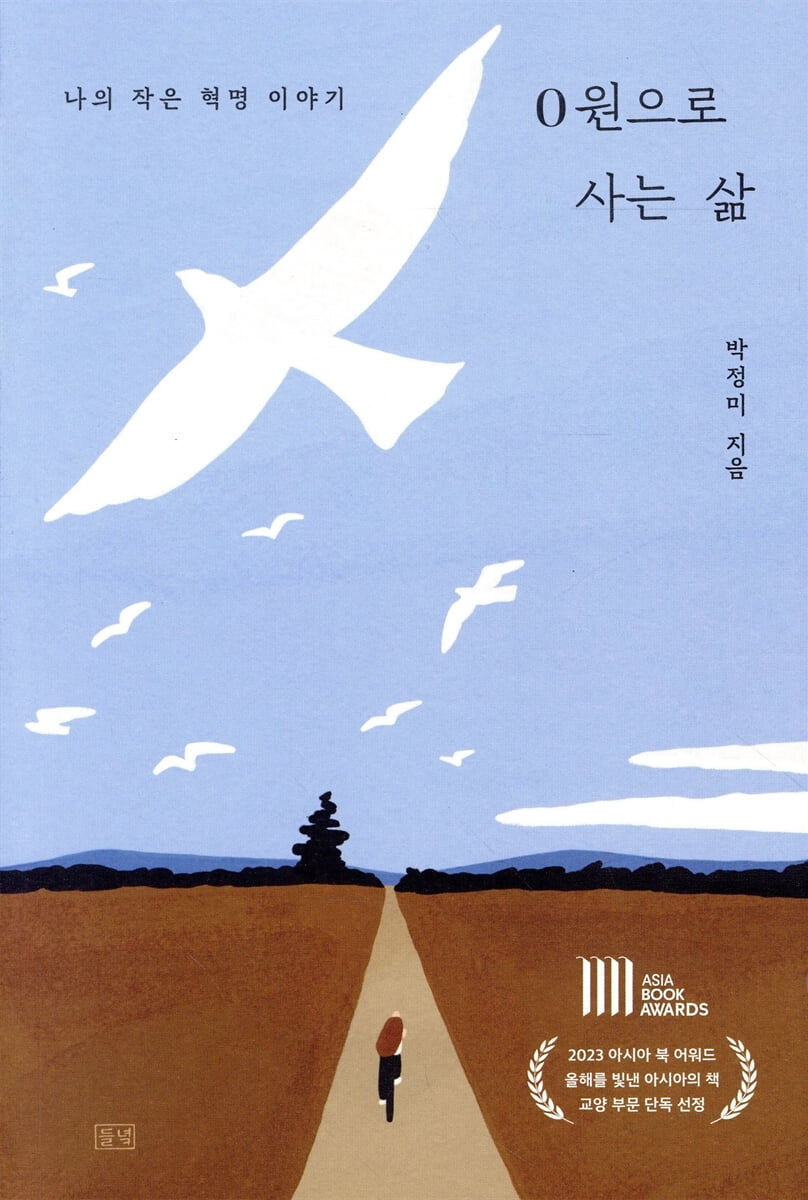
Living on 0 won
 |
Description
Book Introduction
Can we live without money? Where do you sleep (without money)? What to eat (without money)? How can I go (without money)? London, England, is known for its murderous rents and high cost of living. The book begins with the author's decision to live without spending money while living in London. The author did not start living on zero won from the beginning with the intention of influencing the act of not spending in any significant way. As we work hard every day to prove our reason for existence, strive for recognition, labor to earn money, and dress up and consume to be loved and cared for, our anxiety grows and our lives become thoroughly shackled to the shackles of labor and consumption. Even when you're lying in your room breathing, your rent is leaking out. Suddenly, the author realized that his life, time, and existence were being used 'to make money.' The author decided to find a reason to live even if he didn't earn money, to find a way to live even if he didn't have money, to find a reason to live just by being alive. Decided not to spend money. The author traveled from the self-sufficient organic farm 'Old Chapel Farm' in Wales, UK, to the eco-friendly community 'Tinker's Bubble' in southwest Somerset, to the bike repair cafe 'Roll for the Soul' in the cycling city of Bristol, and then to Worcester in central England before returning to London. Although he could have stayed in the labor exchange community for a long time, the author decides to move beyond mere survival and find his own way of life. This is also the reason why I decided to continue living on zero won even in the city. From mobile living in boats and caravans, to warehouse living in abandoned warehouses and factories, to squatters occupying empty buildings. People who live in alternative housing are practicing changes in their lifestyle and the way they live. Although not common, the variety of housing styles themselves serve as resistance to housing issues. Leaving the UK, the journey continues in Germany, Poland and Lithuania. In Hungary, he spends time with hippies and discovers a world beyond survival and love. Meeting refugees in Serbia, then Macedonia and Greece, the author surrenders himself to the flow in search of the key to peace. |
- You can preview some of the book's contents.
Preview
index
Beginning the story: The expansion of the world
Living in an empty house * Making a living * Doing what your heart desires * A world without money
From I system to nature
1 What does man live by?
Without money, there is no life
I need food and a place to stay * Eat and sleep without money|Start and end of the day|Important things|Enough
Because I want to be loved
Transportation: Riding the butterfly of good deeds
Declaring a zero-won life
Zero Won Living Project Rules
2 What is a more strange world?
Tinker's Forest
I was the only one who felt uncomfortable here.
The most beautiful and harmonious house in the world
Tinker's Bubble Principles
'Nothing' and 'lack'
The difference between what you need and what you want
Warning! Do not come.
Baggage inspection
Things to be suspicious of: Food * Agriculture | Livestock | Fishing | Processed foods and fast food
Chris's Philosophy * The Human Form of Existence | A Life Consumed by Consumption | What is Love?
3 Surviving on Trash in London
Radical Housing Network * Reckless Self-Praise | Boat People | Monthly Boat Living
Squatters: Living in an Abandoned House * A Dating for a Couple Without Consumption | Jay-May's Hideout | Not a Homeless Person, but a Squatter
Skip Diving: How to Fill Your Belly Without Money * Dive into a Useful Trash Can! | People's Views | Skip Divers Rescue Discarded Food | People Still Starve
Reborn Bicycles: Rebuilding Abandoned Bikes
Freegan: The Free Non-Consumer * Authentic Freegan | Zero Waste, Jay-May Hideout | Boycott | Faith and Courage
4. To nature
Noisy is the mind: 7-day challenge * Fasting No Food|Camping No Shelter|No Fun|Nature's hypnosis|In the Bluebell Valley|Filled with light
Permaculture: A Home Like Nature, A Life Like Nature * A Life of Serving Nature | Be Like Nature | Observe | Diversity: How Nature Works | Connect | Let the Wild Be Wild
Ecological Architecture, Earth House * Natural Materials | Aesthetics: The Shape and Use of Earth | A House Built with My Own Hands
Finding Survival and Love in Nature
II From Nature to Space, Welcome Home
1 home
Leaving Britain: Germany, Poland * Finding a New 'Home' | Welcome Home | Berlin Go! Hitchhiking | A Heart of Faith, Hitchhikingism | A Journey of Flow
Forest of Naked Nature: Lithuania * Welcome Home, Sister | Rainbow Gathering | Rainbow Guideline One: No Photography | Rainbow Guideline Two: No Chemicals | Rainbow Guideline Three: I Cover My Own Poop | Rainbow Guideline Four: That's Your Job | Rainbow Time, Where Time and Waiting Don't Exist | Nudity and Sex | Living Vibrations, Rainbow Music | No Need for Unnecessary Greetings | The Spell of Connection
Conversations with a Wise Man: Slovakia * My World | Conversations with Neptune, Liberation | Letting Go With the Flow
2 Things that happen on their own
Hop on the Hippies' Moving Castle: Hungary * Rainbow Family | Hippies: No One Knows When | Heaven on Earth
Legal Residents: Let's Go to Serbia * Police Station Ruckus | Legal Resident Celebration Ceremony | Syrian Refugee Family | Resistance and Compliance | People Who Don't Worry | Rosie Drinking Water
Purification Process * Heavenly Valley | Hello, Our Moving Castle | Silent Interview | Healing Ritual
A world beyond survival and love
3 The universe has everything ready
The Practice of Trusting the Flow: Serbia * Only Non-Refugees Are Protected | A Divided World, Finding the Key to Peace | A World Without Borders
Hardship and Miracles Come Together: Macedonia
A Day of Doing Nothing: Greece * Vegan Community Free & Real | Vegan
Winnie the Pooh's Daily Life
The First Anniversary of Radio-Freedom, and Beyond * Rebirth Anniversary | The Journey Home
In conclusion: The world I live in
The journey of non-consumption continues * Non-consumerist | We are all connected as one | Nature, the evidence of 'God', the mind, the tool of 'God'
All crises are connected * Epidemics | War | Food crisis | Energy crisis | The worst crisis is the best opportunity
Let's stop consuming
self-sufficient livelihood
Awakening
Things that helped me while making the book
Documentaries: About Veganism, the Food Industry, and the Climate Crisis | Books | Other Inspiring Films and Books | Useful Sites and Organizations for Traveling Without a Car
main
Living in an empty house * Making a living * Doing what your heart desires * A world without money
From I system to nature
1 What does man live by?
Without money, there is no life
I need food and a place to stay * Eat and sleep without money|Start and end of the day|Important things|Enough
Because I want to be loved
Transportation: Riding the butterfly of good deeds
Declaring a zero-won life
Zero Won Living Project Rules
2 What is a more strange world?
Tinker's Forest
I was the only one who felt uncomfortable here.
The most beautiful and harmonious house in the world
Tinker's Bubble Principles
'Nothing' and 'lack'
The difference between what you need and what you want
Warning! Do not come.
Baggage inspection
Things to be suspicious of: Food * Agriculture | Livestock | Fishing | Processed foods and fast food
Chris's Philosophy * The Human Form of Existence | A Life Consumed by Consumption | What is Love?
3 Surviving on Trash in London
Radical Housing Network * Reckless Self-Praise | Boat People | Monthly Boat Living
Squatters: Living in an Abandoned House * A Dating for a Couple Without Consumption | Jay-May's Hideout | Not a Homeless Person, but a Squatter
Skip Diving: How to Fill Your Belly Without Money * Dive into a Useful Trash Can! | People's Views | Skip Divers Rescue Discarded Food | People Still Starve
Reborn Bicycles: Rebuilding Abandoned Bikes
Freegan: The Free Non-Consumer * Authentic Freegan | Zero Waste, Jay-May Hideout | Boycott | Faith and Courage
4. To nature
Noisy is the mind: 7-day challenge * Fasting No Food|Camping No Shelter|No Fun|Nature's hypnosis|In the Bluebell Valley|Filled with light
Permaculture: A Home Like Nature, A Life Like Nature * A Life of Serving Nature | Be Like Nature | Observe | Diversity: How Nature Works | Connect | Let the Wild Be Wild
Ecological Architecture, Earth House * Natural Materials | Aesthetics: The Shape and Use of Earth | A House Built with My Own Hands
Finding Survival and Love in Nature
II From Nature to Space, Welcome Home
1 home
Leaving Britain: Germany, Poland * Finding a New 'Home' | Welcome Home | Berlin Go! Hitchhiking | A Heart of Faith, Hitchhikingism | A Journey of Flow
Forest of Naked Nature: Lithuania * Welcome Home, Sister | Rainbow Gathering | Rainbow Guideline One: No Photography | Rainbow Guideline Two: No Chemicals | Rainbow Guideline Three: I Cover My Own Poop | Rainbow Guideline Four: That's Your Job | Rainbow Time, Where Time and Waiting Don't Exist | Nudity and Sex | Living Vibrations, Rainbow Music | No Need for Unnecessary Greetings | The Spell of Connection
Conversations with a Wise Man: Slovakia * My World | Conversations with Neptune, Liberation | Letting Go With the Flow
2 Things that happen on their own
Hop on the Hippies' Moving Castle: Hungary * Rainbow Family | Hippies: No One Knows When | Heaven on Earth
Legal Residents: Let's Go to Serbia * Police Station Ruckus | Legal Resident Celebration Ceremony | Syrian Refugee Family | Resistance and Compliance | People Who Don't Worry | Rosie Drinking Water
Purification Process * Heavenly Valley | Hello, Our Moving Castle | Silent Interview | Healing Ritual
A world beyond survival and love
3 The universe has everything ready
The Practice of Trusting the Flow: Serbia * Only Non-Refugees Are Protected | A Divided World, Finding the Key to Peace | A World Without Borders
Hardship and Miracles Come Together: Macedonia
A Day of Doing Nothing: Greece * Vegan Community Free & Real | Vegan
Winnie the Pooh's Daily Life
The First Anniversary of Radio-Freedom, and Beyond * Rebirth Anniversary | The Journey Home
In conclusion: The world I live in
The journey of non-consumption continues * Non-consumerist | We are all connected as one | Nature, the evidence of 'God', the mind, the tool of 'God'
All crises are connected * Epidemics | War | Food crisis | Energy crisis | The worst crisis is the best opportunity
Let's stop consuming
self-sufficient livelihood
Awakening
Things that helped me while making the book
Documentaries: About Veganism, the Food Industry, and the Climate Crisis | Books | Other Inspiring Films and Books | Useful Sites and Organizations for Traveling Without a Car
main
Into the book
While writing this, I have personally renovated and lived in three country houses.
The first house was a shabby empty house at the tip of the Korean peninsula.
The second was a small farmhouse in my father's hometown, and the third house was a cabin in a remote forest at the foot of Jirisan Mountain.
Over the past six years, my walking path has changed from the sea to the rice paddies and then to the mountains, but the way I live hasn't changed much.
I don't have a steady income and live on minimal consumption.
Don't do what you don't want to do, and only do what you want to do.
(syncopation)
Since the spring of 2021, I have been living in a ‘forest cabin’ at the foot of Jirisan Mountain.
Unless I play the drums so loudly, no one will notice that someone lives in this forest.
This house is not something I searched for or bought with great effort.
It appeared to me, literally by chance, like a miracle.
Besides, this house had the things I had been longing for.
I can only say that it is a gift from heaven to me.
Neither in the shabby empty house nor in the cabin in the woods did I pay rent.
Instead, it took about three months for both families to stretch out and sleep for the first time.
Clearing away tons of trash, fixing broken walls and floors, replacing window paper, laying bathroom tiles, organizing wires, and building shelves and furniture.
Removing the wallpaper and plywood revealed the beautifully hidden rafters and mud walls.
Every time I see my nostrils getting black even though I'm working with a mask on, every time I go through the hardship of having to carry firewood down from the mountain every winter, I'm reminded that housing isn't free.
I still live in a 'house that is not fit for living', but I am happy to live without paying rent or heating bills.
Guests who come to my house always ask if it isn't scary to live alone in the forest.
Every time, I answer, “Strangely, I’m not scared at all.”
It's amazing how I am like this.
I used to lose sleep over fear of ghosts appearing, fear of bad things happening to me on my way home at night, and tremble with anxiety over encountering wild animals in the mountains.
Even though I have a roommate in the living room, I have to leave the light on in my room to fall asleep, so I can't believe I'm spending the night alone in the woods.
---From "Living in an Empty House"
“How did you find the life you truly wanted?”
'What is the life I truly want?' This is perhaps the most important question for every human being.
I, too, have spent my entire life searching for the answer to this question.
I may have asked the same question in the distant past, far beyond my memory, and only now, after tens of thousands of lifetimes, have I found the answer.
So, I can't say that my life changed from fear to blessing due to just one event.
Because everything is connected.
But as far back as I can remember, there was definitely an event that brought about a very dramatic and powerful change in my life, in my world.
This is the '0 Won Living Project' that was carried out for approximately two years from October 2014 to October 2016.
The project, which was planned to last one year, lasted for a little over two years, and the journey that began in England ended in India.
No, the journey is not over yet.
Now, instead of the grand name of 'project', 'life' is guiding my journey.
---From "What the Heart Wants"
As I said before, I use money now.
The taboo of projects that "don't use money" has long since disappeared.
There is no aversion to money, and no strict rules.
If you have it, live with it. If you don't have it, live with it.
Now the possibilities in my life flow endlessly, regardless of whether I have money or not.
What the '0 Won Living' journey brought me was not only freedom from money.
In fact, at some point during my journey, the topic of 'money' itself disappeared from my interests.
'Not spending money' has become a familiar routine, and more important values to focus on are beginning to appear.
The journey of 'living on zero won' has led my life to a deeper and higher level than material things, and in the process, I have experienced truly profound changes.
(syncopation)
The world didn't end because you didn't have money.
Rather, ‘not having money’ became the wings that led me to the real world.
A world of systems based on contradictions and exploitation.
By escaping from this world and experiencing an alternative life for self-reliance, I was freed from the anxiety of survival.
Connecting with the living world of nature healed my inner loneliness, and my world expanded from the system to nature, and from nature to the universe.
And finally, I found the purpose of life and the path to ultimate peace.
All these miracles started after I erased 'money' from my life.
It is a miracle of living on zero won.
In this book, I describe how my world expanded during my journey of living on zero, what triggers and encounters led to that expansion, and what changes I experienced within it.
Here, there are both 'miraculous truths' and 'inconvenient truths'.
I want you to face both the miracles and the discomforts as they are.
Only after we first open our eyes to the uncomfortable world can we move forward into the true world, the truth of miracles.
---From "The World Where Money Disappeared"
The most important factor for tinkerers when building a house is 'how harmless it is to the Earth?'
I don't want a neat and 'convenient' building.
I long for a simple hideaway where even a small bug or a blade of grass will not cause any harm.
While humans build warm and pretty houses, the Earth is getting hotter and the ecosystem is collapsing.
Wear short sleeves in a warm house on a cold day, and turn on the air conditioner on a hot day to create a cool and comfortable space.
The perfect home that humans desire today destroys the perfect harmony of the Earth.
It was only then that I realized that the tinkers' house, so shabby and run-down, was the most beautiful and harmonious house in the world.
---From "The World's Most Beautiful and Harmonious House"
Chris inspected my belongings thoroughly.
They carefully examined the ingredients listed on each toothpaste and shampoo and confiscated them all.
It is a harmful product.
Then he handed me his natural toothpaste and said.
“You will find here that there is quite a lot to know.
You need to know the truth, not the distorted misinformation on TV and the Internet, that will restore your health and freedom.
“It all starts with the products and foods you put on your body.”
Morak had been using a menstrual cup for several years already.
She showed me the menstrual cup she uses and explained in detail how to use it.
The thought of putting something that wasn't that small into my vagina made me feel quite uncomfortable.
As I frowned, Morak explained in detail how menstrual cups are harmless and comfortable for our bodies, and how disposable menstrual products have harmed our health and the environment.
Chris even said he would be willing to buy me a menstrual cup if I wanted one.
(syncopation)
Chris was particularly insistent that we must question the entire food production process.
What kind of seeds do vegetables come from, what kind of soil do they come from, what kind of substances do they mix with, how are they transported, and how are they processed before they reach our mouths?
How is meat born, how is it raised, how is it treated, how is it slaughtered, how is it prepared, and how does it end up in our mouths?
We must know the whole process, and once we know the truth, we will never be able to eat just any food.
---From "Inspection of Personal Effects"
There are about 3,500 km of canals in Britain.
The canal is also called the 'longest village in the world' as it provides homes to over 15,000 people.
While some people start boating because they long for the romance of the water, most boaters choose boating for practical reasons.
As London house prices soared, the housing situation became unstable for ordinary people and they suffered from financial difficulties.
People, fed up with the gloomy economic situation, eventually resorted to boats instead of buildings.
(syncopation)
Life on a boat is not just an 'experience' for them, but a 'daily life', so it cannot always be romantic.
Life on the water is fraught with dangers and difficulties.
Not only were they exposed to natural disasters caused by wind and rain, but they were also vulnerable to the risk of crime.
They were often victims of robbery, assault, theft, and even dangerous pranks.
The difficulties arising from the life of a waterman itself were also considerable.
For people who live constantly moving on the water, the benefits of central public services were a story from the other side of the water.
You have to take care of your own water, gas, and electricity, and since there is no sewage tank, you also have to take care of your own sewage disposal.
To effectively manage scarce resources, you must acquire the necessary knowledge and related skills.
We need to know exactly where those resources come from, how sustainable they are, and where they are exported and recycled.
So, the boaters cannot even afford the necessities of life.
Because resources were always insufficient, we had to constantly lighten the load, filling the space with only what was absolutely necessary.
Boat life is wild.
Those who have acquired various life skills have even made apartment residents who depend on public facilities look like they are crippled in life skills.
(Omitted) He couldn't stay on his boat forever, wasting food.
I had to find a way to be sustainable and self-sufficient without being beholden to anyone.
I went back to basics and tried to figure out how to survive.
I looked around.
Dense buildings and restaurants, bicycles that have been abandoned for unknown periods of time.
The streets were overflowing with things I needed.
But there is no space for even one of my bodies.
The city was full of waste.
On the other hand, there are people struggling with the desperation of survival.
I was overcome with sadness and grief at the unreasonable reality.
It's a truly contradictory world.
Soon I came to appreciate the culture of 'waste' enough to bow down to this 'luxury' of the city.
Interestingly enough, the key to self-reliance and survival was found right here.
---From "Living on a Monthly Rent Boat"
We left the Valley of Heaven and began our drift to the Greek island of Evvoia.
Instead of deciding on a route in advance, I decided to choose a route based on the destination of the driver I met at the time and the direction my intuition pointed me to at each moment.
I stood on the road without any destination sign, believing that the universe would guide me.
(Omitted) Serbia's roads were simple and the people were friendly.
There was no need to wait for more than 10 minutes for a car or worry about complicated directions.
I happened to meet a driver heading towards Macedonia.
This sets the route.
Passing through Macedonia, we head to Greece.
The driver was friendly.
We moved slowly as if we were traveling, eating and drinking tea together.
And after 9pm we arrived at a village near the Serbia-Macedonia border.
The driver dropped me off at the entrance to the village and left for his destination.
So I was left alone late at night in an unknown place.
The night was dark and the village was quiet.
Where should I go now… .
When I was actually alone, I felt lost.
(syncopation)
The streets that seemed to be the center of the town were filled with countless refugees.
Although tents were visible here and there, most people were lying on the bare floor, roughly covered with blankets, sprawled out among the trash on the street.
Among them were many women and children.
Only then did I understand why the man had asked, “Syrian?”, which camp he meant by “camp!”, and why the villagers were so wary of me and waved me off.
Located next to the border between Serbia and Macedonia, the town was a major transit point for Syrian refugees on their way to safety.
So, to anyone who saw me, wandering the streets at night, shouting "Camping! Camping!" with a large backpack, shabby clothes, and a dark, sooty face, I was clearly a refugee.
(Omitted) I tried to tell the police in a hurry, 'I am not a refugee!'
At that moment, my eyes met with a refugee sister who was standing in line in front of the police.
Lifeless eyes and exhausted expression.
Her face was so tired that one could not even imagine how difficult a day she had had.
I stopped what I was about to say to the police officer and walked quietly to the end of the long line.
I couldn't bring myself to say, "I'm not a refugee!" to people who couldn't even understand how I became a refugee overnight.
Compared to what she's going through, my situation right now is nothing, so how dare I ask her to help me?
I waited in line for a long time with mixed emotions of guilt and fear.
After a long wait, it was my turn and I approached the police officer.
The police suddenly shouted, “Paper!”
I explained to him quietly.
“I am Korean.
I was traveling and somehow ended up here.
“I didn’t know where to go from here, so I came to you, the police officer.”
The police officer didn't understand English and just kept shouting "Paper!"
I felt like I couldn't communicate with him at all, so I gave him my South Korean passport.
The police looked through my passport and then brought in another officer who appeared to be my superior.
I explained to the policeman the whole story of how I ended up here.
But the policeman also looked like he didn't understand what I was saying.
Of course, the language barrier was a problem, but more than that, it seemed like they couldn't logically accept my situation.
The police couldn't understand my situation. They couldn't understand why I looked like a beggar even though I wasn't a refugee. They couldn't understand why Koreans' faces were naturally so dark. They also couldn't understand why I was a woman traveling alone to a refugee camp so late at night.
Eventually, they took me to a nearby cafe to question me in more detail.
---From "Practice of Trusting the Flow: Serbia" and "Only Those Who Are Not Refugees Are Protected"
Why must they endure such suffering? Is there no world without war? Becoming an officer has long been my dream.
As soon as I graduated from college, I applied to become a female officer in the military.
On the day he wore diamonds on both shoulders, he placed the mission of 'Protecting the Fatherland' on one shoulder and 'Maintaining World Peace' on the other.
The two shining diamonds were a source of pride.
He served as a platoon leader and instructor at a new recruit training unit in a forward area.
He taught combat skills to trainees in their early twenties who had just had their hair cut.
When I shouted, “Charge forward!” they ran, shouting and dodging invisible bullets.
He threw practice grenades into the trenches and waved his bayonets in the air.
In a war situation, they would run through a hail of bullets at my shouts and kill their opponents with the tip of their bayonets.
Even if it was training, the more murderous their eyes were and the more brutally they swung their bayonets, the higher the score I praised them.
Then, in November 2010, two years after my appointment, it was a day like that.
The Yeonpyeong Island bombardment occurred.
North Korea's sudden provocation has plunged the entire Korean Peninsula into a state of tension and anxiety.
It seemed like war was about to break out at any moment.
The forward area was prepared for wartime conditions.
All members of the unit, including officers, waited in the barracks in full combat gear and slept in their combat uniforms.
We stopped basic training and trained for wartime missions.
The front-line unit members took pictures of the spirits and wrote wills.
The officers called the family and informed them that they would not be able to enter the house for the time being.
Our deputy platoon leader had a video call with his pregnant wife and three-year-old daughter.
The platoon members asked me with frightened eyes.
(syncopation)
About a week has passed since we were on standby.
Fortunately, no war broke out and everything returned to normal.
However, the precious lives of the four people who died during the artillery battle were never returned.
Along with this, my mission of ‘protecting the fatherland’ and ‘maintaining world peace’ never returned.
My head was full of questions.
What is peace? Is it truly justifiable to wage war to preserve it? Isn't peace simply the continuation of our current peaceful daily lives? How can we achieve peace through war when our daily lives are shattered, our loved ones are killed, and our homes are destroyed? What is a nation? Why, exactly, must so many of its sons and daughters give their lives? Is it truly a natural duty to send our living citizens to their deaths to protect our nation? Killing our own sons and daughters to "defend our nation" and destroying the current peace to "maintain world peace" was no longer a source of pride.
Eventually, I finished my three-year mandatory service and left the military.
(Omitted) What we must protect is not our country, but ‘life’ itself; what we must follow is not orders, but ‘conscience’; and what we desire is not victory, but ‘peace’.
No war can have a just cause.
Peace itself must be both a means and an end, and war is the enemy that humanity must defeat.
There are no people to protect and no people to kill.
Both Russian and Ukrainian soldiers have precious lives.
A world where all soldiers refuse war and killing, give bread to enemies and foes, and live as one nation without distinction between my country and the four countries.
I pray for a dreamlike world without borders or countries on the battlefields of Ukraine.
The first house was a shabby empty house at the tip of the Korean peninsula.
The second was a small farmhouse in my father's hometown, and the third house was a cabin in a remote forest at the foot of Jirisan Mountain.
Over the past six years, my walking path has changed from the sea to the rice paddies and then to the mountains, but the way I live hasn't changed much.
I don't have a steady income and live on minimal consumption.
Don't do what you don't want to do, and only do what you want to do.
(syncopation)
Since the spring of 2021, I have been living in a ‘forest cabin’ at the foot of Jirisan Mountain.
Unless I play the drums so loudly, no one will notice that someone lives in this forest.
This house is not something I searched for or bought with great effort.
It appeared to me, literally by chance, like a miracle.
Besides, this house had the things I had been longing for.
I can only say that it is a gift from heaven to me.
Neither in the shabby empty house nor in the cabin in the woods did I pay rent.
Instead, it took about three months for both families to stretch out and sleep for the first time.
Clearing away tons of trash, fixing broken walls and floors, replacing window paper, laying bathroom tiles, organizing wires, and building shelves and furniture.
Removing the wallpaper and plywood revealed the beautifully hidden rafters and mud walls.
Every time I see my nostrils getting black even though I'm working with a mask on, every time I go through the hardship of having to carry firewood down from the mountain every winter, I'm reminded that housing isn't free.
I still live in a 'house that is not fit for living', but I am happy to live without paying rent or heating bills.
Guests who come to my house always ask if it isn't scary to live alone in the forest.
Every time, I answer, “Strangely, I’m not scared at all.”
It's amazing how I am like this.
I used to lose sleep over fear of ghosts appearing, fear of bad things happening to me on my way home at night, and tremble with anxiety over encountering wild animals in the mountains.
Even though I have a roommate in the living room, I have to leave the light on in my room to fall asleep, so I can't believe I'm spending the night alone in the woods.
---From "Living in an Empty House"
“How did you find the life you truly wanted?”
'What is the life I truly want?' This is perhaps the most important question for every human being.
I, too, have spent my entire life searching for the answer to this question.
I may have asked the same question in the distant past, far beyond my memory, and only now, after tens of thousands of lifetimes, have I found the answer.
So, I can't say that my life changed from fear to blessing due to just one event.
Because everything is connected.
But as far back as I can remember, there was definitely an event that brought about a very dramatic and powerful change in my life, in my world.
This is the '0 Won Living Project' that was carried out for approximately two years from October 2014 to October 2016.
The project, which was planned to last one year, lasted for a little over two years, and the journey that began in England ended in India.
No, the journey is not over yet.
Now, instead of the grand name of 'project', 'life' is guiding my journey.
---From "What the Heart Wants"
As I said before, I use money now.
The taboo of projects that "don't use money" has long since disappeared.
There is no aversion to money, and no strict rules.
If you have it, live with it. If you don't have it, live with it.
Now the possibilities in my life flow endlessly, regardless of whether I have money or not.
What the '0 Won Living' journey brought me was not only freedom from money.
In fact, at some point during my journey, the topic of 'money' itself disappeared from my interests.
'Not spending money' has become a familiar routine, and more important values to focus on are beginning to appear.
The journey of 'living on zero won' has led my life to a deeper and higher level than material things, and in the process, I have experienced truly profound changes.
(syncopation)
The world didn't end because you didn't have money.
Rather, ‘not having money’ became the wings that led me to the real world.
A world of systems based on contradictions and exploitation.
By escaping from this world and experiencing an alternative life for self-reliance, I was freed from the anxiety of survival.
Connecting with the living world of nature healed my inner loneliness, and my world expanded from the system to nature, and from nature to the universe.
And finally, I found the purpose of life and the path to ultimate peace.
All these miracles started after I erased 'money' from my life.
It is a miracle of living on zero won.
In this book, I describe how my world expanded during my journey of living on zero, what triggers and encounters led to that expansion, and what changes I experienced within it.
Here, there are both 'miraculous truths' and 'inconvenient truths'.
I want you to face both the miracles and the discomforts as they are.
Only after we first open our eyes to the uncomfortable world can we move forward into the true world, the truth of miracles.
---From "The World Where Money Disappeared"
The most important factor for tinkerers when building a house is 'how harmless it is to the Earth?'
I don't want a neat and 'convenient' building.
I long for a simple hideaway where even a small bug or a blade of grass will not cause any harm.
While humans build warm and pretty houses, the Earth is getting hotter and the ecosystem is collapsing.
Wear short sleeves in a warm house on a cold day, and turn on the air conditioner on a hot day to create a cool and comfortable space.
The perfect home that humans desire today destroys the perfect harmony of the Earth.
It was only then that I realized that the tinkers' house, so shabby and run-down, was the most beautiful and harmonious house in the world.
---From "The World's Most Beautiful and Harmonious House"
Chris inspected my belongings thoroughly.
They carefully examined the ingredients listed on each toothpaste and shampoo and confiscated them all.
It is a harmful product.
Then he handed me his natural toothpaste and said.
“You will find here that there is quite a lot to know.
You need to know the truth, not the distorted misinformation on TV and the Internet, that will restore your health and freedom.
“It all starts with the products and foods you put on your body.”
Morak had been using a menstrual cup for several years already.
She showed me the menstrual cup she uses and explained in detail how to use it.
The thought of putting something that wasn't that small into my vagina made me feel quite uncomfortable.
As I frowned, Morak explained in detail how menstrual cups are harmless and comfortable for our bodies, and how disposable menstrual products have harmed our health and the environment.
Chris even said he would be willing to buy me a menstrual cup if I wanted one.
(syncopation)
Chris was particularly insistent that we must question the entire food production process.
What kind of seeds do vegetables come from, what kind of soil do they come from, what kind of substances do they mix with, how are they transported, and how are they processed before they reach our mouths?
How is meat born, how is it raised, how is it treated, how is it slaughtered, how is it prepared, and how does it end up in our mouths?
We must know the whole process, and once we know the truth, we will never be able to eat just any food.
---From "Inspection of Personal Effects"
There are about 3,500 km of canals in Britain.
The canal is also called the 'longest village in the world' as it provides homes to over 15,000 people.
While some people start boating because they long for the romance of the water, most boaters choose boating for practical reasons.
As London house prices soared, the housing situation became unstable for ordinary people and they suffered from financial difficulties.
People, fed up with the gloomy economic situation, eventually resorted to boats instead of buildings.
(syncopation)
Life on a boat is not just an 'experience' for them, but a 'daily life', so it cannot always be romantic.
Life on the water is fraught with dangers and difficulties.
Not only were they exposed to natural disasters caused by wind and rain, but they were also vulnerable to the risk of crime.
They were often victims of robbery, assault, theft, and even dangerous pranks.
The difficulties arising from the life of a waterman itself were also considerable.
For people who live constantly moving on the water, the benefits of central public services were a story from the other side of the water.
You have to take care of your own water, gas, and electricity, and since there is no sewage tank, you also have to take care of your own sewage disposal.
To effectively manage scarce resources, you must acquire the necessary knowledge and related skills.
We need to know exactly where those resources come from, how sustainable they are, and where they are exported and recycled.
So, the boaters cannot even afford the necessities of life.
Because resources were always insufficient, we had to constantly lighten the load, filling the space with only what was absolutely necessary.
Boat life is wild.
Those who have acquired various life skills have even made apartment residents who depend on public facilities look like they are crippled in life skills.
(Omitted) He couldn't stay on his boat forever, wasting food.
I had to find a way to be sustainable and self-sufficient without being beholden to anyone.
I went back to basics and tried to figure out how to survive.
I looked around.
Dense buildings and restaurants, bicycles that have been abandoned for unknown periods of time.
The streets were overflowing with things I needed.
But there is no space for even one of my bodies.
The city was full of waste.
On the other hand, there are people struggling with the desperation of survival.
I was overcome with sadness and grief at the unreasonable reality.
It's a truly contradictory world.
Soon I came to appreciate the culture of 'waste' enough to bow down to this 'luxury' of the city.
Interestingly enough, the key to self-reliance and survival was found right here.
---From "Living on a Monthly Rent Boat"
We left the Valley of Heaven and began our drift to the Greek island of Evvoia.
Instead of deciding on a route in advance, I decided to choose a route based on the destination of the driver I met at the time and the direction my intuition pointed me to at each moment.
I stood on the road without any destination sign, believing that the universe would guide me.
(Omitted) Serbia's roads were simple and the people were friendly.
There was no need to wait for more than 10 minutes for a car or worry about complicated directions.
I happened to meet a driver heading towards Macedonia.
This sets the route.
Passing through Macedonia, we head to Greece.
The driver was friendly.
We moved slowly as if we were traveling, eating and drinking tea together.
And after 9pm we arrived at a village near the Serbia-Macedonia border.
The driver dropped me off at the entrance to the village and left for his destination.
So I was left alone late at night in an unknown place.
The night was dark and the village was quiet.
Where should I go now… .
When I was actually alone, I felt lost.
(syncopation)
The streets that seemed to be the center of the town were filled with countless refugees.
Although tents were visible here and there, most people were lying on the bare floor, roughly covered with blankets, sprawled out among the trash on the street.
Among them were many women and children.
Only then did I understand why the man had asked, “Syrian?”, which camp he meant by “camp!”, and why the villagers were so wary of me and waved me off.
Located next to the border between Serbia and Macedonia, the town was a major transit point for Syrian refugees on their way to safety.
So, to anyone who saw me, wandering the streets at night, shouting "Camping! Camping!" with a large backpack, shabby clothes, and a dark, sooty face, I was clearly a refugee.
(Omitted) I tried to tell the police in a hurry, 'I am not a refugee!'
At that moment, my eyes met with a refugee sister who was standing in line in front of the police.
Lifeless eyes and exhausted expression.
Her face was so tired that one could not even imagine how difficult a day she had had.
I stopped what I was about to say to the police officer and walked quietly to the end of the long line.
I couldn't bring myself to say, "I'm not a refugee!" to people who couldn't even understand how I became a refugee overnight.
Compared to what she's going through, my situation right now is nothing, so how dare I ask her to help me?
I waited in line for a long time with mixed emotions of guilt and fear.
After a long wait, it was my turn and I approached the police officer.
The police suddenly shouted, “Paper!”
I explained to him quietly.
“I am Korean.
I was traveling and somehow ended up here.
“I didn’t know where to go from here, so I came to you, the police officer.”
The police officer didn't understand English and just kept shouting "Paper!"
I felt like I couldn't communicate with him at all, so I gave him my South Korean passport.
The police looked through my passport and then brought in another officer who appeared to be my superior.
I explained to the policeman the whole story of how I ended up here.
But the policeman also looked like he didn't understand what I was saying.
Of course, the language barrier was a problem, but more than that, it seemed like they couldn't logically accept my situation.
The police couldn't understand my situation. They couldn't understand why I looked like a beggar even though I wasn't a refugee. They couldn't understand why Koreans' faces were naturally so dark. They also couldn't understand why I was a woman traveling alone to a refugee camp so late at night.
Eventually, they took me to a nearby cafe to question me in more detail.
---From "Practice of Trusting the Flow: Serbia" and "Only Those Who Are Not Refugees Are Protected"
Why must they endure such suffering? Is there no world without war? Becoming an officer has long been my dream.
As soon as I graduated from college, I applied to become a female officer in the military.
On the day he wore diamonds on both shoulders, he placed the mission of 'Protecting the Fatherland' on one shoulder and 'Maintaining World Peace' on the other.
The two shining diamonds were a source of pride.
He served as a platoon leader and instructor at a new recruit training unit in a forward area.
He taught combat skills to trainees in their early twenties who had just had their hair cut.
When I shouted, “Charge forward!” they ran, shouting and dodging invisible bullets.
He threw practice grenades into the trenches and waved his bayonets in the air.
In a war situation, they would run through a hail of bullets at my shouts and kill their opponents with the tip of their bayonets.
Even if it was training, the more murderous their eyes were and the more brutally they swung their bayonets, the higher the score I praised them.
Then, in November 2010, two years after my appointment, it was a day like that.
The Yeonpyeong Island bombardment occurred.
North Korea's sudden provocation has plunged the entire Korean Peninsula into a state of tension and anxiety.
It seemed like war was about to break out at any moment.
The forward area was prepared for wartime conditions.
All members of the unit, including officers, waited in the barracks in full combat gear and slept in their combat uniforms.
We stopped basic training and trained for wartime missions.
The front-line unit members took pictures of the spirits and wrote wills.
The officers called the family and informed them that they would not be able to enter the house for the time being.
Our deputy platoon leader had a video call with his pregnant wife and three-year-old daughter.
The platoon members asked me with frightened eyes.
(syncopation)
About a week has passed since we were on standby.
Fortunately, no war broke out and everything returned to normal.
However, the precious lives of the four people who died during the artillery battle were never returned.
Along with this, my mission of ‘protecting the fatherland’ and ‘maintaining world peace’ never returned.
My head was full of questions.
What is peace? Is it truly justifiable to wage war to preserve it? Isn't peace simply the continuation of our current peaceful daily lives? How can we achieve peace through war when our daily lives are shattered, our loved ones are killed, and our homes are destroyed? What is a nation? Why, exactly, must so many of its sons and daughters give their lives? Is it truly a natural duty to send our living citizens to their deaths to protect our nation? Killing our own sons and daughters to "defend our nation" and destroying the current peace to "maintain world peace" was no longer a source of pride.
Eventually, I finished my three-year mandatory service and left the military.
(Omitted) What we must protect is not our country, but ‘life’ itself; what we must follow is not orders, but ‘conscience’; and what we desire is not victory, but ‘peace’.
No war can have a just cause.
Peace itself must be both a means and an end, and war is the enemy that humanity must defeat.
There are no people to protect and no people to kill.
Both Russian and Ukrainian soldiers have precious lives.
A world where all soldiers refuse war and killing, give bread to enemies and foes, and live as one nation without distinction between my country and the four countries.
I pray for a dreamlike world without borders or countries on the battlefields of Ukraine.
---From "Separated World, Finding the Key to Peace"
Publisher's Review
A real revolution is not about protesting by throwing Molotov cocktails,
It starts with a lifestyle of not consuming.
The journey of 'Living on 0 Won' began with two questions.
'How can I make a living?' 'How can I be loved?' And these two questions stem from the two most basic human desires: survival and love.
The author found three treasures in a small, few, and flowing life: 'nature', 'freedom', and 'happiness'.
It is the new fruit of my resolution to live without spending money.
Even though he uses his body to make meals, eats discarded food, and wears used clothes, the author is not lonely.
On the contrary, it becomes 'sufficient'.
In a society filled with anxiety and competition, the author sought the truth while searching for a way of life that would ensure human survival and sustainability.
This book does not call for the rejection of capitalism and the globalized economic structure itself.
However, the author hopes that consumption will 'evolve' for the survival and sustainability of humanity.
Whether deep in the mountains, in the city, or on a farm, the location doesn't matter.
I would be happy to do any work that creates a 'life' based on life.
Let's go back to the simple roots
“I will stop spending from today.” The author is still living in a renovated empty house in Korea.
Now I live in a cabin in a remote forest at the foot of Jirisan Mountain.
The author's walking course has changed from the sea to the rice paddies and mountains over the past six years, but his lifestyle has not changed much.
I don't have a steady income and live on minimal consumption.
But we don't live for consumption.
There is no aversion to money, and no strict rules.
If you have it, you have it, if you don't have it, you leave it to the flow.
In the author's life, possibilities flow regardless of money.
Readers can follow the author's journey and connect 'consumption', 'environment', and 'truth'.
Everyone has the right to decide their own consumption and lifestyle.
'No consumption', this small revolution will save humanity from the current crisis with freedom, peace, and love.
The author asks, "Is your consumption saving the world? Is your consumption and labor voluntary?"
It starts with a lifestyle of not consuming.
The journey of 'Living on 0 Won' began with two questions.
'How can I make a living?' 'How can I be loved?' And these two questions stem from the two most basic human desires: survival and love.
The author found three treasures in a small, few, and flowing life: 'nature', 'freedom', and 'happiness'.
It is the new fruit of my resolution to live without spending money.
Even though he uses his body to make meals, eats discarded food, and wears used clothes, the author is not lonely.
On the contrary, it becomes 'sufficient'.
In a society filled with anxiety and competition, the author sought the truth while searching for a way of life that would ensure human survival and sustainability.
This book does not call for the rejection of capitalism and the globalized economic structure itself.
However, the author hopes that consumption will 'evolve' for the survival and sustainability of humanity.
Whether deep in the mountains, in the city, or on a farm, the location doesn't matter.
I would be happy to do any work that creates a 'life' based on life.
Let's go back to the simple roots
“I will stop spending from today.” The author is still living in a renovated empty house in Korea.
Now I live in a cabin in a remote forest at the foot of Jirisan Mountain.
The author's walking course has changed from the sea to the rice paddies and mountains over the past six years, but his lifestyle has not changed much.
I don't have a steady income and live on minimal consumption.
But we don't live for consumption.
There is no aversion to money, and no strict rules.
If you have it, you have it, if you don't have it, you leave it to the flow.
In the author's life, possibilities flow regardless of money.
Readers can follow the author's journey and connect 'consumption', 'environment', and 'truth'.
Everyone has the right to decide their own consumption and lifestyle.
'No consumption', this small revolution will save humanity from the current crisis with freedom, peace, and love.
The author asks, "Is your consumption saving the world? Is your consumption and labor voluntary?"
GOODS SPECIFICS
- Publication date: October 28, 2022
- Pages, weight, size: 454 pages | 508g | 140*210*30mm
- ISBN13: 9791159259111
- ISBN10: 1159259119
You may also like
카테고리
korean


korean

![GQ KOREA Mark (Monthly): December [2025]](http://librairie.coreenne.fr/cdn/shop/files/8ef265dbbfbf186523ed75ba7319009d.jpg?v=1765340328&width=3840)


