

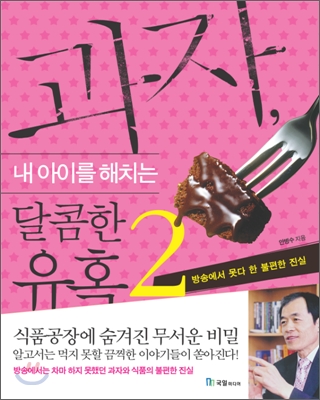
Sweets, the Sweet Temptation That Hurts My Child 2
 |
Description
Book Introduction
Break free from the dreaded 'sweets and processed foods'!
The author who caused a stir in South Korea a few years ago with the book "Sweets, the Sweet Temptation That Harms My Child," about the scary secrets hidden in snacks, has spoken again.
The book begins with a story about foods that seem natural, but are never naturally absorbed by our bodies, such as crab meat, radish, and juice.
It explains in detail why children hate 'Mom's snacks' and why the popcorn we enjoy at the movie theater is harmful to our bodies, and it also digs into the truth about the chemicals added to processed foods.
He also points out the blind spots in the Food Sanitation Act, saying that we should not just trust the labels “0g trans fat” and “No MSG added.”
The greatest strength of this book is that it even addresses the reader's concern: "So, what should I eat?"
The author cites various examples, recommending unrefined sugar instead of refined sugar, yogurt instead of allergenic milk, and fresh fruit instead of juice, and even suggests nutritious snacks that can be easily made at home.
In addition, it corrects some of the misconceptions we had about eating only fruit, such as making you gain weight, and about trans fatty acids and butter.
They say you see as much as you know, right? Only by properly understanding these facts can you make smart choices and eat right.
The things discussed in this book are not secrets that will one day be revealed, but rather stories that must now be revealed, somewhat uncomfortable truths that must now be changed.
The author who caused a stir in South Korea a few years ago with the book "Sweets, the Sweet Temptation That Harms My Child," about the scary secrets hidden in snacks, has spoken again.
The book begins with a story about foods that seem natural, but are never naturally absorbed by our bodies, such as crab meat, radish, and juice.
It explains in detail why children hate 'Mom's snacks' and why the popcorn we enjoy at the movie theater is harmful to our bodies, and it also digs into the truth about the chemicals added to processed foods.
He also points out the blind spots in the Food Sanitation Act, saying that we should not just trust the labels “0g trans fat” and “No MSG added.”
The greatest strength of this book is that it even addresses the reader's concern: "So, what should I eat?"
The author cites various examples, recommending unrefined sugar instead of refined sugar, yogurt instead of allergenic milk, and fresh fruit instead of juice, and even suggests nutritious snacks that can be easily made at home.
In addition, it corrects some of the misconceptions we had about eating only fruit, such as making you gain weight, and about trans fatty acids and butter.
They say you see as much as you know, right? Only by properly understanding these facts can you make smart choices and eat right.
The things discussed in this book are not secrets that will one day be revealed, but rather stories that must now be revealed, somewhat uncomfortable truths that must now be changed.
- You can preview some of the book's contents.
Preview
index
preface
The answer to the new flu is on the table.
Chapter 1
Foods that seem natural but aren't
Sugar Blues
The Truth About Brown Sugar
Counterfeit food No. 1, crab meat
Do you like chewy radish?
Xylitol's hometown is a "blooming" chemical plant.
An additive called vitamin C
Juice is the fruit shop's squash
The true health benefits of 'Homemade Curry'
Chapter 2
A taste you can't give up, but...
The Unfair Story of 'Mom's Snack'
'Works of Hydrochloric Acid' and 'Works of Microorganisms'
Janus Foods, Popcorn
The coffee culture ruined by teahouses
Suing 'excitotoxin'
The Distorted 'Soul of Food'
Chapter 3
Rice cakes that look good, rice cakes that taste good
Are natural pigments okay?
The king of food coloring, caramel coloring
The difference between natural and artificial colors
Tar hidden in food
Please leave out the 'light ham'
Sunglasses diet
The paradox of fresh vegetables
Chapter 4
Contradictions and absurdity on the dinner table
Aspartame Gate
The mysterious acidity regulator
The Secret of 'No MSG Added'
The 'Soft Knife' of French Fries
"0g trans fat" is not a safety label.
You don't eat butter?
Trans fatty acids are on probation?
Preservatives: 'Warning Substance No. 1'
The best soft drink is water
Opaque additives in clear soju
Organic is angry
Chapter 5
Cheap things are expensive
Chocolate and 'fake cocoa butter'
Are all chocolates chocolate?
The inappropriate combination of soybeans and hexane
The Sausage Boss's Excuse
The era of 'GMO starch sugar'
Chapter 6
Evolving Food Hazards
Benzene drinks are just the tip of the iceberg
The Secret to Crispy Tonkatsu
Prepare for a Second Melamine Crisis
Grilled meat is copper, boiled meat is gold
Are sweets unrelated to atopic dermatitis?
The Current State of the Safest Food
Something scarier than norovirus
The Hidden Flaws of 'Drops of God'
Chapter 7
You have to know to live
Rice is an 'obesity food'?
The strange run of oligosaccharides
Look for 'raw sesame oil'
Is grapeseed oil good for frying?
The gentle charisma of perilla and perilla leaves
Yogurt is the solution
Is our bakery oven okay?
The incomplete 'Food Complete Labeling System'
Electromagnetic violence in the kitchen
Chapter 8
Foods that cross borders
Food from the 'extraterritorial zone'
Are pesticide dumplings a fire across the river?
Post-harvest pesticides
Health comes from rice bins
Food Mileage
Chapter 9
The power of natural foods
Peanuts, a health jackpot
Chewing gum specifications
Milk Allergy Connection
The Innocence of Saturated Fat: Breast Milk Knows
Is a thick waist due to the neighborhood?
Watermelon, you make summer happy
The Mystery of Fiber
MSG attacks the brain
Health supplements without a 'health code'
The return of sea salt
Chapter 10
We are what we eat
Let's look at it through a woman's eyes
Insulin's Complaints
Even cavity-causing bacteria love civilization.
The Three Musketeers' bare faces
Health grows by feeding on nature.
References For those who want to know more
The answer to the new flu is on the table.
Chapter 1
Foods that seem natural but aren't
Sugar Blues
The Truth About Brown Sugar
Counterfeit food No. 1, crab meat
Do you like chewy radish?
Xylitol's hometown is a "blooming" chemical plant.
An additive called vitamin C
Juice is the fruit shop's squash
The true health benefits of 'Homemade Curry'
Chapter 2
A taste you can't give up, but...
The Unfair Story of 'Mom's Snack'
'Works of Hydrochloric Acid' and 'Works of Microorganisms'
Janus Foods, Popcorn
The coffee culture ruined by teahouses
Suing 'excitotoxin'
The Distorted 'Soul of Food'
Chapter 3
Rice cakes that look good, rice cakes that taste good
Are natural pigments okay?
The king of food coloring, caramel coloring
The difference between natural and artificial colors
Tar hidden in food
Please leave out the 'light ham'
Sunglasses diet
The paradox of fresh vegetables
Chapter 4
Contradictions and absurdity on the dinner table
Aspartame Gate
The mysterious acidity regulator
The Secret of 'No MSG Added'
The 'Soft Knife' of French Fries
"0g trans fat" is not a safety label.
You don't eat butter?
Trans fatty acids are on probation?
Preservatives: 'Warning Substance No. 1'
The best soft drink is water
Opaque additives in clear soju
Organic is angry
Chapter 5
Cheap things are expensive
Chocolate and 'fake cocoa butter'
Are all chocolates chocolate?
The inappropriate combination of soybeans and hexane
The Sausage Boss's Excuse
The era of 'GMO starch sugar'
Chapter 6
Evolving Food Hazards
Benzene drinks are just the tip of the iceberg
The Secret to Crispy Tonkatsu
Prepare for a Second Melamine Crisis
Grilled meat is copper, boiled meat is gold
Are sweets unrelated to atopic dermatitis?
The Current State of the Safest Food
Something scarier than norovirus
The Hidden Flaws of 'Drops of God'
Chapter 7
You have to know to live
Rice is an 'obesity food'?
The strange run of oligosaccharides
Look for 'raw sesame oil'
Is grapeseed oil good for frying?
The gentle charisma of perilla and perilla leaves
Yogurt is the solution
Is our bakery oven okay?
The incomplete 'Food Complete Labeling System'
Electromagnetic violence in the kitchen
Chapter 8
Foods that cross borders
Food from the 'extraterritorial zone'
Are pesticide dumplings a fire across the river?
Post-harvest pesticides
Health comes from rice bins
Food Mileage
Chapter 9
The power of natural foods
Peanuts, a health jackpot
Chewing gum specifications
Milk Allergy Connection
The Innocence of Saturated Fat: Breast Milk Knows
Is a thick waist due to the neighborhood?
Watermelon, you make summer happy
The Mystery of Fiber
MSG attacks the brain
Health supplements without a 'health code'
The return of sea salt
Chapter 10
We are what we eat
Let's look at it through a woman's eyes
Insulin's Complaints
Even cavity-causing bacteria love civilization.
The Three Musketeers' bare faces
Health grows by feeding on nature.
References For those who want to know more
Into the book
What strengthens our body's immunity? There are likely several factors.
But the most important thing is ‘food’.
Of course, it has to be good food.
To be more precise, they are the 'good ingredients' contained in good food, namely high-quality protein, high-quality fat, natural vitamins, natural minerals, and natural antioxidants.
Unfortunately, the foods that modern people enjoy eating, especially junk food, are largely devoid of such good ingredients.
Rather, substances that weaken the immune system, such as refined raw materials, food additives, and pesticides, are lurking.
In that sense, it would not be unreasonable to interpret today's 'new flu fear' as merely one aspect of the distorted eating habits that modern civilization has created.
Washing your hands thoroughly and wearing a mask are of course important, but they are only stopgap measures.
Suddenly, I remembered the announcement that the new flu is more fatal to obese people.
Doesn't the word 'obesity' also go well with junk food?
The answer was ultimately on the table. ---p.9
“First, shape the mashed fish meat into thin sheets.
Let's make some fine cuts on this sheet.
If you roll this up and chew it, it feels like real crab meat.
Acidity regulators such as phosphates make this process easier.
The unique bright red color of crab meat comes from cochineal extract.
The important thing is taste, and of course, the crab flavor takes care of that.
“L-glutamate monosodium glutamate makes the crab flavor soft and strong,” said a representative from a Japanese crab meat company.
The story is that what transforms cheap pollack into precious crab meat is ultimately additives.
--- p.24
“The tongue is the guard at the door.
“When the security guard becomes the owner, everything becomes a mess.” Dr. Yoo Byung-pal, a physiologist at the University of Texas, said this, sounding the alarm about the modern eating habits that only pursue gustatory satisfaction.
Good food is not food that your mouth likes, but food that your body likes.
--- p.55
The term acidity regulator is a new word created in September 2006 when the ‘Food Complete Labeling System’ was implemented.
There are a whopping 55 chemicals that have this name tag.
These are additives that are almost essential in processed foods.
However, it is extremely rare for consumers to see that name on a product.
Because it is always hidden behind the convenient term of acidity regulator.
The roles these substances play in food are dazzling, including seasoning, coloring, texture improvement, and preservation enhancement.
--- pp.99~100
'A grain of sand in a luxury watch', 'A substance that extends the shelf life of food and shortens the life of consumers', 'A substance that food manufacturers love but health experts hate', 'A silent killer'.
Everyone is talking about trans fatty acids.
These are satires that hint at the evil side of trans fatty acids.
Since the United States began requiring the labeling of trans fatty acid content on processed foods in 2006, Korean media outlets have also begun reporting on the existence of this substance.
Experts also actively joined in.
Thanks to this, it seems that a significant portion of this nasty substance's 'claws' have been exposed.
So now, when it comes to fat issues, everyone thinks of trans fatty acids… … .
But the most important thing is ‘food’.
Of course, it has to be good food.
To be more precise, they are the 'good ingredients' contained in good food, namely high-quality protein, high-quality fat, natural vitamins, natural minerals, and natural antioxidants.
Unfortunately, the foods that modern people enjoy eating, especially junk food, are largely devoid of such good ingredients.
Rather, substances that weaken the immune system, such as refined raw materials, food additives, and pesticides, are lurking.
In that sense, it would not be unreasonable to interpret today's 'new flu fear' as merely one aspect of the distorted eating habits that modern civilization has created.
Washing your hands thoroughly and wearing a mask are of course important, but they are only stopgap measures.
Suddenly, I remembered the announcement that the new flu is more fatal to obese people.
Doesn't the word 'obesity' also go well with junk food?
The answer was ultimately on the table. ---p.9
“First, shape the mashed fish meat into thin sheets.
Let's make some fine cuts on this sheet.
If you roll this up and chew it, it feels like real crab meat.
Acidity regulators such as phosphates make this process easier.
The unique bright red color of crab meat comes from cochineal extract.
The important thing is taste, and of course, the crab flavor takes care of that.
“L-glutamate monosodium glutamate makes the crab flavor soft and strong,” said a representative from a Japanese crab meat company.
The story is that what transforms cheap pollack into precious crab meat is ultimately additives.
--- p.24
“The tongue is the guard at the door.
“When the security guard becomes the owner, everything becomes a mess.” Dr. Yoo Byung-pal, a physiologist at the University of Texas, said this, sounding the alarm about the modern eating habits that only pursue gustatory satisfaction.
Good food is not food that your mouth likes, but food that your body likes.
--- p.55
The term acidity regulator is a new word created in September 2006 when the ‘Food Complete Labeling System’ was implemented.
There are a whopping 55 chemicals that have this name tag.
These are additives that are almost essential in processed foods.
However, it is extremely rare for consumers to see that name on a product.
Because it is always hidden behind the convenient term of acidity regulator.
The roles these substances play in food are dazzling, including seasoning, coloring, texture improvement, and preservation enhancement.
--- pp.99~100
'A grain of sand in a luxury watch', 'A substance that extends the shelf life of food and shortens the life of consumers', 'A substance that food manufacturers love but health experts hate', 'A silent killer'.
Everyone is talking about trans fatty acids.
These are satires that hint at the evil side of trans fatty acids.
Since the United States began requiring the labeling of trans fatty acid content on processed foods in 2006, Korean media outlets have also begun reporting on the existence of this substance.
Experts also actively joined in.
Thanks to this, it seems that a significant portion of this nasty substance's 'claws' have been exposed.
So now, when it comes to fat issues, everyone thinks of trans fatty acids… … .
--- p.195
Publisher's Review
A torrent of horrible stories that you won't be able to eat if you know them!
The inconvenient truth about snacks and food that couldn't be revealed on TV.
The answer is on the table
The whole world is suffering from the new flu.
However, it should be noted that even if the new flu is a 'pandemic', not everyone will get it, and even if they do get it, only a very small number of people will become victims.
The difference is immunity.
People with strong immune systems are less likely to contract the new flu, no matter how contagious it is.
Even if you get it again, there is no need to resort to antibiotics.
Because it is a natural healing process.
So, what boosts our immune system? There are many factors, but the most important is food.
To be more precise, they are the 'good ingredients' contained in good food, namely high-quality protein, high-quality fat, natural vitamins, natural minerals, and natural antioxidants.
Unfortunately, the foods that modern people enjoy eating, especially junk food, are largely devoid of these beneficial ingredients.
Rather, substances that weaken the immune system, such as refined raw materials, food additives, and pesticides, are lurking.
Fake fragrances and fake colors are a real problem.
Chemicals added to processed foods include monosodium L-glutamate, synthetic coloring, synthetic flavoring, aspartame, etc.
So why do food companies abuse so many additives?
Let's talk about just one synthetic fragrance.
It is said that the taste difference between food with and without aromatic ingredients is five times.
When you have a bad cold and your nose is blocked, it's for the same reason that you can't taste food.
Today, science can chemically create any fragrance ingredient.
If you need orange flavor, make orange flavor, if you need milk flavor, make milk flavor.
Even among the milk flavors, it can be varied to suit your needs, whether it's fresh, savory, or buttery.
It even creates the fishy smell of mud flats and the smell of trees in the forest.
This fact explains well why food flavorings are so abused today.
Most processed foods, including fast food, contain flavorings.
The problem is that consumers are not aware of this fact.
There are quite a few people who believe that they never eat spices.
Why is that so?
Because there is no ‘fragrance’ label on the product.
Since it is not marked, there is no way to know that it was used.
This isn't just a story about spices.
Most food additives, such as emulsifiers, leavening agents, thickeners, artificial flavorings, and acidity regulators, were rarely listed.
Because that's how the law was.
But now things are a little different.
This is because the ‘Food Complete Labeling System’ has been in effect since September 8, 2006.
The food labeling system is based on the principle that ‘all raw materials, including additives, must be labeled.’
This is the biggest achievement made by a civic group in terms of consumers' right to know.
Incomplete food labeling system
So, does this mean consumers can now verify all the ingredients used in their food? Unfortunately, no.
Because there are loopholes hidden in the regulations.
It can be summarized in the following seven points:
First, some additives do not need to be named.
You just need to write the designated usage name.
For example, let's say you used sodium phosphate as an acidity regulator.
At that time, it would be sufficient to simply label it as an ‘acidity regulator.’
Additives classified as acidity regulators, whether two or three, can be used with confidence.
Second, the concept of ‘composite raw materials’ was introduced.
A composite raw material is a mixture of two or more raw materials or additives.
The materials used here are not required to be indicated except in special cases.
If there are additives that you don't want to disclose, there is a high possibility that they will be abused.
Third, additives contained in semi-finished products are exempt from the labeling obligation if they are not used in particularly large quantities.
For example, let's say you used soy sauce in sausage.
At this time, preservatives in soy sauce do not need to be indicated.
It is also a rule that can be abused.
Fourth, substances that do not remain in the final product do not need to be labeled.
For example, let's say hydrochloric acid was used as a raw material in the food manufacturing process.
If the intermediate solution is neutralized with alkali so that no hydrochloric acid remains, the obligation to describe it disappears.
Fifth, products with small packaging sizes are an exception to the principle of full labeling.
As before, you only need to list the names of five raw materials.
Don't you see additive labels on products like candy, gum, and chocolate you carry in your pocket? It's because of this regulation.
Sixth, in the case of double-packaged products, there is no need to indicate the ‘inner packaging.’
If a small product sold individually does not have an ingredient label, it is subject to this regulation.
At that time, you need to check by looking at the ‘outer packaging’.
Seventh, instant food products do not need to be labeled on the packaging.
A representative example is bakery products.
Because it is baked and made directly in the store, there is no need to list additives.
The complete food labeling system is the result of persistent efforts by civic groups.
Consumers will undoubtedly have more information about additives than before.
Accordingly, you will be able to exercise your choice more confidently.
However, the fact that blind spots still exist is discouraging.
If this blind spot is used maliciously, the food labeling system could become a 'good-looking apricot'.
This era demands conscience from food companies and 'informed choice' from consumers.
The basis of 'well-being' is eating properly!
The author of this book constantly points out that numerous processed foods, including snacks full of food additives, are making our bodies and minds sick.
If you have been giving your child juice, cola, and instant food without hesitation, you will be in for quite a shock every time you turn the page of a book.
The author calmly but firmly points out how many problems have been caused by additives such as crab meat, radish, xylitol, and vitamin C drinks, which were previously thought to be harmless.
It's too late after you get sick.
We need to turn over the table full of junk food right now.
'So what should we eat?' many people will ask.
The answer to that is also in this book.
We recommend unrefined sugar instead of refined sugar, yogurt instead of allergenic milk, and distilled soju instead of diluted soju.
In addition, it corrects common misconceptions, such as the idea that eating only fruit will make you gain weight.
Great foods that boost our body's immunity.
If you look closely, these great foods that play such a great role are surprisingly simple.
Foods that make your body and mind healthy.
The basis of 'webbing' is eating properly.
Now let's learn and eat properly!
The inconvenient truth about snacks and food that couldn't be revealed on TV.
The answer is on the table
The whole world is suffering from the new flu.
However, it should be noted that even if the new flu is a 'pandemic', not everyone will get it, and even if they do get it, only a very small number of people will become victims.
The difference is immunity.
People with strong immune systems are less likely to contract the new flu, no matter how contagious it is.
Even if you get it again, there is no need to resort to antibiotics.
Because it is a natural healing process.
So, what boosts our immune system? There are many factors, but the most important is food.
To be more precise, they are the 'good ingredients' contained in good food, namely high-quality protein, high-quality fat, natural vitamins, natural minerals, and natural antioxidants.
Unfortunately, the foods that modern people enjoy eating, especially junk food, are largely devoid of these beneficial ingredients.
Rather, substances that weaken the immune system, such as refined raw materials, food additives, and pesticides, are lurking.
Fake fragrances and fake colors are a real problem.
Chemicals added to processed foods include monosodium L-glutamate, synthetic coloring, synthetic flavoring, aspartame, etc.
So why do food companies abuse so many additives?
Let's talk about just one synthetic fragrance.
It is said that the taste difference between food with and without aromatic ingredients is five times.
When you have a bad cold and your nose is blocked, it's for the same reason that you can't taste food.
Today, science can chemically create any fragrance ingredient.
If you need orange flavor, make orange flavor, if you need milk flavor, make milk flavor.
Even among the milk flavors, it can be varied to suit your needs, whether it's fresh, savory, or buttery.
It even creates the fishy smell of mud flats and the smell of trees in the forest.
This fact explains well why food flavorings are so abused today.
Most processed foods, including fast food, contain flavorings.
The problem is that consumers are not aware of this fact.
There are quite a few people who believe that they never eat spices.
Why is that so?
Because there is no ‘fragrance’ label on the product.
Since it is not marked, there is no way to know that it was used.
This isn't just a story about spices.
Most food additives, such as emulsifiers, leavening agents, thickeners, artificial flavorings, and acidity regulators, were rarely listed.
Because that's how the law was.
But now things are a little different.
This is because the ‘Food Complete Labeling System’ has been in effect since September 8, 2006.
The food labeling system is based on the principle that ‘all raw materials, including additives, must be labeled.’
This is the biggest achievement made by a civic group in terms of consumers' right to know.
Incomplete food labeling system
So, does this mean consumers can now verify all the ingredients used in their food? Unfortunately, no.
Because there are loopholes hidden in the regulations.
It can be summarized in the following seven points:
First, some additives do not need to be named.
You just need to write the designated usage name.
For example, let's say you used sodium phosphate as an acidity regulator.
At that time, it would be sufficient to simply label it as an ‘acidity regulator.’
Additives classified as acidity regulators, whether two or three, can be used with confidence.
Second, the concept of ‘composite raw materials’ was introduced.
A composite raw material is a mixture of two or more raw materials or additives.
The materials used here are not required to be indicated except in special cases.
If there are additives that you don't want to disclose, there is a high possibility that they will be abused.
Third, additives contained in semi-finished products are exempt from the labeling obligation if they are not used in particularly large quantities.
For example, let's say you used soy sauce in sausage.
At this time, preservatives in soy sauce do not need to be indicated.
It is also a rule that can be abused.
Fourth, substances that do not remain in the final product do not need to be labeled.
For example, let's say hydrochloric acid was used as a raw material in the food manufacturing process.
If the intermediate solution is neutralized with alkali so that no hydrochloric acid remains, the obligation to describe it disappears.
Fifth, products with small packaging sizes are an exception to the principle of full labeling.
As before, you only need to list the names of five raw materials.
Don't you see additive labels on products like candy, gum, and chocolate you carry in your pocket? It's because of this regulation.
Sixth, in the case of double-packaged products, there is no need to indicate the ‘inner packaging.’
If a small product sold individually does not have an ingredient label, it is subject to this regulation.
At that time, you need to check by looking at the ‘outer packaging’.
Seventh, instant food products do not need to be labeled on the packaging.
A representative example is bakery products.
Because it is baked and made directly in the store, there is no need to list additives.
The complete food labeling system is the result of persistent efforts by civic groups.
Consumers will undoubtedly have more information about additives than before.
Accordingly, you will be able to exercise your choice more confidently.
However, the fact that blind spots still exist is discouraging.
If this blind spot is used maliciously, the food labeling system could become a 'good-looking apricot'.
This era demands conscience from food companies and 'informed choice' from consumers.
The basis of 'well-being' is eating properly!
The author of this book constantly points out that numerous processed foods, including snacks full of food additives, are making our bodies and minds sick.
If you have been giving your child juice, cola, and instant food without hesitation, you will be in for quite a shock every time you turn the page of a book.
The author calmly but firmly points out how many problems have been caused by additives such as crab meat, radish, xylitol, and vitamin C drinks, which were previously thought to be harmless.
It's too late after you get sick.
We need to turn over the table full of junk food right now.
'So what should we eat?' many people will ask.
The answer to that is also in this book.
We recommend unrefined sugar instead of refined sugar, yogurt instead of allergenic milk, and distilled soju instead of diluted soju.
In addition, it corrects common misconceptions, such as the idea that eating only fruit will make you gain weight.
Great foods that boost our body's immunity.
If you look closely, these great foods that play such a great role are surprisingly simple.
Foods that make your body and mind healthy.
The basis of 'webbing' is eating properly.
Now let's learn and eat properly!
GOODS SPECIFICS
- Date of issue: November 30, 2009
- Page count, weight, size: 312 pages | 656g | 172*215*30mm
- ISBN13: 9788974255510
- ISBN10: 8974255510
You may also like
카테고리
korean


korean

![GQ KOREA Mark (Monthly): December [2025]](http://librairie.coreenne.fr/cdn/shop/files/8ef265dbbfbf186523ed75ba7319009d.jpg?v=1765340328&width=3840)


