

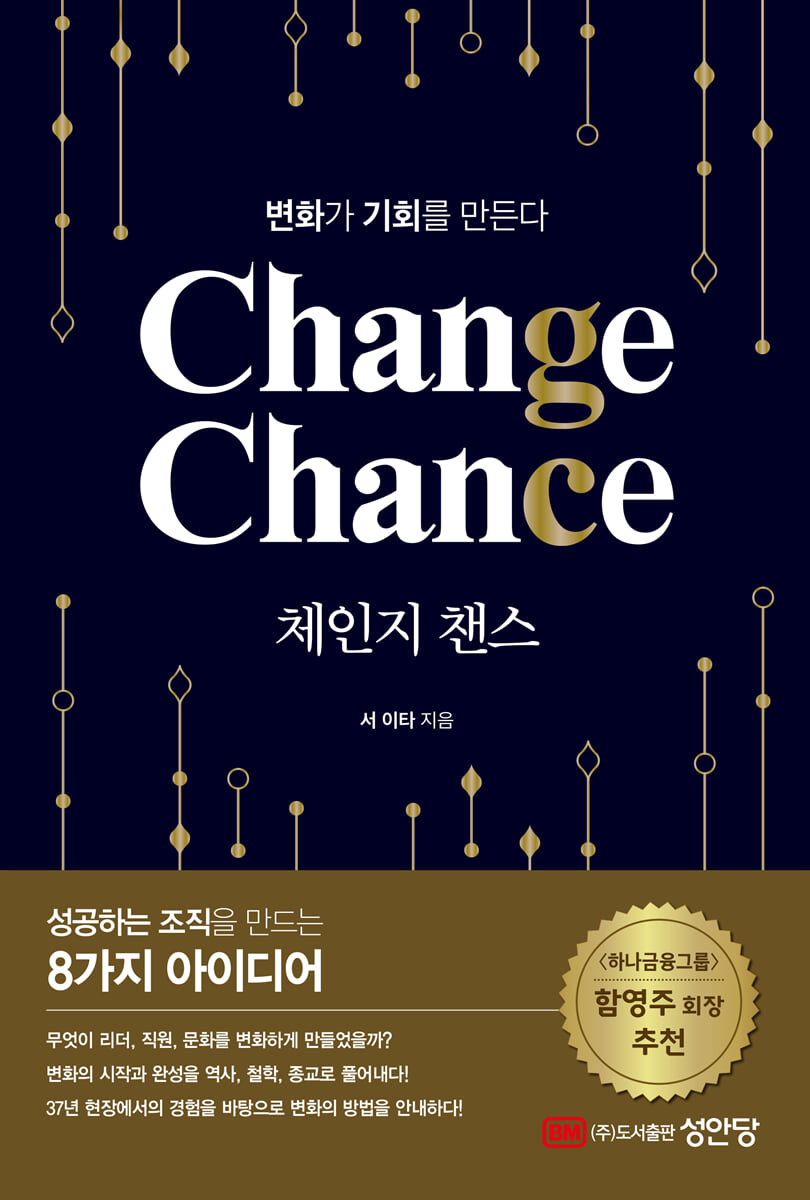
Change Chance: Change Creates Opportunity
 |
Description
Book Introduction
“8 Ideas for Creating a Successful Organization!”
“What drives change in leaders, employees, and culture?”
This book is written by an author who has experienced the integration and transformation of employees and corporate cultures in various organizations for 37 years in the field. Based on his extensive practical experience and intense academic research, he clearly defines the three key players in change—leaders, employees, and corporate culture—with academic evidence and presents, through abundant examples, how these three elements organically interact to bring about successful change.
The environment surrounding businesses is constantly changing, but many cases and studies show that 70% of companies that attempt change fail.
The change management required here is managing change.
Change refers to the constant change in the environment surrounding a company, and management is the process of transforming that change into the future state the company desires.
The reason companies must manage change is because the external environment changes at a faster rate than the company itself, and today's external environment for companies is not only difficult to predict and uncertain, but also complex.
In this book, the author cites historical, philosophical, and religious examples to gain ideas about change, and emphasizes that companies can succeed in change only when they fully understand change management, including change models, change processes, and successful change flows, beyond rigid management theories.
“What drives change in leaders, employees, and culture?”
This book is written by an author who has experienced the integration and transformation of employees and corporate cultures in various organizations for 37 years in the field. Based on his extensive practical experience and intense academic research, he clearly defines the three key players in change—leaders, employees, and corporate culture—with academic evidence and presents, through abundant examples, how these three elements organically interact to bring about successful change.
The environment surrounding businesses is constantly changing, but many cases and studies show that 70% of companies that attempt change fail.
The change management required here is managing change.
Change refers to the constant change in the environment surrounding a company, and management is the process of transforming that change into the future state the company desires.
The reason companies must manage change is because the external environment changes at a faster rate than the company itself, and today's external environment for companies is not only difficult to predict and uncertain, but also complex.
In this book, the author cites historical, philosophical, and religious examples to gain ideas about change, and emphasizes that companies can succeed in change only when they fully understand change management, including change models, change processes, and successful change flows, beyond rigid management theories.
- You can preview some of the book's contents.
Preview
index
Introduction: What is Change?: The Need for Change Management
Chapter 1 Success
01 Habits of Successful Companies
02 There is one person
03 Direction is more important than speed
04 Employees also evaluate their superiors.
05 Small differences make a big difference
06 Let's acknowledge differences
07 There is a 10,000x investment
08 Let's build an ecosystem
09 Let's just change the environment
Let's start with 10 strengths
Chapter 2 Model
11 Most Used Models
12 Is it a gradual or radical change?
13 Bottom-up or top-down change?
14 The Simplest Three-Step Change Management Model
15 Models that can be applied directly on site
16 Most Practical Change Management Models
Chapter 3 Obstacles
17. 70% of change management efforts fail.
18 Organizations resist change
19 Everyone hates change.
20 Don't hang up a sign that says change.
21. Patricide causes loss of assets.
22 If the content is weak, it ends with Hope Day.
23 This too shall pass.
24 Reasons Why Startups Fail to Transform
25 The human brain resists change
Chapter 3 Obstacles
Chapter 4 History
26 Why did the Imjin War occur?
27 How did Yi Sun-sin achieve 23 victories?
Why did the Byeongja Horan occur after 37 years?
29 How Did the Meiji Restoration Succeed?
30 Changes in the History of War
Chapter 5 Philosophy
31 Nietzsche's Camel-Lion-Child
32 Kierkegaard's Journey
33 Hegel's Thesis-Antithesis-Synthesis
34 John Dewey's Experience
35 The 64 hexagrams of the Book of Changes
Chapter 6 Religion
36 Let's change everything except love
37 No one can see the kingdom of heaven unless he is born again.
38 All things work together for those who are called.
39 『Heart Sutra』
Chapter 40
41. Buddhism of the Righteous
Chapter 7 Individuals
42 Get ideas by running
43 Listen to the sounds of nature while hiking
44 Meet the Masters through Reading
45 Let's make friends through golf
46 Find Peace of Mind Through Money Management
Chapter 8 Completion
47 Leaders Initiate Change
48 employees implement change
49 Culture sustains change
Chapter 7 Individuals
References
Chapter 1 Success
01 Habits of Successful Companies
02 There is one person
03 Direction is more important than speed
04 Employees also evaluate their superiors.
05 Small differences make a big difference
06 Let's acknowledge differences
07 There is a 10,000x investment
08 Let's build an ecosystem
09 Let's just change the environment
Let's start with 10 strengths
Chapter 2 Model
11 Most Used Models
12 Is it a gradual or radical change?
13 Bottom-up or top-down change?
14 The Simplest Three-Step Change Management Model
15 Models that can be applied directly on site
16 Most Practical Change Management Models
Chapter 3 Obstacles
17. 70% of change management efforts fail.
18 Organizations resist change
19 Everyone hates change.
20 Don't hang up a sign that says change.
21. Patricide causes loss of assets.
22 If the content is weak, it ends with Hope Day.
23 This too shall pass.
24 Reasons Why Startups Fail to Transform
25 The human brain resists change
Chapter 3 Obstacles
Chapter 4 History
26 Why did the Imjin War occur?
27 How did Yi Sun-sin achieve 23 victories?
Why did the Byeongja Horan occur after 37 years?
29 How Did the Meiji Restoration Succeed?
30 Changes in the History of War
Chapter 5 Philosophy
31 Nietzsche's Camel-Lion-Child
32 Kierkegaard's Journey
33 Hegel's Thesis-Antithesis-Synthesis
34 John Dewey's Experience
35 The 64 hexagrams of the Book of Changes
Chapter 6 Religion
36 Let's change everything except love
37 No one can see the kingdom of heaven unless he is born again.
38 All things work together for those who are called.
39 『Heart Sutra』
Chapter 40
41. Buddhism of the Righteous
Chapter 7 Individuals
42 Get ideas by running
43 Listen to the sounds of nature while hiking
44 Meet the Masters through Reading
45 Let's make friends through golf
46 Find Peace of Mind Through Money Management
Chapter 8 Completion
47 Leaders Initiate Change
48 employees implement change
49 Culture sustains change
Chapter 7 Individuals
References
Detailed image

Publisher's Review
Unraveling the beginning and completion of change through history, philosophy, and religion!
Guide to change based on 37 years of experience in the field!
This book is the author's conclusion after reviewing approximately 2,000 international papers and numerous domestic and foreign books, and is also based on his experience from 37 years of working life.
Rather than rigid theories, this book provides guidance to those who fear change or wish to lead it, by illustrating how key players in change interact organically and successfully bring about change through abundant case studies.
Recently, the structure of existing industries is rapidly changing due to advancements in technologies such as artificial intelligence (AI), blockchain, cloud computing, and big data.
Fickle customers are always switching to cheaper, faster, and more convenient services.
As globalization has connected the world, competitors can emerge anytime, anywhere.
When we look at companies that have achieved success despite these changes, we see that they have a thorough understanding of change management and that the core elements verified by the change model influence each other to drive success.
He also emphasizes that successful change follows a certain pattern, a pattern that has been proven through case studies by numerous scholars.
On the other hand, it is argued that most companies fail to change because their employees do not participate in the change, and that to succeed in change, employees' emotions must be influenced to encourage participation.
Rather than rational thinking, emotions increase employees' willingness to participate, and this willingness helps overcome obstacles that arise in the change process.
Because we cannot expect organizational change without changes in the employees, change must be gradually permeated from the bottom up, rather than issued unilaterally from above, so that it can take firm root within the organization.
In other words, only when each and every employee participates in the change can the entire organization change direction and create new results.
This book states that for change to be successful, there are three main players: leaders, employees, and corporate culture, and that these three are interconnected and influence each other.
He also said that when the three entities are in harmony, change can become not just an attempt, but a new standard for the organization.
In other words, in order to successfully implement change, it is essential that both leaders and employees properly understand the contents of Chapters 1 through 7 of this book.
Guide to change based on 37 years of experience in the field!
This book is the author's conclusion after reviewing approximately 2,000 international papers and numerous domestic and foreign books, and is also based on his experience from 37 years of working life.
Rather than rigid theories, this book provides guidance to those who fear change or wish to lead it, by illustrating how key players in change interact organically and successfully bring about change through abundant case studies.
Recently, the structure of existing industries is rapidly changing due to advancements in technologies such as artificial intelligence (AI), blockchain, cloud computing, and big data.
Fickle customers are always switching to cheaper, faster, and more convenient services.
As globalization has connected the world, competitors can emerge anytime, anywhere.
When we look at companies that have achieved success despite these changes, we see that they have a thorough understanding of change management and that the core elements verified by the change model influence each other to drive success.
He also emphasizes that successful change follows a certain pattern, a pattern that has been proven through case studies by numerous scholars.
On the other hand, it is argued that most companies fail to change because their employees do not participate in the change, and that to succeed in change, employees' emotions must be influenced to encourage participation.
Rather than rational thinking, emotions increase employees' willingness to participate, and this willingness helps overcome obstacles that arise in the change process.
Because we cannot expect organizational change without changes in the employees, change must be gradually permeated from the bottom up, rather than issued unilaterally from above, so that it can take firm root within the organization.
In other words, only when each and every employee participates in the change can the entire organization change direction and create new results.
This book states that for change to be successful, there are three main players: leaders, employees, and corporate culture, and that these three are interconnected and influence each other.
He also said that when the three entities are in harmony, change can become not just an attempt, but a new standard for the organization.
In other words, in order to successfully implement change, it is essential that both leaders and employees properly understand the contents of Chapters 1 through 7 of this book.
GOODS SPECIFICS
- Date of issue: November 12, 2025
- Page count, weight, size: 400 pages | 582g | 152*225*20mm
- ISBN13: 9788931585865
- ISBN10: 8931585861
You may also like
카테고리
korean


korean

![ELLE 엘르 스페셜 에디션 A형 : 12월 [2025]](http://librairie.coreenne.fr/cdn/shop/files/b8e27a3de6c9538896439686c6b0e8fb.jpg?v=1766436872&width=3840)


