

Abandon a cat
 |
Description
Book Introduction
- A word from MD
-
Haruki Murakami's Time Revealed for the First TimeHaruki Murakami has brought out a story about his father that he has kept deep in his heart for a long time.
It begins with a flashback of a time when he and his father abandoned a cat at the beach, and then goes back to his father's past when he was in the war.
A single narrative that follows the trajectory of author Haruki Murakami and Haruki Murakami's literature, which has continued from his father's time.
October 20, 2020. Essay PD Kim Tae-hee
Haruki Murakami's Time Revealed for the First Time
A single narrative carefully built from the time of my father
“We are but nameless drops of vast rain falling upon the vast earth.
It is a unique, yet interchangeable drop.
But each drop of rainwater has its own thoughts.
Every drop of rain has a history, and as a drop, we have a responsibility to carry it on.
We must not forget that.”_Haruki Murakami
Haruki Murakami, an author who has maintained a certain distance from the typical Japanese literary style of personal novels, has opened up for the first time about his most personal theme: his father.
As the title suggests, 『Abandoning a Cat: When Talking About My Father』 begins with a recollection of going to the beach with my father to abandon a cat. It is a non-fiction book that looks back on the personal history of my father, Chiaki Murakami, including his adoption and abandonment during his childhood, his participation in the Second Sino-Japanese War during his youth, his teaching career during his middle age, and his struggles with illness during his old age.
Through this, Haruki Murakami reflects on his own ontological foundation and faces his literary foundation as a writer.
The author always preaches that no matter how much we want to forget history, we must remember and pass it on as it is.
And he courageously tells the story of his father, a story that is not all that he is proud of, in the form of a non-fiction story.
As a writer's responsibility.
Kim Nan-ju, who was in charge of the translation, said, “I felt the author’s hesitation here and there.
As he said about his work, “There were a lot of commas, and the conjunction ‘anyway’ appeared several times,” it is a piece filled with countless hesitations and cautions.
Although it is a short book of just over 100 pages, the weight and lingering feeling of the story are neither light nor short.
"Abandoning a Cat: When Talking About Father" was first published in the June 2019 issue of [Bungei Shunju] and won the "Bungei Shunju Readers' Award" given to the best article chosen by readers that year. After revisions and additions, it was published as a book with illustrations, and topped various book charts, including Amazon Japan, Kinokuniya, and Oricon.
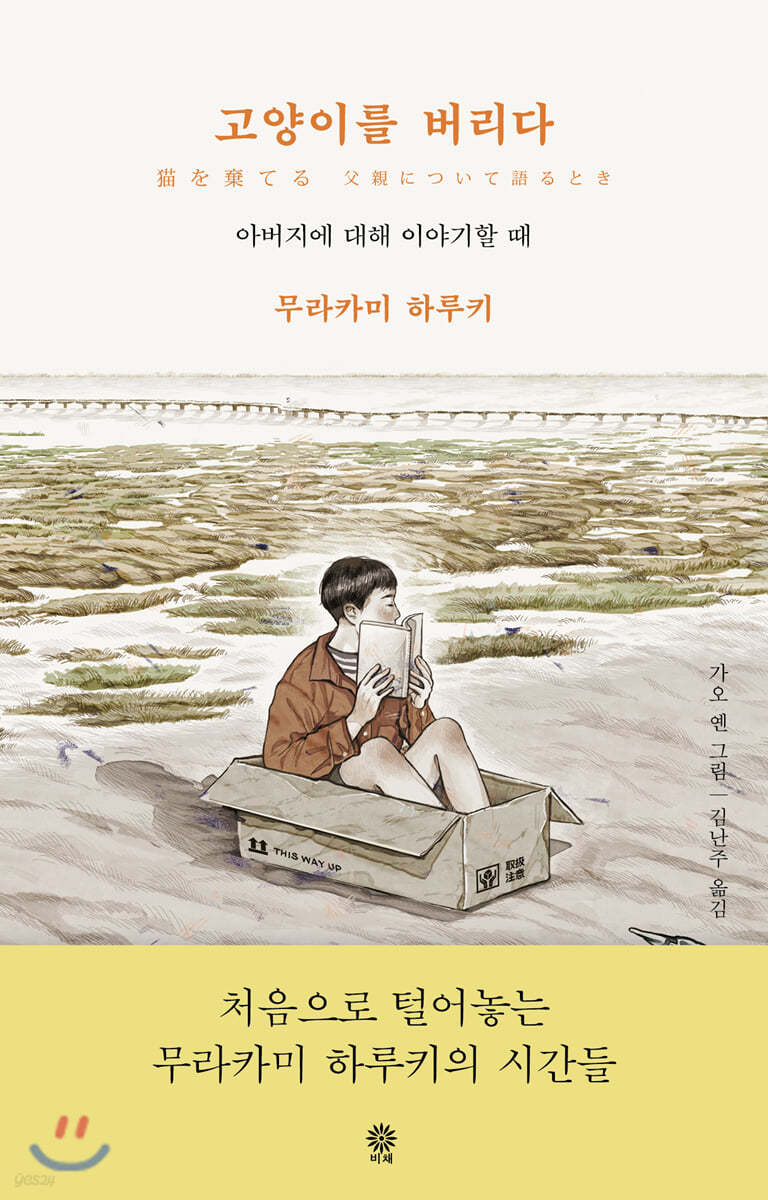
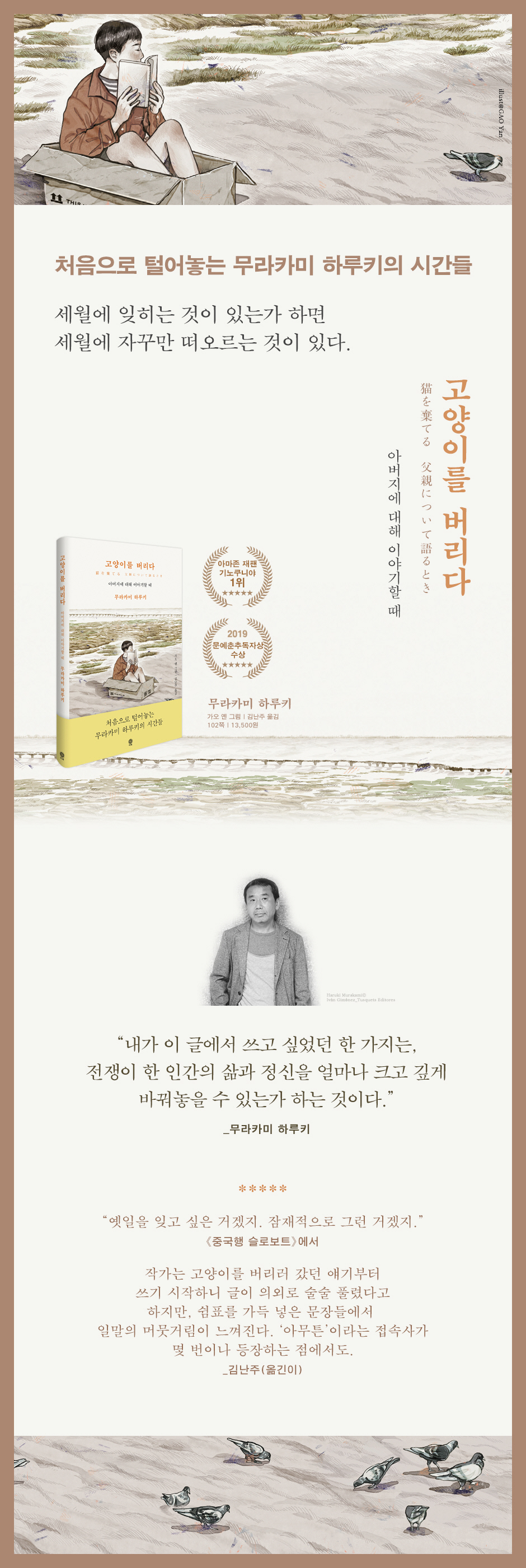
The 13 illustrations, imbued with a strange sense of longing, are the work of Taiwanese emerging artist Gao Yan.
A single narrative carefully built from the time of my father
“We are but nameless drops of vast rain falling upon the vast earth.
It is a unique, yet interchangeable drop.
But each drop of rainwater has its own thoughts.
Every drop of rain has a history, and as a drop, we have a responsibility to carry it on.
We must not forget that.”_Haruki Murakami
Haruki Murakami, an author who has maintained a certain distance from the typical Japanese literary style of personal novels, has opened up for the first time about his most personal theme: his father.
As the title suggests, 『Abandoning a Cat: When Talking About My Father』 begins with a recollection of going to the beach with my father to abandon a cat. It is a non-fiction book that looks back on the personal history of my father, Chiaki Murakami, including his adoption and abandonment during his childhood, his participation in the Second Sino-Japanese War during his youth, his teaching career during his middle age, and his struggles with illness during his old age.
Through this, Haruki Murakami reflects on his own ontological foundation and faces his literary foundation as a writer.
The author always preaches that no matter how much we want to forget history, we must remember and pass it on as it is.
And he courageously tells the story of his father, a story that is not all that he is proud of, in the form of a non-fiction story.
As a writer's responsibility.
Kim Nan-ju, who was in charge of the translation, said, “I felt the author’s hesitation here and there.
As he said about his work, “There were a lot of commas, and the conjunction ‘anyway’ appeared several times,” it is a piece filled with countless hesitations and cautions.
Although it is a short book of just over 100 pages, the weight and lingering feeling of the story are neither light nor short.
"Abandoning a Cat: When Talking About Father" was first published in the June 2019 issue of [Bungei Shunju] and won the "Bungei Shunju Readers' Award" given to the best article chosen by readers that year. After revisions and additions, it was published as a book with illustrations, and topped various book charts, including Amazon Japan, Kinokuniya, and Oricon.
The 13 illustrations, imbued with a strange sense of longing, are the work of Taiwanese emerging artist Gao Yan.
- You can preview some of the book's contents.
Preview
index
Abandoning a cat 9
Author's Note 96
Author's Note 96
Detailed image
Into the book
For a long time, I had been thinking that I should write a sentence about my late father someday, but time passed without me ever getting started.
Writing about family is quite a burden (at least for me), and I have no idea where to start or how to write about it.
That burden stayed in my heart for a long time, like a thorn in my throat.
But then I remembered going to the beach with my father to abandon a cat when I was young, so I started writing about that story, and surprisingly, the sentences came out smoothly and naturally.
One thing I wanted to write about in this piece is how profoundly and profoundly war can change the life and spirit of a human being—a very ordinary, nameless citizen.
And as a result, here I am.
If my father's fate had taken even the slightest different path, I, as a human being, would never have existed in the first place.
That's what history is—a single, harsh reality born from countless hypotheses.
History is not something of the past.
History flows like living blood, warm and alive, from within the consciousness or the unconscious, and is passed on to the next generation.
In that sense, what is written here is both a personal story and part of a larger story that constitutes the entire world we live in.
It's a very small part, but it's definitely a piece.
But for me, I didn't want to use those words as a 'message'.
As a nameless story from a corner of history, I simply wanted to present it in as original a form as possible.
And the few cats that were by my side in the past quietly supported the flow of the story from behind.
Writing about family is quite a burden (at least for me), and I have no idea where to start or how to write about it.
That burden stayed in my heart for a long time, like a thorn in my throat.
But then I remembered going to the beach with my father to abandon a cat when I was young, so I started writing about that story, and surprisingly, the sentences came out smoothly and naturally.
One thing I wanted to write about in this piece is how profoundly and profoundly war can change the life and spirit of a human being—a very ordinary, nameless citizen.
And as a result, here I am.
If my father's fate had taken even the slightest different path, I, as a human being, would never have existed in the first place.
That's what history is—a single, harsh reality born from countless hypotheses.
History is not something of the past.
History flows like living blood, warm and alive, from within the consciousness or the unconscious, and is passed on to the next generation.
In that sense, what is written here is both a personal story and part of a larger story that constitutes the entire world we live in.
It's a very small part, but it's definitely a piece.
But for me, I didn't want to use those words as a 'message'.
As a nameless story from a corner of history, I simply wanted to present it in as original a form as possible.
And the few cats that were by my side in the past quietly supported the flow of the story from behind.
--- p.96-98
Publisher's Review
★Ranked #1 on Amazon Japan, Oricon, and Kinokuniya Bestseller lists immediately after release★
★The winner of the 2019 Munye Chunchu Readers' Award, selected by Munye Chunchu★
There are things that are forgotten over time.
There's something that keeps coming to mind as time goes by
Chiaki Murakami, born in 1917 as the second of six children in a Buddhist temple in Kyoto, endured the barbaric days of war, and worked as a Japanese language teacher at a middle and high school in Nishinomiya City, Hyogo Prefecture, before passing away in 2008.
When the author was in the lower grades of elementary school, his father, Chiaki, shared with the boy Haruki a horrific memory of the battlefield.
Among them, the fragment of the brutal memory of killing Chinese prisoners of war remains a trauma to Haruki Murakami to this day.
The incident developed into a fear that his father had participated in the infamous Battle of Nanjing, where a massacre occurred, but the author somehow was unable to confirm this directly with his father.
Moreover, after graduating from college, he abandoned his father's expectations and embarked on a career as a full-time writer, and the relationship between father and son became strained. As a result, the writer was unable to resolve his doubts and eventually passed away from his father.
Then, one day in his seventies, the author decided to write down the scenes of his father's life that were hanging like a thorn in his neck.
This is how "Abandoning a Cat: When Talking About Father" started.
While he received enthusiastic applause, including winning the 'Munye Chunchu Readers' Award', which is given to the best article of the year as chosen by readers, he also received criticism from some extreme right-wing historical revisionists.
As a writer and an individual in history, 'Haruki Murakami, born in 1949'
A unique writing that follows its origins and trajectories
Reading "Abandoning the Cat: When I Talk About My Father" will deepen your understanding of "The Wind-Up Bird Chronicle."
You can see that the cruel scenes in the novel, such as the cat Wataya Noboru who appears at the beginning, disappears for nearly a year, and then returns, as well as the skinning of a living person, are derived from fragments of the author's life.
The starting point of the work "Slow Boat to China" is the same as the round flashbacks of "Hwa Hwa" or the episode of the Battle of Nanjing in "Killing Commendatore."
This work will resonate deeply with fans of Haruki Murakami, as well as with any Korean who directly or indirectly experienced the painful history of colonialism.
[From the author's interview]
Q1- It was a shocking essay. Perhaps you felt compelled to write it when you turned 70.
Murakami: I thought it would be difficult if I didn't write it down now.
To be honest, I didn't really want to write about my family, but I wrote diligently because I felt I had to leave a legacy.
As one of the writer's responsibilities.
Q2- Is it because it is about the wars my father was called up to three times, especially the invasion of China by Japan?
Murakami - That would have been pretty big.
There are so many people who would like to pretend that something like that never happened, so it's important to write down what happened.
Historical revisionism is rampant, and this is a serious problem.
I couldn't write it while my father was alive, but I wrote it after he passed away (in 2008).
Q3- There is a passage that says that you were reluctant to look through the records because you thought that your father might have participated in the Battle of Nanjing where the massacre occurred.
Eventually, you found out that your father did not participate in the Battle of Nanjing.
Murakami - I couldn't get my hands on it because of that kind of content, but now I've decided that I have to write it.
After investigating, I found out that my father's unit had advanced all the way to the vicinity of Wuhan.
(In the Corona News) I also thought of it when I saw the Wuhan (video).
Q4- China has been featured in various forms since your early works.
Since it is a serious problem, it will continue to come up.
Murakami- Yes.
It definitely became a theme, a motif.
Q5- Were the stories you heard firsthand, such as the story of your father's unit executing a captured Chinese soldier, a big factor?
Murakami - Since it was my childhood, I guess it was a shock, and I can't erase it.
Q6- Many readers were surprised by the description of a father and son who had been 'isolated' for a long time in the past.
Murakami - That sentence was quite difficult to write.
Because writing the truth about myself is a very tricky thing.
It took me some time to decide on my stance on how to write it.
_From an interview commemorating the publication┃Mainichi Shimbun (July 11, 2019)
[Brief Translator's Note]
“You must want to forget the old days.
“Potentially, that would be it.” - From Slow Boat to China
It is not easy to hold on to old memories that you want to forget so that they do not fade into the back of your mind.
That too, as a lifelong burden, with heavy shoulders.
The author himself said that he once wanted to organize the 'heavy story about his father' into sentences, and when he started writing about going to abandon a cat with his father, it came out surprisingly smoothly. However, there is a hint of hesitation in the sentences that are interrupted by a comma in the introduction and then continue again.
And also, the conjunction ‘anyway’ appears several times.
The impact of 'war' on a human being was also dealt with in a novel in 'The Wind-Up Bird Chronicle', but 'Abandoning a Cat: When Talking About My Father' deals with it in the personal realm of Haruki Murakami.
And further, as a record of countless 'pieces' engraved in the harsh history of mankind.
_ Kim Nan-ju (translator)
★The winner of the 2019 Munye Chunchu Readers' Award, selected by Munye Chunchu★
There are things that are forgotten over time.
There's something that keeps coming to mind as time goes by
Chiaki Murakami, born in 1917 as the second of six children in a Buddhist temple in Kyoto, endured the barbaric days of war, and worked as a Japanese language teacher at a middle and high school in Nishinomiya City, Hyogo Prefecture, before passing away in 2008.
When the author was in the lower grades of elementary school, his father, Chiaki, shared with the boy Haruki a horrific memory of the battlefield.
Among them, the fragment of the brutal memory of killing Chinese prisoners of war remains a trauma to Haruki Murakami to this day.
The incident developed into a fear that his father had participated in the infamous Battle of Nanjing, where a massacre occurred, but the author somehow was unable to confirm this directly with his father.
Moreover, after graduating from college, he abandoned his father's expectations and embarked on a career as a full-time writer, and the relationship between father and son became strained. As a result, the writer was unable to resolve his doubts and eventually passed away from his father.
Then, one day in his seventies, the author decided to write down the scenes of his father's life that were hanging like a thorn in his neck.
This is how "Abandoning a Cat: When Talking About Father" started.
While he received enthusiastic applause, including winning the 'Munye Chunchu Readers' Award', which is given to the best article of the year as chosen by readers, he also received criticism from some extreme right-wing historical revisionists.
As a writer and an individual in history, 'Haruki Murakami, born in 1949'
A unique writing that follows its origins and trajectories
Reading "Abandoning the Cat: When I Talk About My Father" will deepen your understanding of "The Wind-Up Bird Chronicle."
You can see that the cruel scenes in the novel, such as the cat Wataya Noboru who appears at the beginning, disappears for nearly a year, and then returns, as well as the skinning of a living person, are derived from fragments of the author's life.
The starting point of the work "Slow Boat to China" is the same as the round flashbacks of "Hwa Hwa" or the episode of the Battle of Nanjing in "Killing Commendatore."
This work will resonate deeply with fans of Haruki Murakami, as well as with any Korean who directly or indirectly experienced the painful history of colonialism.
[From the author's interview]
Q1- It was a shocking essay. Perhaps you felt compelled to write it when you turned 70.
Murakami: I thought it would be difficult if I didn't write it down now.
To be honest, I didn't really want to write about my family, but I wrote diligently because I felt I had to leave a legacy.
As one of the writer's responsibilities.
Q2- Is it because it is about the wars my father was called up to three times, especially the invasion of China by Japan?
Murakami - That would have been pretty big.
There are so many people who would like to pretend that something like that never happened, so it's important to write down what happened.
Historical revisionism is rampant, and this is a serious problem.
I couldn't write it while my father was alive, but I wrote it after he passed away (in 2008).
Q3- There is a passage that says that you were reluctant to look through the records because you thought that your father might have participated in the Battle of Nanjing where the massacre occurred.
Eventually, you found out that your father did not participate in the Battle of Nanjing.
Murakami - I couldn't get my hands on it because of that kind of content, but now I've decided that I have to write it.
After investigating, I found out that my father's unit had advanced all the way to the vicinity of Wuhan.
(In the Corona News) I also thought of it when I saw the Wuhan (video).
Q4- China has been featured in various forms since your early works.
Since it is a serious problem, it will continue to come up.
Murakami- Yes.
It definitely became a theme, a motif.
Q5- Were the stories you heard firsthand, such as the story of your father's unit executing a captured Chinese soldier, a big factor?
Murakami - Since it was my childhood, I guess it was a shock, and I can't erase it.
Q6- Many readers were surprised by the description of a father and son who had been 'isolated' for a long time in the past.
Murakami - That sentence was quite difficult to write.
Because writing the truth about myself is a very tricky thing.
It took me some time to decide on my stance on how to write it.
_From an interview commemorating the publication┃Mainichi Shimbun (July 11, 2019)
[Brief Translator's Note]
“You must want to forget the old days.
“Potentially, that would be it.” - From Slow Boat to China
It is not easy to hold on to old memories that you want to forget so that they do not fade into the back of your mind.
That too, as a lifelong burden, with heavy shoulders.
The author himself said that he once wanted to organize the 'heavy story about his father' into sentences, and when he started writing about going to abandon a cat with his father, it came out surprisingly smoothly. However, there is a hint of hesitation in the sentences that are interrupted by a comma in the introduction and then continue again.
And also, the conjunction ‘anyway’ appears several times.
The impact of 'war' on a human being was also dealt with in a novel in 'The Wind-Up Bird Chronicle', but 'Abandoning a Cat: When Talking About My Father' deals with it in the personal realm of Haruki Murakami.
And further, as a record of countless 'pieces' engraved in the harsh history of mankind.
_ Kim Nan-ju (translator)
GOODS SPECIFICS
- Publication date: October 26, 2020
- Format: Hardcover book binding method guide
- Page count, weight, size: 102 pages | 190g | 113*180*11mm
- ISBN13: 9788934992097
- ISBN10: 8934992093
You may also like
카테고리
korean


korean

![GQ KOREA Mark (Monthly): December [2025]](http://librairie.coreenne.fr/cdn/shop/files/8ef265dbbfbf186523ed75ba7319009d.jpg?v=1765340328&width=3840)


