

Islands LES ILES
 |
Description
Book Introduction
Delicate aesthetic thinking, the language of reflection discovered in everyday life
Jean Grenier's revised edition of The Island
Jean Grenier's "The Island," which has been consistently loved by readers since its debut in August 1997, has been published in a revised edition with a new translation and design.
Jean Grenier, well known to us as Albert Camus's teacher, is a representative French aesthetician and essayist who has conveyed his philosophy and beliefs on aesthetics through numerous art books and essay collections.
Because Grenier wrote concisely and reflectively, using a variety of anecdotes from his daily life, his writing is easy and comfortable to read, yet deeply touches the heart and resonates deeply with readers living today.
The book that inspired Camus to begin writing in earnest was “The Island,” so Camus took to heart the benefits he received from this book by Grenier and made it a lifelong learning experience.
Camus says that The Island shows “another reality that, without denying the sensuous reality we have taken for our kingdom, parallels it and explains where our youthful anxieties come from.”
These words from Camus are even more meaningful to us as we endure a reality more bleak than ever before.
In a calm tone, Grenier reminds readers of the value of living alone and spending everyday life with neighbors, and emphasizes life with animals.
The revised edition of Jean Grenier's Anthology 1, "The Island," is even more anticipated because not only has the cover and text been redesigned, but also because translator Kim Hwa-young has completely retranslated the book, forty years after its first translation.
Translator Kim Hwa-young, in translating this revised edition of “The Island,” has tried to avoid the overly descriptive and friendly nature of translation sentences in order to preserve the elegance and secrets of Jean Grenier’s characteristically restrained sentences.
The philosophical and beautiful essays of Jean Grenier, a true teacher of our time, are expected to warmly comfort and convey a rich message to Korean readers going through difficult times.
Jean Grenier's revised edition of The Island
Jean Grenier's "The Island," which has been consistently loved by readers since its debut in August 1997, has been published in a revised edition with a new translation and design.
Jean Grenier, well known to us as Albert Camus's teacher, is a representative French aesthetician and essayist who has conveyed his philosophy and beliefs on aesthetics through numerous art books and essay collections.
Because Grenier wrote concisely and reflectively, using a variety of anecdotes from his daily life, his writing is easy and comfortable to read, yet deeply touches the heart and resonates deeply with readers living today.
The book that inspired Camus to begin writing in earnest was “The Island,” so Camus took to heart the benefits he received from this book by Grenier and made it a lifelong learning experience.
Camus says that The Island shows “another reality that, without denying the sensuous reality we have taken for our kingdom, parallels it and explains where our youthful anxieties come from.”
These words from Camus are even more meaningful to us as we endure a reality more bleak than ever before.
In a calm tone, Grenier reminds readers of the value of living alone and spending everyday life with neighbors, and emphasizes life with animals.
The revised edition of Jean Grenier's Anthology 1, "The Island," is even more anticipated because not only has the cover and text been redesigned, but also because translator Kim Hwa-young has completely retranslated the book, forty years after its first translation.
Translator Kim Hwa-young, in translating this revised edition of “The Island,” has tried to avoid the overly descriptive and friendly nature of translation sentences in order to preserve the elegance and secrets of Jean Grenier’s characteristically restrained sentences.
The philosophical and beautiful essays of Jean Grenier, a true teacher of our time, are expected to warmly comfort and convey a rich message to Korean readers going through difficult times.
- You can preview some of the book's contents.
Preview
index
Dedicated to "The Island" / Albert Camus 4
The Allure of the Ball 20
Cat Mulu 31
Kerguelen Archipelago 72
Lucky Islands 90
Easter Island 105
Imaginary India 122
Days Gone 159
Borromean Islands 166
Translator's Note
The Silence of Writing / Kim Hwa-young 171
The Island Floating in Each Heart / Kim Hwa-young 175
The Allure of the Ball 20
Cat Mulu 31
Kerguelen Archipelago 72
Lucky Islands 90
Easter Island 105
Imaginary India 122
Days Gone 159
Borromean Islands 166
Translator's Note
The Silence of Writing / Kim Hwa-young 171
The Island Floating in Each Heart / Kim Hwa-young 175
Into the book
In each of our lives, especially at the dawn of that life, there is a moment that determines everything.
It's hard to find that moment again.
It is buried deep in the sediment of countless other moments.
Other moments passed by countless times, yet they were eerily absent.
Decisive moments don't necessarily flash by in a flash --- p.21
It is no wonder that the fascination with emptiness leads us to leap and bound, jumping from one thing to another as if we were running on one leg.
Fear and fascination mix together.
― It is to step forward (and at the same time run away) and step back.
It is impossible to stay still.
But the day will come when I will be rewarded for that endless movement, and even if I just gaze at a certain scenery in silence, my desire will shut its mouth.
--- p.29
I've dreamed countless times of arriving in a strange city, alone, with nothing.
Then I thought I could live humbly, or rather, poorly.
Above all, it seemed like it would be possible to keep the 'secret'.
I've always felt that to speak of myself, to reveal who I am, to act in my name, is to reveal something of the most precious thing I possess.
What is so precious about it? --- p.178
It is not the realization of the futility of dreams that makes them disappear.
Strangely enough, such a secret feeling is like a persistent, headache-inducing smell, a smell that doesn't go away even when the windows are wide open.
--- p.77-78
What society demands of individuals who must live by labor—that is, of almost all people—is utterly cruel.
So if they have one hope (besides the hope of revolution, of course), it is to get sick.
(……) For a poor person, illness is like a journey, and hospital life is a kind of luxurious life in an ancient palace.
If the rich had known that, they would not have allowed the poor to get sick.
--- p.87-88
Therefore, it can be said that a person travels not to escape from himself - which is impossible - but to find himself again.
Just as Jesuits use physical training, Buddhists use opium, and painters use alcohol, so travel becomes a means.
--- p.92
In Seville, once you ignore the palaces, cathedrals, the Guadalquivir River, and so on, life becomes pleasant for many reasons.
But to truly feel the profound 'enchantment' of that place, you must try to climb to the top of the Giralda and be stopped by the guard there.
“You have to go up there two at a time,” he tells you.
“No, why?” ― “Because there are too many people committing suicide.” --- p.95-96
Flowers floating on the sea, flowers that appear at the most unexpected moments, seaweed, corpses, sleeping seagulls, you who are torn apart by the prow of the ship, ah, my lucky islands! Unexpected surprises of the morning, hopes of the evening—will I ever see you again? Only you free me from myself.
Only in you can I recognize myself.
O mirror without stains, O sky without light, O love without an object.
--- p.103-104
Why does the thought of islands suffocate me? Where else can I experience the cool air of the open sea, the ocean freely bursting into the horizon on all sides? Where else can I experience and live this physical ecstasy? Yet, when we go to an island, we are "isolated" (isole)—isn't that the very etymology of the word "island" (ile)? An island, or a person "alone."
Islands, or 'alone' humans.
--- p.120
The main symptom of mania found in young people is 'loss of interest'.
'In the case of adolescents, great hopes and concerns about their personal and social future develop, while patients gradually become indifferent to their own situation.
Studying becomes boring, play and sports become less interesting, and nature appears gray and devoid of light.
Even when a major incident occurs, it is received with indifference as if it were something from an old tale.' --- p.146
Who says humans can't change? All humans have ever done is change.
The Christian saints resemble neither the ancient sages nor the modern citizens.
The Russian people are trying to create some kind of 'new human being'.
--- p.156
What's the point of traveling? After crossing a mountain, there's another mountain, after crossing a field, there's another field, after crossing a desert, there's another desert.
In the end, there will never be an end and I will never find my Dulcinea.
So, as someone said, let's trap a long hope in this short space.
It is impossible to live along the pebbles and balustrades of Lake Maggiore, so we must seek only its glorious substitutes!
It's hard to find that moment again.
It is buried deep in the sediment of countless other moments.
Other moments passed by countless times, yet they were eerily absent.
Decisive moments don't necessarily flash by in a flash --- p.21
It is no wonder that the fascination with emptiness leads us to leap and bound, jumping from one thing to another as if we were running on one leg.
Fear and fascination mix together.
― It is to step forward (and at the same time run away) and step back.
It is impossible to stay still.
But the day will come when I will be rewarded for that endless movement, and even if I just gaze at a certain scenery in silence, my desire will shut its mouth.
--- p.29
I've dreamed countless times of arriving in a strange city, alone, with nothing.
Then I thought I could live humbly, or rather, poorly.
Above all, it seemed like it would be possible to keep the 'secret'.
I've always felt that to speak of myself, to reveal who I am, to act in my name, is to reveal something of the most precious thing I possess.
What is so precious about it? --- p.178
It is not the realization of the futility of dreams that makes them disappear.
Strangely enough, such a secret feeling is like a persistent, headache-inducing smell, a smell that doesn't go away even when the windows are wide open.
--- p.77-78
What society demands of individuals who must live by labor—that is, of almost all people—is utterly cruel.
So if they have one hope (besides the hope of revolution, of course), it is to get sick.
(……) For a poor person, illness is like a journey, and hospital life is a kind of luxurious life in an ancient palace.
If the rich had known that, they would not have allowed the poor to get sick.
--- p.87-88
Therefore, it can be said that a person travels not to escape from himself - which is impossible - but to find himself again.
Just as Jesuits use physical training, Buddhists use opium, and painters use alcohol, so travel becomes a means.
--- p.92
In Seville, once you ignore the palaces, cathedrals, the Guadalquivir River, and so on, life becomes pleasant for many reasons.
But to truly feel the profound 'enchantment' of that place, you must try to climb to the top of the Giralda and be stopped by the guard there.
“You have to go up there two at a time,” he tells you.
“No, why?” ― “Because there are too many people committing suicide.” --- p.95-96
Flowers floating on the sea, flowers that appear at the most unexpected moments, seaweed, corpses, sleeping seagulls, you who are torn apart by the prow of the ship, ah, my lucky islands! Unexpected surprises of the morning, hopes of the evening—will I ever see you again? Only you free me from myself.
Only in you can I recognize myself.
O mirror without stains, O sky without light, O love without an object.
--- p.103-104
Why does the thought of islands suffocate me? Where else can I experience the cool air of the open sea, the ocean freely bursting into the horizon on all sides? Where else can I experience and live this physical ecstasy? Yet, when we go to an island, we are "isolated" (isole)—isn't that the very etymology of the word "island" (ile)? An island, or a person "alone."
Islands, or 'alone' humans.
--- p.120
The main symptom of mania found in young people is 'loss of interest'.
'In the case of adolescents, great hopes and concerns about their personal and social future develop, while patients gradually become indifferent to their own situation.
Studying becomes boring, play and sports become less interesting, and nature appears gray and devoid of light.
Even when a major incident occurs, it is received with indifference as if it were something from an old tale.' --- p.146
Who says humans can't change? All humans have ever done is change.
The Christian saints resemble neither the ancient sages nor the modern citizens.
The Russian people are trying to create some kind of 'new human being'.
--- p.156
What's the point of traveling? After crossing a mountain, there's another mountain, after crossing a field, there's another field, after crossing a desert, there's another desert.
In the end, there will never be an end and I will never find my Dulcinea.
So, as someone said, let's trap a long hope in this short space.
It is impossible to live along the pebbles and balustrades of Lake Maggiore, so we must seek only its glorious substitutes!
--- p.169
Publisher's Review
“In each person’s life, especially in the dawn of that life,
There is one moment that determines everything.
(……) It is childhood or adolescence
It continues throughout, seemingly as ordinary as it could be.
“It also colors the passage of time with a special brilliance.”
“I envy without any regrets.
“I envy that young stranger who is opening this 『Island』 for the first time today.”
― Albert Camus
“Here, the farthest from us… and therefore the closest… the dusted and newly adorned islands of beauty, the mother islands… the Borromean islands await you.”
― Kim Hwa-young (translator)
■ Delicate aesthetic thinking, the language of reflection discovered in everyday life
A revised edition of Jean Grenier's "The Island" has been published.
Jean Grenier's "The Island," which has been consistently loved by readers for twenty-three years since its debut in August 1997, was published by Minumsa in a revised edition with a new translation and design in October 2020.
Jean Grenier, well known to us as Albert Camus's teacher, is a representative French aesthetician and essayist who has conveyed his philosophy and beliefs on aesthetics through numerous art books and essay collections.
Because Grenier wrote concisely and reflectively, using a variety of anecdotes from his daily life, his writing is easy and comfortable to read, yet deeply touches the heart and resonates deeply with readers living today.
Here, "The Island" comes to us! Jean Grenier's "The Island" is particularly famous for being a beloved work of Albert Camus, who expressed his admiration for his teacher's book in a preface that bordered on praise.
I think I also wanted to write when I discovered 『Island』.
But it was after reading the book that that vague thought truly became my decision.
It's true that other books helped me make this decision, but once they finished their work, I forgot about them.
On the contrary, this book has lived inside me constantly, and I have been reading it for over twenty years.
Even today, I often write and speak about the words in “The Island” or in other books by the same author as if they were my own.
(Albert Camus, “On the Island,” pp. 11-12)
The book that inspired Camus to begin writing in earnest was “The Island,” so Camus took to heart the benefits he received from this book by Grenier and made it a lifelong learning experience.
Camus says that The Island shows “another reality that, without denying the sensuous reality we have taken for our kingdom, parallels it and explains where our youthful anxieties come from.”
These words from Camus are even more meaningful to us as we endure a reality more bleak than ever before.
In a calm tone, Grenier reminds readers of the value of living alone and spending everyday life with neighbors, and emphasizes life with animals.
■ Jean Grenier, who 'shows' without teaching
A true life with neighbors and animals, that is hope.
Jean Grenier's essay neither unconditionally affirms nor denies life.
He does not show off his experiences and does not treat any of his neighbors rudely.
Grenier consistently philosophizes about life and finds hope for a strong life in his own weakness.
Grenier does not try to force or teach his own thoughts.
He respects the lives of his neighbors in everyday life ("Easter Island"), and as a philosopher, he does not compare the superiority of human intelligence to animals, but rather informs us that the loving nature of animals is the most excellent teaching in life ("The Cat Mulu"). The sincerity of Grenier's essays is revealed in contemplation and observation. He simply 'looks' at the objects he looks at with a gaze of interest and affection, without giving them any special meaning or applying a standard of judgment. He simply watches, observes, and thinks.
Perhaps our attachment to life is so strong because of the unexpected surprises our bodies offer.
We were despairing that the illness would not get better, but then suddenly we stood up from our seats.
We had so much faith, but then suddenly that faith crumbles.
The ending is always the same, but the twists and turns leading there are as varied as the slopes of the Russian mountains. (Easter Island, p. 119)
Indeed, when it is said that in order to attain some absolute, it is necessary to break away from oneself and from everything human, what better example could there be for this than an animal?
It is often said that emotions are something that only humans possess, and that animals do not have such emotions. (Cat Mulu, pp. 57-58)
Another point of thought that shines brightly in Jean Grenier's essay is 'empty space.'
Grenier is not interested in the meanings that fill our lives, but rather in verbalizing emptiness itself.
This does not look at the world in a confrontational way, but rather reflects the organic flow of life that includes emptiness.
So the language his thoughts point to is neither negative nor positive.
As Camus confessed, 'The Island has come to teach us the secret of disillusionment', and only then do we discover culture.
A culture that is not limited to a specific person, but includes ordinary neighbors and even animals that cannot express their thoughts in words.
It shows a culture that is not just comprised of knowledge, but an unadorned and honest culture that reflects the emotions of life.
He prefers the story of a cat's death, a butcher's illness, the scent of flowers, and the passage of time.
Nothing is really said in this book.
Here everything is implied with unparalleled power and delicacy.
This light language, precise yet dreamy, flows like music.
(...) He simply tells us simple, familiar experiences in a language that is not overtly embellished.
Then he leaves it up to each of us to interpret it as we see fit.
(Albert Camus, “On the Island,” pp. 13-14)
I am… …a blank page doing nothing.
It's not just today that's completely blank.
There are countless pages in my life that are almost blank.
The greatest luxury is to take a life given to us for free and use it with the same generosity as the giver, and not to turn something of infinite value into an object of petty interests.
("The Vanished Days," pp. 161-162)
Don't we need stories like this, teachers like this right now?
A teacher who, as Camus said, is capable of “a conversation that, once started, never ceases to burn and fills each other’s lives.”
As translator Kim Hwa-young said, “Like a sculptor who chisels away at a solid log or marble until it can no longer be chiseled away, and then finds the core or true nature of the last remaining work, like a monk facing death, a philosopher who thinks and writes with moderation and nakedness of mind as his greatest virtues.” Jean Grenier.
The philosophical and beautiful essays of Jean Grenier, a true teacher of our time, are expected to warmly comfort and convey a rich message to Korean readers going through difficult times.
Jean Grenier's "The Island," renovated after twenty-three years
Resurfaced with a new translation by Kim Hwa-young
The revised edition of Jean Grenier's Anthology 1, "The Island," is even more anticipated because not only has the cover and text been redesigned, but also because translator Kim Hwa-young has completely retranslated the book, forty years after its first translation.
Translator Kim Hwa-young, in translating this revised edition of “The Island,” has tried to avoid the overly descriptive and friendly nature of translation sentences in order to preserve the elegance and secrets of Jean Grenier’s characteristically restrained sentences.
In addition, rather than further explaining the profound implications and meaning of the text, we added detailed footnotes related to relatively independent knowledge to help understanding.
The reasons are as follows:
Jean Grenier is a philosopher who thinks and writes not by combining or connecting materials, but like a sculptor who chisels away at a solid log or marble until he can no longer cut it, until he finds the true nature of the last remaining work, like a monk facing death, who holds moderation and nakedness of spirit as the greatest virtues.
That point, the few short words at the beginning of the book, is a kind of warning to the readers: “Faith, compassion, love, etc., must also be realities.
Ancient temples, churches, palaces, and even today's factories are strong refuges from despair.
“Things that humans acquire postnatally… … are not what I am talking about here.” This is a world of denial and rejection, far removed from vain decorations or comforts.
Therefore, I have taken care to minimize the number of words and syllables in the translation as much as possible, so that a great silence gathers around sentences or words that are in themselves solitary, solid, and isolated, like islands.
(From the translator's note)
The first edition of 『Island』 was first published by Minumsa on December 10, 1980.
At the time, the author Jean Grenier was unknown in Korea, so it was difficult to publish his writings, and it is said that several publishers refused to publish them.
There is an anecdote that translator Kim Hwa-young wanted to introduce Grenier to Korean readers, so she introduced “Kerguelen Archipelago” from “Islands” to literary media, and later Minumsa suggested publishing it.
As expected, "The Island" received an enthusiastic response from readers after its publication, and is still loved even after forty years.
Today, we are able to encounter Grenier's "Island" again thanks to two intellectuals who recognized its true value in conveying a message of timeless reflection.
Many years after introducing 『The Island』, in the summer of 2012, I was wandering through the small villages scattered across the mountains of Haute-Provence, and stopped for lunch in the village of Simien-la-Rotonde, with its 13th-century medieval castle tower perched on the mountaintop like the “cherry on the cake.”
I asked the owner of a restaurant that had a few tables set up in a shady spot in a narrow alley if he knew where Jean Grenier's house was.
The hostess was delighted and told me that her son, Ambassador Alain Grenier, would be coming to the country house for his vacation, and that he had asked her to open the windows of her house to ventilate the house a few days before, as he was planning to come down soon.
I stood in front of the old Jean Grenier house at the bottom of the hill and looked out over the fields of purple lavender, bathed in the brilliant Provençal light.
And then I thought of the Borromeo Islands in the middle of Lake Maggiore, not far from there.
Someday, when we are free from this tiresome coronavirus pandemic, I want to visit the islands floating in the middle of Lake Maggiore, not far from Locarno.
(From the translator's note)
Jean Grenier's four-volume anthology: The Island, In Memory of Camus, The Death of a Dog, and Everyday Life
Discover the message of our time's true teacher in a new design and new translation!
The four anthologies of Jean Grenier published by Minumsa (Anthology 1: The Island, Anthology 2: Remembering Camus, Anthology 3: The Death of a Dog, Anthology 4: Everyday Life) were first published in August 1997 and have been loved by readers for over a century.
This time, we will be publishing all four volumes of Jean Grenier's anthologies, starting with "The Island," in revised editions, to approach readers as an autumn gift.
This revised edition of the four Jean Grenier anthologies includes a comprehensive revision and new translation of the previously included translations, enhancing the modern linguistic sensibility and the completeness of the translations.
The design has also changed.
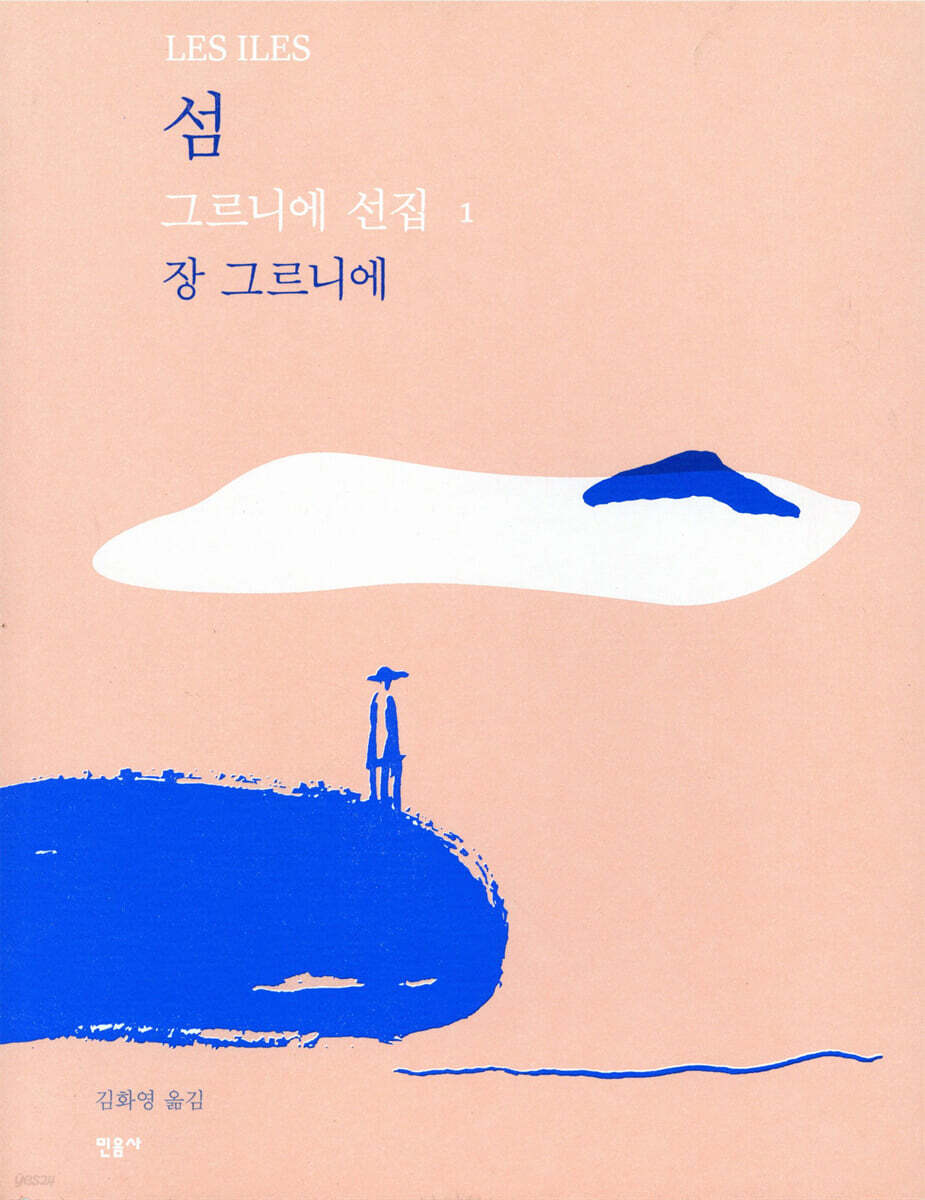
All four anthologies feature refreshing illustrations created by Etop in their cover designs, highlighting the image of friendliness and novelty.
Here, we have also preserved the characteristic empty and quiet feeling of the 1997 edition, making it an anthology with an empty, hidden, and delicate materiality.
Let's meet the beautiful essays of Jean Grenier, the teacher admired by Albert Camus, in a new design and new translation.
There is one moment that determines everything.
(……) It is childhood or adolescence
It continues throughout, seemingly as ordinary as it could be.
“It also colors the passage of time with a special brilliance.”
“I envy without any regrets.
“I envy that young stranger who is opening this 『Island』 for the first time today.”
― Albert Camus
“Here, the farthest from us… and therefore the closest… the dusted and newly adorned islands of beauty, the mother islands… the Borromean islands await you.”
― Kim Hwa-young (translator)
■ Delicate aesthetic thinking, the language of reflection discovered in everyday life
A revised edition of Jean Grenier's "The Island" has been published.
Jean Grenier's "The Island," which has been consistently loved by readers for twenty-three years since its debut in August 1997, was published by Minumsa in a revised edition with a new translation and design in October 2020.
Jean Grenier, well known to us as Albert Camus's teacher, is a representative French aesthetician and essayist who has conveyed his philosophy and beliefs on aesthetics through numerous art books and essay collections.
Because Grenier wrote concisely and reflectively, using a variety of anecdotes from his daily life, his writing is easy and comfortable to read, yet deeply touches the heart and resonates deeply with readers living today.
Here, "The Island" comes to us! Jean Grenier's "The Island" is particularly famous for being a beloved work of Albert Camus, who expressed his admiration for his teacher's book in a preface that bordered on praise.
I think I also wanted to write when I discovered 『Island』.
But it was after reading the book that that vague thought truly became my decision.
It's true that other books helped me make this decision, but once they finished their work, I forgot about them.
On the contrary, this book has lived inside me constantly, and I have been reading it for over twenty years.
Even today, I often write and speak about the words in “The Island” or in other books by the same author as if they were my own.
(Albert Camus, “On the Island,” pp. 11-12)
The book that inspired Camus to begin writing in earnest was “The Island,” so Camus took to heart the benefits he received from this book by Grenier and made it a lifelong learning experience.
Camus says that The Island shows “another reality that, without denying the sensuous reality we have taken for our kingdom, parallels it and explains where our youthful anxieties come from.”
These words from Camus are even more meaningful to us as we endure a reality more bleak than ever before.
In a calm tone, Grenier reminds readers of the value of living alone and spending everyday life with neighbors, and emphasizes life with animals.
■ Jean Grenier, who 'shows' without teaching
A true life with neighbors and animals, that is hope.
Jean Grenier's essay neither unconditionally affirms nor denies life.
He does not show off his experiences and does not treat any of his neighbors rudely.
Grenier consistently philosophizes about life and finds hope for a strong life in his own weakness.
Grenier does not try to force or teach his own thoughts.
He respects the lives of his neighbors in everyday life ("Easter Island"), and as a philosopher, he does not compare the superiority of human intelligence to animals, but rather informs us that the loving nature of animals is the most excellent teaching in life ("The Cat Mulu"). The sincerity of Grenier's essays is revealed in contemplation and observation. He simply 'looks' at the objects he looks at with a gaze of interest and affection, without giving them any special meaning or applying a standard of judgment. He simply watches, observes, and thinks.
Perhaps our attachment to life is so strong because of the unexpected surprises our bodies offer.
We were despairing that the illness would not get better, but then suddenly we stood up from our seats.
We had so much faith, but then suddenly that faith crumbles.
The ending is always the same, but the twists and turns leading there are as varied as the slopes of the Russian mountains. (Easter Island, p. 119)
Indeed, when it is said that in order to attain some absolute, it is necessary to break away from oneself and from everything human, what better example could there be for this than an animal?
It is often said that emotions are something that only humans possess, and that animals do not have such emotions. (Cat Mulu, pp. 57-58)
Another point of thought that shines brightly in Jean Grenier's essay is 'empty space.'
Grenier is not interested in the meanings that fill our lives, but rather in verbalizing emptiness itself.
This does not look at the world in a confrontational way, but rather reflects the organic flow of life that includes emptiness.
So the language his thoughts point to is neither negative nor positive.
As Camus confessed, 'The Island has come to teach us the secret of disillusionment', and only then do we discover culture.
A culture that is not limited to a specific person, but includes ordinary neighbors and even animals that cannot express their thoughts in words.
It shows a culture that is not just comprised of knowledge, but an unadorned and honest culture that reflects the emotions of life.
He prefers the story of a cat's death, a butcher's illness, the scent of flowers, and the passage of time.
Nothing is really said in this book.
Here everything is implied with unparalleled power and delicacy.
This light language, precise yet dreamy, flows like music.
(...) He simply tells us simple, familiar experiences in a language that is not overtly embellished.
Then he leaves it up to each of us to interpret it as we see fit.
(Albert Camus, “On the Island,” pp. 13-14)
I am… …a blank page doing nothing.
It's not just today that's completely blank.
There are countless pages in my life that are almost blank.
The greatest luxury is to take a life given to us for free and use it with the same generosity as the giver, and not to turn something of infinite value into an object of petty interests.
("The Vanished Days," pp. 161-162)
Don't we need stories like this, teachers like this right now?
A teacher who, as Camus said, is capable of “a conversation that, once started, never ceases to burn and fills each other’s lives.”
As translator Kim Hwa-young said, “Like a sculptor who chisels away at a solid log or marble until it can no longer be chiseled away, and then finds the core or true nature of the last remaining work, like a monk facing death, a philosopher who thinks and writes with moderation and nakedness of mind as his greatest virtues.” Jean Grenier.
The philosophical and beautiful essays of Jean Grenier, a true teacher of our time, are expected to warmly comfort and convey a rich message to Korean readers going through difficult times.
Jean Grenier's "The Island," renovated after twenty-three years
Resurfaced with a new translation by Kim Hwa-young
The revised edition of Jean Grenier's Anthology 1, "The Island," is even more anticipated because not only has the cover and text been redesigned, but also because translator Kim Hwa-young has completely retranslated the book, forty years after its first translation.
Translator Kim Hwa-young, in translating this revised edition of “The Island,” has tried to avoid the overly descriptive and friendly nature of translation sentences in order to preserve the elegance and secrets of Jean Grenier’s characteristically restrained sentences.
In addition, rather than further explaining the profound implications and meaning of the text, we added detailed footnotes related to relatively independent knowledge to help understanding.
The reasons are as follows:
Jean Grenier is a philosopher who thinks and writes not by combining or connecting materials, but like a sculptor who chisels away at a solid log or marble until he can no longer cut it, until he finds the true nature of the last remaining work, like a monk facing death, who holds moderation and nakedness of spirit as the greatest virtues.
That point, the few short words at the beginning of the book, is a kind of warning to the readers: “Faith, compassion, love, etc., must also be realities.
Ancient temples, churches, palaces, and even today's factories are strong refuges from despair.
“Things that humans acquire postnatally… … are not what I am talking about here.” This is a world of denial and rejection, far removed from vain decorations or comforts.
Therefore, I have taken care to minimize the number of words and syllables in the translation as much as possible, so that a great silence gathers around sentences or words that are in themselves solitary, solid, and isolated, like islands.
(From the translator's note)
The first edition of 『Island』 was first published by Minumsa on December 10, 1980.
At the time, the author Jean Grenier was unknown in Korea, so it was difficult to publish his writings, and it is said that several publishers refused to publish them.
There is an anecdote that translator Kim Hwa-young wanted to introduce Grenier to Korean readers, so she introduced “Kerguelen Archipelago” from “Islands” to literary media, and later Minumsa suggested publishing it.
As expected, "The Island" received an enthusiastic response from readers after its publication, and is still loved even after forty years.
Today, we are able to encounter Grenier's "Island" again thanks to two intellectuals who recognized its true value in conveying a message of timeless reflection.
Many years after introducing 『The Island』, in the summer of 2012, I was wandering through the small villages scattered across the mountains of Haute-Provence, and stopped for lunch in the village of Simien-la-Rotonde, with its 13th-century medieval castle tower perched on the mountaintop like the “cherry on the cake.”
I asked the owner of a restaurant that had a few tables set up in a shady spot in a narrow alley if he knew where Jean Grenier's house was.
The hostess was delighted and told me that her son, Ambassador Alain Grenier, would be coming to the country house for his vacation, and that he had asked her to open the windows of her house to ventilate the house a few days before, as he was planning to come down soon.
I stood in front of the old Jean Grenier house at the bottom of the hill and looked out over the fields of purple lavender, bathed in the brilliant Provençal light.
And then I thought of the Borromeo Islands in the middle of Lake Maggiore, not far from there.
Someday, when we are free from this tiresome coronavirus pandemic, I want to visit the islands floating in the middle of Lake Maggiore, not far from Locarno.
(From the translator's note)
Jean Grenier's four-volume anthology: The Island, In Memory of Camus, The Death of a Dog, and Everyday Life
Discover the message of our time's true teacher in a new design and new translation!
The four anthologies of Jean Grenier published by Minumsa (Anthology 1: The Island, Anthology 2: Remembering Camus, Anthology 3: The Death of a Dog, Anthology 4: Everyday Life) were first published in August 1997 and have been loved by readers for over a century.
This time, we will be publishing all four volumes of Jean Grenier's anthologies, starting with "The Island," in revised editions, to approach readers as an autumn gift.
This revised edition of the four Jean Grenier anthologies includes a comprehensive revision and new translation of the previously included translations, enhancing the modern linguistic sensibility and the completeness of the translations.
The design has also changed.
All four anthologies feature refreshing illustrations created by Etop in their cover designs, highlighting the image of friendliness and novelty.
Here, we have also preserved the characteristic empty and quiet feeling of the 1997 edition, making it an anthology with an empty, hidden, and delicate materiality.
Let's meet the beautiful essays of Jean Grenier, the teacher admired by Albert Camus, in a new design and new translation.
GOODS SPECIFICS
- Publication date: October 16, 2020
- Page count, weight, size: 184 pages | 300g | 152*195*10mm
- ISBN13: 9788937402852
- ISBN10: 8937402858
You may also like
카테고리
korean


korean

![GQ KOREA Mark (Monthly): December [2025]](http://librairie.coreenne.fr/cdn/shop/files/8ef265dbbfbf186523ed75ba7319009d.jpg?v=1765340328&width=3840)


