

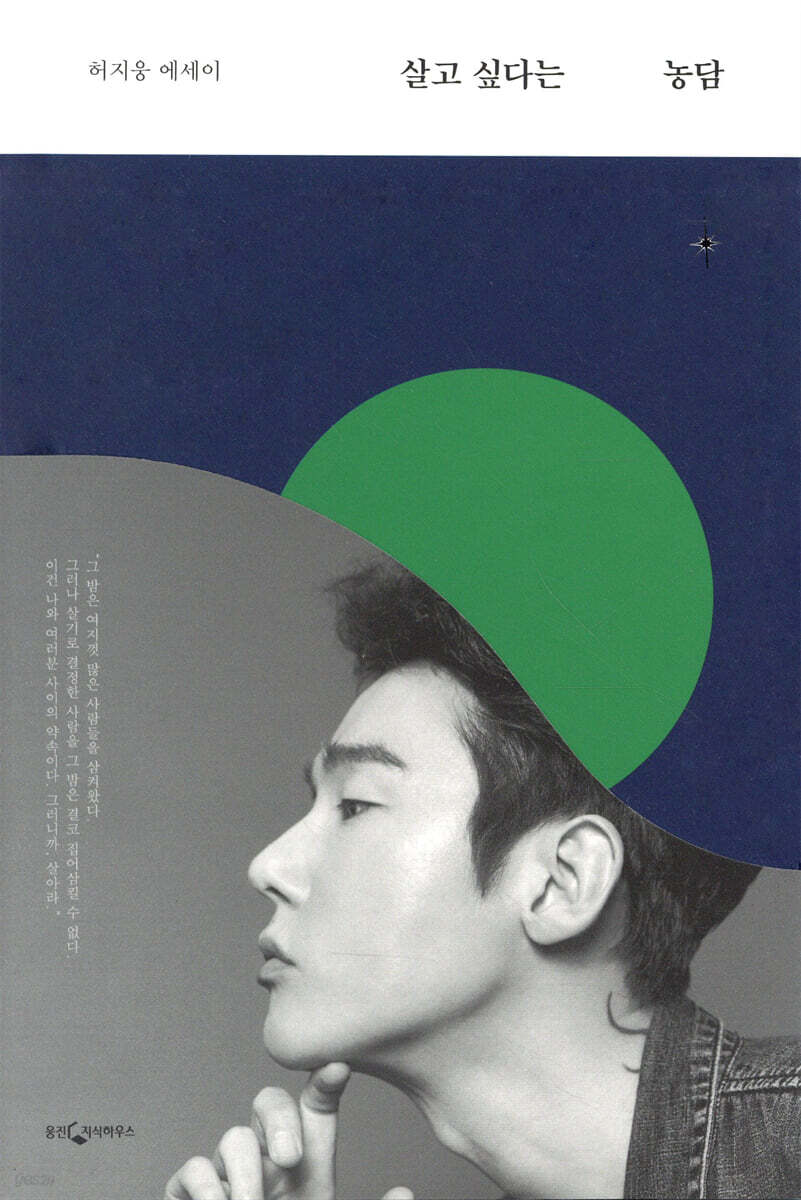
A joke about wanting to live
 |
Description
Book Introduction
To all those who are fighting despair today, Why we must live despite everything This is a new essay written by author Heo Ji-woong, who poured his heart and soul into it after suffering the great ordeal of malignant lymphoma, a type of blood cancer, in 2018, and who has a significantly different perspective on life than before. This collection contains 25 stories that I would like to share with people who are struggling to keep from collapsing while carrying their own heavy ceilings on their shoulders, and with people who are exhausted and have nowhere to lean on and rest. In this new work, released four years after his previous work, “My Dear Enemy,” author Heo Ji-woong’s interpretation of life has become sharper, and his affection for people has deepened. Is there anyone who has not struggled to escape from pain and unhappiness? However, if you focus only on blaming others for your misfortune, you may end up falling into a deeper pit of victim consciousness. It is a vicious cycle of despair where I am the only one in this unfair situation due to the unfortunate reality, and I cannot escape from this because I am unhappy. Regarding this, the author says, “Misfortune is not the villains in the front car of the Snowpiercer, but rather like the snow that always falls outside the train,” and suggests that we acknowledge misfortune as an emotion that we must embrace, coexist with, and endure life together, and look at our own lives proactively. This book is a solid piece of advice from author Heo Ji-woong, who returned to life after a struggle with death, to those struggling with the harsh reality, and ultimately, a warm consolation to all those who are enduring life today. |
- You can preview some of the book's contents.
Preview
index
Introduction
Part 1.
Still a long way to go before it fails
Still a long way to go before it fails
What we need is not a conclusion, but a resolution.
Starting over again
ceiling and floor
How to deal with misfortune
If
Seven Scenes of Your Life
Go back to the 8th floor
Memory 1 - John Hurt, I am a man
Part 2.
When you need to say okay at the bottom of life
My calculations were wrong, as I didn't believe it and didn't expect it.
The War Between Yukio Mishima and Osamu Dazai
When good people lie
We always fight among ourselves
The devil invented the victim mentality to ruin you.
To those who seek ways to save themselves
When you need to say okay at the bottom of life
Memory 2 - Kim Young-ae, She Was Beautiful and Dangerous
Part 3.
Starting over again
The courage to change what you can and the composure to change what you cannot
Memory 3 - George Romero, the man who never stopped
The question of whether to take off the mask
A name everyone knows but no one knows
Choi Eun-hee, an ordinary person
There are no innocent victims
Turning misfortune into motivation
May the force be with you
Part 1.
Still a long way to go before it fails
Still a long way to go before it fails
What we need is not a conclusion, but a resolution.
Starting over again
ceiling and floor
How to deal with misfortune
If
Seven Scenes of Your Life
Go back to the 8th floor
Memory 1 - John Hurt, I am a man
Part 2.
When you need to say okay at the bottom of life
My calculations were wrong, as I didn't believe it and didn't expect it.
The War Between Yukio Mishima and Osamu Dazai
When good people lie
We always fight among ourselves
The devil invented the victim mentality to ruin you.
To those who seek ways to save themselves
When you need to say okay at the bottom of life
Memory 2 - Kim Young-ae, She Was Beautiful and Dangerous
Part 3.
Starting over again
The courage to change what you can and the composure to change what you cannot
Memory 3 - George Romero, the man who never stopped
The question of whether to take off the mask
A name everyone knows but no one knows
Choi Eun-hee, an ordinary person
There are no innocent victims
Turning misfortune into motivation
May the force be with you
Detailed image
.jpg)
Into the book
Several months have passed since I endured that darkest and deepest night.
Surprisingly, I am much healthier than before I got sick.
I had that thought a while ago.
If I hadn't survived that most difficult night, where would I be now?
Why couldn't I tell my family and friends to be by my side?
If I had said so, would that night have been so deep and dangerous?
I've always been proud of the fact that I survived and persevered like an orphan on my own.
But at the same time, I became an idiot who couldn't ask anyone for help.
Such a person is completely useless.
A person like that cannot last long.
If you can't hold on for long, you won't be able to prove anything you want to prove with your life.
I don't know what happiness is.
But at least I know that happiness is not just about the fancy pictures and the chatter displayed on the shelf.
Perhaps happiness is something we prove to ourselves throughout our lives.
I want to speak to the children tonight who are thinking, "I'm screwed," as a person who knows how to ask for help.
It's still a long way from ruin.
--- p.13~14, from “Still a long way to go before we perish”
If grand conclusions ruin your life, small resolutions become your motivation.
And if you keep those small resolutions and accumulate results, they can become important ideas for shaping your life.
In fact, clinging to conclusions is the best refuge for those in the most dire, desperate, and terrible situations.
I can say this for sure because I was there.
Because when you're focused solely on death, you don't have to worry about other trivial things.
But while I was ignoring such trivial things, I ended up becoming someone who couldn't think of anything else but death.
--- p.23~24, from “What we need is not a conclusion, but a resolution”
Young people born into wealthy families have a relatively easy time accumulating winning experience.
If you think you are at a disadvantage, try to gain experience in overcoming your body more than anything else.
Since the starting point is different and the situation is not favorable, you should instead gain experience in overcoming your body.
Gaining the experience of winning is like remembering the sensation of using your muscles and breathing, when to apply and release force, and when to inhale and exhale.
If you become accustomed to losing, it becomes difficult to distinguish between what is truly winning and what is truly losing.
That's why only those who succeed always succeed.
Only those who have won can win again, and those who have lost can start again.
In short, the idea is to build a body that can endure to the end.
When I think back to when I was young, I often think, 'If I were me now, I wouldn't do that, I'd be stupid.'
At forty-two, I find myself thinking more and more, "If I were back then, I wouldn't be doing this now. I'd be stupid."
Growing older means being defeated by your past self more often.
--- p.34~35, from “Starting Again”
I don't want to say that I know about your pain.
I don't even want to say that I understand.
That's a deception.
Because suffering is unquantifiable and incomparable, and there are a thousand ceilings and floors for a thousand people.
But I want to tell you to decide to live.
Rather than living in inertia and sorrow because you cannot die, decide to live according to your own will.
If you decide to live, if you decide to embrace and navigate life between the ceiling and the floor, I can promise you that the victim mentality at the ceiling and the reality at the floor will no longer weigh you down or crush your face as they once did.
At least I can promise you that you won't be helpless like before.
That night has swallowed up many people so far.
But the night can never devour those who have decided to live.
This is a promise between me and you.
So, live.
--- p.45~46, from “Ceiling and Floor”
There needs to be an appropriate distance between people.
Some people need ten steps, others need half a step.
Anything more or less than that and the bridge connecting the two will collapse.
Human relationships are about calculating that distance.
When I think about this distance, I always think of electromagnetic forces.
There are four forces in the world: gravitational force, strong force, weak force, and electromagnetic force.
Among them, the reason my hands can press the keyboard instead of just passing through it is because of electromagnetic force.
Electromagnetic force allows 'me' to exist in the form of 'me'.
For example, it is the minimum distance that I can maintain my form, like the length of a hedgehog's thorns or the 'AT field' of [Evangelion].
If I just kick myself out because I'm too lonely, my country will collapse.
Conversely, if you are too afraid of others and surround yourself with a thick protective shield, you will end up becoming too distant.
In short, the distance between us and others is simply a matter of adding to the thickness of our protective shields.
Having recently gone through what could be considered a major life event, I realized that my thorns and protective shields were ridiculously long and thick.
Its length and thickness have long been enlarged by the compulsion that it must be that way in order to survive alone.
So, it is meaningless to calculate the exact distance from others in the first place.
Because no matter what, we are too far apart to be able to communicate with each other.
My calculations were wrong.
--- p.106~107, from “My calculations, which I did not believe and did not expect, were wrong”
There is no one whose life is not full of sorrow.
Everyone feels misunderstood.
It's true.
An evaluation of someone is not determined by precise criteria and records.
It depends on the mood of the evaluator.
right.
It's so unfair.
But that's the reality.
Faced with this reality, some people detach themselves from the evaluation of themselves.
It's not as easy as it sounds.
But I do my best to do it.
And he silently does what he can.
On the other hand, some people are unable to escape from evaluation and end up destroying themselves and those around them.
--- p.141, from “The Devil Invented the Victim Consciousness to Ruin You”
There are times when we must fight alone, without any divine being to lean on or institutional safeguards.
At times like that, we become exhausted.
Get rough to fight.
Only distrust remains.
Even those who are supposed to understand each other best hate each other.
When we discover the aspects of ourselves we dislike most in others, we tend to prioritize criticism and drawing lines over empathy and understanding.
There are cases where you can survive by holding on.
But in the end, we are trapped in the darkness we fought against.
Because I've been surviving on my own for so long, I've forgotten how to ask for help from others.
We must persevere and fight to the end, but we must also be kind to those who are exhausted and in need, and help each other by doing good deeds.
[Three Billboards] suggests that only good intentions, actions, and solidarity among people who rise up for self-sufficiency can overcome pessimistic endings like [The Deer Hunter] or [Don't Look Up].
In the end, we will be saved not by the best and most excellent things we have, but by the good deeds we have done long ago, even though we don't remember when we did them.
I think so.
--- p.162~163, from “To Those Who Seek a Way to Save Themselves”
The Xenomorph is the most successful monster in film history.
Monsters make money.
Successful monsters like the Xenomorph not only make money, they become genres and industries.
Not all monsters succeed.
A failed monster becomes a laughing stock.
But there is something that both successful monsters like the Xenomorph and those who failed and became a laughing stock cannot avoid.
I'm talking about the indifference towards the person who is playing the actual monster.
Until the 2000s, all monster characters were voiced by people.
Yes, that's right.
There was a person there.
We know all the monsters we've loved.
But the actors who played the monsters were completely forgotten.
Or maybe you weren't interested in the first place.
People that everyone loved but no one knew about.
People who are not recorded.
People who spent their later years strangely lonely.
People who all lived truly lonely lives.
I really wanted to leave a story about him.
I want to record those names.
These names deserve to be recorded.
This is a simple tribute to monsters from someone who has been fascinated by them his entire life.
--- p.229~230, from “A Name Everyone Knows But No One Knows”
Misfortune is not the villains in the front car of Snowpiercer, but rather the snow that always falls outside the train.
It's fatal, but we have to be together all the time.
This attitude toward misfortune is different from discouragement, self-mockery, or passive pessimism.
Rather, it is the will to accept and lead life proactively.
This gives the person experiencing misfortune a space to separate themselves from the situation.
Instead of being immersed in immediate emotions and branding yourself as a perpetual victim, it allows you to look at the incident from a minimal spatial and temporal distance.
In short, it helps us look at the causal relationship of misfortune objectively.
To say that I am the unhappiest person in the world is, in a sense, a greater arrogance than to say that I am the happiest person in the world.
It can be easy and comfortable to curl up in a ball, surrounded by thoughts that I am the most pitiful, the most unfortunate, and the most sick person in the world.
But that's usually just a subjective impression.
It's different from what actually happened.
When conflict arises, no one sees themselves as the perpetrator.
Both claim to be victims.
Objectivity is needed to think about what really happened, what I did, what was done to me, and how I will deal with it.
--- p.257~258, from “Turning Misfortune into Motivation”
Except for a very lucky few, you will not be recognized for your efforts and your worth will be denied.
It would be unfair.
I will long for someone to recognize my worth.
It seems like everyone else is valued except me.
Looks happy.
At least that's what it looks like on social media.
Despair grows.
But we must not give in to despair.
You must not let despair consume you.
The moment you lose objectivity and become consumed by a sense of victimhood, it is only a matter of time before you become a monster.
We must not be consumed by evaluation.
You have to separate yourself from the evaluation.
Let's regain our composure and maintain objectivity.
That is the balance the Force speaks of.
Someday, someone will surely recognize your efforts and thank you.
If you constantly refine, improve, and persevere, that day will surely come.
Surprisingly, I am much healthier than before I got sick.
I had that thought a while ago.
If I hadn't survived that most difficult night, where would I be now?
Why couldn't I tell my family and friends to be by my side?
If I had said so, would that night have been so deep and dangerous?
I've always been proud of the fact that I survived and persevered like an orphan on my own.
But at the same time, I became an idiot who couldn't ask anyone for help.
Such a person is completely useless.
A person like that cannot last long.
If you can't hold on for long, you won't be able to prove anything you want to prove with your life.
I don't know what happiness is.
But at least I know that happiness is not just about the fancy pictures and the chatter displayed on the shelf.
Perhaps happiness is something we prove to ourselves throughout our lives.
I want to speak to the children tonight who are thinking, "I'm screwed," as a person who knows how to ask for help.
It's still a long way from ruin.
--- p.13~14, from “Still a long way to go before we perish”
If grand conclusions ruin your life, small resolutions become your motivation.
And if you keep those small resolutions and accumulate results, they can become important ideas for shaping your life.
In fact, clinging to conclusions is the best refuge for those in the most dire, desperate, and terrible situations.
I can say this for sure because I was there.
Because when you're focused solely on death, you don't have to worry about other trivial things.
But while I was ignoring such trivial things, I ended up becoming someone who couldn't think of anything else but death.
--- p.23~24, from “What we need is not a conclusion, but a resolution”
Young people born into wealthy families have a relatively easy time accumulating winning experience.
If you think you are at a disadvantage, try to gain experience in overcoming your body more than anything else.
Since the starting point is different and the situation is not favorable, you should instead gain experience in overcoming your body.
Gaining the experience of winning is like remembering the sensation of using your muscles and breathing, when to apply and release force, and when to inhale and exhale.
If you become accustomed to losing, it becomes difficult to distinguish between what is truly winning and what is truly losing.
That's why only those who succeed always succeed.
Only those who have won can win again, and those who have lost can start again.
In short, the idea is to build a body that can endure to the end.
When I think back to when I was young, I often think, 'If I were me now, I wouldn't do that, I'd be stupid.'
At forty-two, I find myself thinking more and more, "If I were back then, I wouldn't be doing this now. I'd be stupid."
Growing older means being defeated by your past self more often.
--- p.34~35, from “Starting Again”
I don't want to say that I know about your pain.
I don't even want to say that I understand.
That's a deception.
Because suffering is unquantifiable and incomparable, and there are a thousand ceilings and floors for a thousand people.
But I want to tell you to decide to live.
Rather than living in inertia and sorrow because you cannot die, decide to live according to your own will.
If you decide to live, if you decide to embrace and navigate life between the ceiling and the floor, I can promise you that the victim mentality at the ceiling and the reality at the floor will no longer weigh you down or crush your face as they once did.
At least I can promise you that you won't be helpless like before.
That night has swallowed up many people so far.
But the night can never devour those who have decided to live.
This is a promise between me and you.
So, live.
--- p.45~46, from “Ceiling and Floor”
There needs to be an appropriate distance between people.
Some people need ten steps, others need half a step.
Anything more or less than that and the bridge connecting the two will collapse.
Human relationships are about calculating that distance.
When I think about this distance, I always think of electromagnetic forces.
There are four forces in the world: gravitational force, strong force, weak force, and electromagnetic force.
Among them, the reason my hands can press the keyboard instead of just passing through it is because of electromagnetic force.
Electromagnetic force allows 'me' to exist in the form of 'me'.
For example, it is the minimum distance that I can maintain my form, like the length of a hedgehog's thorns or the 'AT field' of [Evangelion].
If I just kick myself out because I'm too lonely, my country will collapse.
Conversely, if you are too afraid of others and surround yourself with a thick protective shield, you will end up becoming too distant.
In short, the distance between us and others is simply a matter of adding to the thickness of our protective shields.
Having recently gone through what could be considered a major life event, I realized that my thorns and protective shields were ridiculously long and thick.
Its length and thickness have long been enlarged by the compulsion that it must be that way in order to survive alone.
So, it is meaningless to calculate the exact distance from others in the first place.
Because no matter what, we are too far apart to be able to communicate with each other.
My calculations were wrong.
--- p.106~107, from “My calculations, which I did not believe and did not expect, were wrong”
There is no one whose life is not full of sorrow.
Everyone feels misunderstood.
It's true.
An evaluation of someone is not determined by precise criteria and records.
It depends on the mood of the evaluator.
right.
It's so unfair.
But that's the reality.
Faced with this reality, some people detach themselves from the evaluation of themselves.
It's not as easy as it sounds.
But I do my best to do it.
And he silently does what he can.
On the other hand, some people are unable to escape from evaluation and end up destroying themselves and those around them.
--- p.141, from “The Devil Invented the Victim Consciousness to Ruin You”
There are times when we must fight alone, without any divine being to lean on or institutional safeguards.
At times like that, we become exhausted.
Get rough to fight.
Only distrust remains.
Even those who are supposed to understand each other best hate each other.
When we discover the aspects of ourselves we dislike most in others, we tend to prioritize criticism and drawing lines over empathy and understanding.
There are cases where you can survive by holding on.
But in the end, we are trapped in the darkness we fought against.
Because I've been surviving on my own for so long, I've forgotten how to ask for help from others.
We must persevere and fight to the end, but we must also be kind to those who are exhausted and in need, and help each other by doing good deeds.
[Three Billboards] suggests that only good intentions, actions, and solidarity among people who rise up for self-sufficiency can overcome pessimistic endings like [The Deer Hunter] or [Don't Look Up].
In the end, we will be saved not by the best and most excellent things we have, but by the good deeds we have done long ago, even though we don't remember when we did them.
I think so.
--- p.162~163, from “To Those Who Seek a Way to Save Themselves”
The Xenomorph is the most successful monster in film history.
Monsters make money.
Successful monsters like the Xenomorph not only make money, they become genres and industries.
Not all monsters succeed.
A failed monster becomes a laughing stock.
But there is something that both successful monsters like the Xenomorph and those who failed and became a laughing stock cannot avoid.
I'm talking about the indifference towards the person who is playing the actual monster.
Until the 2000s, all monster characters were voiced by people.
Yes, that's right.
There was a person there.
We know all the monsters we've loved.
But the actors who played the monsters were completely forgotten.
Or maybe you weren't interested in the first place.
People that everyone loved but no one knew about.
People who are not recorded.
People who spent their later years strangely lonely.
People who all lived truly lonely lives.
I really wanted to leave a story about him.
I want to record those names.
These names deserve to be recorded.
This is a simple tribute to monsters from someone who has been fascinated by them his entire life.
--- p.229~230, from “A Name Everyone Knows But No One Knows”
Misfortune is not the villains in the front car of Snowpiercer, but rather the snow that always falls outside the train.
It's fatal, but we have to be together all the time.
This attitude toward misfortune is different from discouragement, self-mockery, or passive pessimism.
Rather, it is the will to accept and lead life proactively.
This gives the person experiencing misfortune a space to separate themselves from the situation.
Instead of being immersed in immediate emotions and branding yourself as a perpetual victim, it allows you to look at the incident from a minimal spatial and temporal distance.
In short, it helps us look at the causal relationship of misfortune objectively.
To say that I am the unhappiest person in the world is, in a sense, a greater arrogance than to say that I am the happiest person in the world.
It can be easy and comfortable to curl up in a ball, surrounded by thoughts that I am the most pitiful, the most unfortunate, and the most sick person in the world.
But that's usually just a subjective impression.
It's different from what actually happened.
When conflict arises, no one sees themselves as the perpetrator.
Both claim to be victims.
Objectivity is needed to think about what really happened, what I did, what was done to me, and how I will deal with it.
--- p.257~258, from “Turning Misfortune into Motivation”
Except for a very lucky few, you will not be recognized for your efforts and your worth will be denied.
It would be unfair.
I will long for someone to recognize my worth.
It seems like everyone else is valued except me.
Looks happy.
At least that's what it looks like on social media.
Despair grows.
But we must not give in to despair.
You must not let despair consume you.
The moment you lose objectivity and become consumed by a sense of victimhood, it is only a matter of time before you become a monster.
We must not be consumed by evaluation.
You have to separate yourself from the evaluation.
Let's regain our composure and maintain objectivity.
That is the balance the Force speaks of.
Someday, someone will surely recognize your efforts and thank you.
If you constantly refine, improve, and persevere, that day will surely come.
--- p.273, from “I hope the force is with you”
Publisher's Review
I am still living a life of endurance today.
Comfort to all
Author Heo Ji-woong, who has been active in various media as a writer and broadcaster, has returned with a new book after four years.
It was just over a year ago in August 2019 that I announced that I had completed my cancer treatment and was in good health, and in that time I have written enough to compile a book.
He is still a diligent writer, proving that he is alive through writing.
Is it because I went through a great ordeal that was between life and death?
Reading the new work, "The Joke of Wanting to Live," you get the feeling that the author's writing and speaking style remain the same, but something has changed.
It feels warm and earnest somewhere.
The author, who has been talking about the distance between oneself and the world and the struggle to endure each person's life through his previous works, takes the story one step further in this book.
I speak to you out there, not to me or the world around me.
This new work contains stories I want to tell to people who are struggling to keep from collapsing, each carrying their own heavy ceiling on their shoulders, and to people who are exhausted with no place to lean on and rest.
“People say I look different before and after I get sick.
I have no idea what has changed.
But it is true that the topics I want to write about have changed.
I don't know when I will relapse, and if I do, I have no intention of getting treatment.
One treatment is enough for cancer.
So, rather than just saying the right thing while I can, I want to leave behind some words that can be of practical help to young people.
Everything I wrote after I recovered was like that.
I hope you don't make the same mistakes I did and that you won't be unhappy or lonely.
“I hope that in a world already full of hurtful things, at least we don’t bring it upon ourselves.” (p.217)
To those of you who think you're screwed tonight
"We're still a long way from ruin."
In Part 1, “Still a Long Way to Go,” the author honestly writes about the changes in his thoughts after his battle with illness, which could be considered a major turning point in his life.
I used to feel proud of having survived and persevered like an orphan on my own, but looking back, I realized that I had become a fool who couldn't ask anyone for help.
A confession: “I’ve been surviving on my own for so long that I’ve forgotten how to receive help from others.”
The author says he decided to focus on helping people in despair, poor young people with nowhere to turn for help, so that they don't have to go through the same trials and tribulations as he did.
So, the author started to reply to each and every email sent by people who were having a hard time and were in pain.
Then, when the volume of emails became too much to reply to, I started opening a voicemail to listen to people's stories and communicate with them.
Some of them were introduced through the author's YouTube channel [Heo Ji-woong's Answer], and some were included in this book.
After listening to the stories of countless people's worries, the author found that the most important solution was 'acknowledging unhappiness.'
Just as there is no life without pain, there is no person who is not unhappy.
However, if you focus only on blaming others for your misfortune, you may end up falling into a deeper pit of victim consciousness.
It is a vicious cycle of despair where I am the only one in this unfair situation due to the unfortunate reality, and I cannot escape from this because I am unhappy.
Regarding this, the author says, “Misfortune is not the villains in the front car of the Snowpiercer, but rather like the snow that always falls outside the train,” and suggests that we acknowledge misfortune as an emotion that we must embrace, coexist with, and endure life together, and look at our own lives proactively.
“Misfortune is not the villains in the front car of the Snowpiercer, but the snow that always falls outside the train.
It's fatal, but we have to be together all the time.
This attitude toward misfortune is different from discouragement, self-mockery, or passive pessimism.
Rather, it is the will to accept and lead life proactively.
This gives the person experiencing misfortune a space to separate themselves from the situation.
Instead of being immersed in immediate emotions and branding yourself as a perpetual victim, it allows you to look at the incident from a minimal spatial and temporal distance.
In short, it helps us look at the causal relationship of misfortune objectively.
(…) Objectivity is necessary to think about what really happened, what I did and what was done to me, and how I will deal with it.” (_p.257~258)
If there is misfortune, there is always hope.
Hoping that your day will shine someday
In Parts 2 and 3, the author uses examples from various movie characters and real-life people to show how a life obsessed with 'blaming one's misfortune' can lead to a sad ending.
Nixon, who rose to the position of President of the United States but was unable to overcome his victim mentality and committed illegal acts before resigning just before impeachment; Oscar Wilde, who enjoyed the greatest popularity as a genius writer in Ireland in the 1890s but was accused of homosexuality and fell from grace; and ended his life in loneliness, struggling with resentment and regret toward his lover; Anakin Skywalker, who eventually turned dark and became Darth Vader due to his victim mentality of not being recognized despite his outstanding talent.
As we follow the author's story, we can vividly feel how unhappiness and a sense of victimhood push our lives into further unhappiness.
In short, we are not unhappy because of unhappy things, but because we think we are unhappy.
“Except for a very lucky few, you will not be recognized for your efforts and your worth will be denied.
It would be unfair.
I will long for someone to recognize my worth.
It seems like everyone else is valued except me.
Looks happy.
At least that's what it looks like on social media.
Despair grows.
But we must not give in to despair.
You must not let despair consume you.
The moment you lose objectivity and become consumed by a sense of victimhood, it is only a matter of time before you become a monster.
We must not be consumed by evaluation.
You have to separate yourself from the evaluation.
Let's regain our composure and maintain objectivity.
That is the balance the Force speaks of.
Someday, someone will surely recognize your efforts and thank you.
“If you constantly refine, improve, and persevere, that day will surely come.” (p.273)
As a counter-example, the author tells the story of Nietzsche.
Nietzsche, who suffered from depression and insomnia after being cruelly abandoned by his beloved woman and friend, and went through hellish times, including becoming addicted to opium, managed to climb out of that miserable rock bottom and write his life's work, 'Thus Spoke Zarathustra'.
The author advises that instead of blaming all of life's suffering on misfortune, we can find a way to overcome it by facing and objectifying misfortune as it is.
“The past is just a variable, not a curse that can never be escaped.
It doesn't determine your future life.
If you can master your unhappiness through self-objectification, and maintain it for as long as possible, I am confident that you can turn unhappiness into motivation.
I think it will be a stepping stone to becoming a stronger and healthier person.
Don't try to guess your hope and luck day by day with words like "there is no hope" or "there is no luck."
Hope is like a reflex to misfortune.
If there is misfortune, there is always hope.
I hope you become an adult who can empathize with the misfortunes of others in a much warmer and more mature way than I can, and who can seek a better tomorrow together.
And be happy.” (_p.261)
nevertheless,
On the courage to endure life once again
The topic the author has consistently emphasized since his previous work is 'enduring life.'
This book goes one step further, offering this message to those who are standing at the end of their lives, enduring and enduring.
“I don’t want to say that I know about your suffering.
I don't even want to say that I understand.
That's a deception.
Because suffering is unquantifiable and incomparable, and there are a thousand ceilings and floors for a thousand people.
But I want to tell you to decide to live.
Rather than living in inertia and sorrow because you cannot die, decide to live according to your own will.
If you decide to live, if you decide to embrace and navigate life between the ceiling and the floor, I can promise you that the victim mentality at the ceiling and the reality on the floor will no longer weigh you down or crush your face as they did before.
At least I can promise you that you won't be helpless like before.
That night has swallowed up many people so far.
But the night can never devour those who have decided to live.
This is a promise between me and you.
So, live.” (_p.45~46)
Misfortune appears in different faces for each person, so only you can find the key to solving your own misfortune.
Instead of speaking rashly about the misfortunes of others, the author urges those who are enduring misfortune to simply persevere and resolve to live one more time.
This book is a solid piece of advice from author Heo Ji-woong to those struggling with the harsh reality, and ultimately, a warm consolation to all those who are enduring life today.
Comfort to all
Author Heo Ji-woong, who has been active in various media as a writer and broadcaster, has returned with a new book after four years.
It was just over a year ago in August 2019 that I announced that I had completed my cancer treatment and was in good health, and in that time I have written enough to compile a book.
He is still a diligent writer, proving that he is alive through writing.
Is it because I went through a great ordeal that was between life and death?
Reading the new work, "The Joke of Wanting to Live," you get the feeling that the author's writing and speaking style remain the same, but something has changed.
It feels warm and earnest somewhere.
The author, who has been talking about the distance between oneself and the world and the struggle to endure each person's life through his previous works, takes the story one step further in this book.
I speak to you out there, not to me or the world around me.
This new work contains stories I want to tell to people who are struggling to keep from collapsing, each carrying their own heavy ceiling on their shoulders, and to people who are exhausted with no place to lean on and rest.
“People say I look different before and after I get sick.
I have no idea what has changed.
But it is true that the topics I want to write about have changed.
I don't know when I will relapse, and if I do, I have no intention of getting treatment.
One treatment is enough for cancer.
So, rather than just saying the right thing while I can, I want to leave behind some words that can be of practical help to young people.
Everything I wrote after I recovered was like that.
I hope you don't make the same mistakes I did and that you won't be unhappy or lonely.
“I hope that in a world already full of hurtful things, at least we don’t bring it upon ourselves.” (p.217)
To those of you who think you're screwed tonight
"We're still a long way from ruin."
In Part 1, “Still a Long Way to Go,” the author honestly writes about the changes in his thoughts after his battle with illness, which could be considered a major turning point in his life.
I used to feel proud of having survived and persevered like an orphan on my own, but looking back, I realized that I had become a fool who couldn't ask anyone for help.
A confession: “I’ve been surviving on my own for so long that I’ve forgotten how to receive help from others.”
The author says he decided to focus on helping people in despair, poor young people with nowhere to turn for help, so that they don't have to go through the same trials and tribulations as he did.
So, the author started to reply to each and every email sent by people who were having a hard time and were in pain.
Then, when the volume of emails became too much to reply to, I started opening a voicemail to listen to people's stories and communicate with them.
Some of them were introduced through the author's YouTube channel [Heo Ji-woong's Answer], and some were included in this book.
After listening to the stories of countless people's worries, the author found that the most important solution was 'acknowledging unhappiness.'
Just as there is no life without pain, there is no person who is not unhappy.
However, if you focus only on blaming others for your misfortune, you may end up falling into a deeper pit of victim consciousness.
It is a vicious cycle of despair where I am the only one in this unfair situation due to the unfortunate reality, and I cannot escape from this because I am unhappy.
Regarding this, the author says, “Misfortune is not the villains in the front car of the Snowpiercer, but rather like the snow that always falls outside the train,” and suggests that we acknowledge misfortune as an emotion that we must embrace, coexist with, and endure life together, and look at our own lives proactively.
“Misfortune is not the villains in the front car of the Snowpiercer, but the snow that always falls outside the train.
It's fatal, but we have to be together all the time.
This attitude toward misfortune is different from discouragement, self-mockery, or passive pessimism.
Rather, it is the will to accept and lead life proactively.
This gives the person experiencing misfortune a space to separate themselves from the situation.
Instead of being immersed in immediate emotions and branding yourself as a perpetual victim, it allows you to look at the incident from a minimal spatial and temporal distance.
In short, it helps us look at the causal relationship of misfortune objectively.
(…) Objectivity is necessary to think about what really happened, what I did and what was done to me, and how I will deal with it.” (_p.257~258)
If there is misfortune, there is always hope.
Hoping that your day will shine someday
In Parts 2 and 3, the author uses examples from various movie characters and real-life people to show how a life obsessed with 'blaming one's misfortune' can lead to a sad ending.
Nixon, who rose to the position of President of the United States but was unable to overcome his victim mentality and committed illegal acts before resigning just before impeachment; Oscar Wilde, who enjoyed the greatest popularity as a genius writer in Ireland in the 1890s but was accused of homosexuality and fell from grace; and ended his life in loneliness, struggling with resentment and regret toward his lover; Anakin Skywalker, who eventually turned dark and became Darth Vader due to his victim mentality of not being recognized despite his outstanding talent.
As we follow the author's story, we can vividly feel how unhappiness and a sense of victimhood push our lives into further unhappiness.
In short, we are not unhappy because of unhappy things, but because we think we are unhappy.
“Except for a very lucky few, you will not be recognized for your efforts and your worth will be denied.
It would be unfair.
I will long for someone to recognize my worth.
It seems like everyone else is valued except me.
Looks happy.
At least that's what it looks like on social media.
Despair grows.
But we must not give in to despair.
You must not let despair consume you.
The moment you lose objectivity and become consumed by a sense of victimhood, it is only a matter of time before you become a monster.
We must not be consumed by evaluation.
You have to separate yourself from the evaluation.
Let's regain our composure and maintain objectivity.
That is the balance the Force speaks of.
Someday, someone will surely recognize your efforts and thank you.
“If you constantly refine, improve, and persevere, that day will surely come.” (p.273)
As a counter-example, the author tells the story of Nietzsche.
Nietzsche, who suffered from depression and insomnia after being cruelly abandoned by his beloved woman and friend, and went through hellish times, including becoming addicted to opium, managed to climb out of that miserable rock bottom and write his life's work, 'Thus Spoke Zarathustra'.
The author advises that instead of blaming all of life's suffering on misfortune, we can find a way to overcome it by facing and objectifying misfortune as it is.
“The past is just a variable, not a curse that can never be escaped.
It doesn't determine your future life.
If you can master your unhappiness through self-objectification, and maintain it for as long as possible, I am confident that you can turn unhappiness into motivation.
I think it will be a stepping stone to becoming a stronger and healthier person.
Don't try to guess your hope and luck day by day with words like "there is no hope" or "there is no luck."
Hope is like a reflex to misfortune.
If there is misfortune, there is always hope.
I hope you become an adult who can empathize with the misfortunes of others in a much warmer and more mature way than I can, and who can seek a better tomorrow together.
And be happy.” (_p.261)
nevertheless,
On the courage to endure life once again
The topic the author has consistently emphasized since his previous work is 'enduring life.'
This book goes one step further, offering this message to those who are standing at the end of their lives, enduring and enduring.
“I don’t want to say that I know about your suffering.
I don't even want to say that I understand.
That's a deception.
Because suffering is unquantifiable and incomparable, and there are a thousand ceilings and floors for a thousand people.
But I want to tell you to decide to live.
Rather than living in inertia and sorrow because you cannot die, decide to live according to your own will.
If you decide to live, if you decide to embrace and navigate life between the ceiling and the floor, I can promise you that the victim mentality at the ceiling and the reality on the floor will no longer weigh you down or crush your face as they did before.
At least I can promise you that you won't be helpless like before.
That night has swallowed up many people so far.
But the night can never devour those who have decided to live.
This is a promise between me and you.
So, live.” (_p.45~46)
Misfortune appears in different faces for each person, so only you can find the key to solving your own misfortune.
Instead of speaking rashly about the misfortunes of others, the author urges those who are enduring misfortune to simply persevere and resolve to live one more time.
This book is a solid piece of advice from author Heo Ji-woong to those struggling with the harsh reality, and ultimately, a warm consolation to all those who are enduring life today.
GOODS SPECIFICS
- Date of issue: August 12, 2020
- Format: Hardcover book binding method guide
- Page count, weight, size: 276 pages | 368g | 124*188*20mm
- ISBN13: 9788901244600
- ISBN10: 8901244608
You may also like
카테고리
korean


korean

![GQ KOREA Mark (Monthly): December [2025]](http://librairie.coreenne.fr/cdn/shop/files/8ef265dbbfbf186523ed75ba7319009d.jpg?v=1765340328&width=3840)


