

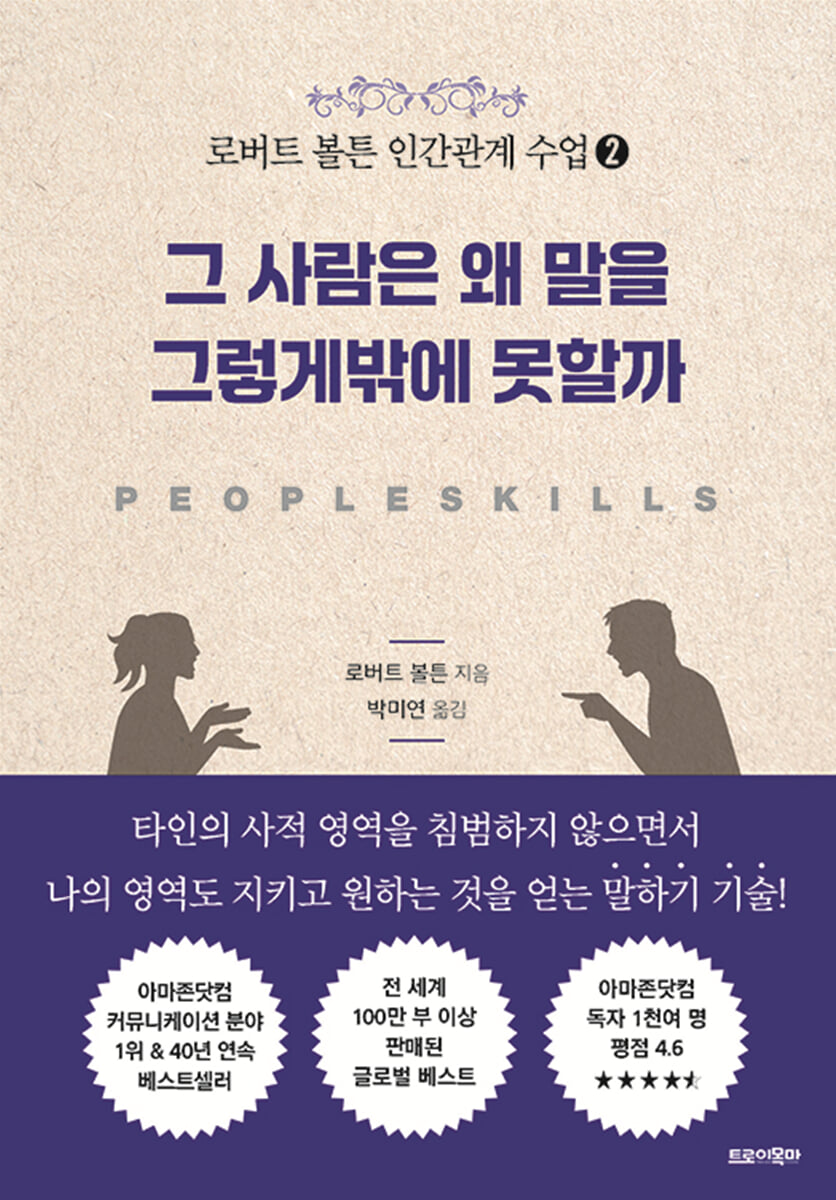
Robert Bolton's Human Relations Lesson 2: Why Can't He Speak Anymore?
 |
Description
Book Introduction
● #1 in the Amazon.com Communications category & 40 consecutive years of bestseller
● A global bestseller with over 1 million copies sold worldwide
● Amazon.com reader rating of 4.6 ★★★★★ from over 1,000 readers
Since the publication of the revised edition in 1986,
A long-term bestseller in the communications field for 40 consecutive years
If you've read Dale Carnegie's How to Win Friends and Influence People, it's time to learn conversation skills for everyday life!
The Korean translation of the classic book on communication skills, "People Skills," which has been a long-term bestseller in the English-speaking world for 40 years, including the #1 position in the Amazon.com Communications category since its first edition in 1979 and a revised edition in 1986, has been published.
The Korean version of "Robert Bolton's Human Relations Lessons ①" - "Why Does That Person Keep Interrupting Me?" (published in October) related to "Human Relations and Listening Skills" has been published, followed by "Robert Bolton's Human Relations Lessons ②" - "Why Can't That Person Speak Any Other Way?" related to "Speaking and Conflict Resolution Skills."
Author Dr. Robert Bolton founded Ridge Training, which teaches communication skills to improve relationships to tens of thousands of people working in Fortune 500 companies, healthcare, education, government agencies, and non-profit organizations.
Because interpersonal relationships were the most difficult part of his life, the author studied this topic more deeply than anyone else and worked to improve it. He concluded that learning proper communication skills can lead to better relationships and a happier life.
Since then, he has developed relevant training programs, studied and analyzed tens of thousands of program participants, and written a book called People Skills, which is based on human psychology and behavioral science theories, introducing his communication improvement techniques to millions of readers around the world.
In fact, for decades, readers from all over the world, including the US, UK, Australia, Netherlands, Germany, Japan, and Taiwan, have written reviews saying, “I have come to deeply understand the problems in human relationships that have been damaged by poor communication skills up until now. After reading this book and putting the methods in the book into practice, I have found that they are effective not only in my daily life but also in my work.”
《Robert Bolton's Human Relations Lessons ②》- In the 'Why Can't That Person Speak Any Other Way?' section, following Volume 1, we will cover speaking skills and techniques for managing and resolving conflicts.
The author introduces the art of 'assertion skills', which is not simply a way to speak well, but a skill of speaking wisely so that others can accept one's legitimate opinions and claims.
Rather than unconditionally accepting the other person's rude behavior or words that invade my space in a submissive manner or unconditionally getting angry in an aggressive manner, I should say, "When you [objectively explain the problem behavior], I [express my feelings].
Based on various cases and psychological theories, it introduces the fact that assertiveness that accurately expresses "because [the behavior affects my life]" is a much more effective way to solve problems.
In addition, it teaches us how to manage 'conflict', which is inevitable in human relationships, what collaborative problem-solving methods are available to find clearer solutions, and how to put into practice the 'listening skills', 'assertion skills', and 'conflict management skills' we have learned so far, ultimately arguing that through this, we can build more positive human relationships and lead a better life.
● A global bestseller with over 1 million copies sold worldwide
● Amazon.com reader rating of 4.6 ★★★★★ from over 1,000 readers
Since the publication of the revised edition in 1986,
A long-term bestseller in the communications field for 40 consecutive years
If you've read Dale Carnegie's How to Win Friends and Influence People, it's time to learn conversation skills for everyday life!
The Korean translation of the classic book on communication skills, "People Skills," which has been a long-term bestseller in the English-speaking world for 40 years, including the #1 position in the Amazon.com Communications category since its first edition in 1979 and a revised edition in 1986, has been published.
The Korean version of "Robert Bolton's Human Relations Lessons ①" - "Why Does That Person Keep Interrupting Me?" (published in October) related to "Human Relations and Listening Skills" has been published, followed by "Robert Bolton's Human Relations Lessons ②" - "Why Can't That Person Speak Any Other Way?" related to "Speaking and Conflict Resolution Skills."
Author Dr. Robert Bolton founded Ridge Training, which teaches communication skills to improve relationships to tens of thousands of people working in Fortune 500 companies, healthcare, education, government agencies, and non-profit organizations.
Because interpersonal relationships were the most difficult part of his life, the author studied this topic more deeply than anyone else and worked to improve it. He concluded that learning proper communication skills can lead to better relationships and a happier life.
Since then, he has developed relevant training programs, studied and analyzed tens of thousands of program participants, and written a book called People Skills, which is based on human psychology and behavioral science theories, introducing his communication improvement techniques to millions of readers around the world.
In fact, for decades, readers from all over the world, including the US, UK, Australia, Netherlands, Germany, Japan, and Taiwan, have written reviews saying, “I have come to deeply understand the problems in human relationships that have been damaged by poor communication skills up until now. After reading this book and putting the methods in the book into practice, I have found that they are effective not only in my daily life but also in my work.”
《Robert Bolton's Human Relations Lessons ②》- In the 'Why Can't That Person Speak Any Other Way?' section, following Volume 1, we will cover speaking skills and techniques for managing and resolving conflicts.
The author introduces the art of 'assertion skills', which is not simply a way to speak well, but a skill of speaking wisely so that others can accept one's legitimate opinions and claims.
Rather than unconditionally accepting the other person's rude behavior or words that invade my space in a submissive manner or unconditionally getting angry in an aggressive manner, I should say, "When you [objectively explain the problem behavior], I [express my feelings].
Based on various cases and psychological theories, it introduces the fact that assertiveness that accurately expresses "because [the behavior affects my life]" is a much more effective way to solve problems.
In addition, it teaches us how to manage 'conflict', which is inevitable in human relationships, what collaborative problem-solving methods are available to find clearer solutions, and how to put into practice the 'listening skills', 'assertion skills', and 'conflict management skills' we have learned so far, ultimately arguing that through this, we can build more positive human relationships and lead a better life.
- You can preview some of the book's contents.
Preview
index
PART 1 Assertiveness Skills
CHAPTER 1.
3 Types of Relationships
Listening and Assertiveness - The Yin and Yang of Communication
How to Develop Assertiveness
The need to protect personal space
Developing your own world through active self-assertion
Submissive - Assertive - Aggressive Behavior
Rewards and Costs of Three Types of Reactions
Choose for yourself
To summarize…
CHAPTER 2.
3 Elements of Creating an Assertive Message
Assertion through words: a third alternative
Assertive messages containing three elements
Effective and ineffective ways to solve problem situations
Writing an assertive message that includes three elements:
A journey of self-discovery and growth
To summarize…
CHAPTER 3.
Pushing - Dealing with the Pushback Phenomenon
surprise attack
human defensive tendencies
The vicious cycle of defensiveness
6 Steps to Assertiveness
To summarize…
CHAPTER 4.
There are many different ways to assert yourself.
Various assertive behaviors
Other ways to defend your territory
Ways to Actively Express Your Influence
Informal self-assertion
Aura of assertiveness
To summarize…
PART 2 CONFLICT MANAGEMENT TECHNIQUES
CHAPTER 5.
Conflict Prevention and Control
Conflict is inevitable
Conflict divides or destroys.
The Benefits of Conflict
From unproductive conflict to productive conflict
Reducing and controlling inner conflict
Reduce and control conflict within organizations and groups
To summarize…
CHAPTER 6.
Dealing with the emotional elements of conflict
Conflict resolution methods
Applying conflict resolution techniques
Four Cases in Which Conflict Resolution Methods Apply
Preparing for the conversation
Evaluate the fight
Expected outcomes of conflict resolution methods
To summarize…
CHAPTER 7.
Collaborative Problem Solving, Finding Clear Solutions
Three Types of Conflict
Alternatives to Collaborative Problem Solving
Finding "Clear Solutions" Through Collaborative Problem Solving
6 Steps to Collaborative Problem Solving
What collaborative problem solving means
Avoiding common pitfalls in the solution process
Applying collaborative problem solving
To summarize…
CHAPTER 8.
3 Key Elements of Effective Communication
Technology isn't everything in communication.
true
Love without possessions
Empathy
Implementing core attitudes
To summarize…
Conclusion: Practical Use of Interpersonal Skills
Concrete commitments to leverage communication technologies
Finding the right situation
Don't give in to failure
Prepare the other person to accept change
technical training
To summarize…
Endnotes
CHAPTER 1.
3 Types of Relationships
Listening and Assertiveness - The Yin and Yang of Communication
How to Develop Assertiveness
The need to protect personal space
Developing your own world through active self-assertion
Submissive - Assertive - Aggressive Behavior
Rewards and Costs of Three Types of Reactions
Choose for yourself
To summarize…
CHAPTER 2.
3 Elements of Creating an Assertive Message
Assertion through words: a third alternative
Assertive messages containing three elements
Effective and ineffective ways to solve problem situations
Writing an assertive message that includes three elements:
A journey of self-discovery and growth
To summarize…
CHAPTER 3.
Pushing - Dealing with the Pushback Phenomenon
surprise attack
human defensive tendencies
The vicious cycle of defensiveness
6 Steps to Assertiveness
To summarize…
CHAPTER 4.
There are many different ways to assert yourself.
Various assertive behaviors
Other ways to defend your territory
Ways to Actively Express Your Influence
Informal self-assertion
Aura of assertiveness
To summarize…
PART 2 CONFLICT MANAGEMENT TECHNIQUES
CHAPTER 5.
Conflict Prevention and Control
Conflict is inevitable
Conflict divides or destroys.
The Benefits of Conflict
From unproductive conflict to productive conflict
Reducing and controlling inner conflict
Reduce and control conflict within organizations and groups
To summarize…
CHAPTER 6.
Dealing with the emotional elements of conflict
Conflict resolution methods
Applying conflict resolution techniques
Four Cases in Which Conflict Resolution Methods Apply
Preparing for the conversation
Evaluate the fight
Expected outcomes of conflict resolution methods
To summarize…
CHAPTER 7.
Collaborative Problem Solving, Finding Clear Solutions
Three Types of Conflict
Alternatives to Collaborative Problem Solving
Finding "Clear Solutions" Through Collaborative Problem Solving
6 Steps to Collaborative Problem Solving
What collaborative problem solving means
Avoiding common pitfalls in the solution process
Applying collaborative problem solving
To summarize…
CHAPTER 8.
3 Key Elements of Effective Communication
Technology isn't everything in communication.
true
Love without possessions
Empathy
Implementing core attitudes
To summarize…
Conclusion: Practical Use of Interpersonal Skills
Concrete commitments to leverage communication technologies
Finding the right situation
Don't give in to failure
Prepare the other person to accept change
technical training
To summarize…
Endnotes
Detailed image

Into the book
Open and honest conversation.
Learning to relax and let go of your worries.
Something that satisfies your needs more.
Learning social skills that strengthen interpersonal relationships.
Being able to express your positive and negative feelings, thoughts, and emotions, both verbally and nonverbally, without worry or guilt, and without harming the dignity of others.
Taking responsibility for what happens to you in life.
Making more decisions and freer choices.
Be your own friend and protect your own dignity and self-esteem.
Realizing that you have certain rights and value systems that you cannot give up.
Knowing how to protect yourself from being sacrificed or exploited by others.
Discerning the positive and negative consequences of assertiveness.
Essentially, we believe that all of this is what assertiveness training is all about.
It is not an attack training that tramples on the rights and dignity of others.
It is not about manipulating or deceiving others for your own advancement.
Rather, the core of what we think of as assertiveness training is respect for yourself, respect for others, and respect for your own value system.
--- p.13, 「PART 1.
Assertiveness Skills CHAPTER 1.
Among the “3 Types of Relationships”
When someone invades my physical, emotional, or psychological space, I assertively express my disapproval and demand that the behavior stop.
The hallmark of effective assertiveness is that it is firm without being dominating.
That's why there is no right answer for assertive messages that contain three elements.
It's up to the other person to decide how to most effectively remove him from their space.
The person who receives the message usually finds a solution that meets my needs while preserving his or her own self-esteem.
When correcting the behavior of someone who is invading my space, the following conditions must be met:
A three-part assertive message begins by describing the other person's problematic behavior, then explains how that behavior is affecting your life, and then explains how it makes you feel.
For your assertiveness to be successful, each element of your message must be carefully constructed.
--- p.49~50, 「PART 1.
Assertiveness Skills CHAPTER 2.
Among the “3 elements of creating a self-assertive message”
Some people respond to assertiveness with arguments.
This type of defense is mainly used by people who are quick-witted and good at arguing.
Even if there is no basis for it.
They say they are very objective and just want to know for sure, but the truth is they don't want to change their behavior because it is invading other people's territory.
Debate is a game where you win and lose.
If the opponent wins, I lose, and if I win, the opponent loses.
In either case, if your assertiveness is ignored and your demands are not met, your relationship will deteriorate.
Because nobody likes to lose.
The way to meet your needs and strengthen your relationships is to stick to reflective listening without getting caught up in arguments.
--- p.101~102, 「PART 1.
Assertiveness Skills CHAPTER 3.
From "Coping with the Push-Push Phenomenon"
Many theories on conflict resolution emphasize looking at the specific problem rationally from the beginning, but in my experience, this is the second thing to do.
When emotions are running high, you need to let go of the emotional side before you can think of rational solutions to the problem.
Once the emotions have subsided, the next step is to begin to rationally and creatively examine the real issues that divide them.
There's a reason rational approaches don't work when emotions are running high.
When a person is excited, he or she becomes a very different person than when he or she is calm.
When you're angry or afraid, your adrenaline levels increase and your energy level increases by about 20 percent.
(Omitted) Management consultant George Odiorne says:
“When people are emotionally aroused, their bodies are optimally suited for argument, but they are also very vulnerable to problem solving.
Therefore, the first goal in conflict resolution is to deal wisely with emotional issues.
This is the goal of so-called conflict resolution methods.
--- p.166~167, 「PART 2.
Conflict Management Skills CHAPTER 6.
From "Dealing with the Emotional Elements of Conflict"
If you discover through assertiveness and listening that your needs are in conflict, you need to resolve the issue. Psychologist Thomas Gordon recommends following these six steps:
1.
Define the problem based on necessity, not conclusion.
2.
Brainstorm possible solutions through brainstorming sessions.
3.
Choose the solution that best meets the needs of both parties and verify the results.
4.
Plan who will do what, where, and by when.
5.
Put your plan into action.
6.
Evaluate the problem-solving process and the effectiveness of the solution.
Collaborative problem solving requires the use of listening skills, assertiveness skills, and conflict resolution techniques.
This collaborative problem-solving method is very easy to understand because it is a logical process, but you should be aware of some common pitfalls.
Learning to relax and let go of your worries.
Something that satisfies your needs more.
Learning social skills that strengthen interpersonal relationships.
Being able to express your positive and negative feelings, thoughts, and emotions, both verbally and nonverbally, without worry or guilt, and without harming the dignity of others.
Taking responsibility for what happens to you in life.
Making more decisions and freer choices.
Be your own friend and protect your own dignity and self-esteem.
Realizing that you have certain rights and value systems that you cannot give up.
Knowing how to protect yourself from being sacrificed or exploited by others.
Discerning the positive and negative consequences of assertiveness.
Essentially, we believe that all of this is what assertiveness training is all about.
It is not an attack training that tramples on the rights and dignity of others.
It is not about manipulating or deceiving others for your own advancement.
Rather, the core of what we think of as assertiveness training is respect for yourself, respect for others, and respect for your own value system.
--- p.13, 「PART 1.
Assertiveness Skills CHAPTER 1.
Among the “3 Types of Relationships”
When someone invades my physical, emotional, or psychological space, I assertively express my disapproval and demand that the behavior stop.
The hallmark of effective assertiveness is that it is firm without being dominating.
That's why there is no right answer for assertive messages that contain three elements.
It's up to the other person to decide how to most effectively remove him from their space.
The person who receives the message usually finds a solution that meets my needs while preserving his or her own self-esteem.
When correcting the behavior of someone who is invading my space, the following conditions must be met:
A three-part assertive message begins by describing the other person's problematic behavior, then explains how that behavior is affecting your life, and then explains how it makes you feel.
For your assertiveness to be successful, each element of your message must be carefully constructed.
--- p.49~50, 「PART 1.
Assertiveness Skills CHAPTER 2.
Among the “3 elements of creating a self-assertive message”
Some people respond to assertiveness with arguments.
This type of defense is mainly used by people who are quick-witted and good at arguing.
Even if there is no basis for it.
They say they are very objective and just want to know for sure, but the truth is they don't want to change their behavior because it is invading other people's territory.
Debate is a game where you win and lose.
If the opponent wins, I lose, and if I win, the opponent loses.
In either case, if your assertiveness is ignored and your demands are not met, your relationship will deteriorate.
Because nobody likes to lose.
The way to meet your needs and strengthen your relationships is to stick to reflective listening without getting caught up in arguments.
--- p.101~102, 「PART 1.
Assertiveness Skills CHAPTER 3.
From "Coping with the Push-Push Phenomenon"
Many theories on conflict resolution emphasize looking at the specific problem rationally from the beginning, but in my experience, this is the second thing to do.
When emotions are running high, you need to let go of the emotional side before you can think of rational solutions to the problem.
Once the emotions have subsided, the next step is to begin to rationally and creatively examine the real issues that divide them.
There's a reason rational approaches don't work when emotions are running high.
When a person is excited, he or she becomes a very different person than when he or she is calm.
When you're angry or afraid, your adrenaline levels increase and your energy level increases by about 20 percent.
(Omitted) Management consultant George Odiorne says:
“When people are emotionally aroused, their bodies are optimally suited for argument, but they are also very vulnerable to problem solving.
Therefore, the first goal in conflict resolution is to deal wisely with emotional issues.
This is the goal of so-called conflict resolution methods.
--- p.166~167, 「PART 2.
Conflict Management Skills CHAPTER 6.
From "Dealing with the Emotional Elements of Conflict"
If you discover through assertiveness and listening that your needs are in conflict, you need to resolve the issue. Psychologist Thomas Gordon recommends following these six steps:
1.
Define the problem based on necessity, not conclusion.
2.
Brainstorm possible solutions through brainstorming sessions.
3.
Choose the solution that best meets the needs of both parties and verify the results.
4.
Plan who will do what, where, and by when.
5.
Put your plan into action.
6.
Evaluate the problem-solving process and the effectiveness of the solution.
Collaborative problem solving requires the use of listening skills, assertiveness skills, and conflict resolution techniques.
This collaborative problem-solving method is very easy to understand because it is a logical process, but you should be aware of some common pitfalls.
--- p.206~207,「 PART 2.
Conflict Management Skills CHAPTER 7.
From "Collaborative Problem Solving, Finding Clear Solutions"
Conflict Management Skills CHAPTER 7.
From "Collaborative Problem Solving, Finding Clear Solutions"
Publisher's Review
Without invading the private space of others
Speaking skills that protect your territory and get what you want
▶ A long-term bestseller for 40 consecutive years and a global bestseller with over 1 million copies sold worldwide
《Robert Bolton's Human Relationship Rules ②》 - 'Why Can't That Person Speak Any Other Way?' is the second volume in the Korean edition of 《People Skills》, a classic book on 'communication skills and human relations' that has been a long-term bestseller (in the communication field) in the UK and the US for 40 years since its revised edition was published in 1986, and covers 'speaking skills and conflict management skills.' (《People Skills》 is published in two volumes in Korean, and 《Robert Bolton's Human Relationship Rules ①》 - 'Why Does That Person Keep Interrupting Me?' will be published in October.) Over 1 million copies have been sold worldwide, and readers in various countries including the US, UK, Australia, the Netherlands, Germany, Japan, and Taiwan have said, "I used the methods in the book and it was effective.
He left a review saying, “It helped me with my relationships and life.”
- “I read this book twice.
I read it again the first time for fun, and the second time when I was having trouble communicating with my lover.
If it weren't for this book, we probably would have broken up.
We rate this book as a key to restoring relationships.” _ Mo****, USA, June 2017
- "This is a very insightful book! It helped me build confidence and emotional control.
“People find it difficult to argue with what I say now.” _ So***, Australia, August 2023
- “It’s a book that I treasure so much that I had to buy a new one because my husband lost the one he bought.
It's easy to read and practical, with plenty of examples and exercises that allow you to practice the basics of conversation.
It is especially helpful for those who have found it difficult to ‘speak confidently’, and it improves relationships with partners, children, coworkers, and even with oneself.” _ UK, Ms.********, January 2012
- “A very practical guide that comprehensively covers expressions that cause communication problems, effective listening techniques, assertiveness, and conflict resolution skills.
Although published in 1986, it is still relevant and reflects the author's decades of teaching experience and psychological research.” _ Taiwan, Er*****, August 2024
"How I wish I had read it when I was younger! Coming across this book mid-career completely changed my life and my relationships." _ Germany, Be************, May 2000
- This is the easiest communication book I've ever read.
I especially resonated with the part that addressed common pitfalls when learning new skills.
_ Japan, Haru, April 2015
▶ How to improve everyday conversation skills based on psychological and behavioral science theories
Dr. Robert Bolton, who experienced significant difficulties with interpersonal relationships and communication, studied effective communication methods based on psychological and behavioral science theories.
He founded Ridge Training, a company that provides communication skills and interpersonal coaching to tens of thousands of individuals working in corporate, medical, educational, non-profit, and government organizations.
Dr. Bolton later published "People Skills," which analyzed and summarized the conversation skills of tens of thousands of people who participated in Ridge Training's program to help more people improve their interpersonal relationships.
The author writes, “Our training seminars have brought together people from all walks of life: business executives, salespeople, secretaries, teachers, medical professionals, corporate account managers, construction workers, public officials, psychologists, lawyers, clergy, and many others. As they struggle to improve their communication skills, I have found ways to teach these skills more easily.
“That is, I was able to discover theoretical methods that were presented inappropriately and develop more effective practical methods,” he said, revealing that he had made a lot of efforts to widely publicize the conversational skills that he had discovered to enhance human relationships.
▶ Effective self-assertion skills, conflict management and resolution techniques, and practical know-how
In Volume 1, Dr. Robert Bolton introduced 'listening skills that improve human relationships', and in Volume 2, he introduces assertiveness skills, a skill that effectively explains one's situation and asserts one's opinion, rather than blindly obeying or acting aggressively toward those who trample or invade one's personal space.
He explains, with specific examples, how to speak for assertiveness, how to combine your speaking attitude and gestures, and how to respond calmly when the other person is flustered or aggressive.
Next, the author explains the final skill for better human relationships: 'conflict management and resolution.'
Using various psychological and behavioral science theories, it explains how to avoid or manage the inevitable 'conflict' in human relationships, why 'feelings' should be dealt with before 'facts' when conflict arises, and how to resolve conflicts to mutual satisfaction without damaging the relationship.
Finally, we'll discuss what to keep in mind when learning new communication skills and applying them in real life, and Dr. Bolton emphasizes how listening, speaking, and conflict management skills, which have helped countless people, can improve our relationships and lives.
Speaking skills that protect your territory and get what you want
▶ A long-term bestseller for 40 consecutive years and a global bestseller with over 1 million copies sold worldwide
《Robert Bolton's Human Relationship Rules ②》 - 'Why Can't That Person Speak Any Other Way?' is the second volume in the Korean edition of 《People Skills》, a classic book on 'communication skills and human relations' that has been a long-term bestseller (in the communication field) in the UK and the US for 40 years since its revised edition was published in 1986, and covers 'speaking skills and conflict management skills.' (《People Skills》 is published in two volumes in Korean, and 《Robert Bolton's Human Relationship Rules ①》 - 'Why Does That Person Keep Interrupting Me?' will be published in October.) Over 1 million copies have been sold worldwide, and readers in various countries including the US, UK, Australia, the Netherlands, Germany, Japan, and Taiwan have said, "I used the methods in the book and it was effective.
He left a review saying, “It helped me with my relationships and life.”
- “I read this book twice.
I read it again the first time for fun, and the second time when I was having trouble communicating with my lover.
If it weren't for this book, we probably would have broken up.
We rate this book as a key to restoring relationships.” _ Mo****, USA, June 2017
- "This is a very insightful book! It helped me build confidence and emotional control.
“People find it difficult to argue with what I say now.” _ So***, Australia, August 2023
- “It’s a book that I treasure so much that I had to buy a new one because my husband lost the one he bought.
It's easy to read and practical, with plenty of examples and exercises that allow you to practice the basics of conversation.
It is especially helpful for those who have found it difficult to ‘speak confidently’, and it improves relationships with partners, children, coworkers, and even with oneself.” _ UK, Ms.********, January 2012
- “A very practical guide that comprehensively covers expressions that cause communication problems, effective listening techniques, assertiveness, and conflict resolution skills.
Although published in 1986, it is still relevant and reflects the author's decades of teaching experience and psychological research.” _ Taiwan, Er*****, August 2024
"How I wish I had read it when I was younger! Coming across this book mid-career completely changed my life and my relationships." _ Germany, Be************, May 2000
- This is the easiest communication book I've ever read.
I especially resonated with the part that addressed common pitfalls when learning new skills.
_ Japan, Haru, April 2015
▶ How to improve everyday conversation skills based on psychological and behavioral science theories
Dr. Robert Bolton, who experienced significant difficulties with interpersonal relationships and communication, studied effective communication methods based on psychological and behavioral science theories.
He founded Ridge Training, a company that provides communication skills and interpersonal coaching to tens of thousands of individuals working in corporate, medical, educational, non-profit, and government organizations.
Dr. Bolton later published "People Skills," which analyzed and summarized the conversation skills of tens of thousands of people who participated in Ridge Training's program to help more people improve their interpersonal relationships.
The author writes, “Our training seminars have brought together people from all walks of life: business executives, salespeople, secretaries, teachers, medical professionals, corporate account managers, construction workers, public officials, psychologists, lawyers, clergy, and many others. As they struggle to improve their communication skills, I have found ways to teach these skills more easily.
“That is, I was able to discover theoretical methods that were presented inappropriately and develop more effective practical methods,” he said, revealing that he had made a lot of efforts to widely publicize the conversational skills that he had discovered to enhance human relationships.
▶ Effective self-assertion skills, conflict management and resolution techniques, and practical know-how
In Volume 1, Dr. Robert Bolton introduced 'listening skills that improve human relationships', and in Volume 2, he introduces assertiveness skills, a skill that effectively explains one's situation and asserts one's opinion, rather than blindly obeying or acting aggressively toward those who trample or invade one's personal space.
He explains, with specific examples, how to speak for assertiveness, how to combine your speaking attitude and gestures, and how to respond calmly when the other person is flustered or aggressive.
Next, the author explains the final skill for better human relationships: 'conflict management and resolution.'
Using various psychological and behavioral science theories, it explains how to avoid or manage the inevitable 'conflict' in human relationships, why 'feelings' should be dealt with before 'facts' when conflict arises, and how to resolve conflicts to mutual satisfaction without damaging the relationship.
Finally, we'll discuss what to keep in mind when learning new communication skills and applying them in real life, and Dr. Bolton emphasizes how listening, speaking, and conflict management skills, which have helped countless people, can improve our relationships and lives.
GOODS SPECIFICS
- Date of issue: November 4, 2025
- Page count, weight, size: 272 pages | 342g | 140*200*17mm
- ISBN13: 9791192959610
- ISBN10: 1192959612
You may also like
카테고리
korean


korean

![GQ KOREA Mark (Monthly): December [2025]](http://librairie.coreenne.fr/cdn/shop/files/8ef265dbbfbf186523ed75ba7319009d.jpg?v=1765340328&width=3840)


