

Love even stops dementia
 |
Description
Book Introduction
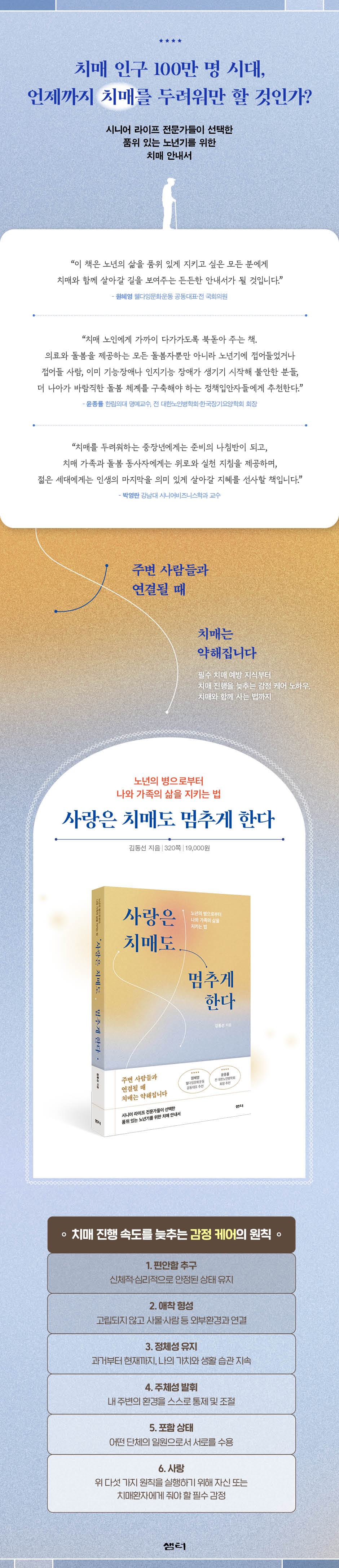
With a million people living with dementia, how long will we have to fear it?
Selected by senior life experts
A Guide to Dementia for a Dignified Aging
★ Recommended by Won Hye-young, co-representative of the Well-Dying Culture Movement, and former president of the Korean Geriatrics Society, Yoon Jong-ryul!
By 2025, Korea will have entered a super-aged society, and it is said that one in ten people over the age of 65 suffer from dementia.
With the rapid increase in the elderly population, the number of people with dementia is also expected to increase.
Yet, our current thinking about dementia can be summarized in one word: 'If you get dementia, your life is over.'
This is because there is a strong perception that it is a disease that makes it impossible to live the way you want by losing yourself, and that it is a disease that only becomes a burden to your family.
The author of Person-Centered Care, known as the most ethical dementia care method in the world, who is leading this movement in Korea, says, "Dementia may not be curable, but people with dementia can maintain their daily lives."
Having observed many dementia patients in the field for a long time, the author has witnessed cases where dementia progresses quickly to severe symptoms even in the early stages, and cases where people live relatively normal lives for a long time, to the point where one wonders, "Are they really dementia patients?"
This depends on whether the symptoms or feelings of the person with dementia are the focus.
This means that by alleviating negative emotions such as loneliness, it is possible to maintain the early stage of dementia, when symptoms are not so severe, for as long as possible and live according to one's own will.
The author emphasizes that for this to happen, it is necessary to treat the person involved with love, either by oneself or by those around oneself.
Of course, it is best not to get dementia.
However, dementia, a byproduct of aging, can strike anyone and at any time.
The author says that dementia is no longer something to be feared, as there are ways to slow its progression even if it does occur.
To achieve this, we must first understand what dementia is, correct our prejudices about dementia, and provide a new perspective on dementia.
Selected by senior life experts
A Guide to Dementia for a Dignified Aging
★ Recommended by Won Hye-young, co-representative of the Well-Dying Culture Movement, and former president of the Korean Geriatrics Society, Yoon Jong-ryul!
By 2025, Korea will have entered a super-aged society, and it is said that one in ten people over the age of 65 suffer from dementia.
With the rapid increase in the elderly population, the number of people with dementia is also expected to increase.
Yet, our current thinking about dementia can be summarized in one word: 'If you get dementia, your life is over.'
This is because there is a strong perception that it is a disease that makes it impossible to live the way you want by losing yourself, and that it is a disease that only becomes a burden to your family.
The author of Person-Centered Care, known as the most ethical dementia care method in the world, who is leading this movement in Korea, says, "Dementia may not be curable, but people with dementia can maintain their daily lives."
Having observed many dementia patients in the field for a long time, the author has witnessed cases where dementia progresses quickly to severe symptoms even in the early stages, and cases where people live relatively normal lives for a long time, to the point where one wonders, "Are they really dementia patients?"
This depends on whether the symptoms or feelings of the person with dementia are the focus.
This means that by alleviating negative emotions such as loneliness, it is possible to maintain the early stage of dementia, when symptoms are not so severe, for as long as possible and live according to one's own will.
The author emphasizes that for this to happen, it is necessary to treat the person involved with love, either by oneself or by those around oneself.
Of course, it is best not to get dementia.
However, dementia, a byproduct of aging, can strike anyone and at any time.
The author says that dementia is no longer something to be feared, as there are ways to slow its progression even if it does occur.
To achieve this, we must first understand what dementia is, correct our prejudices about dementia, and provide a new perspective on dementia.
- You can preview some of the book's contents.
Preview
index
Recommendation
Introduction_ Even if I get dementia, I dream of a happy ending that is my own.
Chapter 1: I Want to Live True to Myself Even When I'm Old and Sick: Why You Need to Know About Aging and Dementia
01 The belief that you become useless as you age
02 Conditions that make old age the prime of life
03 What to eat and experience as you age
04 We Who Hate Our Future
05 What is the reality of the fear of aging?
06 The misconception that dementia prevents you from living the way you want
07 Those who are not afraid have the power to overcome dementia.
Chapter 2: Love Stops Dementia: Knowledge and Emotions Effective in Preventing Dementia
08 Knowing About Dementia Transforms Your Life in Old Age
09 In fact, we already have dementia patients
10 You can't finish it, but you can delay it.
11 Love, so that dementia may weaken
12 Dementia comes with bad emotions.
13 Recover, as if you had never suffered.
14 People-centered care that cares for dementia patients with love
Chapter 3: The sooner you prepare for dementia, the better: What you need to do now to ensure a fulfilling retirement.
15 Remember what I like
16 Raise the threshold for dementia
17 The more friends you have and the more frequent your meetings, the better.
18 Finding things you can do even when you're older
19 'Recording' is always right
20 I will see with my own eyes where I will live in the end.
21 Prepare for your twilight years with an advance care plan.
22. Give a message to those who will guard you.
Chapter 4: Staying with Your Family Even with Dementia: Protecting Your Life and Your Family's with Emotional Care
23 The process of care that sprouts love
24 Care that makes everyone feel comfortable while caring for each other
25 Dementia Formulas That Bring You Closer
26 Care that can be easily mistaken for giving love
27 The misconception that dementia eliminates emotions
28 Principle of Emotional Care 1: Make your body and mind comfortable.
29 Principle of Emotional Care 2: Build Mature Relationships
30 Principle of Emotional Care 3 Understand the other person's life history
31 Principle 4 of Emotional Care: Help others do what they want to do.
32 Principles of Emotional Care 5 Things to Do Together
33 The greatest of these is love.
Chapter 5: Everyone Should Be Able to Age Worry-Free: Living with Dementia
34 The prejudice that dementia requires hiding
35. Attention to prevent the tragedy of loneliness that leads to dementia
36 An Act of Kindness That Saved a Dementia Patient
37 Opportunities to work that slow dementia
38 A life where you can have a voice in your work until the end
39 A gaze that does not see walks and outings as wandering
40 Understanding the Role of Love in Supporting Self-Esteem
Outgoing writing_ Hoping for a world where all elderly people's faces brighten
Appendix 1_ Signs of Dementia That Should Not Be Ignored in Those Over 40
Appendix 2_ Domestic People-Centered Care Practices You Should Know About
References
Introduction_ Even if I get dementia, I dream of a happy ending that is my own.
Chapter 1: I Want to Live True to Myself Even When I'm Old and Sick: Why You Need to Know About Aging and Dementia
01 The belief that you become useless as you age
02 Conditions that make old age the prime of life
03 What to eat and experience as you age
04 We Who Hate Our Future
05 What is the reality of the fear of aging?
06 The misconception that dementia prevents you from living the way you want
07 Those who are not afraid have the power to overcome dementia.
Chapter 2: Love Stops Dementia: Knowledge and Emotions Effective in Preventing Dementia
08 Knowing About Dementia Transforms Your Life in Old Age
09 In fact, we already have dementia patients
10 You can't finish it, but you can delay it.
11 Love, so that dementia may weaken
12 Dementia comes with bad emotions.
13 Recover, as if you had never suffered.
14 People-centered care that cares for dementia patients with love
Chapter 3: The sooner you prepare for dementia, the better: What you need to do now to ensure a fulfilling retirement.
15 Remember what I like
16 Raise the threshold for dementia
17 The more friends you have and the more frequent your meetings, the better.
18 Finding things you can do even when you're older
19 'Recording' is always right
20 I will see with my own eyes where I will live in the end.
21 Prepare for your twilight years with an advance care plan.
22. Give a message to those who will guard you.
Chapter 4: Staying with Your Family Even with Dementia: Protecting Your Life and Your Family's with Emotional Care
23 The process of care that sprouts love
24 Care that makes everyone feel comfortable while caring for each other
25 Dementia Formulas That Bring You Closer
26 Care that can be easily mistaken for giving love
27 The misconception that dementia eliminates emotions
28 Principle of Emotional Care 1: Make your body and mind comfortable.
29 Principle of Emotional Care 2: Build Mature Relationships
30 Principle of Emotional Care 3 Understand the other person's life history
31 Principle 4 of Emotional Care: Help others do what they want to do.
32 Principles of Emotional Care 5 Things to Do Together
33 The greatest of these is love.
Chapter 5: Everyone Should Be Able to Age Worry-Free: Living with Dementia
34 The prejudice that dementia requires hiding
35. Attention to prevent the tragedy of loneliness that leads to dementia
36 An Act of Kindness That Saved a Dementia Patient
37 Opportunities to work that slow dementia
38 A life where you can have a voice in your work until the end
39 A gaze that does not see walks and outings as wandering
40 Understanding the Role of Love in Supporting Self-Esteem
Outgoing writing_ Hoping for a world where all elderly people's faces brighten
Appendix 1_ Signs of Dementia That Should Not Be Ignored in Those Over 40
Appendix 2_ Domestic People-Centered Care Practices You Should Know About
References
Detailed image
Into the book
According to a domestic dementia awareness survey conducted by the Central Dementia Center, the disease that the elderly in Korea fear most is dementia (43 percent).
Children fear that their parents will develop dementia, and parents with dementia fall into despair, saying, “My life is over.”
These days, as the number of patients with early-onset dementia before the age of 65 increases, dementia is becoming a fearful disease for middle-aged and older people, even those in their 30s.
Some people wish for euthanasia due to extreme fear and denial about dementia.
Dementia is sending our entire society into a panic.
--- p.49 From “We Who Hate Our Future”
Dementia is the disease with the longest survival period.
For example, if you are diagnosed with Alzheimer's disease in your early 60s, you may live for more than 20 years.
Of course, the problem with dementia is that the symptoms gradually worsen after the onset.
However, while some people can maintain their daily lives for a long time even after being diagnosed with dementia, there are also cases where people are diagnosed with mild dementia and their memory is almost lost within a few months, and the condition deteriorates rapidly to the point where it becomes impossible to live alone.
Even if you are diagnosed with dementia, if you manage it well in the early stages, it is possible to enjoy your daily life.
However, in many cases, the moment they are diagnosed with dementia, they despair and give up on all their efforts.
If you give up, dementia will worsen rapidly.
--- p.65 From “Those who are not afraid have the power to overcome dementia”
Emotions are deeply involved in our thoughts, judgments, and decisions.
It makes us more likely to remember happy or extremely sad events, and when making important decisions, we base our judgments on memory data selected by our emotions.
It also has a major impact on health and dementia.
Positive thoughts and feelings release dopamine, which reduces pain in our bodies.
Conversely, anger and negative thoughts are detrimental to your health.
It is well known that loneliness has a negative impact on health, comparable to smoking 15 cigarettes.
Feelings of loneliness can cause cardiovascular problems and harm your health in every way you can think of: personality disorders, mental illness, cognitive decline, diabetes, arthritis, and more.
--- pp.103~104 From “Dementia Comes Through Bad Emotions”
What is the self you want to retain until the end? According to Carl Rogers' person-centered theory, which emphasizes humanistic psychological counseling, the "authentic self" is comprised of one's values, beliefs, and experiences.
Living true to yourself means living according to your own standards and desires, not those of others.
American social psychologists Christopher Sabat and Harriet Foster presented an interview with a dementia patient who had been a lawyer in his youth.
When asked, “Were you a lawyer?” he is said to have replied, “I am a lawyer.”
Being diagnosed with dementia doesn't mean he's lost his identity as a lawyer.
Because he majored in law, spent his entire life advocating for the law and using his legal knowledge to help others in their difficulties, his identity will always be that of a 'lawyer.'
--- p.130 From “I Will Remember What I Like”
How many close friends are needed to feel safe? Several studies examining relationships suggest that three to five close friends is the optimal number.
But even that number cannot be considered safe in old age when relationships are reduced.
The number of friends is like a candy jar.
The amount I can handle is the most appropriate.
People who have a broad perspective on the world are said to meet and associate with a wide variety of people.
You can make friends with people of different educational levels, backgrounds, political views, and religions.
The same goes for age.
We need old friends to help us grow old and new friends to help us stay young.
--- p.145 From “The more friends you have and the more often you meet, the better”
According to British social policy scholar Mary Daly, care is 'the work of looking after someone who cannot take care of themselves.'
Care must meet three essential needs: first, to provide assistance in daily life, and second, to provide assistance in crisis situations.
Lastly, the most important thing is companionship.
The key is intimacy, being ‘by your side.’
It is about both the caregiver and the care recipient existing alongside each other as their complete selves.
Caring is the desire for the other person to be happy.
It is a mutual giving and receiving, contributing to the satisfaction of the other person's needs.
--- pp.191~192 From “Care that makes everyone feel comfortable while caring for each other”
Laughter changes our brains, and laughing together is more effective than laughing alone.
In one study, participants watched a comedy film alone or with a close friend, and then their brains were scanned using positron emission tomography (PET).
In the brain after laughing, we were able to confirm that the production of opioids, which are stress relievers, increased.
A key finding was that the laughter effect was greater for those who watched the comedy with a friend than for those who watched it alone.
The effects of laughter and joy are not limited to healthy people.
Even in dementia patients, laughter can activate brain cells and increase the number of wrinkles in the brain.
In dementia care, it is important to understand and care for the anxiety or nervousness felt by the patient to maintain a good mood, which is important in preventing the progression of the disease.
--- p.212 From “The Misconception That Dementia Eliminates Emotions”
Sometimes, people lie as a temporary measure to calm the anxiety of dementia patients.
When a grandmother with dementia visits her deceased spouse, she says, “Grandpa is out right now.
“Just wait a little bit and he’ll be back,” he said, trying to appease her.
Even with good intentions, lying can actually destroy trust with the other person, which can have negative consequences for future care.
People with dementia do not show symptoms of dementia 24 hours a day.
Even if you are delusional, the next moment you recognize reality.
When I find out that the other person has been lying to me, I no longer trust that person.
To form an attachment, you need to 'accept the person as they are', 'treat them sincerely', and 'have an attitude that acknowledges the person's world'.
--- p.223 From “Principle 2 of Emotional Care: Build a Mature Relationship”
In person-centered care, we prioritize joint decision-making in care and treatment.
To understand and practice the desire for inclusion, we must first remove the barriers within our own hearts.
The first mental barrier to dementia is the idea that 'there is cognitive decline, so I have to do it for them.'
The idea that it is dangerous to leave a person with dementia alone and that everything must be done for them leads to oppressive caregiving.
Such care ignores the person's potential and takes away things he or she can do for himself or herself, ultimately leaving the person worse off than he or she is now.
--- p.243 From “Principle 5 of Emotional Care: Being Together”
Efforts to create dementia-friendly environments aren't just for people with dementia.
I may also worry about caring for my parents, or my spouse or sibling may be diagnosed with dementia.
I might start losing my memory first.
At that time, you will face firsthand how much of a burden it is on you and your family due to difficulties in preparing meals, doing housework, using public transportation, and pursuing hobbies that cannot be resolved with hospital treatment alone.
Changing negative thoughts about dementia and showing interest in the elderly people with dementia around you.
This is no different from helping others and protecting my future life and the lives of my family.
Children fear that their parents will develop dementia, and parents with dementia fall into despair, saying, “My life is over.”
These days, as the number of patients with early-onset dementia before the age of 65 increases, dementia is becoming a fearful disease for middle-aged and older people, even those in their 30s.
Some people wish for euthanasia due to extreme fear and denial about dementia.
Dementia is sending our entire society into a panic.
--- p.49 From “We Who Hate Our Future”
Dementia is the disease with the longest survival period.
For example, if you are diagnosed with Alzheimer's disease in your early 60s, you may live for more than 20 years.
Of course, the problem with dementia is that the symptoms gradually worsen after the onset.
However, while some people can maintain their daily lives for a long time even after being diagnosed with dementia, there are also cases where people are diagnosed with mild dementia and their memory is almost lost within a few months, and the condition deteriorates rapidly to the point where it becomes impossible to live alone.
Even if you are diagnosed with dementia, if you manage it well in the early stages, it is possible to enjoy your daily life.
However, in many cases, the moment they are diagnosed with dementia, they despair and give up on all their efforts.
If you give up, dementia will worsen rapidly.
--- p.65 From “Those who are not afraid have the power to overcome dementia”
Emotions are deeply involved in our thoughts, judgments, and decisions.
It makes us more likely to remember happy or extremely sad events, and when making important decisions, we base our judgments on memory data selected by our emotions.
It also has a major impact on health and dementia.
Positive thoughts and feelings release dopamine, which reduces pain in our bodies.
Conversely, anger and negative thoughts are detrimental to your health.
It is well known that loneliness has a negative impact on health, comparable to smoking 15 cigarettes.
Feelings of loneliness can cause cardiovascular problems and harm your health in every way you can think of: personality disorders, mental illness, cognitive decline, diabetes, arthritis, and more.
--- pp.103~104 From “Dementia Comes Through Bad Emotions”
What is the self you want to retain until the end? According to Carl Rogers' person-centered theory, which emphasizes humanistic psychological counseling, the "authentic self" is comprised of one's values, beliefs, and experiences.
Living true to yourself means living according to your own standards and desires, not those of others.
American social psychologists Christopher Sabat and Harriet Foster presented an interview with a dementia patient who had been a lawyer in his youth.
When asked, “Were you a lawyer?” he is said to have replied, “I am a lawyer.”
Being diagnosed with dementia doesn't mean he's lost his identity as a lawyer.
Because he majored in law, spent his entire life advocating for the law and using his legal knowledge to help others in their difficulties, his identity will always be that of a 'lawyer.'
--- p.130 From “I Will Remember What I Like”
How many close friends are needed to feel safe? Several studies examining relationships suggest that three to five close friends is the optimal number.
But even that number cannot be considered safe in old age when relationships are reduced.
The number of friends is like a candy jar.
The amount I can handle is the most appropriate.
People who have a broad perspective on the world are said to meet and associate with a wide variety of people.
You can make friends with people of different educational levels, backgrounds, political views, and religions.
The same goes for age.
We need old friends to help us grow old and new friends to help us stay young.
--- p.145 From “The more friends you have and the more often you meet, the better”
According to British social policy scholar Mary Daly, care is 'the work of looking after someone who cannot take care of themselves.'
Care must meet three essential needs: first, to provide assistance in daily life, and second, to provide assistance in crisis situations.
Lastly, the most important thing is companionship.
The key is intimacy, being ‘by your side.’
It is about both the caregiver and the care recipient existing alongside each other as their complete selves.
Caring is the desire for the other person to be happy.
It is a mutual giving and receiving, contributing to the satisfaction of the other person's needs.
--- pp.191~192 From “Care that makes everyone feel comfortable while caring for each other”
Laughter changes our brains, and laughing together is more effective than laughing alone.
In one study, participants watched a comedy film alone or with a close friend, and then their brains were scanned using positron emission tomography (PET).
In the brain after laughing, we were able to confirm that the production of opioids, which are stress relievers, increased.
A key finding was that the laughter effect was greater for those who watched the comedy with a friend than for those who watched it alone.
The effects of laughter and joy are not limited to healthy people.
Even in dementia patients, laughter can activate brain cells and increase the number of wrinkles in the brain.
In dementia care, it is important to understand and care for the anxiety or nervousness felt by the patient to maintain a good mood, which is important in preventing the progression of the disease.
--- p.212 From “The Misconception That Dementia Eliminates Emotions”
Sometimes, people lie as a temporary measure to calm the anxiety of dementia patients.
When a grandmother with dementia visits her deceased spouse, she says, “Grandpa is out right now.
“Just wait a little bit and he’ll be back,” he said, trying to appease her.
Even with good intentions, lying can actually destroy trust with the other person, which can have negative consequences for future care.
People with dementia do not show symptoms of dementia 24 hours a day.
Even if you are delusional, the next moment you recognize reality.
When I find out that the other person has been lying to me, I no longer trust that person.
To form an attachment, you need to 'accept the person as they are', 'treat them sincerely', and 'have an attitude that acknowledges the person's world'.
--- p.223 From “Principle 2 of Emotional Care: Build a Mature Relationship”
In person-centered care, we prioritize joint decision-making in care and treatment.
To understand and practice the desire for inclusion, we must first remove the barriers within our own hearts.
The first mental barrier to dementia is the idea that 'there is cognitive decline, so I have to do it for them.'
The idea that it is dangerous to leave a person with dementia alone and that everything must be done for them leads to oppressive caregiving.
Such care ignores the person's potential and takes away things he or she can do for himself or herself, ultimately leaving the person worse off than he or she is now.
--- p.243 From “Principle 5 of Emotional Care: Being Together”
Efforts to create dementia-friendly environments aren't just for people with dementia.
I may also worry about caring for my parents, or my spouse or sibling may be diagnosed with dementia.
I might start losing my memory first.
At that time, you will face firsthand how much of a burden it is on you and your family due to difficulties in preparing meals, doing housework, using public transportation, and pursuing hobbies that cannot be resolved with hospital treatment alone.
Changing negative thoughts about dementia and showing interest in the elderly people with dementia around you.
This is no different from helping others and protecting my future life and the lives of my family.
--- p.299 From “Understanding the Role of Love in Supporting Oneness”
Publisher's Review
The sooner you prepare for dementia, the better.
For my own old age
What to do from now on
The onset of dementia is closely related to daily life in old age.
Therefore, dementia prevention is divided into activities to delay the onset of dementia and activities to maintain a life as authentic as possible even if dementia occurs.
This book emphasizes that the most effective way to prevent this is to maintain your own identity.
Before dementia sets in, having a sense of meaning and purpose in life is especially important.
The key is that it must be based on love for myself.
In other words, in order to feel positive, even if it is something small, you have to do ‘what you decided to do.’
For example, if you can feel happy just by watering your houseplant once a day, that's enough.
He also emphasizes the importance of walking, sleeping, and eating well, as well as habits that make you feel more at ease, as he says that our current lifestyle shapes the way we age.
Recently, the number of patients with early-onset dementia under the age of 65 has been increasing, and it is highly likely that modern people who frequently work overtime will develop the disease. If you work overtime and lack sleep, it is recommended that you at least follow one of the following three guidelines: reduce alcohol consumption; and if you do drink, walk more than usual the next day.
If you have dementia, it is even more important to maintain your ‘self’.
The author suggests activities to preserve one's identity, such as deciding on a title to be called in old age and creating a memory book to remember oneself.
The most important thing is connecting with other people.
It emphasizes that you should continue to do things that you can do even as you get older, and that you should keep in touch with and meet people.
When we do things we love, laugh and chat with loved ones, and share body heat, we release happy hormones like oxytocin, which acts as a barrier against dementia.
These connections also help us as we approach the end of our twilight years.
Even if you don't have dementia, as you age, you will have difficulty moving around, and in this state, you will have to prepare for the end that will come someday.
The author says that this is also inseparable from preparing for dementia, and recommends writing an advance care plan, stating who you would like to receive care from, where you would like to receive care, and how you would like to be cared for, and leaving a note in advance asking those around you who can protect your individuality.
Love even slows down dementia
Anyone can put it into practice right away
How to care for your emotions
Loneliness due to social isolation after retirement can lead to various geriatric diseases, including dementia.
In other words, sharing emotions with people around you in old age is a great help in slowing down the pace of dementia.
This book shows this way of emotional communication as a process of care.
What exactly is the act of giving and receiving love? Koreans tend to think of caregiving as arduous emotional and physical labor.
This is because it is considered a one-sided relationship of giving and receiving care.
The author says that caring doesn't have to mean doing something, but rather simply being there and understanding the other person's feelings.
Here are five ways to share love and care.
I will make the other person comfortable in body and mind, build a mature relationship, understand the other person's life story, help them do what they want to do, and be together.
The author explains each step in detail so that anyone can easily follow it.
It is a way to make it easy to understand by sharing anecdotes from real-life situations, such as the fact that you need to slow down your speech to relax your body and mind.
In the process of caring, our relationships become stronger, and we are positively influenced by the emotions and love we feel at that time.
When we talk about care, the object of care is usually family.
By caring for my loved ones, I come to understand the love that parents give to their children and the love that children can give to their parents. I also understand what kind of life my parents or spouse want for me, and I learn how I want to grow old.
This could be a great help in preventing dementia from coming to us.
Additionally, the author states that the number of elderly people with dementia will increase due to the rapid increase in single-person households, and that a dementia-friendly environment must be created so that everyone can grow old without worry.
The starting point is to change the negative view of dementia.
If you know how to take care of yourself even if you have dementia, and have family and neighbors who will look after you with love, you will be able to spend your old age with the people you want until the very end.
This book contains reasons why we need to eliminate the fear of dementia, things to do from now on to avoid getting dementia, and ways to live a life worthy of oneself even if you have dementia. It will be a specific and practical guide for not only families of dementia patients, but also middle-aged and older people approaching old age, caregivers, and community members to understand and prepare for dementia and design a dignified old age.
For my own old age
What to do from now on
The onset of dementia is closely related to daily life in old age.
Therefore, dementia prevention is divided into activities to delay the onset of dementia and activities to maintain a life as authentic as possible even if dementia occurs.
This book emphasizes that the most effective way to prevent this is to maintain your own identity.
Before dementia sets in, having a sense of meaning and purpose in life is especially important.
The key is that it must be based on love for myself.
In other words, in order to feel positive, even if it is something small, you have to do ‘what you decided to do.’
For example, if you can feel happy just by watering your houseplant once a day, that's enough.
He also emphasizes the importance of walking, sleeping, and eating well, as well as habits that make you feel more at ease, as he says that our current lifestyle shapes the way we age.
Recently, the number of patients with early-onset dementia under the age of 65 has been increasing, and it is highly likely that modern people who frequently work overtime will develop the disease. If you work overtime and lack sleep, it is recommended that you at least follow one of the following three guidelines: reduce alcohol consumption; and if you do drink, walk more than usual the next day.
If you have dementia, it is even more important to maintain your ‘self’.
The author suggests activities to preserve one's identity, such as deciding on a title to be called in old age and creating a memory book to remember oneself.
The most important thing is connecting with other people.
It emphasizes that you should continue to do things that you can do even as you get older, and that you should keep in touch with and meet people.
When we do things we love, laugh and chat with loved ones, and share body heat, we release happy hormones like oxytocin, which acts as a barrier against dementia.
These connections also help us as we approach the end of our twilight years.
Even if you don't have dementia, as you age, you will have difficulty moving around, and in this state, you will have to prepare for the end that will come someday.
The author says that this is also inseparable from preparing for dementia, and recommends writing an advance care plan, stating who you would like to receive care from, where you would like to receive care, and how you would like to be cared for, and leaving a note in advance asking those around you who can protect your individuality.
Love even slows down dementia
Anyone can put it into practice right away
How to care for your emotions
Loneliness due to social isolation after retirement can lead to various geriatric diseases, including dementia.
In other words, sharing emotions with people around you in old age is a great help in slowing down the pace of dementia.
This book shows this way of emotional communication as a process of care.
What exactly is the act of giving and receiving love? Koreans tend to think of caregiving as arduous emotional and physical labor.
This is because it is considered a one-sided relationship of giving and receiving care.
The author says that caring doesn't have to mean doing something, but rather simply being there and understanding the other person's feelings.
Here are five ways to share love and care.
I will make the other person comfortable in body and mind, build a mature relationship, understand the other person's life story, help them do what they want to do, and be together.
The author explains each step in detail so that anyone can easily follow it.
It is a way to make it easy to understand by sharing anecdotes from real-life situations, such as the fact that you need to slow down your speech to relax your body and mind.
In the process of caring, our relationships become stronger, and we are positively influenced by the emotions and love we feel at that time.
When we talk about care, the object of care is usually family.
By caring for my loved ones, I come to understand the love that parents give to their children and the love that children can give to their parents. I also understand what kind of life my parents or spouse want for me, and I learn how I want to grow old.
This could be a great help in preventing dementia from coming to us.
Additionally, the author states that the number of elderly people with dementia will increase due to the rapid increase in single-person households, and that a dementia-friendly environment must be created so that everyone can grow old without worry.
The starting point is to change the negative view of dementia.
If you know how to take care of yourself even if you have dementia, and have family and neighbors who will look after you with love, you will be able to spend your old age with the people you want until the very end.
This book contains reasons why we need to eliminate the fear of dementia, things to do from now on to avoid getting dementia, and ways to live a life worthy of oneself even if you have dementia. It will be a specific and practical guide for not only families of dementia patients, but also middle-aged and older people approaching old age, caregivers, and community members to understand and prepare for dementia and design a dignified old age.
GOODS SPECIFICS
- Date of issue: October 7, 2025
- Page count, weight, size: 320 pages | 145*210*30mm
- ISBN13: 9788946423145
- ISBN10: 8946423145
You may also like
카테고리
korean


korean

![GQ KOREA Mark (Monthly): December [2025]](http://librairie.coreenne.fr/cdn/shop/files/8ef265dbbfbf186523ed75ba7319009d.jpg?v=1765340328&width=3840)


