

How do people face death?
 |
Description
Book Introduction
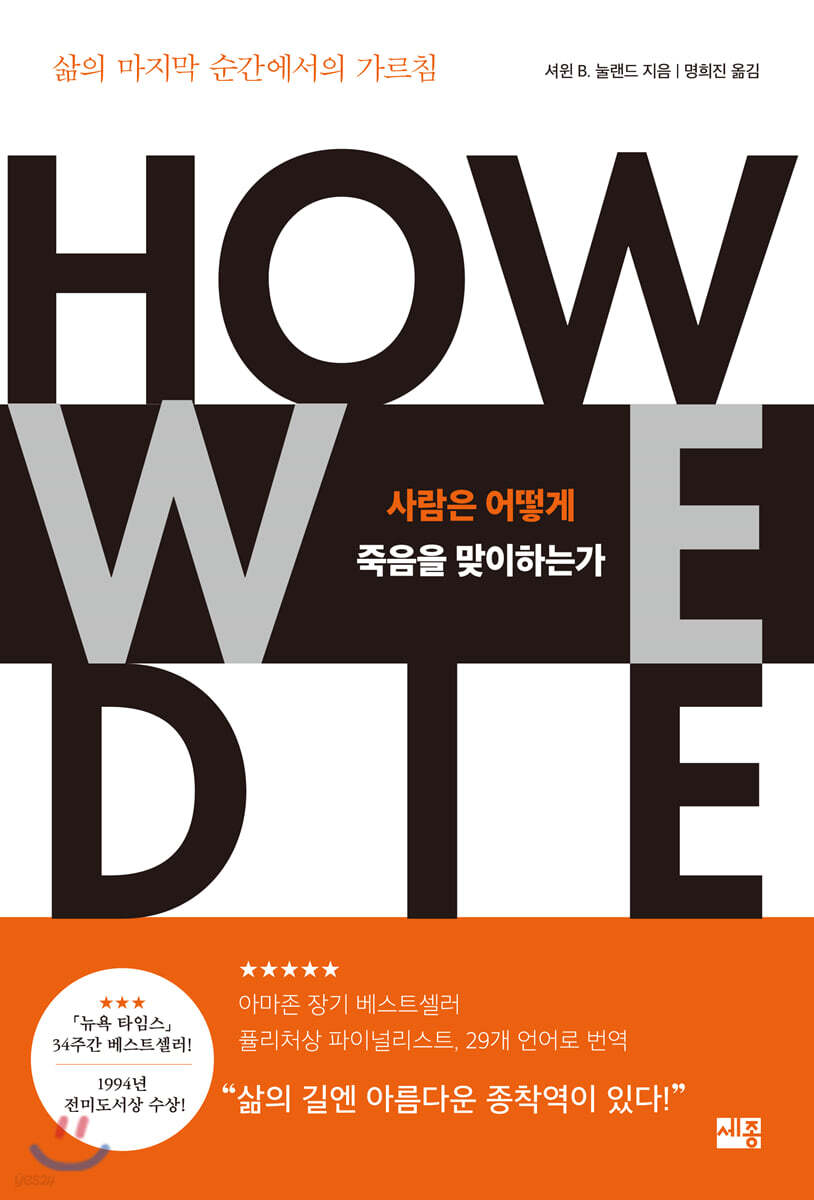
Amazon long-term bestseller
Pulitzer Prize finalist, translated into 29 languages
"How People Face Death" Recover Edition Released!
“There is a beautiful destination on the road of life!”
A doctor who has seen countless deaths for over 50 years asks
A shocking and moving medical essay!
No living person can know death.
Because the death we think of is the feeling of death, not death itself.
Therefore, if we understand death properly, we will be able to free ourselves from the fear of death.
This book is written by a doctor who has observed death for decades with this very awareness of the problem.
Sherwin B., author of "How We Die" and a Yale University School of Medicine doctor,
Nuland asserts:
Death is just a natural process of life.
If we understand that, we can be free from unnecessary fear and exaggerated suffering.
But he did not approach this subject with a cold scientific gaze.
I wrote this not as a doctor, but as a result of the deep emotional pain and despair I felt when I lost my grandmother, who raised my two grandchildren alone, and my older brother, who was like a father to me, and I felt empathy for others, believing that they might be in the same situation.
That is why this book is filled with the author's humanism.
It is also imbued with a wealth of clinical case studies based on experience, deep compassion for patients, and the pain of losing a beloved family member.
Through "How People Face Death," readers will encounter unvarnished descriptions and vivid expressions of the shocking truths revealed in human life and death, as well as expert knowledge about the diseases that lead to death.
Pulitzer Prize finalist, translated into 29 languages
"How People Face Death" Recover Edition Released!
“There is a beautiful destination on the road of life!”
A doctor who has seen countless deaths for over 50 years asks
A shocking and moving medical essay!
No living person can know death.
Because the death we think of is the feeling of death, not death itself.
Therefore, if we understand death properly, we will be able to free ourselves from the fear of death.
This book is written by a doctor who has observed death for decades with this very awareness of the problem.
Sherwin B., author of "How We Die" and a Yale University School of Medicine doctor,
Nuland asserts:
Death is just a natural process of life.
If we understand that, we can be free from unnecessary fear and exaggerated suffering.
But he did not approach this subject with a cold scientific gaze.
I wrote this not as a doctor, but as a result of the deep emotional pain and despair I felt when I lost my grandmother, who raised my two grandchildren alone, and my older brother, who was like a father to me, and I felt empathy for others, believing that they might be in the same situation.
That is why this book is filled with the author's humanism.
It is also imbued with a wealth of clinical case studies based on experience, deep compassion for patients, and the pain of losing a beloved family member.
Through "How People Face Death," readers will encounter unvarnished descriptions and vivid expressions of the shocking truths revealed in human life and death, as well as expert knowledge about the diseases that lead to death.
- You can preview some of the book's contents.
Preview
index
Acknowledgements
preface
1. Heart disease
2 The Fall of Valentine
3 What is life?
4 Old Age and Death
5 Alzheimer's
6 Murder and Peace
7 Accidents, Suicide, and Euthanasia
8 AIDS, the Grim Reaper
9 Viruses and Death
10 Cancer's Poison
11 Hope and Cancer Patients
12 Lessons from Death
Conclusion
preface
1. Heart disease
2 The Fall of Valentine
3 What is life?
4 Old Age and Death
5 Alzheimer's
6 Murder and Peace
7 Accidents, Suicide, and Euthanasia
8 AIDS, the Grim Reaper
9 Viruses and Death
10 Cancer's Poison
11 Hope and Cancer Patients
12 Lessons from Death
Conclusion
Into the book
These days, not many people get to see the death of a loved one in person.
Because very few people die at home.
Most people die in their hospital beds, but only a few patients suffer from long-term illnesses or are chronically bedridden to the point of drug addiction and slowly deteriorate.
According to one statistic, 80 percent of Americans die in hospitals.
And most of them pass away isolated from their families who had been with them during their final moments.
--- p.33
I watched for a long time a man who, as soon as he became old enough to have some awareness of life, was gradually dying of old age.
She was my grandmother.
The year I was born, my grandmother's actual age was 78.
But the number written on the yellowed immigration certificate was 73.
Twenty-five years ago, when my grandmother left Ellis Island and entered the United States, she had to tell the immigration officers in their gold-buttoned uniforms, who were asking her a series of questions, that her age was five years younger than her actual age of 54.
It was because of a rumor that being even one year younger would have an advantage in immigration screening.
--- p.83
Even setting aside the theory that human death is necessary to maintain biological systems, nature never lends a helping hand to this kind of thinking.
Perhaps we have turned a blind eye to the unnecessary and worthless sight of humans killing each other and even themselves.
Trauma is an act that robs nature of its offspring and hinders systematic development.
Death by injury never helps anyone.
It is a tragedy that not only the families left behind, but also our species as humans must endure.
--- p.217
Nature just goes on its own path silently.
Nature works in a way that allows us, the individuals she has created, to adapt.
Sometimes it's heart disease, sometimes it's stroke, sometimes it's cancer, and so it comes to each of us.
The world of all living things is formed by an order in which each generation is replaced by the next generation.
When confronted with the majestic cycles and merciless forces of nature, there is only defeat.
Because very few people die at home.
Most people die in their hospital beds, but only a few patients suffer from long-term illnesses or are chronically bedridden to the point of drug addiction and slowly deteriorate.
According to one statistic, 80 percent of Americans die in hospitals.
And most of them pass away isolated from their families who had been with them during their final moments.
--- p.33
I watched for a long time a man who, as soon as he became old enough to have some awareness of life, was gradually dying of old age.
She was my grandmother.
The year I was born, my grandmother's actual age was 78.
But the number written on the yellowed immigration certificate was 73.
Twenty-five years ago, when my grandmother left Ellis Island and entered the United States, she had to tell the immigration officers in their gold-buttoned uniforms, who were asking her a series of questions, that her age was five years younger than her actual age of 54.
It was because of a rumor that being even one year younger would have an advantage in immigration screening.
--- p.83
Even setting aside the theory that human death is necessary to maintain biological systems, nature never lends a helping hand to this kind of thinking.
Perhaps we have turned a blind eye to the unnecessary and worthless sight of humans killing each other and even themselves.
Trauma is an act that robs nature of its offspring and hinders systematic development.
Death by injury never helps anyone.
It is a tragedy that not only the families left behind, but also our species as humans must endure.
--- p.217
Nature just goes on its own path silently.
Nature works in a way that allows us, the individuals she has created, to adapt.
Sometimes it's heart disease, sometimes it's stroke, sometimes it's cancer, and so it comes to each of us.
The world of all living things is formed by an order in which each generation is replaced by the next generation.
When confronted with the majestic cycles and merciless forces of nature, there is only defeat.
--- p.380
Publisher's Review
1994 National Book Award Winner
New York Times bestseller for 34 weeks
Amazon long-term bestseller
Publisher's Weekly Bestseller for 14 Weeks
Translated into 29 languages
Pulitzer Prize finalist
Death has tens of thousands of doors.
How is a beautiful ending possible?
A question from a Yale University medical school professor who has seen countless deaths over the past 40 years.
A shocking and moving medical essay!
What is death? Pain and fear? Eternal annihilation?
No living person can know death.
Because the death we think of is the feeling of death, not death itself.
Therefore, if we understand death properly, we will be able to free ourselves from the fear of death.
This book is written by a doctor who has observed death for decades with this very awareness of the problem.
Sherwin B., author of "How We Die" and a Yale University School of Medicine doctor,
Nuland asserts:
Death is just a natural process of life.
If we understand that, we can be free from unnecessary fear and exaggerated suffering.
But he did not approach this subject with a cold scientific gaze.
I wrote this not as a doctor, but as a result of the deep emotional pain and despair I felt when I lost my grandmother, who raised my two grandchildren alone, and my older brother, who was like a father to me, and I felt empathy for others, believing that they might be in the same situation.
That is why this book is filled with the author's humanism.
It is also imbued with a wealth of clinical case studies based on experience, deep compassion for patients, and the pain of losing a beloved family member.
Through "How People Face Death," readers will encounter unvarnished descriptions and vivid expressions of the shocking truths revealed in human life and death, as well as expert knowledge about the diseases that lead to death.
How should we face death?
There are many ways in which people face death.
Accidents can happen, you can suddenly get sick, or old age can strike.
The unchanging truth is that we all eventually face death in one way or another.
It is the law of nature and an absolute and unchangeable principle.
But of all the living things on Earth, only humans fear death.
The author of this book, Sherwin B.
Dr. Nuland lost his beloved brother to colon cancer.
He has been advising terminally ill patients and their families to calmly prepare for their final moments, but when his own older brother is diagnosed with a terminal illness, he cannot tell them the truth, even though he knows he does not have much time left.
Unable to ignore his brother's desperate eyes that want to live, he uses all the power of medicine in the vain belief that his brother will definitely get better.
But in the end, my brother passed away while receiving strong drug treatment.
Through this, the author realizes:
Rather than suffering through meaningless efforts to prolong life, it is more valuable to enjoy the life you have been given without regrets and leave with beautiful memories.
Prepare for a beautiful ending
"How People Face Death" discusses the themes of "heart disease, old age, Alzheimer's, accidents, suicide, euthanasia, and cancer" and provides examples of people who have experienced them, and tells how patients or their relatives or family members spent their final moments.
If you don't know what form death will take, you won't be able to properly complete the final moments you have to share with those you love.
That is exactly what the author is warning against.
Because accepting death as an inevitable natural law is the first step toward a beautiful death.
As poet Yun Dong-ju said, everything that lives eventually dies.
It is a vivid proof that we are 'alive' and an inescapable reason why we must value life.
When death finally comes, shouldn't we live life without regret and embrace it with a fearless heart? "How People Face Death" will help us in that regard, if only a little.
New York Times bestseller for 34 weeks
Amazon long-term bestseller
Publisher's Weekly Bestseller for 14 Weeks
Translated into 29 languages
Pulitzer Prize finalist
Death has tens of thousands of doors.
How is a beautiful ending possible?
A question from a Yale University medical school professor who has seen countless deaths over the past 40 years.
A shocking and moving medical essay!
What is death? Pain and fear? Eternal annihilation?
No living person can know death.
Because the death we think of is the feeling of death, not death itself.
Therefore, if we understand death properly, we will be able to free ourselves from the fear of death.
This book is written by a doctor who has observed death for decades with this very awareness of the problem.
Sherwin B., author of "How We Die" and a Yale University School of Medicine doctor,
Nuland asserts:
Death is just a natural process of life.
If we understand that, we can be free from unnecessary fear and exaggerated suffering.
But he did not approach this subject with a cold scientific gaze.
I wrote this not as a doctor, but as a result of the deep emotional pain and despair I felt when I lost my grandmother, who raised my two grandchildren alone, and my older brother, who was like a father to me, and I felt empathy for others, believing that they might be in the same situation.
That is why this book is filled with the author's humanism.
It is also imbued with a wealth of clinical case studies based on experience, deep compassion for patients, and the pain of losing a beloved family member.
Through "How People Face Death," readers will encounter unvarnished descriptions and vivid expressions of the shocking truths revealed in human life and death, as well as expert knowledge about the diseases that lead to death.
How should we face death?
There are many ways in which people face death.
Accidents can happen, you can suddenly get sick, or old age can strike.
The unchanging truth is that we all eventually face death in one way or another.
It is the law of nature and an absolute and unchangeable principle.
But of all the living things on Earth, only humans fear death.
The author of this book, Sherwin B.
Dr. Nuland lost his beloved brother to colon cancer.
He has been advising terminally ill patients and their families to calmly prepare for their final moments, but when his own older brother is diagnosed with a terminal illness, he cannot tell them the truth, even though he knows he does not have much time left.
Unable to ignore his brother's desperate eyes that want to live, he uses all the power of medicine in the vain belief that his brother will definitely get better.
But in the end, my brother passed away while receiving strong drug treatment.
Through this, the author realizes:
Rather than suffering through meaningless efforts to prolong life, it is more valuable to enjoy the life you have been given without regrets and leave with beautiful memories.
Prepare for a beautiful ending
"How People Face Death" discusses the themes of "heart disease, old age, Alzheimer's, accidents, suicide, euthanasia, and cancer" and provides examples of people who have experienced them, and tells how patients or their relatives or family members spent their final moments.
If you don't know what form death will take, you won't be able to properly complete the final moments you have to share with those you love.
That is exactly what the author is warning against.
Because accepting death as an inevitable natural law is the first step toward a beautiful death.
As poet Yun Dong-ju said, everything that lives eventually dies.
It is a vivid proof that we are 'alive' and an inescapable reason why we must value life.
When death finally comes, shouldn't we live life without regret and embrace it with a fearless heart? "How People Face Death" will help us in that regard, if only a little.
GOODS SPECIFICS
- Date of issue: June 30, 2020
- Page count, weight, size: 383 pages | 518g | 152*224*30mm
- ISBN13: 9788984077942
- ISBN10: 8984077941
You may also like
카테고리
korean


korean

![GQ KOREA Mark (Monthly): December [2025]](http://librairie.coreenne.fr/cdn/shop/files/8ef265dbbfbf186523ed75ba7319009d.jpg?v=1765340328&width=3840)


