

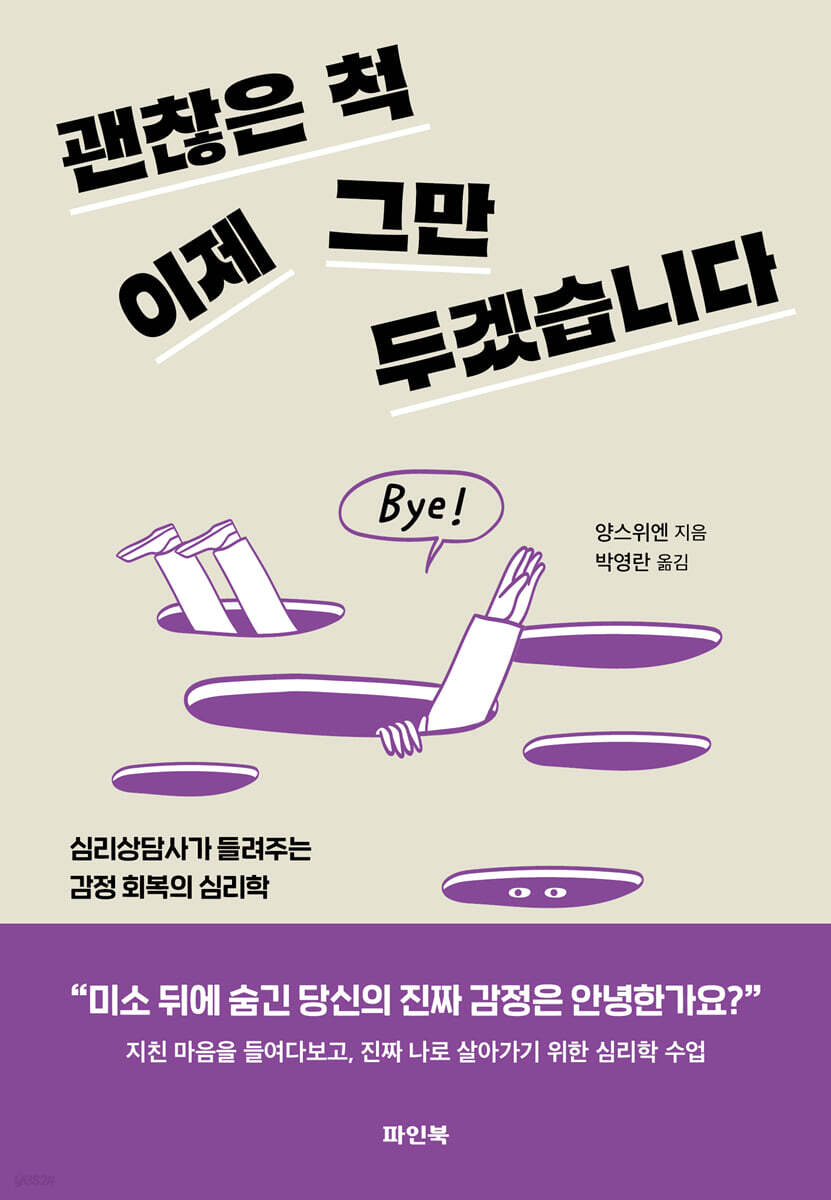
I'll stop pretending I'm okay now.
 |
Description
Book Introduction
“It’s okay if you don’t pretend or act like you’re okay.”
Columnist with 100,000 views, veteran psychologist
A self-healing story to tell
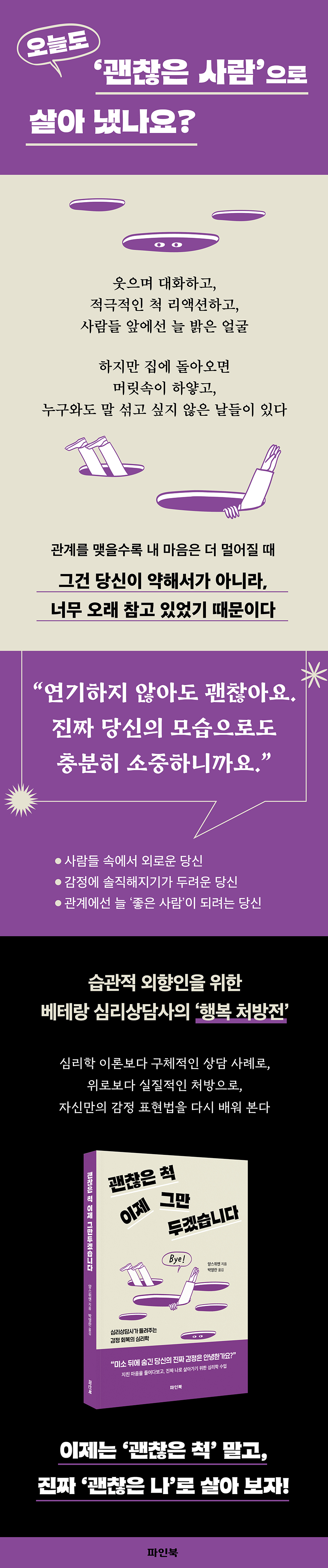
There are people who are more active than anyone else on social media, receive more likes, and are said to be sociable and cheerful.
He is always the center of attention in gatherings, good at joking, and a sensitive person who considers other people's feelings first.
Everyone remembers him as a 'mood maker' and a 'nice person', but after a meeting, he falls into an inexplicable sense of emptiness in a quiet room.
Lying in bed with an empty heart, not knowing why, I became confused as to whether the bright image people remembered was really my true self.
While we're together, I'm more energetic than anyone else, but when I get home, my whole body feels weak, and if I don't have time for myself, I become so exhausted that I can't stand it.
Do you happen to be like that too?
"I'll Stop Pretending to Be Okay" is a psychological healing book that guides people who suppress their true emotions to meet other people's expectations on how to live as their "true selves."
The author of this book, Yang Swi-en, is a veteran psychological counselor who has met countless people in the field of psychological counseling for many years, and a popular psychological columnist who has garnered sympathy from hundreds of thousands of readers.
Her columns have attracted great interest from readers, garnering over 100,000 views each time, and her psychological content platform, "Swiss Psychological Growth," also enjoys support, with over 50,000 followers.
She organized this book around concrete examples from actual counseling activities rather than psychological theories.
PART 1 deals with extroverted solitude.
For those who find themselves increasingly drained by the feelings of others, who prioritize their own, I advise them to stop wasting their time acting as mood makers. PART 2 is about inner healing.
If you trace the roots of the emotions that make you anxious, you will eventually come across your childhood relationships with your family and the personality patterns that formed.
The author emphasizes that this process, though difficult, is the beginning of a necessary inner recovery. Part 3 discusses the awareness of boundaries essential for developing an independent personality.
The author says that without a 'healthy sense of boundaries', one cannot live as an independent person.
The topic of whether it's okay to secretly look at your spouse's phone resonates with readers. Part 4 is about building relationships without hurt feelings.
The author emphasizes that a good relationship isn't one without conflict, but rather one that knows how to handle conflict healthily. Part 5 contains the author's prescription for shedding the mask of the mind and living as one's true self.
I hope that this book will help those with sensitive emotions, those who are introverted but strive to show only their bright side to others, and all those who easily become tired and hurt in relationships to look into their own emotions and find true happiness.
Columnist with 100,000 views, veteran psychologist
A self-healing story to tell
There are people who are more active than anyone else on social media, receive more likes, and are said to be sociable and cheerful.
He is always the center of attention in gatherings, good at joking, and a sensitive person who considers other people's feelings first.
Everyone remembers him as a 'mood maker' and a 'nice person', but after a meeting, he falls into an inexplicable sense of emptiness in a quiet room.
Lying in bed with an empty heart, not knowing why, I became confused as to whether the bright image people remembered was really my true self.
While we're together, I'm more energetic than anyone else, but when I get home, my whole body feels weak, and if I don't have time for myself, I become so exhausted that I can't stand it.
Do you happen to be like that too?
"I'll Stop Pretending to Be Okay" is a psychological healing book that guides people who suppress their true emotions to meet other people's expectations on how to live as their "true selves."
The author of this book, Yang Swi-en, is a veteran psychological counselor who has met countless people in the field of psychological counseling for many years, and a popular psychological columnist who has garnered sympathy from hundreds of thousands of readers.
Her columns have attracted great interest from readers, garnering over 100,000 views each time, and her psychological content platform, "Swiss Psychological Growth," also enjoys support, with over 50,000 followers.
She organized this book around concrete examples from actual counseling activities rather than psychological theories.
PART 1 deals with extroverted solitude.
For those who find themselves increasingly drained by the feelings of others, who prioritize their own, I advise them to stop wasting their time acting as mood makers. PART 2 is about inner healing.
If you trace the roots of the emotions that make you anxious, you will eventually come across your childhood relationships with your family and the personality patterns that formed.
The author emphasizes that this process, though difficult, is the beginning of a necessary inner recovery. Part 3 discusses the awareness of boundaries essential for developing an independent personality.
The author says that without a 'healthy sense of boundaries', one cannot live as an independent person.
The topic of whether it's okay to secretly look at your spouse's phone resonates with readers. Part 4 is about building relationships without hurt feelings.
The author emphasizes that a good relationship isn't one without conflict, but rather one that knows how to handle conflict healthily. Part 5 contains the author's prescription for shedding the mask of the mind and living as one's true self.
I hope that this book will help those with sensitive emotions, those who are introverted but strive to show only their bright side to others, and all those who easily become tired and hurt in relationships to look into their own emotions and find true happiness.
- You can preview some of the book's contents.
Preview
index
Prologue - For the day when the Joker takes off his mask and shows his true smile.
PART 1.
Extroverted Loneliness Trapped in the Crowd
- You are different on the outside and inside, cheerful but depressed
- I'm smiling even in a situation that's so hard I could die.
- 'No relation' that seems to exist but doesn't exist
- What did I do wrong?
- Adapt to others, but don't be influenced by their moods.
- A state of emotional numbness and a state of emotional stability are different.
How Introverts Can Leverage Their Strengths
PART 2.
Healing inner wounds
Anxiety disorders begin in the minds of small children.
- Excessive narcissism creates an iron wall.
Say goodbye to 'fake independence'
- If you are not happy no matter what you do
- Becoming the master of your true emotions in real life
- True independence from the original family that hurts and injures others
Flexibility changes lives.
PART 3.
A tight, centralized door lock
- Create a boundary to protect me.
- A Stolen Life
- Rudeness disguised as honesty
- Shame is a kind of disease.
- The disaster brought about by habitual 'likes'
- The too easy and dangerous words, 'I understand'
- We are perfect strangers to everyone.
PART 4.
Fight until we are united
- Fight, but fight properly.
- The duality of wanting to be loved but turning away from it
- The power of 'truth' that permeates all things
- Let's be honest!
- Did we love?
- Stop the 'brain official' that sees the world in a distorted way.
Why do we inflict greater psychological violence on those close to us?
PART 5.
I believe that 'it's okay'
- 'Ordinary strength' that is unwavering in the face of any adversity
A life of 'want to' rather than 'have to'
- 'New love' is not the antidote to life.
Accepting disappointment is a necessary part of life.
- Humans are lazier than we think.
- Anxiety caused by a lack of ability to delay gratification
- There is a magic potion that solves life's challenges!
PART 1.
Extroverted Loneliness Trapped in the Crowd
- You are different on the outside and inside, cheerful but depressed
- I'm smiling even in a situation that's so hard I could die.
- 'No relation' that seems to exist but doesn't exist
- What did I do wrong?
- Adapt to others, but don't be influenced by their moods.
- A state of emotional numbness and a state of emotional stability are different.
How Introverts Can Leverage Their Strengths
PART 2.
Healing inner wounds
Anxiety disorders begin in the minds of small children.
- Excessive narcissism creates an iron wall.
Say goodbye to 'fake independence'
- If you are not happy no matter what you do
- Becoming the master of your true emotions in real life
- True independence from the original family that hurts and injures others
Flexibility changes lives.
PART 3.
A tight, centralized door lock
- Create a boundary to protect me.
- A Stolen Life
- Rudeness disguised as honesty
- Shame is a kind of disease.
- The disaster brought about by habitual 'likes'
- The too easy and dangerous words, 'I understand'
- We are perfect strangers to everyone.
PART 4.
Fight until we are united
- Fight, but fight properly.
- The duality of wanting to be loved but turning away from it
- The power of 'truth' that permeates all things
- Let's be honest!
- Did we love?
- Stop the 'brain official' that sees the world in a distorted way.
Why do we inflict greater psychological violence on those close to us?
PART 5.
I believe that 'it's okay'
- 'Ordinary strength' that is unwavering in the face of any adversity
A life of 'want to' rather than 'have to'
- 'New love' is not the antidote to life.
Accepting disappointment is a necessary part of life.
- Humans are lazier than we think.
- Anxiety caused by a lack of ability to delay gratification
- There is a magic potion that solves life's challenges!
Detailed image
Into the book
** Contrary to popular belief, other people's feelings often have nothing to do with us, and we are not responsible for their feelings.
If we clearly recognize this point and apply it to all areas of life, we will no longer feel fatigued in our relationships.
The reason we care about what other people think of us is because we cannot accept the disappointment that others feel about us and the disappointment that we feel about ourselves.
But no matter how hard you try, you can't please everyone.
** As we grow older, we become more socialized.
In this process, we forget our own emotional language, or we unconsciously ignore its existence and even suppress it.
If you do that, not only will you lose the channel for understanding yourself, but you may also experience a sudden mental breakdown due to the negative influence.
Ultimately, this can lead to problems in daily life or work, and mental illnesses such as lethargy, insomnia, anxiety, and depression due to nervous breakdowns.
** Covert narcissists are usually described as gentle, humble, and introverted, but the closer you get to them, the more you realize how self-centered they really are.
They think they are very great people, but on the other hand, they feel sensitive and inferior.
This is the contradiction they have.
** Even the strongest people have times when they are weak.
Only when we reveal our own vulnerability can we comfortably ask for help and better accept the kindness and love of others.
Even if you are rejected when you ask for help, it doesn't mean you are being rejected; it simply shows that the other person is incapable of satisfying you.
** Murray Bowen, a pioneer in American family therapy and founder of systemic therapy, said that the more differentiated a person is, that is, the more differentiated his or her reason and emotions are, the more mature a person is, and that human maturity can be measured by whether or not he or she has achieved true emotional independence.
To escape the influence of one's family of origin, it is important to become emotionally independent.
Emotional independence means having near-perfect self-differentiation and being able to respond flexibly to one's own emotional needs.
** To take control of your life, the designer, builder, and beneficiary of your life must be in perfect harmony.
The most difficult part is recognizing that you are the beneficiary of your own life.
This is the most difficult because it involves dealing with negative emotions like guilt, shame, and fear that are deeply rooted in the subconscious.
** The reason we activate 'passive-aggressive' mode is obviously because some negative emotion has been triggered inside us.
When you can express your feelings peacefully, it is easier for the other person to understand and accept them.
Many psychological studies have shown that being honest about your feelings when communicating is crucial for fostering positive relationships.
** For the secure attachment type, love means 'trust, praise, stability, and a sense of belonging.'
On the other hand, for the avoidant attachment type, love means 'shame, self-reproach, self-doubt, and self-denial.'
Avoidant attachment style people experience extreme anxiety when expressing love to a loved one because they have never experienced true love.
If we clearly recognize this point and apply it to all areas of life, we will no longer feel fatigued in our relationships.
The reason we care about what other people think of us is because we cannot accept the disappointment that others feel about us and the disappointment that we feel about ourselves.
But no matter how hard you try, you can't please everyone.
** As we grow older, we become more socialized.
In this process, we forget our own emotional language, or we unconsciously ignore its existence and even suppress it.
If you do that, not only will you lose the channel for understanding yourself, but you may also experience a sudden mental breakdown due to the negative influence.
Ultimately, this can lead to problems in daily life or work, and mental illnesses such as lethargy, insomnia, anxiety, and depression due to nervous breakdowns.
** Covert narcissists are usually described as gentle, humble, and introverted, but the closer you get to them, the more you realize how self-centered they really are.
They think they are very great people, but on the other hand, they feel sensitive and inferior.
This is the contradiction they have.
** Even the strongest people have times when they are weak.
Only when we reveal our own vulnerability can we comfortably ask for help and better accept the kindness and love of others.
Even if you are rejected when you ask for help, it doesn't mean you are being rejected; it simply shows that the other person is incapable of satisfying you.
** Murray Bowen, a pioneer in American family therapy and founder of systemic therapy, said that the more differentiated a person is, that is, the more differentiated his or her reason and emotions are, the more mature a person is, and that human maturity can be measured by whether or not he or she has achieved true emotional independence.
To escape the influence of one's family of origin, it is important to become emotionally independent.
Emotional independence means having near-perfect self-differentiation and being able to respond flexibly to one's own emotional needs.
** To take control of your life, the designer, builder, and beneficiary of your life must be in perfect harmony.
The most difficult part is recognizing that you are the beneficiary of your own life.
This is the most difficult because it involves dealing with negative emotions like guilt, shame, and fear that are deeply rooted in the subconscious.
** The reason we activate 'passive-aggressive' mode is obviously because some negative emotion has been triggered inside us.
When you can express your feelings peacefully, it is easier for the other person to understand and accept them.
Many psychological studies have shown that being honest about your feelings when communicating is crucial for fostering positive relationships.
** For the secure attachment type, love means 'trust, praise, stability, and a sense of belonging.'
On the other hand, for the avoidant attachment type, love means 'shame, self-reproach, self-doubt, and self-denial.'
Avoidant attachment style people experience extreme anxiety when expressing love to a loved one because they have never experienced true love.
--- From the text
Publisher's Review
For those who pretend to be extroverted and pretend to be okay
Practical Psychology Prescription
To package yourself as a good person
True comfort to those who are exhausted
When we think of depression, we often picture someone with slumped shoulders or a listless expression.
But in modern society, there are more people who are 'smiling but depressed'.
Modern people who show off themselves through social media have a harder time expressing their depressed feelings.
They appear energetic and positive on the outside, but are empty and lonely on the inside.
Experts call this state of suppressing emotions and maintaining a smile 'smile depression.'
If you force yourself to smile and suppress your emotions even when you are stressed, you may eventually reach a point where you are unable to recognize the emotions you are feeling.
In this way, the number of people wearing masks when around others is increasing.
On the outside, you may appear sociable, cheerful, and outgoing, but once you're alone, you become depressed and lonely because of the energy you expend putting on the mask.
They habitually pretend to be proactive and take the initiative in solving other people's problems, but their own difficulties receive no attention and they just slowly endure them on their own.
Although he is easily hurt by a single word from others, he tries to keep his expression calm and manage his expression for fear of being caught by someone.
I wish I could find a friend who would understand my introverted nature, but if someone like that really comes along, I instinctively run away.
Behind the pretense of being proactive, generous, unhurt, okay, and good, there is a child inside who is so exhausted that no one can understand.
This book is a warm and practical psychological prescription from a veteran psychological counselor for people who live their lives ignoring their own emotions.
The author offers thoughtful comfort and concrete solutions to those suffering from "micro-depression," focusing on five themes: extroverted solitude, healing inner wounds, awareness of boundaries, the true nature of conflict and emotions, and self-recovery.
The author, who has worked with a variety of clients for many years, generously shares vivid examples from his counseling practice, helping readers more easily understand their own situations.
As readers discover aspects of themselves in other people's stories and follow the realistic solutions presented within them, they too gain the courage to let go of their masks and stop hiding their emotions.
In particular, the psychological knowledge explained by the author will be of great help to readers in deeply understanding not only their own minds but also the emotions of others.
Practical Psychology Prescription
To package yourself as a good person
True comfort to those who are exhausted
When we think of depression, we often picture someone with slumped shoulders or a listless expression.
But in modern society, there are more people who are 'smiling but depressed'.
Modern people who show off themselves through social media have a harder time expressing their depressed feelings.
They appear energetic and positive on the outside, but are empty and lonely on the inside.
Experts call this state of suppressing emotions and maintaining a smile 'smile depression.'
If you force yourself to smile and suppress your emotions even when you are stressed, you may eventually reach a point where you are unable to recognize the emotions you are feeling.
In this way, the number of people wearing masks when around others is increasing.
On the outside, you may appear sociable, cheerful, and outgoing, but once you're alone, you become depressed and lonely because of the energy you expend putting on the mask.
They habitually pretend to be proactive and take the initiative in solving other people's problems, but their own difficulties receive no attention and they just slowly endure them on their own.
Although he is easily hurt by a single word from others, he tries to keep his expression calm and manage his expression for fear of being caught by someone.
I wish I could find a friend who would understand my introverted nature, but if someone like that really comes along, I instinctively run away.
Behind the pretense of being proactive, generous, unhurt, okay, and good, there is a child inside who is so exhausted that no one can understand.
This book is a warm and practical psychological prescription from a veteran psychological counselor for people who live their lives ignoring their own emotions.
The author offers thoughtful comfort and concrete solutions to those suffering from "micro-depression," focusing on five themes: extroverted solitude, healing inner wounds, awareness of boundaries, the true nature of conflict and emotions, and self-recovery.
The author, who has worked with a variety of clients for many years, generously shares vivid examples from his counseling practice, helping readers more easily understand their own situations.
As readers discover aspects of themselves in other people's stories and follow the realistic solutions presented within them, they too gain the courage to let go of their masks and stop hiding their emotions.
In particular, the psychological knowledge explained by the author will be of great help to readers in deeply understanding not only their own minds but also the emotions of others.
GOODS SPECIFICS
- Date of issue: September 15, 2025
- Page count, weight, size: 288 pages | 147*212*20mm
- ISBN13: 9791198632562
- ISBN10: 1198632569
You may also like
카테고리
korean


korean

![ELLE 엘르 스페셜 에디션 A형 : 12월 [2025]](http://librairie.coreenne.fr/cdn/shop/files/b8e27a3de6c9538896439686c6b0e8fb.jpg?v=1766436872&width=3840)


