

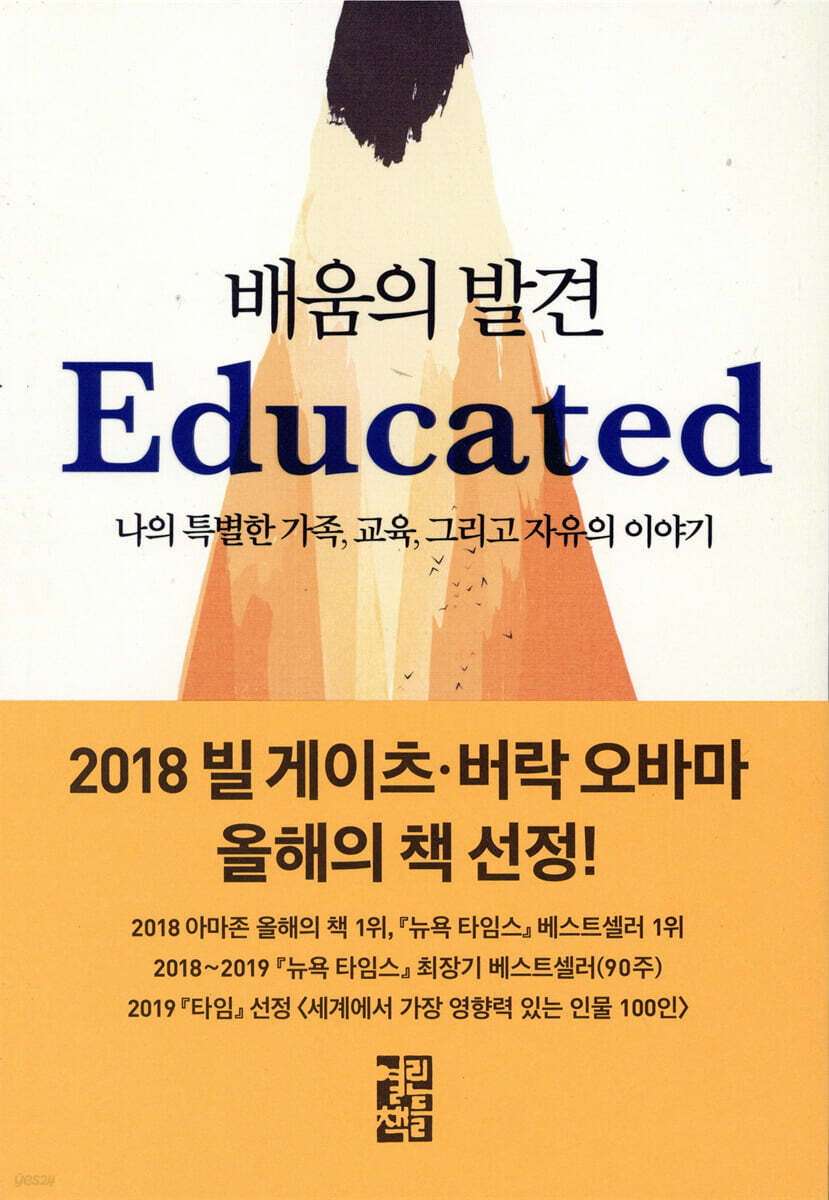
The discovery of learning
 |
Description
Book Introduction
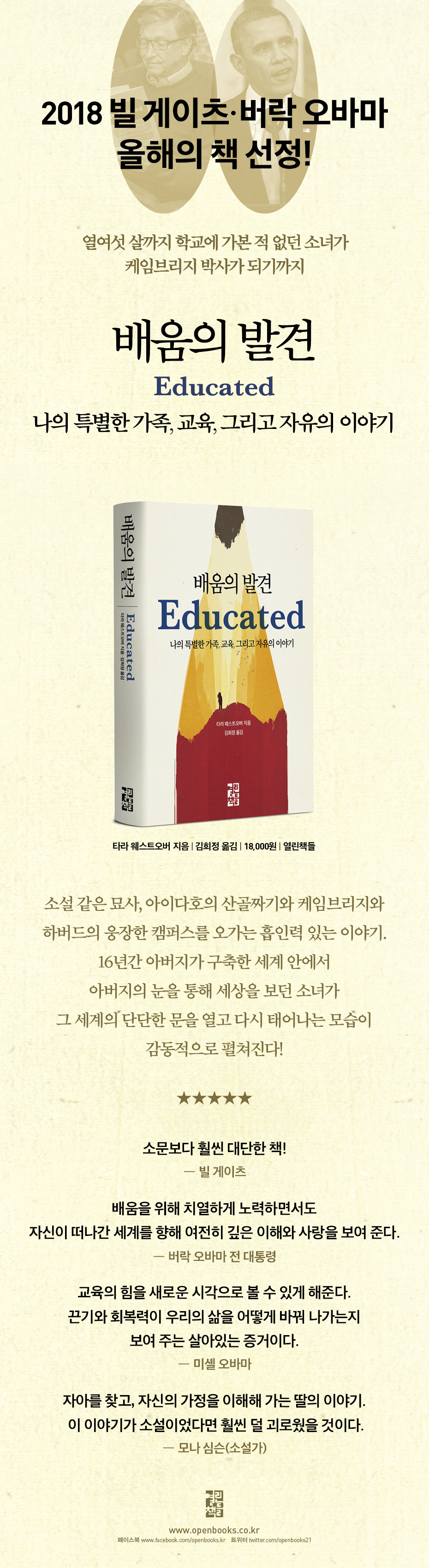
The global bestseller "The Discovery of Learning" is now available in Korea! Educated is Tara Westover's debut book and memoir. It chronicles his extraordinary educational journey, from his childhood in Bucks Peak, Idaho, to his PhD in history at Cambridge. As soon as this book was published in February 2018, it became the hottest topic in American publishing. It quickly rose to the top of the New York Times bestseller list, and remained at the top for 96 weeks until the end of December 2019 (this record is still ongoing). The rights were sold to 54 countries, and over 3 million copies were sold in the English-speaking world alone. It was named Book of the Year by nearly every media outlet, with praise from celebrities including former President Barack Obama, Bill Gates, and Oprah Winfrey. In particular, Bill Gates revealed on his book review blog [Gates Notes] that he was surprised to learn while reading the book that Tara had received the [Gates Cambridge Scholarship] provided by his foundation. He himself had always prided himself on his ability to learn independently, but after reading Tara's memoir, he lost that confidence and was full of praise for "The Discovery of Learning." Amid the explosive popularity of her memoir, Tara was named one of Time magazine's 100 Most Influential People in the World in 2019. |
- You can preview some of the book's contents.
Preview
index
Author's Note
prolog
Part 1
Choose 1 line
2 Midwives
3 cream shoes
4 Apache Women
5 Honest Soot
6 Shields and Protections
7 The Lord will provide
8 Little Whores
9 For that generation it was perfect
10 Shield made of feathers
11 Instincts
12 fish eyes
13 Silence within the church
14 My feet no longer touch the ground
15 No longer a child
16 Disloyal humans, disobedient heavens
Part 2
17 To protect the sacredness
18 Blood and Feathers
19 In the beginning
20 Fathers' Chorus
21. Golmugwat
22 The words we whispered and the words we shouted
23 I'm from Idaho
24 A Knight on a Journey
25 Harmony of Hellfire
26 Waiting for the flowing water
27 If I were a woman
28 Pygmalion
29 Graduation
Part 3
30 The Hand of the Almighty Lord
31 Tragedy and Farce
32 The Bustling Woman in the Big House
33 The Magic of Physics
34 The content of things
35 West of the Sun
36 Four long, flailing arms
37 Gamble for Salvation
38 families
39 Watching a herd of buffalo
40 Education
Acknowledgements
Author's Note on the Text
prolog
Part 1
Choose 1 line
2 Midwives
3 cream shoes
4 Apache Women
5 Honest Soot
6 Shields and Protections
7 The Lord will provide
8 Little Whores
9 For that generation it was perfect
10 Shield made of feathers
11 Instincts
12 fish eyes
13 Silence within the church
14 My feet no longer touch the ground
15 No longer a child
16 Disloyal humans, disobedient heavens
Part 2
17 To protect the sacredness
18 Blood and Feathers
19 In the beginning
20 Fathers' Chorus
21. Golmugwat
22 The words we whispered and the words we shouted
23 I'm from Idaho
24 A Knight on a Journey
25 Harmony of Hellfire
26 Waiting for the flowing water
27 If I were a woman
28 Pygmalion
29 Graduation
Part 3
30 The Hand of the Almighty Lord
31 Tragedy and Farce
32 The Bustling Woman in the Big House
33 The Magic of Physics
34 The content of things
35 West of the Sun
36 Four long, flailing arms
37 Gamble for Salvation
38 families
39 Watching a herd of buffalo
40 Education
Acknowledgements
Author's Note on the Text
Detailed image
Into the book
My father worried that the government would force us to go to school, but that never happened.
Because the government doesn't even know we exist.
Four of my parents' seven children do not have birth certificates.
I was born at home and have never been to a doctor or nurse, so I have no medical records.
--- p.12
I spent most of my time studying this abstract concept.
Looking back, that was my learning and education.
Those long hours spent sitting at a borrowed desk, imitating my brother who had abandoned me, and trying to understand a sect of Mormon thought.
The persistence to persevere and read through things I still don't understand was the core of the skill I learned.
--- pp.108-109
I had to remain a child forever, always.
Otherwise, you will lose your father.
--- p.214
“I’m sorry,” I asked, taking the paper she handed me.
"What is this?"
"It's an OMR card.
"Write down the answer."
"How do you write it?"
"It's no different from any other OMR card." She didn't hide her nervous expression as she walked over to hand out the test papers to the others.
He seemed to think I was joking.
--- p.218
It was difficult to tell which of Napoleon and Jean Valjean was a historical figure and which was a fictional character.
Because both of them were people I had never heard of before.
--- p.242
“You shouldn’t joke about things like that.
"This isn't a topic for jokes." I sat in my seat until everyone else left the classroom.
I avoided eye contact with other people by pretending that the zipper on my coat was broken.
Then I went straight to the computer lab and searched for the word I had asked about.
That word was [Holocaust].
--- p.252
While others believed in the Lord's healing power, we left our healing in His hands.
While others believed they had to prepare for the Lord's return, we were actually prepared.
For as long as I can remember, I've known my family to be the only true Mormons.
--- p.254
Acknowledging uncertainty is an admission of weakness and helplessness, but it is also an act of not losing faith in oneself.
Weak, but there is strength in that weakness.
The confidence to live within oneself and not in the minds of others.
--- p.311
Now the word [prostitute] has become a description of essence rather than action.
It wasn't that I did something wrong, it was that my very existence was wrong.
There was something impure about the fact that I existed.
--- p.315
I know what it feels like to have something I was wrong about corrected.
The scale of the misconception was so vast that correcting it would change the whole world.
Now it was time to find out how the great gatekeepers who guarded the door leading to the understanding of history had overcome their own ignorance and prejudice.
--- p.373
“I have been teaching at Cambridge for 30 years,” he said.
"This essay is one of the best I've ever read." I was prepared to be insulted, but I wasn't prepared to hear something like this.
--- p.376
“Students are not fake gold diggers.
Such fakes only shine when a special light shines on them.
No matter what kind of person a student becomes or what kind of person he or she develops into, that is the student's true self.
The essential form that has always existed within oneself.
It's not that it looks that way because it's Cambridge, it's that it's something that the students have inside them.
Students are pure gold.
--- p.379
Professor Steinberg likened this situation to Pygmalion.
The protagonist was a low-class worker who wore nice clothes.
Until you start to believe in yourself.
Once that belief was established, it didn't matter what she was wearing at all."
--- p.381
“If you were in America,” my father whispered.
"We can pick you up.
Wherever you are.
There are 4,000 liters of fuel in an underground tank buried in the field, so when the end comes, I can go to where you are and bring you home.
To a safe place, that is.
But if you cross the sea… … .」
--- p.394
Until then, it was the first time I had heard the word feminism used for anything other than to criticize someone.
At Brigham Young University, saying, "You sound like a feminist" was the end of the argument.
It also meant that I lost.
--- p.402
For some reason, it never occurred to me that my sister might have lived the same life I did before.
--- p.414
If I accept this blessing, the Father will purify me.
I will place my hands on my head and expel from my body the evil that has incited my past words, the evil that has made me an unwelcome presence in our family.
All I had to do was accept everything, and in five minutes it would all be over.
--- p.468
All the effort I had put in up until then, all the studying I had done for years, was to buy this privilege.
The privilege of seeing and experiencing truths beyond what my father gave me, and of using those truths to build my own spirit.
Giving in now means more than just losing an argument.
It meant losing ownership of my mind.
This was the price asked of me.
--- p.471
[Who writes history?] I thought, [It's me].
Because the government doesn't even know we exist.
Four of my parents' seven children do not have birth certificates.
I was born at home and have never been to a doctor or nurse, so I have no medical records.
--- p.12
I spent most of my time studying this abstract concept.
Looking back, that was my learning and education.
Those long hours spent sitting at a borrowed desk, imitating my brother who had abandoned me, and trying to understand a sect of Mormon thought.
The persistence to persevere and read through things I still don't understand was the core of the skill I learned.
--- pp.108-109
I had to remain a child forever, always.
Otherwise, you will lose your father.
--- p.214
“I’m sorry,” I asked, taking the paper she handed me.
"What is this?"
"It's an OMR card.
"Write down the answer."
"How do you write it?"
"It's no different from any other OMR card." She didn't hide her nervous expression as she walked over to hand out the test papers to the others.
He seemed to think I was joking.
--- p.218
It was difficult to tell which of Napoleon and Jean Valjean was a historical figure and which was a fictional character.
Because both of them were people I had never heard of before.
--- p.242
“You shouldn’t joke about things like that.
"This isn't a topic for jokes." I sat in my seat until everyone else left the classroom.
I avoided eye contact with other people by pretending that the zipper on my coat was broken.
Then I went straight to the computer lab and searched for the word I had asked about.
That word was [Holocaust].
--- p.252
While others believed in the Lord's healing power, we left our healing in His hands.
While others believed they had to prepare for the Lord's return, we were actually prepared.
For as long as I can remember, I've known my family to be the only true Mormons.
--- p.254
Acknowledging uncertainty is an admission of weakness and helplessness, but it is also an act of not losing faith in oneself.
Weak, but there is strength in that weakness.
The confidence to live within oneself and not in the minds of others.
--- p.311
Now the word [prostitute] has become a description of essence rather than action.
It wasn't that I did something wrong, it was that my very existence was wrong.
There was something impure about the fact that I existed.
--- p.315
I know what it feels like to have something I was wrong about corrected.
The scale of the misconception was so vast that correcting it would change the whole world.
Now it was time to find out how the great gatekeepers who guarded the door leading to the understanding of history had overcome their own ignorance and prejudice.
--- p.373
“I have been teaching at Cambridge for 30 years,” he said.
"This essay is one of the best I've ever read." I was prepared to be insulted, but I wasn't prepared to hear something like this.
--- p.376
“Students are not fake gold diggers.
Such fakes only shine when a special light shines on them.
No matter what kind of person a student becomes or what kind of person he or she develops into, that is the student's true self.
The essential form that has always existed within oneself.
It's not that it looks that way because it's Cambridge, it's that it's something that the students have inside them.
Students are pure gold.
--- p.379
Professor Steinberg likened this situation to Pygmalion.
The protagonist was a low-class worker who wore nice clothes.
Until you start to believe in yourself.
Once that belief was established, it didn't matter what she was wearing at all."
--- p.381
“If you were in America,” my father whispered.
"We can pick you up.
Wherever you are.
There are 4,000 liters of fuel in an underground tank buried in the field, so when the end comes, I can go to where you are and bring you home.
To a safe place, that is.
But if you cross the sea… … .」
--- p.394
Until then, it was the first time I had heard the word feminism used for anything other than to criticize someone.
At Brigham Young University, saying, "You sound like a feminist" was the end of the argument.
It also meant that I lost.
--- p.402
For some reason, it never occurred to me that my sister might have lived the same life I did before.
--- p.414
If I accept this blessing, the Father will purify me.
I will place my hands on my head and expel from my body the evil that has incited my past words, the evil that has made me an unwelcome presence in our family.
All I had to do was accept everything, and in five minutes it would all be over.
--- p.468
All the effort I had put in up until then, all the studying I had done for years, was to buy this privilege.
The privilege of seeing and experiencing truths beyond what my father gave me, and of using those truths to build my own spirit.
Giving in now means more than just losing an argument.
It meant losing ownership of my mind.
This was the price asked of me.
--- p.471
[Who writes history?] I thought, [It's me].
--- p.492
Publisher's Review
A house where the school bus doesn't stop
Tara Westover was born in 1986 in Idaho, USA, the youngest of seven children.
His father was a Mormon fundamentalist who believed the end of the world was imminent, and because of his distrust of public education, he did not send his children to school.
Tara followed her father's instructions and made peach preserves, and at night she slept hugging her [mountain escape] bag.
I spent my summers helping my mother, a midwife and homeopathic healer, brew herbs, and my winters working at my father's scrapyard, collecting and cutting scrap metal.
Tara's family lived so isolated from mainstream society that their children had no access to a proper education or to support from the secret abuse within the family.
I had never even seen a doctor or nurse because my father did not believe in modern medicine.
Bleeding wounds, severe concussions, and even burns from explosions were all treated at home with herbal remedies made by my mother.
Learning started at seventeen
Tara first stepped into a classroom when she was seventeen.
When her third brother, who had entered college, returned home and told her about the world beyond the mountains, Tara decided to take steps toward a new life.
At the age of sixteen, Tara studied on her own to prepare for the ACT, avoiding her father's supervision, and miraculously was accepted to Brigham Young University (a Mormon university that accepts homeschooled students).
Tara's college life wasn't easy.
She entered college without any basic education, so she lacked the basic knowledge to be able to tell the difference between Napoleon and Jean Valjean, who was a historical figure and who was a fictional character.
I learned through trial and error how to register for classes, how to take my first note test, and that art textbooks aren't just picture books handed out for you to admire the beautiful paintings; you also need to read the captions underneath.
With little social experience beyond helping her parents with chores in a remote mountain village and going to church on weekends, Tara had to relearn everything: how to interact with friends, acquaintances, the opposite sex, and even how to drink coffee.
A world-changing experience
The new university I experienced was so different from the world I had heard about through my father's mouth.
For Tara, who had never properly read any books other than the Bible and the Mormon scriptures, everything she learned in college was a shock.
I first heard the word "Holocaust" and learned about the civil rights movement.
It was also the first time I saw the word "feminism" used in a general sense, rather than as an expression of reprimand.
For the first time, I had the idea (something I had never imagined before) that I could question the words of a great prophet or the interpretations offered by a historian and add my own thoughts.
Her father called the people of the world [strangers], but Tara gradually realized that her own family were the real strangers.
Tara realized how much her father's distorted beliefs had cost her and her family, and felt a deep sense of anger and betrayal.
Tara realized that the girl [who was raised by her father] and the new [me] she had created through learning could not coexist.
Tara recalled the question the professor had written on the blackboard in the classroom.
[Who writes history?] She thought, [It's me].
Tara's passion for learning opened new doors for her, and she traveled across oceans and continents to study at Cambridge and Harvard Universities.
But life cut off from her family brought her great pain.
She begins to wonder if she has gone too far and if there is still a way back home.
The discovery of learning
If this book had been a memoir written by a girl from the countryside who never even set foot on the school threshold until she was sixteen and then earned a doctorate from the prestigious University of Cambridge, it would have been difficult to receive this much attention.
This book is the story of one woman's struggle to find her own self.
It's a story about the grief that comes with losing those closest to you, and the struggle to find your place in the world without losing your connection to family.
For Tara, learning wasn't just about earning a degree from a good university; it was about opening her eyes to a deeper and broader view of the world and rediscovering herself.
With the insight shared by all great writers, Tara Westover tells a universal story of growth: what learning is and what we can gain from it.
It is through learning that we can gain new perspectives on our lives and the will to change them.
With its elegant writing and captivating story, this international bestseller will have readers feeling embarrassed, hurt, and happy alongside Tara.
Even after closing the book, it will be difficult to erase the images of her going back and forth between the beautiful four seasons of Bucks Peak and the magnificent buildings of Cambridge and Harvard.
List of major awards
Winner of the 2018 Goodreads Choice Award for Best Memoir
2018 National Society of Book Critics Award for Memoir Finalist
2018 President Barack Obama's Book of the Year
2018 Bill Gates Book of the Year
#1 New York Times Bestseller in 2018
#1 Amazon Book of the Year 2018
2018 [New York Times Book Review] Books of the Year
2018 [Washington Post] Book of the Year
2018 [O: The Oprah Magazine] Book of the Year
2018 [Time] Book of the Year
2018 [Guardian] Book of the Year
2018 [Economist] Book of the Year
2018 [Financial Times] Book of the Year
2018 [Publisher's Weekly] Book of the Year
Other [Book of the Year] Selections
NPR · Good Morning America · San Francisco Chronicle · Newsday · New York Post · Bloomberg · New York Public · Library · Library Journal · Librarian's Self · Bustle · Refinery29 · Town & Country … …
It beautifully demonstrates the power of education to open eyes and transform lives.
- Amy Chua, [New York Times Book Review]
The story of a woman who had to learn how to learn.
- [Harvard Crimson]
Overcoming the limitations of birth and environment, we stride forward towards a better life.
- [USA Today]
Her history is (…) surprisingly impressive.
- [The Economist]
A memoir about the formation of the mind.
Her bitter ordeal is not over yet.
- [Atlantic]
How much of ourselves must we give to those we love? And how much must we betray them for our own growth?
- [Vogue]
Tara Westover was born in 1986 in Idaho, USA, the youngest of seven children.
His father was a Mormon fundamentalist who believed the end of the world was imminent, and because of his distrust of public education, he did not send his children to school.
Tara followed her father's instructions and made peach preserves, and at night she slept hugging her [mountain escape] bag.
I spent my summers helping my mother, a midwife and homeopathic healer, brew herbs, and my winters working at my father's scrapyard, collecting and cutting scrap metal.
Tara's family lived so isolated from mainstream society that their children had no access to a proper education or to support from the secret abuse within the family.
I had never even seen a doctor or nurse because my father did not believe in modern medicine.
Bleeding wounds, severe concussions, and even burns from explosions were all treated at home with herbal remedies made by my mother.
Learning started at seventeen
Tara first stepped into a classroom when she was seventeen.
When her third brother, who had entered college, returned home and told her about the world beyond the mountains, Tara decided to take steps toward a new life.
At the age of sixteen, Tara studied on her own to prepare for the ACT, avoiding her father's supervision, and miraculously was accepted to Brigham Young University (a Mormon university that accepts homeschooled students).
Tara's college life wasn't easy.
She entered college without any basic education, so she lacked the basic knowledge to be able to tell the difference between Napoleon and Jean Valjean, who was a historical figure and who was a fictional character.
I learned through trial and error how to register for classes, how to take my first note test, and that art textbooks aren't just picture books handed out for you to admire the beautiful paintings; you also need to read the captions underneath.
With little social experience beyond helping her parents with chores in a remote mountain village and going to church on weekends, Tara had to relearn everything: how to interact with friends, acquaintances, the opposite sex, and even how to drink coffee.
A world-changing experience
The new university I experienced was so different from the world I had heard about through my father's mouth.
For Tara, who had never properly read any books other than the Bible and the Mormon scriptures, everything she learned in college was a shock.
I first heard the word "Holocaust" and learned about the civil rights movement.
It was also the first time I saw the word "feminism" used in a general sense, rather than as an expression of reprimand.
For the first time, I had the idea (something I had never imagined before) that I could question the words of a great prophet or the interpretations offered by a historian and add my own thoughts.
Her father called the people of the world [strangers], but Tara gradually realized that her own family were the real strangers.
Tara realized how much her father's distorted beliefs had cost her and her family, and felt a deep sense of anger and betrayal.
Tara realized that the girl [who was raised by her father] and the new [me] she had created through learning could not coexist.
Tara recalled the question the professor had written on the blackboard in the classroom.
[Who writes history?] She thought, [It's me].
Tara's passion for learning opened new doors for her, and she traveled across oceans and continents to study at Cambridge and Harvard Universities.
But life cut off from her family brought her great pain.
She begins to wonder if she has gone too far and if there is still a way back home.
The discovery of learning
If this book had been a memoir written by a girl from the countryside who never even set foot on the school threshold until she was sixteen and then earned a doctorate from the prestigious University of Cambridge, it would have been difficult to receive this much attention.
This book is the story of one woman's struggle to find her own self.
It's a story about the grief that comes with losing those closest to you, and the struggle to find your place in the world without losing your connection to family.
For Tara, learning wasn't just about earning a degree from a good university; it was about opening her eyes to a deeper and broader view of the world and rediscovering herself.
With the insight shared by all great writers, Tara Westover tells a universal story of growth: what learning is and what we can gain from it.
It is through learning that we can gain new perspectives on our lives and the will to change them.
With its elegant writing and captivating story, this international bestseller will have readers feeling embarrassed, hurt, and happy alongside Tara.
Even after closing the book, it will be difficult to erase the images of her going back and forth between the beautiful four seasons of Bucks Peak and the magnificent buildings of Cambridge and Harvard.
List of major awards
Winner of the 2018 Goodreads Choice Award for Best Memoir
2018 National Society of Book Critics Award for Memoir Finalist
2018 President Barack Obama's Book of the Year
2018 Bill Gates Book of the Year
#1 New York Times Bestseller in 2018
#1 Amazon Book of the Year 2018
2018 [New York Times Book Review] Books of the Year
2018 [Washington Post] Book of the Year
2018 [O: The Oprah Magazine] Book of the Year
2018 [Time] Book of the Year
2018 [Guardian] Book of the Year
2018 [Economist] Book of the Year
2018 [Financial Times] Book of the Year
2018 [Publisher's Weekly] Book of the Year
Other [Book of the Year] Selections
NPR · Good Morning America · San Francisco Chronicle · Newsday · New York Post · Bloomberg · New York Public · Library · Library Journal · Librarian's Self · Bustle · Refinery29 · Town & Country … …
It beautifully demonstrates the power of education to open eyes and transform lives.
- Amy Chua, [New York Times Book Review]
The story of a woman who had to learn how to learn.
- [Harvard Crimson]
Overcoming the limitations of birth and environment, we stride forward towards a better life.
- [USA Today]
Her history is (…) surprisingly impressive.
- [The Economist]
A memoir about the formation of the mind.
Her bitter ordeal is not over yet.
- [Atlantic]
How much of ourselves must we give to those we love? And how much must we betray them for our own growth?
- [Vogue]
GOODS SPECIFICS
- Date of issue: January 5, 2020
- Page count, weight, size: 520 pages | 680g | 143*210*32mm
- ISBN13: 9788932919553
- ISBN10: 8932919550
You may also like
카테고리
korean


korean

![GQ KOREA Mark (Monthly): December [2025]](http://librairie.coreenne.fr/cdn/shop/files/8ef265dbbfbf186523ed75ba7319009d.jpg?v=1765340328&width=3840)


