

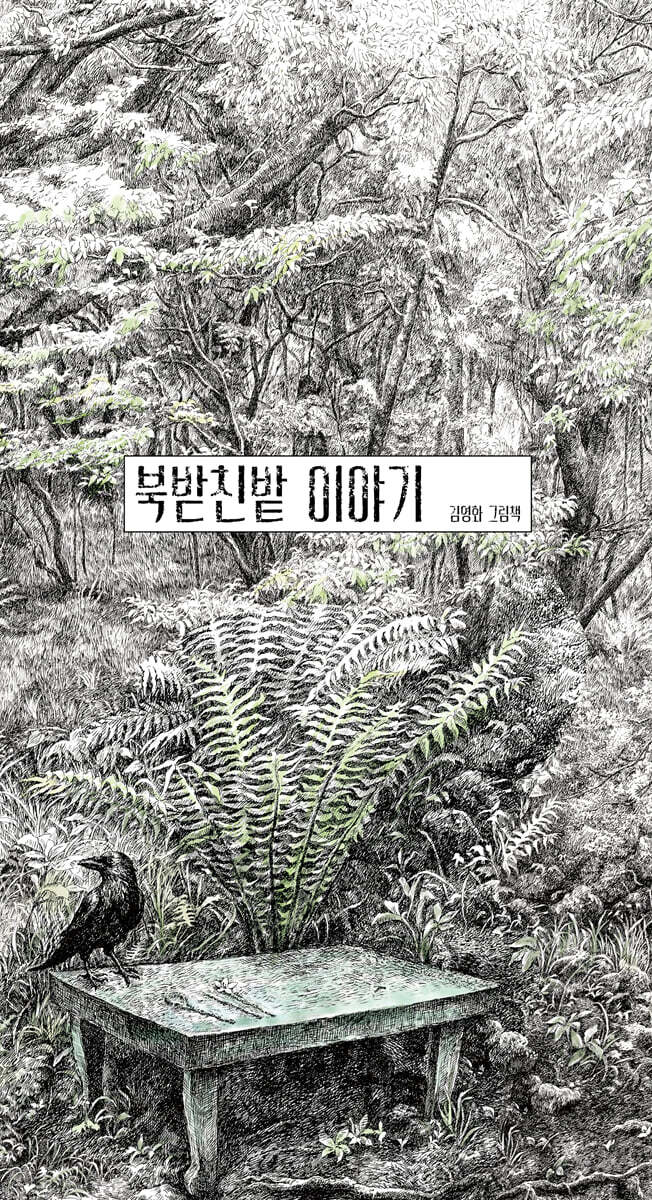
The Story of the Field of Buk-bok
 |
Description
Book Introduction
- A word from MD
-
The forest is silent, but memories are within it.The forest that holds the memories of the Jeju April 3rd Incident, Bukbapchinbat.
『The Story of the Field of Buk-Bat』 is a book that follows the memories of the people who were there.
As you turn the pages that unfold like a folding screen, memories gradually become 'stories'.
A story that some people couldn't tell, and some people couldn't tell.
All we can do now is read it to the end.
PD YooA Song Go-woon
A 17-meter-long forest painting and the stories it holds, spread out on a 4.2-meter, 27-panel folding screen
Jeju's forests and fields are sad and beautiful, and sad and beautiful.
The 'Bukbatchinbat' near the Jeju Saryeoni Forest Trail is where the people of the villages in the central mountainous area of Jeju hid from the storm of the 'Great Suppression' from December 1948 to June of the following year, during the 'Jeju April 3 Incident'.
It is also said that this is where Lee Deok-gu, the 'last leader of the Jeju community', met his end.
Jeju's forests and fields are sad and beautiful, and sad and beautiful.
The 'Bukbatchinbat' near the Jeju Saryeoni Forest Trail is where the people of the villages in the central mountainous area of Jeju hid from the storm of the 'Great Suppression' from December 1948 to June of the following year, during the 'Jeju April 3 Incident'.
It is also said that this is where Lee Deok-gu, the 'last leader of the Jeju community', met his end.
- You can preview some of the book's contents.
Preview
Detailed image

Into the book
I heard a story, that people lived in that forest in the field.
......
I decided to draw that forest.
From the snowy winter to the early summer when the flowers of the bellflowers bloom
I decided to draw the story that the forest tells.
November 20, 2023
I found the forest in the field.
The forest in early winter, with its leaves falling, was desolate.
‘I wish it snowed…’
For them, the snow covers everything in white.
Wouldn't that have been a consolation?
I wanted to start with a snowy forest.
They wanted to leave a message in their footprints that someone had come looking for them.
--- p.2
I started to draw the forest by pasting warm Korean paper along the wall.
I took a deep breath and drew the first line.
Lines intertwine and trees reveal themselves.
There are no leaves, so there are a lot of twigs to draw.
Eyes and hands follow the branches.
I feel like each and every tree is like a person.
The space between the branches is the sky.
A path opens between the stems.
--- p.7
Climb up and down the ladder and draw a line.
Even in the picture, a forest grows.
Low grass flowers between the bushes.
Dogwood, Hyeonho-saek, Aster, and Bulkkaenangi… I call out their names one by one.
“Shh! It’s cotton wool.
It's cotton.
“That’s how you survive.” I can’t even call out your name loudly.
What names did the people who waited for spring there have?
--- p.11
Once you have drawn the fully grown and strong bracken, your work will be finished.
I slowly look around the forest I've been drawing from last winter to this summer.
The forest speaks to me.
"Would it be sadder to die or to be forgotten?" It was a familiar question, but I wanted a new answer.
As I closed my eyes and stammered out an answer, I heard a “Caw!”
--- p.23
As I turned around in the forest, a sign someone had hung on a tree caught my eye.
“We are not dead yet.
“Our fight is not over.”
Back in my studio, after I finished drawing the final lines on the painting that covered three walls, I noticed a pile of worn-out brush pens on the floor.
......
I decided to draw that forest.
From the snowy winter to the early summer when the flowers of the bellflowers bloom
I decided to draw the story that the forest tells.
November 20, 2023
I found the forest in the field.
The forest in early winter, with its leaves falling, was desolate.
‘I wish it snowed…’
For them, the snow covers everything in white.
Wouldn't that have been a consolation?
I wanted to start with a snowy forest.
They wanted to leave a message in their footprints that someone had come looking for them.
--- p.2
I started to draw the forest by pasting warm Korean paper along the wall.
I took a deep breath and drew the first line.
Lines intertwine and trees reveal themselves.
There are no leaves, so there are a lot of twigs to draw.
Eyes and hands follow the branches.
I feel like each and every tree is like a person.
The space between the branches is the sky.
A path opens between the stems.
--- p.7
Climb up and down the ladder and draw a line.
Even in the picture, a forest grows.
Low grass flowers between the bushes.
Dogwood, Hyeonho-saek, Aster, and Bulkkaenangi… I call out their names one by one.
“Shh! It’s cotton wool.
It's cotton.
“That’s how you survive.” I can’t even call out your name loudly.
What names did the people who waited for spring there have?
--- p.11
Once you have drawn the fully grown and strong bracken, your work will be finished.
I slowly look around the forest I've been drawing from last winter to this summer.
The forest speaks to me.
"Would it be sadder to die or to be forgotten?" It was a familiar question, but I wanted a new answer.
As I closed my eyes and stammered out an answer, I heard a “Caw!”
--- p.23
As I turned around in the forest, a sign someone had hung on a tree caught my eye.
“We are not dead yet.
“Our fight is not over.”
Back in my studio, after I finished drawing the final lines on the painting that covered three walls, I noticed a pile of worn-out brush pens on the floor.
--- p.25
Publisher's Review
A 2.7m high, 17m long mural embracing the history of the people and the people of history.
Picture book author Kim Young-hwa visited this place, which was originally an open space covered with reeds and shrubs, but has become a dense forest over time.
And I drew the story of the forest's present and past.
For seven months, from the winter of 2023 to the early summer of 2024, the artist went on dozens of field trips and returned to his studio, where he pasted warm Korean paper on three walls and climbed up and down ladders for 16 hours a day, drawing hundreds of thousands of lines with only a single fine-tip brush.
After wearing out 130 brush pens, I completed a mural measuring 2.7 meters high and 17 meters long.
A 4.2-meter, 27-panel folding screen depicts a field of lush greenery, presenting today's landscape and stories from 77 years ago.
This book is a picture book in the form of a folding screen containing the picture and the story.
The front of the folding screen contains the time from winter to early summer in the forest today, from left to right, in one space, and the back tells the story of the people who took refuge there from winter to early summer during the April 3 Incident and of those who perished at the end of the struggle, in chronological order.
Today's fields, transformed into lush forests, are covered in snow, the snow melts away with the azaleas, the sturdy azalea trees sprout spring leaves, and the white blossoms fall, creating a breathtakingly beautiful natural scene.
In it, crows with divine eyes, as if remembering a sad story from long ago, greet the painter who visits them from time to time.
The fields of the past, where reeds and shrubs grow, are the site of a history of hardships and upheavals for those who once lived there.
The author does not subjectively interpret that painful history.
By simply transcribing the testimonies of those who visited that place - refugees, armed forces, and punitive forces - we are providing readers with space for interpretation.
The past and present, and the time and space of the dead and the living, connected by memories and records
This book is divided into a front page containing the present and a back page containing the past.
The stories on the front and back, starting from each cover, are connected by the footprints of those who perished there and the footprints of the author who visited that place, expressing the author's will not to separate them from those of the past and us of today.
This is because, in order for our history to take steps toward peace and coexistence, the past must be able to help the present, and the dead must be able to save the living, and the prerequisite for this is ‘memory and records.’
Picture book author Kim Young-hwa visited this place, which was originally an open space covered with reeds and shrubs, but has become a dense forest over time.
And I drew the story of the forest's present and past.
For seven months, from the winter of 2023 to the early summer of 2024, the artist went on dozens of field trips and returned to his studio, where he pasted warm Korean paper on three walls and climbed up and down ladders for 16 hours a day, drawing hundreds of thousands of lines with only a single fine-tip brush.
After wearing out 130 brush pens, I completed a mural measuring 2.7 meters high and 17 meters long.
A 4.2-meter, 27-panel folding screen depicts a field of lush greenery, presenting today's landscape and stories from 77 years ago.
This book is a picture book in the form of a folding screen containing the picture and the story.
The front of the folding screen contains the time from winter to early summer in the forest today, from left to right, in one space, and the back tells the story of the people who took refuge there from winter to early summer during the April 3 Incident and of those who perished at the end of the struggle, in chronological order.
Today's fields, transformed into lush forests, are covered in snow, the snow melts away with the azaleas, the sturdy azalea trees sprout spring leaves, and the white blossoms fall, creating a breathtakingly beautiful natural scene.
In it, crows with divine eyes, as if remembering a sad story from long ago, greet the painter who visits them from time to time.
The fields of the past, where reeds and shrubs grow, are the site of a history of hardships and upheavals for those who once lived there.
The author does not subjectively interpret that painful history.
By simply transcribing the testimonies of those who visited that place - refugees, armed forces, and punitive forces - we are providing readers with space for interpretation.
The past and present, and the time and space of the dead and the living, connected by memories and records
This book is divided into a front page containing the present and a back page containing the past.
The stories on the front and back, starting from each cover, are connected by the footprints of those who perished there and the footprints of the author who visited that place, expressing the author's will not to separate them from those of the past and us of today.
This is because, in order for our history to take steps toward peace and coexistence, the past must be able to help the present, and the dead must be able to save the living, and the prerequisite for this is ‘memory and records.’
GOODS SPECIFICS
- Date of issue: September 1, 2025
- Page count, weight, size: 54 pages | 155*285*15mm
- ISBN13: 9791192102429
- ISBN10: 1192102428
You may also like
카테고리
korean


korean

![GQ KOREA Mark (Monthly): December [2025]](http://librairie.coreenne.fr/cdn/shop/files/8ef265dbbfbf186523ed75ba7319009d.jpg?v=1765340328&width=3840)


