

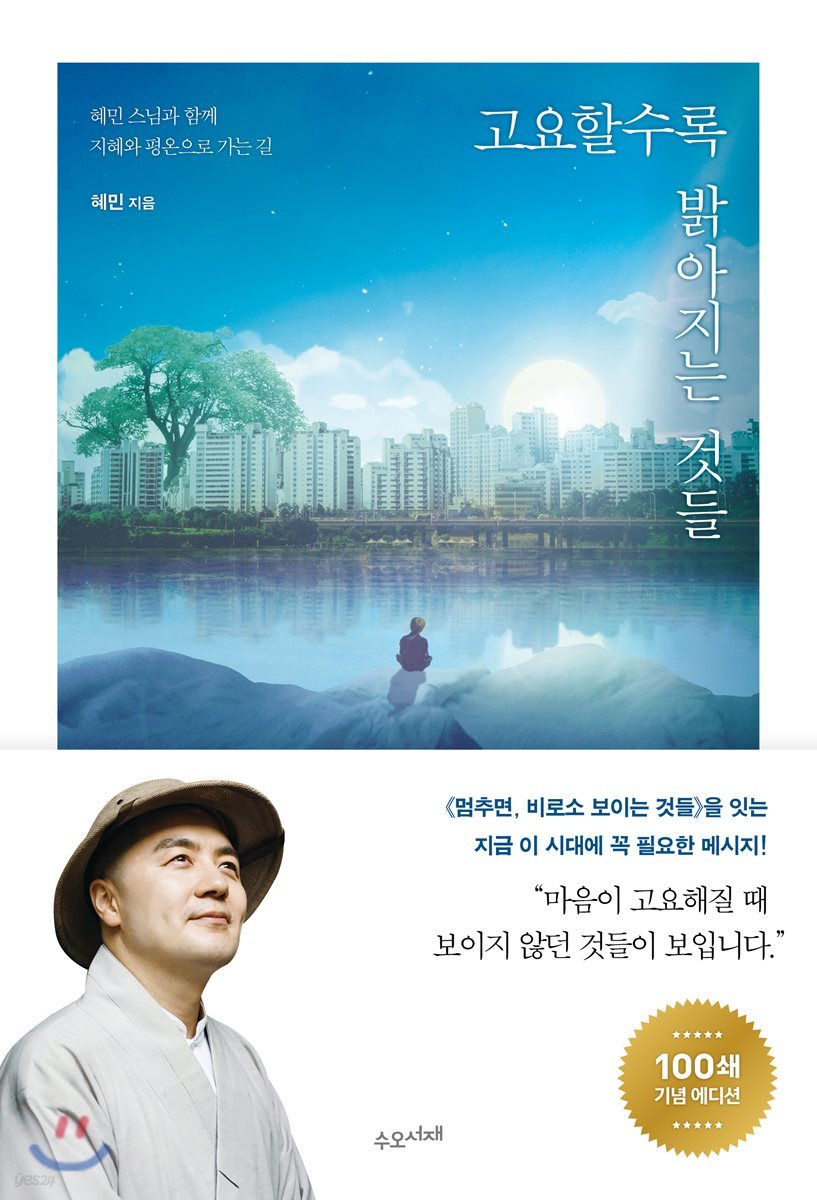
The quieter it is, the brighter things become
 |
Description
Book Introduction
- A word from MD
-
A quiet forest of the mind, walking with Monk Hye-minA clear and profound story from Monk Hye-min to those who are losing themselves in this complex and busy world.
When your mind becomes calm, things you weren't aware of often come to light.
A book that offers a 'rest' where you can experience peace of mind, freedom, and warm love, and walk through your own quiet forest of the mind.
December 4, 2018. Essay PD Kim Do-hoon
“Sometimes, give yourself the gift of time to meet me in silence.”
An essay by Monk Hyemin, which provided an opportunity to reflect on oneself through "Things You Only See When You Stop," and a deeper understanding of oneself, others, and the world through "Love for Imperfect Things."
This book, which can be considered the completion of the trilogy of monk Hye-min's guide to happiness, contains a message for modern people who are losing themselves in a busy, complex, and noisy world, wondering who they are and what they truly want to do.
It will be an opportunity to discover the inner desires that are revealed only when the mind becomes calm, to find the direction and values of the life you truly dream of, or to heal from emotions and memories that have been suppressed for a long time.
As the author says, "Silence is the greatest gift I can give myself," this book will serve as a guide on the "path to myself" for those who want to find themselves.
An essay by Monk Hyemin, which provided an opportunity to reflect on oneself through "Things You Only See When You Stop," and a deeper understanding of oneself, others, and the world through "Love for Imperfect Things."
This book, which can be considered the completion of the trilogy of monk Hye-min's guide to happiness, contains a message for modern people who are losing themselves in a busy, complex, and noisy world, wondering who they are and what they truly want to do.
It will be an opportunity to discover the inner desires that are revealed only when the mind becomes calm, to find the direction and values of the life you truly dream of, or to heal from emotions and memories that have been suppressed for a long time.
As the author says, "Silence is the greatest gift I can give myself," this book will serve as a guide on the "path to myself" for those who want to find themselves.
- You can preview some of the book's contents.
Preview
index
Entering_The way back to me
Chapter 1.
Time to focus on myself
I can't do it
Two me's inside me
Listen to the pain inside me first
Chapter 2.
The gift of being called family
Grandma's Star
Memories like a warm lamp
My jealousy, my pain
Chapter 3.
How to appreciate life
My own small happiness
Breakfast at Mihwangsa Temple
When the seeking mind rests
Chapter 4.
The Many Faces of Friendship
A being that gives strength to life
A day when I thought of him more than myself
Spring days are passing by
Chapter 5.
Thoughts on loneliness
Why We Are Lonely
A New Era of Solitude
If you want to escape from loneliness
Chapter 6.
Purifying the mind
How to live well together
The Story of the Sea of Mind
Awake stillness, transparent silence
Chapter 1.
Time to focus on myself
I can't do it
Two me's inside me
Listen to the pain inside me first
Chapter 2.
The gift of being called family
Grandma's Star
Memories like a warm lamp
My jealousy, my pain
Chapter 3.
How to appreciate life
My own small happiness
Breakfast at Mihwangsa Temple
When the seeking mind rests
Chapter 4.
The Many Faces of Friendship
A being that gives strength to life
A day when I thought of him more than myself
Spring days are passing by
Chapter 5.
Thoughts on loneliness
Why We Are Lonely
A New Era of Solitude
If you want to escape from loneliness
Chapter 6.
Purifying the mind
How to live well together
The Story of the Sea of Mind
Awake stillness, transparent silence
Detailed image

Into the book
I think that perhaps one of the reasons we feel so tired and worn out now is because we have lost the peace of our own lives.
Wherever I go, I hear the constant clamor of advertisements demanding attention, the constant news of accidents and incidents happening every minute, the honking of car horns here and there, the sound of construction work pounding and breaking, and the sound of people forcing their beliefs on me.
In addition, the cell phones we hold in our hands ring and text message notifications at all times.
Modern civilization seems to never allow our souls to rest for even a moment.
As a result, many psychological problems arise in us living today, and one of them is self-alienation.
I live my life with myself, but I live busy without knowing who I am or what I truly want.
Our attention is primarily directed outward, and we are so busy reacting to external stimuli that we just live without time to look into how we feel, what kind of life we want to live, and what values we want to pursue.
Because we constantly meet other people and rarely have time to meet ourselves.
--- p.7
Don't be too hurt if someone rejects you.
There may be a better relationship waiting for you.
It didn't turn out the way I initially wanted, but later I saw
Actually, there are many times in my life when I was very fortunate.
--- p.24
Modern people come into contact with a lot of information from outside sources as they live.
The reason we struggle is because we only react to this information.
Especially when using a smartphone, you can end the day just responding.
Don't just react and be led around; live a life where you make your own decisions and take the lead.
--- p.44
What I wish I could tell myself when I was a teenager:
There are things that are so difficult and important that I feel like I'm going to die right now.
Looking back, it was just a very small part of life.
It doesn't really matter what my friends say about me.
And there are many paths in life other than the one you are thinking of now.
It's okay to fail a little.
Life is longer than you think.
cheer up.
What I want to say to my 20-year-old self:
Try to relax a little more and be a little more honest.
Compare less and take it easy.
Thinking a lot doesn't mean your life will turn out the way you think.
Don't be afraid of the future, just enjoy your passion now.
Unexpected connections will arise.
What I want to tell my 30-year-old self:
Don't settle for small successes or comfort.
Find something to learn from others.
When looking at people, rather than their appearance such as academic background, family background, or specifications,
Look at the person's growth process, personality, sense of humor, and perseverance.
Stay close to nature and books, and exercise regularly.
--- p.51
While interpreting Thich Nhat Hanh's words, I also reflected on whether I had paid enough attention to the pain within me.
I began to wonder if I was just pretending not to know because I was busy, or if I was trying to forget the pain for a while by watching a movie or chatting with people.
Most people's minds are primarily directed outward.
As a result, we may not be accustomed to being able to delicately perceive the feelings within our body and mind.
But I must draw my attention outward and give it the warm spring sunshine of attention that I have within me.
Because that is the way to love yourself and to release the energy of suffering that has been building up in your body and mind, and to enter the path of fundamental healing.
--- p.57
When I went to the head monk's room, I saw a beautiful piece of calligraphy and painting he had recently written: "There are big, gentle hands protecting me."
When we are going through a difficult time, we may feel lonely and meaningless, as if we are thrown into the world alone, but that is not the case.
The world is not everything we see with our eyes.
Although it does not show itself outwardly, there is always the silent, awake Buddha nature that mercifully embraces all things that have form, or, for Christians, the God of love.
Please don't lose heart.
If you read this article and go to Mihwangsa Temple someday to have breakfast, you probably won't regret it.
The clear chirping of birds, the vibrant sounds of insects, the cool, clear morning air, and the soft ringing of bells throughout the temple grounds will help me recover.
As you enjoy the beautiful scenery of Mt. Dalma and the warm tea served by the head monk, your worries and anxieties will fade away like the sunset, and you will return to your true self.
--- p.126
When I'm with people, I want to be alone a little bit,
When you are alone, there comes a time when you want to talk
I want to be with someone.
So then our problem is that we are alone
It's not because there are a lot of people
When I'm alone, I hate being alone
When we are together, being together soon becomes uncomfortable
Could it be that it's a habit of the mind tossing and turning? --- p.223
Another is to 'accept the given situation as positively as possible.'
Before the retreat begins, the place to stay is usually decided by age group.
Older monks are given single or double rooms, while the general public live together in large rooms.
This fall, during the retreat, it was decided that, unfortunately, the monk right in front of me would be given a double room, and from then on, I would live together in the main room.
If you use your mind wrongly in this situation, you may be dissatisfied throughout the retreat.
But if you turn your mind quickly, you can find good things even in things that initially seem bad, and conversely, you can see bad things even in things that initially seem good.
After looking into it carefully, I found that there were many advantages to having multiple people share a room.
First of all, if I were to stay in a room alone, I would sometimes be so tired that I would miss the 3 a.m. prayer time because I couldn't hear the sound of the moktak (traditional Korean Buddhist prayer bell). But since I was staying with several people, I could sleep with peace of mind.
And there was the advantage of being able to know the announcements that were happening in the room most quickly and accurately, and even if a mosquito came into the room, if you were alone, there was a high chance of being bitten by a mosquito, but in a room where several people were sleeping, there was no need to worry so much.
Wherever I go, I hear the constant clamor of advertisements demanding attention, the constant news of accidents and incidents happening every minute, the honking of car horns here and there, the sound of construction work pounding and breaking, and the sound of people forcing their beliefs on me.
In addition, the cell phones we hold in our hands ring and text message notifications at all times.
Modern civilization seems to never allow our souls to rest for even a moment.
As a result, many psychological problems arise in us living today, and one of them is self-alienation.
I live my life with myself, but I live busy without knowing who I am or what I truly want.
Our attention is primarily directed outward, and we are so busy reacting to external stimuli that we just live without time to look into how we feel, what kind of life we want to live, and what values we want to pursue.
Because we constantly meet other people and rarely have time to meet ourselves.
--- p.7
Don't be too hurt if someone rejects you.
There may be a better relationship waiting for you.
It didn't turn out the way I initially wanted, but later I saw
Actually, there are many times in my life when I was very fortunate.
--- p.24
Modern people come into contact with a lot of information from outside sources as they live.
The reason we struggle is because we only react to this information.
Especially when using a smartphone, you can end the day just responding.
Don't just react and be led around; live a life where you make your own decisions and take the lead.
--- p.44
What I wish I could tell myself when I was a teenager:
There are things that are so difficult and important that I feel like I'm going to die right now.
Looking back, it was just a very small part of life.
It doesn't really matter what my friends say about me.
And there are many paths in life other than the one you are thinking of now.
It's okay to fail a little.
Life is longer than you think.
cheer up.
What I want to say to my 20-year-old self:
Try to relax a little more and be a little more honest.
Compare less and take it easy.
Thinking a lot doesn't mean your life will turn out the way you think.
Don't be afraid of the future, just enjoy your passion now.
Unexpected connections will arise.
What I want to tell my 30-year-old self:
Don't settle for small successes or comfort.
Find something to learn from others.
When looking at people, rather than their appearance such as academic background, family background, or specifications,
Look at the person's growth process, personality, sense of humor, and perseverance.
Stay close to nature and books, and exercise regularly.
--- p.51
While interpreting Thich Nhat Hanh's words, I also reflected on whether I had paid enough attention to the pain within me.
I began to wonder if I was just pretending not to know because I was busy, or if I was trying to forget the pain for a while by watching a movie or chatting with people.
Most people's minds are primarily directed outward.
As a result, we may not be accustomed to being able to delicately perceive the feelings within our body and mind.
But I must draw my attention outward and give it the warm spring sunshine of attention that I have within me.
Because that is the way to love yourself and to release the energy of suffering that has been building up in your body and mind, and to enter the path of fundamental healing.
--- p.57
When I went to the head monk's room, I saw a beautiful piece of calligraphy and painting he had recently written: "There are big, gentle hands protecting me."
When we are going through a difficult time, we may feel lonely and meaningless, as if we are thrown into the world alone, but that is not the case.
The world is not everything we see with our eyes.
Although it does not show itself outwardly, there is always the silent, awake Buddha nature that mercifully embraces all things that have form, or, for Christians, the God of love.
Please don't lose heart.
If you read this article and go to Mihwangsa Temple someday to have breakfast, you probably won't regret it.
The clear chirping of birds, the vibrant sounds of insects, the cool, clear morning air, and the soft ringing of bells throughout the temple grounds will help me recover.
As you enjoy the beautiful scenery of Mt. Dalma and the warm tea served by the head monk, your worries and anxieties will fade away like the sunset, and you will return to your true self.
--- p.126
When I'm with people, I want to be alone a little bit,
When you are alone, there comes a time when you want to talk
I want to be with someone.
So then our problem is that we are alone
It's not because there are a lot of people
When I'm alone, I hate being alone
When we are together, being together soon becomes uncomfortable
Could it be that it's a habit of the mind tossing and turning? --- p.223
Another is to 'accept the given situation as positively as possible.'
Before the retreat begins, the place to stay is usually decided by age group.
Older monks are given single or double rooms, while the general public live together in large rooms.
This fall, during the retreat, it was decided that, unfortunately, the monk right in front of me would be given a double room, and from then on, I would live together in the main room.
If you use your mind wrongly in this situation, you may be dissatisfied throughout the retreat.
But if you turn your mind quickly, you can find good things even in things that initially seem bad, and conversely, you can see bad things even in things that initially seem good.
After looking into it carefully, I found that there were many advantages to having multiple people share a room.
First of all, if I were to stay in a room alone, I would sometimes be so tired that I would miss the 3 a.m. prayer time because I couldn't hear the sound of the moktak (traditional Korean Buddhist prayer bell). But since I was staying with several people, I could sleep with peace of mind.
And there was the advantage of being able to know the announcements that were happening in the room most quickly and accurately, and even if a mosquito came into the room, if you were alone, there was a high chance of being bitten by a mosquito, but in a room where several people were sleeping, there was no need to worry so much.
--- p.236
Publisher's Review
“Sometimes, give yourself the gift of time to meet me in silence.”
A book that brings peace of mind! A story essential for us living in this day and age!
Readers of Hye-min's book say, "It's a book that brings peace of mind when you read it," "It's a book that gives strength to a weary life," and "It's a good book to give as a gift."
Hye-min, a monk who is loved by many for his writings that provide wisdom, insight, leisure, and relaxation, has published a new book titled "Things That Become Brighter When They Are Quiet."
Monk Hye-min, who shares the big and small realizations that come to him from time to time in life with people through social media, pays deep attention to the source of the pain and suffering that comes to modern people, as befitting a monk who breathes with the public.
We deliver a message appropriate to the times, with the hope of reaching even one person who is struggling or in pain.
Following 『Things You Can See Only When You Stop』, which has been exported to 35 countries around the world and has become a bestseller not only in Korea but also in the UK, the Netherlands, and Brazil, and 『Love for Imperfect Things』, a book loved across all religions and ages, 『Things That Brighten the More You Become』, which contains the importance of ‘stillness’, can be called ‘Monk Hye-min’s Happiness Guide Trilogy’.
Just as 『Things You Can See Only When You Stop』 interprets the old saying of ‘Ji-gwan (止觀)’ into modern language, this book contains the message of ‘Jeok-jeok-seong-seong (寂寂惺惺)’, the wisdom of the old Zen masters, which emphasizes ‘stillness and awareness.’
“This book contains my hope that you will encounter the tranquility within you.
When the mind becomes calm, things that were previously unknown become clear and finally revealed.
It is possible to revive and heal from long-suppressed emotions and memories, such as the desires within you, the direction of life you truly dream of, the values you wish to pursue in life, and even long-suppressed emotions and memories.
Also, when the mind becomes completely calm, the self-nature that practitioners wish to realize also becomes bright.” - From the author’s words
A time to reflect on yourself in this complex and noisy world!
This book, consisting of six chapters, guides you on the path to wisdom and peace.
Chapter 1.
'Time to focus on myself' tells us to listen to what our body and mind are saying in silence.
It guides you to discover the 'wisdom in silence' when things don't go your way, when you feel rejected by someone, when you don't know what you like, when life is tiring and difficult.
Chapter 2.
'A Gift Called Family' is a warm and honest story of Hye-min's mother, grandmother, and childhood memories, and shows how important it is to respect and love one another within the family.
I encourage parents to embrace the sweet yet burdensome bonds of their children, as well as the desire to control them, and to build deep and stable bonds within the most precious and intimate relationships.
Chapter 3.
'How to Appreciate Life' guides you to break away from the standardized standards of happiness and success created by society and find your own small but certain happiness.
As we follow the monk's story, which seems to ask, "When are you happy?", we come to realize how precious it is to have a leisurely mind, a moment to rest our thoughts, and a time to sleep comfortably at the end of the day.
Chapter 4.
'The Many Facets of Friendship' delves into the relationship issues that modern people continue to struggle with.
Self-reflection is possible through the mirror of relationships.
As the saying goes, "If you observe closely how your mind reacts when you collide with others, you will see a reflection of yourself," it provides an opportunity to look into yourself and others.
Chapter 5.
In 'Thoughts on Loneliness', we discuss the topic of 'loneliness', which has become a chronic disease of modern people, the reasons why we are lonely, how to escape loneliness, and our attitude towards the new era of solitude.
Chapter 6.
The book's title, "Purifying the Mind," contains the author's earnest wish that readers will encounter a transparent silence that awakens them to stillness and discover the true nature of their minds.
As the author says, “Silence is the greatest gift I can give myself,” this book will serve as an opportunity to discover the inner desires that can only be revealed when I am still, to find the direction and values of the life I truly dream of, or to heal from emotions and memories that have been suppressed for a long time.
A book that brings peace of mind! A story essential for us living in this day and age!
Readers of Hye-min's book say, "It's a book that brings peace of mind when you read it," "It's a book that gives strength to a weary life," and "It's a good book to give as a gift."
Hye-min, a monk who is loved by many for his writings that provide wisdom, insight, leisure, and relaxation, has published a new book titled "Things That Become Brighter When They Are Quiet."
Monk Hye-min, who shares the big and small realizations that come to him from time to time in life with people through social media, pays deep attention to the source of the pain and suffering that comes to modern people, as befitting a monk who breathes with the public.
We deliver a message appropriate to the times, with the hope of reaching even one person who is struggling or in pain.
Following 『Things You Can See Only When You Stop』, which has been exported to 35 countries around the world and has become a bestseller not only in Korea but also in the UK, the Netherlands, and Brazil, and 『Love for Imperfect Things』, a book loved across all religions and ages, 『Things That Brighten the More You Become』, which contains the importance of ‘stillness’, can be called ‘Monk Hye-min’s Happiness Guide Trilogy’.
Just as 『Things You Can See Only When You Stop』 interprets the old saying of ‘Ji-gwan (止觀)’ into modern language, this book contains the message of ‘Jeok-jeok-seong-seong (寂寂惺惺)’, the wisdom of the old Zen masters, which emphasizes ‘stillness and awareness.’
“This book contains my hope that you will encounter the tranquility within you.
When the mind becomes calm, things that were previously unknown become clear and finally revealed.
It is possible to revive and heal from long-suppressed emotions and memories, such as the desires within you, the direction of life you truly dream of, the values you wish to pursue in life, and even long-suppressed emotions and memories.
Also, when the mind becomes completely calm, the self-nature that practitioners wish to realize also becomes bright.” - From the author’s words
A time to reflect on yourself in this complex and noisy world!
This book, consisting of six chapters, guides you on the path to wisdom and peace.
Chapter 1.
'Time to focus on myself' tells us to listen to what our body and mind are saying in silence.
It guides you to discover the 'wisdom in silence' when things don't go your way, when you feel rejected by someone, when you don't know what you like, when life is tiring and difficult.
Chapter 2.
'A Gift Called Family' is a warm and honest story of Hye-min's mother, grandmother, and childhood memories, and shows how important it is to respect and love one another within the family.
I encourage parents to embrace the sweet yet burdensome bonds of their children, as well as the desire to control them, and to build deep and stable bonds within the most precious and intimate relationships.
Chapter 3.
'How to Appreciate Life' guides you to break away from the standardized standards of happiness and success created by society and find your own small but certain happiness.
As we follow the monk's story, which seems to ask, "When are you happy?", we come to realize how precious it is to have a leisurely mind, a moment to rest our thoughts, and a time to sleep comfortably at the end of the day.
Chapter 4.
'The Many Facets of Friendship' delves into the relationship issues that modern people continue to struggle with.
Self-reflection is possible through the mirror of relationships.
As the saying goes, "If you observe closely how your mind reacts when you collide with others, you will see a reflection of yourself," it provides an opportunity to look into yourself and others.
Chapter 5.
In 'Thoughts on Loneliness', we discuss the topic of 'loneliness', which has become a chronic disease of modern people, the reasons why we are lonely, how to escape loneliness, and our attitude towards the new era of solitude.
Chapter 6.
The book's title, "Purifying the Mind," contains the author's earnest wish that readers will encounter a transparent silence that awakens them to stillness and discover the true nature of their minds.
As the author says, “Silence is the greatest gift I can give myself,” this book will serve as an opportunity to discover the inner desires that can only be revealed when I am still, to find the direction and values of the life I truly dream of, or to heal from emotions and memories that have been suppressed for a long time.
GOODS SPECIFICS
- Date of issue: December 5, 2018
- Page count, weight, size: 272 pages | 460g | 145*213*20mm
- ISBN13: 9791187498384
- ISBN10: 1187498386
You may also like
카테고리
korean


korean

![GQ KOREA Mark (Monthly): December [2025]](http://librairie.coreenne.fr/cdn/shop/files/8ef265dbbfbf186523ed75ba7319009d.jpg?v=1765340328&width=3840)


