

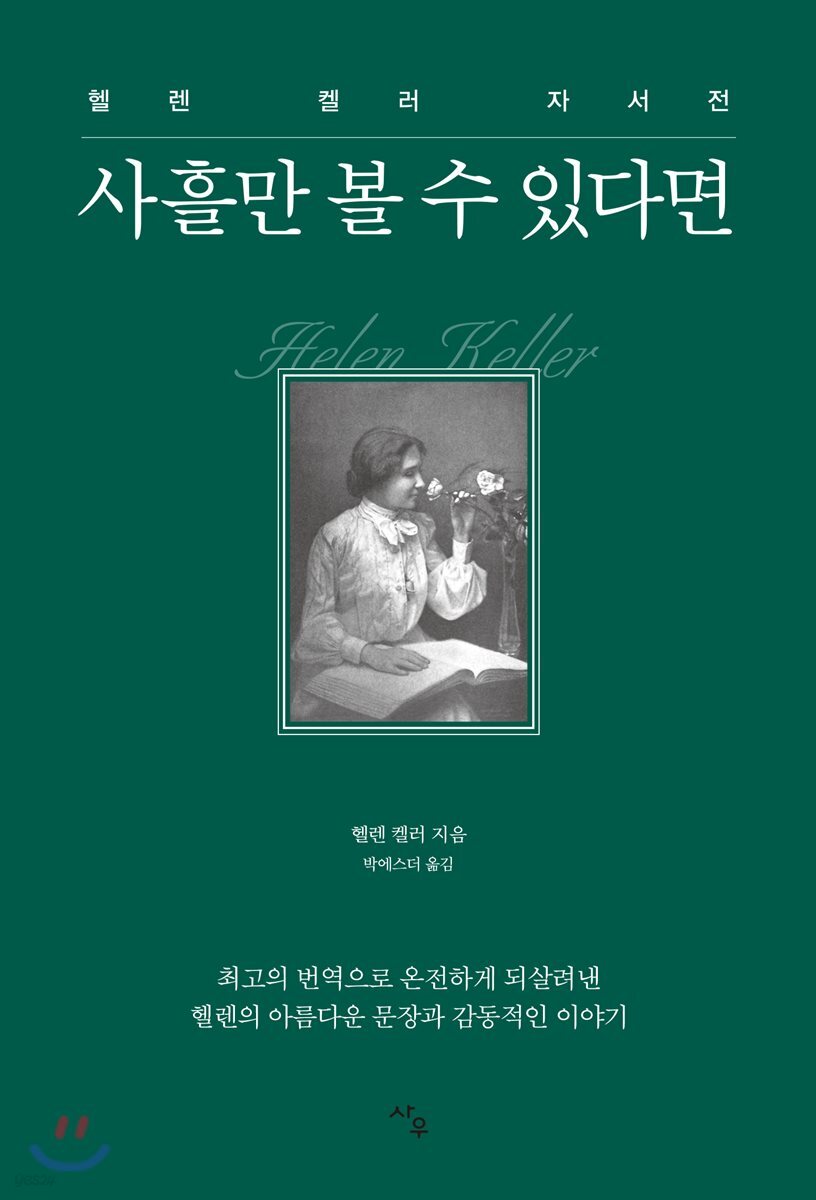
If I could see you for just three days
 |
Description
Book Introduction
Helen Keller's autobiography, considered a classic in biographical literature
Meet us in its entirety with meticulous and perfect translation!
This book is a collection of Helen Keller's "The Story of My Life," written when she was twenty-three, and her essay "If I Could See for Three Days," written when she was in her fifties.
We are all familiar with Helen's life, which began with a high fever as a child, which left her blind and deaf, but she overcame her disabilities through her tutor, Anne Sullivan, and dedicated her life to working for the disabled.
However, most people have only encountered the content through movies, summaries, or children's stories.
This book is the result of the translator's meticulous and perfect translation of Helen's writing, without missing a single word or sentence.
Helen's own book, "The Story of My Life," describes in detail her life as she navigated the world with her senses of touch, smell, and imagination instead of her lost senses.
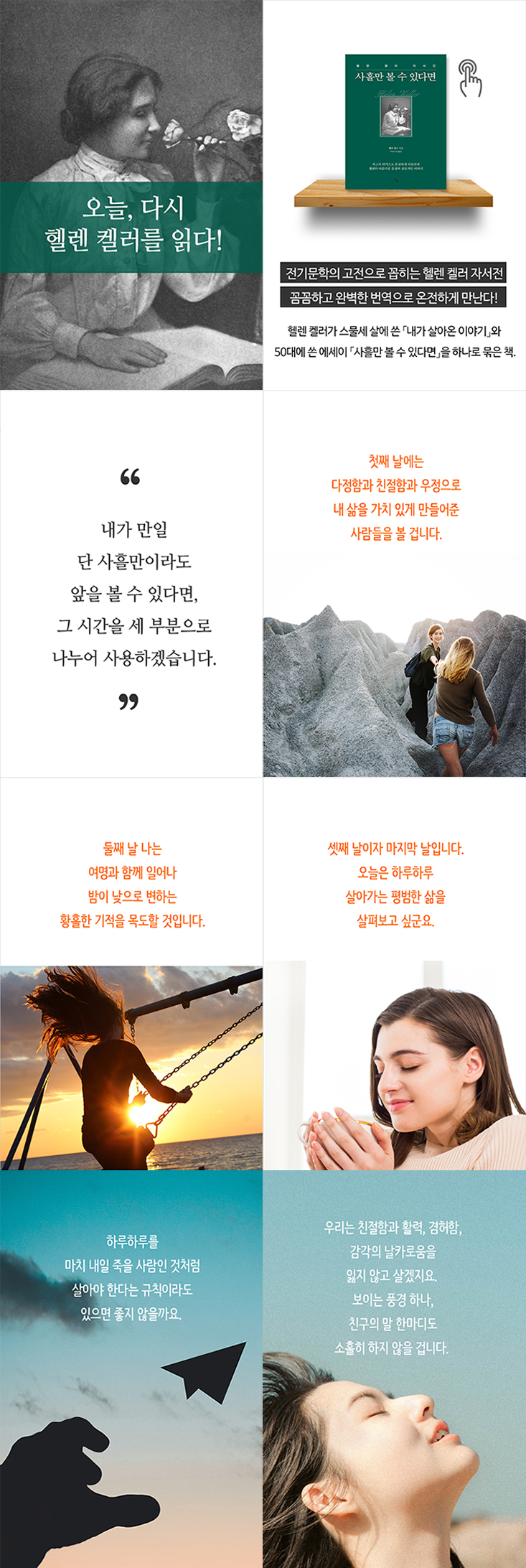
"If I Could See for Three Days" is an essay written assuming that I would be able to see the world for three days when I reach my fifties.
It is also a work selected by Reader's Digest as 'the best essay of the 20th century.'
Having never seen anything in her life, she finds beauty and precious value in things we pass by without a second thought.
It's a piece that makes you realize just how blessed it is to be able to see ahead.
Meet us in its entirety with meticulous and perfect translation!
This book is a collection of Helen Keller's "The Story of My Life," written when she was twenty-three, and her essay "If I Could See for Three Days," written when she was in her fifties.
We are all familiar with Helen's life, which began with a high fever as a child, which left her blind and deaf, but she overcame her disabilities through her tutor, Anne Sullivan, and dedicated her life to working for the disabled.
However, most people have only encountered the content through movies, summaries, or children's stories.
This book is the result of the translator's meticulous and perfect translation of Helen's writing, without missing a single word or sentence.
Helen's own book, "The Story of My Life," describes in detail her life as she navigated the world with her senses of touch, smell, and imagination instead of her lost senses.
"If I Could See for Three Days" is an essay written assuming that I would be able to see the world for three days when I reach my fifties.
It is also a work selected by Reader's Digest as 'the best essay of the 20th century.'
Having never seen anything in her life, she finds beauty and precious value in things we pass by without a second thought.
It's a piece that makes you realize just how blessed it is to be able to see ahead.
- You can preview some of the book's contents.
Preview
index
Translator's Note: A rich world seen and heard with one's own hands.
Part 1: The Story of My Life
Part 2 If I could see the world for just three days
Helen Keller Chronology
Part 1: The Story of My Life
Part 2 If I could see the world for just three days
Helen Keller Chronology
Detailed image
Into the book
I don't remember when I first realized I was different from other people.
But it is clear that it was before the teacher came.
Not only did I notice that my mother and friends used different signals than I did, but I also noticed that they used their mouths.
Sometimes I would stand between two people talking and touch their lips.
I was so angry because I couldn't understand it at all.
I tried moving my lips, but it didn't work, so I started gesturing like crazy.
This sometimes made me even more angry, and I would kick and scream until I was exhausted.
--- p.26~27
Someone was approaching.
I reached out, thinking it might be my mother.
Someone took my hand.
Then he pulled me close and wrapped his arms around me tightly.
She was the one who came here to reveal all things to me, to reveal their secrets, and to give me love.
--- p.47
The most enjoyable activity all winter was definitely sledding.
There were places along the lakeshore that suddenly rose up from the water's edge.
This slope was perfect for sledding.
When I sat on the sled, the boys would push me from behind, and the thrill of running was amazing, jumping into snowdrifts, jumping over hollows, and plummeting into the lake.
At other times, it would rush forward so powerfully that it could reach the other shore, running across the frozen, sparkling lake.
I can't tell you how much fun it was to realize that crazy things could be so life-enhancing.
For this moment of wild joy, of breaking the chains that bind us to the earth and soaring, we joined hands with the wind that made us feel divine. --- p.106
I was dissatisfied with my communication style.
People who have to rely solely on the sign language alphabet always feel frustrated by the limited limitations.
Because of this feeling, I always feel like I need something more and I torment myself with this feeling of lack.
When a thought occurred to me, I would often tremble like a bird in the wind, insisting on using my lips and voice.
My friends came forward and tried to console me, saying that it would never work out and that I would be discouraged.
But I didn't give up.
Finally, an event occurred that shattered this enormous obstacle.
--- p.109
I constantly drew pictures of my family members who would be happy to see my accomplishments.
“My little brother will be able to understand what I am saying.” This one thought alone was enough to overcome all obstacles.
“I am no longer mute.” I repeated this countless times.
There was no room for discouragement as I looked forward to the exchange of words, speaking to my mother and then tracing her lips to read her answer.
I was amazed at how much easier it was to say the words than to spell them out with my fingers.
--- p.113
The first day's test subject was German.
Mr. Gilman sat next to me and read the problem, and I repeated it out loud, and then he read it sentence by sentence, checking to see if I understood it correctly.
The problem was difficult, so I was very worried even as I typed out the answers.
Once the answers were written, Mr. Gilman copied them down word by word into my hand.
I would ask for corrections whenever I felt they were necessary, and the teacher would immediately write down the corrections I had pointed out.
Since taking this test here, I have never enjoyed this benefit anywhere else.
Later, when I went to Radcliffe to take the exam, no one read my answers again, so if I didn't finish before the exam ended, I had no chance to correct what I had written.
--- p.162
When I was looking forward to college life, college was romance itself to me.
But when you actually look at it, what is all that romance?
In the days when romance tumbles into reality, I learn many things I would never have known if I had not tried to do it myself.
One of them is the valuable discipline of patience.
Patience teaches, and education is just like taking a walk along a country road, opening our five senses and taking in the various impressions that come our way with a relaxed mind.
The knowledge that enters us overflows and forms waves of deep thought, rushing in like a tidal wave, silently wetting the invisible soul.
“Knowledge is power.” No, knowledge is happiness.
Because by possessing broad and deep knowledge, you will be able to discern what is your true purpose and what is more valuable.
--- p.188
Before I started reading, the teacher carefully explained things that I thought would be difficult to understand, and when I encountered unfamiliar words while reading, he explained their meanings one by one.
At first, there were many words I didn't know, so I often stopped reading.
But once I figured out what was going on, I was so engrossed in the story that I didn't want to pay attention to every single insignificant word.
As a result, I felt impatient even while listening to the explanations the teacher gave me because he thought they were absolutely necessary.
Finally, the teacher's fingers became so tired that he could no longer read.
At that time, for the first time in my life, I was able to look into the reality of my being, which I could neither see nor hear, and my heart ached because of the senses I had lost.
I picked up the book and traced the letters again and again with an unforgettable, passionate longing.
--- p.194
I read books in between studying and playing, and I enjoyed a joy I had never experienced before.
Not only had I not studied or analyzed the book myself, I had no idea whether it was well written or not.
Come to think of it, I've never thought about who wrote it and in what style.
One day, I saw beautiful jewels lying at my feet, and I simply accepted them as I would the sunlight or the love of my friends.
--- p.176
I also enjoyed canoeing.
People will laugh if I tell them that I especially loved canoeing under the gentle moonlight.
Yes, of course I am the moon rising high in the sky behind the pine branches, and I cannot see the moonlight on the path that the moon illuminates for us.
But I know the moon is there.
If you lean against the sill and dip your hand into the water, you feel as if you can touch the hem of the moon's clothes, sparkling and fluttering as it skims across the water.
Sometimes a young fish will dare to slip through my fingers, and sometimes a lotus will shyly press against my hand.
When you row out of a narrow, backwater, you can feel the sudden opening up of the surroundings through the movement of the air.
A warmth like that created by bright light surrounds me.
It is never known whether this warmth comes from the trees, which have been warmed by the sun, or from the water.
--- p.217
Museums and art galleries are also places of joy and inspiration.
People would probably find it strange if they were told that they could feel the form, emotion, and beauty of a cold marble sculpture with their hands without even seeing it.
But it is true that we get real joy from touching great works of art.
I trace the curves of the sculpture with my fingertips, discovering the thoughts and feelings the sculptor was trying to express.
In the faces of gods and heroes I meet the same hatred, courage, and love that I have felt when I touched the faces of living people.
In the form of the goddess Diana, I sense the freedom and beauty of the forest, the overflowing spirit that renders lions docile and even puts to rest their roars.
My soul loves the graceful curves and balance of Venus.
I also read the secrets of the jungle in Barre's bronze sculptures.
--- p.229
To this extent, even though my life has been limited, I can say I've been exposed to a wide range of beautiful things in life. Nothing in this world is without its surprises.
Even if we met in darkness and silence, it was definitely so.
No matter what situation I find myself in, I learn to be content with it.
--- p.236
I often ask my friends who have both eyesight what they saw.
Recently, a close friend of mine came to me after a long walk in the woods and asked me what I saw.
I heard the answer, “There was nothing special.”
I readily accepted her words because I was already accustomed to such reactions and had long known that what we see with our eyes is, in fact, very little.
I asked myself how it was possible to walk through the woods for an hour and not find anything of particular interest.
I, who cannot see, can find hundreds of interesting things just by touching.
I can feel the delicate balance of the leaves.
I gladly stroke the soft bark of a birch or the rough bark of a pine.
I feel the sweetly soft texture of the flower and discover its amazing spiral structure.
If you're very lucky, you can gently place your hand on a small tree and feel the joyful trembling of a singing bird.
The cold water of the stream flowing vigorously between my spread fingers also makes me happy.
I prefer a lush, green carpet of pine needles or fluffy grasses to the most luxurious Persian carpet.
The parade of seasons is like an endless, ecstatic play, the scenes of which pass by my fingertips.
--- p.262
Sometimes my heart feels like bursting with longing to see all this for myself.
It's so enjoyable just to touch, so how beautiful it must be to see it in person.
But those who see with their eyes seem to see less.
To those who can see, a world filled with a panorama of color and movement might seem insignificant.
Perhaps it may seem more human to wish for what we don't have than to be grateful for what we have.
If I were the dean of a university, I would create a required course called “How to Use Your Eyes.”
The teacher will want to help students see things they previously overlooked and show them how to add joy to their lives.
We will try to awaken the students' dormant, dull senses.
But it is clear that it was before the teacher came.
Not only did I notice that my mother and friends used different signals than I did, but I also noticed that they used their mouths.
Sometimes I would stand between two people talking and touch their lips.
I was so angry because I couldn't understand it at all.
I tried moving my lips, but it didn't work, so I started gesturing like crazy.
This sometimes made me even more angry, and I would kick and scream until I was exhausted.
--- p.26~27
Someone was approaching.
I reached out, thinking it might be my mother.
Someone took my hand.
Then he pulled me close and wrapped his arms around me tightly.
She was the one who came here to reveal all things to me, to reveal their secrets, and to give me love.
--- p.47
The most enjoyable activity all winter was definitely sledding.
There were places along the lakeshore that suddenly rose up from the water's edge.
This slope was perfect for sledding.
When I sat on the sled, the boys would push me from behind, and the thrill of running was amazing, jumping into snowdrifts, jumping over hollows, and plummeting into the lake.
At other times, it would rush forward so powerfully that it could reach the other shore, running across the frozen, sparkling lake.
I can't tell you how much fun it was to realize that crazy things could be so life-enhancing.
For this moment of wild joy, of breaking the chains that bind us to the earth and soaring, we joined hands with the wind that made us feel divine. --- p.106
I was dissatisfied with my communication style.
People who have to rely solely on the sign language alphabet always feel frustrated by the limited limitations.
Because of this feeling, I always feel like I need something more and I torment myself with this feeling of lack.
When a thought occurred to me, I would often tremble like a bird in the wind, insisting on using my lips and voice.
My friends came forward and tried to console me, saying that it would never work out and that I would be discouraged.
But I didn't give up.
Finally, an event occurred that shattered this enormous obstacle.
--- p.109
I constantly drew pictures of my family members who would be happy to see my accomplishments.
“My little brother will be able to understand what I am saying.” This one thought alone was enough to overcome all obstacles.
“I am no longer mute.” I repeated this countless times.
There was no room for discouragement as I looked forward to the exchange of words, speaking to my mother and then tracing her lips to read her answer.
I was amazed at how much easier it was to say the words than to spell them out with my fingers.
--- p.113
The first day's test subject was German.
Mr. Gilman sat next to me and read the problem, and I repeated it out loud, and then he read it sentence by sentence, checking to see if I understood it correctly.
The problem was difficult, so I was very worried even as I typed out the answers.
Once the answers were written, Mr. Gilman copied them down word by word into my hand.
I would ask for corrections whenever I felt they were necessary, and the teacher would immediately write down the corrections I had pointed out.
Since taking this test here, I have never enjoyed this benefit anywhere else.
Later, when I went to Radcliffe to take the exam, no one read my answers again, so if I didn't finish before the exam ended, I had no chance to correct what I had written.
--- p.162
When I was looking forward to college life, college was romance itself to me.
But when you actually look at it, what is all that romance?
In the days when romance tumbles into reality, I learn many things I would never have known if I had not tried to do it myself.
One of them is the valuable discipline of patience.
Patience teaches, and education is just like taking a walk along a country road, opening our five senses and taking in the various impressions that come our way with a relaxed mind.
The knowledge that enters us overflows and forms waves of deep thought, rushing in like a tidal wave, silently wetting the invisible soul.
“Knowledge is power.” No, knowledge is happiness.
Because by possessing broad and deep knowledge, you will be able to discern what is your true purpose and what is more valuable.
--- p.188
Before I started reading, the teacher carefully explained things that I thought would be difficult to understand, and when I encountered unfamiliar words while reading, he explained their meanings one by one.
At first, there were many words I didn't know, so I often stopped reading.
But once I figured out what was going on, I was so engrossed in the story that I didn't want to pay attention to every single insignificant word.
As a result, I felt impatient even while listening to the explanations the teacher gave me because he thought they were absolutely necessary.
Finally, the teacher's fingers became so tired that he could no longer read.
At that time, for the first time in my life, I was able to look into the reality of my being, which I could neither see nor hear, and my heart ached because of the senses I had lost.
I picked up the book and traced the letters again and again with an unforgettable, passionate longing.
--- p.194
I read books in between studying and playing, and I enjoyed a joy I had never experienced before.
Not only had I not studied or analyzed the book myself, I had no idea whether it was well written or not.
Come to think of it, I've never thought about who wrote it and in what style.
One day, I saw beautiful jewels lying at my feet, and I simply accepted them as I would the sunlight or the love of my friends.
--- p.176
I also enjoyed canoeing.
People will laugh if I tell them that I especially loved canoeing under the gentle moonlight.
Yes, of course I am the moon rising high in the sky behind the pine branches, and I cannot see the moonlight on the path that the moon illuminates for us.
But I know the moon is there.
If you lean against the sill and dip your hand into the water, you feel as if you can touch the hem of the moon's clothes, sparkling and fluttering as it skims across the water.
Sometimes a young fish will dare to slip through my fingers, and sometimes a lotus will shyly press against my hand.
When you row out of a narrow, backwater, you can feel the sudden opening up of the surroundings through the movement of the air.
A warmth like that created by bright light surrounds me.
It is never known whether this warmth comes from the trees, which have been warmed by the sun, or from the water.
--- p.217
Museums and art galleries are also places of joy and inspiration.
People would probably find it strange if they were told that they could feel the form, emotion, and beauty of a cold marble sculpture with their hands without even seeing it.
But it is true that we get real joy from touching great works of art.
I trace the curves of the sculpture with my fingertips, discovering the thoughts and feelings the sculptor was trying to express.
In the faces of gods and heroes I meet the same hatred, courage, and love that I have felt when I touched the faces of living people.
In the form of the goddess Diana, I sense the freedom and beauty of the forest, the overflowing spirit that renders lions docile and even puts to rest their roars.
My soul loves the graceful curves and balance of Venus.
I also read the secrets of the jungle in Barre's bronze sculptures.
--- p.229
To this extent, even though my life has been limited, I can say I've been exposed to a wide range of beautiful things in life. Nothing in this world is without its surprises.
Even if we met in darkness and silence, it was definitely so.
No matter what situation I find myself in, I learn to be content with it.
--- p.236
I often ask my friends who have both eyesight what they saw.
Recently, a close friend of mine came to me after a long walk in the woods and asked me what I saw.
I heard the answer, “There was nothing special.”
I readily accepted her words because I was already accustomed to such reactions and had long known that what we see with our eyes is, in fact, very little.
I asked myself how it was possible to walk through the woods for an hour and not find anything of particular interest.
I, who cannot see, can find hundreds of interesting things just by touching.
I can feel the delicate balance of the leaves.
I gladly stroke the soft bark of a birch or the rough bark of a pine.
I feel the sweetly soft texture of the flower and discover its amazing spiral structure.
If you're very lucky, you can gently place your hand on a small tree and feel the joyful trembling of a singing bird.
The cold water of the stream flowing vigorously between my spread fingers also makes me happy.
I prefer a lush, green carpet of pine needles or fluffy grasses to the most luxurious Persian carpet.
The parade of seasons is like an endless, ecstatic play, the scenes of which pass by my fingertips.
--- p.262
Sometimes my heart feels like bursting with longing to see all this for myself.
It's so enjoyable just to touch, so how beautiful it must be to see it in person.
But those who see with their eyes seem to see less.
To those who can see, a world filled with a panorama of color and movement might seem insignificant.
Perhaps it may seem more human to wish for what we don't have than to be grateful for what we have.
If I were the dean of a university, I would create a required course called “How to Use Your Eyes.”
The teacher will want to help students see things they previously overlooked and show them how to add joy to their lives.
We will try to awaken the students' dormant, dull senses.
--- p.264
Publisher's Review
Helen's beautiful autobiography, meticulously translated at age twenty-three.
Helen Keller's autobiography, surprisingly, was written when she was a sophomore in college.
Helen's honest writings, serialized in a magazine, aroused enormous interest among readers at the time and were eventually published as a book.
That book is “The Story of My Life,” which is recognized as a classic of biographical literature today.
However, due to its excessive popularity, it is a book that few people have read properly.
Many people know the plot through the movie or a summary, but not many have read the entire book she wrote.
Of course, the fact that there is no proper translation available in Korea may have also played a role.
The children's biography is nothing more than a condensed excerpt, and the book for the general public is also not enough to be called a complete translation.
The person who translated this book into Korean tried not to leave out even a single sentence or word from the original text.
This is to allow readers to truly experience Helen Keller's true life and dreams, which can only be found in her own handwriting.
In fact, "The Story of My Life" is not a book that you can just grasp the plot and end with.
You must read each sentence carefully.
Helen Keller, who lost her sight and hearing and thus developed a richer and more sensitive sensibility, described people, animals, objects, landscapes, and events with meticulous detail, without overlooking a single detail.
As I read the beautiful sentences, which seem like detailed paintings, I feel as if I can grasp the process of her growth, in which she learned about the world by mobilizing all her senses, including touch, smell, imagination, and inspiration, in place of her lost senses.
Through this book, readers are able to look again at the people and scenery around them that they had been looking at indifferently.
You will also regain your lost courage, passion for life, and gratitude.
It would be a great loss to the reader to come across such a text in a condensed form.
The essay "If I Could See for Three Days," included with her autobiography, was written by Helen Keller when she was in her fifties.
Helen is excitedly wondering how she would spend those three days if she were miraculously able to see the world.
She is good at finding beautiful and valuable things that we often overlook.
Listening to her story, I realize how blessed we are to be able to see ahead, and how much we miss out on that blessing in our lives.
The world-renowned magazine Reader's Digest selected this piece as "the greatest essay of the 20th century."
Why I'm Reading Helen Keller Again Today
There are few people who don't know Helen Keller.
Mark Twain predicted that Helen Keller would still be remembered a thousand years from now.
Why not?
Helen Keller became blind, deaf, and mute after suffering from a high fever at the age of 19 months.
No one expected her to read, write, or speak.
Yet, despite her triple disability, she moved forward, eventually earning a college education, writing several books, and dedicating her life to working for people with disabilities around the world.
She will forever be remembered as a miracle worker, a godmother to the disabled, and a practicing socialist.
Reading Helen Keller's writings, one is struck by the fact that she, who suffered from a fate that could be called cursed, viewed the world with brighter and more positive eyes than anyone else.
She loved nature more than anyone else and enjoyed the gifts it gave her to the fullest.
He also had a great passion for learning and intellectual curiosity.
Meeting Professor Sullivan, embarking on a path of learning, and achieving academic achievements one by one amidst darkness and silence is truly a marvel.
She also never lost interest in the poor and marginalized.
That is why even today, many people around the world read her autobiography, which contains her voice in its entirety.
In this book, people learn to love reality as it is and gain the wisdom and courage to overcome hardship.
Helen Keller's autobiography, surprisingly, was written when she was a sophomore in college.
Helen's honest writings, serialized in a magazine, aroused enormous interest among readers at the time and were eventually published as a book.
That book is “The Story of My Life,” which is recognized as a classic of biographical literature today.
However, due to its excessive popularity, it is a book that few people have read properly.
Many people know the plot through the movie or a summary, but not many have read the entire book she wrote.
Of course, the fact that there is no proper translation available in Korea may have also played a role.
The children's biography is nothing more than a condensed excerpt, and the book for the general public is also not enough to be called a complete translation.
The person who translated this book into Korean tried not to leave out even a single sentence or word from the original text.
This is to allow readers to truly experience Helen Keller's true life and dreams, which can only be found in her own handwriting.
In fact, "The Story of My Life" is not a book that you can just grasp the plot and end with.
You must read each sentence carefully.
Helen Keller, who lost her sight and hearing and thus developed a richer and more sensitive sensibility, described people, animals, objects, landscapes, and events with meticulous detail, without overlooking a single detail.
As I read the beautiful sentences, which seem like detailed paintings, I feel as if I can grasp the process of her growth, in which she learned about the world by mobilizing all her senses, including touch, smell, imagination, and inspiration, in place of her lost senses.
Through this book, readers are able to look again at the people and scenery around them that they had been looking at indifferently.
You will also regain your lost courage, passion for life, and gratitude.
It would be a great loss to the reader to come across such a text in a condensed form.
The essay "If I Could See for Three Days," included with her autobiography, was written by Helen Keller when she was in her fifties.
Helen is excitedly wondering how she would spend those three days if she were miraculously able to see the world.
She is good at finding beautiful and valuable things that we often overlook.
Listening to her story, I realize how blessed we are to be able to see ahead, and how much we miss out on that blessing in our lives.
The world-renowned magazine Reader's Digest selected this piece as "the greatest essay of the 20th century."
Why I'm Reading Helen Keller Again Today
There are few people who don't know Helen Keller.
Mark Twain predicted that Helen Keller would still be remembered a thousand years from now.
Why not?
Helen Keller became blind, deaf, and mute after suffering from a high fever at the age of 19 months.
No one expected her to read, write, or speak.
Yet, despite her triple disability, she moved forward, eventually earning a college education, writing several books, and dedicating her life to working for people with disabilities around the world.
She will forever be remembered as a miracle worker, a godmother to the disabled, and a practicing socialist.
Reading Helen Keller's writings, one is struck by the fact that she, who suffered from a fate that could be called cursed, viewed the world with brighter and more positive eyes than anyone else.
She loved nature more than anyone else and enjoyed the gifts it gave her to the fullest.
He also had a great passion for learning and intellectual curiosity.
Meeting Professor Sullivan, embarking on a path of learning, and achieving academic achievements one by one amidst darkness and silence is truly a marvel.
She also never lost interest in the poor and marginalized.
That is why even today, many people around the world read her autobiography, which contains her voice in its entirety.
In this book, people learn to love reality as it is and gain the wisdom and courage to overcome hardship.
GOODS SPECIFICS
- Publication date: November 27, 2018
- Page count, weight, size: 288 pages | 366g | 128*188*20mm
- ISBN13: 9791187332299
- ISBN10: 1187332291
You may also like
카테고리
korean


korean

![GQ KOREA Mark (Monthly): December [2025]](http://librairie.coreenne.fr/cdn/shop/files/8ef265dbbfbf186523ed75ba7319009d.jpg?v=1765340328&width=3840)


