

100 Philosophies That Question the Obvious
 |
Description
Book Introduction
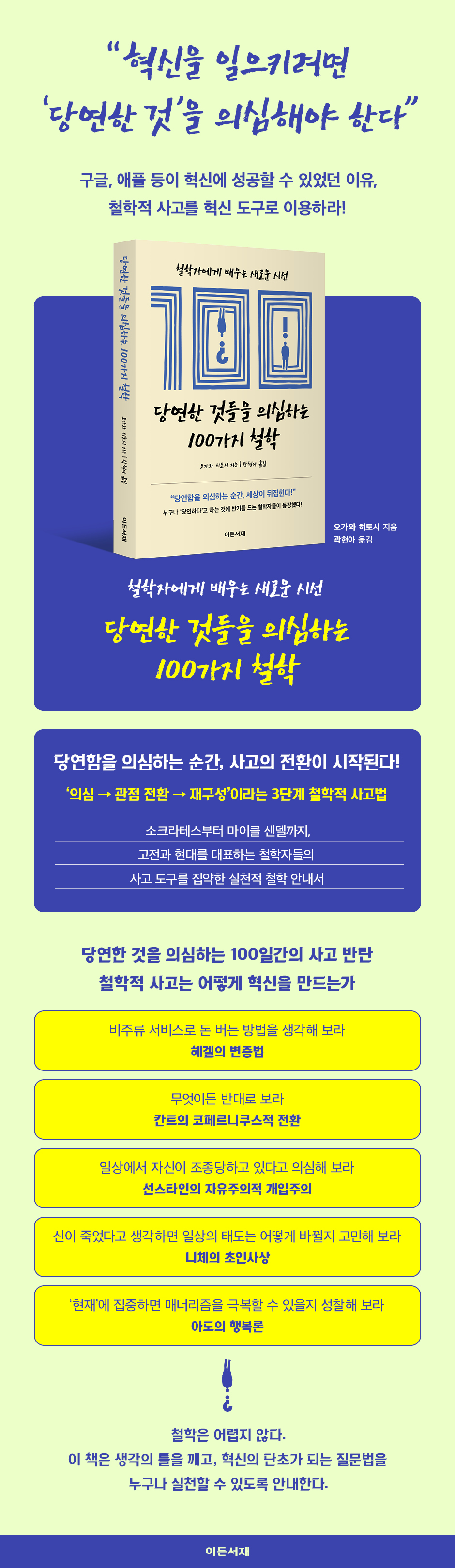
Question the 'obvious', and innovation begins!
Why Google and Apple's innovations were possible
Arm yourself with 100 philosophical ideas!
A must-read for managers who refuse to settle - JBpress
"Learn how to gather doubts and achieve great change" - Gentosha Plus
With the advent of AI and the accelerating digital transformation, both businesses and individuals are feeling the threat. As AI's capabilities rapidly advance and usurp human roles, our position is increasingly diminished.
In this irresistible current of the times, how can we maintain our unique competitiveness as human beings and maintain our place?
Professor Hitoshi Ogawa, an expert who has led the transformation of thinking in organizations and individuals for over 20 years in the field, says that the clue to the answer can be found through a philosophical thinking process consisting of three steps: ① doubt → ② change perspective → ③ reconstruct.
As philosopher Marcus Gabriel put it, “Humans discover problems, AI solves them.”
And without properly training ourselves in the first step, doubting, the philosophical thought process cannot even begin.
This is why we must look closely at this book.
To learn how to "question the obvious," ask the right questions, and achieve innovation, we must begin the philosophical thinking training presented in this book.
This book contains tools for philosophical doubt, namely 'questions,' presented by philosophers representing both classical and contemporary times, from Socrates to Michael Sandel.
100 Questions makes you question the obvious, and in that moment, your frame of mind is shaken and a new perspective opens up.
Plato encourages us to consider that "everything is false," and Hobbes asks us to imagine "how our outlook on life would change if everything were fixed."
This book approaches our daily lives and businesses from a philosophical perspective, leading to a shift in perspective and innovation in thinking.
This thinking tool, used by global companies like Google and Apple to drive innovation, will plant the seeds of change in your mind.
If you want to break free from conventional wisdom and overturn your thinking, this book will be a tool for practical change.
Why Google and Apple's innovations were possible
Arm yourself with 100 philosophical ideas!
A must-read for managers who refuse to settle - JBpress
"Learn how to gather doubts and achieve great change" - Gentosha Plus
With the advent of AI and the accelerating digital transformation, both businesses and individuals are feeling the threat. As AI's capabilities rapidly advance and usurp human roles, our position is increasingly diminished.
In this irresistible current of the times, how can we maintain our unique competitiveness as human beings and maintain our place?
Professor Hitoshi Ogawa, an expert who has led the transformation of thinking in organizations and individuals for over 20 years in the field, says that the clue to the answer can be found through a philosophical thinking process consisting of three steps: ① doubt → ② change perspective → ③ reconstruct.
As philosopher Marcus Gabriel put it, “Humans discover problems, AI solves them.”
And without properly training ourselves in the first step, doubting, the philosophical thought process cannot even begin.
This is why we must look closely at this book.
To learn how to "question the obvious," ask the right questions, and achieve innovation, we must begin the philosophical thinking training presented in this book.
This book contains tools for philosophical doubt, namely 'questions,' presented by philosophers representing both classical and contemporary times, from Socrates to Michael Sandel.
100 Questions makes you question the obvious, and in that moment, your frame of mind is shaken and a new perspective opens up.
Plato encourages us to consider that "everything is false," and Hobbes asks us to imagine "how our outlook on life would change if everything were fixed."
This book approaches our daily lives and businesses from a philosophical perspective, leading to a shift in perspective and innovation in thinking.
This thinking tool, used by global companies like Google and Apple to drive innovation, will plant the seeds of change in your mind.
If you want to break free from conventional wisdom and overturn your thinking, this book will be a tool for practical change.
- You can preview some of the book's contents.
Preview
index
Small and __ We must question the 'obvious' to innovate.
PartⅠ.
50 Ways to Question the Obvious
① Present facts different from what is known__Socrates' 'method of questioning'
② Stop Judging__Husserl's 'Phenomenological Reduction'
③ Break it down into elements__Derrida's 'deconstruction'
④ See the world through movement__Deleuze's 'Generation and Change'
⑤ See the world upside down__Kant's 'Copernican Revolution'
⑥ Adapt to your opponent__Ser's 'Etch'
⑦ Focus on the useless things__Ser's 'Noise'
⑧ Penetrate the deeper depths of desire__Lacan's 'object a'
⑨ Let's assume that 'the world changes completely'__Mayasou's 'Speculative Realism'
⑩ Let's think about it without humans__Harman's 'OOO'
⑪ Let's think that 'we all live in different worlds'__Wicksquill's 'Illusionary World'
⑫ Let's think about 'not knowing what we know'__Socrates' 'Knowledge of ignorance'
⑬ Let's suspect that 'everything is fake'__Plato's 'Idea'
⑭ Let us assume that 'everything is established by one principle'__Leibniz's 'Monad'
⑮ Let's think that 'everything is due to prejudice'__Bacon's 'Idol'
Let's consider everything as 'mere perception' __Hume's 'bundle of perceptions'
Let's think with our bodies, not our heads. Merleau-Ponty's "Theory of the Body"
Let's think about 'words create the world'__Saussure's 'Signe'
? Turn your eyes to the overall structure__Lévi-Strauss's 'Structuralism'
Let's consider whether voluntary actions were not forced upon us by someone. __Foucault's 'Panopticon'
Let's recognize that 'seeing = being' __Gabriel's 'New Realism'
Let's think about "nothing is impossible" __ Hegel's "Dialectics"
Let's think about 'there is some great principle at the root'__Marx's 'infrastructure'
Let's recognize that "difference existed before things" __ Derrida's "difference"
Let's consider that 'everything is predetermined' __ Hobbes' 'Free Will'
Let's consider everything as a 'coincidence'__Cookie Shujo's 'Coincidence'
Let's think of everything as a "fashion of knowledge" __Foucault's "episteme"
Let's think, 'I can change the world'__Sartre's 'Existentialism'
Let's recognize that this world is all 'the same'. Zhuangzi's 'All Things in the World'
Let's perceive everything through the lens of intensity. Deleuze's 'Intensity'
Let's find value in the heterogeneous. Bataille's "The Sacred"
Let's break down the perspectives__Nanai's 'Distributed Focus'
Let's put our own circumstances aside__Rolls' 'Veil of Ignorance'
Let's recognize that 'everything is just a possibility' __ Armstrong's 'possible worlds'
Let's think, "It's better not to organize things." __Adorno's "Negative Dialectics"
Let's consider that 'thoughts can also be saved'__Ockham's 'razor'
Let's consider it as 'infinite'__Anaximander's 'Cosmology'
Let's recognize confession as "thinking" __Augustine's "Continentia"
Let's draw our own boundaries. Williamson's "The Sandhill Paradox"
Let's believe that differences in values can be transcended. Gadamer's "Fusion of Horizons"
Let's think of 'common understanding' __ Galtung's 'Transcendental Law'
Let's consider the importance of touch. Condillac's "Cautious Metaphysics"
Let's suspect that we are being manipulated. Sunstein's "liberal interventionism"
Let's think of humans as "slaves to technology" __Stigler's "Prosthetics"
Let's think of it as not yet complete. Malabu's 'Plasticity'
Let's think, "The future is here." De Schalit's "Transcendental Community"
Let's consider that "there was no system from the beginning"__Didore's "Philosophical Mind"
Let's think about 'the essence is revealed through measurement' __ Plotinus' 'The One'
Let's find meaning in the passage. Benjamin's 'Theory of Passage'
Let's consider that vice is not a bad thing. Mandeville's 'The Fable of the Bees'
PartⅡ.
50 Doubts to Learn from Philosophers
Let's think about 'how much freedom we can have'__Nozick's 'libertarianism'
Let's consider that 'the body and mind are different'__Descartes' 'mind-body dualism'
Let's think about 'God is dead'__Nietzsche's 'Superman'
Let's consider that death is not a bad thing. Heidegger's 'Ontology of Design'
Let's consider the idea that "contentment is not good" __ Aristotle's "Doctrine of the Mean"
Let's think about 'It's better to instill fear'__Machiavelli's 'The Prince'
Let's think about 'solitude as happiness'__Schopenhauer's 'On Solitude'
Let's think of insomnia as an opportunity for growth. Hilti's "Sleep Philosophy"
Let's think about it: "It's better to postpone things you don't like as much as possible." __Perry's "Postponement Philosophy"
Let's consider the existence of a common will in society. Rousseau's "general will"
Let's consider the idea that "it's better not to Google"__Montaigne's "Cousseges"
Let's consider the idea that "rights are better left unattended" __ Hobbes's "Leviathan"
Let's think of ourselves as 'part of God'__Spinoza's 'Pantheism'
Let's think about the "limitless" in becoming wise. Hegel's "absolute knowledge"
Let's consider that 'death is better than despair'__Kierkegaard's 'The Essence of Despair'
Let's consider 'time does not flow'__Bergson's 'pure duration'
Let's consider that 'others determine oneself' __ Levinas' 'Theory of the Other'
Let's think of 'knowledge as a tool' __ Dewey's 'pragmatism'
Let's consider that "uncivilized civilization is actually superior" __ Levi-Strauss's "Wild Thought"
Let's consider the idea that "it's better to withhold the answer" __Keats's "negative capacity"
Consider: "The Internet is making the world narrow-minded." Sunstein's "Information Cocoon"
Let's think about it: 'It's better not to save money.' __Simmel's 'Philosophy of Money'
Consider the idea of being exploited by social media. Han Byung-chul's "Dominance of Information"
Let's consider that 'desire is nothing more than imitating someone'__Girard's 'Triangle of Desire'
Let's think about "hope is giving up" __ Miki Kiyoshi's "Hope"
Let's think of the metaverse as the 'real world'__Chalmers' 'Reality+'
Let's think of humans as 'machines'__Twain's 'Theory of Human Machinery'
Let's think about "memory" as more important than records. Vico's "Topeka"
Let's consider the idea that "youth can be obtained through intensity." Garcia's "Intense Life"
Let's consider the dangers of blindly following the government. West's "Philosophy of Action"
Let's consider that 'it is natural to pursue holiness'__Eliade's 'Homo religiosus'
Consider the idea that "anyone can commit great evil." Arendt's "The Banality of Evil"
Let's think of inferiority as a good thing. Adler's "Separation of Tasks"
Let's consider that 'revenge is not a bad thing' __Herschowitz's 'Theory of Revenge'
Let's consider 'our own happiness as a duty to others'__Alan's 'Indomitable Optimism'
Let's consider that 'humans are inherently incapable of understanding others'__Locke's 'Empiricism'
Let's think about the meaning of words being determined by context. __Wittgenstein's 'Language Game'
Let's consider the idea that "there is a just war." Walzer's "Theory of Armistice"
Let's think about "breaking through passion" __ Unamuno's "Extreme"
Let's think about 'paper books are superior'__Echo's 'organic tools'
Let's think about 'eating is life'__Epicurus' 'Hedonism'
Let's consider the idea that "a fool is thoughtful"__Erasmus' "In Praise of Folly"
Let's think about the idea that "if you play like a child, ideas will flow out." __Erikson's "Play"
Let's think about the idea that "being a nobleman allows you to have your own opinions." Ortega's "Rebellion of the Masses"
Let's consider the "existence of fear" in the background of social media. Canetti's "Contact Fear Conversion"
Let's think about how we can overcome mannerism by living in the present. Ado's "Theory of Happiness"
Let's think of art as a way of perceiving the world. Goodman's "Theory of Art"
Let's think of 'silence as music'__Cage's 'Silence'
Let's consider the idea that "focusing on each individual discrimination doesn't solve the problem" __Collins' "intersectionality"
Let's consider skill as "just luck" __Sandel's "contributory justice"
Finally__Doubt is not the end, but the 'beginning'
PartⅠ.
50 Ways to Question the Obvious
① Present facts different from what is known__Socrates' 'method of questioning'
② Stop Judging__Husserl's 'Phenomenological Reduction'
③ Break it down into elements__Derrida's 'deconstruction'
④ See the world through movement__Deleuze's 'Generation and Change'
⑤ See the world upside down__Kant's 'Copernican Revolution'
⑥ Adapt to your opponent__Ser's 'Etch'
⑦ Focus on the useless things__Ser's 'Noise'
⑧ Penetrate the deeper depths of desire__Lacan's 'object a'
⑨ Let's assume that 'the world changes completely'__Mayasou's 'Speculative Realism'
⑩ Let's think about it without humans__Harman's 'OOO'
⑪ Let's think that 'we all live in different worlds'__Wicksquill's 'Illusionary World'
⑫ Let's think about 'not knowing what we know'__Socrates' 'Knowledge of ignorance'
⑬ Let's suspect that 'everything is fake'__Plato's 'Idea'
⑭ Let us assume that 'everything is established by one principle'__Leibniz's 'Monad'
⑮ Let's think that 'everything is due to prejudice'__Bacon's 'Idol'
Let's consider everything as 'mere perception' __Hume's 'bundle of perceptions'
Let's think with our bodies, not our heads. Merleau-Ponty's "Theory of the Body"
Let's think about 'words create the world'__Saussure's 'Signe'
? Turn your eyes to the overall structure__Lévi-Strauss's 'Structuralism'
Let's consider whether voluntary actions were not forced upon us by someone. __Foucault's 'Panopticon'
Let's recognize that 'seeing = being' __Gabriel's 'New Realism'
Let's think about "nothing is impossible" __ Hegel's "Dialectics"
Let's think about 'there is some great principle at the root'__Marx's 'infrastructure'
Let's recognize that "difference existed before things" __ Derrida's "difference"
Let's consider that 'everything is predetermined' __ Hobbes' 'Free Will'
Let's consider everything as a 'coincidence'__Cookie Shujo's 'Coincidence'
Let's think of everything as a "fashion of knowledge" __Foucault's "episteme"
Let's think, 'I can change the world'__Sartre's 'Existentialism'
Let's recognize that this world is all 'the same'. Zhuangzi's 'All Things in the World'
Let's perceive everything through the lens of intensity. Deleuze's 'Intensity'
Let's find value in the heterogeneous. Bataille's "The Sacred"
Let's break down the perspectives__Nanai's 'Distributed Focus'
Let's put our own circumstances aside__Rolls' 'Veil of Ignorance'
Let's recognize that 'everything is just a possibility' __ Armstrong's 'possible worlds'
Let's think, "It's better not to organize things." __Adorno's "Negative Dialectics"
Let's consider that 'thoughts can also be saved'__Ockham's 'razor'
Let's consider it as 'infinite'__Anaximander's 'Cosmology'
Let's recognize confession as "thinking" __Augustine's "Continentia"
Let's draw our own boundaries. Williamson's "The Sandhill Paradox"
Let's believe that differences in values can be transcended. Gadamer's "Fusion of Horizons"
Let's think of 'common understanding' __ Galtung's 'Transcendental Law'
Let's consider the importance of touch. Condillac's "Cautious Metaphysics"
Let's suspect that we are being manipulated. Sunstein's "liberal interventionism"
Let's think of humans as "slaves to technology" __Stigler's "Prosthetics"
Let's think of it as not yet complete. Malabu's 'Plasticity'
Let's think, "The future is here." De Schalit's "Transcendental Community"
Let's consider that "there was no system from the beginning"__Didore's "Philosophical Mind"
Let's think about 'the essence is revealed through measurement' __ Plotinus' 'The One'
Let's find meaning in the passage. Benjamin's 'Theory of Passage'
Let's consider that vice is not a bad thing. Mandeville's 'The Fable of the Bees'
PartⅡ.
50 Doubts to Learn from Philosophers
Let's think about 'how much freedom we can have'__Nozick's 'libertarianism'
Let's consider that 'the body and mind are different'__Descartes' 'mind-body dualism'
Let's think about 'God is dead'__Nietzsche's 'Superman'
Let's consider that death is not a bad thing. Heidegger's 'Ontology of Design'
Let's consider the idea that "contentment is not good" __ Aristotle's "Doctrine of the Mean"
Let's think about 'It's better to instill fear'__Machiavelli's 'The Prince'
Let's think about 'solitude as happiness'__Schopenhauer's 'On Solitude'
Let's think of insomnia as an opportunity for growth. Hilti's "Sleep Philosophy"
Let's think about it: "It's better to postpone things you don't like as much as possible." __Perry's "Postponement Philosophy"
Let's consider the existence of a common will in society. Rousseau's "general will"
Let's consider the idea that "it's better not to Google"__Montaigne's "Cousseges"
Let's consider the idea that "rights are better left unattended" __ Hobbes's "Leviathan"
Let's think of ourselves as 'part of God'__Spinoza's 'Pantheism'
Let's think about the "limitless" in becoming wise. Hegel's "absolute knowledge"
Let's consider that 'death is better than despair'__Kierkegaard's 'The Essence of Despair'
Let's consider 'time does not flow'__Bergson's 'pure duration'
Let's consider that 'others determine oneself' __ Levinas' 'Theory of the Other'
Let's think of 'knowledge as a tool' __ Dewey's 'pragmatism'
Let's consider that "uncivilized civilization is actually superior" __ Levi-Strauss's "Wild Thought"
Let's consider the idea that "it's better to withhold the answer" __Keats's "negative capacity"
Consider: "The Internet is making the world narrow-minded." Sunstein's "Information Cocoon"
Let's think about it: 'It's better not to save money.' __Simmel's 'Philosophy of Money'
Consider the idea of being exploited by social media. Han Byung-chul's "Dominance of Information"
Let's consider that 'desire is nothing more than imitating someone'__Girard's 'Triangle of Desire'
Let's think about "hope is giving up" __ Miki Kiyoshi's "Hope"
Let's think of the metaverse as the 'real world'__Chalmers' 'Reality+'
Let's think of humans as 'machines'__Twain's 'Theory of Human Machinery'
Let's think about "memory" as more important than records. Vico's "Topeka"
Let's consider the idea that "youth can be obtained through intensity." Garcia's "Intense Life"
Let's consider the dangers of blindly following the government. West's "Philosophy of Action"
Let's consider that 'it is natural to pursue holiness'__Eliade's 'Homo religiosus'
Consider the idea that "anyone can commit great evil." Arendt's "The Banality of Evil"
Let's think of inferiority as a good thing. Adler's "Separation of Tasks"
Let's consider that 'revenge is not a bad thing' __Herschowitz's 'Theory of Revenge'
Let's consider 'our own happiness as a duty to others'__Alan's 'Indomitable Optimism'
Let's consider that 'humans are inherently incapable of understanding others'__Locke's 'Empiricism'
Let's think about the meaning of words being determined by context. __Wittgenstein's 'Language Game'
Let's consider the idea that "there is a just war." Walzer's "Theory of Armistice"
Let's think about "breaking through passion" __ Unamuno's "Extreme"
Let's think about 'paper books are superior'__Echo's 'organic tools'
Let's think about 'eating is life'__Epicurus' 'Hedonism'
Let's consider the idea that "a fool is thoughtful"__Erasmus' "In Praise of Folly"
Let's think about the idea that "if you play like a child, ideas will flow out." __Erikson's "Play"
Let's think about the idea that "being a nobleman allows you to have your own opinions." Ortega's "Rebellion of the Masses"
Let's consider the "existence of fear" in the background of social media. Canetti's "Contact Fear Conversion"
Let's think about how we can overcome mannerism by living in the present. Ado's "Theory of Happiness"
Let's think of art as a way of perceiving the world. Goodman's "Theory of Art"
Let's think of 'silence as music'__Cage's 'Silence'
Let's consider the idea that "focusing on each individual discrimination doesn't solve the problem" __Collins' "intersectionality"
Let's consider skill as "just luck" __Sandel's "contributory justice"
Finally__Doubt is not the end, but the 'beginning'
Detailed image
Into the book
Husserl argues that we should first set aside existing information, such as our perspectives, preconceptions, and habitual understandings, and believe only what comes into our consciousness.
This act of putting down existing information is called 'epoché (suspension of judgment).'
This way of thinking is sometimes called 'parenthesizing'.
Because it is not about denying, but rather about withholding judgment.
--- p.23
French thinker Michel Serres (1930-2019) recognized the obvious fact that humans think about things in a very surprising way.
Usually, when we think about things, we tend to have an image of a strong ego, and that ego seems to be looking at things from the outside.
But Serre suggests that when we think about things, we try to become the objects of thought themselves.
For example, when we think about a cup, we become that cup.
You might think it's strange, but if you think about it the other way around, wouldn't it be easier to understand if you imagine a situation where there's nothing to think about?
--- p.31
The ancient Greek philosopher Plato (427 BC - 347 BC) was a person who doubted that 'everything in this world is fake.'
I thought that everything was nothing more than a shadow of the 'idea'.
So what is an idea? Originally, the word "idea" meant the form or shape of an object.
However, even if it is called a form, it does not refer to the form that is visible to our eyes, but rather to the true form of an object or the original form of an object that can only be perceived with the mind's eye.
Anything perceived through the senses, such as sight or hearing, eventually disappears.
But the idea is an eternal and immortal being.
--- p.48
English philosopher Thomas Hobbes (1588-1679) is famous for comparing society to the sea monster Leviathan from the Old Testament.
On the one hand, he is also a pioneer of the 'theory of free will' that is still used today.
In libertarianism, it is discussed whether necessity and free will can coexist.
It is a debate about whether fate determines everything or whether humans have free will.
--- p.76
French thinker Georges Bataille (1897-1962) viewed the 'sacred' as a heterogeneous value in itself.
The 'sacred' that Bataille speaks of is something that both awes and attracts people.
Like the eerie illustrations or the crypt of the Basilica of Santa Maria della Concezione, also known as the 'Temple of Skulls'.
The sacred things he speaks of are grotesque, universally undesirable entities.
They are different from ordinary beings and cause fear.
But at the same time, it has its own unique charm.
Therefore, the 'sacred' that Bataille speaks of refers to the sensation that arises in the subject who sees or hears such a being.
--- p.90
Swiss philosopher Carl Hilty (1833-1909) philosophically reflected on 'insomnia' in his book 'For Sleepless Nights'.
He even emphasized, "If you have insomnia, you don't have to sleep."
In other words, he persuaded them not to force themselves to sleep, but rather to utilize the nights when they couldn't sleep.
The reason I say this is because there are many people who have come to a critical insight or decision in their lives during sleepless nights.
So, he even says, “Consider the sleepless nights as ‘a gift from God’ and make the most of them.”
--- p.158
What if we have a question or concern? Why not immediately search the internet? French philosopher Michel Eyquem de Montaigne (1533-1592) harshly criticized this attitude.
Montaigne warned against the tendency for people to seek answers to their questions from outside themselves.
Instead, he says, you have to find the answer within yourself.
For us modern people who immediately ask the internet or AI for answers before even thinking deeply, this actually sounds like nagging.
But the stories of ancient philosophers are never wrong.
--- p.165
When considering the nature of time, we can refer to the concept of 'pure duration' advocated by French philosopher Henri Bergson (1859-1941).
Typically, time is thought to be quantitatively measured in a time series, as illustrated by drawing a line.
As in saying, '1 minute passed, 1 hour waited, 10 hours passed.'
But this is only a division of time, something we understand from the outside.
Bergson says about this, “Time is something that arises and continues within human beings.”
This is the mindset of 'pure continuity'.
--- p.179
French thinker René Girard (1923-2015) said that rather than having a direct desire for an object, we desire it through the medium of the 'other' by imitating someone else who desires that object.
And the relationship formed between oneself, others, and objects is called the ‘triangle of desire.’
That is, it is not that you want something directly, but rather that you want it because someone else has it.
It's like when you want something your friend has, or when you see a lot of people using it with satisfaction on social media, you feel a desire.
--- p.197
Are you confident you won't commit "heavy crimes"? It's easy to think that hefty crimes are committed by special individuals.
But Hannah Arendt (1906-1975), a German-born Jewish thinker, says otherwise.
At the time when Arendt was working in exile in the United States, a man named Eichmann, a former Nazi officer, was arrested by the Israeli intelligence agency Mossad and put on trial in Jerusalem.
Arendt, who attended the trial, points out that Eichmann, whom she considered a great villain, was nothing more than a stamping clerk.
We believe in the existence of absolute evil, like the Nazis, but as we see from Eichmann, real 'evil' is something that ordinary people can easily commit.
This act of putting down existing information is called 'epoché (suspension of judgment).'
This way of thinking is sometimes called 'parenthesizing'.
Because it is not about denying, but rather about withholding judgment.
--- p.23
French thinker Michel Serres (1930-2019) recognized the obvious fact that humans think about things in a very surprising way.
Usually, when we think about things, we tend to have an image of a strong ego, and that ego seems to be looking at things from the outside.
But Serre suggests that when we think about things, we try to become the objects of thought themselves.
For example, when we think about a cup, we become that cup.
You might think it's strange, but if you think about it the other way around, wouldn't it be easier to understand if you imagine a situation where there's nothing to think about?
--- p.31
The ancient Greek philosopher Plato (427 BC - 347 BC) was a person who doubted that 'everything in this world is fake.'
I thought that everything was nothing more than a shadow of the 'idea'.
So what is an idea? Originally, the word "idea" meant the form or shape of an object.
However, even if it is called a form, it does not refer to the form that is visible to our eyes, but rather to the true form of an object or the original form of an object that can only be perceived with the mind's eye.
Anything perceived through the senses, such as sight or hearing, eventually disappears.
But the idea is an eternal and immortal being.
--- p.48
English philosopher Thomas Hobbes (1588-1679) is famous for comparing society to the sea monster Leviathan from the Old Testament.
On the one hand, he is also a pioneer of the 'theory of free will' that is still used today.
In libertarianism, it is discussed whether necessity and free will can coexist.
It is a debate about whether fate determines everything or whether humans have free will.
--- p.76
French thinker Georges Bataille (1897-1962) viewed the 'sacred' as a heterogeneous value in itself.
The 'sacred' that Bataille speaks of is something that both awes and attracts people.
Like the eerie illustrations or the crypt of the Basilica of Santa Maria della Concezione, also known as the 'Temple of Skulls'.
The sacred things he speaks of are grotesque, universally undesirable entities.
They are different from ordinary beings and cause fear.
But at the same time, it has its own unique charm.
Therefore, the 'sacred' that Bataille speaks of refers to the sensation that arises in the subject who sees or hears such a being.
--- p.90
Swiss philosopher Carl Hilty (1833-1909) philosophically reflected on 'insomnia' in his book 'For Sleepless Nights'.
He even emphasized, "If you have insomnia, you don't have to sleep."
In other words, he persuaded them not to force themselves to sleep, but rather to utilize the nights when they couldn't sleep.
The reason I say this is because there are many people who have come to a critical insight or decision in their lives during sleepless nights.
So, he even says, “Consider the sleepless nights as ‘a gift from God’ and make the most of them.”
--- p.158
What if we have a question or concern? Why not immediately search the internet? French philosopher Michel Eyquem de Montaigne (1533-1592) harshly criticized this attitude.
Montaigne warned against the tendency for people to seek answers to their questions from outside themselves.
Instead, he says, you have to find the answer within yourself.
For us modern people who immediately ask the internet or AI for answers before even thinking deeply, this actually sounds like nagging.
But the stories of ancient philosophers are never wrong.
--- p.165
When considering the nature of time, we can refer to the concept of 'pure duration' advocated by French philosopher Henri Bergson (1859-1941).
Typically, time is thought to be quantitatively measured in a time series, as illustrated by drawing a line.
As in saying, '1 minute passed, 1 hour waited, 10 hours passed.'
But this is only a division of time, something we understand from the outside.
Bergson says about this, “Time is something that arises and continues within human beings.”
This is the mindset of 'pure continuity'.
--- p.179
French thinker René Girard (1923-2015) said that rather than having a direct desire for an object, we desire it through the medium of the 'other' by imitating someone else who desires that object.
And the relationship formed between oneself, others, and objects is called the ‘triangle of desire.’
That is, it is not that you want something directly, but rather that you want it because someone else has it.
It's like when you want something your friend has, or when you see a lot of people using it with satisfaction on social media, you feel a desire.
--- p.197
Are you confident you won't commit "heavy crimes"? It's easy to think that hefty crimes are committed by special individuals.
But Hannah Arendt (1906-1975), a German-born Jewish thinker, says otherwise.
At the time when Arendt was working in exile in the United States, a man named Eichmann, a former Nazi officer, was arrested by the Israeli intelligence agency Mossad and put on trial in Jerusalem.
Arendt, who attended the trial, points out that Eichmann, whom she considered a great villain, was nothing more than a stamping clerk.
We believe in the existence of absolute evil, like the Nazis, but as we see from Eichmann, real 'evil' is something that ordinary people can easily commit.
--- p.217
Publisher's Review
“Begin the journey now to question everything you take for granted!”
100-Day Philosophy-Based Thinking Innovation Training
No matter how intelligent AI may be, asking "why?" and reconsidering the world from an unfamiliar perspective remains entirely a human responsibility. No matter how excellent the answers AI provides, it is ultimately humans who determine how to utilize them and ask questions that challenge familiarity.
And failing to ask the right questions can lead to disastrous results.
For example, Kodak, which once dominated the analog photography industry, was the first to develop digital camera technology, but failed to innovate due to its complacent belief that it had to continue the "film business," and went bankrupt.
It is because we failed to properly ask the question “Why?” to the obvious things of the past.
"What if everything we take for granted is actually just a clue to countless possibilities?" This book begins with this very question.
Professor Hitoshi Ogawa, a philosopher who has never stopped asking "why?" since childhood, emphasizes that what AI will never be able to do is "question the obvious," and provides 100 philosophical techniques that can help us break free from the old framework of "common sense" and "customs" that we have taken for granted.
The first half of the book introduces 50 common doubt techniques already proven among corporate innovators, including “present facts different from existing ones” according to the Socratic method of questioning and answering, and “see the world upside down” according to Kant’s Copernican revolution, along with real-life examples.
In the latter part, 50 methods applicable to one's inner self and daily life are explained, such as borrowing Lacan's 'object a' to 'penetrate the deeper part of desire' and referring to Plato's ideas to 'suspect that everything is fake'.
Each chapter includes 'tips you can implement right away' in a Q&A format, so you can experience change right away in your work or life, not just in theory.
The moment you question what you know, new ideas, as well as the creativity and courage that were dormant within you, awaken.
Open this book now.
Any brilliant idea, any bold breakthrough, ultimately begins with 'a step of questioning the obvious.'
This book will be the most reliable compass for your innovation project.
Nietzsche, Derrida, Husserl, Foucault, Rousseau, Hegel…
Achieving innovation through the thinking of great thinkers
"100 Ways to Think That Break Conventional Sense and Create Results"
The way of thinking proposed in this book will completely change the reader's thinking landscape.
By filtering complex market research and field data through "epoché" (suspending judgment), redesigning the organization from the perspective of a "watchtower," creating your own ethical principles to uphold, and practicing dialectics to transform the "impossible" into the possible, you will finally develop your own powerful innovation protocol.
The 'phenomenological reduction' proposed by Edmund Husserl allows us to focus solely on the phenomenon unfolding before our eyes, eliminating all the noise of complex information.
Let's pause for a moment and consider the countless interpretations and hypotheses that surround a product or service, and simply understand what customers see and feel right now.
At that moment, key insights you've been missing will come to mind clearly.
Michel Foucault's technique of 'panoptic self-surveillance' is a powerful starting point for organizational culture reform.
By critically examining all of a company's systems and processes, likening them to a "watchtower," we can design a structure that encourages each and every member to observe and question themselves.
As soon as we understand how information and power circulate, hidden bottlenecks and inefficiencies become apparent, and spontaneous innovation begins.
If we look at capitalism from the perspective of the 'general will' proposed by Jean-Jacques Rousseau, the pursuit of profit and social responsibility can be seen as mutually reinforcing rather than opposing.
Instead of focusing solely on performance, let's define the "social responsibilities that companies must uphold."
When a company's top priority changes, the loyalty of its members will be strengthened and its long-term competitiveness will be secured.
“To innovate, you have to question the ‘obvious.’”
This simple message—that innovation begins when we break all assumptions we take for granted, rather than resting on past success formulas—remains powerful even after the book's pages are closed, inspiring the next action.
In today's world of heightened uncertainty, the exercises suggested in this book alone will empower individuals and organizations to find their own solutions to navigate this "era of no right answers."
The journey of questioning the 'obvious' is no longer the exclusive domain of philosophers.
The thought-transformation training contained in this book will truly empower you to navigate uncertain business environments and proactively navigate your personal life.
100-Day Philosophy-Based Thinking Innovation Training
No matter how intelligent AI may be, asking "why?" and reconsidering the world from an unfamiliar perspective remains entirely a human responsibility. No matter how excellent the answers AI provides, it is ultimately humans who determine how to utilize them and ask questions that challenge familiarity.
And failing to ask the right questions can lead to disastrous results.
For example, Kodak, which once dominated the analog photography industry, was the first to develop digital camera technology, but failed to innovate due to its complacent belief that it had to continue the "film business," and went bankrupt.
It is because we failed to properly ask the question “Why?” to the obvious things of the past.
"What if everything we take for granted is actually just a clue to countless possibilities?" This book begins with this very question.
Professor Hitoshi Ogawa, a philosopher who has never stopped asking "why?" since childhood, emphasizes that what AI will never be able to do is "question the obvious," and provides 100 philosophical techniques that can help us break free from the old framework of "common sense" and "customs" that we have taken for granted.
The first half of the book introduces 50 common doubt techniques already proven among corporate innovators, including “present facts different from existing ones” according to the Socratic method of questioning and answering, and “see the world upside down” according to Kant’s Copernican revolution, along with real-life examples.
In the latter part, 50 methods applicable to one's inner self and daily life are explained, such as borrowing Lacan's 'object a' to 'penetrate the deeper part of desire' and referring to Plato's ideas to 'suspect that everything is fake'.
Each chapter includes 'tips you can implement right away' in a Q&A format, so you can experience change right away in your work or life, not just in theory.
The moment you question what you know, new ideas, as well as the creativity and courage that were dormant within you, awaken.
Open this book now.
Any brilliant idea, any bold breakthrough, ultimately begins with 'a step of questioning the obvious.'
This book will be the most reliable compass for your innovation project.
Nietzsche, Derrida, Husserl, Foucault, Rousseau, Hegel…
Achieving innovation through the thinking of great thinkers
"100 Ways to Think That Break Conventional Sense and Create Results"
The way of thinking proposed in this book will completely change the reader's thinking landscape.
By filtering complex market research and field data through "epoché" (suspending judgment), redesigning the organization from the perspective of a "watchtower," creating your own ethical principles to uphold, and practicing dialectics to transform the "impossible" into the possible, you will finally develop your own powerful innovation protocol.
The 'phenomenological reduction' proposed by Edmund Husserl allows us to focus solely on the phenomenon unfolding before our eyes, eliminating all the noise of complex information.
Let's pause for a moment and consider the countless interpretations and hypotheses that surround a product or service, and simply understand what customers see and feel right now.
At that moment, key insights you've been missing will come to mind clearly.
Michel Foucault's technique of 'panoptic self-surveillance' is a powerful starting point for organizational culture reform.
By critically examining all of a company's systems and processes, likening them to a "watchtower," we can design a structure that encourages each and every member to observe and question themselves.
As soon as we understand how information and power circulate, hidden bottlenecks and inefficiencies become apparent, and spontaneous innovation begins.
If we look at capitalism from the perspective of the 'general will' proposed by Jean-Jacques Rousseau, the pursuit of profit and social responsibility can be seen as mutually reinforcing rather than opposing.
Instead of focusing solely on performance, let's define the "social responsibilities that companies must uphold."
When a company's top priority changes, the loyalty of its members will be strengthened and its long-term competitiveness will be secured.
“To innovate, you have to question the ‘obvious.’”
This simple message—that innovation begins when we break all assumptions we take for granted, rather than resting on past success formulas—remains powerful even after the book's pages are closed, inspiring the next action.
In today's world of heightened uncertainty, the exercises suggested in this book alone will empower individuals and organizations to find their own solutions to navigate this "era of no right answers."
The journey of questioning the 'obvious' is no longer the exclusive domain of philosophers.
The thought-transformation training contained in this book will truly empower you to navigate uncertain business environments and proactively navigate your personal life.
GOODS SPECIFICS
- Date of issue: August 10, 2025
- Page count, weight, size: 272 pages | 147*212*20mm
- ISBN13: 9791194812043
- ISBN10: 119481204X
You may also like
카테고리
korean


korean

![ELLE 엘르 스페셜 에디션 A형 : 12월 [2025]](http://librairie.coreenne.fr/cdn/shop/files/b8e27a3de6c9538896439686c6b0e8fb.jpg?v=1766436872&width=3840)


