

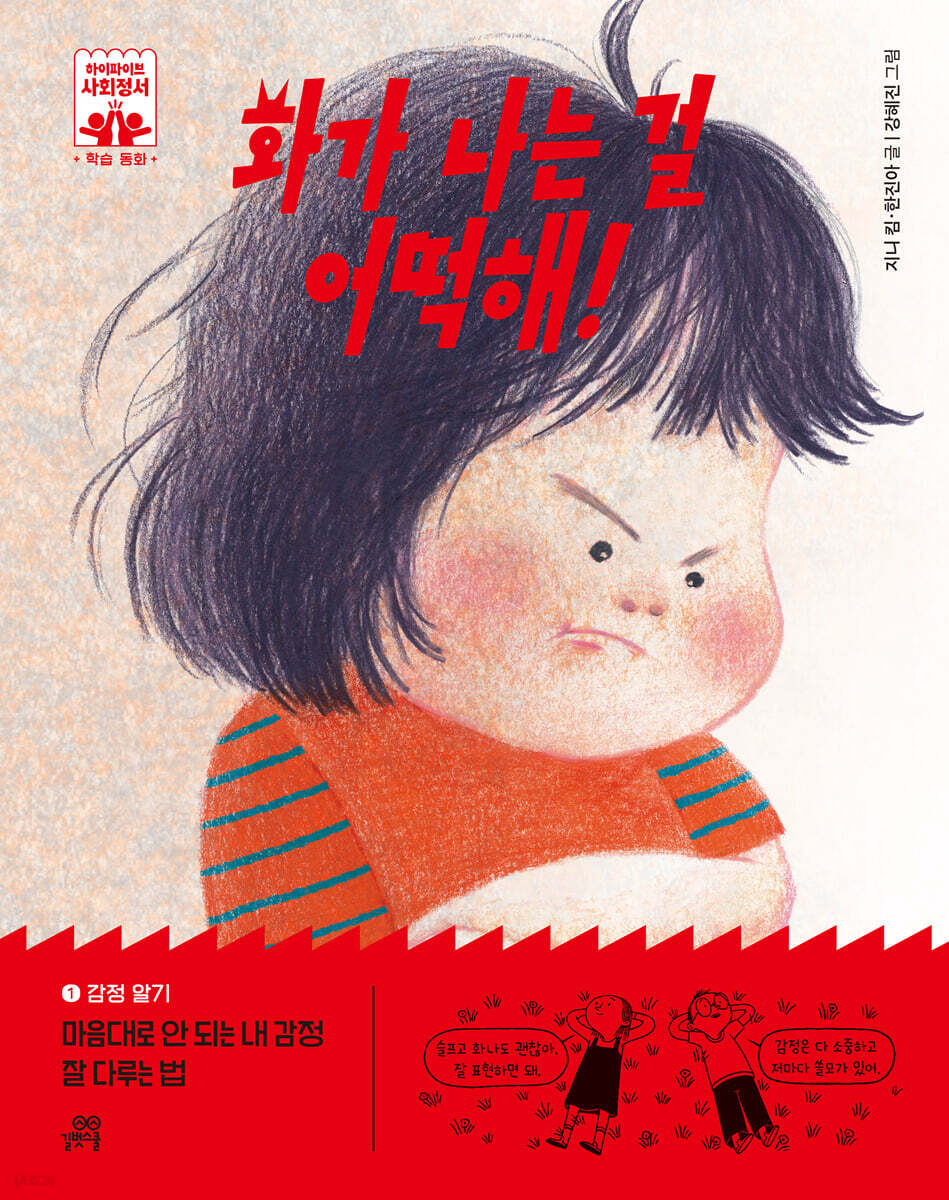
What should I do when I'm angry!
 |
Description
Book Introduction
Self-esteem and peer relationships both start with understanding emotions!
Please tell me there are healthier ways to express myself than crying, throwing tantrums, and sulking.
“So that the child can express his or her feelings comfortably
Please create a safe environment.
“Only the parent can do that.” (Harvard education expert Jeannie Kim)
“Do you find it difficult to accept your child’s negative emotions?
Do you end up yelling or ignoring them even though you know you shouldn't do it?
“Read this book with your child.” (Children’s book author Jinah Han)
When you look into it, there are actually many different names for emotions that we used to only express with words like “like,” “dislike,” and “annoying.”
Knowing the name for your emotions and understanding their purpose and purpose makes it easier to accept and express them.
Also, in this process, your understanding of yourself deepens and a positive self-image is formed.
Only by understanding your own emotions like this can you understand your friends' feelings and build healthy peer relationships.
Harvard education expert Dr. Jini Kim and children's book author teach you how to recognize, accept, and express emotions, and how to build a healthy mind based on these skills.
"What Should I Do When I'm Angry!" is the first picture book in the "High Five Social-Emotional Learning Fairy Tales."
Please tell me there are healthier ways to express myself than crying, throwing tantrums, and sulking.
“So that the child can express his or her feelings comfortably
Please create a safe environment.
“Only the parent can do that.” (Harvard education expert Jeannie Kim)
“Do you find it difficult to accept your child’s negative emotions?
Do you end up yelling or ignoring them even though you know you shouldn't do it?
“Read this book with your child.” (Children’s book author Jinah Han)
When you look into it, there are actually many different names for emotions that we used to only express with words like “like,” “dislike,” and “annoying.”
Knowing the name for your emotions and understanding their purpose and purpose makes it easier to accept and express them.
Also, in this process, your understanding of yourself deepens and a positive self-image is formed.
Only by understanding your own emotions like this can you understand your friends' feelings and build healthy peer relationships.
Harvard education expert Dr. Jini Kim and children's book author teach you how to recognize, accept, and express emotions, and how to build a healthy mind based on these skills.
"What Should I Do When I'm Angry!" is the first picture book in the "High Five Social-Emotional Learning Fairy Tales."
- You can preview some of the book's contents.
Preview
Detailed image

Into the book
Each emotion has a name. What is the first thing you do when making a friend?
That's right, know your friend's name!
Likewise, to become familiar with emotions, you must first know their names.
When you look into it, you realize that emotions that we used to only express with words like “like,” “dislike,” “annoying,” and “ah, I don’t know” actually have many different names.
The feelings that we used to just call “annoying” might have had names like anxious, tired, annoyed, frustrated, jealous, and disappointed.
The feelings expressed with the word “good” might have been names like refreshing, cool, happy, excited, proud, and loving.
Find a name that suits your feelings.
Like the stars in the night sky, emotions that were once intangible will come close enough to be touched.
--- p.8
Are all emotions valuable and useful? Are joy, pleasure, and happiness good emotions, while sadness, anger, worry, and fear are bad emotions?
No, there are no good or bad feelings.
The emotions we feel each have their own usefulness.
Sadness is a signal that your body and mind are tired and need rest.
Anger gives us the courage to confront what is wrong or unfair, and worry helps us prepare for what might happen in the future.
Fear doesn't make us run away or ask an adult for help when something dangerous happens.
--- p.16
What does it mean to express your emotions in a healthy way? It's okay to express your emotions freely, whether alone or with someone who respects your feelings, as long as it's not dangerous.
If you're happy, it's okay to jump up and down or scream.
If you're sad, it's okay to cry.
If you're scared, scream.
But you shouldn't do that in places where many people are together, such as libraries, classrooms, restaurants, or department stores.
The expression of emotions should also vary depending on the time and place.
Sometimes you may hate someone so much that you get angry.
There's nothing wrong with feeling that way.
But feeling that way doesn't mean you should hit someone or say bad things to them.
A good way to express your feelings calmly and verbally is to
That's right, know your friend's name!
Likewise, to become familiar with emotions, you must first know their names.
When you look into it, you realize that emotions that we used to only express with words like “like,” “dislike,” “annoying,” and “ah, I don’t know” actually have many different names.
The feelings that we used to just call “annoying” might have had names like anxious, tired, annoyed, frustrated, jealous, and disappointed.
The feelings expressed with the word “good” might have been names like refreshing, cool, happy, excited, proud, and loving.
Find a name that suits your feelings.
Like the stars in the night sky, emotions that were once intangible will come close enough to be touched.
--- p.8
Are all emotions valuable and useful? Are joy, pleasure, and happiness good emotions, while sadness, anger, worry, and fear are bad emotions?
No, there are no good or bad feelings.
The emotions we feel each have their own usefulness.
Sadness is a signal that your body and mind are tired and need rest.
Anger gives us the courage to confront what is wrong or unfair, and worry helps us prepare for what might happen in the future.
Fear doesn't make us run away or ask an adult for help when something dangerous happens.
--- p.16
What does it mean to express your emotions in a healthy way? It's okay to express your emotions freely, whether alone or with someone who respects your feelings, as long as it's not dangerous.
If you're happy, it's okay to jump up and down or scream.
If you're sad, it's okay to cry.
If you're scared, scream.
But you shouldn't do that in places where many people are together, such as libraries, classrooms, restaurants, or department stores.
The expression of emotions should also vary depending on the time and place.
Sometimes you may hate someone so much that you get angry.
There's nothing wrong with feeling that way.
But feeling that way doesn't mean you should hit someone or say bad things to them.
A good way to express your feelings calmly and verbally is to
--- p.20
Publisher's Review
It's okay to be sad, angry, or annoyed!
As long as you can express your emotions in a healthy way, that's all that matters!
How do you react when your child experiences negative emotions? Do you try to comfort them, downplay them, or scold them? These actions can lead your child to hide their emotions or express them in unhealthy ways.
To raise a child who can express and regulate his or her emotions healthily, we must first teach him or her three skills: recognizing, accepting, and expressing emotions.
As you read "What to Do When You're Angry!" together, teach your child how to name emotions, understand emotional signals, understand the reasons and uses of emotions, and express emotions appropriately at the right time and place. Teach them how to become the true masters of their own emotions.
The world's most affectionate and exciting cheer! "High Five Social-Emotional Learning Fairy Tale"
"What Should I Do When I'm Angry!" is the first picture book in the "High Five Social-Emotional Learning Fairy Tales."
The 'High Five Social Emotional' series is based on the Ministry of Education's social emotional education theory and was designed to help caregivers systematically develop and support their children's social emotional capabilities at home.
We selected seven core socio-emotional competencies, including understanding emotions, self-esteem, self-regulation, empathy, diversity, manners and etiquette, and good choices, and designed them so that these competencies are strengthened through a cycle.
As long as you can express your emotions in a healthy way, that's all that matters!
How do you react when your child experiences negative emotions? Do you try to comfort them, downplay them, or scold them? These actions can lead your child to hide their emotions or express them in unhealthy ways.
To raise a child who can express and regulate his or her emotions healthily, we must first teach him or her three skills: recognizing, accepting, and expressing emotions.
As you read "What to Do When You're Angry!" together, teach your child how to name emotions, understand emotional signals, understand the reasons and uses of emotions, and express emotions appropriately at the right time and place. Teach them how to become the true masters of their own emotions.
The world's most affectionate and exciting cheer! "High Five Social-Emotional Learning Fairy Tale"
"What Should I Do When I'm Angry!" is the first picture book in the "High Five Social-Emotional Learning Fairy Tales."
The 'High Five Social Emotional' series is based on the Ministry of Education's social emotional education theory and was designed to help caregivers systematically develop and support their children's social emotional capabilities at home.
We selected seven core socio-emotional competencies, including understanding emotions, self-esteem, self-regulation, empathy, diversity, manners and etiquette, and good choices, and designed them so that these competencies are strengthened through a cycle.
GOODS SPECIFICS
- Date of issue: May 15, 2025
- Page count, weight, size: 32 pages | 280g | 180*230*9mm
- ISBN13: 9791164069002
- ISBN10: 1164069004
- KC Certification: Certification Type: Conformity Confirmation
You may also like
카테고리
korean


korean

![GQ KOREA Mark (Monthly): December [2025]](http://librairie.coreenne.fr/cdn/shop/files/8ef265dbbfbf186523ed75ba7319009d.jpg?v=1765340328&width=3840)


