

Maybe a good age
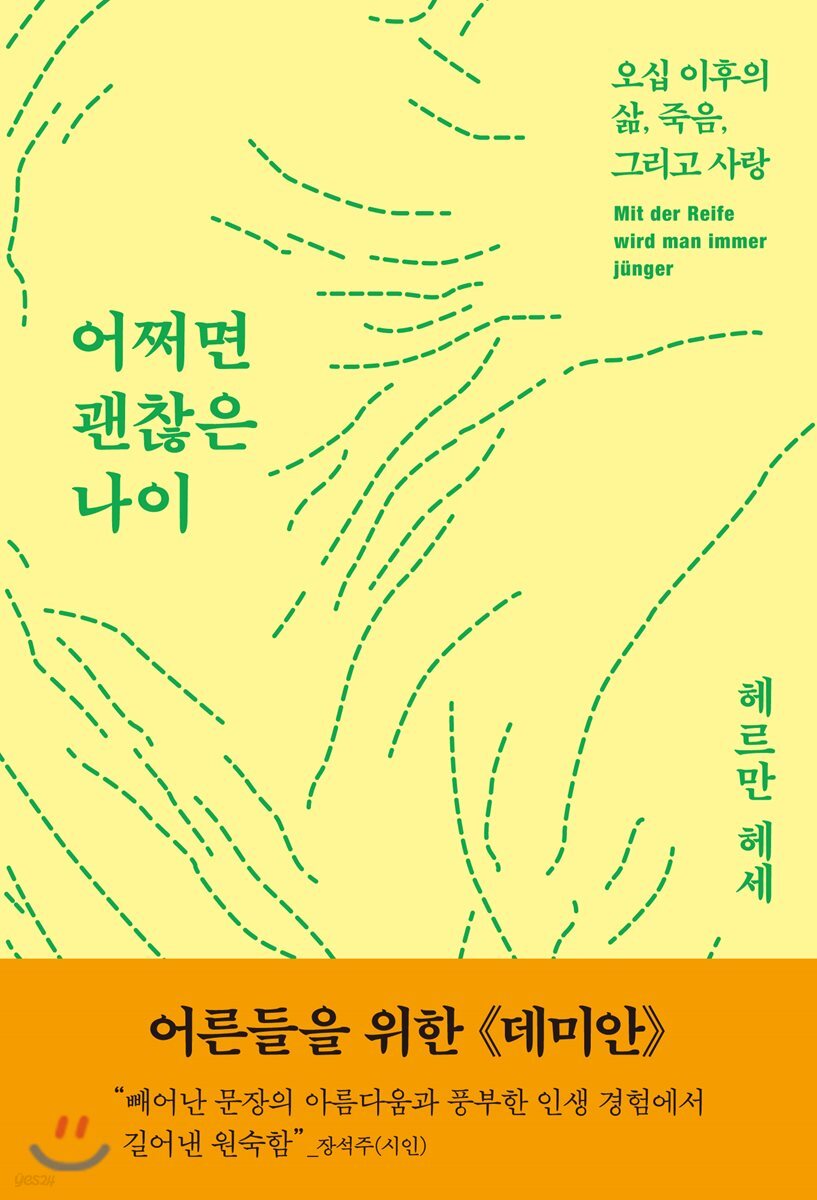 |
Description
Book Introduction
Demian for Adults
Hermann Hesse's "Aging Lessons"
The period after fifty requires more reflection and contemplation than any other stage of life.
My body isn't what it used to be, my memory is fading, my relationships are becoming more distant, and I'm experiencing a new level of fear about the future...
Growing old can be a bewildering experience for everyone, bringing about a different set of emotions: anxiety and worry, rather than anticipation and excitement.
This book is a collection of Hermann Hesse's writings on aging and old age.
Essays, poems, and aphorisms in elegant strokes blend together to create a beautiful symphony.
Hermann Hesse, the author of [Demian], a novel that sensitively captures the turning points of life, looks at the various phenomena that accompany aging with transparent intelligence.
The author's deep insight into the meaning of growing older, gained through living past the age of eighty, is presented in refreshing essays and poems.
Hermann Hesse's "Aging Lessons"
The period after fifty requires more reflection and contemplation than any other stage of life.
My body isn't what it used to be, my memory is fading, my relationships are becoming more distant, and I'm experiencing a new level of fear about the future...
Growing old can be a bewildering experience for everyone, bringing about a different set of emotions: anxiety and worry, rather than anticipation and excitement.
This book is a collection of Hermann Hesse's writings on aging and old age.
Essays, poems, and aphorisms in elegant strokes blend together to create a beautiful symphony.
Hermann Hesse, the author of [Demian], a novel that sensitively captures the turning points of life, looks at the various phenomena that accompany aging with transparent intelligence.
The author's deep insight into the meaning of growing older, gained through living past the age of eighty, is presented in refreshing essays and poems.
- You can preview some of the book's contents.
Preview
index
Part 1: What It Means to Get Old
Spring's Coming / Eavesdropping / The End of Summer / Growing Old 1 / Late Summer / About Time Gone / Sometimes / In the Nursing Home / Teaching / The Boatman / Time Flies! / A Fifty-Year-Old Man / Growing Old 2 / Nina and I Met Again
Part 2: Thoughts on Disappearing Things
In old age / The rise and fall of Max Wasmer on his sixtieth birthday / Sketches / Death / Restlessness / Withered leaves / Harmony of activity and rest / The March sun / On old age / Autumn rain / Gray winter days / A young boy / Stairs / The language of spring / A weary evening / The hands of an old man / The chimney sweep / Reminiscence / Return / Proverbs / Early autumn / Thoughts on things that disappear
Part 3: A Cry from Beyond Custom
Goodbye, beloved world / Sometimes / A cry from beyond custom / Late August / A budding branch / Autumn experience / Hearing the death of a friend / In late autumn / The meaning of experience / Let us go to loneliness / Initiation into old age / A Buddha statue in a Japanese mountain valley / A Chinese fable / A finger raised high / First snow / All death / Brother called death / A thousand years ago / A little song
Spring's Coming / Eavesdropping / The End of Summer / Growing Old 1 / Late Summer / About Time Gone / Sometimes / In the Nursing Home / Teaching / The Boatman / Time Flies! / A Fifty-Year-Old Man / Growing Old 2 / Nina and I Met Again
Part 2: Thoughts on Disappearing Things
In old age / The rise and fall of Max Wasmer on his sixtieth birthday / Sketches / Death / Restlessness / Withered leaves / Harmony of activity and rest / The March sun / On old age / Autumn rain / Gray winter days / A young boy / Stairs / The language of spring / A weary evening / The hands of an old man / The chimney sweep / Reminiscence / Return / Proverbs / Early autumn / Thoughts on things that disappear
Part 3: A Cry from Beyond Custom
Goodbye, beloved world / Sometimes / A cry from beyond custom / Late August / A budding branch / Autumn experience / Hearing the death of a friend / In late autumn / The meaning of experience / Let us go to loneliness / Initiation into old age / A Buddha statue in a Japanese mountain valley / A Chinese fable / A finger raised high / First snow / All death / Brother called death / A thousand years ago / A little song
Into the book
Old people don't take young people very seriously.
Of course, passion is a beautiful thing, and young people are great.
But older people need humor.
It makes you smile a little, it's not serious, and it captures the changing world in one picture.
Moreover, such humor allows us to observe things as if we were watching the passing sunset. --- p.30~31
The decade between the ages of forty and fifty is always a difficult time for emotionally rich people and artists.
It is a time when you often feel dissatisfied because your mind is anxious and it is difficult to properly balance life and yourself.
But then comes a time of comfort.
I didn't just feel it in myself, I observed it in many other people too.
Just as youth, with its seething heartache and heartache, was beautiful, so too is there beauty and joy in growing older and maturing. --- p.65
As people reach the age of fifty, they gradually lose their childish habits.
He gradually shakes off the idea of gaining fame and respect, and begins to look back on his past life without any passion.
You learn to wait, you learn to be silent, you learn to listen.
It is a great advantage to have such good things instead of becoming weak and feeble. --- p.68
Growing old doesn't just mean breaking down and withering.
It has its own value, as does every stage of life.
It has its own magic, its own unique wisdom, and its own unique sadness. --- p.102
Now, in the garden of old age, many flowers that we had not been able to cultivate before are blooming beautifully.
As the noble flower of patience blossoms, we will become more relaxed and generous. --- p.134
The best weapons to avoid living a mean life are courage, persistence, and perseverance.
Courage makes you strong, persistence makes you interesting, and patience gives you rest.
Unfortunately, people usually find out about it later in life.
Most people need it when they are battered by storms and when they are slowly approaching death. --- p.148
It is very difficult to grow old gracefully, to act in a way that befits our age, and to have wisdom.
In most cases, our souls tend to either precede or lag behind our bodies. --- p.151
In fact, there is no such thing as a completely new experience for older people.
These are all things I have already experienced in the past at a reasonable size.
The increasingly rare 'new' experiences are merely repetitions of experiences that have occurred many times before.
It's like painting new, light colors over dozens or hundreds of layers of old experiences on a canvas that appears to have been completed long ago.
Yet it is a new and authentic experience.
Although it is not primal, when considering various other aspects, it becomes an encounter with oneself and a test of oneself. --- p.237
Death is not accidental, meaningless, or cruel.
It's not that evil has taken the dead person, he has simply completed the task given to him in life.
And he goes back to get a new form and continue to influence.
The statement that “his life’s work is finished” does not mean that he could not continue to do valuable work for a long time, or that he was replaceable.
It means that the person himself has reached the deepest meaning in his life and has matured.
Of course, passion is a beautiful thing, and young people are great.
But older people need humor.
It makes you smile a little, it's not serious, and it captures the changing world in one picture.
Moreover, such humor allows us to observe things as if we were watching the passing sunset. --- p.30~31
The decade between the ages of forty and fifty is always a difficult time for emotionally rich people and artists.
It is a time when you often feel dissatisfied because your mind is anxious and it is difficult to properly balance life and yourself.
But then comes a time of comfort.
I didn't just feel it in myself, I observed it in many other people too.
Just as youth, with its seething heartache and heartache, was beautiful, so too is there beauty and joy in growing older and maturing. --- p.65
As people reach the age of fifty, they gradually lose their childish habits.
He gradually shakes off the idea of gaining fame and respect, and begins to look back on his past life without any passion.
You learn to wait, you learn to be silent, you learn to listen.
It is a great advantage to have such good things instead of becoming weak and feeble. --- p.68
Growing old doesn't just mean breaking down and withering.
It has its own value, as does every stage of life.
It has its own magic, its own unique wisdom, and its own unique sadness. --- p.102
Now, in the garden of old age, many flowers that we had not been able to cultivate before are blooming beautifully.
As the noble flower of patience blossoms, we will become more relaxed and generous. --- p.134
The best weapons to avoid living a mean life are courage, persistence, and perseverance.
Courage makes you strong, persistence makes you interesting, and patience gives you rest.
Unfortunately, people usually find out about it later in life.
Most people need it when they are battered by storms and when they are slowly approaching death. --- p.148
It is very difficult to grow old gracefully, to act in a way that befits our age, and to have wisdom.
In most cases, our souls tend to either precede or lag behind our bodies. --- p.151
In fact, there is no such thing as a completely new experience for older people.
These are all things I have already experienced in the past at a reasonable size.
The increasingly rare 'new' experiences are merely repetitions of experiences that have occurred many times before.
It's like painting new, light colors over dozens or hundreds of layers of old experiences on a canvas that appears to have been completed long ago.
Yet it is a new and authentic experience.
Although it is not primal, when considering various other aspects, it becomes an encounter with oneself and a test of oneself. --- p.237
Death is not accidental, meaningless, or cruel.
It's not that evil has taken the dead person, he has simply completed the task given to him in life.
And he goes back to get a new form and continue to influence.
The statement that “his life’s work is finished” does not mean that he could not continue to do valuable work for a long time, or that he was replaceable.
It means that the person himself has reached the deepest meaning in his life and has matured.
--- p.263
Publisher's Review
“Even if life deceives us,
The reason we love life so much.
“That is packed into this book.” _Jeong Yeo-ul (author)
Does growing older even have meaning? These days, "growing older" isn't exactly welcome.
Not only is one physically declining, but age itself is not as socially respected as it used to be.
Growing old often brings about feelings of depression, and people try to avoid it by living as young as possible.
In fact, the West during Hesse's time had a similar social atmosphere.
In both Germany and the United States, the 'worship of youth' spread like wildfire.
Hesse lived to be over eighty years old in such a cultural era.
Naturally, 'getting older' came to mind as one of his writing interests.
This book is a collection of essays and poems on the topics of 'aging' and 'old age' from Hesse's 14,000-page complete works and 35,000 letters.
The editor, Volker Michels, is an authority in this field who has edited and published numerous works by Hesse, including [The Letters of Hermann Hesse]. This book has been revised several times since its first publication in Germany in 1990 and has remained a steady seller ever since.
The latest revised edition of the German Amazon bestseller
"Maturity cultivated through rich life experience" _Jang Seok-ju (poet)
Most people are moved by Hesse's novel [Demian] during their school days.
“The bird breaks out of the egg.
The egg is the world.
“He who wants to be born must destroy a world.”
But perhaps human life requires a "second wandering," a "second hatching." After all, a period of mental confusion and wandering comes at least once before the age of fifty.
“The decade between the ages of forty and fifty is always a difficult time for emotional people and artists.
It is a time when you often feel dissatisfied because your mind is anxious and it is difficult to properly balance life and yourself.
But then comes a time of comfort.” (From the text)
What will Hesse have to say when we meet again at a crossroads of aging and maturity? Hesse doesn't draw a definitive conclusion.
Rather, he too hesitates and feels regret many times in the face of ‘aging.’
Such sincerity sometimes brings laughter, and sometimes resonates deeply.
Hesse says:
“There is beauty and joy in growing older and maturing.” His affirmation of aging gives readers great courage and wisdom.
The reason we love life so much.
“That is packed into this book.” _Jeong Yeo-ul (author)
Does growing older even have meaning? These days, "growing older" isn't exactly welcome.
Not only is one physically declining, but age itself is not as socially respected as it used to be.
Growing old often brings about feelings of depression, and people try to avoid it by living as young as possible.
In fact, the West during Hesse's time had a similar social atmosphere.
In both Germany and the United States, the 'worship of youth' spread like wildfire.
Hesse lived to be over eighty years old in such a cultural era.
Naturally, 'getting older' came to mind as one of his writing interests.
This book is a collection of essays and poems on the topics of 'aging' and 'old age' from Hesse's 14,000-page complete works and 35,000 letters.
The editor, Volker Michels, is an authority in this field who has edited and published numerous works by Hesse, including [The Letters of Hermann Hesse]. This book has been revised several times since its first publication in Germany in 1990 and has remained a steady seller ever since.
The latest revised edition of the German Amazon bestseller
"Maturity cultivated through rich life experience" _Jang Seok-ju (poet)
Most people are moved by Hesse's novel [Demian] during their school days.
“The bird breaks out of the egg.
The egg is the world.
“He who wants to be born must destroy a world.”
But perhaps human life requires a "second wandering," a "second hatching." After all, a period of mental confusion and wandering comes at least once before the age of fifty.
“The decade between the ages of forty and fifty is always a difficult time for emotional people and artists.
It is a time when you often feel dissatisfied because your mind is anxious and it is difficult to properly balance life and yourself.
But then comes a time of comfort.” (From the text)
What will Hesse have to say when we meet again at a crossroads of aging and maturity? Hesse doesn't draw a definitive conclusion.
Rather, he too hesitates and feels regret many times in the face of ‘aging.’
Such sincerity sometimes brings laughter, and sometimes resonates deeply.
Hesse says:
“There is beauty and joy in growing older and maturing.” His affirmation of aging gives readers great courage and wisdom.
GOODS SPECIFICS
- Date of publication: October 10, 2017
- Page count, weight, size: 292 pages | 364g | 128*188*20mm
- ISBN13: 9791196155605
- ISBN10: 1196155607
You may also like
카테고리
korean


korean

![GQ KOREA Mark (Monthly): December [2025]](http://librairie.coreenne.fr/cdn/shop/files/8ef265dbbfbf186523ed75ba7319009d.jpg?v=1765340328&width=3840)


