

Hillbilly Elegy
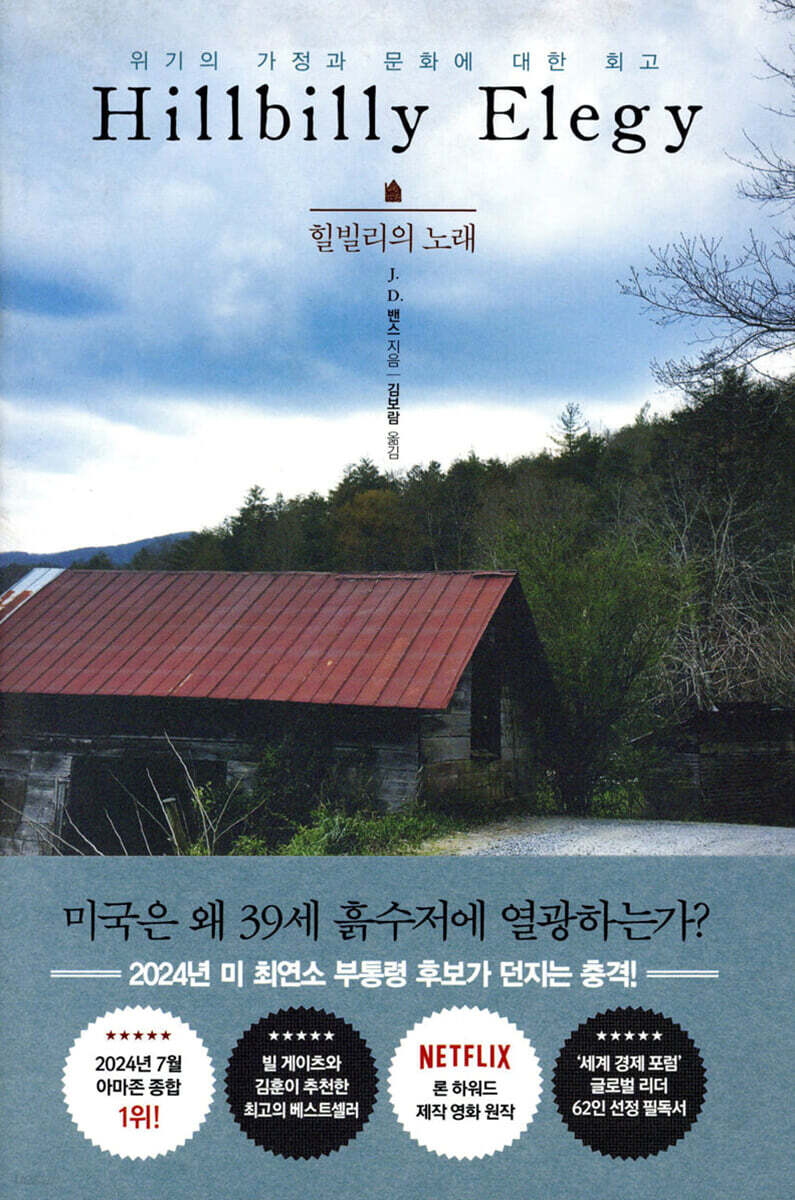 |
Description
Book Introduction
Ranked #1 on Amazon.com, #1 in nonfiction on the New York Times, and a hot topic recommended by Bill Gates and novelist Kim Hoon! A true story of growth for a young man who rises from the darkness of poverty and a crumbling family! 'Hillbilly' is a term used to describe poor and marginalized white people living in the Rust Belt, a declining industrial region of the United States. Author J. D. Vance is a 32-year-old hillbilly raised by a drug-addicted mother, a constant stream of potential fathers, and choleric, irascible grandparents who love their grandson more than anyone else. He faces the realities of moral and cultural breakdown, family disintegration, despair about the future, alienation, and poverty. And he published this book by projecting the impact of this phenomenon on human life onto the trajectory of his own short life. What was more painful to the author than material poverty was the spiritual poverty of not having someone to feel a sense of security and belonging, and not having a sense of purpose. Although Vance had successfully settled into society after graduating from Yale Law School, he could not abandon the world he had escaped, and so he wrote this book. |
- You can preview some of the book's contents.
Preview
index
/ Prologue
Part 1: The Roots of My Life, About Hillbillies
1 Hillbilly Village, Jackson
2 Marriage between grandmother and grandfather
3 Failed Middle Class
4. Declining Middletown
5 Long line of father candidates
6 Heavenly Father and Biological Father
7. Halbo's death and Mom's rampage
8 Feeling trapped
Part 2: A Hillbilly Stranger, But a Shadow You Can't Escape
9 Into the arms of grandmother
10 The Beginning of Independence and the Death of Grandmother
11 Most Pessimistic Groups in America
12 The Other Side of Status Rising
13 Their Own World
14 Monster in the Closet
15 Things Middletown Needs
/ Epilogue
/ Acknowledgements
/ Translator's Note
/ America
Part 1: The Roots of My Life, About Hillbillies
1 Hillbilly Village, Jackson
2 Marriage between grandmother and grandfather
3 Failed Middle Class
4. Declining Middletown
5 Long line of father candidates
6 Heavenly Father and Biological Father
7. Halbo's death and Mom's rampage
8 Feeling trapped
Part 2: A Hillbilly Stranger, But a Shadow You Can't Escape
9 Into the arms of grandmother
10 The Beginning of Independence and the Death of Grandmother
11 Most Pessimistic Groups in America
12 The Other Side of Status Rising
13 Their Own World
14 Monster in the Closet
15 Things Middletown Needs
/ Epilogue
/ Acknowledgements
/ Translator's Note
/ America
Detailed image
.jpg)
Into the book
Nobel Prize-winning economists are concerned about the decline of the Midwestern industrial belt and the collapse of the white working-class economic axis.
Manufacturing is moving overseas, and there are concerns that middle-class jobs are hard to come by without a college degree.
That's right.
I'm worried about that situation too.
But that is not the issue I want to address in this book.
This book is about what happens to real people's lives when the manufacturing economy collapses, about people reacting in the worst possible ways to bad situations, and about a culture that, rather than combating social corruption, promotes it.
--- pp.29~30
The truth is harsh.
Among them, the harshest truth for mountain people is that they must be honest about their situation.
Jackson is full of incredibly kind people.
But there are also drug addicts, and at least one person who has had time to raise eight children but no time to support them.
Jackson's scenery is undoubtedly beautiful, but its beauty is overshadowed by the environmental waste and trash strewn throughout the town.
Some people work hard, but many others live on food stamps and show no interest in sweating it out.
Jackson is as contradictory as the Blanton men.
--- p.54
Something I said as we entered the highway made my mom angry.
Then, my mother said that she wanted to die with me, running at a speed that must have been at least 100 miles per hour.
I quickly jumped to the back seat, thinking that maybe if I fastened both seat belts at once, I might be able to survive in the event of an accident.
My mother, who was furious at my behavior, stopped the car with the intention of beating me up.
Then I jumped out of the car and ran for my life.
The place I got out of the car was a remote rural village, and as soon as I got out, I ran at full speed across the wide grassy field.
As I picked up speed, the tall grasses slapped against my ankles.
--- p.137
Let's look back on my life before I moved into my grandmother's house.
During my third year of high school, my family moved to Preble County, where my Uncle Bob lived.
At the end of my senior year, I left Preble County and moved to 200 McKinley Street in Middletown.
Around the time I finished fifth grade, we moved to 300 McKinley Street, and that's when Uncle Chip showed up.
By the end of sixth grade, Uncle Chip was replaced by Uncle Steve.
At the end of seventh grade, Uncle Matt showed up, and Mom prepared to move into Uncle Matt's house.
When I finished eighth grade, my mom asked me to come to Dayton, and after a brief stay at my biological father's house, I accepted.
When I finished 9th grade, I went into the house of Uncle Ken, whom I had never seen before.
In the meantime, my mother was on drugs, was on trial for domestic violence, and my grandfather passed away.
Even now, just recalling the memories to write about the situation at that time brings on an indescribable, extreme anxiety.
--- pp.250-251
It was all thanks to my grandmother that I had friends who were eager to study.
By the time I was in the first year of middle school, most of the neighborhood kids my age were already smoking marijuana.
When my grandmother found out about this, she stopped me from associating with those kinds of kids.
Teenagers often ignore adult instructions not to hang out with certain friends, but that's probably because the adult giving the instructions isn't like Mrs. Vance.
My grandmother told me flat out that if she ever saw me hanging out with a friend on her banned list, she would immediately hit him in the car.
Then he whispered threateningly.
“No one will know that Grandma did that.”
--- p.256
Paying my grandmother's insurance premiums on her behalf made me feel like I was her guardian for the first time.
I felt a satisfaction I had never imagined before.
Before I joined the Marines, I had never touched money that could help someone.
No pep talk or lecture ever told me what it feels like to go from being cared for to caring for someone else.
That was something I had to realize on my own.
And once you wake up, you can never go back to the past.
--- pp.276-277
By the time I started my studies at Ohio State University, I had the unwavering determination I'd learned in the Marine Corps.
It was a tight schedule, but every aspect of independent living that had been terrifying when I was eighteen now felt like a piece of cake.
Just a few years ago, I was going through financial aid applications with my grandmother, and I was having a hard time deciding whether to put my mother's name or my grandmother's name in the "Parent/Guardian" field.
I was also worried that if I somehow obtained and submitted the financial information of my legal father, Bob Hamel, I would be charged with fraud.
Going through that process, I realized how ignorant I had been of how the world worked.
--- pp.296-297
I have friends who have grown into healthy adults, and others who have fallen victim to the terrible temptations of Middletown and become parents too young, addicted to drugs, or incarcerated.
Depending on whether or not they had expectations for their lives, some people became successful adults, while others became failures.
However, 'being left behind is not an individual's problem.
The voices of the right wing shouting, 'That is a failure of the government' are getting louder.
--- p.318
Throughout the week of interviews, I was amazed at how easily I could meet some of the most respected lawyers in America.
Just two years ago, after graduating from college, I applied to over a dozen places looking for a well-paying job, only to be rejected every time.
Yet, despite having only been at Yale Law School for a year, my classmates and I were being offered six-figure salaries by people who argued before the Supreme Court.
--- pp.343~344
It was around that time that Professor Amy Chua explained to me exactly what role a journal plays.
“If you plan to become a judge or professor, having experience as an editorial committee member will be useful.
Otherwise it's just a waste of time.
“If you’re not sure what you want to do yet, just give it a try.” That was million-dollar advice.
I wasn't sure what I wanted to do, so I decided to take on the challenge following my professor's advice.
Although he failed in his first year, he achieved his goal in his second year and became an editorial board member of a prestigious publication.
The point is not whether my writing was published or not.
The important thing is that the information gap was resolved thanks to the professor's help.
It felt as if I had new eyes to see the world.
--- p.349
My grandmother always resented the stereotype that hillbillies were all drooling fools.
But the reality was that I was very ignorant about getting ahead.
If you don't know what everyone else knows, you're likely to suffer serious financial losses.
I paid a heavy price in my undergraduate years for trying to get a job wearing Marine Corps combat boots and military pants, which were completely inappropriate for interviews, and I might have paid an even higher price in law school if it weren't for the people who helped me along the way.
--- pp.356-357
I am a graduate of Yale Law School, a former editor of the prestigious Yale Law Journal, and a member in good standing of the Bar Association.
Two months ago, on a clear day in eastern Kentucky, I got married to Usha.
By changing my last name to Vance, I finally have the same last name as my family.
I had a good job and was living happily.
I achieved my dream of becoming a millionaire, my American dream.
At least that's how it seemed to others.
But the rise in social status is never clear, and the world I left behind keeps trying to pull me back.
My mom started taking drugs again.
--- pp.378-379
I think we hillbillies are the toughest and most vicious people in the world.
We are the people who go after the person who insulted our mother and take a chainsaw to him.
We are also the ones who, in order to protect our sister's honor, would stuff our underwear into the mouth of the man who insulted our sister.
But let's think about it.
Are we strong enough to do what we must to help children like Brian? Are we strong enough to build churches that empower children like me to stand up for the world rather than turn away from it? Are we strong enough to look ourselves in the mirror and acknowledge the reality that we are engaging in behaviors that are harming children? Public policy can help solve the problem.
But there is no government anywhere that can solve our problems.
Manufacturing is moving overseas, and there are concerns that middle-class jobs are hard to come by without a college degree.
That's right.
I'm worried about that situation too.
But that is not the issue I want to address in this book.
This book is about what happens to real people's lives when the manufacturing economy collapses, about people reacting in the worst possible ways to bad situations, and about a culture that, rather than combating social corruption, promotes it.
--- pp.29~30
The truth is harsh.
Among them, the harshest truth for mountain people is that they must be honest about their situation.
Jackson is full of incredibly kind people.
But there are also drug addicts, and at least one person who has had time to raise eight children but no time to support them.
Jackson's scenery is undoubtedly beautiful, but its beauty is overshadowed by the environmental waste and trash strewn throughout the town.
Some people work hard, but many others live on food stamps and show no interest in sweating it out.
Jackson is as contradictory as the Blanton men.
--- p.54
Something I said as we entered the highway made my mom angry.
Then, my mother said that she wanted to die with me, running at a speed that must have been at least 100 miles per hour.
I quickly jumped to the back seat, thinking that maybe if I fastened both seat belts at once, I might be able to survive in the event of an accident.
My mother, who was furious at my behavior, stopped the car with the intention of beating me up.
Then I jumped out of the car and ran for my life.
The place I got out of the car was a remote rural village, and as soon as I got out, I ran at full speed across the wide grassy field.
As I picked up speed, the tall grasses slapped against my ankles.
--- p.137
Let's look back on my life before I moved into my grandmother's house.
During my third year of high school, my family moved to Preble County, where my Uncle Bob lived.
At the end of my senior year, I left Preble County and moved to 200 McKinley Street in Middletown.
Around the time I finished fifth grade, we moved to 300 McKinley Street, and that's when Uncle Chip showed up.
By the end of sixth grade, Uncle Chip was replaced by Uncle Steve.
At the end of seventh grade, Uncle Matt showed up, and Mom prepared to move into Uncle Matt's house.
When I finished eighth grade, my mom asked me to come to Dayton, and after a brief stay at my biological father's house, I accepted.
When I finished 9th grade, I went into the house of Uncle Ken, whom I had never seen before.
In the meantime, my mother was on drugs, was on trial for domestic violence, and my grandfather passed away.
Even now, just recalling the memories to write about the situation at that time brings on an indescribable, extreme anxiety.
--- pp.250-251
It was all thanks to my grandmother that I had friends who were eager to study.
By the time I was in the first year of middle school, most of the neighborhood kids my age were already smoking marijuana.
When my grandmother found out about this, she stopped me from associating with those kinds of kids.
Teenagers often ignore adult instructions not to hang out with certain friends, but that's probably because the adult giving the instructions isn't like Mrs. Vance.
My grandmother told me flat out that if she ever saw me hanging out with a friend on her banned list, she would immediately hit him in the car.
Then he whispered threateningly.
“No one will know that Grandma did that.”
--- p.256
Paying my grandmother's insurance premiums on her behalf made me feel like I was her guardian for the first time.
I felt a satisfaction I had never imagined before.
Before I joined the Marines, I had never touched money that could help someone.
No pep talk or lecture ever told me what it feels like to go from being cared for to caring for someone else.
That was something I had to realize on my own.
And once you wake up, you can never go back to the past.
--- pp.276-277
By the time I started my studies at Ohio State University, I had the unwavering determination I'd learned in the Marine Corps.
It was a tight schedule, but every aspect of independent living that had been terrifying when I was eighteen now felt like a piece of cake.
Just a few years ago, I was going through financial aid applications with my grandmother, and I was having a hard time deciding whether to put my mother's name or my grandmother's name in the "Parent/Guardian" field.
I was also worried that if I somehow obtained and submitted the financial information of my legal father, Bob Hamel, I would be charged with fraud.
Going through that process, I realized how ignorant I had been of how the world worked.
--- pp.296-297
I have friends who have grown into healthy adults, and others who have fallen victim to the terrible temptations of Middletown and become parents too young, addicted to drugs, or incarcerated.
Depending on whether or not they had expectations for their lives, some people became successful adults, while others became failures.
However, 'being left behind is not an individual's problem.
The voices of the right wing shouting, 'That is a failure of the government' are getting louder.
--- p.318
Throughout the week of interviews, I was amazed at how easily I could meet some of the most respected lawyers in America.
Just two years ago, after graduating from college, I applied to over a dozen places looking for a well-paying job, only to be rejected every time.
Yet, despite having only been at Yale Law School for a year, my classmates and I were being offered six-figure salaries by people who argued before the Supreme Court.
--- pp.343~344
It was around that time that Professor Amy Chua explained to me exactly what role a journal plays.
“If you plan to become a judge or professor, having experience as an editorial committee member will be useful.
Otherwise it's just a waste of time.
“If you’re not sure what you want to do yet, just give it a try.” That was million-dollar advice.
I wasn't sure what I wanted to do, so I decided to take on the challenge following my professor's advice.
Although he failed in his first year, he achieved his goal in his second year and became an editorial board member of a prestigious publication.
The point is not whether my writing was published or not.
The important thing is that the information gap was resolved thanks to the professor's help.
It felt as if I had new eyes to see the world.
--- p.349
My grandmother always resented the stereotype that hillbillies were all drooling fools.
But the reality was that I was very ignorant about getting ahead.
If you don't know what everyone else knows, you're likely to suffer serious financial losses.
I paid a heavy price in my undergraduate years for trying to get a job wearing Marine Corps combat boots and military pants, which were completely inappropriate for interviews, and I might have paid an even higher price in law school if it weren't for the people who helped me along the way.
--- pp.356-357
I am a graduate of Yale Law School, a former editor of the prestigious Yale Law Journal, and a member in good standing of the Bar Association.
Two months ago, on a clear day in eastern Kentucky, I got married to Usha.
By changing my last name to Vance, I finally have the same last name as my family.
I had a good job and was living happily.
I achieved my dream of becoming a millionaire, my American dream.
At least that's how it seemed to others.
But the rise in social status is never clear, and the world I left behind keeps trying to pull me back.
My mom started taking drugs again.
--- pp.378-379
I think we hillbillies are the toughest and most vicious people in the world.
We are the people who go after the person who insulted our mother and take a chainsaw to him.
We are also the ones who, in order to protect our sister's honor, would stuff our underwear into the mouth of the man who insulted our sister.
But let's think about it.
Are we strong enough to do what we must to help children like Brian? Are we strong enough to build churches that empower children like me to stand up for the world rather than turn away from it? Are we strong enough to look ourselves in the mirror and acknowledge the reality that we are engaging in behaviors that are harming children? Public policy can help solve the problem.
But there is no government anywhere that can solve our problems.
--- pp.404-405
Publisher's Review
· Highly recommended by Kim Hoon, a master of Korean literature and novelist.
· Bill Gates' "2017 Vacation Must-Reads"
· [New York Times] Bestseller for 55 consecutive weeks
· #1 Amazon bestseller for over 8 years since publication
· Academy Award-winning director Ron Howard's film [Hillbilly Elegy]
· A must-read for 62 global leaders selected by the World Economic Forum
· [The New York Times] [Bloomberg] [The Times] [The Sunday Times] [The Washington Post] [Kirkus Review]
· Selected as a 'Book of the Year (2016)' by major media outlets such as Amazon.com and NPR.
“A must-read at this very moment in history!”
The confession of a young man who shook American society, the protagonist of 'Hillbilly Elegy'
J., nominated as the Republican Party's vice presidential candidate.
D. Vance's autobiography
J., who was recently nominated as the Republican vice presidential candidate.
D. Vance's autobiography, Hillbilly Elegy, is receiving renewed attention.
His nomination is being evaluated as a demonstration of the Republican Party's vision for the future and its will to solve America's problems.
Indeed, Hillbilly Elegy is not simply an autobiography; it is a window into the social and economic problems facing America today.
Vance's nomination for vice president means his story is not just a recollection of the past, but can play a significant role in shaping present and future policies and visions.
His experiences represent a voice for marginalized groups in political discourse, and through this, symbolize his own efforts to bring about change and integration in American society.
After graduating from Yale Law School, one of the most prestigious law schools in the United States, Vance grew into a promising businessman in Silicon Valley.
He later entered politics by being elected to the Ohio State Senate in 2022.
His campaign centered on a strong message about addressing the economic downturn and social problems in the Rust Belt region, and this won him the support of voters.
Now, as the Republican nominee for Vice President, he is demonstrating his willingness to address America's problems from a higher position.
His political career stems from the deep insight and understanding of social issues he presented to the public through his first work, Hillbilly Elegy.
Currently, the book has nearly 96,000 reviews on Amazon.com, and reader ratings are close to 5 out of 5.
Since its publication in 2016, it has been ranked 1st to 3rd on the New York Times Bestseller list for 55 consecutive weeks and currently holds the top spot in its category (Sociology of Rural Areas).
Numerous media outlets selected this book as the 'Best Book of 2016', and it has been praised by opinion leaders in American society regardless of progressive or conservative, including Microsoft advisor Bill Gates, famous columnists such as David Brooks (New York Times), David Aronovich (Times), and Ian Birrell (Independent), PayPal founder Peter Thiel, Harvard economics professor Gregory Mankiw, and Yale Law School professor Amy Chua.
This book contains the author's memoirs of how, from the Rust Belt, a declining industrial area, the author overcame a drug-addicted mother, a father who gave up custody early, poverty, domestic violence, depression, and anxiety to graduate from Yale Law School and achieve what he calls "success."
What Vance reveals in this book is not a 'journey to success'.
Ironically, he gained fame as a writer by capturing the painful and desperate past of his memory in this book, and by revealing social problems that had been hidden in indifference from the perspective of the person involved.
The psychological poverty of Vance's childhood, confessed to by a white, male, heterosexual, Protestant, and proud Silicon Valley businessman, who graduated from a prestigious law school, has drawn even greater attention.
The Rust Belt region where he grew up, unlike iconic eastern cities like New York or Boston, is a harsh and isolated environment blocked by the Appalachian Mountains, where people who have given up on their futures are trapped in poverty and live amid domestic violence, family breakdown, and cultural isolation.
This place was evaluated as the main contributor to Trump's victory in the last election, which was considered unlikely.
The ignorant and violent "hillbillies" were a social problem and a target of the welfare system, but their voices were unfamiliar even in America.
Vance brought the social issues he had faced and those he left behind to the forefront of the world, for the marginalized who didn't even know how to make their voices heard.
And many readers expressed their sympathy and support.
Bill Gates praised the book:
“I was amazed that this book was not just remarkable, but also quite excellent.
I think Vance's courage played a part in this book's excellent reviews.
Vance learned early on from his maternal grandmother that "the worst thing you can do is betray your fellow human beings."
But in publishing this book, Vance risked being labeled a traitor, to borrow the author's words, for exposing a culture suffering from self-inflicted wounds." David Brooks, a renowned columnist and historian, also praised the book in his review for the New York Times, saying that it accurately pointed out "the problem of the loss of social institutions and cultural values that allow us to nurture self-esteem in the face of adversity," and that it was "a must-read at this moment in history."
Vance's story also has important implications for the issues of conservatism and progressivism.
Conservatives emphasize traditional values and self-reliance, while progressives prioritize social safety nets and equality.
Vance's experience symbolizes an attempt to balance these two perspectives and understand the nature of social problems from different perspectives.
His memoir vividly illustrates how issues like poverty, education, and family breakdown impact individual lives, highlighting the need for political and social dialogue to address these issues.
Vance's nomination for vice president signifies that his personal experience and insight could play a vital role in addressing current social problems in America.
Hillbilly Elegy is not just a story of the past; it will serve as an important passageway for understanding American society today and in the future.
“I was one of those children who faced a miserable future.”
A heartfelt narrative about family that everyone can relate to.
In this book, 32-year-old Vance projects the cultural turmoil and social problems faced by young people in the economically depressed Rust Belt region onto his own life trajectory.
The rise of the marginalized class due to social polarization, the disintegration of families, and the resignation to a future without hope are widespread in our society.
As numerous studies conducted in Korea have concluded that parents' education and wealth determine their children's social status, our society no longer allows for 'grassroots'.
According to the Korea Institute of Public Administration's '2016 Social Integration Survey', respondents gave an average of 2.4 points (out of 4) to the question asking about the possibility of their social and economic status rising through effort.
This is the lowest level since 2013, when the Korea Institute for Public Administration began its survey on this issue, as well as the results of the 2015 survey (2.6 points).
The possibility of social upward mobility is also blocked in the United States.
In the introduction to the book, Vance describes himself as follows:
I grew up poor in a steel town in Ohio, in the Rust Belt.
If I recall correctly, it was a neighborhood where jobs and hope were disappearing at an uncontrollable rate.
My relationship with my parents is complicated, to put it mildly, and my mother has been struggling with drug addiction since almost the day I was born.
My maternal grandparents, who raised me, didn't even graduate from high school, and even including my relatives, almost no one in my family went on to college.
Statistically, the future for children like me is bleak.
If you're lucky, you'll avoid becoming a welfare recipient, but if you're unlucky, you'll die from a heroin overdose.
(…) I was also one of the children facing a miserable future.
(From the prologue)
Moreover, to borrow Vance's words, he is "a son abandoned by a man he barely knows and a woman he would have been better off not knowing" (p. 42).
Young Vance was constantly plagued by anxiety and depression due to his mother's drug addiction and constant physical and mental abuse, his father's abandonment of custody for money, and the countless potential fathers who passed by his mother.
Home was a place that filled Vance with fear and dread, to the point where “when the bell to signal dismissal approached, his heart would sink” (p. 130).
After being separated from his grandmother, who had been his greatest support when he had nowhere to rely on emotionally, and going to live with his stepfather, Vance's school life became a mess, and he "nearly avoided dropping out of high school and was on the verge of breaking down, unable to overcome the boiling anger he felt toward those around him." (p. 22) So, Vance was greatly shocked to find out that his wife, Usha, whom he met at Yale, had a peaceful family.
In my wife's family, even if there were differences of opinion, it did not lead to violent arguments or assault.
The scene where Vance's mother, who had been apologizing for her drug addiction and violence, suddenly confesses to the death threats she had inflicted on a twelve-year-old boy is so painful that it makes one wonder how he ever got his life back on track.
Later in the book, Vance reveals that his mother was also a victim of constant bickering, his grandmother's alcoholism, his grandmother's indifference, and domestic violence.
The scene where Vance unilaterally loses his temper with his wife, Usha, and then reproaches himself, saying, “Even when I’m perfectly fine, I’m like a time bomb” (p. 369) vividly reveals how difficult it is to erase the scars of violence that parents pass on to their children.
People I've met recently think I'm some kind of genius just by looking at my Ivy League degree and my job title.
I believe that only exceptionally outstanding people can reach my current position.
I'm sorry to say this to those people, but it's all bullshit.
I couldn't even talk about innate talent, because I was struggling in a slum life until a few people I loved came to my rescue.
(From the prologue)
Even in this unstable environment, Vance became a 'dog' with the love of his grandmother and grandfather and the support and care of his older sister, the only true adult in the family (p. 148).
Vance expressed gratitude to his family, including his mother, saying, “If any of them hadn’t been a variable in the equation of my life, I probably would have been a mess.
Other people who have succeeded against slim odds have confessed that they have experienced interventions of a similar type to what I have experienced” (p. 382).
This is why Vance refers to himself as “a damn lucky son of a bitch” (p. 402).
“A level of cynicism that could almost be called religious was widespread.”
The reality of a world where 'cultural disconnection' and 'lack of social capital' coexist
Hillbilly Elegy is divided into two main parts.
One part is the family story that Vance vividly describes so vividly that it feels like it's something I've actually experienced, and the other part is the issues that Vance raises.
Among these, this is a particularly important issue.
How much of the hillbillies' misfortune are they responsible for? Here, Vance seems determined to deliver a poignant, yet loving, critique.
Much of Vance's personal story revolves around his slow and painful separation from "hillbilly culture."
Leaving his insane mother and living with his grandmother, he graduated from school and then volunteered for the Marine Corps, which was a major turning point in his life.
His time in the Marine Corps gave him confidence and a sense of purpose, and the hope that he could achieve anything if he worked hard.
I'm not saying that ability isn't important.
Of course, ability is a big help.
However, it is very important to realize that we have been living our lives lowering our self-worth by mistaking lack of effort for lack of ability.
That's why whenever people ask me what I'd most like to change about the white working class, I say, "The feeling that their decisions don't matter."
The Marines cut that out of me like a surgeon cuts out a tumor.
(From Chapter 10, 'The Beginning of Independence and Grandmother's Death')
Meanwhile, Vance's friends who remained in Middletown had fallen into "learned helplessness," believing that upward mobility was a lifelong impossibility and had given up on the future early on, possessing only "a cynicism that borders on religious" (p. 309).
Vance says that his aunt, Lori, and his older sister, Lindsay, have had happy family lives, unlike their mother, because they married people from a different culture than the hillbilly.
Vance, too, sought to escape the hillbilly culture that had become a stigma in his mind by marrying a girlfriend who had grown up in a different culture than the hillbillies, where poverty had become a culture.
As an insider growing up in hillbilly culture and an outsider in a new world, Vance experienced a confusion that was both funny and sad.
When I was attending Ohio State University, I didn't have any basic interview knowledge, so I went in wearing military pants, a shabby lime green shirt, and Marine Corps combat boots, which were my only alternative to sneakers, and was turned down.
Although he was armed with the spirit of the Marine Corps, he entered Yale Law School simply because he didn't want to work hard and see blood, as he didn't know any other profession that would be considered successful besides being a doctor or a lawyer.
Even after studying enough to attend an interview party attended by recruiters from prestigious law firms, I almost embarrassed myself by not knowing the true nature of “sparkling water” (p. 341), which refers to carbonated water.
This passage gives us an idea of how culturally disconnected Vance was.
Before he met Professor Amy Chua at Yale Law School, he had no adult by his side who could offer him serious advice and direction in life, or anyone he could look up to as a role model.
Vance calls this the "absence of social capital," explaining why prestigious schools like Yale are filled with students from incredibly wealthy families, regardless of race.
Cultural divides and the absence of social capital have created barriers between classes that welfare systems and scholarships simply cannot bridge.
As HuffPost columnist Peter Clossier noted in his review, “If you grew up in a well-to-do, middle-class family and received a decent education within a decent school system, this book will open your eyes to what the other half of people live like.”
Cultural and social disconnects between classes are making inter-class mobility increasingly difficult, not only in the United States but also in our country.
A world so polarized becomes a breeding ground for political populism that seduces isolated and marginalized groups.
While intellectuals focus on the debate over welfare systems, culturally marginalized groups are consuming politics as an outlet for their frustration and anger rather than listening to policies and visions.
Hillbilly Elegy asks what choices individuals and society should make and what responsibilities they should bear in the complex web of family and welfare, jobs and education, politics and culture.
This is why this book caused a stir in American intellectual circles.
“It’s shocking, heartbreaking, painful, and utterly hilarious all at the same time.”
A captivating narrative, filled with literary delight and emotion.
J.
In this book, D. Vance unfilteredly describes the family as both the root and obstacle of life, the source of happiness and anxiety, the mental poverty that eats away at them, and the crucial influence of a stable environment on human growth.
It also details the discrimination Vance felt at Yale (one professor thought Yale Law School should only admit Ivy Leaguers because it doesn't offer supplementary classes, p. 327) and the unbridgeable gap (Vance took his Yale friends to his favorite restaurant, but to them it was "just a filthy restaurant that threatened public health," p. 335).
By incorporating weighty themes of ethical and cultural breakdown, domestic violence and family breakdown, alienation and poverty into the gentle narrative of a coming-of-age essay, he succeeds in effectively conveying his message to readers.
The power of the story in Hillbilly Elegy is so great that Academy Award-winning director Ron Howard decided to make the book into a film.
The vivid descriptions and seamless narrative that draw you in the moment you read provide the same enjoyment as reading a novel.
The fact that Kim Hoon, a master novelist in the Korean literary world, wrote an unprecedentedly long review of this book, not in a novel but in a foreign essay, saying, “It is the story of a person who found hope in the midst of poverty,” is a testament to the power of the book’s ‘story.’
As Yale Law School professor Amy Chua put it, “Hillbilly Elegy is shocking, heartbreaking, painful, and utterly hilarious.
“This is a truly remarkable book, offering genuine hope amidst shocking truths.”
Hillbilly Elegy offers two gifts: literary entertainment and a social awakening.
The reader gets what he wants.
There is no need to approach this book solely from the heavy perspective of social issues.
It would be nice to read it just for fun, like a novel.
When you close the last page, you will have many thoughts lingering in your mind.
· Bill Gates' "2017 Vacation Must-Reads"
· [New York Times] Bestseller for 55 consecutive weeks
· #1 Amazon bestseller for over 8 years since publication
· Academy Award-winning director Ron Howard's film [Hillbilly Elegy]
· A must-read for 62 global leaders selected by the World Economic Forum
· [The New York Times] [Bloomberg] [The Times] [The Sunday Times] [The Washington Post] [Kirkus Review]
· Selected as a 'Book of the Year (2016)' by major media outlets such as Amazon.com and NPR.
“A must-read at this very moment in history!”
The confession of a young man who shook American society, the protagonist of 'Hillbilly Elegy'
J., nominated as the Republican Party's vice presidential candidate.
D. Vance's autobiography
J., who was recently nominated as the Republican vice presidential candidate.
D. Vance's autobiography, Hillbilly Elegy, is receiving renewed attention.
His nomination is being evaluated as a demonstration of the Republican Party's vision for the future and its will to solve America's problems.
Indeed, Hillbilly Elegy is not simply an autobiography; it is a window into the social and economic problems facing America today.
Vance's nomination for vice president means his story is not just a recollection of the past, but can play a significant role in shaping present and future policies and visions.
His experiences represent a voice for marginalized groups in political discourse, and through this, symbolize his own efforts to bring about change and integration in American society.
After graduating from Yale Law School, one of the most prestigious law schools in the United States, Vance grew into a promising businessman in Silicon Valley.
He later entered politics by being elected to the Ohio State Senate in 2022.
His campaign centered on a strong message about addressing the economic downturn and social problems in the Rust Belt region, and this won him the support of voters.
Now, as the Republican nominee for Vice President, he is demonstrating his willingness to address America's problems from a higher position.
His political career stems from the deep insight and understanding of social issues he presented to the public through his first work, Hillbilly Elegy.
Currently, the book has nearly 96,000 reviews on Amazon.com, and reader ratings are close to 5 out of 5.
Since its publication in 2016, it has been ranked 1st to 3rd on the New York Times Bestseller list for 55 consecutive weeks and currently holds the top spot in its category (Sociology of Rural Areas).
Numerous media outlets selected this book as the 'Best Book of 2016', and it has been praised by opinion leaders in American society regardless of progressive or conservative, including Microsoft advisor Bill Gates, famous columnists such as David Brooks (New York Times), David Aronovich (Times), and Ian Birrell (Independent), PayPal founder Peter Thiel, Harvard economics professor Gregory Mankiw, and Yale Law School professor Amy Chua.
This book contains the author's memoirs of how, from the Rust Belt, a declining industrial area, the author overcame a drug-addicted mother, a father who gave up custody early, poverty, domestic violence, depression, and anxiety to graduate from Yale Law School and achieve what he calls "success."
What Vance reveals in this book is not a 'journey to success'.
Ironically, he gained fame as a writer by capturing the painful and desperate past of his memory in this book, and by revealing social problems that had been hidden in indifference from the perspective of the person involved.
The psychological poverty of Vance's childhood, confessed to by a white, male, heterosexual, Protestant, and proud Silicon Valley businessman, who graduated from a prestigious law school, has drawn even greater attention.
The Rust Belt region where he grew up, unlike iconic eastern cities like New York or Boston, is a harsh and isolated environment blocked by the Appalachian Mountains, where people who have given up on their futures are trapped in poverty and live amid domestic violence, family breakdown, and cultural isolation.
This place was evaluated as the main contributor to Trump's victory in the last election, which was considered unlikely.
The ignorant and violent "hillbillies" were a social problem and a target of the welfare system, but their voices were unfamiliar even in America.
Vance brought the social issues he had faced and those he left behind to the forefront of the world, for the marginalized who didn't even know how to make their voices heard.
And many readers expressed their sympathy and support.
Bill Gates praised the book:
“I was amazed that this book was not just remarkable, but also quite excellent.
I think Vance's courage played a part in this book's excellent reviews.
Vance learned early on from his maternal grandmother that "the worst thing you can do is betray your fellow human beings."
But in publishing this book, Vance risked being labeled a traitor, to borrow the author's words, for exposing a culture suffering from self-inflicted wounds." David Brooks, a renowned columnist and historian, also praised the book in his review for the New York Times, saying that it accurately pointed out "the problem of the loss of social institutions and cultural values that allow us to nurture self-esteem in the face of adversity," and that it was "a must-read at this moment in history."
Vance's story also has important implications for the issues of conservatism and progressivism.
Conservatives emphasize traditional values and self-reliance, while progressives prioritize social safety nets and equality.
Vance's experience symbolizes an attempt to balance these two perspectives and understand the nature of social problems from different perspectives.
His memoir vividly illustrates how issues like poverty, education, and family breakdown impact individual lives, highlighting the need for political and social dialogue to address these issues.
Vance's nomination for vice president signifies that his personal experience and insight could play a vital role in addressing current social problems in America.
Hillbilly Elegy is not just a story of the past; it will serve as an important passageway for understanding American society today and in the future.
“I was one of those children who faced a miserable future.”
A heartfelt narrative about family that everyone can relate to.
In this book, 32-year-old Vance projects the cultural turmoil and social problems faced by young people in the economically depressed Rust Belt region onto his own life trajectory.
The rise of the marginalized class due to social polarization, the disintegration of families, and the resignation to a future without hope are widespread in our society.
As numerous studies conducted in Korea have concluded that parents' education and wealth determine their children's social status, our society no longer allows for 'grassroots'.
According to the Korea Institute of Public Administration's '2016 Social Integration Survey', respondents gave an average of 2.4 points (out of 4) to the question asking about the possibility of their social and economic status rising through effort.
This is the lowest level since 2013, when the Korea Institute for Public Administration began its survey on this issue, as well as the results of the 2015 survey (2.6 points).
The possibility of social upward mobility is also blocked in the United States.
In the introduction to the book, Vance describes himself as follows:
I grew up poor in a steel town in Ohio, in the Rust Belt.
If I recall correctly, it was a neighborhood where jobs and hope were disappearing at an uncontrollable rate.
My relationship with my parents is complicated, to put it mildly, and my mother has been struggling with drug addiction since almost the day I was born.
My maternal grandparents, who raised me, didn't even graduate from high school, and even including my relatives, almost no one in my family went on to college.
Statistically, the future for children like me is bleak.
If you're lucky, you'll avoid becoming a welfare recipient, but if you're unlucky, you'll die from a heroin overdose.
(…) I was also one of the children facing a miserable future.
(From the prologue)
Moreover, to borrow Vance's words, he is "a son abandoned by a man he barely knows and a woman he would have been better off not knowing" (p. 42).
Young Vance was constantly plagued by anxiety and depression due to his mother's drug addiction and constant physical and mental abuse, his father's abandonment of custody for money, and the countless potential fathers who passed by his mother.
Home was a place that filled Vance with fear and dread, to the point where “when the bell to signal dismissal approached, his heart would sink” (p. 130).
After being separated from his grandmother, who had been his greatest support when he had nowhere to rely on emotionally, and going to live with his stepfather, Vance's school life became a mess, and he "nearly avoided dropping out of high school and was on the verge of breaking down, unable to overcome the boiling anger he felt toward those around him." (p. 22) So, Vance was greatly shocked to find out that his wife, Usha, whom he met at Yale, had a peaceful family.
In my wife's family, even if there were differences of opinion, it did not lead to violent arguments or assault.
The scene where Vance's mother, who had been apologizing for her drug addiction and violence, suddenly confesses to the death threats she had inflicted on a twelve-year-old boy is so painful that it makes one wonder how he ever got his life back on track.
Later in the book, Vance reveals that his mother was also a victim of constant bickering, his grandmother's alcoholism, his grandmother's indifference, and domestic violence.
The scene where Vance unilaterally loses his temper with his wife, Usha, and then reproaches himself, saying, “Even when I’m perfectly fine, I’m like a time bomb” (p. 369) vividly reveals how difficult it is to erase the scars of violence that parents pass on to their children.
People I've met recently think I'm some kind of genius just by looking at my Ivy League degree and my job title.
I believe that only exceptionally outstanding people can reach my current position.
I'm sorry to say this to those people, but it's all bullshit.
I couldn't even talk about innate talent, because I was struggling in a slum life until a few people I loved came to my rescue.
(From the prologue)
Even in this unstable environment, Vance became a 'dog' with the love of his grandmother and grandfather and the support and care of his older sister, the only true adult in the family (p. 148).
Vance expressed gratitude to his family, including his mother, saying, “If any of them hadn’t been a variable in the equation of my life, I probably would have been a mess.
Other people who have succeeded against slim odds have confessed that they have experienced interventions of a similar type to what I have experienced” (p. 382).
This is why Vance refers to himself as “a damn lucky son of a bitch” (p. 402).
“A level of cynicism that could almost be called religious was widespread.”
The reality of a world where 'cultural disconnection' and 'lack of social capital' coexist
Hillbilly Elegy is divided into two main parts.
One part is the family story that Vance vividly describes so vividly that it feels like it's something I've actually experienced, and the other part is the issues that Vance raises.
Among these, this is a particularly important issue.
How much of the hillbillies' misfortune are they responsible for? Here, Vance seems determined to deliver a poignant, yet loving, critique.
Much of Vance's personal story revolves around his slow and painful separation from "hillbilly culture."
Leaving his insane mother and living with his grandmother, he graduated from school and then volunteered for the Marine Corps, which was a major turning point in his life.
His time in the Marine Corps gave him confidence and a sense of purpose, and the hope that he could achieve anything if he worked hard.
I'm not saying that ability isn't important.
Of course, ability is a big help.
However, it is very important to realize that we have been living our lives lowering our self-worth by mistaking lack of effort for lack of ability.
That's why whenever people ask me what I'd most like to change about the white working class, I say, "The feeling that their decisions don't matter."
The Marines cut that out of me like a surgeon cuts out a tumor.
(From Chapter 10, 'The Beginning of Independence and Grandmother's Death')
Meanwhile, Vance's friends who remained in Middletown had fallen into "learned helplessness," believing that upward mobility was a lifelong impossibility and had given up on the future early on, possessing only "a cynicism that borders on religious" (p. 309).
Vance says that his aunt, Lori, and his older sister, Lindsay, have had happy family lives, unlike their mother, because they married people from a different culture than the hillbilly.
Vance, too, sought to escape the hillbilly culture that had become a stigma in his mind by marrying a girlfriend who had grown up in a different culture than the hillbillies, where poverty had become a culture.
As an insider growing up in hillbilly culture and an outsider in a new world, Vance experienced a confusion that was both funny and sad.
When I was attending Ohio State University, I didn't have any basic interview knowledge, so I went in wearing military pants, a shabby lime green shirt, and Marine Corps combat boots, which were my only alternative to sneakers, and was turned down.
Although he was armed with the spirit of the Marine Corps, he entered Yale Law School simply because he didn't want to work hard and see blood, as he didn't know any other profession that would be considered successful besides being a doctor or a lawyer.
Even after studying enough to attend an interview party attended by recruiters from prestigious law firms, I almost embarrassed myself by not knowing the true nature of “sparkling water” (p. 341), which refers to carbonated water.
This passage gives us an idea of how culturally disconnected Vance was.
Before he met Professor Amy Chua at Yale Law School, he had no adult by his side who could offer him serious advice and direction in life, or anyone he could look up to as a role model.
Vance calls this the "absence of social capital," explaining why prestigious schools like Yale are filled with students from incredibly wealthy families, regardless of race.
Cultural divides and the absence of social capital have created barriers between classes that welfare systems and scholarships simply cannot bridge.
As HuffPost columnist Peter Clossier noted in his review, “If you grew up in a well-to-do, middle-class family and received a decent education within a decent school system, this book will open your eyes to what the other half of people live like.”
Cultural and social disconnects between classes are making inter-class mobility increasingly difficult, not only in the United States but also in our country.
A world so polarized becomes a breeding ground for political populism that seduces isolated and marginalized groups.
While intellectuals focus on the debate over welfare systems, culturally marginalized groups are consuming politics as an outlet for their frustration and anger rather than listening to policies and visions.
Hillbilly Elegy asks what choices individuals and society should make and what responsibilities they should bear in the complex web of family and welfare, jobs and education, politics and culture.
This is why this book caused a stir in American intellectual circles.
“It’s shocking, heartbreaking, painful, and utterly hilarious all at the same time.”
A captivating narrative, filled with literary delight and emotion.
J.
In this book, D. Vance unfilteredly describes the family as both the root and obstacle of life, the source of happiness and anxiety, the mental poverty that eats away at them, and the crucial influence of a stable environment on human growth.
It also details the discrimination Vance felt at Yale (one professor thought Yale Law School should only admit Ivy Leaguers because it doesn't offer supplementary classes, p. 327) and the unbridgeable gap (Vance took his Yale friends to his favorite restaurant, but to them it was "just a filthy restaurant that threatened public health," p. 335).
By incorporating weighty themes of ethical and cultural breakdown, domestic violence and family breakdown, alienation and poverty into the gentle narrative of a coming-of-age essay, he succeeds in effectively conveying his message to readers.
The power of the story in Hillbilly Elegy is so great that Academy Award-winning director Ron Howard decided to make the book into a film.
The vivid descriptions and seamless narrative that draw you in the moment you read provide the same enjoyment as reading a novel.
The fact that Kim Hoon, a master novelist in the Korean literary world, wrote an unprecedentedly long review of this book, not in a novel but in a foreign essay, saying, “It is the story of a person who found hope in the midst of poverty,” is a testament to the power of the book’s ‘story.’
As Yale Law School professor Amy Chua put it, “Hillbilly Elegy is shocking, heartbreaking, painful, and utterly hilarious.
“This is a truly remarkable book, offering genuine hope amidst shocking truths.”
Hillbilly Elegy offers two gifts: literary entertainment and a social awakening.
The reader gets what he wants.
There is no need to approach this book solely from the heavy perspective of social issues.
It would be nice to read it just for fun, like a novel.
When you close the last page, you will have many thoughts lingering in your mind.
GOODS SPECIFICS
- Date of publication: August 21, 2017
- Page count, weight, size: 424 pages | 556g | 135*205*30mm
- ISBN13: 9788965962281
- ISBN10: 8965962285
You may also like
카테고리
korean


korean

![GQ KOREA Mark (Monthly): December [2025]](http://librairie.coreenne.fr/cdn/shop/files/8ef265dbbfbf186523ed75ba7319009d.jpg?v=1765340328&width=3840)


