

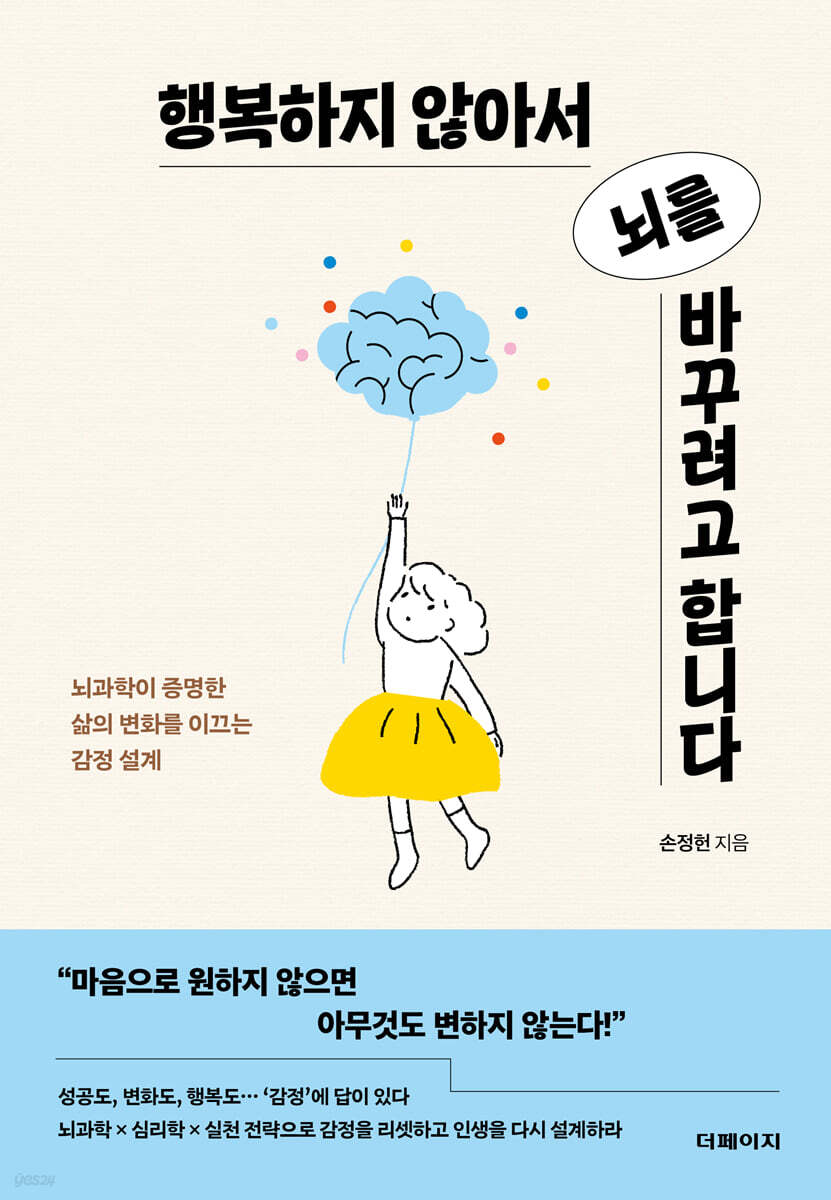
I'm trying to change my brain because I'm not happy.
 |
Description
Book Introduction
“If you want to change your frustrating life, start by designing your ‘emotions’!”
This book is about 'Why can't we change even though we know?'
Provides scientific and practical answers
“I made a resolution, but why do I keep putting it off?”, “My plans are perfect, but why do they always last only three days?”, “Why do I keep having the same regrets?” When faced with questions like these, we often blame our reason.
It's because of weak will, lack of thought, and lack of training.
But this book directly challenges this familiar convention.
The author states firmly:
“It’s not the thoughts, it’s the ‘feelings’ that matter.” He delved deeply into over 1,000 books on biology, psychology, and brain science, and the insights he gained from them fundamentally changed his life.
And rather than simply providing emotional comfort, it scientifically and persuasively explains how emotions govern human behavior.
According to him, humans are 'thinking, emotional beings'.
We believe that we make choices logically, but in reality, emotions make decisions first, and reason justifies them later.
So, even though we know we 'should' do something, we keep failing to take action.
It's not a matter of will, it's just that the 'emotional brain' isn't working.
As the interesting metaphor in the book suggests, there are two puppies living inside our brains.
One is a 'left-brained puppy' who growls with fear and worry, and the other is a 'right-brained puppy' who runs around with curiosity and passion.
The real problem is that we are leaving these puppies to live unattended without knowing how to train and discipline them.
Despite the clear scientific fact that emotions shape our lives, we still cling to the age-old illusion that reason alone is sufficient.
But reason that ignores emotions never works.
From survival to love, consumption, education, leadership, habits, addictions, and goal achievement, emotions are the energy that drives all human behavior.
This book provides a friendly, easy-to-follow guide to understanding, designing, and training emotions.
It is not simply a book on emotional theory.
This is an 'emotional training manual' based on the author's practical experiences, including the attic flooding incident, overcoming childhood trauma, and successful real estate investment.
As we close the book, we are confronted with an important realization.
“Your actions change when your mood changes, and your emotions change when your life moves.” The reason your resolutions always fall through, why your plans seem great but don’t get executed, why you’re always anxious and exhausted—it’s not your thoughts, it’s your emotions.
Only those who understand and manage their emotions can truly transform themselves and, by extension, their lives.
After all, that's the only way we can change our lives.
This book is about 'Why can't we change even though we know?'
Provides scientific and practical answers
“I made a resolution, but why do I keep putting it off?”, “My plans are perfect, but why do they always last only three days?”, “Why do I keep having the same regrets?” When faced with questions like these, we often blame our reason.
It's because of weak will, lack of thought, and lack of training.
But this book directly challenges this familiar convention.
The author states firmly:
“It’s not the thoughts, it’s the ‘feelings’ that matter.” He delved deeply into over 1,000 books on biology, psychology, and brain science, and the insights he gained from them fundamentally changed his life.
And rather than simply providing emotional comfort, it scientifically and persuasively explains how emotions govern human behavior.
According to him, humans are 'thinking, emotional beings'.
We believe that we make choices logically, but in reality, emotions make decisions first, and reason justifies them later.
So, even though we know we 'should' do something, we keep failing to take action.
It's not a matter of will, it's just that the 'emotional brain' isn't working.
As the interesting metaphor in the book suggests, there are two puppies living inside our brains.
One is a 'left-brained puppy' who growls with fear and worry, and the other is a 'right-brained puppy' who runs around with curiosity and passion.
The real problem is that we are leaving these puppies to live unattended without knowing how to train and discipline them.
Despite the clear scientific fact that emotions shape our lives, we still cling to the age-old illusion that reason alone is sufficient.
But reason that ignores emotions never works.
From survival to love, consumption, education, leadership, habits, addictions, and goal achievement, emotions are the energy that drives all human behavior.
This book provides a friendly, easy-to-follow guide to understanding, designing, and training emotions.
It is not simply a book on emotional theory.
This is an 'emotional training manual' based on the author's practical experiences, including the attic flooding incident, overcoming childhood trauma, and successful real estate investment.
As we close the book, we are confronted with an important realization.
“Your actions change when your mood changes, and your emotions change when your life moves.” The reason your resolutions always fall through, why your plans seem great but don’t get executed, why you’re always anxious and exhausted—it’s not your thoughts, it’s your emotions.
Only those who understand and manage their emotions can truly transform themselves and, by extension, their lives.
After all, that's the only way we can change our lives.
- You can preview some of the book's contents.
Preview
index
Prologue _ Your emotions now determine your life.
Part 1.
As I am now, I will never be able to live the life I want.
I was lazy because I didn't feel like it
- I know I have to do it, but what can I do if I don't want to do it?
The secret to their success? It's their emotions they manage.
- The world already knows I'm emotional.
The emotional brain rules the mind.
- How can you know yourself without knowing your brain?
- The puppies of emotions are ruling me.
- The Stressed Brain: Why It Determines My Life
Why is life so painful?
- It was ultimately my fault that I couldn't live the life I wanted.
- The survival process that makes me suffer
- My life is focused on worrying right now
Part 2.
If you want to change me, feel different.
The blueprint of my heart that I didn't even know about
- Is this what my heart looks like?
- How is my life being created?
- There is an equation to create life?
- My mind's working model, this is how I react
Mental management techniques to create the emotions you need
- The thoughts I'm having right now are what make me who I am.
- Puppy skin contact to create desired emotions
- How can I evolve through brain conversation?
- I let go of the emotions hidden in my heart, and they let me go too.
- Brain care methods you must know for brain health
- Where are you focusing besides me?
Break the Chains of Suffering with Meditation
- The most powerful mind technique, meditation
- The link of pain that torments me and meditation
- How can meditation heal painful memories?
- Sit down every day for yourself.
Reading Powerful Books That Change Your Neurons
Reading books changes brain connections.
- Another world I encounter
- I don't remember reading the book.
Part 3.
Once your brain is set, start being real.
How to Find the Answer to "What Should I Do for a Living?"
- Mission Driven by Emotions: I Need a Business Plan for My Life Too
- Creating a storyboard that will be imprinted on your brain
- Creating a 'good thinking algorithm'
- A cyclical pattern that creates action
- Life is like a graph: it rises, bends, and stops.
Stop hesitating and press the action button.
- If you want to take action, secure the support of your brain.
- A new emotional cycle created by action
- Use your emotional energy wisely.
- The illusion of fear, the world doesn't care about you
- How will I move through my day?
If you change your mindset, your life will change.
- Life blooms differently at different times.
- Who said capitalism is a competitive society?
- Death is a blessing
- You don't have to live like that.
Epilogue_ 20 years, round and round, it was a path that eventually led me to myself.
Part 1.
As I am now, I will never be able to live the life I want.
I was lazy because I didn't feel like it
- I know I have to do it, but what can I do if I don't want to do it?
The secret to their success? It's their emotions they manage.
- The world already knows I'm emotional.
The emotional brain rules the mind.
- How can you know yourself without knowing your brain?
- The puppies of emotions are ruling me.
- The Stressed Brain: Why It Determines My Life
Why is life so painful?
- It was ultimately my fault that I couldn't live the life I wanted.
- The survival process that makes me suffer
- My life is focused on worrying right now
Part 2.
If you want to change me, feel different.
The blueprint of my heart that I didn't even know about
- Is this what my heart looks like?
- How is my life being created?
- There is an equation to create life?
- My mind's working model, this is how I react
Mental management techniques to create the emotions you need
- The thoughts I'm having right now are what make me who I am.
- Puppy skin contact to create desired emotions
- How can I evolve through brain conversation?
- I let go of the emotions hidden in my heart, and they let me go too.
- Brain care methods you must know for brain health
- Where are you focusing besides me?
Break the Chains of Suffering with Meditation
- The most powerful mind technique, meditation
- The link of pain that torments me and meditation
- How can meditation heal painful memories?
- Sit down every day for yourself.
Reading Powerful Books That Change Your Neurons
Reading books changes brain connections.
- Another world I encounter
- I don't remember reading the book.
Part 3.
Once your brain is set, start being real.
How to Find the Answer to "What Should I Do for a Living?"
- Mission Driven by Emotions: I Need a Business Plan for My Life Too
- Creating a storyboard that will be imprinted on your brain
- Creating a 'good thinking algorithm'
- A cyclical pattern that creates action
- Life is like a graph: it rises, bends, and stops.
Stop hesitating and press the action button.
- If you want to take action, secure the support of your brain.
- A new emotional cycle created by action
- Use your emotional energy wisely.
- The illusion of fear, the world doesn't care about you
- How will I move through my day?
If you change your mindset, your life will change.
- Life blooms differently at different times.
- Who said capitalism is a competitive society?
- Death is a blessing
- You don't have to live like that.
Epilogue_ 20 years, round and round, it was a path that eventually led me to myself.
Detailed image
.jpg)
Into the book
** Why can't I just take action, even when I know I need to? Why am I so lazy? The secret lies in emotions.
Yes, that's right.
The obvious reason we are lazy is because of emotions.
The reason we don't do what we need to do is simple.
Because I don't want to do it.
In other words, it's because I'm not feeling well right now, and that feeling isn't getting any better.
What does this mean? It literally means that it's "emotions" that create actions.
The key to all actions is whether or not the emotions accept it.
** First, when information comes in from the outside, our emotional brain first determines whether the information is safe.
And emotions give that information 'value' and, furthermore, 'meaning'.
Information interpreted through emotions in this way soon influences thoughts and actions, and these two factors in turn interact with emotions to shape the direction of our lives.
“Emotions create thoughts, and thoughts in turn create emotions.” “Emotions lead to actions, and actions in turn create emotions.”
** When values formed through emotions and experiences are repeated and solidified into beliefs, they create a frame of thought called a frame or worldview, and further become established as beliefs, identity, and ultimately the essence of my existence.
When identity is formed in this way, the way you view the world, your behavior patterns, and even your standards of judgment change.
** Emotions create values, values shape our worldview, worldview builds our identity, and we live based on that identity.
So, if we repeatedly feel the emotion of 'I am worthless', our brain accepts that state and forms our own identity.
** If you want to live a good life, you must first create good emotions.
In other words, neglecting your emotions is no different from neglecting your life.
When a person who lives by emotions neglects his emotions, the price will eventually come back to his own life.
** Identity is a belief in values.
As mentioned earlier, values cannot be changed through reason, but only through experiences that involve emotional changes (emotions × actions).
The only way to change your values is to experience something that runs counter to your values.
Only then will your faith change.
Then your goals change, new motivation is created, and new persistence is born.
And the starting point of all values is 'the emotional response to thoughts and actions.'
** On the outside, they may seem to have a high opinion of their own abilities, but deep down, they have more self-doubt than faith in themselves, so they cannot muster up true courage.
That is, we return to the familiar emotional state of escape.
After this repetition, we create for ourselves a limited identity as someone who “can’t do what they want,” rather than someone who “can do what they want.”
As a result, actions are constantly postponed, and there is no change in neuronal patterns.
** Neuroscientist Jill Bolte Taylor says we have the power to choose what kind of being we want to be in this world at every moment, and that power lies in our brain cells.
That is, we have the ability to deliberately select and shape the connections between our neurons, and we are no longer bound to a life reflexively driven by our emotions.
** Our brain reacts to our thoughts and creates our reality based on those thoughts.
And we have the ability to renew ourselves at any time through our thoughts, feelings, and actions.
Of course, that change takes effort, but what could be more important than changing your mind?
** Neuroscientists Dr. Andrew Newberg and Dr. Robert Waldman also revealed that 'words' have such a powerful power that they can even influence the expression of genes that regulate stress in the body and mind.
They explain that simply thinking of positive words can activate specific areas of the brain, which can positively change not only your self-perception but also the way you view others.
** Self-esteem that is strong only in front of the weak is a weak emotion that easily crumbles in front of the strong.
A person with truly high self-esteem can accept even their negative aspects as they are.
Being overly conscious of other people's gaze is in the same vein.
We waste unnecessary energy worrying about what others think.
This is not concern for myself, but rather a drain on my energy for the thoughts and actions of others that I can never change.
** Pain arises from reacting to sensations.
On the other hand, if you do not respond to the sensation, the pain can also disappear.
There is always a ‘body sensation’ between me and the world.
We react not to the events in the external world themselves, but to the sensations within our bodies that arise through those events.
Therefore, ‘sensation’ and ‘reaction’ are the deepest secrets of our mind.
** If you simply observe the sensations occurring in your body and continue to practice not reacting to them, you can change the brain's habit of automatically reacting to the world.
That is, as the brain gradually begins to look at itself objectively, the reflexive response patterns of the emotional brain gradually change.
** Our brains contain approximately 100 billion neurons and 1,000 trillion synapses, which exchange information in an astonishing combination.
The moment you start reading, these vast numbers of neurons are activated and new brain circuits begin to form.
Connections between neurons react throughout the brain in an extremely short time of one thousandth of a second, and during this time, the 'reading circuit' mobilizes almost all brain regions, including the entire cerebral cortex, including the frontal lobe, temporal lobe, parietal lobe, and occipital lobe, as well as the limbic system, diencephalon, cerebellum, and brainstem.
Yes, that's right.
The obvious reason we are lazy is because of emotions.
The reason we don't do what we need to do is simple.
Because I don't want to do it.
In other words, it's because I'm not feeling well right now, and that feeling isn't getting any better.
What does this mean? It literally means that it's "emotions" that create actions.
The key to all actions is whether or not the emotions accept it.
** First, when information comes in from the outside, our emotional brain first determines whether the information is safe.
And emotions give that information 'value' and, furthermore, 'meaning'.
Information interpreted through emotions in this way soon influences thoughts and actions, and these two factors in turn interact with emotions to shape the direction of our lives.
“Emotions create thoughts, and thoughts in turn create emotions.” “Emotions lead to actions, and actions in turn create emotions.”
** When values formed through emotions and experiences are repeated and solidified into beliefs, they create a frame of thought called a frame or worldview, and further become established as beliefs, identity, and ultimately the essence of my existence.
When identity is formed in this way, the way you view the world, your behavior patterns, and even your standards of judgment change.
** Emotions create values, values shape our worldview, worldview builds our identity, and we live based on that identity.
So, if we repeatedly feel the emotion of 'I am worthless', our brain accepts that state and forms our own identity.
** If you want to live a good life, you must first create good emotions.
In other words, neglecting your emotions is no different from neglecting your life.
When a person who lives by emotions neglects his emotions, the price will eventually come back to his own life.
** Identity is a belief in values.
As mentioned earlier, values cannot be changed through reason, but only through experiences that involve emotional changes (emotions × actions).
The only way to change your values is to experience something that runs counter to your values.
Only then will your faith change.
Then your goals change, new motivation is created, and new persistence is born.
And the starting point of all values is 'the emotional response to thoughts and actions.'
** On the outside, they may seem to have a high opinion of their own abilities, but deep down, they have more self-doubt than faith in themselves, so they cannot muster up true courage.
That is, we return to the familiar emotional state of escape.
After this repetition, we create for ourselves a limited identity as someone who “can’t do what they want,” rather than someone who “can do what they want.”
As a result, actions are constantly postponed, and there is no change in neuronal patterns.
** Neuroscientist Jill Bolte Taylor says we have the power to choose what kind of being we want to be in this world at every moment, and that power lies in our brain cells.
That is, we have the ability to deliberately select and shape the connections between our neurons, and we are no longer bound to a life reflexively driven by our emotions.
** Our brain reacts to our thoughts and creates our reality based on those thoughts.
And we have the ability to renew ourselves at any time through our thoughts, feelings, and actions.
Of course, that change takes effort, but what could be more important than changing your mind?
** Neuroscientists Dr. Andrew Newberg and Dr. Robert Waldman also revealed that 'words' have such a powerful power that they can even influence the expression of genes that regulate stress in the body and mind.
They explain that simply thinking of positive words can activate specific areas of the brain, which can positively change not only your self-perception but also the way you view others.
** Self-esteem that is strong only in front of the weak is a weak emotion that easily crumbles in front of the strong.
A person with truly high self-esteem can accept even their negative aspects as they are.
Being overly conscious of other people's gaze is in the same vein.
We waste unnecessary energy worrying about what others think.
This is not concern for myself, but rather a drain on my energy for the thoughts and actions of others that I can never change.
** Pain arises from reacting to sensations.
On the other hand, if you do not respond to the sensation, the pain can also disappear.
There is always a ‘body sensation’ between me and the world.
We react not to the events in the external world themselves, but to the sensations within our bodies that arise through those events.
Therefore, ‘sensation’ and ‘reaction’ are the deepest secrets of our mind.
** If you simply observe the sensations occurring in your body and continue to practice not reacting to them, you can change the brain's habit of automatically reacting to the world.
That is, as the brain gradually begins to look at itself objectively, the reflexive response patterns of the emotional brain gradually change.
** Our brains contain approximately 100 billion neurons and 1,000 trillion synapses, which exchange information in an astonishing combination.
The moment you start reading, these vast numbers of neurons are activated and new brain circuits begin to form.
Connections between neurons react throughout the brain in an extremely short time of one thousandth of a second, and during this time, the 'reading circuit' mobilizes almost all brain regions, including the entire cerebral cortex, including the frontal lobe, temporal lobe, parietal lobe, and occipital lobe, as well as the limbic system, diencephalon, cerebellum, and brainstem.
--- From the text
Publisher's Review
"You can only achieve this if your emotions take precedence over reason."
The emotions you feel now create your life.
The only way to change my life: a story about 'emotions'
The author, who majored in philosophy, has been asking himself this question for a long time.
“Why are people unhappy?”, “Why is it so difficult to change oneself?” In search of answers to these questions, he has spent over ten years immersed in psychology, brain science, meditation, habit theory, and self-help books.
But books alone didn't make a difference.
The unwanted life was still repeating itself in the past and present.
A cartoon tape that I played over and over again to erase the loneliness and fear of my childhood.
The extreme stress left behind by the hellish days of military service.
Loss of identity in a social life that falls short of expectations… .
In every moment of despair, he asked himself:
“Why can’t I act?” And finally, I came to an insight.
“If the emotions don’t move, the brain never acts.”
This book contains the process of reaching that conclusion and redesigning one's life based on it.
It wasn't because I lacked knowledge.
It wasn't because I didn't make a plan.
The real problem was that the 'emotional brain' didn't allow it.
In a key passage from the actual book, the author says:
“The limbic system, which is responsible for feeling emotions, evolved first in the human brain, while the frontal lobe, which is responsible for rational thinking, emerged much later.
So emotions always react first, and reason justifies those emotions later.
“The brain reacts much faster and more strongly to emotions than to logic.”
The reason we procrastinate is not because we are lazy.
Because I feel bad.
The reason why resolutions only last three days is not because of a lack of thought, but because emotions do not follow.
This book offers concrete, practical strategies for regulating and training your emotions at this very point.
An 'emotional brain routine' that soothes the left-brained puppy and plays with the right-brained puppy.
How to control your emotions through self-talk and design goals based on your emotions.
A practice of designing and managing emotions within the rhythm of daily life, including meditation, breathing exercises, and habit formation.
All of this is not just theory.
This is a proven method that the author has actually applied to his life and has brought about change as a result.
The author also emphasizes this:
“When you design your emotions, your thoughts become organized, and when your thoughts are organized, actions become easier.
“If emotions come first, we will eventually achieve it.”
This book is not a warm emotional essay.
This is an 'emotion-based behavior design manual' proven by the author with a philosophy background through his body and mind, and is 'practical psychology' that persuades the emotional brain that stops behavior.
Why you can't put your plans into action, why you wake up in the morning and want to go back to bed, why you keep blaming yourself—all the answers are in this book.
And I can say it clearly.
You can change too.
If we can understand and design our emotions, change is possible.
This book guides you through that first step.
The emotions you feel now create your life.
The only way to change my life: a story about 'emotions'
The author, who majored in philosophy, has been asking himself this question for a long time.
“Why are people unhappy?”, “Why is it so difficult to change oneself?” In search of answers to these questions, he has spent over ten years immersed in psychology, brain science, meditation, habit theory, and self-help books.
But books alone didn't make a difference.
The unwanted life was still repeating itself in the past and present.
A cartoon tape that I played over and over again to erase the loneliness and fear of my childhood.
The extreme stress left behind by the hellish days of military service.
Loss of identity in a social life that falls short of expectations… .
In every moment of despair, he asked himself:
“Why can’t I act?” And finally, I came to an insight.
“If the emotions don’t move, the brain never acts.”
This book contains the process of reaching that conclusion and redesigning one's life based on it.
It wasn't because I lacked knowledge.
It wasn't because I didn't make a plan.
The real problem was that the 'emotional brain' didn't allow it.
In a key passage from the actual book, the author says:
“The limbic system, which is responsible for feeling emotions, evolved first in the human brain, while the frontal lobe, which is responsible for rational thinking, emerged much later.
So emotions always react first, and reason justifies those emotions later.
“The brain reacts much faster and more strongly to emotions than to logic.”
The reason we procrastinate is not because we are lazy.
Because I feel bad.
The reason why resolutions only last three days is not because of a lack of thought, but because emotions do not follow.
This book offers concrete, practical strategies for regulating and training your emotions at this very point.
An 'emotional brain routine' that soothes the left-brained puppy and plays with the right-brained puppy.
How to control your emotions through self-talk and design goals based on your emotions.
A practice of designing and managing emotions within the rhythm of daily life, including meditation, breathing exercises, and habit formation.
All of this is not just theory.
This is a proven method that the author has actually applied to his life and has brought about change as a result.
The author also emphasizes this:
“When you design your emotions, your thoughts become organized, and when your thoughts are organized, actions become easier.
“If emotions come first, we will eventually achieve it.”
This book is not a warm emotional essay.
This is an 'emotion-based behavior design manual' proven by the author with a philosophy background through his body and mind, and is 'practical psychology' that persuades the emotional brain that stops behavior.
Why you can't put your plans into action, why you wake up in the morning and want to go back to bed, why you keep blaming yourself—all the answers are in this book.
And I can say it clearly.
You can change too.
If we can understand and design our emotions, change is possible.
This book guides you through that first step.
GOODS SPECIFICS
- Date of issue: July 7, 2025
- Page count, weight, size: 256 pages | 147*212*20mm
- ISBN13: 9791194156222
- ISBN10: 1194156223
You may also like
카테고리
korean


korean

![GQ KOREA Mark (Monthly): December [2025]](http://librairie.coreenne.fr/cdn/shop/files/8ef265dbbfbf186523ed75ba7319009d.jpg?v=1765340328&width=3840)


