

The planner's questioning method
 |
Description
Book Introduction
Questions asked by planners
Results produced by the organization
This book revisits the essence of planning.
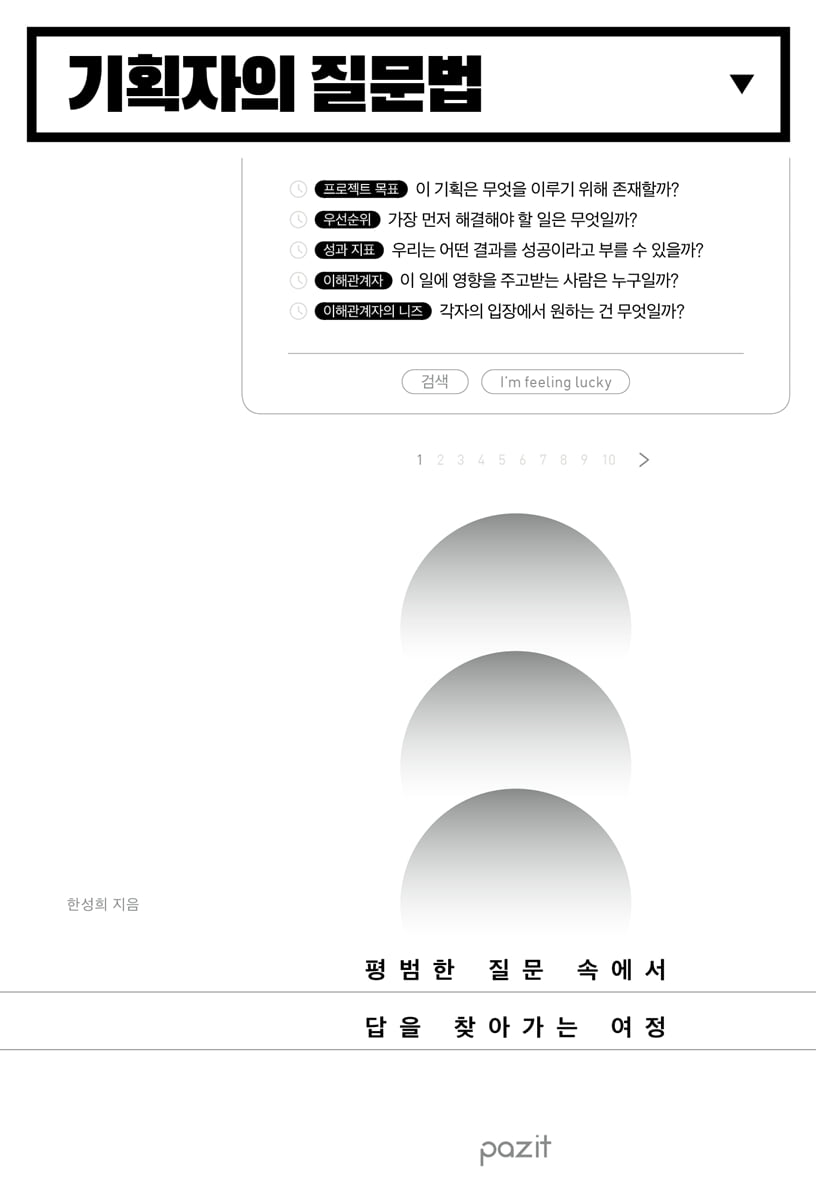
"Why is this plan necessary?" "Whose behavior do we want to change?" "What exactly is success, exactly?" The author included 27 questions necessary for planning in this book, based on problems he actually encountered in the field in Korea, rather than theories popular in Silicon Valley.
It is largely structured around starting and running.
"Questions to Start Planning" introduces key questions that serve as the basis for execution, such as project goals, priorities, and performance indicators. "Questions to Clarify Your Customers" cautions against the mistake of overly broadening the target, and contains strategies for narrowing down and defining your core customers based on real-life examples.
'Questions for Execution' is composed of questions that enhance the execution of plans, such as idea verification, collaborative design, and market positioning.
In addition, we provide guidance on checking the completeness of the plan through questions that must be checked immediately before execution and during the retrospective stage after planning.
When marketing performance stagnates, retention declines, and the organization feels fatigued, what questions should planners ask to turn the tide?
“Questions are a compass,” the author says.
This book will give you a planner's toolbox to change the flow, design strategies, and drive results through questions.
Results produced by the organization
This book revisits the essence of planning.
"Why is this plan necessary?" "Whose behavior do we want to change?" "What exactly is success, exactly?" The author included 27 questions necessary for planning in this book, based on problems he actually encountered in the field in Korea, rather than theories popular in Silicon Valley.
It is largely structured around starting and running.
"Questions to Start Planning" introduces key questions that serve as the basis for execution, such as project goals, priorities, and performance indicators. "Questions to Clarify Your Customers" cautions against the mistake of overly broadening the target, and contains strategies for narrowing down and defining your core customers based on real-life examples.
'Questions for Execution' is composed of questions that enhance the execution of plans, such as idea verification, collaborative design, and market positioning.
In addition, we provide guidance on checking the completeness of the plan through questions that must be checked immediately before execution and during the retrospective stage after planning.
When marketing performance stagnates, retention declines, and the organization feels fatigued, what questions should planners ask to turn the tide?
“Questions are a compass,” the author says.
This book will give you a planner's toolbox to change the flow, design strategies, and drive results through questions.
- You can preview some of the book's contents.
Preview
index
Prologue Now it's your turn to ask the question.
Chapter 1.
People who are good at something ask different questions.
1-1 Understand people and make them move
If the questions are different, the plan will be different.
Questions 1-3 lead the planning.
Chapter 2.
Questions to Start Planning
Q1.
What does this project exist to achieve?
Q2.
What is the first thing that needs to be addressed?
Q3.
What results can we call success?
Chapter 3.
Questions to clarify your customer
Q4.
Who influences and is influenced by this work?
Q5.
What do each of you want from your own perspective?
Q6.
Who is the person who absolutely must take action to achieve their goals?
Q7.
Ultimately, whose problem should we be solving?
Q8.
What do you really want, even though you don't say it out loud?
Q9.
Are the needs we've identified really important issues?
Chapter 4.
Questions for Implementation
Q10.
Will this idea really work?
Q11.
What should customers actually do?
Q12.
Why should they act?
Q13.
If they don't take action, why not?
Q14.
How to design behavior?
Q15.
Where are we now, and why do customers use us?
Q16.
How can you be superior to your competitors?
Q17.
How to make it effective?
Q18.
Who should I work with and how can we join forces?
Chapter 5.
Questions to ask before taking action
Q19.
What message do you really want to convey to your customers?
Q20.
What emotions and memories should they take with them?
Q21.
How do customers connect with us?
Q22.
Is there anything else needed besides planning?
Chapter 6.
Questions after planning
Q23.
Are the plans so far aligned with the goals?
Q24.
Is this a plan that satisfies the greatest number of people?
Q25.
Have I asked enough questions to be able to write a document?
Q26.
What changes and achievements remain?
Q27.
If you were to start over, what would you do differently?
Workbook & Appendix
7 Tips for Practice
27 Questions to Develop Planning Skills Worksheet
Chapter 1.
People who are good at something ask different questions.
1-1 Understand people and make them move
If the questions are different, the plan will be different.
Questions 1-3 lead the planning.
Chapter 2.
Questions to Start Planning
Q1.
What does this project exist to achieve?
Q2.
What is the first thing that needs to be addressed?
Q3.
What results can we call success?
Chapter 3.
Questions to clarify your customer
Q4.
Who influences and is influenced by this work?
Q5.
What do each of you want from your own perspective?
Q6.
Who is the person who absolutely must take action to achieve their goals?
Q7.
Ultimately, whose problem should we be solving?
Q8.
What do you really want, even though you don't say it out loud?
Q9.
Are the needs we've identified really important issues?
Chapter 4.
Questions for Implementation
Q10.
Will this idea really work?
Q11.
What should customers actually do?
Q12.
Why should they act?
Q13.
If they don't take action, why not?
Q14.
How to design behavior?
Q15.
Where are we now, and why do customers use us?
Q16.
How can you be superior to your competitors?
Q17.
How to make it effective?
Q18.
Who should I work with and how can we join forces?
Chapter 5.
Questions to ask before taking action
Q19.
What message do you really want to convey to your customers?
Q20.
What emotions and memories should they take with them?
Q21.
How do customers connect with us?
Q22.
Is there anything else needed besides planning?
Chapter 6.
Questions after planning
Q23.
Are the plans so far aligned with the goals?
Q24.
Is this a plan that satisfies the greatest number of people?
Q25.
Have I asked enough questions to be able to write a document?
Q26.
What changes and achievements remain?
Q27.
If you were to start over, what would you do differently?
Workbook & Appendix
7 Tips for Practice
27 Questions to Develop Planning Skills Worksheet
Into the book
The road to planning is rough and uncertain.
Sometimes I doubt myself countless times and taste the bitterness of failure.
But the courage to willingly take on those worries and frustrations is the true quality of a planner.
It's okay if it's not perfect.
The important thing is the attitude of not stopping.
There will come a moment when the questions you have been piling up will shine.
At that moment, the high wall called planning becomes a staircase that makes me stronger and leads me to a higher place.
--- p.8
The essence of planning is to derive the optimal solution in a complex situation.
It's not about making superficial plans, but about engaging people in the best way possible for the situation.
[...] In conclusion, planning is the act of reading people's minds and leading them to action.
Reading the customer's needs, understanding the developer's reality, respecting the designer's perspective, and considering the management's goals.
Designing the flow so that all these people are heading in the same direction.
That is the role of the planner, and that is why the power of questions discussed in this book is necessary.
--- p.14~16
The sharper the questions become, the more powerful the plan becomes.
That question shapes your actions, changes the quality of your performance, and shapes the next steps in your career.
How deep is your thinking?
--- p.22
Planners often make the mistake of considering only the goals or customers presented by the leader.
But this is a big pitfall of planning.
Who really needs to take action to achieve your goals? They are the stakeholders.
Depending on the situation, the stakeholders change.
For example, when planning a report to be submitted to a representative, the representative becomes the stakeholder, and when planning a service for the public, the customer becomes the center.
--- p.55
The moment you answer this question, planning goes beyond simply listing ideas and becomes a strategy for designing customer behavior and value experiences.
Changing customer behavior is the fastest way to business success.
Let's not forget that planning, from beginning to end, ultimately begins with the customer's actions.
Sometimes I doubt myself countless times and taste the bitterness of failure.
But the courage to willingly take on those worries and frustrations is the true quality of a planner.
It's okay if it's not perfect.
The important thing is the attitude of not stopping.
There will come a moment when the questions you have been piling up will shine.
At that moment, the high wall called planning becomes a staircase that makes me stronger and leads me to a higher place.
--- p.8
The essence of planning is to derive the optimal solution in a complex situation.
It's not about making superficial plans, but about engaging people in the best way possible for the situation.
[...] In conclusion, planning is the act of reading people's minds and leading them to action.
Reading the customer's needs, understanding the developer's reality, respecting the designer's perspective, and considering the management's goals.
Designing the flow so that all these people are heading in the same direction.
That is the role of the planner, and that is why the power of questions discussed in this book is necessary.
--- p.14~16
The sharper the questions become, the more powerful the plan becomes.
That question shapes your actions, changes the quality of your performance, and shapes the next steps in your career.
How deep is your thinking?
--- p.22
Planners often make the mistake of considering only the goals or customers presented by the leader.
But this is a big pitfall of planning.
Who really needs to take action to achieve your goals? They are the stakeholders.
Depending on the situation, the stakeholders change.
For example, when planning a report to be submitted to a representative, the representative becomes the stakeholder, and when planning a service for the public, the customer becomes the center.
--- p.55
The moment you answer this question, planning goes beyond simply listing ideas and becomes a strategy for designing customer behavior and value experiences.
Changing customer behavior is the fastest way to business success.
Let's not forget that planning, from beginning to end, ultimately begins with the customer's actions.
--- p.101
Publisher's Review
Planning is not about making plans.
It is the process of design that sets direction, coordinates complex stakeholders, and changes people's behavior.
But most organizations prioritize formalities and skip over the questions of why they are doing this, who it is for, and what needs to be addressed first.
As a result, plans often end up being haphazardly implemented or with no one taking responsibility.
This book seeks to restore that disconnect.
It was written based on the problems and questions the author personally encountered while working in planning, operations, and product strategy in various industries and organizations for 25 years.
This book is based on his experience designing, failing, and then completing numerous projects while working as CPO and COO at Naver, Samsung Electronics, Yogiyo, and Bithumb.
Thanks to this, the questions in the book are not mere abstractions or theories.
“What is the most important thing to address right now?” “Whose behavior needs to change?” “Who has influence on this?” “What do customers really want?” These are questions that we actually encounter and use in the field.
Above all, this book says that planning is not just a job for a specific job.
From leaders who lead teams, to practitioners who develop marketing strategies, to PMs who plan service UX, to people who design HR, content, and communications.
Anyone who needs to define problems, design flows, and create outcomes will find in this book a reason to ask questions like a planner.
This book's definition of planning is clear and concise.
"Planning isn't about documents, it's about changing the flow." For team leaders who want to hold onto a wavering team and re-establish direction, and for practitioners who see a problem but are at a loss as to where to start, this book will quietly but powerfully demonstrate the power of questions to change the flow.
It is the process of design that sets direction, coordinates complex stakeholders, and changes people's behavior.
But most organizations prioritize formalities and skip over the questions of why they are doing this, who it is for, and what needs to be addressed first.
As a result, plans often end up being haphazardly implemented or with no one taking responsibility.
This book seeks to restore that disconnect.
It was written based on the problems and questions the author personally encountered while working in planning, operations, and product strategy in various industries and organizations for 25 years.
This book is based on his experience designing, failing, and then completing numerous projects while working as CPO and COO at Naver, Samsung Electronics, Yogiyo, and Bithumb.
Thanks to this, the questions in the book are not mere abstractions or theories.
“What is the most important thing to address right now?” “Whose behavior needs to change?” “Who has influence on this?” “What do customers really want?” These are questions that we actually encounter and use in the field.
Above all, this book says that planning is not just a job for a specific job.
From leaders who lead teams, to practitioners who develop marketing strategies, to PMs who plan service UX, to people who design HR, content, and communications.
Anyone who needs to define problems, design flows, and create outcomes will find in this book a reason to ask questions like a planner.
This book's definition of planning is clear and concise.
"Planning isn't about documents, it's about changing the flow." For team leaders who want to hold onto a wavering team and re-establish direction, and for practitioners who see a problem but are at a loss as to where to start, this book will quietly but powerfully demonstrate the power of questions to change the flow.
GOODS SPECIFICS
- Date of issue: June 13, 2025
- Page count, weight, size: 240 pages | 302g | 128*188*15mm
- ISBN13: 9791171520947
- ISBN10: 1171520948
You may also like
카테고리
korean


korean

![GQ KOREA Mark (Monthly): December [2025]](http://librairie.coreenne.fr/cdn/shop/files/8ef265dbbfbf186523ed75ba7319009d.jpg?v=1765340328&width=3840)


