

Is this human?
 |
Description
Book Introduction
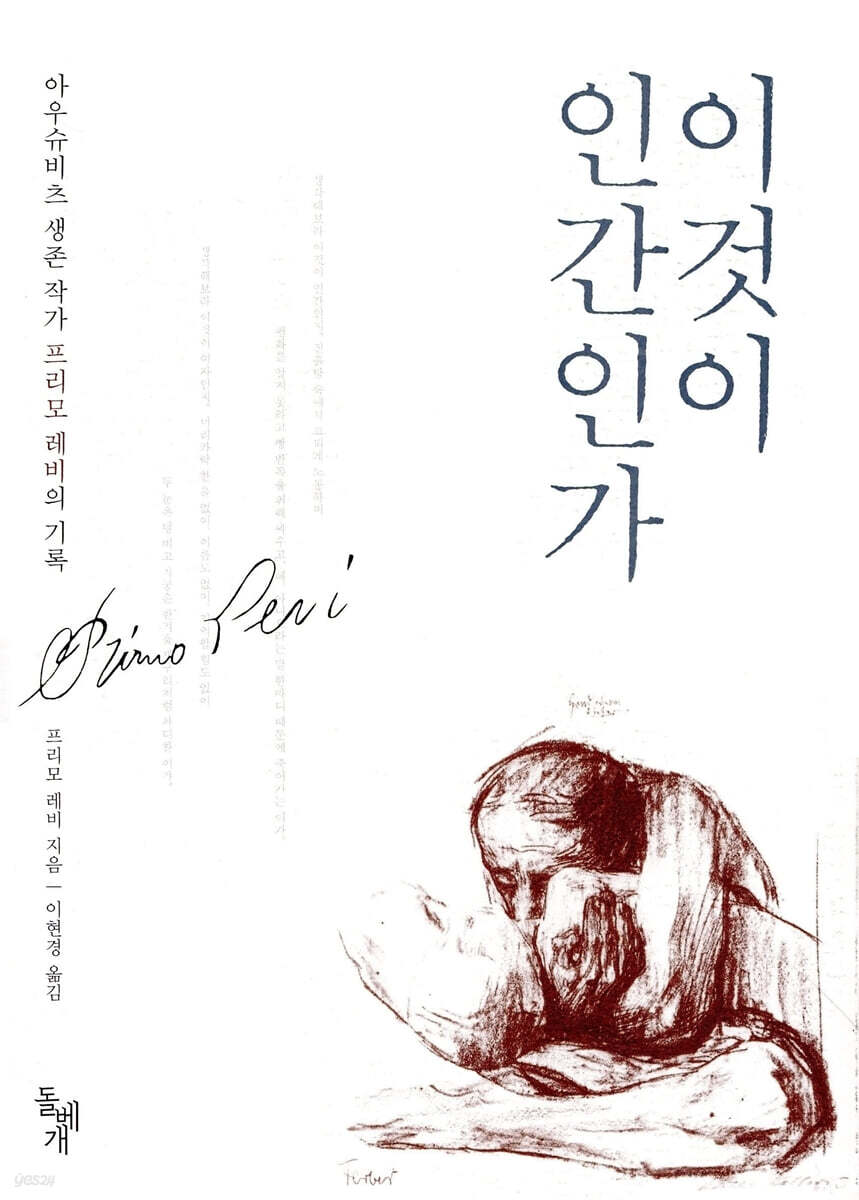
This book records Levi's experiences during his ten months in Auschwitz III concentration camp in Poland.
It covers the period from December 1943, when he was captured by the fascist army while working in a partisan unit and transferred to the Pozzoli transit camp, to January 1945, when Auschwitz was liberated by the Russian army.
Each chapter sharply develops a single theme through two or three episodes and character descriptions.
In the concentration camp, where all the ordinary, trivial habits and things that sustain human society are removed, the prisoners turn into zombies day by day.
They die like machine parts and are replaced just as quickly.
Those who cannot provide the necessary labor there are mercilessly eliminated by the most efficient means, and those who survive devise their own strategies.
There is no brotherhood or camaraderie, but an underground economy runs smoothly to supply and procure necessary goods, and its main driving force is theft and fraud.
He describes the horrors he witnessed and endured in detail and realistically, yet without losing his characteristic restraint and wit.
This provides a valuable opportunity to vividly encounter the process of human dignity and degradation exposed to extreme violence.
It covers the period from December 1943, when he was captured by the fascist army while working in a partisan unit and transferred to the Pozzoli transit camp, to January 1945, when Auschwitz was liberated by the Russian army.
Each chapter sharply develops a single theme through two or three episodes and character descriptions.
In the concentration camp, where all the ordinary, trivial habits and things that sustain human society are removed, the prisoners turn into zombies day by day.
They die like machine parts and are replaced just as quickly.
Those who cannot provide the necessary labor there are mercilessly eliminated by the most efficient means, and those who survive devise their own strategies.
There is no brotherhood or camaraderie, but an underground economy runs smoothly to supply and procure necessary goods, and its main driving force is theft and fraud.
He describes the horrors he witnessed and endured in detail and realistically, yet without losing his characteristic restraint and wit.
This provides a valuable opportunity to vividly encounter the process of human dignity and degradation exposed to extreme violence.
- You can preview some of the book's contents.
Preview
Publisher's Review
The most serious literary answer to the question of why and how we should remember history.
What attracts our attention most of all in Primo Levi's work is its historical significance.
Levy's work is fascinating and beautiful, but above all else, it stands out as a testimony to one of the most violent and absurd scenes in modern history.
Levy wrote to young readers explaining why his story should be remembered:
A new fascism, embodying intolerance, oppression, and subordination, could be born outside this country and creep into our country under a different name.
Or it can grow slowly from within and become so violent that it destroys all defenses.
In that case, wise advice is of no use.
We must find the strength to resist.
At this time, memories of what happened in the heart of Europe not so long ago will serve as strength and a lesson. (From "Appendix 1" of "Is This Human?")
While dealing with personal experiences, Levy's work maintains a distance as a witness and witness, capturing the human landscape and distilling a remarkably calm reflection on human destruction and ruin.
He never shows any pain.
I only witness and record its fundamental conditions, its vivid situation.
With a thoroughly cool yet human perspective, most vividly and most heartbreakingly.
In doing so, his work shows that we must revisit Auschwitz not simply to sympathize with the Jews, condemn the Germans, or praise the survivors.
It persuades us to universalize that suffering to a human level, to accept it as our historical wound, and to truly overcome it.
Moreover, the nature of the madness and violence he witnessed was not something onto which he could project his personal anger.
Because, as Hannah Arendt so aptly put it in her phrase “the banality of evil,” it does not originate from a single evil monster, but from the collective power of ordinary, good, and obedient citizens.
Their thoughts were usually abnormal, foolish, or cruel.
But they were welcomed and millions of followers followed them until their deaths.
It should be remembered that these followers, including those who diligently carried out his unspoken orders, were (with a few exceptions) ordinary human beings, not natural torturers or monsters.
Monsters exist, but their numbers are so small that they pose little threat to us.
Ordinary people, technicians who are ready to believe and obey without question, are much more dangerous.
Eichmann, Höss, the commandant of Auschwitz, Stangl, the commandant of Treblinka, the French soldiers who committed massacres in Algeria 20 years later, and the American soldiers who committed massacres in Vietnam 30 years later are such people.
“If Levi had not committed suicide, everything would have been much simpler and clearer,” Todorov said.
Throughout his work, and even through his death, Levy raises the questions of 'what it means to be a witness to history' and 'why and how should we remember history?'
"Is This a Man?" is the testimony of a survivor of the Auschwitz concentration camp.
This book is remarkable not only for its personal experience, but also for its profound and universal testimony to the crisis of modern humanity itself.
This book not only testifies to the brutal events of the past, but also goes a step further, bearing witness to the chilling danger that such testimony might never be conveyed. (From the "Work Commentary" in "Is This Human?")
Levi's intense and delicate reflections will likely have much to suggest about the conflicts and confrontations occurring in our society today over the memories of the past and the interpretation of history.
What attracts our attention most of all in Primo Levi's work is its historical significance.
Levy's work is fascinating and beautiful, but above all else, it stands out as a testimony to one of the most violent and absurd scenes in modern history.
Levy wrote to young readers explaining why his story should be remembered:
A new fascism, embodying intolerance, oppression, and subordination, could be born outside this country and creep into our country under a different name.
Or it can grow slowly from within and become so violent that it destroys all defenses.
In that case, wise advice is of no use.
We must find the strength to resist.
At this time, memories of what happened in the heart of Europe not so long ago will serve as strength and a lesson. (From "Appendix 1" of "Is This Human?")
While dealing with personal experiences, Levy's work maintains a distance as a witness and witness, capturing the human landscape and distilling a remarkably calm reflection on human destruction and ruin.
He never shows any pain.
I only witness and record its fundamental conditions, its vivid situation.
With a thoroughly cool yet human perspective, most vividly and most heartbreakingly.
In doing so, his work shows that we must revisit Auschwitz not simply to sympathize with the Jews, condemn the Germans, or praise the survivors.
It persuades us to universalize that suffering to a human level, to accept it as our historical wound, and to truly overcome it.
Moreover, the nature of the madness and violence he witnessed was not something onto which he could project his personal anger.
Because, as Hannah Arendt so aptly put it in her phrase “the banality of evil,” it does not originate from a single evil monster, but from the collective power of ordinary, good, and obedient citizens.
Their thoughts were usually abnormal, foolish, or cruel.
But they were welcomed and millions of followers followed them until their deaths.
It should be remembered that these followers, including those who diligently carried out his unspoken orders, were (with a few exceptions) ordinary human beings, not natural torturers or monsters.
Monsters exist, but their numbers are so small that they pose little threat to us.
Ordinary people, technicians who are ready to believe and obey without question, are much more dangerous.
Eichmann, Höss, the commandant of Auschwitz, Stangl, the commandant of Treblinka, the French soldiers who committed massacres in Algeria 20 years later, and the American soldiers who committed massacres in Vietnam 30 years later are such people.
“If Levi had not committed suicide, everything would have been much simpler and clearer,” Todorov said.
Throughout his work, and even through his death, Levy raises the questions of 'what it means to be a witness to history' and 'why and how should we remember history?'
"Is This a Man?" is the testimony of a survivor of the Auschwitz concentration camp.
This book is remarkable not only for its personal experience, but also for its profound and universal testimony to the crisis of modern humanity itself.
This book not only testifies to the brutal events of the past, but also goes a step further, bearing witness to the chilling danger that such testimony might never be conveyed. (From the "Work Commentary" in "Is This Human?")
Levi's intense and delicate reflections will likely have much to suggest about the conflicts and confrontations occurring in our society today over the memories of the past and the interpretation of history.
GOODS SPECIFICS
- Date of issue: January 12, 2007
- Page count, weight, size: 340 pages | 447g | 146*205*30mm
- ISBN13: 9788971992647
- ISBN10: 8971992646
You may also like
카테고리
korean


korean

![GQ KOREA Mark (Monthly): December [2025]](http://librairie.coreenne.fr/cdn/shop/files/8ef265dbbfbf186523ed75ba7319009d.jpg?v=1765340328&width=3840)


