

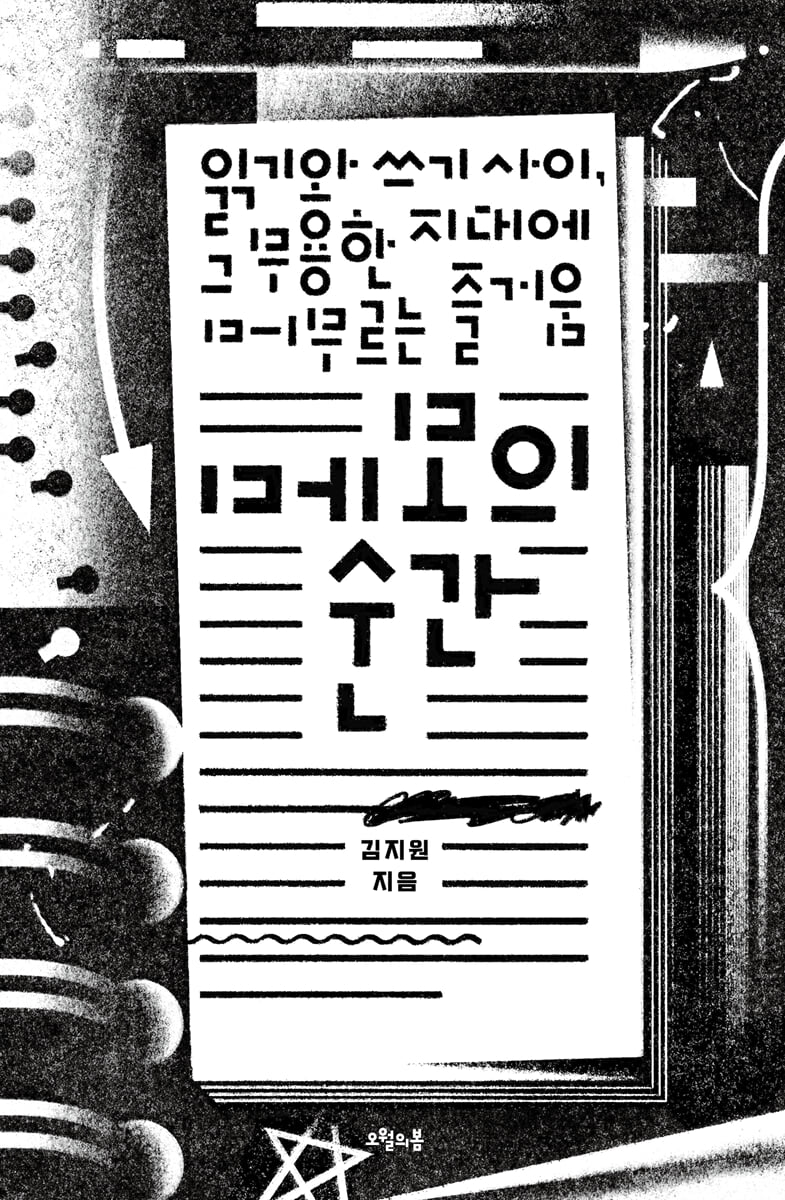
Moment of Note
 |
Description
Book Introduction
- A word from MD
-
A fascinating thought on notesFor Kim Ji-won, a reporter who ran "Inspia," memoing is the joy of lingering in that useless space between reading and writing. In this age of AI and productivity obsession, this is a fascinating book for those who simply find joy in reading and writing.
September 26, 2025. Son Min-gyu, Humanities PD
What joys are we missing in the AI era?
Diaries, letters, papers, novels, essays, nonfiction, newsletters, blogs, reading notes…
Rediscovering Notes for Those Who Read and Write Anything
The story of Jiwon Kim, a reporter with 13 years of experience and the planner and publisher of the book-based humanities newsletter "Inspia" from 2021 to mid-2025, has been published.
With the concept of 'Haechal', this newsletter, which reads and introduces three or four humanities/social science books every week while deeply exploring today's social issues, has established a unique and solid position as a newsletter that 'those who know know', and has received a lot of positive responses from subscribers.
At the heart of this newsletter was none other than a note.
But for reporter Kim Ji-won, notes are firmly rooted in enjoyment rather than practicality or productivity.
He said, “I read books to take notes.
In other words, I am a person who loves taking notes so much that I would say, “If I can’t take notes, I don’t read the book.”
For him, reading and note-taking are like two sides of the same coin.
We usually take notes with the intention of using them somewhere, or to remember and store them well, but the author praises 'useless' notes.
So I'm not too worried about forgetting.
For him, taking notes is an act of ‘staying’ rather than ‘remembering.’
And paradoxically, he says, it is when you stay like that that you remember.
The joy of staying in that useless space between reading and writing
So what does note-taking mean as an act of lingering? The author believes note-taking is the space "between" reading and writing.
The materialization of the time spent in between is the memo.
This perspective on notes has long led the author to the following questions:
"Are readers truly passive? To what extent should we consider reading and writing as separate activities?" Reading and writing are often perceived as distinct activities, but for authors, they are like two sides of the same coin.
Write while reading, read while writing.
The author's definition of note-taking as "a reading/writing style in which a person writes while reading, meticulously analyzing and annotating the text" is interesting.
The writing at this time is so hasty that there is no time to worry about things like spacing, there are a lot of typos, and it is just right for the shameless rearing of the head.
The key to these notes is one thing: to capture the passionate moments of thought.
If I encounter an external text and something is 'triggered' within me, I don't put it off for later, but immediately rush in, stay, and grab it.
This very staying and grabbing is all the note the author is talking about.
Whether it will be used, whether it will be useful, whether it will be remembered for a long time, all depends on later.
This perspective on notes tells us almost nothing about useful note-taking 'methods'.
There is absolutely nothing written about good applications or programs for note-taking or organizing/classifying, or about the key points that must be written in notes, or about how to classify and organize them.
The author is someone who takes notes by tearing out the blank pages of a book he is reading, the wide margins of a large company's full-page advertisement in a daily newspaper, or an envelope containing a bill, or someone who turns on the computer simply because he needs more 'white space.'
Of course, he also writes practical notes when working on specific projects, but this book is written to talk about notes that are closer to miscellaneous 'diaries' or 'albums' than those notes.
The author says that these notes are “notes of people who find pure joy and pleasure in the very act of writing something,” rather than in what the writer will become or what will come out of their hands.
The rediscovery of the note takes place at this very point.
Don't worry about classification or usefulness, don't worry about forgetting,
Writing while reading, actively doing something else while not reading, doodling in the margins…
Just do it all for fun
The energy that flows throughout this book is 'joy'.
The author talks about the joy of note-taking almost from beginning to end.
The note-taking that the author speaks of is an act of staying in a moment caught up in something interesting, so it can never be unrelated to fun, and the pleasure of capturing it is also something that brings enjoyment.
This is because I wrote the note “because I felt like I couldn’t stand writing at that very moment, because writing was fun.”
And this pleasure, the author says, requires, in some ways, a certain subjectivity, the ability to judge 'what not to see' as much as 'what to see'.
This judgment involves “the existence, body, life, bias, and usefulness of an individual placed at a specific coordinate.”
This is why there can be no such thing as a 'note-taking method' that is useful and efficient for everyone.
Therefore, the methodology is up to the reader.
Because if you think about “what kind of notes do I want to make and why?”, it will come out naturally.
It is from this very perspective that the author continues his unique story about reading and note-taking.
When we talk about note-taking as a 'pleasure' as an act of lingering on something one is caught up in and catching vague thoughts, the conversation expands to a broader realm of reading and writing.
For example, this is a story about writers obsessed with the pleasure of writing notes, books that exude the energy of note-taking (enjoyment), letters and diaries that are at the peak of the 'pleasure of writing,' quotations as a place to stay, books as a pile of notes, reading while doing something else, doodling in the margins, etc.
These stories ultimately re-evaluate “the joy and value of creation itself.”
One could see the memo as the first step toward that primal pleasure.
The author reminds us of the joys we are missing in the AI era, where generative AI like ChatGPi summarizes long texts and expands short ones.
In the area called 'Memo'
We become more free
The moment of staying and grabbing a note is, above all, a moment of freedom.
Between reading and writing, notes are simply an act of remaining pure, free from the compulsion to remember without worrying about their usefulness.
In that realm of utterly 'useless' notes, we can freely get caught up and lose ourselves in other thoughts.
And surprisingly, that very moment of immersion leads to something unexpectedly 'useful'.
As the author wrote the newsletter “solely on the power of notes.”
In an age where we are bombarded with information screaming "important" from all sides, we are almost suffocated by the "compulsion to hoard and accumulate something intellectual."
The long-standing interest in notes may also have been largely an extension of that production/storage obsession.
The author, both personally and professionally as a journalist, has suffered from such obsessions, so the notes rediscovered in this book resonate deeply and are particularly welcome.
Let's rediscover the primal joy of note-taking by staying and capturing it with this book.
Diaries, letters, papers, novels, essays, nonfiction, newsletters, blogs, reading notes…
Rediscovering Notes for Those Who Read and Write Anything
The story of Jiwon Kim, a reporter with 13 years of experience and the planner and publisher of the book-based humanities newsletter "Inspia" from 2021 to mid-2025, has been published.
With the concept of 'Haechal', this newsletter, which reads and introduces three or four humanities/social science books every week while deeply exploring today's social issues, has established a unique and solid position as a newsletter that 'those who know know', and has received a lot of positive responses from subscribers.
At the heart of this newsletter was none other than a note.
But for reporter Kim Ji-won, notes are firmly rooted in enjoyment rather than practicality or productivity.
He said, “I read books to take notes.
In other words, I am a person who loves taking notes so much that I would say, “If I can’t take notes, I don’t read the book.”
For him, reading and note-taking are like two sides of the same coin.
We usually take notes with the intention of using them somewhere, or to remember and store them well, but the author praises 'useless' notes.
So I'm not too worried about forgetting.
For him, taking notes is an act of ‘staying’ rather than ‘remembering.’
And paradoxically, he says, it is when you stay like that that you remember.
The joy of staying in that useless space between reading and writing
So what does note-taking mean as an act of lingering? The author believes note-taking is the space "between" reading and writing.
The materialization of the time spent in between is the memo.
This perspective on notes has long led the author to the following questions:
"Are readers truly passive? To what extent should we consider reading and writing as separate activities?" Reading and writing are often perceived as distinct activities, but for authors, they are like two sides of the same coin.
Write while reading, read while writing.
The author's definition of note-taking as "a reading/writing style in which a person writes while reading, meticulously analyzing and annotating the text" is interesting.
The writing at this time is so hasty that there is no time to worry about things like spacing, there are a lot of typos, and it is just right for the shameless rearing of the head.
The key to these notes is one thing: to capture the passionate moments of thought.
If I encounter an external text and something is 'triggered' within me, I don't put it off for later, but immediately rush in, stay, and grab it.
This very staying and grabbing is all the note the author is talking about.
Whether it will be used, whether it will be useful, whether it will be remembered for a long time, all depends on later.
This perspective on notes tells us almost nothing about useful note-taking 'methods'.
There is absolutely nothing written about good applications or programs for note-taking or organizing/classifying, or about the key points that must be written in notes, or about how to classify and organize them.
The author is someone who takes notes by tearing out the blank pages of a book he is reading, the wide margins of a large company's full-page advertisement in a daily newspaper, or an envelope containing a bill, or someone who turns on the computer simply because he needs more 'white space.'
Of course, he also writes practical notes when working on specific projects, but this book is written to talk about notes that are closer to miscellaneous 'diaries' or 'albums' than those notes.
The author says that these notes are “notes of people who find pure joy and pleasure in the very act of writing something,” rather than in what the writer will become or what will come out of their hands.
The rediscovery of the note takes place at this very point.
Don't worry about classification or usefulness, don't worry about forgetting,
Writing while reading, actively doing something else while not reading, doodling in the margins…
Just do it all for fun
The energy that flows throughout this book is 'joy'.
The author talks about the joy of note-taking almost from beginning to end.
The note-taking that the author speaks of is an act of staying in a moment caught up in something interesting, so it can never be unrelated to fun, and the pleasure of capturing it is also something that brings enjoyment.
This is because I wrote the note “because I felt like I couldn’t stand writing at that very moment, because writing was fun.”
And this pleasure, the author says, requires, in some ways, a certain subjectivity, the ability to judge 'what not to see' as much as 'what to see'.
This judgment involves “the existence, body, life, bias, and usefulness of an individual placed at a specific coordinate.”
This is why there can be no such thing as a 'note-taking method' that is useful and efficient for everyone.
Therefore, the methodology is up to the reader.
Because if you think about “what kind of notes do I want to make and why?”, it will come out naturally.
It is from this very perspective that the author continues his unique story about reading and note-taking.
When we talk about note-taking as a 'pleasure' as an act of lingering on something one is caught up in and catching vague thoughts, the conversation expands to a broader realm of reading and writing.
For example, this is a story about writers obsessed with the pleasure of writing notes, books that exude the energy of note-taking (enjoyment), letters and diaries that are at the peak of the 'pleasure of writing,' quotations as a place to stay, books as a pile of notes, reading while doing something else, doodling in the margins, etc.
These stories ultimately re-evaluate “the joy and value of creation itself.”
One could see the memo as the first step toward that primal pleasure.
The author reminds us of the joys we are missing in the AI era, where generative AI like ChatGPi summarizes long texts and expands short ones.
In the area called 'Memo'
We become more free
The moment of staying and grabbing a note is, above all, a moment of freedom.
Between reading and writing, notes are simply an act of remaining pure, free from the compulsion to remember without worrying about their usefulness.
In that realm of utterly 'useless' notes, we can freely get caught up and lose ourselves in other thoughts.
And surprisingly, that very moment of immersion leads to something unexpectedly 'useful'.
As the author wrote the newsletter “solely on the power of notes.”
In an age where we are bombarded with information screaming "important" from all sides, we are almost suffocated by the "compulsion to hoard and accumulate something intellectual."
The long-standing interest in notes may also have been largely an extension of that production/storage obsession.
The author, both personally and professionally as a journalist, has suffered from such obsessions, so the notes rediscovered in this book resonate deeply and are particularly welcome.
Let's rediscover the primal joy of note-taking by staying and capturing it with this book.
- You can preview some of the book's contents.
Preview
index
Prologue: Notes as Desire
1.
Note-taking and the joy of writing
2.
A note called a letter
3.
The compulsion to remember more
4.
Land of Useless Notes
5.
Reading/Notes While Doing Something Else
6.
The fate and potential of notes
7.
Strike when it's hot
8.
Being held free
9.
A bundle of notes called a book
10.
A short reflection on the dwelling called quotation
11.
Active passivity of reading
12.
Scribbling in the Margins: The Infinitely Expanding World of Marginalia
13.
An awkward pose for taking notes
14. Can SNS be a memo?
15.
Anyway, keep writing whatever: On notes that don't become books
Epilogue: Stay and Grab
1.
Note-taking and the joy of writing
2.
A note called a letter
3.
The compulsion to remember more
4.
Land of Useless Notes
5.
Reading/Notes While Doing Something Else
6.
The fate and potential of notes
7.
Strike when it's hot
8.
Being held free
9.
A bundle of notes called a book
10.
A short reflection on the dwelling called quotation
11.
Active passivity of reading
12.
Scribbling in the Margins: The Infinitely Expanding World of Marginalia
13.
An awkward pose for taking notes
14. Can SNS be a memo?
15.
Anyway, keep writing whatever: On notes that don't become books
Epilogue: Stay and Grab
Into the book
I used to be obsessed with notes for a while.
I tried to collect all the impressive pieces, and I also tried to preserve what was 'left over' from reading the book.
I was suffocating myself with all the clutter of notes, like a crow that collects anything shiny, whether it be a piece of gold dust or a piece of gold, and piles it up in its nest… … After writing notes for so long, I suddenly had a thought.
Perhaps, in the process of taking notes, remembering may be only a secondary aspect.
Also, my long-standing concern has been the gap between reading and writing.
Are readers truly passive? To what extent should we consider reading and writing as separate? Therefore, this book will discuss readers who write, or writers who read, which is by no means unrelated to note-taking.
--- From the "Prologue"
But if we view notes simply as something to be left for the future, we overlook their 'present' nature.
Many people wrote to leave something behind for later, but others simply wrote because they felt compelled to do so.
No, rather than out of obligation, I wrote because I just felt like I couldn't stand writing 'right now', and because it was fun to write.
Meanwhile, some writers preferred to write on the street or elsewhere rather than at their desks.
There are many reasons for this, such as not having enough time to sit down at a desk or disliking the chair, but for some, it is mainly because they need to be thrown outside and have their self and the world intertwined in order to write.
I would like to call the writings that come out of these gaps 'memo-like writing'.
--- 「1.
From “Note-taking and the Pleasure of Writing”
The essence of memo writing can be seen as remaining more strongly in the epistolary tradition (or diary) than in the productive memo as a data archive for taxidermy that is commonly used today.
This is because these writings are generally written without any set form, classification, or purpose, and are written simply out of a desire to write in any dimension.
The joy of writing is the only thing that today's writing machines (generative artificial intelligence) don't pay attention to.
And a key part of the epistolary tradition is the joy of writing.
--- 「2.
From the note titled “Letter”
People seem to have finally found a solution to the problem of the endless flood of information.
The idea is to simply 'inhale' the flood of information and solve it.
Our society is under the illusion that technological advancements will allow us to 'actually' read and remember everything.
Even writing, which was previously considered a unique ability of an individual, is now believed to be something that generative artificial intelligence can take over.
There are already many cases where generative artificial intelligence is being actively used in areas such as literature review, summarization, skimming, and citation.
Now we can pass over them like bodiless ghosts, without the tedious struggle, without the burden of being crushed by all those bookshelves.
But are these technologies actually improving our reading and writing experiences?
I tried to collect all the impressive pieces, and I also tried to preserve what was 'left over' from reading the book.
I was suffocating myself with all the clutter of notes, like a crow that collects anything shiny, whether it be a piece of gold dust or a piece of gold, and piles it up in its nest… … After writing notes for so long, I suddenly had a thought.
Perhaps, in the process of taking notes, remembering may be only a secondary aspect.
Also, my long-standing concern has been the gap between reading and writing.
Are readers truly passive? To what extent should we consider reading and writing as separate? Therefore, this book will discuss readers who write, or writers who read, which is by no means unrelated to note-taking.
--- From the "Prologue"
But if we view notes simply as something to be left for the future, we overlook their 'present' nature.
Many people wrote to leave something behind for later, but others simply wrote because they felt compelled to do so.
No, rather than out of obligation, I wrote because I just felt like I couldn't stand writing 'right now', and because it was fun to write.
Meanwhile, some writers preferred to write on the street or elsewhere rather than at their desks.
There are many reasons for this, such as not having enough time to sit down at a desk or disliking the chair, but for some, it is mainly because they need to be thrown outside and have their self and the world intertwined in order to write.
I would like to call the writings that come out of these gaps 'memo-like writing'.
--- 「1.
From “Note-taking and the Pleasure of Writing”
The essence of memo writing can be seen as remaining more strongly in the epistolary tradition (or diary) than in the productive memo as a data archive for taxidermy that is commonly used today.
This is because these writings are generally written without any set form, classification, or purpose, and are written simply out of a desire to write in any dimension.
The joy of writing is the only thing that today's writing machines (generative artificial intelligence) don't pay attention to.
And a key part of the epistolary tradition is the joy of writing.
--- 「2.
From the note titled “Letter”
People seem to have finally found a solution to the problem of the endless flood of information.
The idea is to simply 'inhale' the flood of information and solve it.
Our society is under the illusion that technological advancements will allow us to 'actually' read and remember everything.
Even writing, which was previously considered a unique ability of an individual, is now believed to be something that generative artificial intelligence can take over.
There are already many cases where generative artificial intelligence is being actively used in areas such as literature review, summarization, skimming, and citation.
Now we can pass over them like bodiless ghosts, without the tedious struggle, without the burden of being crushed by all those bookshelves.
But are these technologies actually improving our reading and writing experiences?
--- 「3.
From "The Obsession to Remember More"
From "The Obsession to Remember More"
Publisher's Review
Rediscovering notes for those who read and write anything.
Reporter Jiwon Kim, who has received much reader support for her book-based liberal arts newsletter, Inspia, tells a new story about notes.
'Notes' have almost always been discussed from a practical and productive perspective.
Reporter Kim Ji-won, contrary to that view, talks about the memo with a focus on 'fun'.
This book will make you look at your notes in a completely different way, making you think about what you 'won't' remember.
What's the difference between practical notes, organized and categorized for memory, perhaps to be used someday, and notes simply for the pleasure of lingering? Why does everything feel so important and necessary to remember? What should we allow to "disappear" from our memories? For the author, notes are as much a time to dwell on something tangible and to catch murky thoughts as they are a judgment about "what not to see."
Between reading and writing, in the realm of 'notes', we become more free.
Reporter Jiwon Kim, who has received much reader support for her book-based liberal arts newsletter, Inspia, tells a new story about notes.
'Notes' have almost always been discussed from a practical and productive perspective.
Reporter Kim Ji-won, contrary to that view, talks about the memo with a focus on 'fun'.
This book will make you look at your notes in a completely different way, making you think about what you 'won't' remember.
What's the difference between practical notes, organized and categorized for memory, perhaps to be used someday, and notes simply for the pleasure of lingering? Why does everything feel so important and necessary to remember? What should we allow to "disappear" from our memories? For the author, notes are as much a time to dwell on something tangible and to catch murky thoughts as they are a judgment about "what not to see."
Between reading and writing, in the realm of 'notes', we become more free.
GOODS SPECIFICS
- Date of issue: October 1, 2025
- Page count, weight, size: 256 pages | 272g | 123*188*17mm
- ISBN13: 9791168731615
- ISBN10: 1168731615
You may also like
카테고리
korean


korean

![GQ KOREA Mark (Monthly): December [2025]](http://librairie.coreenne.fr/cdn/shop/files/8ef265dbbfbf186523ed75ba7319009d.jpg?v=1765340328&width=3840)


