

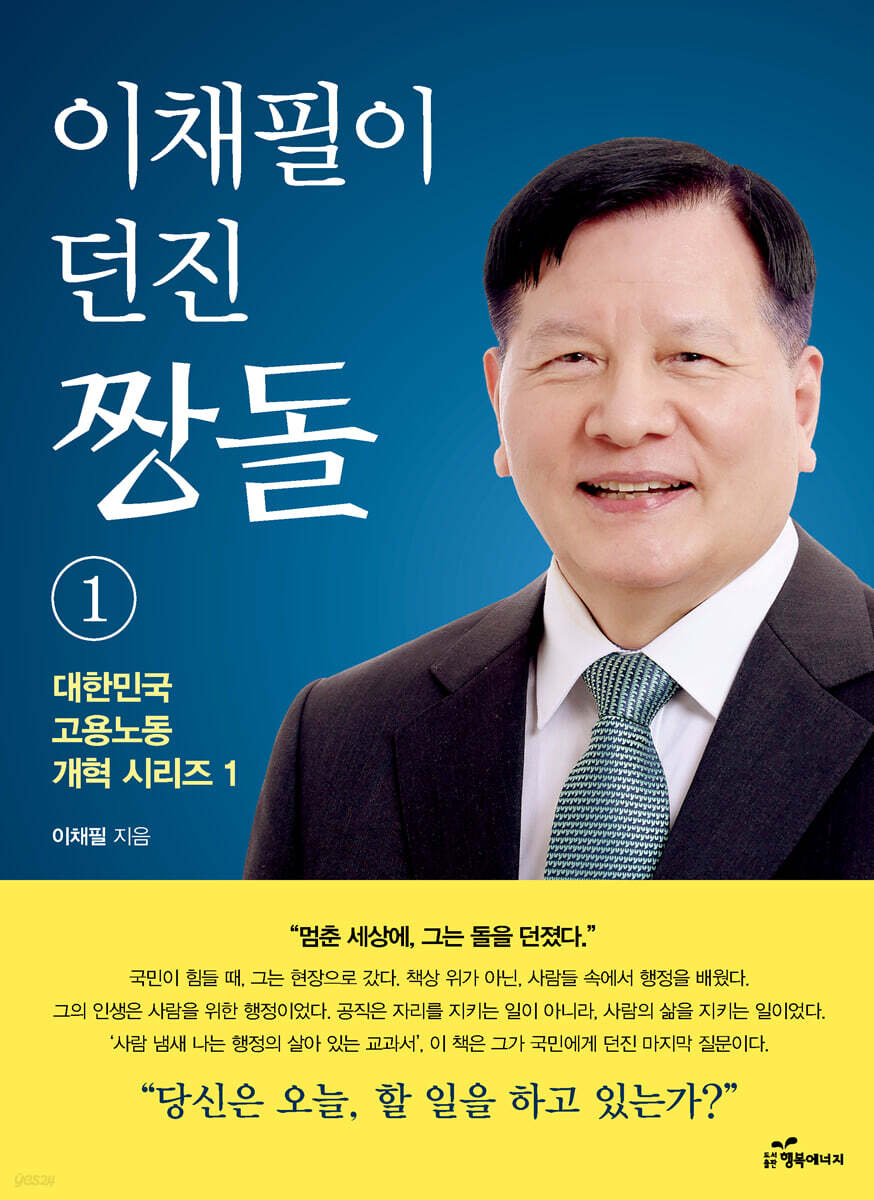
A rock thrown by Lee Chae-pil 1
 |
Description
Book Introduction
This book covers the life of former Minister of Employment and Labor Lee Chae-pil, filled with adversity and challenges, as well as the beliefs he established and maintained in labor-related administration and the actions he took in accordance with them while working in labor-related fields, from his position as a civil servant at the Ministry of Employment and Labor to his position as Minister.
The author, who had to endure the world's contempt and discrimination while living with a disability in both legs due to polio, says that he wanted to throw a stone of resentment at various irrationalities and inefficiencies in South Korea, starting with the stone he threw as a child to protect himself from those who bullied him by making fun of his disability.
This book is a collection of writings that pour out the author's life and beliefs as a labor administrator in over 900 pages. "The Rock Thrown by Lee Chae-pil (1)" corresponds to the first four chapters of this extensive work.
Chapter 1 contains the story of the author, who had to overcome discrimination and contempt for being labeled as a "polio-disabled person" in a rural area where electricity was only available in his hometown when he was a senior in college. He overcame many adversities and challenges to enter college through the GED exam, and then took the civil service exam to become a civil servant at the Ministry of Employment and Labor.
The author recounts that as a child, living in a remote village, the only means of contact with the world was the radio. One day, by chance, he heard the words, “Administration is what actively solves the world’s problems, and a modern state is an administrative state,” and this sent shivers down his spine, solidifying his resolve to become a civil servant.
Chapter 2 discusses labor policies that author Lee Chae-pil led and participated in while serving as an employment and labor expert and administrative official, including the enactment of the Act on Promotion of Employment of Persons with Disabilities, the integration of the utilization of foreign workers and the employment permit system, the implementation of the employment insurance system, and the introduction of the vocational skills development account system.
The author, who has spent over 30 years as a labor administrator, has noted that administrators must always focus on the "field," and has declared "jobs" and "people" as his administrative goals.
Chapters 3 and 4 are chapters that provide a glimpse into author Lee Chae-pil's beliefs and principles regarding the proper position of 'law' in labor-management relations, based on his experience in regulating labor-management relations, which is a major axis of labor-related issues in Korea.
It contains public misunderstandings about the role and mission of the Ministry of Employment and Labor, secrets for resolving difficulties and problems encountered while enacting laws or promoting administration, the story of how maternity protection benefits came to be borne by the Employment Insurance Fund, suggestions for creative challenges for young people, the honest response of labor, management, and government to the long-term strike at Hyundai Heavy Industries, and the process by which the principle of no work, no pay and the principle of post-discussive legal action regardless of labor and management came to be established, as well as evaluations of the labor disputes at Ssangyong Motors and Hanjin Heavy Industries. In particular, in 'Labor Reform after 13 Years - Implementation of Multiple Unions and Abolition of Full-time Union Officials', vivid testimony about the 'labor administration' that the author was involved in or promoted is recorded.
You can read the author's philosophy of labor administration, titled 'CD on LP: Labor-management autonomous solution within the framework of law and principles.'
In order to resolve the conflictual labor-management relations in Korea, the book specifically describes the implementation process of various labor-management relations reforms, such as labor reform through a tripartite agreement between labor, management, and the government based on a broad national consensus including labor, management, and the public interest, the introduction of a work hour exemption system, reform of full-time union officials, and the permission of multiple unions and the unification of negotiation channels. It also fully captures the leadership of labor, management, and the wisdom of administrators who wisely displayed themselves in the face of crises.
Chapter 5, "Safety and Justice - Behind the Industrial Accident and Serious Accident Prevention Act," is filled with content related to the revision of laws related to industrial safety and health to create a country safe from industrial accidents, and, above all, the spread of safety culture and awareness and the establishment of a center for the prevention of serious industrial accidents.
In his keynote speech at the 30th World Congress on Occupational Health, titled "Korea's Strategy for Preventing Industrial Accidents and Improving the Working Environment," he focused on introducing key issues in Korea's industrial health and strategies for preventing industrial accidents.
Through the contents of this keynote speech, we can find the future and direction of industrial safety and health administration.
And it clearly clarified the social, economic, and historical background of the Serious Disaster Punishment Act, which is currently a social issue, and the limitations of the law that prioritizes criminal punishment in the process of creating a safe country.
In Chapter 6, "The National Assembly and the Executive Branch in a Strange Country - Administration, Politics, and the Accountability of Bureaucracy," we can sense the author's lament over the "excessive politicization of administration and policy" resulting from political acumen and judgment that go beyond administrative procedures and legal requirements.
In various administrative and policy cases, such as the 'Establishment of Job World', 'Non-regular Workers Protection Act', 'Extension of retirement age for favoritism like roasting beans in a flash', 'Income-led growth and rapid increase in minimum wage', and 'Reduction of working hours', it systematically records the social and economic chaos and side effects caused by 'populism for favoritism' and 'administration for favoritism' that go beyond the law and common sense.
What kind of National Assembly is this? The book specifically addresses issues such as Yeouido politics, populism, and political budgeting, empirical exploration of a healthy relationship between the National Assembly and the executive branch, and the problems of excessive attempts at politically motivated legislation. The author's view of public service, stating, "Politics can be implemented with 51% approval, but a policy will ultimately fail if even 1% of the votes are wrong," will serve as a model for all public servants.
As a public official, he confesses the failures and frustrations he experienced directly and indirectly in the employment and labor administration (policy) and emphasizes that such failures should not be repeated.
Chapter 7, 'The Shadow of Reform - After the Jjangdol, Reflection and Responsibility', conveys to readers the turbulent life of a civil servant who promoted reform after leaving office (the true nature of eradicating deep-rooted evils), focusing on his experiences and records during the investigation and trial process.
In Chapter 8, 'Answering Foolish Questions - With a Ground-Up Spirit', he reflects on his 30 years of public service and introduces various episodes and cases of promoting personnel innovation and revitalizing organizations based on his direct and indirect experience of 'work and practicality are separate' personnel management.
In particular, in the section “Pro-labor, pro-management, pro-job minister,” one can feel the author’s deep convictions and philosophy regarding employment and labor policy, as well as his love for the people and the country.
This book is much more of a historical record of the complex production process of labor-related policies than an autobiographical account of the author.
As a civil servant in the Republic of Korea, I share my concerns, struggles, twists and turns, pain, and vision and direction for the future of administration, while delivering a message of dreams and hope to everyone.
The author passed the civil service examination with excellent grades and chose the Ministry of Labor. He then covered the entire spectrum of employment and labor administration, including industrial safety, employment, job skills, and labor-management relations. He improved and developed policies with a practical approach, while simultaneously recording his multifaceted efforts to legislate them, thereby adding historical value.
Behind this background, one can read a sharp sense of problem and the courage to throw a fastball at each time, and this can be seen to be supported by the author's skill and perseverance that he subtly displays.
The author, who had to endure the world's contempt and discrimination while living with a disability in both legs due to polio, says that he wanted to throw a stone of resentment at various irrationalities and inefficiencies in South Korea, starting with the stone he threw as a child to protect himself from those who bullied him by making fun of his disability.
This book is a collection of writings that pour out the author's life and beliefs as a labor administrator in over 900 pages. "The Rock Thrown by Lee Chae-pil (1)" corresponds to the first four chapters of this extensive work.
Chapter 1 contains the story of the author, who had to overcome discrimination and contempt for being labeled as a "polio-disabled person" in a rural area where electricity was only available in his hometown when he was a senior in college. He overcame many adversities and challenges to enter college through the GED exam, and then took the civil service exam to become a civil servant at the Ministry of Employment and Labor.
The author recounts that as a child, living in a remote village, the only means of contact with the world was the radio. One day, by chance, he heard the words, “Administration is what actively solves the world’s problems, and a modern state is an administrative state,” and this sent shivers down his spine, solidifying his resolve to become a civil servant.
Chapter 2 discusses labor policies that author Lee Chae-pil led and participated in while serving as an employment and labor expert and administrative official, including the enactment of the Act on Promotion of Employment of Persons with Disabilities, the integration of the utilization of foreign workers and the employment permit system, the implementation of the employment insurance system, and the introduction of the vocational skills development account system.
The author, who has spent over 30 years as a labor administrator, has noted that administrators must always focus on the "field," and has declared "jobs" and "people" as his administrative goals.
Chapters 3 and 4 are chapters that provide a glimpse into author Lee Chae-pil's beliefs and principles regarding the proper position of 'law' in labor-management relations, based on his experience in regulating labor-management relations, which is a major axis of labor-related issues in Korea.
It contains public misunderstandings about the role and mission of the Ministry of Employment and Labor, secrets for resolving difficulties and problems encountered while enacting laws or promoting administration, the story of how maternity protection benefits came to be borne by the Employment Insurance Fund, suggestions for creative challenges for young people, the honest response of labor, management, and government to the long-term strike at Hyundai Heavy Industries, and the process by which the principle of no work, no pay and the principle of post-discussive legal action regardless of labor and management came to be established, as well as evaluations of the labor disputes at Ssangyong Motors and Hanjin Heavy Industries. In particular, in 'Labor Reform after 13 Years - Implementation of Multiple Unions and Abolition of Full-time Union Officials', vivid testimony about the 'labor administration' that the author was involved in or promoted is recorded.
You can read the author's philosophy of labor administration, titled 'CD on LP: Labor-management autonomous solution within the framework of law and principles.'
In order to resolve the conflictual labor-management relations in Korea, the book specifically describes the implementation process of various labor-management relations reforms, such as labor reform through a tripartite agreement between labor, management, and the government based on a broad national consensus including labor, management, and the public interest, the introduction of a work hour exemption system, reform of full-time union officials, and the permission of multiple unions and the unification of negotiation channels. It also fully captures the leadership of labor, management, and the wisdom of administrators who wisely displayed themselves in the face of crises.
Chapter 5, "Safety and Justice - Behind the Industrial Accident and Serious Accident Prevention Act," is filled with content related to the revision of laws related to industrial safety and health to create a country safe from industrial accidents, and, above all, the spread of safety culture and awareness and the establishment of a center for the prevention of serious industrial accidents.
In his keynote speech at the 30th World Congress on Occupational Health, titled "Korea's Strategy for Preventing Industrial Accidents and Improving the Working Environment," he focused on introducing key issues in Korea's industrial health and strategies for preventing industrial accidents.
Through the contents of this keynote speech, we can find the future and direction of industrial safety and health administration.
And it clearly clarified the social, economic, and historical background of the Serious Disaster Punishment Act, which is currently a social issue, and the limitations of the law that prioritizes criminal punishment in the process of creating a safe country.
In Chapter 6, "The National Assembly and the Executive Branch in a Strange Country - Administration, Politics, and the Accountability of Bureaucracy," we can sense the author's lament over the "excessive politicization of administration and policy" resulting from political acumen and judgment that go beyond administrative procedures and legal requirements.
In various administrative and policy cases, such as the 'Establishment of Job World', 'Non-regular Workers Protection Act', 'Extension of retirement age for favoritism like roasting beans in a flash', 'Income-led growth and rapid increase in minimum wage', and 'Reduction of working hours', it systematically records the social and economic chaos and side effects caused by 'populism for favoritism' and 'administration for favoritism' that go beyond the law and common sense.
What kind of National Assembly is this? The book specifically addresses issues such as Yeouido politics, populism, and political budgeting, empirical exploration of a healthy relationship between the National Assembly and the executive branch, and the problems of excessive attempts at politically motivated legislation. The author's view of public service, stating, "Politics can be implemented with 51% approval, but a policy will ultimately fail if even 1% of the votes are wrong," will serve as a model for all public servants.
As a public official, he confesses the failures and frustrations he experienced directly and indirectly in the employment and labor administration (policy) and emphasizes that such failures should not be repeated.
Chapter 7, 'The Shadow of Reform - After the Jjangdol, Reflection and Responsibility', conveys to readers the turbulent life of a civil servant who promoted reform after leaving office (the true nature of eradicating deep-rooted evils), focusing on his experiences and records during the investigation and trial process.
In Chapter 8, 'Answering Foolish Questions - With a Ground-Up Spirit', he reflects on his 30 years of public service and introduces various episodes and cases of promoting personnel innovation and revitalizing organizations based on his direct and indirect experience of 'work and practicality are separate' personnel management.
In particular, in the section “Pro-labor, pro-management, pro-job minister,” one can feel the author’s deep convictions and philosophy regarding employment and labor policy, as well as his love for the people and the country.
This book is much more of a historical record of the complex production process of labor-related policies than an autobiographical account of the author.
As a civil servant in the Republic of Korea, I share my concerns, struggles, twists and turns, pain, and vision and direction for the future of administration, while delivering a message of dreams and hope to everyone.
The author passed the civil service examination with excellent grades and chose the Ministry of Labor. He then covered the entire spectrum of employment and labor administration, including industrial safety, employment, job skills, and labor-management relations. He improved and developed policies with a practical approach, while simultaneously recording his multifaceted efforts to legislate them, thereby adding historical value.
Behind this background, one can read a sharp sense of problem and the courage to throw a fastball at each time, and this can be seen to be supported by the author's skill and perseverance that he subtly displays.
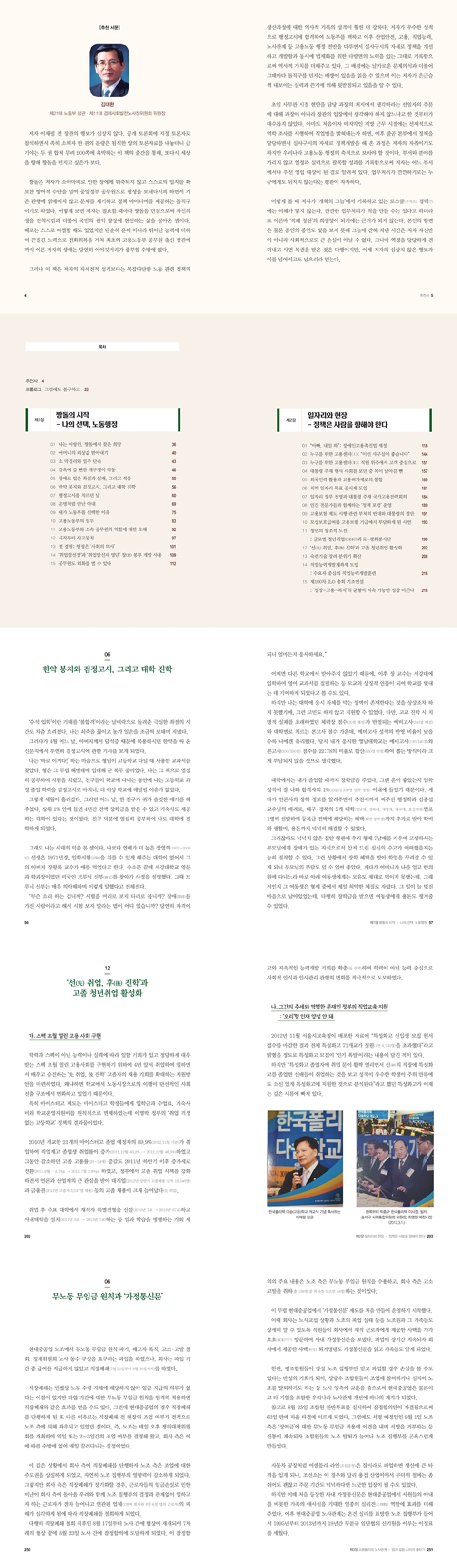
index
Recommendation 000
Prologue Nevertheless 000
Chapter 1: The Beginning of Jjangdol - My Choice, Labor Administration
01 I am a stranger, hope found in Jjangdol 000
02 Receiving compensation for mother's trauma 000
03 Crackdown on Makgeolli and Moonshine 000
04 The mischievous boy who almost went to jail 000
05 Frustration, Failure, and Adaptation Due to Disability 000
06 Herbal Medicine Bags, GED Exams, and College Admission 000
07 The day I took the civil service exam 000
08 My wife, whom I met by fate 000
09 Why I Chose the Ministry of Labor 000
10 Mission of the Ministry of Employment and Labor 000
11 Misunderstandings about the roles of the Ministry of Employment and Labor and its civil servants 000
12 A bundle of troublemakers from the start 000
13 First Experience: Administration is the 'Will of Society' 000
14. Development and use of window envelopes for 'Job Placement' and 'Job Placement List' 000
15 Civil servants can also earn foreign currency 000
Chapter 2: Jobs and the Workplace - Policies Must Be People-Oriented
01 "Dad, Come Tomorrow": Enactment of the Act on Promotion of Employment of Persons with Disabilities 000
02 Employment Center for Whom (Ⅰ): "This Office Is Good" 000
03 Employment Center for Whom (II): From Employee-centered to Customer-centered 000
04 I almost lost my head while watching the president's event. 000
05 Integration of Foreign Workforce Utilization and Employment Permit System 000
06 Introduction of a regional job target disclosure system 000
07 Government Job Creation Declaration and Presidential National Employment Strategy Meeting 000
08 Operating a 'Policy Forum' with Private Sector Experts 000
09 Opposition from Ministries and the President's Decision Regarding the Implementation of the Employment Insurance System 000
10 Reasons why maternity benefits are covered by the Employment Insurance Fund 000
11 Creative Challenges for Youth
: Global Youth Employment for All (GE4U) and K-Peace Corps 000
12. 'Employment first, education later' and revitalizing employment for high school graduates 000
13 Spreading the atmosphere of encouraging skilled technology 000
14. Introduction of the Vocational Skills Development Account System
: Demand-oriented vocational skills development training 000
15 Keynote Address at the 100th ILO General Conference
: A Balance of 'Growth, Employment, and Welfare' Leads to Sustainable Growth 000
Chapter 3: The Whirlwind of Labor-Management Relations: Tightrope Walking Between Law and Conflict
01 A one-night stand with a tiger-like vice minister, the office manager 000
02 Begin establishing a system to impose interest on delayed wages 000
03 Labor lawyers for vulnerable workers
Certified Labor Attorney Joint Service 000
04 Changes to Labor Day and Labor Day:
000 from March 10 to May 1 (May Day)
05 The long-term strike at Hyundai Heavy Industries, a watershed moment, and the labor-management-government response 000
06 No Work, No Pay Principle and the 'Family Newsletter' 000
07 Father's Deep Thoughts 000
08 J Steel Union Strike and 'According to the Law' and 'Autonomy' 000
09 The Founding of the Korean Confederation of Trade Unions and Regional Labor-Management-Government Cooperation 000
10 “The Korean Confederation of Trade Unions must maintain the right path in political activities.” 000
11 Thoughts on the Ssangyong Motors Incident: 67-Year-Old Ssangyong Motors Disappears
12 Regarding the Hanjin Heavy Industries incident
Government Role and Limitations on Claims for Damages 000
13 Opposition politicians visit the minister's office to protest 000
14 International Symposium on 'International Labor Standards and Korean Labor-Management Relations' 000
15 The Political Promotion of the 'Yellow Envelope Law' and Its Impact on the Labor Vulnerable
Chapter 4: Labor Reform After 13 Years: Implementation of Multiple Unions and Abolition of Full-Time Union Officials
01 An eccentric labor leader: "Just endure for three days and it will all pass." 000
02 CD on LP record
: Labor-management autonomous resolution within the framework of law and principles 000
03 Premature intervention by politicians in individual labor-management relations 000
04 Changes in the Operational Status of Labor Unions and the Role of Labor Law 000
05 Permission for multiple unions, will to resolve the issue of union officials 000
06 Forming a consensus on labor reform and discussing it with the Labor-Management-Government Committee
: Public Interest Committee Agreement 000
07 Demonstrated outstanding leadership and political skills
000 Agreeing with Minister Im Tae-hee
08 Seeking agreement between labor, management, and government
: Alternatives to abolishing full-time employees and safety nets for implementing multiple unions 000
09 「2009.12.4.
Labor-Management-Government Agreement" 000
10 The Challenging Legislative Process: The Political Ambition of the Chairman of the Environment and Labor Committee
11. Resignation of the Chairman of the Environment and Labor Committee
: Union law passed despite opposition from party affiliation 000
12 Appointment of members of the Working Hours Exemption Review Committee and response to labor sector tricks 000
13 Introduction of the Working Hours Exemption System and the Current Status of Union Activities 000
14 Implementation of the Multiple Union Permission and Single Negotiation Window System 000
15 The Meaning of Allowing Multiple Unions and Reforming Full-Time Union Officials 000
Prologue Nevertheless 000
Chapter 1: The Beginning of Jjangdol - My Choice, Labor Administration
01 I am a stranger, hope found in Jjangdol 000
02 Receiving compensation for mother's trauma 000
03 Crackdown on Makgeolli and Moonshine 000
04 The mischievous boy who almost went to jail 000
05 Frustration, Failure, and Adaptation Due to Disability 000
06 Herbal Medicine Bags, GED Exams, and College Admission 000
07 The day I took the civil service exam 000
08 My wife, whom I met by fate 000
09 Why I Chose the Ministry of Labor 000
10 Mission of the Ministry of Employment and Labor 000
11 Misunderstandings about the roles of the Ministry of Employment and Labor and its civil servants 000
12 A bundle of troublemakers from the start 000
13 First Experience: Administration is the 'Will of Society' 000
14. Development and use of window envelopes for 'Job Placement' and 'Job Placement List' 000
15 Civil servants can also earn foreign currency 000
Chapter 2: Jobs and the Workplace - Policies Must Be People-Oriented
01 "Dad, Come Tomorrow": Enactment of the Act on Promotion of Employment of Persons with Disabilities 000
02 Employment Center for Whom (Ⅰ): "This Office Is Good" 000
03 Employment Center for Whom (II): From Employee-centered to Customer-centered 000
04 I almost lost my head while watching the president's event. 000
05 Integration of Foreign Workforce Utilization and Employment Permit System 000
06 Introduction of a regional job target disclosure system 000
07 Government Job Creation Declaration and Presidential National Employment Strategy Meeting 000
08 Operating a 'Policy Forum' with Private Sector Experts 000
09 Opposition from Ministries and the President's Decision Regarding the Implementation of the Employment Insurance System 000
10 Reasons why maternity benefits are covered by the Employment Insurance Fund 000
11 Creative Challenges for Youth
: Global Youth Employment for All (GE4U) and K-Peace Corps 000
12. 'Employment first, education later' and revitalizing employment for high school graduates 000
13 Spreading the atmosphere of encouraging skilled technology 000
14. Introduction of the Vocational Skills Development Account System
: Demand-oriented vocational skills development training 000
15 Keynote Address at the 100th ILO General Conference
: A Balance of 'Growth, Employment, and Welfare' Leads to Sustainable Growth 000
Chapter 3: The Whirlwind of Labor-Management Relations: Tightrope Walking Between Law and Conflict
01 A one-night stand with a tiger-like vice minister, the office manager 000
02 Begin establishing a system to impose interest on delayed wages 000
03 Labor lawyers for vulnerable workers
Certified Labor Attorney Joint Service 000
04 Changes to Labor Day and Labor Day:
000 from March 10 to May 1 (May Day)
05 The long-term strike at Hyundai Heavy Industries, a watershed moment, and the labor-management-government response 000
06 No Work, No Pay Principle and the 'Family Newsletter' 000
07 Father's Deep Thoughts 000
08 J Steel Union Strike and 'According to the Law' and 'Autonomy' 000
09 The Founding of the Korean Confederation of Trade Unions and Regional Labor-Management-Government Cooperation 000
10 “The Korean Confederation of Trade Unions must maintain the right path in political activities.” 000
11 Thoughts on the Ssangyong Motors Incident: 67-Year-Old Ssangyong Motors Disappears
12 Regarding the Hanjin Heavy Industries incident
Government Role and Limitations on Claims for Damages 000
13 Opposition politicians visit the minister's office to protest 000
14 International Symposium on 'International Labor Standards and Korean Labor-Management Relations' 000
15 The Political Promotion of the 'Yellow Envelope Law' and Its Impact on the Labor Vulnerable
Chapter 4: Labor Reform After 13 Years: Implementation of Multiple Unions and Abolition of Full-Time Union Officials
01 An eccentric labor leader: "Just endure for three days and it will all pass." 000
02 CD on LP record
: Labor-management autonomous resolution within the framework of law and principles 000
03 Premature intervention by politicians in individual labor-management relations 000
04 Changes in the Operational Status of Labor Unions and the Role of Labor Law 000
05 Permission for multiple unions, will to resolve the issue of union officials 000
06 Forming a consensus on labor reform and discussing it with the Labor-Management-Government Committee
: Public Interest Committee Agreement 000
07 Demonstrated outstanding leadership and political skills
000 Agreeing with Minister Im Tae-hee
08 Seeking agreement between labor, management, and government
: Alternatives to abolishing full-time employees and safety nets for implementing multiple unions 000
09 「2009.12.4.
Labor-Management-Government Agreement" 000
10 The Challenging Legislative Process: The Political Ambition of the Chairman of the Environment and Labor Committee
11. Resignation of the Chairman of the Environment and Labor Committee
: Union law passed despite opposition from party affiliation 000
12 Appointment of members of the Working Hours Exemption Review Committee and response to labor sector tricks 000
13 Introduction of the Working Hours Exemption System and the Current Status of Union Activities 000
14 Implementation of the Multiple Union Permission and Single Negotiation Window System 000
15 The Meaning of Allowing Multiple Unions and Reforming Full-Time Union Officials 000
Detailed image
Into the book
The second civil service examination was held in essay format over four days, with two subjects per day, covering seven subjects.
I found a hanok guesthouse near the test site as my lodging, studied intensively every evening, and went to the test site the next morning.
After taking the first day's exam, I returned to my accommodations and prepared for the next day's exam.
But, unfortunately, a young man and woman stayed in the room next to the one I was staying in, and they were having a noisy and hot night, so I was so nervous that I had a hard time concentrating.
I couldn't sleep properly because the room wasn't soundproof.
Then I fell asleep at dawn, but when I opened my eyes, oh no… it was about 20 minutes before the exam started.
It seemed impossible for me to arrive on time at my pace.
Was this a signal to give up? After a moment of hesitation, I decided I'd come this far anyway, so I left the hotel.
As I was panting and climbing the steep road toward the entrance of Hansung University, a passing car stopped.
He backed up and then gave me a ride. I was lucky enough to get in and barely managed to avoid being late.
Because I was so busy, I couldn't even properly thank the person who was an important benefactor in my life.
The reason I brought up this experience in the beginning is to say that my life has generally been like this: after trials, there have often been reversals.
The problem is that from childhood through adulthood, moments of hardship and trial have repeatedly visited me. As a child, I couldn't even think about going to school because I didn't receive a school admission notice.
I happened to go to school to find a neighborhood kid two years younger than me who I couldn't see, and he became a student there. After that, I picked up rocks from the street and threw them to chase away the kids who mocked me by imitating my steps.
The rock fell next to the children and almost hit them.
He shouted again, throwing the stone sideways at the children who were looking back.
“Stop teasing me”, “If you tease me again, I won’t let you go” The taunts that had been following me around until then almost ended like that.
I just threw a rock at one or two of them, but it seems like the rumor spread like wildfire among the kids.
Before I knew it, the gazes of people looking at me became filled with pity and regret.
A few years ago my wife asked me:
“Which is harder, living with a disability or being unjustly imprisoned?” I said, and the word “disability” came out without a second thought.
If I could go where I wanted to go, do what I wanted to do, and move around as I pleased, I would gladly do any kind of labor, even if it was strenuous, but I couldn't do all of that.
Disability was a clear impossibility for me, a nagging handicap that followed me all my life, training me to know what giving up is.
During my school days, the slogan “A healthy mind resides in a healthy body” was widely used. However, it was interpreted to mean that if the body was not healthy, the mind would also be lacking in some way, which was a cruel thing to hear for someone like me.
I grew up in a rural area so backward that I had to live by the light of a kerosene lamp, as electricity was only available at my hometown house when I was a senior in college (1980).
In addition, he started his life in a harsh environment with little inheritance from his poor farming parents.
I am by no means a person with outstanding abilities or excellence.
However, it seems that he has a bit of a different kind of courage and stamina.
People say I have a penetrating intuition and quick wit, but I also see myself as someone who, when faced with difficulties, has the courage to spring up like a spring from nowhere, and the tenacity to push through when I think something is right, and I'm not easily intimidated.
Because of this tendency and temperament, I didn't know how to give up easily, and the challenging ideas that came up from time to time led me to an energetic attitude.
Thanks to this, the child who was once ridiculed began to live a life of reversal, opening up a future for himself and society.
In that sense, it turns out that I was not someone who “didn’t have much,” but someone who “had what others didn’t have.”
Looking back, I realize that what made me who I am today was the open future I had thanks to my steadfastness in accepting the hardships I faced at various crossroads in life, without giving up and instead thinking positively.
There is a special reason why I became an administrative civil servant and why I ended up working in the employment and labor field.
As a child living in a remote village, the only way I could connect with the world was through the radio. One day, I happened to hear the words, “Administration is what actively solves the world’s problems, and a modern state is an administrative state.” I felt a thrill run through my body.
Inspired by the word "administration," I majored in public administration instead of law or medicine when I entered college. I also took the civil service exam, and thanks to some luck, I was able to become an administrator.
While receiving training for new managers, I looked into the duties of each department and found that the Ministry of Labor was the department that existed to solve the problems of working people.
My heart fluttered at the thought that there was nothing more precious in the world than people.
I thought that the Ministry of Labor, which solves employment and labor issues that arise from entering the labor market until retirement, would be a place that helps increase the value of one's work life throughout the golden years of one's life, from youth to middle age and old age, so it would be very rewarding.
Thus, he began his career as a labor administrator, and in the blink of an eye, he devoted 30 years of his life and youth to the Ministry of Employment and Labor, which was expanded and reorganized to oversee the government's employment policies.
My public service career was a mess from the very beginning.
After completing his training, he had a major accident at a meeting held in his first assigned department.
At the end of the executive meeting, there was a special instruction from the section chief: “As a section chief, I will not be content with my position as a section chief, but will work from the position of a director. So, all of you administrative staff, please work with the mindset of being section chiefs as well.”
After hearing the words of encouragement from my heavenly superior, I thought they were valuable words that could serve as guidance for my life as a public official.
However, I felt like something was missing by 2%, so I ended up asking a question.
"I have a section chief above me, but above them are the directors, the directors, the vice-ministers, and even the ministers, who have the final say. Can we really afford to be criticized or challenged at every step of the reporting and approval process? So, shouldn't section chiefs work from the beginning with the final decision-maker's perspective? And shouldn't administrative staff draft from that perspective as well?" he said, fearlessly confronting the issue.
One word I blurted out unexpectedly became a 'prison of words' that I locked myself in, and I spent the rest of my life in fear.
Because I was afraid that someone would criticize me, saying, “You said you had to act like a minister, but this is all you could do?”
As time passed, I realized that one unrefined retort from that day shaped my attitude and mindset throughout my career in public service.
No matter where or what I do, I am now in a situation where I have to think more deeply and prepare more thoroughly.
The more so, I set out to become a "social doctor" who diagnoses and solves various social pathologies and problems, with pride and responsibility as the "master of my own work," and with an open perspective and ideas.
I worked my way up from administrative officer to secretary, manager, deputy director, and director, reaching the highest level of career civil servants, a senior civil servant (Grade A).
Afterwards, he served as a vice-minister and minister, but that does not mean that he was always at the forefront.
Especially during my days as a working-level employee, such as an administrative officer, secretary, or manager, I often got lost in the pit of work due to the reality that 'the person doing the work was separate from the person who was making a profit', such as 'work instructions' from my superiors, 'acting on behalf of others' assignments, etc.
It would be a lie if I said that, as a human being, I have never felt sad or shaken at times.
But I tried to go back to the beginning.
Because, during the physical examination I took before being appointed as a civil servant, I learned that I had polio in both of my legs (not just one), and I started from the bottom (zero spec) with a dirt spoon, not a silver spoon or a golden spoon, so just being given the opportunity to dedicate myself to public service was precious in itself.
Members of a department or organization must prove their raison d'être by performing the tasks assigned to them, rather than doing what they want to do.
From the beginning, I started working in the headquarters that established and coordinated policies, but I was repeatedly assigned to "unpopular departments" with a lot of work to do or "unwanted departments" that were burdened with pressing issues.
That is, most of the time, I worked in places where the organization called me to handle pressing issues, rather than in the work or department I wanted.
But in my eyes, wherever I went, there were mountains of work waiting for me, even if they didn't attract much attention, and I had to work on them with a sense of mission.
So, as someone who had nothing left to lose, I resolved not to forget my original intentions, which I considered fortunate, even if I worked as an administrative officer for the rest of my life.
From some point on, without me realizing it, I stopped wishing for anything or being petty and greedy about anything other than doing a good job at the tasks assigned to me.
I think the driving force that helped me persevere whenever I faced difficulties was my 'ground-up spirit.'
A gold or silver spoon melts when exposed to fire, but a clay spoon becomes stronger when baked in fire and becomes porcelain or a jar.
As the saying goes, “There is no such thing as meaningless suffering,” and if trials don’t kill me, they only make me stronger.
I have accumulated experience working in the business (policy) field by taking on practical tasks in almost every department and bureau, and as my track record of dedication to current issues has grown, I have gradually gained recognition.
Although I have many shortcomings, I was able to do various things thanks to my seniors and superiors who understood my sincerity and accepted me generously.
So I owe the world a lot.
Although I was lucky enough to start my career in public service with a relatively good score of second place in the 25th Civil Service Examination, I never dreamed of becoming a vice minister like my other friends with excellent qualifications.
Rather than struggling to simply ‘become something’, I have become more accustomed to ‘doing what is necessary’ in a given position and ‘finding solutions from the beginning’ (how to do).
This personality may have been the factor that led me to follow the workaholic path in life.
As the number of instances where large organizations owed a debt to a small individual like me increased, strangely enough, rather than feeling dissatisfied with the poor treatment, I felt a greater sense of pride in not being indebted to anyone.
This book is a confession of how I have handled my duties as a public official at the Ministry of Employment and Labor, examining the methods and processes through which I have overcome difficulties and pushed for reforms, as well as my trial and error and regrets, and suggestions for our future leap forward and new exploration.
It is also a vivid record of my personal experiences and the trajectory of my life, including incidents within the administration, including the Blue House and related ministries, instances of cooperation and conflict with politicians in Yeouido, and the hardships I endured while entangled for political reasons.
In my opinion, it is the result of organizing it with the mindset of writing 『Mokminsimseo』 or 『Jingbirok』.
In particular, while working in employment and labor administration, the focus I have been on is not simply the level of right and wrong or good and evil, but rather which policies or institutional reforms are most conducive to a virtuous cycle of growth, employment, and welfare.
This book is a record of the tireless efforts and practice that went into creating and implementing employment and labor policies.
It's all a trilogy.
However, this time [Part 1] Chapter 1 The Beginning of Jjangdol - My Choice, Labor Administration, Chapter 2 Jobs and the Field - Policies Must Be People-Oriented, Chapter 3 The Whirlwind of Labor-Management Relations - Tightrope Walking Between Law and Conflict, Chapter 4 Labor Reform After 13 Years - Implementation of Multiple Unions and Abolition of Full-Time Union Officials, and [Part 2] Chapter 5 Safety and Justice - The Other Side of the Industrial Accident and Serious Accident Act, Chapter 6 The National Assembly and the Executive Branch in a Strange Country - Administration and Politics, Accountability of Bureaucracy, Chapter 7 The Shadow of Reform - After Jjangdol, Reflection and Responsibility, Chapter 8 Answering Foolish Questions - Sending it Out to the World First with a Grounded Spirit.
Accordingly, I recommend this book to anyone working in labor-management relations, safety and health, or human resource management at a company, or to civil servants handling employment and labor policy and administration, or to anyone interested in related research, case analysis, diagnosis and consulting for construction organizations, or leadership development. I hope it will be helpful.
He took it as his calling to tell the truth, and recorded his life and actions, including his glory and shame.
I wanted to be honest and reveal even my personal weaknesses that I was ashamed of.
Intoxicated with myself, I sometimes praised myself and sometimes even gossiped about myself, measuring myself by my own standards.
The internal secrets that are not revealed in fragmentary articles may seem like dramatic elements, but I tried to be faithful to the facts and not write to judge people's likes and dislikes.
I hope that it will provide some entertainment to the readers, and that they will gain some insight from it.
There are many people I need to thank.
I would like to express my gratitude to the many superiors and seniors at the Ministry of Employment and Labor who dedicated their youth to their best work, as well as to my colleagues and juniors who worked passionately.
That's why it contains stories of people who helped me, gave me advice, and sometimes even served as my mentors while working together.
I cannot help but confess that the sense of duty that comes with being the first Minister of Employment and Labor from within the Ministry of Labor played a significant role in my ability to finish the job despite the psychological burden of unintentionally causing trouble.
There is not the slightest intention to defame any individual in the cases presented in this book.
Although I wrote this article solely for public interest, if there is any room for misunderstanding due to my crude expressions, it is entirely my fault for my lack of writing skills.
Please understand the parts that have been skipped or omitted in an abbreviated form based on the context and between the lines, and I hope you will be lenient in any shortcomings.
However, if there are errors, I hope that a second or third article will be published to correct them, rather than another method.
I would like to express my deepest gratitude to Chairman Kwon Seon-bok of Happy Energy Publishing, who graciously granted permission for this book to be published. I would also like to express my special thanks to the editorial staff, including author Han Yeong-mi and designer Kim So-young, who meticulously read and carefully polished the manuscript.
I would also like to express my gratitude to reporters Park Do-je, Jeong Jin-woo, and labor attorney Choi Sang-ryul, who carefully read the draft and addressed the concerns and repercussions this article might have, as well as the structure and typos.
And I will cherish for a long time the profound gratitude I feel for my wife, Ha Hye-sook, who went beyond advice and editing to ruthlessly edit the manuscript.
Thank you all.
In the study of the eastern village of Gwanaksan Mountain in July 2025
Author Lee Chae-pil
I found a hanok guesthouse near the test site as my lodging, studied intensively every evening, and went to the test site the next morning.
After taking the first day's exam, I returned to my accommodations and prepared for the next day's exam.
But, unfortunately, a young man and woman stayed in the room next to the one I was staying in, and they were having a noisy and hot night, so I was so nervous that I had a hard time concentrating.
I couldn't sleep properly because the room wasn't soundproof.
Then I fell asleep at dawn, but when I opened my eyes, oh no… it was about 20 minutes before the exam started.
It seemed impossible for me to arrive on time at my pace.
Was this a signal to give up? After a moment of hesitation, I decided I'd come this far anyway, so I left the hotel.
As I was panting and climbing the steep road toward the entrance of Hansung University, a passing car stopped.
He backed up and then gave me a ride. I was lucky enough to get in and barely managed to avoid being late.
Because I was so busy, I couldn't even properly thank the person who was an important benefactor in my life.
The reason I brought up this experience in the beginning is to say that my life has generally been like this: after trials, there have often been reversals.
The problem is that from childhood through adulthood, moments of hardship and trial have repeatedly visited me. As a child, I couldn't even think about going to school because I didn't receive a school admission notice.
I happened to go to school to find a neighborhood kid two years younger than me who I couldn't see, and he became a student there. After that, I picked up rocks from the street and threw them to chase away the kids who mocked me by imitating my steps.
The rock fell next to the children and almost hit them.
He shouted again, throwing the stone sideways at the children who were looking back.
“Stop teasing me”, “If you tease me again, I won’t let you go” The taunts that had been following me around until then almost ended like that.
I just threw a rock at one or two of them, but it seems like the rumor spread like wildfire among the kids.
Before I knew it, the gazes of people looking at me became filled with pity and regret.
A few years ago my wife asked me:
“Which is harder, living with a disability or being unjustly imprisoned?” I said, and the word “disability” came out without a second thought.
If I could go where I wanted to go, do what I wanted to do, and move around as I pleased, I would gladly do any kind of labor, even if it was strenuous, but I couldn't do all of that.
Disability was a clear impossibility for me, a nagging handicap that followed me all my life, training me to know what giving up is.
During my school days, the slogan “A healthy mind resides in a healthy body” was widely used. However, it was interpreted to mean that if the body was not healthy, the mind would also be lacking in some way, which was a cruel thing to hear for someone like me.
I grew up in a rural area so backward that I had to live by the light of a kerosene lamp, as electricity was only available at my hometown house when I was a senior in college (1980).
In addition, he started his life in a harsh environment with little inheritance from his poor farming parents.
I am by no means a person with outstanding abilities or excellence.
However, it seems that he has a bit of a different kind of courage and stamina.
People say I have a penetrating intuition and quick wit, but I also see myself as someone who, when faced with difficulties, has the courage to spring up like a spring from nowhere, and the tenacity to push through when I think something is right, and I'm not easily intimidated.
Because of this tendency and temperament, I didn't know how to give up easily, and the challenging ideas that came up from time to time led me to an energetic attitude.
Thanks to this, the child who was once ridiculed began to live a life of reversal, opening up a future for himself and society.
In that sense, it turns out that I was not someone who “didn’t have much,” but someone who “had what others didn’t have.”
Looking back, I realize that what made me who I am today was the open future I had thanks to my steadfastness in accepting the hardships I faced at various crossroads in life, without giving up and instead thinking positively.
There is a special reason why I became an administrative civil servant and why I ended up working in the employment and labor field.
As a child living in a remote village, the only way I could connect with the world was through the radio. One day, I happened to hear the words, “Administration is what actively solves the world’s problems, and a modern state is an administrative state.” I felt a thrill run through my body.
Inspired by the word "administration," I majored in public administration instead of law or medicine when I entered college. I also took the civil service exam, and thanks to some luck, I was able to become an administrator.
While receiving training for new managers, I looked into the duties of each department and found that the Ministry of Labor was the department that existed to solve the problems of working people.
My heart fluttered at the thought that there was nothing more precious in the world than people.
I thought that the Ministry of Labor, which solves employment and labor issues that arise from entering the labor market until retirement, would be a place that helps increase the value of one's work life throughout the golden years of one's life, from youth to middle age and old age, so it would be very rewarding.
Thus, he began his career as a labor administrator, and in the blink of an eye, he devoted 30 years of his life and youth to the Ministry of Employment and Labor, which was expanded and reorganized to oversee the government's employment policies.
My public service career was a mess from the very beginning.
After completing his training, he had a major accident at a meeting held in his first assigned department.
At the end of the executive meeting, there was a special instruction from the section chief: “As a section chief, I will not be content with my position as a section chief, but will work from the position of a director. So, all of you administrative staff, please work with the mindset of being section chiefs as well.”
After hearing the words of encouragement from my heavenly superior, I thought they were valuable words that could serve as guidance for my life as a public official.
However, I felt like something was missing by 2%, so I ended up asking a question.
"I have a section chief above me, but above them are the directors, the directors, the vice-ministers, and even the ministers, who have the final say. Can we really afford to be criticized or challenged at every step of the reporting and approval process? So, shouldn't section chiefs work from the beginning with the final decision-maker's perspective? And shouldn't administrative staff draft from that perspective as well?" he said, fearlessly confronting the issue.
One word I blurted out unexpectedly became a 'prison of words' that I locked myself in, and I spent the rest of my life in fear.
Because I was afraid that someone would criticize me, saying, “You said you had to act like a minister, but this is all you could do?”
As time passed, I realized that one unrefined retort from that day shaped my attitude and mindset throughout my career in public service.
No matter where or what I do, I am now in a situation where I have to think more deeply and prepare more thoroughly.
The more so, I set out to become a "social doctor" who diagnoses and solves various social pathologies and problems, with pride and responsibility as the "master of my own work," and with an open perspective and ideas.
I worked my way up from administrative officer to secretary, manager, deputy director, and director, reaching the highest level of career civil servants, a senior civil servant (Grade A).
Afterwards, he served as a vice-minister and minister, but that does not mean that he was always at the forefront.
Especially during my days as a working-level employee, such as an administrative officer, secretary, or manager, I often got lost in the pit of work due to the reality that 'the person doing the work was separate from the person who was making a profit', such as 'work instructions' from my superiors, 'acting on behalf of others' assignments, etc.
It would be a lie if I said that, as a human being, I have never felt sad or shaken at times.
But I tried to go back to the beginning.
Because, during the physical examination I took before being appointed as a civil servant, I learned that I had polio in both of my legs (not just one), and I started from the bottom (zero spec) with a dirt spoon, not a silver spoon or a golden spoon, so just being given the opportunity to dedicate myself to public service was precious in itself.
Members of a department or organization must prove their raison d'être by performing the tasks assigned to them, rather than doing what they want to do.
From the beginning, I started working in the headquarters that established and coordinated policies, but I was repeatedly assigned to "unpopular departments" with a lot of work to do or "unwanted departments" that were burdened with pressing issues.
That is, most of the time, I worked in places where the organization called me to handle pressing issues, rather than in the work or department I wanted.
But in my eyes, wherever I went, there were mountains of work waiting for me, even if they didn't attract much attention, and I had to work on them with a sense of mission.
So, as someone who had nothing left to lose, I resolved not to forget my original intentions, which I considered fortunate, even if I worked as an administrative officer for the rest of my life.
From some point on, without me realizing it, I stopped wishing for anything or being petty and greedy about anything other than doing a good job at the tasks assigned to me.
I think the driving force that helped me persevere whenever I faced difficulties was my 'ground-up spirit.'
A gold or silver spoon melts when exposed to fire, but a clay spoon becomes stronger when baked in fire and becomes porcelain or a jar.
As the saying goes, “There is no such thing as meaningless suffering,” and if trials don’t kill me, they only make me stronger.
I have accumulated experience working in the business (policy) field by taking on practical tasks in almost every department and bureau, and as my track record of dedication to current issues has grown, I have gradually gained recognition.
Although I have many shortcomings, I was able to do various things thanks to my seniors and superiors who understood my sincerity and accepted me generously.
So I owe the world a lot.
Although I was lucky enough to start my career in public service with a relatively good score of second place in the 25th Civil Service Examination, I never dreamed of becoming a vice minister like my other friends with excellent qualifications.
Rather than struggling to simply ‘become something’, I have become more accustomed to ‘doing what is necessary’ in a given position and ‘finding solutions from the beginning’ (how to do).
This personality may have been the factor that led me to follow the workaholic path in life.
As the number of instances where large organizations owed a debt to a small individual like me increased, strangely enough, rather than feeling dissatisfied with the poor treatment, I felt a greater sense of pride in not being indebted to anyone.
This book is a confession of how I have handled my duties as a public official at the Ministry of Employment and Labor, examining the methods and processes through which I have overcome difficulties and pushed for reforms, as well as my trial and error and regrets, and suggestions for our future leap forward and new exploration.
It is also a vivid record of my personal experiences and the trajectory of my life, including incidents within the administration, including the Blue House and related ministries, instances of cooperation and conflict with politicians in Yeouido, and the hardships I endured while entangled for political reasons.
In my opinion, it is the result of organizing it with the mindset of writing 『Mokminsimseo』 or 『Jingbirok』.
In particular, while working in employment and labor administration, the focus I have been on is not simply the level of right and wrong or good and evil, but rather which policies or institutional reforms are most conducive to a virtuous cycle of growth, employment, and welfare.
This book is a record of the tireless efforts and practice that went into creating and implementing employment and labor policies.
It's all a trilogy.
However, this time [Part 1] Chapter 1 The Beginning of Jjangdol - My Choice, Labor Administration, Chapter 2 Jobs and the Field - Policies Must Be People-Oriented, Chapter 3 The Whirlwind of Labor-Management Relations - Tightrope Walking Between Law and Conflict, Chapter 4 Labor Reform After 13 Years - Implementation of Multiple Unions and Abolition of Full-Time Union Officials, and [Part 2] Chapter 5 Safety and Justice - The Other Side of the Industrial Accident and Serious Accident Act, Chapter 6 The National Assembly and the Executive Branch in a Strange Country - Administration and Politics, Accountability of Bureaucracy, Chapter 7 The Shadow of Reform - After Jjangdol, Reflection and Responsibility, Chapter 8 Answering Foolish Questions - Sending it Out to the World First with a Grounded Spirit.
Accordingly, I recommend this book to anyone working in labor-management relations, safety and health, or human resource management at a company, or to civil servants handling employment and labor policy and administration, or to anyone interested in related research, case analysis, diagnosis and consulting for construction organizations, or leadership development. I hope it will be helpful.
He took it as his calling to tell the truth, and recorded his life and actions, including his glory and shame.
I wanted to be honest and reveal even my personal weaknesses that I was ashamed of.
Intoxicated with myself, I sometimes praised myself and sometimes even gossiped about myself, measuring myself by my own standards.
The internal secrets that are not revealed in fragmentary articles may seem like dramatic elements, but I tried to be faithful to the facts and not write to judge people's likes and dislikes.
I hope that it will provide some entertainment to the readers, and that they will gain some insight from it.
There are many people I need to thank.
I would like to express my gratitude to the many superiors and seniors at the Ministry of Employment and Labor who dedicated their youth to their best work, as well as to my colleagues and juniors who worked passionately.
That's why it contains stories of people who helped me, gave me advice, and sometimes even served as my mentors while working together.
I cannot help but confess that the sense of duty that comes with being the first Minister of Employment and Labor from within the Ministry of Labor played a significant role in my ability to finish the job despite the psychological burden of unintentionally causing trouble.
There is not the slightest intention to defame any individual in the cases presented in this book.
Although I wrote this article solely for public interest, if there is any room for misunderstanding due to my crude expressions, it is entirely my fault for my lack of writing skills.
Please understand the parts that have been skipped or omitted in an abbreviated form based on the context and between the lines, and I hope you will be lenient in any shortcomings.
However, if there are errors, I hope that a second or third article will be published to correct them, rather than another method.
I would like to express my deepest gratitude to Chairman Kwon Seon-bok of Happy Energy Publishing, who graciously granted permission for this book to be published. I would also like to express my special thanks to the editorial staff, including author Han Yeong-mi and designer Kim So-young, who meticulously read and carefully polished the manuscript.
I would also like to express my gratitude to reporters Park Do-je, Jeong Jin-woo, and labor attorney Choi Sang-ryul, who carefully read the draft and addressed the concerns and repercussions this article might have, as well as the structure and typos.
And I will cherish for a long time the profound gratitude I feel for my wife, Ha Hye-sook, who went beyond advice and editing to ruthlessly edit the manuscript.
Thank you all.
In the study of the eastern village of Gwanaksan Mountain in July 2025
Author Lee Chae-pil
--- From "Prologue - Nevertheless"
Publisher's Review
“The Rock Thrown by Lee Chae-pil” is not simply a personal memoir.
This book is the first in the 'Republic of Korea Employment and Labor Reform Series' and contains the intense life of a public official who worked fiercely on the front lines of South Korea's employment and labor administration.
In particular, it is no exaggeration to say that the vivid experiences and struggles of author Lee Chae-pil, the first Minister from within the Ministry of Employment and Labor, are a kind of ‘labor history’ in themselves.
This series is an experiential documentary that addresses deep-rooted employment and labor issues in our society through policy, administration, and fieldwork. It is an important intellectual asset that demonstrates how the perspectives and practices of administrators can transform policies, systems, and people's lives.
When I first encountered the manuscript, I couldn't leave my desk for a long time.
The author's confession was honest and unadorned.
He didn't even cover up his uncomfortable past, and honestly revealed his moments of shortcomings.
The scene where the author, who was physically disabled as a child, throws a stone to stop the ridicule is also exquisitely connected to the title of this book.
The stone was not meant to hurt anyone, but was a 'stone of will' to break the silence and protect oneself.
Even after becoming a public official and fighting against social ills by standing by the most vulnerable groups, including the unemployed, irregular workers, and victims of industrial accidents, he picked up another stone.
It was a rock called ‘System, Policy, and Practice.’
His attitude is consistent throughout the book.
A person who worried about what to do rather than what to become.
A person who pursues depth rather than height.
And he is a person who regards employment and labor not as just a policy, but as an administration that embraces a person's entire life.
The book contains the arduous life of a public servant, working in a variety of undesirable departments as a practitioner before becoming a minister.
A single word he uttered during a staff meeting during his time as an administrative officer became a lifelong prison of words, and no matter what position he held, he always tried to work from the perspective of the person with the final decision-making authority.
This attitude of practice is not simply the result of experience, but rather the product of constant struggle and encounter in the field.
"The Rock Thrown by Lee Chae-pil" is a memoir, but it is also an action manual and policy document.
This book will provide significant insights to civil servants in the field, those involved in labor-management relations and human resources management, and all those who genuinely care about labor and people.
Especially in these times, when trust in public office is wavering and the value of labor is often sacrificed, I believe that former Minister Lee Chae-pil's sincerity and practical ability must be reexamined.
His rebellion is not a symbol of reckless rebellion, but rather a symbol of courage that breaks the inertia of society.
『The Rock Thrown by Lee Chae-pil』 is just beginning.
I hope that this small stone he threw at the heart of employment and labor will crack the walls of this society's long-standing institutional inertia and social prejudice, and lead to policies that resonate with the heart and administrative practices that are centered on the field.
I hope that this first volume of the "Republic of Korea Employment and Labor Reform Series" will remain a meaningful record that prompts us to rethink employment and labor in our time.
This book is the first in the 'Republic of Korea Employment and Labor Reform Series' and contains the intense life of a public official who worked fiercely on the front lines of South Korea's employment and labor administration.
In particular, it is no exaggeration to say that the vivid experiences and struggles of author Lee Chae-pil, the first Minister from within the Ministry of Employment and Labor, are a kind of ‘labor history’ in themselves.
This series is an experiential documentary that addresses deep-rooted employment and labor issues in our society through policy, administration, and fieldwork. It is an important intellectual asset that demonstrates how the perspectives and practices of administrators can transform policies, systems, and people's lives.
When I first encountered the manuscript, I couldn't leave my desk for a long time.
The author's confession was honest and unadorned.
He didn't even cover up his uncomfortable past, and honestly revealed his moments of shortcomings.
The scene where the author, who was physically disabled as a child, throws a stone to stop the ridicule is also exquisitely connected to the title of this book.
The stone was not meant to hurt anyone, but was a 'stone of will' to break the silence and protect oneself.
Even after becoming a public official and fighting against social ills by standing by the most vulnerable groups, including the unemployed, irregular workers, and victims of industrial accidents, he picked up another stone.
It was a rock called ‘System, Policy, and Practice.’
His attitude is consistent throughout the book.
A person who worried about what to do rather than what to become.
A person who pursues depth rather than height.
And he is a person who regards employment and labor not as just a policy, but as an administration that embraces a person's entire life.
The book contains the arduous life of a public servant, working in a variety of undesirable departments as a practitioner before becoming a minister.
A single word he uttered during a staff meeting during his time as an administrative officer became a lifelong prison of words, and no matter what position he held, he always tried to work from the perspective of the person with the final decision-making authority.
This attitude of practice is not simply the result of experience, but rather the product of constant struggle and encounter in the field.
"The Rock Thrown by Lee Chae-pil" is a memoir, but it is also an action manual and policy document.
This book will provide significant insights to civil servants in the field, those involved in labor-management relations and human resources management, and all those who genuinely care about labor and people.
Especially in these times, when trust in public office is wavering and the value of labor is often sacrificed, I believe that former Minister Lee Chae-pil's sincerity and practical ability must be reexamined.
His rebellion is not a symbol of reckless rebellion, but rather a symbol of courage that breaks the inertia of society.
『The Rock Thrown by Lee Chae-pil』 is just beginning.
I hope that this small stone he threw at the heart of employment and labor will crack the walls of this society's long-standing institutional inertia and social prejudice, and lead to policies that resonate with the heart and administrative practices that are centered on the field.
I hope that this first volume of the "Republic of Korea Employment and Labor Reform Series" will remain a meaningful record that prompts us to rethink employment and labor in our time.
GOODS SPECIFICS
- Date of issue: November 11, 2025
- Page count, weight, size: 432 pages | 178*251*30mm
- ISBN13: 9791199442092
- ISBN10: 1199442097
You may also like
카테고리
korean


korean

![GQ KOREA Mark (Monthly): December [2025]](http://librairie.coreenne.fr/cdn/shop/files/8ef265dbbfbf186523ed75ba7319009d.jpg?v=1765340328&width=3840)


