

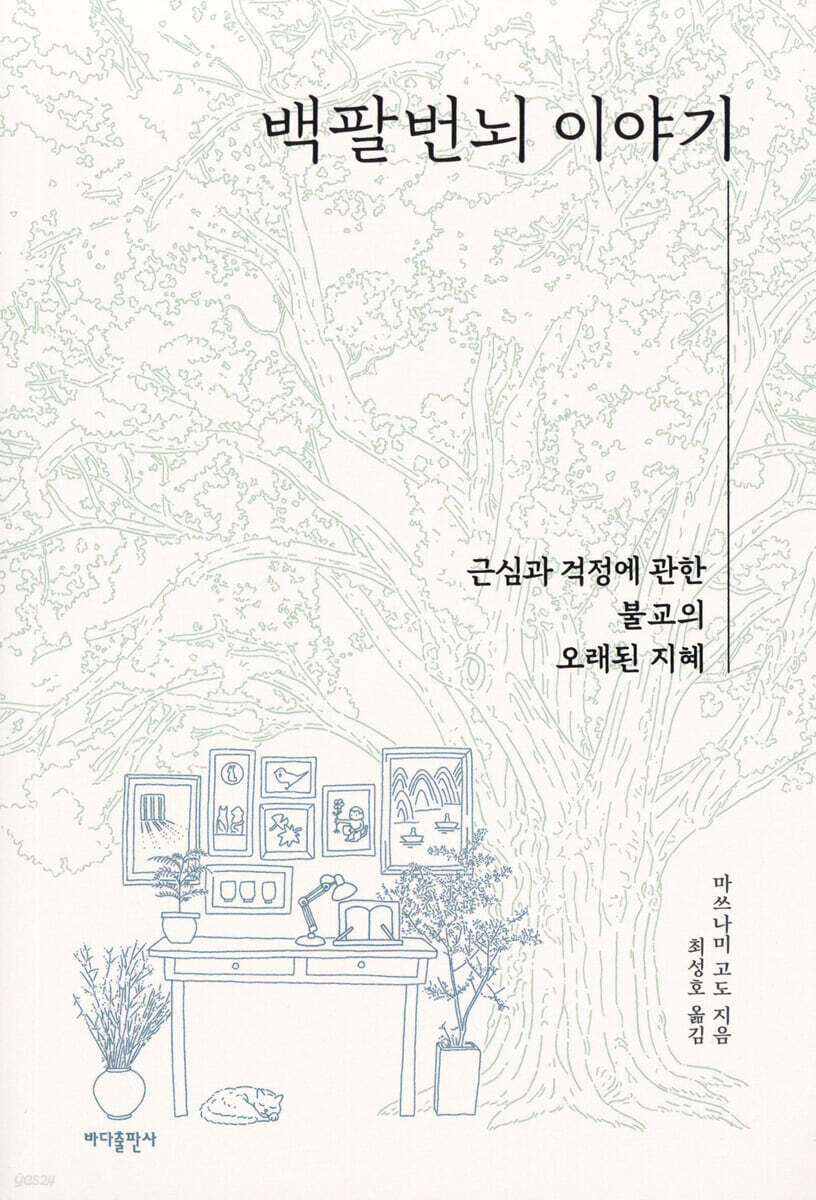
The story of the 108 earthly desires
 |
Description
Book Introduction
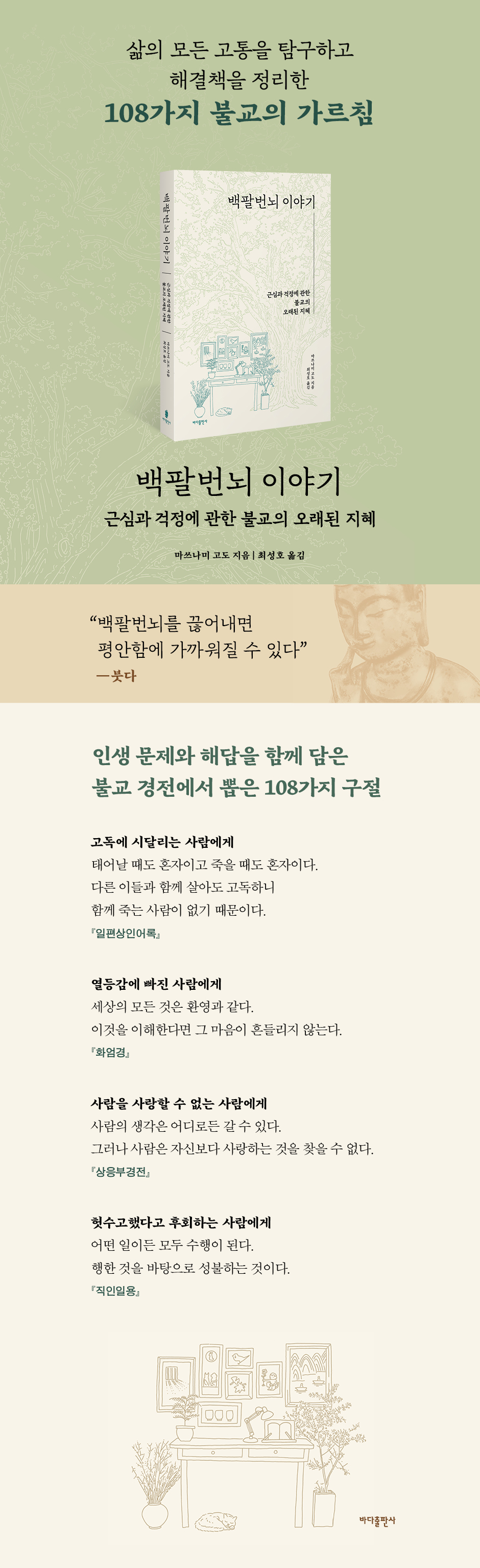
Explore all the pains of life and find solutions to them.
108 Buddhist Teachings
The 108 worries refer to all the worries and concerns that humans experience in life.
The Buddha, who deeply contemplated the suffering people experience, said that if we cut off these 108 defilements, we can get closer to peace.
So, Buddhism collects all the adversities that people have experienced over the past 2,500 years and presents solutions to them.
The 108 defilements begin with the six fundamental defilements of greed, hatred, arrogance, foolishness, prejudice, and hesitation, and include laziness, regret, forgetfulness, distraction, distrust, shame and lack of remorse, sloth, indulgence, and confusion, which we are bound to.
However, Buddhist scriptures also contain solutions for each situation.
In the 『Forty-Two Chapter Sutra』 introduced in this book, 『Story of the 108 Afflictions』, there is the following passage.
“If you clean the mirror and remove the dust, you can see yourself clearly.” The person standing in front of the mirror is ‘me,’ the one who removes the dust and makes it clean is ‘me,’ and the image that can be seen clearly is also ‘me.’
108 Buddhist Teachings
The 108 worries refer to all the worries and concerns that humans experience in life.
The Buddha, who deeply contemplated the suffering people experience, said that if we cut off these 108 defilements, we can get closer to peace.
So, Buddhism collects all the adversities that people have experienced over the past 2,500 years and presents solutions to them.
The 108 defilements begin with the six fundamental defilements of greed, hatred, arrogance, foolishness, prejudice, and hesitation, and include laziness, regret, forgetfulness, distraction, distrust, shame and lack of remorse, sloth, indulgence, and confusion, which we are bound to.
However, Buddhist scriptures also contain solutions for each situation.
In the 『Forty-Two Chapter Sutra』 introduced in this book, 『Story of the 108 Afflictions』, there is the following passage.
“If you clean the mirror and remove the dust, you can see yourself clearly.” The person standing in front of the mirror is ‘me,’ the one who removes the dust and makes it clean is ‘me,’ and the image that can be seen clearly is also ‘me.’
- You can preview some of the book's contents.
Preview
index
introduction
Chapter 1: Removing Internal Delusion
Part 1: To those who blame misfortune
Part 2 For those who are depressed every day
Part 3 To the person who is pointed at as useless
Part 4: To the person who worries about trivial things
To those who regret wasting their efforts in vain
Part 6: For those who find self-reflection difficult
Chapter 7: To those who fear the criticism of others
Chapter 8: To those who are not serious about everything
Chapter 9: To those suffering from loneliness
Part 10: For those who lack flexibility
Chapter 11: To the person who is only flashy on the outside
Chapter 12 To the Arrogant
Chapter 13: For those who lack the ability to execute
14. To the Noisy Person
Chapter 15: For people who are impatient and quick to anger
16. For those who easily go to extremes
Episode 17: For those who are not confident about their appearance
Chapter 18: To a person suffering from inferiority complex
Chapter 19: To the Cowardly
20. For those who can't quit drinking and smoking
21. To those who indulge in binge drinking and eating
Episode 22 To the person who cannot laugh sincerely
Chapter 2: Ending Conflict in Relationships
23. To those who are not happy at home
24. To the person who is campaigning
25. To the person who only makes excuses
26. To the person who talks a lot of useless words
27. To those who cannot work under others
Chapter 28 To the self-willed person
Chapter 29: To those who turn away from reality
30. To those who only imitate others
Chapter 31: To those who find it difficult to teach manners
32 For those who are raising a difficult child
Psalm 33 To those who have lost a beloved child
34. Parenting for those who are unsure about their role
Chapter 35: To those who are swayed by money
Psalm 36: To the one who has become a slave to lust
37. To the person who has been dumped
Chapter 38: For those whose relationship with their spouse is not good
Chapter 39: To the Jealous
40. For those suffering from conflict between mother-in-law and daughter-in-law
41. To those who cannot take good care of the elderly
42 To the person who lost the person he loved most
Chapter 3: Creating Joy in Your Life
43. To those who want to gain fame
Psalm 44 To those who find no purpose in life
For those who don't know how to study, Part 45
Episode 46 To the person who wanders around Busan
Episode 47 For those who still lack confidence
48. To the person who has no room in his heart
Psalm 49 To the person who gets bored easily with everything
For those who are only focused on the 50th test
51. For those who have trouble coming up with ideas
Episode 52 To the person who pretends to know
53. To those who cannot work with enthusiasm
Psalm 54 To the lazy person
55. To those who are dissatisfied with their income and status
Psalm 56: To those who have been shocked by adversity and have lost their motivation
Psalm 57 To the one who is bound by his own possessions
Episode 58: For those who have difficulty in interpersonal relationships
59. To the one who takes responsibility
60. To those who do not hesitate to act irresponsibly
Psalm 61: To those who have not met a good teacher
62. To those who have not acquired talent
63. To those who want to be scolded sincerely
Psalm 64 To the person who only thinks about his own path
Psalm 65 To the person who cannot love others
Chapter 4: Cultivating Compassion
66 To the person who is called a weirdo
67 To those who only find fault
Psalm 68 To those who lack gratitude
69. To those who cannot empathize with the suffering of others.
70 To the inconsiderate
Psalm 71 To those who cannot express their true feelings
Psalm 72 To those who lack a spirit of service
73. To the shy person
Psalm 74 To the one who has sinned
75. To those who are fascinated by trivial things
Psalm 76: To those who cannot overcome temptation
77 To the person who is not liked
Psalm 78: For those who find it difficult to do good deeds
79. To a person who is often misunderstood
80. To a person who has no eyes to see people
Psalm 81 To the Abused
Psalm 82 To those who speak carelessly
Psalm 83 To those who are deceived by fakes
Psalm 84: To those who despise things and life
Psalm 85 To those who hate others
86. To those who are swayed by momentary desires
87 To the Betrayed
Chapter 5: Realizing the Value of Every Day
88 To the person suffering from self-loathing
89. To those without a sense of mission
90. To the person who fell in love with the wrong person
Psalm 91: To those who are tired of life
92 To the person who does not know his own limits
93. To those who cannot do their best in the present.
Psalm 94 To a person whose mind is not at peace
95 To the person who only lies
96. To those suffering from insomnia
Psalm 97 To those who spend their days in vain
Psalm 98 To those who do not do what they should do
99. To those who consider themselves special.
100 To a person suffering from an incurable disease
101. To the person who spends the rest of his life in comfort
Episode 102: To those who want to live long
Psalm 103 To a person gripped by the fear of death
Episode 104: To those who believe only in the omnipotence of science
105 To the Superstitious
106. To those who cannot make offerings to their ancestors
107 To those who cannot believe in God
108 To the person who doesn't want to do anything
Appendix: Introduction to Buddhist Scriptures
Chapter 1: Removing Internal Delusion
Part 1: To those who blame misfortune
Part 2 For those who are depressed every day
Part 3 To the person who is pointed at as useless
Part 4: To the person who worries about trivial things
To those who regret wasting their efforts in vain
Part 6: For those who find self-reflection difficult
Chapter 7: To those who fear the criticism of others
Chapter 8: To those who are not serious about everything
Chapter 9: To those suffering from loneliness
Part 10: For those who lack flexibility
Chapter 11: To the person who is only flashy on the outside
Chapter 12 To the Arrogant
Chapter 13: For those who lack the ability to execute
14. To the Noisy Person
Chapter 15: For people who are impatient and quick to anger
16. For those who easily go to extremes
Episode 17: For those who are not confident about their appearance
Chapter 18: To a person suffering from inferiority complex
Chapter 19: To the Cowardly
20. For those who can't quit drinking and smoking
21. To those who indulge in binge drinking and eating
Episode 22 To the person who cannot laugh sincerely
Chapter 2: Ending Conflict in Relationships
23. To those who are not happy at home
24. To the person who is campaigning
25. To the person who only makes excuses
26. To the person who talks a lot of useless words
27. To those who cannot work under others
Chapter 28 To the self-willed person
Chapter 29: To those who turn away from reality
30. To those who only imitate others
Chapter 31: To those who find it difficult to teach manners
32 For those who are raising a difficult child
Psalm 33 To those who have lost a beloved child
34. Parenting for those who are unsure about their role
Chapter 35: To those who are swayed by money
Psalm 36: To the one who has become a slave to lust
37. To the person who has been dumped
Chapter 38: For those whose relationship with their spouse is not good
Chapter 39: To the Jealous
40. For those suffering from conflict between mother-in-law and daughter-in-law
41. To those who cannot take good care of the elderly
42 To the person who lost the person he loved most
Chapter 3: Creating Joy in Your Life
43. To those who want to gain fame
Psalm 44 To those who find no purpose in life
For those who don't know how to study, Part 45
Episode 46 To the person who wanders around Busan
Episode 47 For those who still lack confidence
48. To the person who has no room in his heart
Psalm 49 To the person who gets bored easily with everything
For those who are only focused on the 50th test
51. For those who have trouble coming up with ideas
Episode 52 To the person who pretends to know
53. To those who cannot work with enthusiasm
Psalm 54 To the lazy person
55. To those who are dissatisfied with their income and status
Psalm 56: To those who have been shocked by adversity and have lost their motivation
Psalm 57 To the one who is bound by his own possessions
Episode 58: For those who have difficulty in interpersonal relationships
59. To the one who takes responsibility
60. To those who do not hesitate to act irresponsibly
Psalm 61: To those who have not met a good teacher
62. To those who have not acquired talent
63. To those who want to be scolded sincerely
Psalm 64 To the person who only thinks about his own path
Psalm 65 To the person who cannot love others
Chapter 4: Cultivating Compassion
66 To the person who is called a weirdo
67 To those who only find fault
Psalm 68 To those who lack gratitude
69. To those who cannot empathize with the suffering of others.
70 To the inconsiderate
Psalm 71 To those who cannot express their true feelings
Psalm 72 To those who lack a spirit of service
73. To the shy person
Psalm 74 To the one who has sinned
75. To those who are fascinated by trivial things
Psalm 76: To those who cannot overcome temptation
77 To the person who is not liked
Psalm 78: For those who find it difficult to do good deeds
79. To a person who is often misunderstood
80. To a person who has no eyes to see people
Psalm 81 To the Abused
Psalm 82 To those who speak carelessly
Psalm 83 To those who are deceived by fakes
Psalm 84: To those who despise things and life
Psalm 85 To those who hate others
86. To those who are swayed by momentary desires
87 To the Betrayed
Chapter 5: Realizing the Value of Every Day
88 To the person suffering from self-loathing
89. To those without a sense of mission
90. To the person who fell in love with the wrong person
Psalm 91: To those who are tired of life
92 To the person who does not know his own limits
93. To those who cannot do their best in the present.
Psalm 94 To a person whose mind is not at peace
95 To the person who only lies
96. To those suffering from insomnia
Psalm 97 To those who spend their days in vain
Psalm 98 To those who do not do what they should do
99. To those who consider themselves special.
100 To a person suffering from an incurable disease
101. To the person who spends the rest of his life in comfort
Episode 102: To those who want to live long
Psalm 103 To a person gripped by the fear of death
Episode 104: To those who believe only in the omnipotence of science
105 To the Superstitious
106. To those who cannot make offerings to their ancestors
107 To those who cannot believe in God
108 To the person who doesn't want to do anything
Appendix: Introduction to Buddhist Scriptures
Detailed image
Into the book
Good and evil follow time, but there is no good or evil in time.
Good and evil are governed by law, but there is no good or evil in the law.
Zen Master Dogen, 『The Treasure of the True Dharma Eye』
--- p.17, from “To Those Who Blame Anxiety”
Since you can't change your natural appearance, you have to cultivate your inner beauty.
A true face cannot be deceived unless you wear colored glasses.
Your eyes should always be clear.
If it becomes cloudy, it can't be used.
--- p.71, from “To People Who Are Not Confident in Their Appearance”
No matter how much we try to suppress or cut off our desires, it doesn't work.
If left alone, it can easily spread like wildfire.
A humane way of life would be to control these destructive desires rather than neglect them and transform or sublimate them into constructive desires.
--- p.83, from “To those who indulge in binge drinking and eating”
No matter how many books you read and how much you study, if you only seek flashy expressions, nothing will come of it.
Only when you abandon your own private thoughts and enter into the teachings and become one with them in order to reach the true meaning can you truly understand what it is.
--- p.162, from “To Those Who Don’t Know How to Study”
A person who is truly qualified to rebuke others has the heart to rebuke himself.
If you scold others with the intention of scolding yourself, it will be ineffective.
Only then will others truly hear it.
Shouldn't we also become people who sincerely rebuke each other?
--- p.219, from “To those who want to be scolded sincerely”
A person's thoughts can go anywhere.
that
But a person cannot find anything he loves more than himself.
Likewise, other people love themselves endlessly.
Therefore, those who love themselves should not harm others.
『Sangeungbugyeongjeon』
--- p.223, from “To a Person Who Cannot Love”
There is a Chinese proverb that says, “Those who share skills will be jealous of each other, but those who share the Way will love each other.”
He who uses others for his own greed cannot have close friends.
You will naturally distance yourself from people who only act as if they are your friend when they are of use to you.
True friendship always blossoms between those who are committed to the other person and do so without regret.
--- p.264, from “To a Person Who Doesn’t Get Liked”
“If someone is wounded by a poisoned arrow and does not pull out the arrow, but instead wants to know who shot it and what kind of poison it was, the poison will spread and he will die while he searches for it.
“The first thing he needs to do is to remove the poisoned arrowhead and treat the wound.”
Good and evil are governed by law, but there is no good or evil in the law.
Zen Master Dogen, 『The Treasure of the True Dharma Eye』
--- p.17, from “To Those Who Blame Anxiety”
Since you can't change your natural appearance, you have to cultivate your inner beauty.
A true face cannot be deceived unless you wear colored glasses.
Your eyes should always be clear.
If it becomes cloudy, it can't be used.
--- p.71, from “To People Who Are Not Confident in Their Appearance”
No matter how much we try to suppress or cut off our desires, it doesn't work.
If left alone, it can easily spread like wildfire.
A humane way of life would be to control these destructive desires rather than neglect them and transform or sublimate them into constructive desires.
--- p.83, from “To those who indulge in binge drinking and eating”
No matter how many books you read and how much you study, if you only seek flashy expressions, nothing will come of it.
Only when you abandon your own private thoughts and enter into the teachings and become one with them in order to reach the true meaning can you truly understand what it is.
--- p.162, from “To Those Who Don’t Know How to Study”
A person who is truly qualified to rebuke others has the heart to rebuke himself.
If you scold others with the intention of scolding yourself, it will be ineffective.
Only then will others truly hear it.
Shouldn't we also become people who sincerely rebuke each other?
--- p.219, from “To those who want to be scolded sincerely”
A person's thoughts can go anywhere.
that
But a person cannot find anything he loves more than himself.
Likewise, other people love themselves endlessly.
Therefore, those who love themselves should not harm others.
『Sangeungbugyeongjeon』
--- p.223, from “To a Person Who Cannot Love”
There is a Chinese proverb that says, “Those who share skills will be jealous of each other, but those who share the Way will love each other.”
He who uses others for his own greed cannot have close friends.
You will naturally distance yourself from people who only act as if they are your friend when they are of use to you.
True friendship always blossoms between those who are committed to the other person and do so without regret.
--- p.264, from “To a Person Who Doesn’t Get Liked”
“If someone is wounded by a poisoned arrow and does not pull out the arrow, but instead wants to know who shot it and what kind of poison it was, the poison will spread and he will die while he searches for it.
“The first thing he needs to do is to remove the poisoned arrowhead and treat the wound.”
--- p.337, from “To Those Who Do Not Do What They Should Do”
Publisher's Review
A treasure trove of wisdom, cited for 2,500 years
Passages from 70 volumes of Buddhist scriptures
The wisdom contained in Buddhist scriptures, passed down for 2,500 years, is so profound and profound that it continues to be expressed in many famous sayings and teachings to this day.
This book contains 108 passages selected from around 70 Buddhist scriptures, including the early Buddhist scriptures 『Forty-Two Chapter Sutra』, 『Beopgu-gyeong』, and 『Gyeongjip』, which preserve the life lessons that the Buddha taught his disciples in his own language, and the 『Yukbang Yegyeong』, which contains Buddhist etiquette that parents and children, teachers and disciples should observe.
These passages teach us that death, aging, anxiety, and frustration, which we experience in life, are not inevitable, and that if we know exactly when and in what form these things we consider misfortunes come to us, we can sufficiently manage them and achieve peace of mind.
It also covers the principles we must follow as we live our lives, how to create joy in life, how to understand others and ourselves, and how to escape conflict in interpersonal relationships.
The verses of the Buddhist scriptures reveal the essential core of life and speak of unchanging truths.
However, although we have all heard of these scriptures at least once in our lives, the reality is that they are not easily accessible.
Accordingly, author Kodo Matsunami, a monk and Buddhist scholar, has specially modified the relevant passages to fit modern language based on his 20 years of experience studying Buddhism and spreading the Buddha's teachings in places such as Hawaii and the United States, and added stories, fables, and anecdotes from Buddhist scriptures to make it easier for the general public to access Buddhist scriptures in their daily lives.
“Happiness and unhappiness are within me.”
'I' have the answers to all life's problems
Once upon a time, there lived a lonely man in a village.
Every day he prayed to the sky, “Please make me happy, even just once.”
One night, as if God had heard the man's prayers, someone knocked on his door.
In front of the door stood the goddess of happiness, Gilsang, and the goddess of misfortune, Heuk-i.
The man wanted to bring only the Goddess of Happiness into his home, but the Goddess of Happiness replied, “We are one body, so we can only enter together or leave together.”
This story was recorded in the Buddhist scripture Abhidharma-kosha-salon 2,500 years ago.
The first Buddhist story that opens this book tells us that happiness and unhappiness may have different bodies, but their essence is the same.
It also tells us that just because misfortune strikes, it doesn't mean we shouldn't be happy tomorrow.
Likewise, even if we are happy now, our lives are such that misfortune can suddenly strike us in various forms, such as anxiety, uncertainty, disappointment, and worry.
If we recognize these truths of life, we will be able to choose happiness and unhappiness for ourselves, without being bound by our own attitudes.
Along with this story, the author introduces a passage from the Buddhist scripture, “Jeongbeopganjang.”
“Good and evil follow time, but time does not follow good and evil.
“Good and evil are subject to law, but law is not subject to good and evil.” Just as happiness and unhappiness are not influenced by law, era, or time, good and evil are not influenced by law.
The results will vary depending on whether we incline our mind and heart towards good or evil.
The direction of all life depends on me.
Money, grades, and career are just means.
Let go of obsession and achieve freedom
An entrepreneur said, “Once you have some money, you start to worry about how to keep it from running out.
They become targets for people and seeds of conflict and suffering.
“I envy people who are doing well without any problems,” he confesses.
He also says that a stable worker who barely makes ends meet day by day is happy.
The author says that if you always keep in mind that “humans originally had nothing,” you will be grateful even if you gain a thousand won, and you will not even blink an eye even if you lose a billion won.
Additionally, we are advised to live a life that is not bound by possessions, recognizing that the life that relies on possessions is fleeting.
Another student came to the author and confided, “I can’t help but feel like each day is meaningless.”
The author confesses that he has no definitive solution to relieve the young student's lethargy.
However, he noticed the student's thought that the meaning of life can be obtained naturally without doing anything, and said, "There is no need to force yourself to worry about it.
Don't expect any results or effects, just do what you feel like doing.
“Just do what you can, and if you still feel empty, then come back for counseling,” he suggested, quoting Maxim Gorky, “If work is enjoyable, life is paradise.
“If work is a duty, life is hell,” he adds.
In addition, it mentions the state of 'Ip-a-ip (I enter him, he enters me)' where you put yourself in the other person's shoes, and says that if you let go of your obsessions and stubbornness and enter into the other person's shoes in relationships with parents and children, friends, lovers, and even in work or school, you will be able to develop understanding and look at the other person with free thoughts.
Passages from 70 volumes of Buddhist scriptures
The wisdom contained in Buddhist scriptures, passed down for 2,500 years, is so profound and profound that it continues to be expressed in many famous sayings and teachings to this day.
This book contains 108 passages selected from around 70 Buddhist scriptures, including the early Buddhist scriptures 『Forty-Two Chapter Sutra』, 『Beopgu-gyeong』, and 『Gyeongjip』, which preserve the life lessons that the Buddha taught his disciples in his own language, and the 『Yukbang Yegyeong』, which contains Buddhist etiquette that parents and children, teachers and disciples should observe.
These passages teach us that death, aging, anxiety, and frustration, which we experience in life, are not inevitable, and that if we know exactly when and in what form these things we consider misfortunes come to us, we can sufficiently manage them and achieve peace of mind.
It also covers the principles we must follow as we live our lives, how to create joy in life, how to understand others and ourselves, and how to escape conflict in interpersonal relationships.
The verses of the Buddhist scriptures reveal the essential core of life and speak of unchanging truths.
However, although we have all heard of these scriptures at least once in our lives, the reality is that they are not easily accessible.
Accordingly, author Kodo Matsunami, a monk and Buddhist scholar, has specially modified the relevant passages to fit modern language based on his 20 years of experience studying Buddhism and spreading the Buddha's teachings in places such as Hawaii and the United States, and added stories, fables, and anecdotes from Buddhist scriptures to make it easier for the general public to access Buddhist scriptures in their daily lives.
“Happiness and unhappiness are within me.”
'I' have the answers to all life's problems
Once upon a time, there lived a lonely man in a village.
Every day he prayed to the sky, “Please make me happy, even just once.”
One night, as if God had heard the man's prayers, someone knocked on his door.
In front of the door stood the goddess of happiness, Gilsang, and the goddess of misfortune, Heuk-i.
The man wanted to bring only the Goddess of Happiness into his home, but the Goddess of Happiness replied, “We are one body, so we can only enter together or leave together.”
This story was recorded in the Buddhist scripture Abhidharma-kosha-salon 2,500 years ago.
The first Buddhist story that opens this book tells us that happiness and unhappiness may have different bodies, but their essence is the same.
It also tells us that just because misfortune strikes, it doesn't mean we shouldn't be happy tomorrow.
Likewise, even if we are happy now, our lives are such that misfortune can suddenly strike us in various forms, such as anxiety, uncertainty, disappointment, and worry.
If we recognize these truths of life, we will be able to choose happiness and unhappiness for ourselves, without being bound by our own attitudes.
Along with this story, the author introduces a passage from the Buddhist scripture, “Jeongbeopganjang.”
“Good and evil follow time, but time does not follow good and evil.
“Good and evil are subject to law, but law is not subject to good and evil.” Just as happiness and unhappiness are not influenced by law, era, or time, good and evil are not influenced by law.
The results will vary depending on whether we incline our mind and heart towards good or evil.
The direction of all life depends on me.
Money, grades, and career are just means.
Let go of obsession and achieve freedom
An entrepreneur said, “Once you have some money, you start to worry about how to keep it from running out.
They become targets for people and seeds of conflict and suffering.
“I envy people who are doing well without any problems,” he confesses.
He also says that a stable worker who barely makes ends meet day by day is happy.
The author says that if you always keep in mind that “humans originally had nothing,” you will be grateful even if you gain a thousand won, and you will not even blink an eye even if you lose a billion won.
Additionally, we are advised to live a life that is not bound by possessions, recognizing that the life that relies on possessions is fleeting.
Another student came to the author and confided, “I can’t help but feel like each day is meaningless.”
The author confesses that he has no definitive solution to relieve the young student's lethargy.
However, he noticed the student's thought that the meaning of life can be obtained naturally without doing anything, and said, "There is no need to force yourself to worry about it.
Don't expect any results or effects, just do what you feel like doing.
“Just do what you can, and if you still feel empty, then come back for counseling,” he suggested, quoting Maxim Gorky, “If work is enjoyable, life is paradise.
“If work is a duty, life is hell,” he adds.
In addition, it mentions the state of 'Ip-a-ip (I enter him, he enters me)' where you put yourself in the other person's shoes, and says that if you let go of your obsessions and stubbornness and enter into the other person's shoes in relationships with parents and children, friends, lovers, and even in work or school, you will be able to develop understanding and look at the other person with free thoughts.
GOODS SPECIFICS
- Date of issue: January 24, 2025
- Page count, weight, size: 384 pages | 470g | 140*203*19mm
- ISBN13: 9791166893209
- ISBN10: 1166893200
You may also like
카테고리
korean


korean

![GQ KOREA Mark (Monthly): December [2025]](http://librairie.coreenne.fr/cdn/shop/files/8ef265dbbfbf186523ed75ba7319009d.jpg?v=1765340328&width=3840)


