

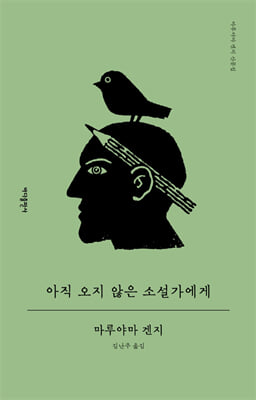
To the novelist who has not yet arrived
 |
Description
Book Introduction
“Do you really want to write a novel?”
Kenji Maruyama, the writer of solitude and seclusion
Advice to Upcoming Novelists
Maruyama Genji is a writer of 'solitude' and 'reclusion' who has never interacted with the literary world and has devoted himself solely to writing.
He broke his rule of dedicating himself to writing novels and took up his pen for others.
This book, "To the Novelist Who Has Not Yet Arrived," is advice from Genji to future novelists who have yet to appear.
For the past 30 years, I've been collecting the words I wanted to say to them, hoping that when they pick up their pens and start writing, they won't be disappointed and run away after diving into the world of literature.
Genji's words are blunt and cold, but at the same time, they are filled with deep affection.
I spare no support and encouragement so that my juniors can follow this path without hesitation and bravely jump into the vast ocean of literature.
It asks not only about the technical elements required to become a novelist, but also what it means to write a novel, to do literature.
Kenji Maruyama, the writer of solitude and seclusion
Advice to Upcoming Novelists
Maruyama Genji is a writer of 'solitude' and 'reclusion' who has never interacted with the literary world and has devoted himself solely to writing.
He broke his rule of dedicating himself to writing novels and took up his pen for others.
This book, "To the Novelist Who Has Not Yet Arrived," is advice from Genji to future novelists who have yet to appear.
For the past 30 years, I've been collecting the words I wanted to say to them, hoping that when they pick up their pens and start writing, they won't be disappointed and run away after diving into the world of literature.
Genji's words are blunt and cold, but at the same time, they are filled with deep affection.
I spare no support and encouragement so that my juniors can follow this path without hesitation and bravely jump into the vast ocean of literature.
It asks not only about the technical elements required to become a novelist, but also what it means to write a novel, to do literature.
- You can preview some of the book's contents.
Preview
index
Preface: What the Novelist Lost
Chapter 1: The Novelist I'm Waiting For
The novelist who has not yet arrived
Strange World
A novelist of an age of comfort
literary talent
Three Types of Aspiring Novelists
The third type I'm looking forward to
Chapter 2: Learn how to write while writing
Write it down first
Once you start writing, there's no looking back.
If you have talent, you fall into self-loathing.
An image that loses its flavor when translated into language
Rewrite it at least seven times
Even if you complete a piece, you will not submit it.
Prepare notes
Dream of creating a work of art
Develop expressive power that is not limited to video
The Novelist's Tools
Keep silent
sort out relationships with friends
Chapter 3 After debuting as a novelist
First steps as a novelist
Don't trust your editor too much
Never compromise
Manuscript fees are different from the evaluation of the work. 9
Self-reliance is the path to becoming a novelist.
At the awards ceremony
Living solely on royalties
Don't be satisfied with just satisfying the desires in front of you.
No matter how much you are struggling, you will never be asked for an advance payment.
Exchanges with novelists
Enforcing 'solitude' and 'individuality'
A novel unprecedented in the world
Don't explain your work
Leave your job
Chapter 4: Living with a Pen
To a novelist, a work is
Those who come
The art of looking into the soul
Mental fatigue should not be overlooked
Physical fitness is also important
Alcohol and drugs that kill brain cells
The brain shines brightest when it's hungry.
Control yourself strictly
There is a time to put down and a time to rush in.
Should I live in the city or the countryside?
Lower the standard of living
Knowledge for Creation
The countryside is the most suitable place for the revival of literature.
Don't approach power
What can we do in front of a starving child?
Chapter 5: Into the vast sea of literature
Is this work appropriate for its age?
I need you
The swamp of novels
Don't look back at the beach
You won't know until you try
Don't be swayed by your own judgment
When I was sick of loneliness
Returning to the novel, the challenge lies ahead
Write a prequel novel
The person who will carry the literature of the future
Chapter 1: The Novelist I'm Waiting For
The novelist who has not yet arrived
Strange World
A novelist of an age of comfort
literary talent
Three Types of Aspiring Novelists
The third type I'm looking forward to
Chapter 2: Learn how to write while writing
Write it down first
Once you start writing, there's no looking back.
If you have talent, you fall into self-loathing.
An image that loses its flavor when translated into language
Rewrite it at least seven times
Even if you complete a piece, you will not submit it.
Prepare notes
Dream of creating a work of art
Develop expressive power that is not limited to video
The Novelist's Tools
Keep silent
sort out relationships with friends
Chapter 3 After debuting as a novelist
First steps as a novelist
Don't trust your editor too much
Never compromise
Manuscript fees are different from the evaluation of the work. 9
Self-reliance is the path to becoming a novelist.
At the awards ceremony
Living solely on royalties
Don't be satisfied with just satisfying the desires in front of you.
No matter how much you are struggling, you will never be asked for an advance payment.
Exchanges with novelists
Enforcing 'solitude' and 'individuality'
A novel unprecedented in the world
Don't explain your work
Leave your job
Chapter 4: Living with a Pen
To a novelist, a work is
Those who come
The art of looking into the soul
Mental fatigue should not be overlooked
Physical fitness is also important
Alcohol and drugs that kill brain cells
The brain shines brightest when it's hungry.
Control yourself strictly
There is a time to put down and a time to rush in.
Should I live in the city or the countryside?
Lower the standard of living
Knowledge for Creation
The countryside is the most suitable place for the revival of literature.
Don't approach power
What can we do in front of a starving child?
Chapter 5: Into the vast sea of literature
Is this work appropriate for its age?
I need you
The swamp of novels
Don't look back at the beach
You won't know until you try
Don't be swayed by your own judgment
When I was sick of loneliness
Returning to the novel, the challenge lies ahead
Write a prequel novel
The person who will carry the literature of the future
Detailed image
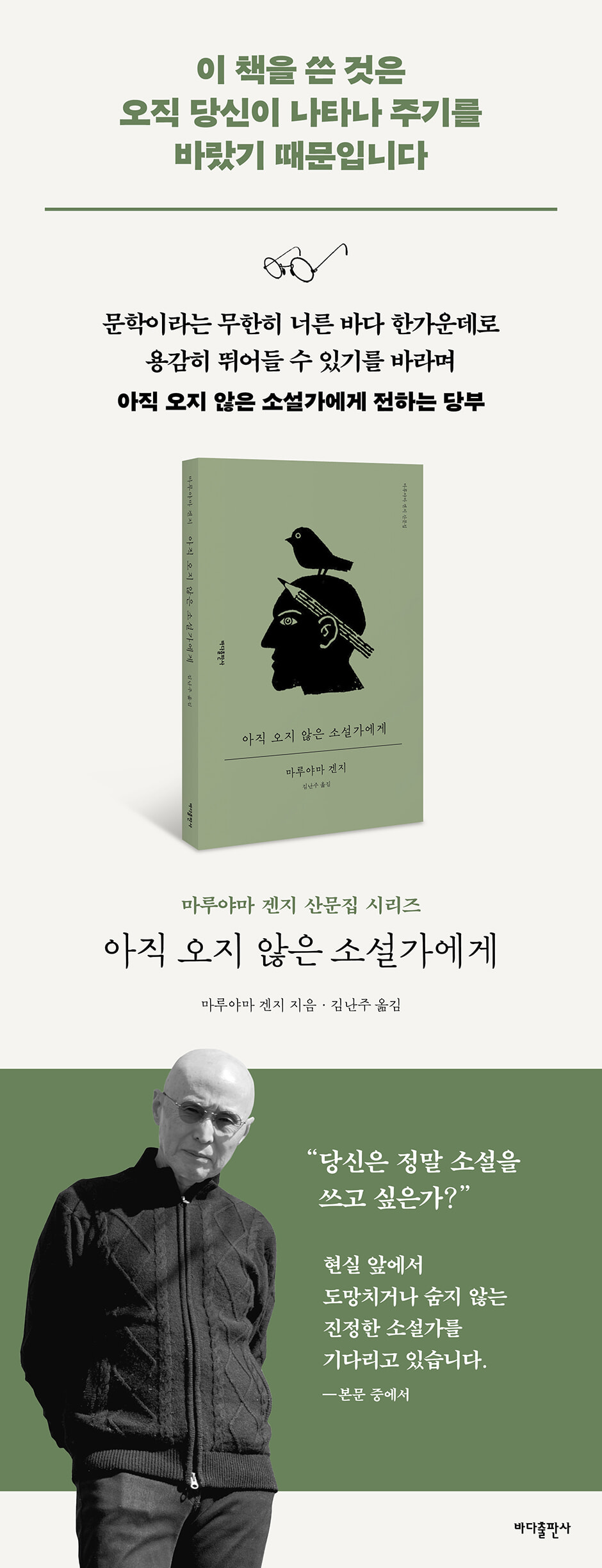
Into the book
The "novelists yet to come" mentioned in this book do not simply refer to the countless unknown newcomers who vaguely dream or hope to become novelists.
--- p.17
Learning how to write by writing is a much faster process than attending a class at a cultural center taught by a third-rate novelist.
Moreover, since you are not influenced by established literature, you can find your own literary path.
And once you've finished your first novel, it will become clear whether you're just a self-absorbed, self-deprecating person who has turned your back on the world, or whether you possess something truly gifted.
It's worth a try just to see if you have the talent.
--- pp.37-38
New literature is never born from the existing types of novelists or their lives and writing methods.
It all depends on whether you maintain an independent spirit and the ability to go it alone.
--- p.99
Perhaps the artist's agony is something that disappears after sweating profusely.
It would be truly ridiculous to neglect the body and then treat suffering for the sake of suffering as the subject of a novel.
--- p.141
There comes a time when I feel the agony that this is not the kind of novel I want to write, that the novel I aim for is something much more tremendous.
This is the result of a gradual improvement in vision rather than skill.
The more seriously I write, the less the mountain I'm climbing feels, and even when I reach the top, I'm not particularly impressed. I'm disappointed to find that there are far higher and more attractive peaks around me.
But never be impatient.
Don't do things like throw away the work you're currently working on and try something else.
--- p.17
Learning how to write by writing is a much faster process than attending a class at a cultural center taught by a third-rate novelist.
Moreover, since you are not influenced by established literature, you can find your own literary path.
And once you've finished your first novel, it will become clear whether you're just a self-absorbed, self-deprecating person who has turned your back on the world, or whether you possess something truly gifted.
It's worth a try just to see if you have the talent.
--- pp.37-38
New literature is never born from the existing types of novelists or their lives and writing methods.
It all depends on whether you maintain an independent spirit and the ability to go it alone.
--- p.99
Perhaps the artist's agony is something that disappears after sweating profusely.
It would be truly ridiculous to neglect the body and then treat suffering for the sake of suffering as the subject of a novel.
--- p.141
There comes a time when I feel the agony that this is not the kind of novel I want to write, that the novel I aim for is something much more tremendous.
This is the result of a gradual improvement in vision rather than skill.
The more seriously I write, the less the mountain I'm climbing feels, and even when I reach the top, I'm not particularly impressed. I'm disappointed to find that there are far higher and more attractive peaks around me.
But never be impatient.
Don't do things like throw away the work you're currently working on and try something else.
--- p.200
Publisher's Review
“This book was written only by a novelist like you.
Because I wanted you to appear.”
Expectations and Requests for Novelists Who Have Not Yet Arrived
If this minimal common sense that a novelist should devote himself to writing seems idealistic or ascetic, then your real goal is not fiction, so before you pick up your pen, ask yourself this question:
'Do you really want to write a novel?'
(Pages 8-9, from the 'Preface')
This book is not for those who vaguely dream of becoming a novelist.
So, we cannot find any plausible words, either literary or artistic.
The 'novelist who has not yet arrived' that Maruyama Genji is waiting for is the savior of the literary world.
He is someone who will overcome the easy and pitiful reality and “walk straight down the path of a novelist.”
As a senior who has walked that path first, he reveals in detail what the life of a novelist is, filled with solitude, seclusion, creativity, and independence.
In other words, it clearly organizes comprehensive advice on novelists' eating habits, money management and health, interpersonal relationships, living environment, methods of writing and revising novels, talent, and effort.
Genji's advice is clear.
If you are a novelist, you should devote yourself to your novels. If there is anything that is hindering you from doing so, you should sort it out and give it up.
The first chapter, “The Novelist I’m Waiting For,” talks about the “three types” of aspiring novelists.
First, the yearning type who says, ‘I want to write a novel like someone else’s work.’
Second, the type that starts with the thought, ‘If it’s to this extent, I can write it somehow, right?’
Third, there is the type who doubts, "Can this level be called literature?", then denies it, saying, "This is not literature," and finally picks up the pen with the determination, "I will write a much more amazing novel."
Among these, the novelist that Genji is looking forward to is the ‘third type.’
This is because they possess the true talent to become true novelists.
The second chapter, “Learning to Write While Writing,” provides specific advice on how to prepare a manuscript to debut as a novelist, and the third chapter, “After Debuting as a Novelist,” provides specific advice on how to realistically live after debuting.
The fourth chapter, “Living with a Pen,” and the fifth chapter, “Into the Middle of the Wide Sea of Literature,” discuss the novelist’s attitude in earnest.
It asks what it means to write a novel, to do literature, and whether there is a place to return to beyond the novel.
I also look forward to the emergence of a new novelist who will shoulder the literature of the future, that is, a 'you' who has not yet arrived.
“It is not literature that has declined,
“A person related to literature”
What a true novelist guards against
As long as humans use language as a tool for communication, the life of literature will be eternal.
What has declined is not literature, but the people who relate to literature.
(Page 209, from "Those Who Will Carry the Literature of the Future")
Genji cries out that literature as it has been up to now is in decline.
To be precise, it is not literature, but all 'humans' who have a relationship with literature that have fallen into the abyss.
This includes not only novelists, but also editors, readers, and critics.
A novelist who wanders around with a sidelong glance at things that aren't novels, an editor who has no love for literature and is only interested in using company money to socialize with novelists, an undiscerning reader who expects something from novelists that isn't part of their work, and a critic who considers the works they read and were impressed by in their youth to be the best in the world and doesn't go any further.
These people formed a force and became the mainstream of the literary world, and by excluding values different from their own as non-literary, they ultimately drove literature down the path of decline.
He criticizes today's literature as nothing more than "a game where grown-ups get together and pretend to be artists."
In particular, he strongly criticizes existing novelists, especially novelists who appear on TV programs, give lectures, and are paid several times the manuscript fee due to their somewhat well-known reputation, and novelists who write 'little' works as soon as they are commissioned under the pretext of making a living.
The same goes for novelists who approach the authority of a literary world or the power of a nation.
Wouldn't this be the era of true literature?
Whether that happens or not depends on the emergence of a novelist who is the exact opposite of existing novelists.
Unless such novelists emerge, literature will forever remain stagnant and doomed to sink.
(Page 25, from "Novelists of an Era of Comfort")
So, what does it take to become a true novelist of the age of literature? Genji's answer: stamina, self-reliance, sincerity, and a never-ending focus.
He is consistently wary of seeing anything other than fiction.
That is, you have to have the will to write on your own, write on your own, and never let go of the novel you wrote, no matter how many years it takes.
In this way, you will “learn to swim by holding onto language and eventually set sail for the distant sea.”
'They laugh at this book,
To the future novelist who will surprise me'
I want to show it through works, not words.
In the vast ocean of literature, I eagerly await your sudden appearance from beyond the horizon.
And I look forward to seeing you, who, in a completely different position than I, will come up with a work that will surprise me while ridiculing this book.
(Page 215, from "Those Who Will Carry the Literature of the Future")
The novelist Genji is waiting for is a novelist who lives an 'independent life'.
Only novelists who are independent or who are trying to become independent can shoulder the burden of future literature.
People born in a stable era, people who are overly affluent, people who want to return to being children, authoritarians, and servile people cannot create new works.
It is said that we should be able to live a minimal life by eating less, earning less, and meeting fewer people.
So, after 30 years, he's finally taking the plunge and pouring out his life's work to a new generation of young novelists, hoping they'll "laugh at this book and show up with a work that will surprise me."
This advice is in line with the attitude of a novelist that Genji emphasizes countless times in this book.
It may also be a supportive message, hoping that he will reject his own advice and follow his own path.
Of course, the independence that Genji pursues does not mean isolation and disconnection.
Just because you're organizing your relationships and not relying on others, or fighting against loneliness, doesn't mean you're completely closed off.
The attitude of a self-reliant novelist is a noble one: to delve deeply into one's own essence, to peer into the hearts of others, and to open one's heart to understand what this world is all about.
It is a forward-looking attitude, the opposite of a lifestyle that is endlessly shut in.
So, it is an attitude of pouring out everything you want to say only through ‘works’.
Because I wanted you to appear.”
Expectations and Requests for Novelists Who Have Not Yet Arrived
If this minimal common sense that a novelist should devote himself to writing seems idealistic or ascetic, then your real goal is not fiction, so before you pick up your pen, ask yourself this question:
'Do you really want to write a novel?'
(Pages 8-9, from the 'Preface')
This book is not for those who vaguely dream of becoming a novelist.
So, we cannot find any plausible words, either literary or artistic.
The 'novelist who has not yet arrived' that Maruyama Genji is waiting for is the savior of the literary world.
He is someone who will overcome the easy and pitiful reality and “walk straight down the path of a novelist.”
As a senior who has walked that path first, he reveals in detail what the life of a novelist is, filled with solitude, seclusion, creativity, and independence.
In other words, it clearly organizes comprehensive advice on novelists' eating habits, money management and health, interpersonal relationships, living environment, methods of writing and revising novels, talent, and effort.
Genji's advice is clear.
If you are a novelist, you should devote yourself to your novels. If there is anything that is hindering you from doing so, you should sort it out and give it up.
The first chapter, “The Novelist I’m Waiting For,” talks about the “three types” of aspiring novelists.
First, the yearning type who says, ‘I want to write a novel like someone else’s work.’
Second, the type that starts with the thought, ‘If it’s to this extent, I can write it somehow, right?’
Third, there is the type who doubts, "Can this level be called literature?", then denies it, saying, "This is not literature," and finally picks up the pen with the determination, "I will write a much more amazing novel."
Among these, the novelist that Genji is looking forward to is the ‘third type.’
This is because they possess the true talent to become true novelists.
The second chapter, “Learning to Write While Writing,” provides specific advice on how to prepare a manuscript to debut as a novelist, and the third chapter, “After Debuting as a Novelist,” provides specific advice on how to realistically live after debuting.
The fourth chapter, “Living with a Pen,” and the fifth chapter, “Into the Middle of the Wide Sea of Literature,” discuss the novelist’s attitude in earnest.
It asks what it means to write a novel, to do literature, and whether there is a place to return to beyond the novel.
I also look forward to the emergence of a new novelist who will shoulder the literature of the future, that is, a 'you' who has not yet arrived.
“It is not literature that has declined,
“A person related to literature”
What a true novelist guards against
As long as humans use language as a tool for communication, the life of literature will be eternal.
What has declined is not literature, but the people who relate to literature.
(Page 209, from "Those Who Will Carry the Literature of the Future")
Genji cries out that literature as it has been up to now is in decline.
To be precise, it is not literature, but all 'humans' who have a relationship with literature that have fallen into the abyss.
This includes not only novelists, but also editors, readers, and critics.
A novelist who wanders around with a sidelong glance at things that aren't novels, an editor who has no love for literature and is only interested in using company money to socialize with novelists, an undiscerning reader who expects something from novelists that isn't part of their work, and a critic who considers the works they read and were impressed by in their youth to be the best in the world and doesn't go any further.
These people formed a force and became the mainstream of the literary world, and by excluding values different from their own as non-literary, they ultimately drove literature down the path of decline.
He criticizes today's literature as nothing more than "a game where grown-ups get together and pretend to be artists."
In particular, he strongly criticizes existing novelists, especially novelists who appear on TV programs, give lectures, and are paid several times the manuscript fee due to their somewhat well-known reputation, and novelists who write 'little' works as soon as they are commissioned under the pretext of making a living.
The same goes for novelists who approach the authority of a literary world or the power of a nation.
Wouldn't this be the era of true literature?
Whether that happens or not depends on the emergence of a novelist who is the exact opposite of existing novelists.
Unless such novelists emerge, literature will forever remain stagnant and doomed to sink.
(Page 25, from "Novelists of an Era of Comfort")
So, what does it take to become a true novelist of the age of literature? Genji's answer: stamina, self-reliance, sincerity, and a never-ending focus.
He is consistently wary of seeing anything other than fiction.
That is, you have to have the will to write on your own, write on your own, and never let go of the novel you wrote, no matter how many years it takes.
In this way, you will “learn to swim by holding onto language and eventually set sail for the distant sea.”
'They laugh at this book,
To the future novelist who will surprise me'
I want to show it through works, not words.
In the vast ocean of literature, I eagerly await your sudden appearance from beyond the horizon.
And I look forward to seeing you, who, in a completely different position than I, will come up with a work that will surprise me while ridiculing this book.
(Page 215, from "Those Who Will Carry the Literature of the Future")
The novelist Genji is waiting for is a novelist who lives an 'independent life'.
Only novelists who are independent or who are trying to become independent can shoulder the burden of future literature.
People born in a stable era, people who are overly affluent, people who want to return to being children, authoritarians, and servile people cannot create new works.
It is said that we should be able to live a minimal life by eating less, earning less, and meeting fewer people.
So, after 30 years, he's finally taking the plunge and pouring out his life's work to a new generation of young novelists, hoping they'll "laugh at this book and show up with a work that will surprise me."
This advice is in line with the attitude of a novelist that Genji emphasizes countless times in this book.
It may also be a supportive message, hoping that he will reject his own advice and follow his own path.
Of course, the independence that Genji pursues does not mean isolation and disconnection.
Just because you're organizing your relationships and not relying on others, or fighting against loneliness, doesn't mean you're completely closed off.
The attitude of a self-reliant novelist is a noble one: to delve deeply into one's own essence, to peer into the hearts of others, and to open one's heart to understand what this world is all about.
It is a forward-looking attitude, the opposite of a lifestyle that is endlessly shut in.
So, it is an attitude of pouring out everything you want to say only through ‘works’.
GOODS SPECIFICS
- Date of issue: October 17, 2025
- Page count, weight, size: 216 pages | 122*190*12mm
- ISBN13: 9791166893742
You may also like
카테고리
korean


korean

![GQ KOREA Mark (Monthly): December [2025]](http://librairie.coreenne.fr/cdn/shop/files/8ef265dbbfbf186523ed75ba7319009d.jpg?v=1765340328&width=3840)


