

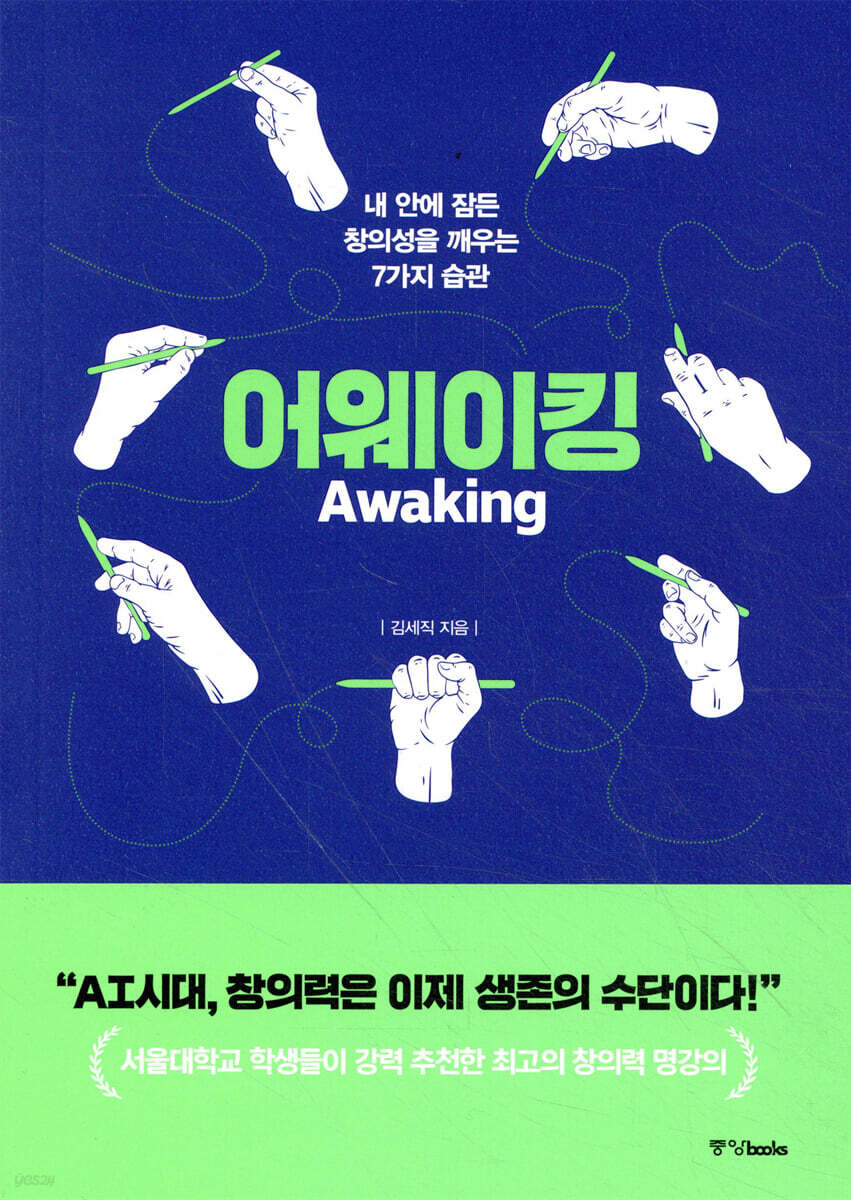
Awaking
 |
Description
Book Introduction
A special creativity class from Korea's leading economist
*** The best creativity lectures highly recommended by Seoul National University students ***
Professor Kim Se-jik, a leading macroeconomist in South Korea and a renowned creative lecturer at Seoul National University's Department of Economics for nearly 20 years, has published a new book, "Awaking."
This book provides seven specific methods that anyone can use to awaken and develop the creative cells dormant within themselves after at least three months of practice.
*** The best creativity lectures highly recommended by Seoul National University students ***
Professor Kim Se-jik, a leading macroeconomist in South Korea and a renowned creative lecturer at Seoul National University's Department of Economics for nearly 20 years, has published a new book, "Awaking."
This book provides seven specific methods that anyone can use to awaken and develop the creative cells dormant within themselves after at least three months of practice.
- You can preview some of the book's contents.
Preview
index
PROLOGUE: Invest in Creativity, Now Your Greatest Asset in the AI Era
PART 1: Three Misconceptions About Creativity
What is human imagination?
Imagination is also a habit
PART 2: 7 Ways to Unleash Your Creativity
1 | Imagining the Unreal
2 | Logical Imagination
3-1 | Thinking Differently I
3-2 | Thinking Differently II
4 | Constantly Asking Questions
5 | Imagine the Unconventional
6 | Developing the Courage to Push My Ideas
7 | Keep practicing and failing
PART 3: 10 Key Economic Facts for Creative Growth
EPILOGUE | The Courage to Practice, the Faith to Move Forward
PART 1: Three Misconceptions About Creativity
What is human imagination?
Imagination is also a habit
PART 2: 7 Ways to Unleash Your Creativity
1 | Imagining the Unreal
2 | Logical Imagination
3-1 | Thinking Differently I
3-2 | Thinking Differently II
4 | Constantly Asking Questions
5 | Imagine the Unconventional
6 | Developing the Courage to Push My Ideas
7 | Keep practicing and failing
PART 3: 10 Key Economic Facts for Creative Growth
EPILOGUE | The Courage to Practice, the Faith to Move Forward
Detailed image
Into the book
Unlike stocks or real estate, creativity is an asset that carries no risk of loss due to price declines.
No matter what way you try
The profit cannot be negative.
If you come up with an idea, what's the harm if it doesn't come to fruition?
No investment in this world is as one would like, but the only investment that is free and without risk of loss is thinking, imagining, and developing creativity.
--- p.9
The most important thing is to first realize that we ourselves are beings with the ability to think and imagine infinitely.
What is needed to do this is the confidence and belief that you have the ability to imagine infinitely.
It is the belief that one has the ability to come up with new ideas through infinite imagination.
--- p.21
Until now, in elementary, middle, and high school, we have only solved 'closed problems' with already determined answers.
When I asked students in the Department of Economics at Seoul National University, they said they had solved as many as 70,000 closed-ended problems in high school.
However, it is said that he has rarely solved open-ended problems without correct answers.
--- p.24
To develop creativity, it is important to believe that you can develop creativity.
That's because you have to keep trying creative ideas, and then suddenly a good idea will come to you.
As we experience the pleasure of thinking through this, our brain becomes more and more absorbed in thinking.
As a result, creativity grows.
That's why I often refer to creativity as a 'self-fulfilling belief.'
Creativity is something that can be nurtured, and it only grows if you believe that you can nurture it.
--- p.36
If you feel like you lack creativity, try adding your own imagination to the space or objects around you.
Even if it's a vain or ridiculous imagination, it's fine.
Why has BTS been able to create such enormous economic value? It's probably because they've constantly practiced imagining the unreal.
Instead of compromising with reality.
So we too must imagine.
Especially the unrealistic, the absurd.
--- p.61
SpaceX successfully sent a civilian crew into space in 2021, and Neuralink, a brain research startup he founded, received FDA clinical approval and implanted an artificial chip into the brain of a clinical trial patient in January.
These are all world firsts.
Of course, we are currently faced with ethical issues that need to be resolved, but one day, as Elon Musk says, humanity may migrate to Mars and live forever with preserved memories.
It's like something out of a science fiction movie.
--- p.70
The first credit card created by McNamara was the Diners Club, which has over 4,000 affiliated stores in over 200 countries around the world.
It means that it started with the 'membership (Club)' of 'Dinner'.
The current postpaid credit card was born thanks to McNamara's imagination, which completely broke the common sense of the time that 'you can't make payments without cash'.
It is.
--- p.85
This tradition began with William Harper, the first president of the University of Chicago.
Harper wanted to create a 'university like no other'.
Harper persuades oil magnate John Rockefeller to make his dream come true.
The University of Chicago was founded in 1982 with a large donation from Rockefeller, who highly valued his vision.
President Harper wanted to make the University of Chicago something completely different from other universities.
I considered research more important than lectures.
In particular, we wanted to become a university that discovers new truths and nurtures those who discover the truth.
Accordingly, the University of Chicago sought individuals who could present unique, new ideas in each field.
The University of Chicago's creative academic culture began right here.
--- p.124
Henri Matisse, who is considered one of the greatest artists of the 20th century along with Picasso, left behind a famous quote.
Creativity takes courage.
Indeed, his life is filled with the courage to showcase his creativity to the world.
After graduating from law school and becoming a lawyer, Matisse began painting with paints and brushes given to him by his mother while he was hospitalized with appendicitis.
Through that, he realized that being a painter was his path.
Eventually, he gave up his stable path as a lawyer and entered art school in Paris despite his father's strong opposition.
It was Matisse's first courage.
No matter what way you try
The profit cannot be negative.
If you come up with an idea, what's the harm if it doesn't come to fruition?
No investment in this world is as one would like, but the only investment that is free and without risk of loss is thinking, imagining, and developing creativity.
--- p.9
The most important thing is to first realize that we ourselves are beings with the ability to think and imagine infinitely.
What is needed to do this is the confidence and belief that you have the ability to imagine infinitely.
It is the belief that one has the ability to come up with new ideas through infinite imagination.
--- p.21
Until now, in elementary, middle, and high school, we have only solved 'closed problems' with already determined answers.
When I asked students in the Department of Economics at Seoul National University, they said they had solved as many as 70,000 closed-ended problems in high school.
However, it is said that he has rarely solved open-ended problems without correct answers.
--- p.24
To develop creativity, it is important to believe that you can develop creativity.
That's because you have to keep trying creative ideas, and then suddenly a good idea will come to you.
As we experience the pleasure of thinking through this, our brain becomes more and more absorbed in thinking.
As a result, creativity grows.
That's why I often refer to creativity as a 'self-fulfilling belief.'
Creativity is something that can be nurtured, and it only grows if you believe that you can nurture it.
--- p.36
If you feel like you lack creativity, try adding your own imagination to the space or objects around you.
Even if it's a vain or ridiculous imagination, it's fine.
Why has BTS been able to create such enormous economic value? It's probably because they've constantly practiced imagining the unreal.
Instead of compromising with reality.
So we too must imagine.
Especially the unrealistic, the absurd.
--- p.61
SpaceX successfully sent a civilian crew into space in 2021, and Neuralink, a brain research startup he founded, received FDA clinical approval and implanted an artificial chip into the brain of a clinical trial patient in January.
These are all world firsts.
Of course, we are currently faced with ethical issues that need to be resolved, but one day, as Elon Musk says, humanity may migrate to Mars and live forever with preserved memories.
It's like something out of a science fiction movie.
--- p.70
The first credit card created by McNamara was the Diners Club, which has over 4,000 affiliated stores in over 200 countries around the world.
It means that it started with the 'membership (Club)' of 'Dinner'.
The current postpaid credit card was born thanks to McNamara's imagination, which completely broke the common sense of the time that 'you can't make payments without cash'.
It is.
--- p.85
This tradition began with William Harper, the first president of the University of Chicago.
Harper wanted to create a 'university like no other'.
Harper persuades oil magnate John Rockefeller to make his dream come true.
The University of Chicago was founded in 1982 with a large donation from Rockefeller, who highly valued his vision.
President Harper wanted to make the University of Chicago something completely different from other universities.
I considered research more important than lectures.
In particular, we wanted to become a university that discovers new truths and nurtures those who discover the truth.
Accordingly, the University of Chicago sought individuals who could present unique, new ideas in each field.
The University of Chicago's creative academic culture began right here.
--- p.124
Henri Matisse, who is considered one of the greatest artists of the 20th century along with Picasso, left behind a famous quote.
Creativity takes courage.
Indeed, his life is filled with the courage to showcase his creativity to the world.
After graduating from law school and becoming a lawyer, Matisse began painting with paints and brushes given to him by his mother while he was hospitalized with appendicitis.
Through that, he realized that being a painter was his path.
Eventually, he gave up his stable path as a lawyer and entered art school in Paris despite his father's strong opposition.
It was Matisse's first courage.
--- p.173
Publisher's Review
Why Economists Emphasize Creativity
The author, who received his Ph.D. in economics from the University of Chicago under the supervision of Nobel Prize winners Professor Robert Lucas and Professor Nancy Stokke, returned to Korea in 2006 and took up a professorship at Seoul National University. He pondered deeply about what kind of classes he should teach, and the answer was 'creativity.'
The Korean economy is likely to enter an ice age of zero growth, with its long-term growth rate continuously declining according to the '5-year 1% decline rule', and the author attributes this to the 'lack of creativity' of Koreans.
This book is based on the author's experience of teaching creativity to Seoul National University students for over 20 years, and is written to awaken the dormant potential of countless Koreans who have become accustomed to "creation through imitation," that is, to follow others.
In an age of AI domination, 7 ways to awaken your inner creativity.
Modern people live in an age of AI that can create images in the style of great artists in seconds with just a simple command.
Life is becoming more and more convenient, but we are living in a time of fear where we are questioning the extent of our "usefulness as humans."
In this age of fear, how can we preserve human dignity and nurture creativity, a uniquely human domain?
The author emphasizes that if we can let go of the fear of the vague concept of "creativity" that we have been thinking about until now and believe that we can awaken the creativity dormant within ourselves, anyone can come up with creative ideas that can change the world.
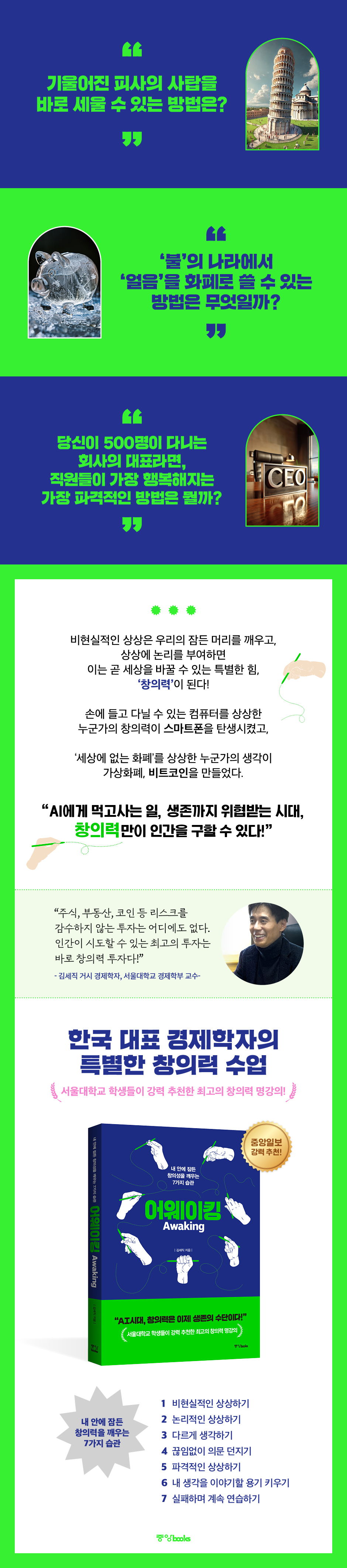
Bitcoin, whose value is skyrocketing, also started from the idea of someone who imagined an ‘invisible virtual currency.’
Bitcoin, which started as an idea just over a decade ago, has created a value equivalent to South Korea's GDP by 2024.
In this book, the author guides readers through seven specific paths to creative growth that they can apply and experiment with on their own.
The seven ways to awaken dormant creativity are: 1) Imagine unrealistically, 2) Imagine logically, 3) Think differently, 4) Constantly ask questions, 5) Imagine unconventionally, 6) Develop the courage to speak your mind, and 7) Keep practicing while failing.
Each step is focused on ‘creation’ rather than ‘imitation’.
At the end of each chapter, there is a special note-taking page where readers can write their own creative answers to the "open questions" the author poses to students and professionals he meets through corporate lectures, adding to the enjoyment of reading the book.
Zero risk of loss! The investment that will give you the highest return is creativity!
Creativity is an intangible asset that can never be lost.
Stocks, real estate, coins, and imitative knowledge are all investments that can yield short-term profits, but creativity has no risk of loss due to price declines, and no matter how you try, you can never have a negative return.
If you come up with an idea, there's no harm in it not being realized.
The author argues that while no investment in this world can be made as one pleases, the only investment that can be made freely and without risk is thinking, imagining, and developing creativity.
If you've ever been a worker who has been stuck in a rut and ultimately left the company because you couldn't achieve the desired results, or if you've been stuck in a work rut and couldn't easily break free from it, blaming your own stubbornness, I highly recommend reading this book.
Just follow the fun steps of a process that anyone can try, even if it's a little unfamiliar and something you've never tried before.
This book will be a must-read for all occupations, including office workers struggling to achieve results, entrepreneurs, planners, and marketers who are building and running their own businesses, and those who seek to "generate ideas from thoughts" or apply creativity to their work.
The author, who received his Ph.D. in economics from the University of Chicago under the supervision of Nobel Prize winners Professor Robert Lucas and Professor Nancy Stokke, returned to Korea in 2006 and took up a professorship at Seoul National University. He pondered deeply about what kind of classes he should teach, and the answer was 'creativity.'
The Korean economy is likely to enter an ice age of zero growth, with its long-term growth rate continuously declining according to the '5-year 1% decline rule', and the author attributes this to the 'lack of creativity' of Koreans.
This book is based on the author's experience of teaching creativity to Seoul National University students for over 20 years, and is written to awaken the dormant potential of countless Koreans who have become accustomed to "creation through imitation," that is, to follow others.
In an age of AI domination, 7 ways to awaken your inner creativity.
Modern people live in an age of AI that can create images in the style of great artists in seconds with just a simple command.
Life is becoming more and more convenient, but we are living in a time of fear where we are questioning the extent of our "usefulness as humans."
In this age of fear, how can we preserve human dignity and nurture creativity, a uniquely human domain?
The author emphasizes that if we can let go of the fear of the vague concept of "creativity" that we have been thinking about until now and believe that we can awaken the creativity dormant within ourselves, anyone can come up with creative ideas that can change the world.
Bitcoin, whose value is skyrocketing, also started from the idea of someone who imagined an ‘invisible virtual currency.’
Bitcoin, which started as an idea just over a decade ago, has created a value equivalent to South Korea's GDP by 2024.
In this book, the author guides readers through seven specific paths to creative growth that they can apply and experiment with on their own.
The seven ways to awaken dormant creativity are: 1) Imagine unrealistically, 2) Imagine logically, 3) Think differently, 4) Constantly ask questions, 5) Imagine unconventionally, 6) Develop the courage to speak your mind, and 7) Keep practicing while failing.
Each step is focused on ‘creation’ rather than ‘imitation’.
At the end of each chapter, there is a special note-taking page where readers can write their own creative answers to the "open questions" the author poses to students and professionals he meets through corporate lectures, adding to the enjoyment of reading the book.
Zero risk of loss! The investment that will give you the highest return is creativity!
Creativity is an intangible asset that can never be lost.
Stocks, real estate, coins, and imitative knowledge are all investments that can yield short-term profits, but creativity has no risk of loss due to price declines, and no matter how you try, you can never have a negative return.
If you come up with an idea, there's no harm in it not being realized.
The author argues that while no investment in this world can be made as one pleases, the only investment that can be made freely and without risk is thinking, imagining, and developing creativity.
If you've ever been a worker who has been stuck in a rut and ultimately left the company because you couldn't achieve the desired results, or if you've been stuck in a work rut and couldn't easily break free from it, blaming your own stubbornness, I highly recommend reading this book.
Just follow the fun steps of a process that anyone can try, even if it's a little unfamiliar and something you've never tried before.
This book will be a must-read for all occupations, including office workers struggling to achieve results, entrepreneurs, planners, and marketers who are building and running their own businesses, and those who seek to "generate ideas from thoughts" or apply creativity to their work.
GOODS SPECIFICS
- Date of issue: December 31, 2024
- Page count, weight, size: 236 pages | 408g | 150*210*15mm
- ISBN13: 9788927880769
- ISBN10: 8927880765
You may also like
카테고리
korean


korean

![ELLE 엘르 스페셜 에디션 A형 : 12월 [2025]](http://librairie.coreenne.fr/cdn/shop/files/b8e27a3de6c9538896439686c6b0e8fb.jpg?v=1766436872&width=3840)


