

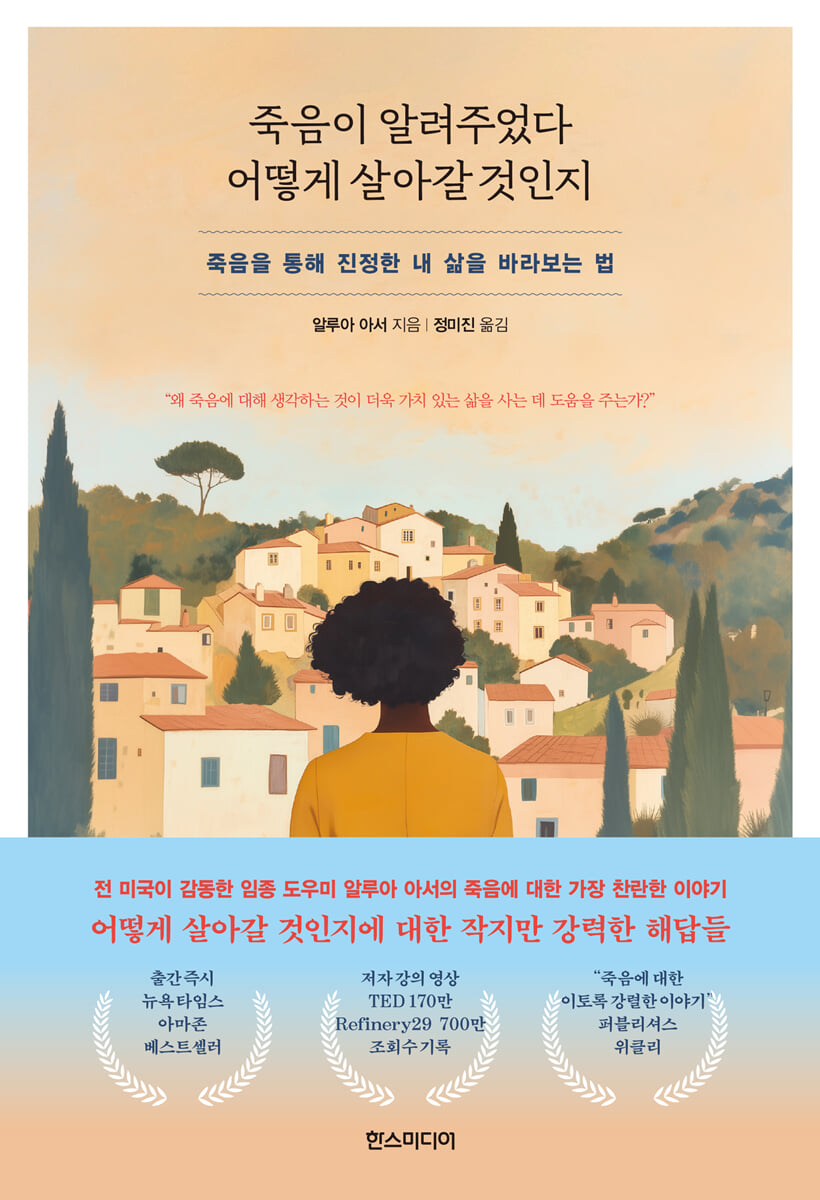
Death taught me how to live.
 |
Description
Book Introduction
★★★ The 2024 Bestseller That Captivated America ★★★
“Why do you think about death?
“Does it help you live a more worthwhile life?”
A beautiful end to life at the end of the world
Alua Arthur, the death attendant
The most brilliant story about death
Small but powerful answers to how to live
★★★★★ A New York Times bestseller upon publication
★★★★★ The author's lecture video has garnered 1.7 million views on TED and 7 million views on Refinery29.
The new book, "Death Taught Me How to Live," is a story about death written by the author, one of America's most influential end-of-life assistants, and it talks about how we think about death and how death can help us lead better, more fulfilling, and more authentic lives.
The book immediately became a New York Times and Amazon bestseller, becoming one of the hottest topics of 2024. Author Alua Arthur's TED talk has been viewed 1.7 million times, and her Refinery29 video has been viewed 7 million times.
“Why do you think about death?
“Does it help you live a more worthwhile life?”
A beautiful end to life at the end of the world
Alua Arthur, the death attendant
The most brilliant story about death
Small but powerful answers to how to live
★★★★★ A New York Times bestseller upon publication
★★★★★ The author's lecture video has garnered 1.7 million views on TED and 7 million views on Refinery29.
The new book, "Death Taught Me How to Live," is a story about death written by the author, one of America's most influential end-of-life assistants, and it talks about how we think about death and how death can help us lead better, more fulfilling, and more authentic lives.
The book immediately became a New York Times and Amazon bestseller, becoming one of the hottest topics of 2024. Author Alua Arthur's TED talk has been viewed 1.7 million times, and her Refinery29 video has been viewed 7 million times.
- You can preview some of the book's contents.
Preview
index
prolog
Chapter 1: A Friend Met at the End of Life
Chapter 2: The winning side is always the body.
Chapter 3: Death Approaches Us
Chapter 4 Peter
Chapter 5: Staying by my side without saying a word
Chapter 6: How to Become a Caregiver
Chapter 7 Dying as a Black Man
Chapter 8: Finding Your Feet
Chapter 9: A Battle Without a Chance of Winning
Chapter 10 Hexagonal Nails
Chapter 11: The Light of Freedom
Chapter 12: Getting Off the Hamster Wheel
Chapter 13: A Troublesome Legacy
Chapter 14: People Who Need People
Chapter 15 Escape
Chapter 16: Cuba Awaits
Epilogue _ Sparkling Waves
Acknowledgements
Chapter 1: A Friend Met at the End of Life
Chapter 2: The winning side is always the body.
Chapter 3: Death Approaches Us
Chapter 4 Peter
Chapter 5: Staying by my side without saying a word
Chapter 6: How to Become a Caregiver
Chapter 7 Dying as a Black Man
Chapter 8: Finding Your Feet
Chapter 9: A Battle Without a Chance of Winning
Chapter 10 Hexagonal Nails
Chapter 11: The Light of Freedom
Chapter 12: Getting Off the Hamster Wheel
Chapter 13: A Troublesome Legacy
Chapter 14: People Who Need People
Chapter 15 Escape
Chapter 16: Cuba Awaits
Epilogue _ Sparkling Waves
Acknowledgements
Detailed image

Into the book
Socially, we avoid conversations about death.
Just as Jessica's friends and family encouraged her to embrace hope for healing instead of dwelling on death, we pretend to have control over illness and life.
In that sense, humans are funny.
The apparent incompetence and helplessness of humans facing death reminds us of our limitations.
Of course, death is scary.
But the thought of death is a seed.
If you nurture that seed with care, life will grow like a wildflower in that spot.
The only thing we can control is how we accept death when we realize it.
When I was in Cuba, I became aware of death.
If you haven't realized it yet, what are you waiting for?
---From "Chapter 1: A Friend Met at the End of Life"
What does it take to love our bodies? How do we trust them, respect them, and let them go when death approaches? As we near the end of life, our bodies will demand surrender from us, having enjoyed the world to the fullest.
All life ultimately needs liberation from the complexity of life.
Nature does what nature does.
It's been like that since ancient times.
No one gets out alive.
---From "The body is always the one who wins Chapter 2"
My anger, expressed on sticky notes, continues to this day.
My sister, and the countless others who are struggling with complicated administrative procedures after her death, burned within me.
I decided that if there was no one to turn to for help anyway, I would be the one who could rely on those who had lost loved ones.
I could remind them that they were doing well.
I could have sat in the traffic office for them and explained to them what the death rally was about.
I was able to teach my children how to talk about death.
It could empower you to take care of your loved ones yourself.
I was able to hold their hands and hearts and be with them during difficult times.
And while I couldn't ease their pain, I could let them know that someone cared about how hard it was for them to endure it.
I could be their witness.
I wanted to do that.
---From "Chapter 4 Peter"
What I thought was 'failure' was just another familiar demon rearing its head in my subconscious.
Justina taught me to let go of such experiences.
The experience wasn't about what I could and couldn't do.
It was about her death.
Justina ended her life in the arms of her best friends, just as she had wanted.
I held her hand and was of use to her.
All we can do for those who are nearing death is to respond to their needs.
---From "Chapter 6: How to Become a Dying Helper"
Many of the qualities we think of as a “good death” are not unlike the qualities that make for a good life.
But everyone is different.
The unfounded belief that "all Black people are the same," living or dead, robs us of our quirkiness, our humor, our love, our obsessions, our individuality, and the complexity of our identities.
This oversimplification seems like an attempt to make black people easier to understand and digest.
But we can't be reduced to one lump.
How can we generalize about a race that has endured centuries of cruelty and yet refuses to suppress its joy? Acknowledging this truth is the best way to face that difficult, but good death.
A good death is grounded in who we were as unique individuals, not as a homogeneous group.
We all deserve it.
---From "Chapter 7 Dying as a Black Man"
As a palliative caregiver, I accompany my clients on their journey from their old self to a new self (even if that new self is the one facing death).
Naturally, people have a hard time accepting their own impending death or the death of a loved one.
To help them focus on the present, I suggest to my clients a daily practice called "finding their feet."
When I'm with someone who's stuck in the past or worried about the future, I simply remind them of their feet and encourage them to stay present with me.
The mind can travel.
But the body is always right here.
By paying attention to our feet and body, whether it's enjoying a warm foot bath or wiggling our toes with our bare feet firmly planted on the ground, we can find ourselves saying life-affirming words like, "Today, I am here."
---From "Chapter 8 Finding Feet"
Too often, death erases a part of a person.
Because the biological family did not condone or support such aspects, or because such aspects were kept secret.
Every part of our identity dies with us.
We ask the whole person.
But if we can honor someone as they were when they died, we can begin to break down the barriers that divide us and obscure our complex humanity.
Likewise, if we can proudly embrace and express our identity while we're alive, we can shine a light on and love the parts of ourselves that others choose to hate.
Ignore the haters and embrace your true self.
---From "10 Hexagonal Nails"
All we know is that everything ends.
Collective death denial encourages us to act as if we can live forever.
But we don't have forever to create the life we want.
---From "Chapter 16: Cuba Waits"
I think about my death almost every day.
Sometimes I do crazy things like roller skating in the kitchen, and I imagine losing my balance, slipping, and crashing into the counter.
When I stand at the gate between this world and the next and witness the death of another, I think about my own death.
I still wonder how a human being can hold the spark of life and then evaporate like a wisp of smoke.
And sometimes I think about my death because my whole life seems to lead up to that very mysterious moment.
Just as Jessica's friends and family encouraged her to embrace hope for healing instead of dwelling on death, we pretend to have control over illness and life.
In that sense, humans are funny.
The apparent incompetence and helplessness of humans facing death reminds us of our limitations.
Of course, death is scary.
But the thought of death is a seed.
If you nurture that seed with care, life will grow like a wildflower in that spot.
The only thing we can control is how we accept death when we realize it.
When I was in Cuba, I became aware of death.
If you haven't realized it yet, what are you waiting for?
---From "Chapter 1: A Friend Met at the End of Life"
What does it take to love our bodies? How do we trust them, respect them, and let them go when death approaches? As we near the end of life, our bodies will demand surrender from us, having enjoyed the world to the fullest.
All life ultimately needs liberation from the complexity of life.
Nature does what nature does.
It's been like that since ancient times.
No one gets out alive.
---From "The body is always the one who wins Chapter 2"
My anger, expressed on sticky notes, continues to this day.
My sister, and the countless others who are struggling with complicated administrative procedures after her death, burned within me.
I decided that if there was no one to turn to for help anyway, I would be the one who could rely on those who had lost loved ones.
I could remind them that they were doing well.
I could have sat in the traffic office for them and explained to them what the death rally was about.
I was able to teach my children how to talk about death.
It could empower you to take care of your loved ones yourself.
I was able to hold their hands and hearts and be with them during difficult times.
And while I couldn't ease their pain, I could let them know that someone cared about how hard it was for them to endure it.
I could be their witness.
I wanted to do that.
---From "Chapter 4 Peter"
What I thought was 'failure' was just another familiar demon rearing its head in my subconscious.
Justina taught me to let go of such experiences.
The experience wasn't about what I could and couldn't do.
It was about her death.
Justina ended her life in the arms of her best friends, just as she had wanted.
I held her hand and was of use to her.
All we can do for those who are nearing death is to respond to their needs.
---From "Chapter 6: How to Become a Dying Helper"
Many of the qualities we think of as a “good death” are not unlike the qualities that make for a good life.
But everyone is different.
The unfounded belief that "all Black people are the same," living or dead, robs us of our quirkiness, our humor, our love, our obsessions, our individuality, and the complexity of our identities.
This oversimplification seems like an attempt to make black people easier to understand and digest.
But we can't be reduced to one lump.
How can we generalize about a race that has endured centuries of cruelty and yet refuses to suppress its joy? Acknowledging this truth is the best way to face that difficult, but good death.
A good death is grounded in who we were as unique individuals, not as a homogeneous group.
We all deserve it.
---From "Chapter 7 Dying as a Black Man"
As a palliative caregiver, I accompany my clients on their journey from their old self to a new self (even if that new self is the one facing death).
Naturally, people have a hard time accepting their own impending death or the death of a loved one.
To help them focus on the present, I suggest to my clients a daily practice called "finding their feet."
When I'm with someone who's stuck in the past or worried about the future, I simply remind them of their feet and encourage them to stay present with me.
The mind can travel.
But the body is always right here.
By paying attention to our feet and body, whether it's enjoying a warm foot bath or wiggling our toes with our bare feet firmly planted on the ground, we can find ourselves saying life-affirming words like, "Today, I am here."
---From "Chapter 8 Finding Feet"
Too often, death erases a part of a person.
Because the biological family did not condone or support such aspects, or because such aspects were kept secret.
Every part of our identity dies with us.
We ask the whole person.
But if we can honor someone as they were when they died, we can begin to break down the barriers that divide us and obscure our complex humanity.
Likewise, if we can proudly embrace and express our identity while we're alive, we can shine a light on and love the parts of ourselves that others choose to hate.
Ignore the haters and embrace your true self.
---From "10 Hexagonal Nails"
All we know is that everything ends.
Collective death denial encourages us to act as if we can live forever.
But we don't have forever to create the life we want.
---From "Chapter 16: Cuba Waits"
I think about my death almost every day.
Sometimes I do crazy things like roller skating in the kitchen, and I imagine losing my balance, slipping, and crashing into the counter.
When I stand at the gate between this world and the next and witness the death of another, I think about my own death.
I still wonder how a human being can hold the spark of life and then evaporate like a wisp of smoke.
And sometimes I think about my death because my whole life seems to lead up to that very mysterious moment.
---From "Epilogue"
Publisher's Review
When we face death head-on,
Our lives shine once again
“The best book that makes you want to live life more fully!
May we always remember that the tomorrow we face each day is never promised.”
- From Amazon reader reviews
The most influential person currently active in the United States
This touching story of the death of Alua Arthur, a bereavement assistant.
Why did a lawyer who graduated from law school become a palliative caregiver?
How does thinking about death make our lives more valuable?
A book that will completely change every idea you've ever had about life and death!
There are bound to be topics that are universally taboo in society.
And one of them is definitely the story about 'death'.
But Alua Arthur, author of "Death Taught Me How to Live," argues that we all need to talk about death more, and louder.
“Just as talking about sex doesn’t make you pregnant, talking about death doesn’t make you die.” Mixing his signature humor with bold visuals of frightening topics, he unravels the story with fascinating lessons, sometimes humorous and sometimes serious.
He says that imagining our ideal life endings helps us clarify how we should live and what kind of people we should become, and gives us a life-changing and life-affirming approach.
The author delivers a passionate appeal for the 'embrace of death' through engaging storytelling.
This book is a powerful testament to how accepting our own mortality can bring us into contact with something deeper in our lives, and its transformative message is that thinking about death, whether imminent or not, can breathe new life into our lives.
We die because we live.
It's a gift
"Why does thinking about death help us live better, more fulfilling, and more authentic lives? This book provides powerful evidence that accepting our own mortality allows us to connect with something deeper in our lives.
A life that feels like a miracle and a death that serves as a satisfying end to a sentence—this is what we all want.
We die because we live.
“It is a gift.”
What adds to the book's charm and value is the fact that the author's dramatic life experiences are interestingly interwoven throughout the book's content.
The author's family fled Ghana during a murderous coup in the 1980s.
During this time, she suffered from severe depression and mental breakdown due to death threats, and her dear friend and brother-in-law died of lymphoma.
Caring for him during his final months led the author to her calling as a palliative caregiver.
Through my experiences of being close to death, I have come to realize firsthand how powerful it is to bear witness to the painful complexities of life and to speak the truth.
“It is true that life is hard, painful, and difficult, yet we do not give ourselves space to accept sadness, loss, or anything other than the words, ‘I am okay.’
Humans feel a wide range of emotions, but we applaud only half of them, and we tend to hide complex emotions deep inside for fear of judgment.
“There, emotions fester and explode, becoming stronger and more intense, so they don’t go away, and eventually, they become more hidden.”
Because we are socially forced to hide negative emotions, we are reluctant to talk about death even as we near the end of our lives, and we end up dying alone.
However, since death is inevitable for humans, it is extremely important to talk about death with those around us and prepare for it in advance in order to 'die better.'
Readers will get a glimpse of themselves as they read about the relationships between authors and their clients, and sometimes even their families.
We all have stories and lessons to teach: working too much, playing too little, regretting romantic decisions, healing neglected emotional wounds, seeking forgiveness and not receiving forgiveness, grappling with aging bodies, feeling emotional fullness and speaking out loud.
Some are heartbreaking, others are bright and empowering lessons.
As the author reflects on his experiences with clients and applies them to his own life, readers will have the opportunity to approach death from a different perspective.
What is a death attendant?
What exactly is a doula? You might think of it as similar to a birth attendant, but the difference is that it assists people at the end of life, not the beginning.
It is a role that helps a dying person end his or her life completely and shamelessly without losing focus.
In addition to preparing for the end of life, it also manages matters such as arranging business and legal matters, handling property and possessions, medical care, funeral or memorial planning, and managing the emotions of loved ones.
As the number of people who do not belong to an organized religion or special group grows, end-of-life care is gaining attention and popularity.
Our ideas about death are also changing, and end-of-life caregivers are growing in number and expertise to fill that gap.
Going With Grace, the end-of-life care organization led by the author, has trained more than 1,500 caregivers in 27 countries.
Our lives shine once again
“The best book that makes you want to live life more fully!
May we always remember that the tomorrow we face each day is never promised.”
- From Amazon reader reviews
The most influential person currently active in the United States
This touching story of the death of Alua Arthur, a bereavement assistant.
Why did a lawyer who graduated from law school become a palliative caregiver?
How does thinking about death make our lives more valuable?
A book that will completely change every idea you've ever had about life and death!
There are bound to be topics that are universally taboo in society.
And one of them is definitely the story about 'death'.
But Alua Arthur, author of "Death Taught Me How to Live," argues that we all need to talk about death more, and louder.
“Just as talking about sex doesn’t make you pregnant, talking about death doesn’t make you die.” Mixing his signature humor with bold visuals of frightening topics, he unravels the story with fascinating lessons, sometimes humorous and sometimes serious.
He says that imagining our ideal life endings helps us clarify how we should live and what kind of people we should become, and gives us a life-changing and life-affirming approach.
The author delivers a passionate appeal for the 'embrace of death' through engaging storytelling.
This book is a powerful testament to how accepting our own mortality can bring us into contact with something deeper in our lives, and its transformative message is that thinking about death, whether imminent or not, can breathe new life into our lives.
We die because we live.
It's a gift
"Why does thinking about death help us live better, more fulfilling, and more authentic lives? This book provides powerful evidence that accepting our own mortality allows us to connect with something deeper in our lives.
A life that feels like a miracle and a death that serves as a satisfying end to a sentence—this is what we all want.
We die because we live.
“It is a gift.”
What adds to the book's charm and value is the fact that the author's dramatic life experiences are interestingly interwoven throughout the book's content.
The author's family fled Ghana during a murderous coup in the 1980s.
During this time, she suffered from severe depression and mental breakdown due to death threats, and her dear friend and brother-in-law died of lymphoma.
Caring for him during his final months led the author to her calling as a palliative caregiver.
Through my experiences of being close to death, I have come to realize firsthand how powerful it is to bear witness to the painful complexities of life and to speak the truth.
“It is true that life is hard, painful, and difficult, yet we do not give ourselves space to accept sadness, loss, or anything other than the words, ‘I am okay.’
Humans feel a wide range of emotions, but we applaud only half of them, and we tend to hide complex emotions deep inside for fear of judgment.
“There, emotions fester and explode, becoming stronger and more intense, so they don’t go away, and eventually, they become more hidden.”
Because we are socially forced to hide negative emotions, we are reluctant to talk about death even as we near the end of our lives, and we end up dying alone.
However, since death is inevitable for humans, it is extremely important to talk about death with those around us and prepare for it in advance in order to 'die better.'
Readers will get a glimpse of themselves as they read about the relationships between authors and their clients, and sometimes even their families.
We all have stories and lessons to teach: working too much, playing too little, regretting romantic decisions, healing neglected emotional wounds, seeking forgiveness and not receiving forgiveness, grappling with aging bodies, feeling emotional fullness and speaking out loud.
Some are heartbreaking, others are bright and empowering lessons.
As the author reflects on his experiences with clients and applies them to his own life, readers will have the opportunity to approach death from a different perspective.
What is a death attendant?
What exactly is a doula? You might think of it as similar to a birth attendant, but the difference is that it assists people at the end of life, not the beginning.
It is a role that helps a dying person end his or her life completely and shamelessly without losing focus.
In addition to preparing for the end of life, it also manages matters such as arranging business and legal matters, handling property and possessions, medical care, funeral or memorial planning, and managing the emotions of loved ones.
As the number of people who do not belong to an organized religion or special group grows, end-of-life care is gaining attention and popularity.
Our ideas about death are also changing, and end-of-life caregivers are growing in number and expertise to fill that gap.
Going With Grace, the end-of-life care organization led by the author, has trained more than 1,500 caregivers in 27 countries.
GOODS SPECIFICS
- Date of issue: December 6, 2024
- Page count, weight, size: 416 pages | 618g | 140*205*27mm
- ISBN13: 9791193712672
- ISBN10: 119371267X
You may also like
카테고리
korean


korean

![ELLE 엘르 스페셜 에디션 A형 : 12월 [2025]](http://librairie.coreenne.fr/cdn/shop/files/b8e27a3de6c9538896439686c6b0e8fb.jpg?v=1766436872&width=3840)


