

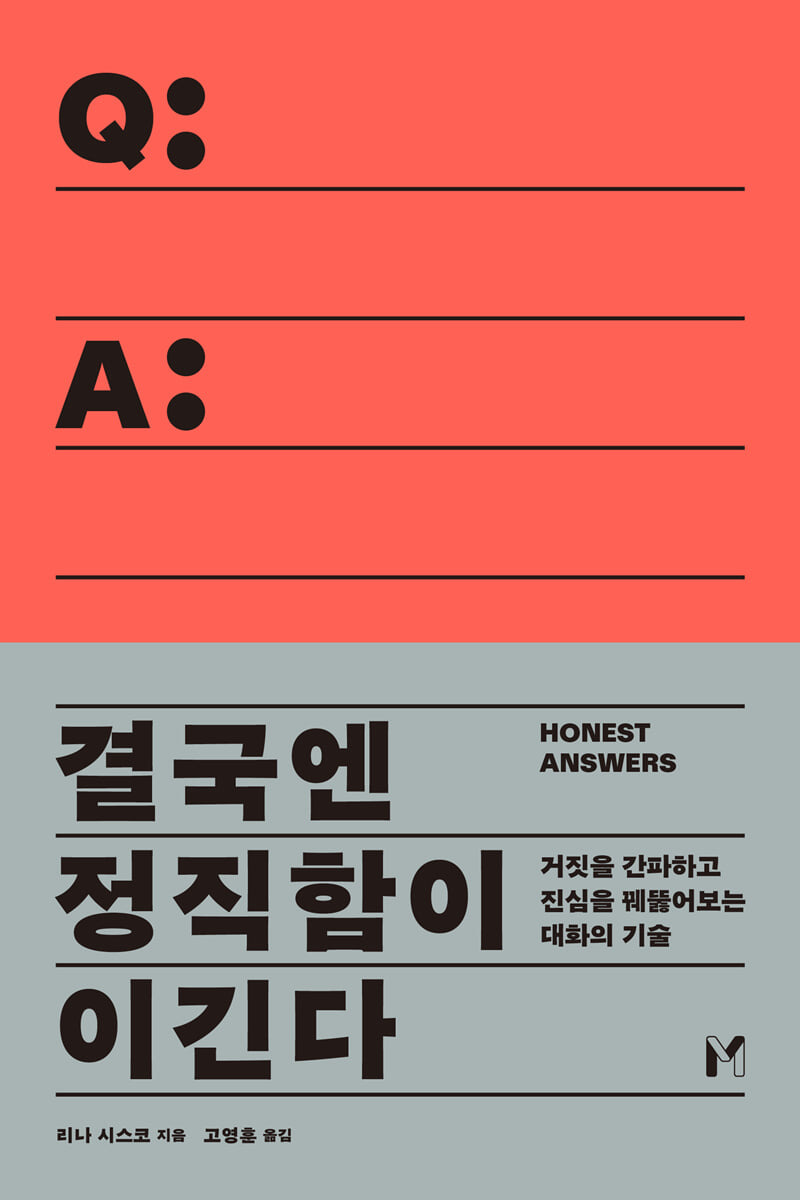
In the end, honesty wins.
 |
Description
Book Introduction
“See through the other person’s mind and you can achieve anything!”
As verified by a former FBI interrogator in hundreds of cases,
Pay attention to the 'profiling conversation method'
"A one-stop shop for the conversation skills needed for genuine communication." - Amazon Reader Review
How refreshing would it be if you could instantly discern whether someone's words were "true" or what their "true feelings" were? MindSelf has published "Honesty Wins in the End," a handy guide for conversations where you're curious about someone's true feelings.
This book is a compilation of the author's expertise, accumulated through dealing with hundreds of individuals as a U.S. Marine Corps and FBI certified interrogator.
In many situations, such as when interviewing for a job, negotiating a salary, persuading a client, negotiating a price with a seller, or asking a lover who has broken up why, we want to know the other person's true feelings and hear the truth.
Because then you can make better choices and build better relationships.
Through the publication of this book, Lina Sisco popularized the professional skill of profiling as a conversational technique that can be used in everyday life.
The author has consistently been a popular speaker, speaking not only to government agencies such as the Department of Defense and law enforcement agencies, but also to private businesses, highlighting the art of honesty and trust-based communication and the effectiveness of negotiation.
"Honesty Wins in the End" is the author's first book to be introduced in Korea. It will help you examine and correct the unverified common sense, careless speech habits, and careless gestures you've been using in conversations. It will also train you to move the other person's sincerity and draw out the truth by instilling trust with a gentle attitude, regardless of who you're talking to and in any situation.
Here are the easiest and most reliable conversation secrets to achieving your desired results through kind and honest communication.
As verified by a former FBI interrogator in hundreds of cases,
Pay attention to the 'profiling conversation method'
"A one-stop shop for the conversation skills needed for genuine communication." - Amazon Reader Review
How refreshing would it be if you could instantly discern whether someone's words were "true" or what their "true feelings" were? MindSelf has published "Honesty Wins in the End," a handy guide for conversations where you're curious about someone's true feelings.
This book is a compilation of the author's expertise, accumulated through dealing with hundreds of individuals as a U.S. Marine Corps and FBI certified interrogator.
In many situations, such as when interviewing for a job, negotiating a salary, persuading a client, negotiating a price with a seller, or asking a lover who has broken up why, we want to know the other person's true feelings and hear the truth.
Because then you can make better choices and build better relationships.
Through the publication of this book, Lina Sisco popularized the professional skill of profiling as a conversational technique that can be used in everyday life.
The author has consistently been a popular speaker, speaking not only to government agencies such as the Department of Defense and law enforcement agencies, but also to private businesses, highlighting the art of honesty and trust-based communication and the effectiveness of negotiation.
"Honesty Wins in the End" is the author's first book to be introduced in Korea. It will help you examine and correct the unverified common sense, careless speech habits, and careless gestures you've been using in conversations. It will also train you to move the other person's sincerity and draw out the truth by instilling trust with a gentle attitude, regardless of who you're talking to and in any situation.
Here are the easiest and most reliable conversation secrets to achieving your desired results through kind and honest communication.
- You can preview some of the book's contents.
Preview
index
Recommendation
Entering
Chapter 1: The 'kind person' always wins?
Chapter 2: Plan, Prepare, and Practice!
Chapter 3: How to Build Trust in 5 Minutes
Chapter 4 What are his motivations, motives, and desires?
Chapter 5: Mastering Questioning Techniques
Chapter 6: Ask Questions, Don't Tell
Chapter 7: Don't Ask for Information, Just Draw It Out
Chapter 8: How to Overcome Conflict in Conversation
Chapter 9: Negotiation Skills Using Empathy
Chapter 10: How to Deal with Limitations
Chapter 11: How to Analyze Body Language
Chapter 12: Deceptive Statements and Answers
Epilogue 279 Appendix A.
11-Step Strategic Interview Flowchart
Appendix B.
Interview Checklist
Appendix C.
Model answer
Acknowledgements
Search
Entering
Chapter 1: The 'kind person' always wins?
Chapter 2: Plan, Prepare, and Practice!
Chapter 3: How to Build Trust in 5 Minutes
Chapter 4 What are his motivations, motives, and desires?
Chapter 5: Mastering Questioning Techniques
Chapter 6: Ask Questions, Don't Tell
Chapter 7: Don't Ask for Information, Just Draw It Out
Chapter 8: How to Overcome Conflict in Conversation
Chapter 9: Negotiation Skills Using Empathy
Chapter 10: How to Deal with Limitations
Chapter 11: How to Analyze Body Language
Chapter 12: Deceptive Statements and Answers
Epilogue 279 Appendix A.
11-Step Strategic Interview Flowchart
Appendix B.
Interview Checklist
Appendix C.
Model answer
Acknowledgements
Search
Detailed image

Into the book
Imagine you are a real estate agent.
How should you respond if a prospective homebuyer tells you now isn't the right time to move and that they'll wait six months, hoping prices will drop to a more favorable level? As an HR representative, what if you're investigating a report of alleged discrimination and the employee who raised the issue suddenly withdraws their objection without providing a reason? What should you do if a potential client expresses interest in your services, only to be told a week later that they need permission from a higher-level manager?
--- p.42
4 Questions to Identify Lies
1 “How did you feel?”
2 “Why should I trust you?”
3 “What do you think should happen to someone who does something like this?”
4 “Are you lying?
--- p.122-124
Deduction utilizes human psychology and human nature.
Most people want to be polite, honest, and trustworthy.
For that very reason, people tend to be more open to those they perceive as polite, honest, and trustworthy.
--- p.146
Similar to invisible ink, people hide their true feelings and thoughts verbally and nonverbally, consciously and unconsciously during communication.
When we trust someone, we take it for granted that they will be honest and truthful in their communications.
Human nature dictates that we want to be honest with ourselves and trust others.
--- p.213
A second way to hide the truth is to use “never” and “absolutely.”
If you ask a yes or no question, you should get a yes or no answer.
If you get a descriptive answer or another answer that replaces “yes” or “no,” it may be an attempt to convince you that you are lying.
To avoid a definitive yes or no answer, people who lie tend to replace “no” with “absolutely not” and “yes” with “of course” or “100 percent sure.”
--- p.255
The active voice emphasizes that the subject is acting, and the passive voice emphasizes that the subject is being acted upon.
People who lie tend to use the passive voice to distance themselves from the crime or event they feel guilty about.
The passive voice allows us to exclude the subject and hide responsibility.
How should you respond if a prospective homebuyer tells you now isn't the right time to move and that they'll wait six months, hoping prices will drop to a more favorable level? As an HR representative, what if you're investigating a report of alleged discrimination and the employee who raised the issue suddenly withdraws their objection without providing a reason? What should you do if a potential client expresses interest in your services, only to be told a week later that they need permission from a higher-level manager?
--- p.42
4 Questions to Identify Lies
1 “How did you feel?”
2 “Why should I trust you?”
3 “What do you think should happen to someone who does something like this?”
4 “Are you lying?
--- p.122-124
Deduction utilizes human psychology and human nature.
Most people want to be polite, honest, and trustworthy.
For that very reason, people tend to be more open to those they perceive as polite, honest, and trustworthy.
--- p.146
Similar to invisible ink, people hide their true feelings and thoughts verbally and nonverbally, consciously and unconsciously during communication.
When we trust someone, we take it for granted that they will be honest and truthful in their communications.
Human nature dictates that we want to be honest with ourselves and trust others.
--- p.213
A second way to hide the truth is to use “never” and “absolutely.”
If you ask a yes or no question, you should get a yes or no answer.
If you get a descriptive answer or another answer that replaces “yes” or “no,” it may be an attempt to convince you that you are lying.
To avoid a definitive yes or no answer, people who lie tend to replace “no” with “absolutely not” and “yes” with “of course” or “100 percent sure.”
--- p.255
The active voice emphasizes that the subject is acting, and the passive voice emphasizes that the subject is being acted upon.
People who lie tend to use the passive voice to distance themselves from the crime or event they feel guilty about.
The passive voice allows us to exclude the subject and hide responsibility.
--- p.273
Publisher's Review
“I am a human lie detector!”
Lina Cisco, who is active in many fields
Concentrating profiling technology
Sometimes, without realizing it, we let our guard down and start trusting strangers.
Because something inside us tells us that he is someone worth being friends with and that we can be at ease.
In that case, you may find yourself confessing to strangers things you wouldn't normally tell your colleagues or friends.
How is this possible? In "Honesty Wins," Lina Sisco reveals the essential know-how of conversational skills that enable you to quickly connect with people you meet for the first time and with whom you feel uncomfortable, and obtain the information you need.
The author has been active in various media as a professional guest who gets others to open their mouths with intimacy and trust, and then extracts the truth.
On the Peacock TV series “Killer Performance,” it detected the deception and fraud of criminals such as psychopaths, serial killers, and parricide; on the YouTube channel “Couples Court,” which simulates courtroom arguments using the stories of real couples, it verified witness statements; and on FoxLiveNow and HBO, it assessed the credibility of the claims of celebrities, including presidential candidates.
In this book, the author emphasizes that we must remember one thing above all else.
“I don’t feel like being honest, but there’s no one I can be honest with.”
During a conversation, both I and the other person influence each other's words and actions.
It is like the flow of the tide, going back and forth and changing repeatedly.
Just as my attitude tends to become defensive when someone tries to deceive me, it is natural that when I give the impression of being friendly to someone, their attitude becomes more sincere.
Laying the groundwork of kindness and trust to guide the truth! This is the author's core technique, ensuring a zero-failure rate and an unfailing honest answer.
Let's discover the conversational skills that will help you build intimacy and trust by utilizing verbal and nonverbal indicators such as your choice of words, tone of voice, eye contact, facial expressions, and posture, quickly and accurately understand the other person's personality, situation, and desires, and achieve the desired results.
A lover's habitual lying? A boss's gaslighting?
Don't be fooled or swayed
Honesty always wins!
No one wants to waste their money, emotions, or energy.
So, countless people constantly ask themselves questions like, "Can I trust a broker's recommendation and sign a real estate contract?", "How much should I trust my partner's words?", "Are the salary and benefits my company offers me appropriate?", and so on, but even so, many end up making poor decisions and making unprofitable choices.
Because it is difficult to know how true the information provided by others is.
The author, who stated that he wrote this book to help people get more truthful information so they can make the best decisions to protect themselves in any situation, covers 'How to know yourself and others' in Chapters 1 and 2, 'How to build trusting relationships' in Chapter 3, 'How to move the other person's heart' in Chapters 4, 'Questioning skills to discern lies and get the information you want' in Chapters 5 to 7, and 'Conflict resolution and negotiation skills' in Chapters 8 to 10, and the core skills are clearly organized in a checklist.
To help readers master the conversation skills covered in the book, it includes situation-specific practical tasks and model answers.
Ultimately, conversation is a mental sparring game with the other person.
You need to quickly assess your own and the other person's situation through an objective lens and know exactly what to say, when, and how to say it.
This book, which covers all the techniques of such conversation, will help you become someone who lets down their guard and puts others at ease, someone who opens their mouths and gives honest answers even when they were reluctant to tell the truth.
Lina Cisco, who is active in many fields
Concentrating profiling technology
Sometimes, without realizing it, we let our guard down and start trusting strangers.
Because something inside us tells us that he is someone worth being friends with and that we can be at ease.
In that case, you may find yourself confessing to strangers things you wouldn't normally tell your colleagues or friends.
How is this possible? In "Honesty Wins," Lina Sisco reveals the essential know-how of conversational skills that enable you to quickly connect with people you meet for the first time and with whom you feel uncomfortable, and obtain the information you need.
The author has been active in various media as a professional guest who gets others to open their mouths with intimacy and trust, and then extracts the truth.
On the Peacock TV series “Killer Performance,” it detected the deception and fraud of criminals such as psychopaths, serial killers, and parricide; on the YouTube channel “Couples Court,” which simulates courtroom arguments using the stories of real couples, it verified witness statements; and on FoxLiveNow and HBO, it assessed the credibility of the claims of celebrities, including presidential candidates.
In this book, the author emphasizes that we must remember one thing above all else.
“I don’t feel like being honest, but there’s no one I can be honest with.”
During a conversation, both I and the other person influence each other's words and actions.
It is like the flow of the tide, going back and forth and changing repeatedly.
Just as my attitude tends to become defensive when someone tries to deceive me, it is natural that when I give the impression of being friendly to someone, their attitude becomes more sincere.
Laying the groundwork of kindness and trust to guide the truth! This is the author's core technique, ensuring a zero-failure rate and an unfailing honest answer.
Let's discover the conversational skills that will help you build intimacy and trust by utilizing verbal and nonverbal indicators such as your choice of words, tone of voice, eye contact, facial expressions, and posture, quickly and accurately understand the other person's personality, situation, and desires, and achieve the desired results.
A lover's habitual lying? A boss's gaslighting?
Don't be fooled or swayed
Honesty always wins!
No one wants to waste their money, emotions, or energy.
So, countless people constantly ask themselves questions like, "Can I trust a broker's recommendation and sign a real estate contract?", "How much should I trust my partner's words?", "Are the salary and benefits my company offers me appropriate?", and so on, but even so, many end up making poor decisions and making unprofitable choices.
Because it is difficult to know how true the information provided by others is.
The author, who stated that he wrote this book to help people get more truthful information so they can make the best decisions to protect themselves in any situation, covers 'How to know yourself and others' in Chapters 1 and 2, 'How to build trusting relationships' in Chapter 3, 'How to move the other person's heart' in Chapters 4, 'Questioning skills to discern lies and get the information you want' in Chapters 5 to 7, and 'Conflict resolution and negotiation skills' in Chapters 8 to 10, and the core skills are clearly organized in a checklist.
To help readers master the conversation skills covered in the book, it includes situation-specific practical tasks and model answers.
Ultimately, conversation is a mental sparring game with the other person.
You need to quickly assess your own and the other person's situation through an objective lens and know exactly what to say, when, and how to say it.
This book, which covers all the techniques of such conversation, will help you become someone who lets down their guard and puts others at ease, someone who opens their mouths and gives honest answers even when they were reluctant to tell the truth.
GOODS SPECIFICS
- Date of issue: December 9, 2024
- Page count, weight, size: 320 pages | 140*210*25mm
- ISBN13: 9791194293484
- ISBN10: 1194293484
You may also like
카테고리
korean


korean

![GQ KOREA Mark (Monthly): December [2025]](http://librairie.coreenne.fr/cdn/shop/files/8ef265dbbfbf186523ed75ba7319009d.jpg?v=1765340328&width=3840)


