

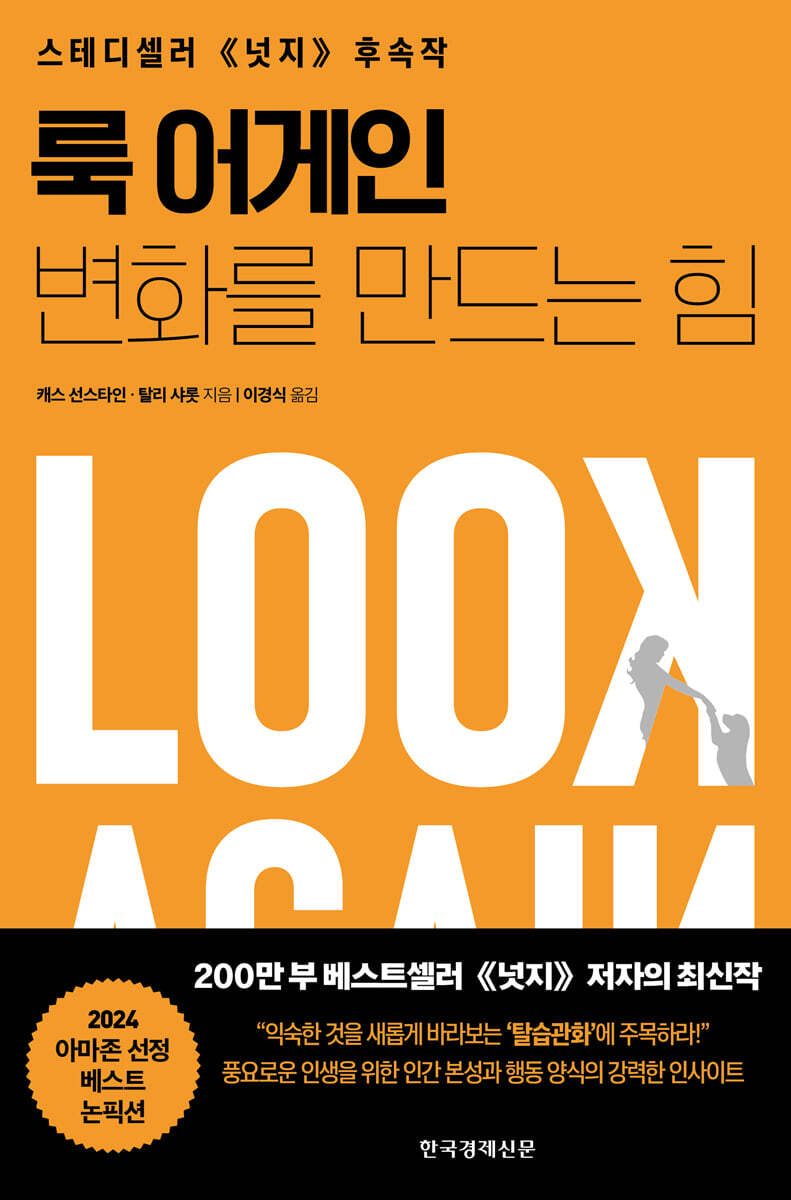
Look Again: The Power to Create Change
 |
Description
Book Introduction
The latest work from the author of the 2 million-copy bestseller "Nudge"
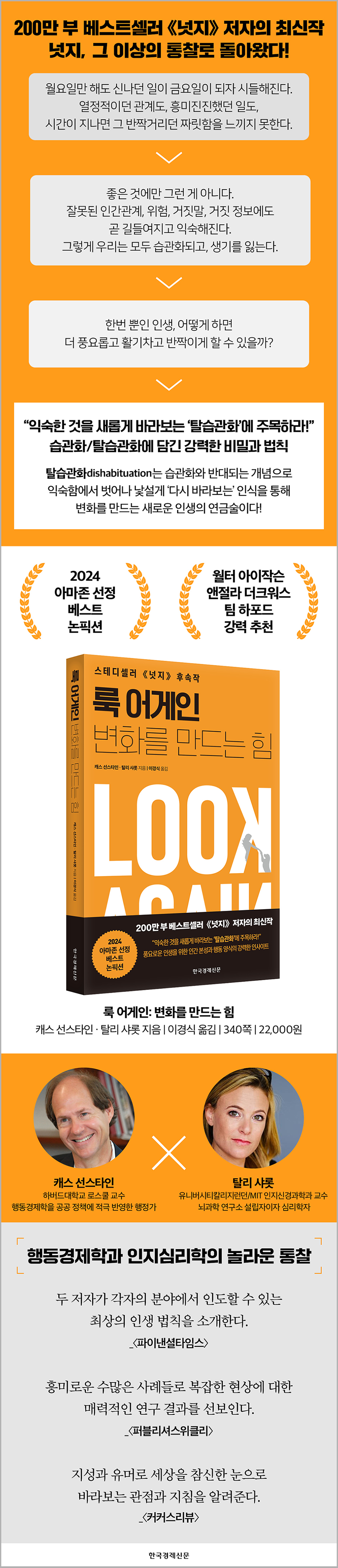
“Pay attention to ‘dehabituation,’ which is looking at familiar things in a new way!”
The Amazing Power of Habituation/De-Habituation and the Law of a Rich Life
“People always get used to everything.
But you have no idea how powerful it is in life when you suddenly realize that it was always there." Have you ever experienced something that was exciting on Monday, only to become dull by Friday? A passionate relationship, an exciting job that you just couldn't put down, or a great work of art that once took your heart away—they all lose that sparkling thrill they had in the beginning.
It's not just about the good things.
People quickly become accustomed to and inured to polluted air, bad relationships, danger, lies, and misinformation.
That's how we become accustomed to it.
Drawing on groundbreaking, cutting-edge scientific research, this book unlocks the secrets of "dehabituation," a remarkable tool for improving our lives.
Whether at work, at home, or on social media, change is the key to seeing, feeling, and realizing things anew.
Change is what can make this world shine brightly.
Let's learn the simple, yet surprising, and powerful insight that life changes only when we step outside the familiar and begin to see things in a new and unfamiliar way.
“Pay attention to ‘dehabituation,’ which is looking at familiar things in a new way!”
The Amazing Power of Habituation/De-Habituation and the Law of a Rich Life
“People always get used to everything.
But you have no idea how powerful it is in life when you suddenly realize that it was always there." Have you ever experienced something that was exciting on Monday, only to become dull by Friday? A passionate relationship, an exciting job that you just couldn't put down, or a great work of art that once took your heart away—they all lose that sparkling thrill they had in the beginning.
It's not just about the good things.
People quickly become accustomed to and inured to polluted air, bad relationships, danger, lies, and misinformation.
That's how we become accustomed to it.
Drawing on groundbreaking, cutting-edge scientific research, this book unlocks the secrets of "dehabituation," a remarkable tool for improving our lives.
Whether at work, at home, or on social media, change is the key to seeing, feeling, and realizing things anew.
Change is what can make this world shine brightly.
Let's learn the simple, yet surprising, and powerful insight that life changes only when we step outside the familiar and begin to see things in a new and unfamiliar way.
- You can preview some of the book's contents.
Preview
index
Introduction: We are tamed by everything.
Part 1: Well-being: Conditions for Happiness and Recovery
Chapter 1 Happiness: Ice Cream.
What Midlife Crisis and Monogamy Have in Common
Chapter 2: Diversity: Why You Should Savor the Good in Small Servings and Swallow the Bad Whole
Chapter 3 Social Media: How to Wake Up from a Technologically Induced Coma
Chapter 4 Recovery: Essential Elements of Mental Health
Part 2: Thoughts and Beliefs: The True and False Frame
Chapter 5 Creativity: How to Overcome Habitual Thinking
Chapter 6: Lying: How to Stop Your Child from Becoming a Liar
Chapter 7 (False) Information: The Power of Repetition to Make Even Fake News Believeable
Part 3: Health and Safety: Balancing Survival and Challenge
Chapter 8: Risk: Lessons from Sweden's "Right-Turn Day"
Chapter 9: Environment: Humanity's Survival in a Difficult Environment
Part 4 Society: For a Better World
Chapter 10: Progress: Breaking the Cycle of Low Expectations and Frustration
Chapter 11 Discrimination: The Gentle Jew, the Scientist in the Miniskirt, and the Ugly Children
Chapter 12: Dictatorship: The Gradually Creeping Habit of Evil
Chapter 13: The Law: Putting a Price on Your Pain
Chapter 14: Practice Dishabituation: Make Experimentation a Routine Part of Your Life
Acknowledgements
Part 1: Well-being: Conditions for Happiness and Recovery
Chapter 1 Happiness: Ice Cream.
What Midlife Crisis and Monogamy Have in Common
Chapter 2: Diversity: Why You Should Savor the Good in Small Servings and Swallow the Bad Whole
Chapter 3 Social Media: How to Wake Up from a Technologically Induced Coma
Chapter 4 Recovery: Essential Elements of Mental Health
Part 2: Thoughts and Beliefs: The True and False Frame
Chapter 5 Creativity: How to Overcome Habitual Thinking
Chapter 6: Lying: How to Stop Your Child from Becoming a Liar
Chapter 7 (False) Information: The Power of Repetition to Make Even Fake News Believeable
Part 3: Health and Safety: Balancing Survival and Challenge
Chapter 8: Risk: Lessons from Sweden's "Right-Turn Day"
Chapter 9: Environment: Humanity's Survival in a Difficult Environment
Part 4 Society: For a Better World
Chapter 10: Progress: Breaking the Cycle of Low Expectations and Frustration
Chapter 11 Discrimination: The Gentle Jew, the Scientist in the Miniskirt, and the Ugly Children
Chapter 12: Dictatorship: The Gradually Creeping Habit of Evil
Chapter 13: The Law: Putting a Price on Your Pain
Chapter 14: Practice Dishabituation: Make Experimentation a Routine Part of Your Life
Acknowledgements
Detailed image
Into the book
Economist Tibor Scytowski said that pleasure is created when desires are satisfied only incompletely and intermittently.
What this means is that the good things in your life (whether it's delicious food, great sex, an expensive car, or whatever you're dreaming of) only trigger explosions of joy when you experience them occasionally.
But if this experience happens frequently, for example, every day, true joy is no longer generated.
Instead, such experiences bring comfort.
Especially, overflowing abundance or wealth can turn thrill into comfort, a comfort that is good but extremely boring.
--- pp.30-31
This research tells us that, on average, if you change the situation you're considering changing, you'll be happier.
The very fact that you are considering change suggests that your current state is not ideal.
Perhaps the most important message of this study is that people aren't trying enough to make the changes they should.
Even when attempts to change are possible and better, people simply maintain the status quo.
We keep doing the same thing in all kinds of big and small ways.
We go to the same restaurants, go to the same resorts, and read the same types of books.
They avoid or ignore the desirable 'sudden jolt' that can be achieved by something new and different.
--- pp.70-71
Let's say you observe people doing the same thing over and over again in the same way.
After some time, you will no longer pay attention to or react to what those people do.
In a sense, it is because it becomes a habit.
But sometimes, someone questions whether the way people have always done things might not be the only way or the best way.
So some people say, “Maybe people could fly instead of just walking?”, “Maybe books could be sold online instead of just in local stores?”, “Maybe they could jump higher if they turned their bellies toward the sky instead of their backs?”
So the question arises:
How did some people break the status quo and achieve innovation?
--- pp.127-128
Now, let's say you take some risk.
Jaywalking on a snowy night, jumping off a high bridge into the water, texting while driving, having unsafe sex, exceeding the speed limit while driving, investing in risky stocks you don't know much about, or burying yourself alive.
If nothing bad happens, your brain will reassess the risk of the behavior as being less than it was before.
Since nothing bad happened anyway, you're likely to repeat that behavior in the future, and even take bigger risks later on, feeling fine about it.
--- p.207
In a world where prejudice and discrimination are a daily occurrence, most people are accustomed to such prejudice and discrimination.
People expect discrimination to occur around them, so they don't perceive it.
If you say it again, people will notice the surprising and different things, but they will just overlook the same thing over and over again.
But this is where the problem arises.
People cannot try to change what they are not aware of.
Only when someone comes along and makes what is before your eyes clear and prominent can you begin to try to change it.
--- p.273
Nowadays, it is much easier to be an experimenter as well as an observer.
Now, more than ever, I can easily experience myself, others, and ways of thinking and acting that are unfamiliar to me.
It's not hard to imagine a future where you can separate that experience from your past experiences or cast a new light on it.
These technologies will become 'de-habituation machines' that will take us out of reality and then bring us back into it.
In some ways, the results can be unsettling and uncomfortable.
But anyway, we will suddenly encounter such amazing things, and the world we live in will shine brightly in a new way.
What this means is that the good things in your life (whether it's delicious food, great sex, an expensive car, or whatever you're dreaming of) only trigger explosions of joy when you experience them occasionally.
But if this experience happens frequently, for example, every day, true joy is no longer generated.
Instead, such experiences bring comfort.
Especially, overflowing abundance or wealth can turn thrill into comfort, a comfort that is good but extremely boring.
--- pp.30-31
This research tells us that, on average, if you change the situation you're considering changing, you'll be happier.
The very fact that you are considering change suggests that your current state is not ideal.
Perhaps the most important message of this study is that people aren't trying enough to make the changes they should.
Even when attempts to change are possible and better, people simply maintain the status quo.
We keep doing the same thing in all kinds of big and small ways.
We go to the same restaurants, go to the same resorts, and read the same types of books.
They avoid or ignore the desirable 'sudden jolt' that can be achieved by something new and different.
--- pp.70-71
Let's say you observe people doing the same thing over and over again in the same way.
After some time, you will no longer pay attention to or react to what those people do.
In a sense, it is because it becomes a habit.
But sometimes, someone questions whether the way people have always done things might not be the only way or the best way.
So some people say, “Maybe people could fly instead of just walking?”, “Maybe books could be sold online instead of just in local stores?”, “Maybe they could jump higher if they turned their bellies toward the sky instead of their backs?”
So the question arises:
How did some people break the status quo and achieve innovation?
--- pp.127-128
Now, let's say you take some risk.
Jaywalking on a snowy night, jumping off a high bridge into the water, texting while driving, having unsafe sex, exceeding the speed limit while driving, investing in risky stocks you don't know much about, or burying yourself alive.
If nothing bad happens, your brain will reassess the risk of the behavior as being less than it was before.
Since nothing bad happened anyway, you're likely to repeat that behavior in the future, and even take bigger risks later on, feeling fine about it.
--- p.207
In a world where prejudice and discrimination are a daily occurrence, most people are accustomed to such prejudice and discrimination.
People expect discrimination to occur around them, so they don't perceive it.
If you say it again, people will notice the surprising and different things, but they will just overlook the same thing over and over again.
But this is where the problem arises.
People cannot try to change what they are not aware of.
Only when someone comes along and makes what is before your eyes clear and prominent can you begin to try to change it.
--- p.273
Nowadays, it is much easier to be an experimenter as well as an observer.
Now, more than ever, I can easily experience myself, others, and ways of thinking and acting that are unfamiliar to me.
It's not hard to imagine a future where you can separate that experience from your past experiences or cast a new light on it.
These technologies will become 'de-habituation machines' that will take us out of reality and then bring us back into it.
In some ways, the results can be unsettling and uncomfortable.
But anyway, we will suddenly encounter such amazing things, and the world we live in will shine brightly in a new way.
--- pp.334-335
Publisher's Review
The sequel to the international bestseller and steady seller, "Nudge."
*** Amazon's Best Nonfiction of 2024 ***
*** Highly recommended by Walter Isaacson, Angela Duckworth, and Tim Harford ***
*** Recommended by Financial Times, Publisher's Weekly, and Kirkus Reviews ***
The Powerful Truth About "Dehabituation" Hidden by Chronic Habituation
The power of dramatic change that allows us to see the familiar in a new way
What was the "best day of your life"? Choose a day you consider a good day.
Some people say it's their wedding or graduation day, some say it's the day they got a job, and some say it's the day their child was born.
It doesn't matter what day it was: the day you breakdanced on the roof with your Labrador Retriever, the day you conquered your fear and gave a successful speech in front of a crowd.
Think back to your favorite special day and imagine yourself reliving that wonderful day from now on.
It will probably be very pleasant, exciting and happy.
Now imagine living that day again.
Have you imagined it? Imagine it again.
Repeat one more time.
Keep repeating.
So you get stuck in a time loop called 'The Best Day of My Life'.
What will happen now?
The best days of your life become less exciting, less pleasant, and less happy than they used to be.
The meaning of that day has changed, and the best day of your life soon becomes a boring day.
What was exciting on Monday becomes boring on Friday, and that's how our daily routine becomes habitual.
When a stimulus is repeated and becomes habitual, even things we once considered great, whether it be relationships, a job, an accomplishment, love, or a work of art, lose their luster as we fail to notice the good in them.
But how would life be different if we could rediscover our sense of wonder at the things we've become unaware of? How would that transform our happiness, our relationships, our work lives, and our communities?
Legal scholar Cass Sunstein, author of the world-renowned bestseller "Nudge," a masterpiece in behavioral economics, and cognitive neuroscientist Tali Charlotte, author of "The Ultimate Influence," say that "dehabituation" is necessary to make our lives happier and filled with more colorful joy.
In his previous work, co-written with Nobel Prize winner in economics Richard Thaler, he introduced the concept of 'choice architecture', which applies the meaning of 'nudge' to reality and leads to desirable choices with only gentle intervention without coercive regulations or orders or large costs. Based on the latest research results, this book introduces the concept of 'dishabituation', which is the opposite of habituation, that is, by breaking away from the familiar and recognizing the object as new and unfamiliar, we can improve our reactions to the object and create a more abundant life design.
“How can I live a vibrant and sparkling life?”
The intersection of behavioral economics and cognitive psychology
Amazing insights into human nature and behavior for a better life.
The authors explore the powerful force that the laws of habituation and dehabituation have on our lives.
We have spent far more time and money developing good habits, capitalizing on our human nature to form habits quickly.
But we need to look a little differently at the habits that modern society encourages and that no one has ever considered wrong.
The fact that humans quickly become accustomed to everything stems from the survival and evolutionary principle that the brain focuses on new things over familiar things. However, adapting too quickly can also lead to falling into mannerism, such as not being able to feel satisfaction and joy in life or being unable to be creative.
This book looks at habituation, not just of good things, but also of bad things.
What if, contrary to the aforementioned "best day of your life," you constantly experienced the "worst day of your life" over and over again? If Tuesday's nightmares were repeated until Sunday and became normal, if even bad things became habitual, people would either ignore financial risks, bad behavior, ruptures in relationships, or foolish decisions, or simply dismiss them as harmless.
We may also become increasingly desensitized to things like risk, discrimination, and dictatorship.
Therefore, the authors reveal in detail, through cross-disciplinary studies such as cognitive psychology, neuroscience, behavioral economics, and philosophy, that 'de-habituation' is just as important as 'habituation', and that when we can utilize it appropriately in our lives, we can live much richer and more useful lives.
By closely examining the impact and lessons learned from habituation and dehabituation, both in the personal and business realms, this book offers wisdom and insight on how to bring new light to the good things that have become habits and transform the bad things we've been unaware of into healthy resilience.
The Secrets and Laws Hidden in Habituation/Dehabituation
A new alchemy of life unfolds that will completely change our perspective!
The authors present a fascinating, multifaceted account of how habits, whether good or bad, pose a threat to our lives when they become chronic, like routines. Conversely, they offer a fascinating glimpse into the many new and exciting elements we can discover when we break habits. This fascinating book presents numerous research findings and real-life examples.
Each chapter is filled with vivid anecdotes about habituation/dishabituation, such as the principles of happiness discovered by Julia Roberts, the reason why Empress Masako of Japan was unhappy, the reckless challenge of high jumper Dick Fosmery, the lesson from the day Sweden switched to right-hand traffic, the unexpected end of magician Joe Burruss, and Hitler's worldview that was intimately colored by him. Each chapter is very persuasive and tells vivid anecdotes about habituation/dishabituation.
This book is divided into four parts.
First, in Part 1, we will explain how we can utilize dehabituation to feel happy in life from a personal perspective or to overcome anxiety and fear, why experiences are happier than buying things, and why it is more useful to dehabituate enjoyable events and habituate difficult ones.
In the next part, we will talk about what kind of thoughts and beliefs we need to have to break the habit of thinking and have the courage to try new things, and what efforts we need to make in our daily lives to avoid becoming habitually deceived by lies or misinformation.
Part 3 also provides a fresh perspective on how to restore balance to reduce risk factors that have become dulled by chronic habituation and to improve environmental problems such as widespread noise and pollution.
Finally, Part 4 goes further and discusses ways to foster a correct perspective on social issues such as discrimination, dictatorship, and law.
Reading the book makes it easy to understand the laws of habit and un-habit that permeate every aspect of our daily lives.
The authors call those who overcome habituation, break free from familiarity, and try new changes "dehabituation entrepreneurs," and encourage anyone to do so.
It emphasizes that new ventilation and change can be important keys to making life sparkle.
When we look into the repetitive patterns of human nature and behavior and see ourselves and our daily lives in a new light, we will not only break free from conventional wisdom and perspectives, but also embark on a truly positive and new alchemy of life.
If you want to change, break the habit.
This book will serve as a guide that provides clear answers to readers who have been unable to find problems in their habit-centered daily lives.
*** Amazon's Best Nonfiction of 2024 ***
*** Highly recommended by Walter Isaacson, Angela Duckworth, and Tim Harford ***
*** Recommended by Financial Times, Publisher's Weekly, and Kirkus Reviews ***
The Powerful Truth About "Dehabituation" Hidden by Chronic Habituation
The power of dramatic change that allows us to see the familiar in a new way
What was the "best day of your life"? Choose a day you consider a good day.
Some people say it's their wedding or graduation day, some say it's the day they got a job, and some say it's the day their child was born.
It doesn't matter what day it was: the day you breakdanced on the roof with your Labrador Retriever, the day you conquered your fear and gave a successful speech in front of a crowd.
Think back to your favorite special day and imagine yourself reliving that wonderful day from now on.
It will probably be very pleasant, exciting and happy.
Now imagine living that day again.
Have you imagined it? Imagine it again.
Repeat one more time.
Keep repeating.
So you get stuck in a time loop called 'The Best Day of My Life'.
What will happen now?
The best days of your life become less exciting, less pleasant, and less happy than they used to be.
The meaning of that day has changed, and the best day of your life soon becomes a boring day.
What was exciting on Monday becomes boring on Friday, and that's how our daily routine becomes habitual.
When a stimulus is repeated and becomes habitual, even things we once considered great, whether it be relationships, a job, an accomplishment, love, or a work of art, lose their luster as we fail to notice the good in them.
But how would life be different if we could rediscover our sense of wonder at the things we've become unaware of? How would that transform our happiness, our relationships, our work lives, and our communities?
Legal scholar Cass Sunstein, author of the world-renowned bestseller "Nudge," a masterpiece in behavioral economics, and cognitive neuroscientist Tali Charlotte, author of "The Ultimate Influence," say that "dehabituation" is necessary to make our lives happier and filled with more colorful joy.
In his previous work, co-written with Nobel Prize winner in economics Richard Thaler, he introduced the concept of 'choice architecture', which applies the meaning of 'nudge' to reality and leads to desirable choices with only gentle intervention without coercive regulations or orders or large costs. Based on the latest research results, this book introduces the concept of 'dishabituation', which is the opposite of habituation, that is, by breaking away from the familiar and recognizing the object as new and unfamiliar, we can improve our reactions to the object and create a more abundant life design.
“How can I live a vibrant and sparkling life?”
The intersection of behavioral economics and cognitive psychology
Amazing insights into human nature and behavior for a better life.
The authors explore the powerful force that the laws of habituation and dehabituation have on our lives.
We have spent far more time and money developing good habits, capitalizing on our human nature to form habits quickly.
But we need to look a little differently at the habits that modern society encourages and that no one has ever considered wrong.
The fact that humans quickly become accustomed to everything stems from the survival and evolutionary principle that the brain focuses on new things over familiar things. However, adapting too quickly can also lead to falling into mannerism, such as not being able to feel satisfaction and joy in life or being unable to be creative.
This book looks at habituation, not just of good things, but also of bad things.
What if, contrary to the aforementioned "best day of your life," you constantly experienced the "worst day of your life" over and over again? If Tuesday's nightmares were repeated until Sunday and became normal, if even bad things became habitual, people would either ignore financial risks, bad behavior, ruptures in relationships, or foolish decisions, or simply dismiss them as harmless.
We may also become increasingly desensitized to things like risk, discrimination, and dictatorship.
Therefore, the authors reveal in detail, through cross-disciplinary studies such as cognitive psychology, neuroscience, behavioral economics, and philosophy, that 'de-habituation' is just as important as 'habituation', and that when we can utilize it appropriately in our lives, we can live much richer and more useful lives.
By closely examining the impact and lessons learned from habituation and dehabituation, both in the personal and business realms, this book offers wisdom and insight on how to bring new light to the good things that have become habits and transform the bad things we've been unaware of into healthy resilience.
The Secrets and Laws Hidden in Habituation/Dehabituation
A new alchemy of life unfolds that will completely change our perspective!
The authors present a fascinating, multifaceted account of how habits, whether good or bad, pose a threat to our lives when they become chronic, like routines. Conversely, they offer a fascinating glimpse into the many new and exciting elements we can discover when we break habits. This fascinating book presents numerous research findings and real-life examples.
Each chapter is filled with vivid anecdotes about habituation/dishabituation, such as the principles of happiness discovered by Julia Roberts, the reason why Empress Masako of Japan was unhappy, the reckless challenge of high jumper Dick Fosmery, the lesson from the day Sweden switched to right-hand traffic, the unexpected end of magician Joe Burruss, and Hitler's worldview that was intimately colored by him. Each chapter is very persuasive and tells vivid anecdotes about habituation/dishabituation.
This book is divided into four parts.
First, in Part 1, we will explain how we can utilize dehabituation to feel happy in life from a personal perspective or to overcome anxiety and fear, why experiences are happier than buying things, and why it is more useful to dehabituate enjoyable events and habituate difficult ones.
In the next part, we will talk about what kind of thoughts and beliefs we need to have to break the habit of thinking and have the courage to try new things, and what efforts we need to make in our daily lives to avoid becoming habitually deceived by lies or misinformation.
Part 3 also provides a fresh perspective on how to restore balance to reduce risk factors that have become dulled by chronic habituation and to improve environmental problems such as widespread noise and pollution.
Finally, Part 4 goes further and discusses ways to foster a correct perspective on social issues such as discrimination, dictatorship, and law.
Reading the book makes it easy to understand the laws of habit and un-habit that permeate every aspect of our daily lives.
The authors call those who overcome habituation, break free from familiarity, and try new changes "dehabituation entrepreneurs," and encourage anyone to do so.
It emphasizes that new ventilation and change can be important keys to making life sparkle.
When we look into the repetitive patterns of human nature and behavior and see ourselves and our daily lives in a new light, we will not only break free from conventional wisdom and perspectives, but also embark on a truly positive and new alchemy of life.
If you want to change, break the habit.
This book will serve as a guide that provides clear answers to readers who have been unable to find problems in their habit-centered daily lives.
GOODS SPECIFICS
- Date of issue: November 20, 2024
- Page count, weight, size: 340 pages | 550g | 145*220*20mm
- ISBN13: 9788947549837
- ISBN10: 8947549835
You may also like
카테고리
korean


korean

![GQ KOREA Mark (Monthly): December [2025]](http://librairie.coreenne.fr/cdn/shop/files/8ef265dbbfbf186523ed75ba7319009d.jpg?v=1765340328&width=3840)


