

Listening mind, speaking skills
 |
Description
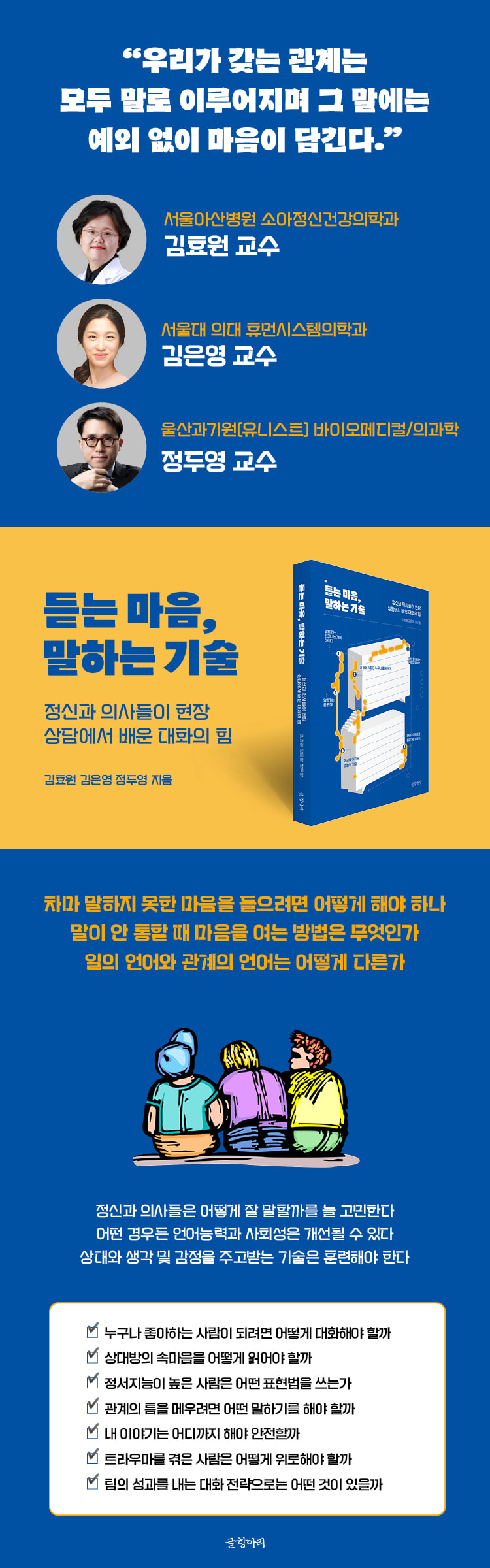
Book Introduction
Listening and Speaking Tips from Three Psychiatrists
To be able to read the other person's emotions and context well
Words are relationships.
And relationships are about the heart.
Therefore, to build good relationships, you need to be good at speaking. It will be helpful to learn how to speak while always looking into the other person's heart.
This is why psychiatrists worked together to write “The Mind of Listening, the Art of Speaking.”
To be able to read the other person's emotions and context well
Words are relationships.
And relationships are about the heart.
Therefore, to build good relationships, you need to be good at speaking. It will be helpful to learn how to speak while always looking into the other person's heart.
This is why psychiatrists worked together to write “The Mind of Listening, the Art of Speaking.”
- You can preview some of the book's contents.
Preview
index
preface
Chapter 1: Conversation Changes Relationships
1.
Speaking isn't innate: it's a trainable communication skill.
2.
The gap in relationships caused by lack of communication
3.
The Communication Secrets of People Who Build Successful Relationships
Chapter 2 Listeners
1.
A person everyone likes: someone who listens to me well
2.
The art of listening
3.
What to Read from the Other Person's Reaction
4.
Listening with emotion
5.
Listening to understand hidden context
6.
Understanding others and myself at the same time
Chapter 3: Building the Basics of Speaking
1.
Why do we communicate?
2.
Developing good speaking habits
3.
Small talk is the beginning of every conversation.
4.
A person who is easy to talk to
5.
How people with high emotional intelligence express themselves
6.
Good questions and bad questions
Chapter 4: Speaking to Enter Others' Hearts
1.
How far should I go with my story?
2.
Praise, do it right
3.
Speaking to Soothe Wounds
4.
Comforting someone who has experienced trauma
5.
How to Talk to Someone Who Wants to Die
6.
Speaking to Protect Me from Verbal Abuse
Chapter 5: Team Communication Skills that Drive Performance
1.
How Highly Effective People Communicate
2.
The Art of Persuasion and Negotiation: From Proposal to Rejection
3.
Conversation Strategies that Drive Team Performance
Chapter 6: Speaking is Relationship
1.
The first skill of speaking well: honesty.
2.
There needs to be distance between hearts.
3.
Accepting the other person without trying to change them
Chapter 1: Conversation Changes Relationships
1.
Speaking isn't innate: it's a trainable communication skill.
2.
The gap in relationships caused by lack of communication
3.
The Communication Secrets of People Who Build Successful Relationships
Chapter 2 Listeners
1.
A person everyone likes: someone who listens to me well
2.
The art of listening
3.
What to Read from the Other Person's Reaction
4.
Listening with emotion
5.
Listening to understand hidden context
6.
Understanding others and myself at the same time
Chapter 3: Building the Basics of Speaking
1.
Why do we communicate?
2.
Developing good speaking habits
3.
Small talk is the beginning of every conversation.
4.
A person who is easy to talk to
5.
How people with high emotional intelligence express themselves
6.
Good questions and bad questions
Chapter 4: Speaking to Enter Others' Hearts
1.
How far should I go with my story?
2.
Praise, do it right
3.
Speaking to Soothe Wounds
4.
Comforting someone who has experienced trauma
5.
How to Talk to Someone Who Wants to Die
6.
Speaking to Protect Me from Verbal Abuse
Chapter 5: Team Communication Skills that Drive Performance
1.
How Highly Effective People Communicate
2.
The Art of Persuasion and Negotiation: From Proposal to Rejection
3.
Conversation Strategies that Drive Team Performance
Chapter 6: Speaking is Relationship
1.
The first skill of speaking well: honesty.
2.
There needs to be distance between hearts.
3.
Accepting the other person without trying to change them
Detailed image
Into the book
Psychiatrists often see this phenomenon in their patients.
For example, after having trouble sleeping, you may keep napping because you are worried about not being able to sleep, which may actually make your insomnia worse. Or, like trying to do well in an interview but getting overly nervous and ruining it, you may misinterpret what is happening inside you and act in a way that makes things worse.
Even smart and successful people are no exception.
Even university professors and students are often unaware of their own needs and feelings.
Emotions like anxiety and depression are more difficult to understand than the temperature of tap water.
It is not easy to understand the situation, but it is even more difficult to come up with the right response and implement it.
Since such errors arise even within oneself, human relationships involving multiple people are even more susceptible to errors.
Listening to understand others is not as easy as you might think.
--- pp.16-17
I sometimes meet students with these characteristics at the UNIST clinic and listen to their concerns.
They struggle because they are not understood by those around them.
People are often misunderstood as ignorant of the other person's position, even though they are well-versed in difficult theories and can understand them without much effort.
People around him have a hard time understanding why he gets better grades in math than his peers but struggles with ethics and social studies.
I encourage them to understand and accept that they have weaknesses in this area.
--- pp.19-20
The sense of security and happiness that humans feel is influenced by interpersonal relationships.
If you didn't have the opportunity to learn the skill properly at home or at school, you need to give yourself the gift of time to learn it even after you become an adult.
We often see people who don't have any major problems in casual relationships struggle with communication in their family or marital relationships.
(…) I also received couples counseling before marriage during my psychiatry residency training, and even after becoming a specialist, I received couples counseling for a considerable period of time, which allowed me to gain a deeper understanding of each other.
Unlike in the past when the perception of counseling was poor, these days, the number of people seeking professional help directly is increasing.
--- pp.24-25
Language for interpersonal relationships requires separate learning.
(…) It is a big misconception to think that because it is your native language, you don’t need to learn it separately to be able to converse well.
--- pp.26
When I was a first-year psychiatrist resident and didn't know what to say when meeting patients or their guardians, my professors and seniors told me, "Just listen."
One of my professors once said, 'Think about a time in your life when someone just listened to you for 20 minutes without talking about themselves.'
(…) It is not easy to lower one’s own position, thoughts, and desires and to be truly interested in and listen to other people’s stories.
So, it seems that everyone feels comfortable with and likes someone who listens to them well.
And listening well is the foundation of speaking well.
--- p.33
When I say, “Please listen to the other person rather than talking about yourself” during family or couples therapy in the clinic, I often get asked, “The conversation has already stopped. How can I get the other person to talk?”
In such cases, it is recommended to carefully watch the reactions shown in entertainment programs such as “Running Man,” “Infinite Challenge,” and “SNL.”
Even without saying anything special, you can get the other person to talk just by reacting well.
--- p.38
Some people are afraid to empathize with others because it feels like agreeing with their opinions.
However, active listening, listening with empathy, does not necessarily mean agreeing with what the other person says or how they act.
--- p.52
So how can we recognize when someone needs comfort or advice? In fact, most conversations we encounter in our daily lives require comfort rather than advice.
--- p.58
In fact, expressing one's feelings is not something that is familiar or easy.
As a specialist who primarily treats mood disorders, I ask people dozens of times a day, “How are you feeling today?” But few people are able to express their feelings or emotions in a nuanced way.
Many people say, “Well.
“I don’t know.” “It’s okay.”
Rather than expressing emotions, they say, “I couldn’t do anything,” or describe a specific situation.
When asked, “What emotions did you feel at that time?”, they only respond with a few words, such as “I was annoyed,” “It wasn’t bad,” “I was angry,” or “I felt good.”
Are our emotions really this simple?
--- pp.103-104
Most people who visit a psychiatrist want to hear decisive advice or a clear solution from their doctor about the difficulties they face.
But surprisingly, most consultations end with ‘questions.’
I primarily treat college students, and I often ask them questions when they confide in me about not knowing what they want and where to start right now.
'What do you really want to do?'
For example, after having trouble sleeping, you may keep napping because you are worried about not being able to sleep, which may actually make your insomnia worse. Or, like trying to do well in an interview but getting overly nervous and ruining it, you may misinterpret what is happening inside you and act in a way that makes things worse.
Even smart and successful people are no exception.
Even university professors and students are often unaware of their own needs and feelings.
Emotions like anxiety and depression are more difficult to understand than the temperature of tap water.
It is not easy to understand the situation, but it is even more difficult to come up with the right response and implement it.
Since such errors arise even within oneself, human relationships involving multiple people are even more susceptible to errors.
Listening to understand others is not as easy as you might think.
--- pp.16-17
I sometimes meet students with these characteristics at the UNIST clinic and listen to their concerns.
They struggle because they are not understood by those around them.
People are often misunderstood as ignorant of the other person's position, even though they are well-versed in difficult theories and can understand them without much effort.
People around him have a hard time understanding why he gets better grades in math than his peers but struggles with ethics and social studies.
I encourage them to understand and accept that they have weaknesses in this area.
--- pp.19-20
The sense of security and happiness that humans feel is influenced by interpersonal relationships.
If you didn't have the opportunity to learn the skill properly at home or at school, you need to give yourself the gift of time to learn it even after you become an adult.
We often see people who don't have any major problems in casual relationships struggle with communication in their family or marital relationships.
(…) I also received couples counseling before marriage during my psychiatry residency training, and even after becoming a specialist, I received couples counseling for a considerable period of time, which allowed me to gain a deeper understanding of each other.
Unlike in the past when the perception of counseling was poor, these days, the number of people seeking professional help directly is increasing.
--- pp.24-25
Language for interpersonal relationships requires separate learning.
(…) It is a big misconception to think that because it is your native language, you don’t need to learn it separately to be able to converse well.
--- pp.26
When I was a first-year psychiatrist resident and didn't know what to say when meeting patients or their guardians, my professors and seniors told me, "Just listen."
One of my professors once said, 'Think about a time in your life when someone just listened to you for 20 minutes without talking about themselves.'
(…) It is not easy to lower one’s own position, thoughts, and desires and to be truly interested in and listen to other people’s stories.
So, it seems that everyone feels comfortable with and likes someone who listens to them well.
And listening well is the foundation of speaking well.
--- p.33
When I say, “Please listen to the other person rather than talking about yourself” during family or couples therapy in the clinic, I often get asked, “The conversation has already stopped. How can I get the other person to talk?”
In such cases, it is recommended to carefully watch the reactions shown in entertainment programs such as “Running Man,” “Infinite Challenge,” and “SNL.”
Even without saying anything special, you can get the other person to talk just by reacting well.
--- p.38
Some people are afraid to empathize with others because it feels like agreeing with their opinions.
However, active listening, listening with empathy, does not necessarily mean agreeing with what the other person says or how they act.
--- p.52
So how can we recognize when someone needs comfort or advice? In fact, most conversations we encounter in our daily lives require comfort rather than advice.
--- p.58
In fact, expressing one's feelings is not something that is familiar or easy.
As a specialist who primarily treats mood disorders, I ask people dozens of times a day, “How are you feeling today?” But few people are able to express their feelings or emotions in a nuanced way.
Many people say, “Well.
“I don’t know.” “It’s okay.”
Rather than expressing emotions, they say, “I couldn’t do anything,” or describe a specific situation.
When asked, “What emotions did you feel at that time?”, they only respond with a few words, such as “I was annoyed,” “It wasn’t bad,” “I was angry,” or “I felt good.”
Are our emotions really this simple?
--- pp.103-104
Most people who visit a psychiatrist want to hear decisive advice or a clear solution from their doctor about the difficulties they face.
But surprisingly, most consultations end with ‘questions.’
I primarily treat college students, and I often ask them questions when they confide in me about not knowing what they want and where to start right now.
'What do you really want to do?'
--- p.115
Publisher's Review
Psychiatrists open people's hearts with words every day.
How can I hear the feelings that I cannot express?
How to open your heart when communication is difficult
How do the language of work and the language of relationships differ?
Are psychiatrists good at speaking? They don't have the eloquence of speech experts or the voices of announcers.
But it is true that there are people who always worry about how to speak well.
We too want to learn speaking skills that will help us build relationships in our daily lives, rather than just being good at giving speeches.
People who communicate well have good communication skills, and that is where friendship, love, and trust are born.
When you become a psychiatrist, the first thing you do is videotape yourself during an interview and analyze it.
Through this, I am seeing more and more patients as I correct their self-talk problems.
Doctors, in particular, often encounter people who hide their true feelings.
People who come for counseling often hide their disappointment with themselves, their fear of failing to find a job, their immediate financial worries, and their anxiety about the future.
So doctors must have the ability to hear what is not being said.
This is why this book, when teaching speaking skills, puts forward the ‘listening heart’ as the first condition.
Psychiatrists listen carefully.
The foundation of good speaking is listening.
This involves listening not only with your ears but also with your heart, and reading the emotions and context from the other person's attitude.
This is where the way of speaking comes into play.
Will you empathize with their feelings, offer practical advice, or simply be a silent presence for them to trust and rely on?
Although the authors are both psychiatrists, their speaking styles, areas of expertise, and training differ.
Dr. Kim Hyo-won specializes in autism spectrum disorder and adolescent suicide and self-harm in the Department of Child and Adolescent Psychiatry.
He prefers to be honest, and sometimes even sheds tears with the children's parents while talking to them in the clinic.
However, when advising on treatment, they sometimes use a firm tone, saying, “You’re saying you won’t treat the child even though there is a very high chance that something will go wrong?”
On the other hand, we have been training medical students' speaking skills by developing and operating a communication education curriculum at Ulsan University College of Medicine.
Professor Kim Eun-young is a professor at Seoul National University College of Medicine, where she counsels students at the Mental Health Center and teaches empathetic communication and character leadership.
Rather than giving advice, the counselor prefers a speaking style that helps the client think more deeply and express themselves by asking questions.
I think it's more important to be able to communicate than to be good at speaking.
Mr. Jeong Du-yeong is strong in communication methods that effectively deal with organizational conflict and stress.
The author provides effective communication techniques for professors and researchers at Ulsan National Institute of Science and Technology (UNIST) to manage their teams effectively and achieve results within their organizations when they face communication difficulties.
The authors emphasize that speaking is essentially a 'conversation'.
When conflict arises, both sides suffer losses.
So, it's a good idea to focus on cooperation without hurting each other's feelings.
This book shows you how such speaking can enrich your life.
Skills learned by practicing listening for '20 minutes'
Relationships depend on language skills
In our society, it is common for adolescents and young adults to have difficulty expressing their emotions accurately.
However, the authors often observe that even successful people in society and university professors are not well aware of their own desires and emotions.
In this way, feelings of anxiety or depression are more difficult to perceive than changes in the temperature of tap water, so it is inevitable that mistakes made in relationships with others will be even more numerous.
For example, students similar to the main character of “The Strange Lawyer Woo Young-woo” visit the clinic at Ulsan National Institute of Science and Technology.
They are often misunderstood as having a good understanding of difficult theories, but pretending not to know the feelings of others that ordinary people can easily perceive.
While they are good at difficult tasks that can be accomplished alone, they struggle with tasks that require communication and coordination with team members.
Relationship interactions are deeply connected to language skills, and the authors emphasize that language and social skills can be improved through training in any case.
However, since you haven't had a chance to learn the skill properly, I suggest that you take the time to learn it from now on.
Language for interpersonal relationships needs to be learned separately.
You also need to train yourself in the skills of exchanging thoughts and feelings with others.
The authors received listening and speaking training during their early years in society.
When he was a first-year resident, Professor Kim Hyo-won only practiced listening to patients and their guardians for '20 minutes.'
My speaking skills improved as I lowered my own position, thoughts, and desires and listened to other people's stories.
As a psychiatrist, Dr. Jeong Du-yeong provided couples counseling before marriage.
Because it takes training to get into someone else's mind.
Medical students must also take a clinical performance test in which they interview and examine mock patients before becoming doctors.
This book begins by examining why you need to learn listening and speaking skills, and then moves on to practical applications.
First, when listening, it is emphasized that you should follow your emotions and understand the hidden context.
It also teaches you how to build speaking habits and distinguish between good and bad questions.
We also need to learn how to have emotional conversations.
For example, in comforting words, listening is key, and you must listen while 'actively responding with words and actions.'
Asking questions about things that seem ambiguous and expressing empathy for the other person's thoughts and feelings will encourage them to be more open.
At this time, the person who expressed depression, anxiety, and anger gets the effect of emotional relief just by doing so.
If you're talking to someone who has experienced trauma, it's helpful to consistently show empathy for their pain and reassure them that the changes brought on by the trauma are natural and normal.
For example, if someone you know says they want to die, the authors recommend asking them directly about their intentions rather than beating around the bush.
“You said earlier that there was no other way and that you wanted to end it all.
Some people worry that asking about suicidal thoughts like “Are you thinking about suicide?” will increase the risk of suicide, but don’t worry, that’s not true.
Here are some things we shouldn't say:
Trying to stop them outright, downplaying the issue, offering hasty advice and solutions, blaming and getting angry…
The skills of persuasion and negotiation that lead to results discussed in the latter part are different from emotional conversations and present another skill.
The beauty of this book is that we all have multiple identities, depending on our roles at work, our position in the family, and our personal friendships and romantic relationships. It teaches us how to communicate appropriately for each situation and relationship.
***
When we listen to the other person's needs and feelings, they are more likely to listen and accept ours.
This is when the relationship deepens.
The moment when we read each other's desires and emotions.
In other words, listening to others leads to understanding my own emotions and desires, and this is where new interpersonal relationships, the source of human happiness, are created.
How can I hear the feelings that I cannot express?
How to open your heart when communication is difficult
How do the language of work and the language of relationships differ?
Are psychiatrists good at speaking? They don't have the eloquence of speech experts or the voices of announcers.
But it is true that there are people who always worry about how to speak well.
We too want to learn speaking skills that will help us build relationships in our daily lives, rather than just being good at giving speeches.
People who communicate well have good communication skills, and that is where friendship, love, and trust are born.
When you become a psychiatrist, the first thing you do is videotape yourself during an interview and analyze it.
Through this, I am seeing more and more patients as I correct their self-talk problems.
Doctors, in particular, often encounter people who hide their true feelings.
People who come for counseling often hide their disappointment with themselves, their fear of failing to find a job, their immediate financial worries, and their anxiety about the future.
So doctors must have the ability to hear what is not being said.
This is why this book, when teaching speaking skills, puts forward the ‘listening heart’ as the first condition.
Psychiatrists listen carefully.
The foundation of good speaking is listening.
This involves listening not only with your ears but also with your heart, and reading the emotions and context from the other person's attitude.
This is where the way of speaking comes into play.
Will you empathize with their feelings, offer practical advice, or simply be a silent presence for them to trust and rely on?
Although the authors are both psychiatrists, their speaking styles, areas of expertise, and training differ.
Dr. Kim Hyo-won specializes in autism spectrum disorder and adolescent suicide and self-harm in the Department of Child and Adolescent Psychiatry.
He prefers to be honest, and sometimes even sheds tears with the children's parents while talking to them in the clinic.
However, when advising on treatment, they sometimes use a firm tone, saying, “You’re saying you won’t treat the child even though there is a very high chance that something will go wrong?”
On the other hand, we have been training medical students' speaking skills by developing and operating a communication education curriculum at Ulsan University College of Medicine.
Professor Kim Eun-young is a professor at Seoul National University College of Medicine, where she counsels students at the Mental Health Center and teaches empathetic communication and character leadership.
Rather than giving advice, the counselor prefers a speaking style that helps the client think more deeply and express themselves by asking questions.
I think it's more important to be able to communicate than to be good at speaking.
Mr. Jeong Du-yeong is strong in communication methods that effectively deal with organizational conflict and stress.
The author provides effective communication techniques for professors and researchers at Ulsan National Institute of Science and Technology (UNIST) to manage their teams effectively and achieve results within their organizations when they face communication difficulties.
The authors emphasize that speaking is essentially a 'conversation'.
When conflict arises, both sides suffer losses.
So, it's a good idea to focus on cooperation without hurting each other's feelings.
This book shows you how such speaking can enrich your life.
Skills learned by practicing listening for '20 minutes'
Relationships depend on language skills
In our society, it is common for adolescents and young adults to have difficulty expressing their emotions accurately.
However, the authors often observe that even successful people in society and university professors are not well aware of their own desires and emotions.
In this way, feelings of anxiety or depression are more difficult to perceive than changes in the temperature of tap water, so it is inevitable that mistakes made in relationships with others will be even more numerous.
For example, students similar to the main character of “The Strange Lawyer Woo Young-woo” visit the clinic at Ulsan National Institute of Science and Technology.
They are often misunderstood as having a good understanding of difficult theories, but pretending not to know the feelings of others that ordinary people can easily perceive.
While they are good at difficult tasks that can be accomplished alone, they struggle with tasks that require communication and coordination with team members.
Relationship interactions are deeply connected to language skills, and the authors emphasize that language and social skills can be improved through training in any case.
However, since you haven't had a chance to learn the skill properly, I suggest that you take the time to learn it from now on.
Language for interpersonal relationships needs to be learned separately.
You also need to train yourself in the skills of exchanging thoughts and feelings with others.
The authors received listening and speaking training during their early years in society.
When he was a first-year resident, Professor Kim Hyo-won only practiced listening to patients and their guardians for '20 minutes.'
My speaking skills improved as I lowered my own position, thoughts, and desires and listened to other people's stories.
As a psychiatrist, Dr. Jeong Du-yeong provided couples counseling before marriage.
Because it takes training to get into someone else's mind.
Medical students must also take a clinical performance test in which they interview and examine mock patients before becoming doctors.
This book begins by examining why you need to learn listening and speaking skills, and then moves on to practical applications.
First, when listening, it is emphasized that you should follow your emotions and understand the hidden context.
It also teaches you how to build speaking habits and distinguish between good and bad questions.
We also need to learn how to have emotional conversations.
For example, in comforting words, listening is key, and you must listen while 'actively responding with words and actions.'
Asking questions about things that seem ambiguous and expressing empathy for the other person's thoughts and feelings will encourage them to be more open.
At this time, the person who expressed depression, anxiety, and anger gets the effect of emotional relief just by doing so.
If you're talking to someone who has experienced trauma, it's helpful to consistently show empathy for their pain and reassure them that the changes brought on by the trauma are natural and normal.
For example, if someone you know says they want to die, the authors recommend asking them directly about their intentions rather than beating around the bush.
“You said earlier that there was no other way and that you wanted to end it all.
Some people worry that asking about suicidal thoughts like “Are you thinking about suicide?” will increase the risk of suicide, but don’t worry, that’s not true.
Here are some things we shouldn't say:
Trying to stop them outright, downplaying the issue, offering hasty advice and solutions, blaming and getting angry…
The skills of persuasion and negotiation that lead to results discussed in the latter part are different from emotional conversations and present another skill.
The beauty of this book is that we all have multiple identities, depending on our roles at work, our position in the family, and our personal friendships and romantic relationships. It teaches us how to communicate appropriately for each situation and relationship.
***
When we listen to the other person's needs and feelings, they are more likely to listen and accept ours.
This is when the relationship deepens.
The moment when we read each other's desires and emotions.
In other words, listening to others leads to understanding my own emotions and desires, and this is where new interpersonal relationships, the source of human happiness, are created.
GOODS SPECIFICS
- Date of issue: November 11, 2024
- Page count, weight, size: 296 pages | 424g | 140*200*18mm
- ISBN13: 9791169093101
You may also like
카테고리
korean


korean

![GQ KOREA Mark (Monthly): December [2025]](http://librairie.coreenne.fr/cdn/shop/files/8ef265dbbfbf186523ed75ba7319009d.jpg?v=1765340328&width=3840)


