

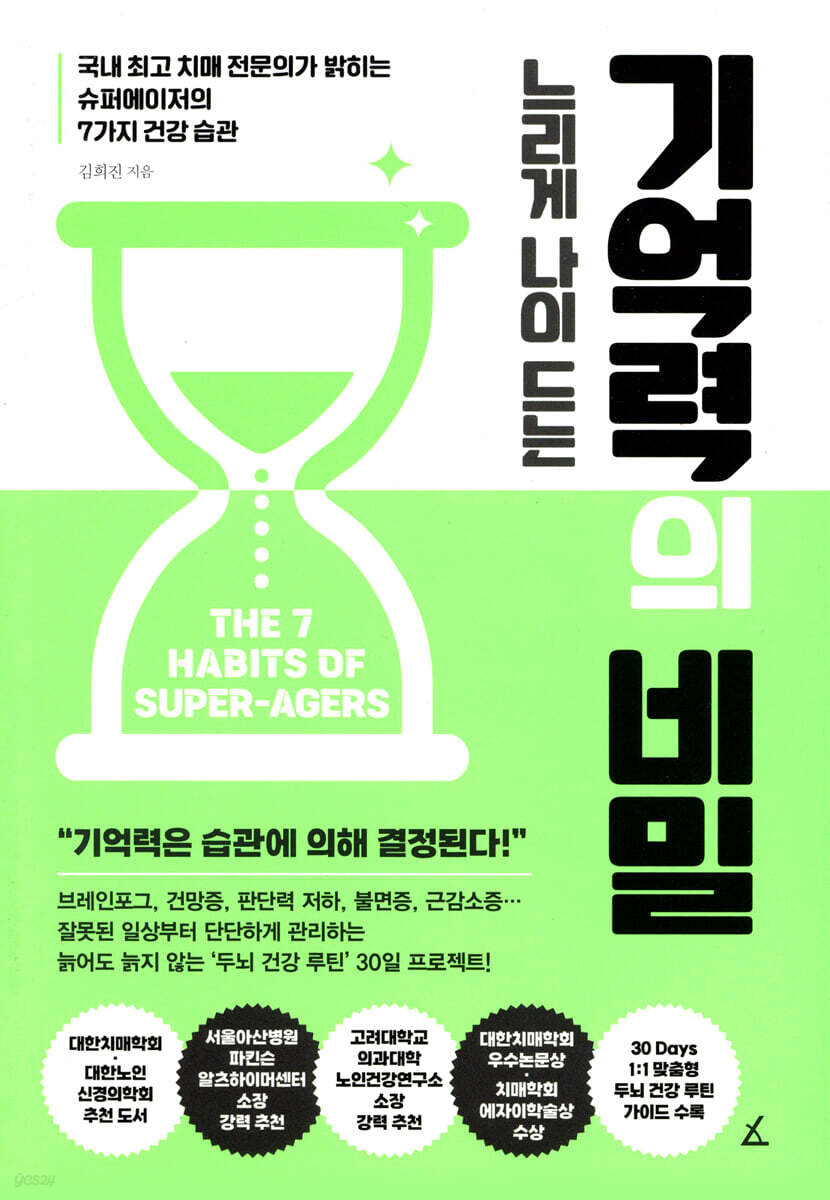
The Secret to Slow-Aging Memory
 |
Description
Book Introduction
From diet, exercise, sleep, mental health management, medication, and treatment solutions.
The Amazing Secret to a Brain 30 Years Younger Than Your Physical Age
“Turning back the age of memory
“I’ve been waiting for a book like this that everyone can believe in and put into practice!”
Why are they super-agers?
Uncovering the Secrets of a Brain 30 Years Younger Than Your Physical Age
People with brains that are usually 20 to 30 years younger than their peers.
These so-called super-agers have memories and cognitive abilities as good as those of young people.
How can they maintain such a brain? The author argues that human aging is not a predetermined process, but rather a process of "wear and tear," and that we can significantly control the "rate at which our brains age" by how well we manage and use our bodies.
Unlike other organs, the brain cannot be replaced, so it inevitably has a high possibility of recovery, that is, regenerative plasticity.
In other words, a young and healthy brain depends on us.
The Amazing Secret to a Brain 30 Years Younger Than Your Physical Age
“Turning back the age of memory
“I’ve been waiting for a book like this that everyone can believe in and put into practice!”
Why are they super-agers?
Uncovering the Secrets of a Brain 30 Years Younger Than Your Physical Age
People with brains that are usually 20 to 30 years younger than their peers.
These so-called super-agers have memories and cognitive abilities as good as those of young people.
How can they maintain such a brain? The author argues that human aging is not a predetermined process, but rather a process of "wear and tear," and that we can significantly control the "rate at which our brains age" by how well we manage and use our bodies.
Unlike other organs, the brain cannot be replaced, so it inevitably has a high possibility of recovery, that is, regenerative plasticity.
In other words, a young and healthy brain depends on us.
- You can preview some of the book's contents.
Preview
index
Introduction
For a brain that doesn't age even as you age
Understanding Part 1
How old is your brain
Chapter 1: What We Didn't Know About "Brain Aging"
The Difference Between Aging and Senescence | Why Does Aging Occur? | The Changing Speed of Thought |
Brain volume decreases with age
Chapter 2: How the Brain Moves and Functions
The control tower of life, the brainstem | The center of balance, the cerebellum | The cerebrum, which controls senses and thought
Chapter 3: The 'Aging Changes' Our Body Experiences
Inflammation increases with age | Does brain aging lead to dementia? |
4 Habits That Age Your Brain and Body | People Who Fear the Night, Chronic Insomnia |
High blood pressure, hyperlipidemia, and diabetes are the three major chronic diseases.
Chapter 4: Three Major Diseases That Accelerate Aging
High blood pressure, the silent demon of death | Hyperlipidemia (dyslipidemia), whose complications are even more frightening |
Diabetes as a result of accumulated lifestyle habits
Follow Part 2
7 Habits to Become a Superager
Chapter 5: Daily Checkup: Is Your Brain 'Hello'?
Analyzing Your Daily Routine for 30 Days | Checklist: “How Was Your Day?” |
Is my forgetfulness pathological or natural? | How many words did I forget today?
Chapter 6, Part 2: The Genius' Diet I: What, How, and How Much to Eat
Food that is enjoyable for the body, not the mouth|Eat less to stay young|
Avoid salt, sugar, and white rice. Avoid fast food and processed foods.
The benefits of vegetable oil you never knew about
Chapter 7: The Genius Diet II: A Healing Diet to Eliminate Dementia Worries
16-Hour Intermittent Fasting: Good for Your Brain | Eat Less, Stay Young |
Finding the Right Meal Pattern for You | Eating Protein and Fat Wisely |
Eat Slowly and Live Young | Drinking Smart Water to Save Your Brain |
Nutrient deficiencies can be addressed with nutritional supplements or supplements. Anything in excess can lead to illness.
Chapter 8: A 'Customized' Diet Checklist Based on Your Symptoms
If your face and limbs are shaking|How to avoid brain fog|
To boost your immunity and prevent cancer
Chapter 9: Brain Stimulation Exercises: A Guide to Using Your Body Properly
Brain Changes from 10 Minutes of Exercise | Exercise to Stay Youthful |
The moment you 'resolve', your brain changes. The brain changes in just a few seconds.
An Upgraded Version of Walking: Climbing Stairs | Simple Stretches for Brain Health |
High-Intensity Weekend Workouts to Wake Up Your Brain | Precautions for High-Intensity Workouts |
The Brain-Activating Effects of Exercise | WHO's Age-Specific Exercise Guidelines
Chapter 10, Part 4: Emotional Habits: Dealing with Stress-Stricken Mental Health
Stress is the root of all evil!|The first step to stress management|
Relieve Stress with 10-Minute Green Therapy | 8 Rules for Feeling Happiness | The Surprising Secret of a Positive Reset | Keep a Journal to Empty Your Emotional Waste
Chapter 11: Brain-Cleaning Sleep Habits: Let's Get Some "Good Night's Sleep"
Could I Have a Sleep Disorder? | The 'Sleep Circuit' That Determines Sleep Quality |
The Real Reason It's Harder to Fall As You Age | Time to Clean Your Brain of Waste |
Sleep Quality Self-Test | Ten Commandments for a Good Night's Sleep
Chapter 12: Rest Habits: How to Overcome Chronic Fatigue
Your body wasn't heavy to begin with | 10 causes of fatigue |
My Body's 'Fatigue' Checklist|Taking a Nap Like a Tonic|
Brain Clearing Time: 'Spacing Out'
Chapter 13, Chapter 7, If You Have a Brain Problem: Treat Smartly, Take Your Medicine Wisely
7 Smart Medical Tips | Understand Your Medications and Take Them Right | Visit a Hospital for a Checkup
Appendix: The Life-Changing 30-Day Brain Project
Ⅰ Measuring your body age and brain age|Ⅱ 30-day diet to change your brain|
Ⅲ 30-Day Brain-Changing Exercise Routine|Ⅳ 30-Day Brain-Changing Emotional Habits|
V Solution Index: Learning from Patient Cases
References
For a brain that doesn't age even as you age
Understanding Part 1
How old is your brain
Chapter 1: What We Didn't Know About "Brain Aging"
The Difference Between Aging and Senescence | Why Does Aging Occur? | The Changing Speed of Thought |
Brain volume decreases with age
Chapter 2: How the Brain Moves and Functions
The control tower of life, the brainstem | The center of balance, the cerebellum | The cerebrum, which controls senses and thought
Chapter 3: The 'Aging Changes' Our Body Experiences
Inflammation increases with age | Does brain aging lead to dementia? |
4 Habits That Age Your Brain and Body | People Who Fear the Night, Chronic Insomnia |
High blood pressure, hyperlipidemia, and diabetes are the three major chronic diseases.
Chapter 4: Three Major Diseases That Accelerate Aging
High blood pressure, the silent demon of death | Hyperlipidemia (dyslipidemia), whose complications are even more frightening |
Diabetes as a result of accumulated lifestyle habits
Follow Part 2
7 Habits to Become a Superager
Chapter 5: Daily Checkup: Is Your Brain 'Hello'?
Analyzing Your Daily Routine for 30 Days | Checklist: “How Was Your Day?” |
Is my forgetfulness pathological or natural? | How many words did I forget today?
Chapter 6, Part 2: The Genius' Diet I: What, How, and How Much to Eat
Food that is enjoyable for the body, not the mouth|Eat less to stay young|
Avoid salt, sugar, and white rice. Avoid fast food and processed foods.
The benefits of vegetable oil you never knew about
Chapter 7: The Genius Diet II: A Healing Diet to Eliminate Dementia Worries
16-Hour Intermittent Fasting: Good for Your Brain | Eat Less, Stay Young |
Finding the Right Meal Pattern for You | Eating Protein and Fat Wisely |
Eat Slowly and Live Young | Drinking Smart Water to Save Your Brain |
Nutrient deficiencies can be addressed with nutritional supplements or supplements. Anything in excess can lead to illness.
Chapter 8: A 'Customized' Diet Checklist Based on Your Symptoms
If your face and limbs are shaking|How to avoid brain fog|
To boost your immunity and prevent cancer
Chapter 9: Brain Stimulation Exercises: A Guide to Using Your Body Properly
Brain Changes from 10 Minutes of Exercise | Exercise to Stay Youthful |
The moment you 'resolve', your brain changes. The brain changes in just a few seconds.
An Upgraded Version of Walking: Climbing Stairs | Simple Stretches for Brain Health |
High-Intensity Weekend Workouts to Wake Up Your Brain | Precautions for High-Intensity Workouts |
The Brain-Activating Effects of Exercise | WHO's Age-Specific Exercise Guidelines
Chapter 10, Part 4: Emotional Habits: Dealing with Stress-Stricken Mental Health
Stress is the root of all evil!|The first step to stress management|
Relieve Stress with 10-Minute Green Therapy | 8 Rules for Feeling Happiness | The Surprising Secret of a Positive Reset | Keep a Journal to Empty Your Emotional Waste
Chapter 11: Brain-Cleaning Sleep Habits: Let's Get Some "Good Night's Sleep"
Could I Have a Sleep Disorder? | The 'Sleep Circuit' That Determines Sleep Quality |
The Real Reason It's Harder to Fall As You Age | Time to Clean Your Brain of Waste |
Sleep Quality Self-Test | Ten Commandments for a Good Night's Sleep
Chapter 12: Rest Habits: How to Overcome Chronic Fatigue
Your body wasn't heavy to begin with | 10 causes of fatigue |
My Body's 'Fatigue' Checklist|Taking a Nap Like a Tonic|
Brain Clearing Time: 'Spacing Out'
Chapter 13, Chapter 7, If You Have a Brain Problem: Treat Smartly, Take Your Medicine Wisely
7 Smart Medical Tips | Understand Your Medications and Take Them Right | Visit a Hospital for a Checkup
Appendix: The Life-Changing 30-Day Brain Project
Ⅰ Measuring your body age and brain age|Ⅱ 30-day diet to change your brain|
Ⅲ 30-Day Brain-Changing Exercise Routine|Ⅳ 30-Day Brain-Changing Emotional Habits|
V Solution Index: Learning from Patient Cases
References
Detailed image

Into the book
I think the patient who gave me the biggest shock in my 20+ years of medical career was Mr. K.
Mr. K, 62, initially started going to the hospital as a caregiver for his mother who suffered from dementia.
While my mother's symptoms were improving while she was going to the hospital, her memory was still intact, and she was healthy enough to go to the swimming pool regularly, her guardian, Mr. K, who works as an architect, was losing weight day by day and showing signs of rapid aging on her face and other areas.
Then, after about five years, I started to often forget my mother's outpatient schedule.
When I asked Mr. K, who came to the hospital with his mother, “How is work going at the company these days?” he honestly confessed, “Unlike before, work progresses slower and I can’t draw drawings well.”
Mr. K's mother's dementia progressed slowly over 13 years, but his son's dementia progressed rapidly as soon as he was diagnosed with an abnormal condition.
And he died of cancer sooner than his mother.
Looking at Mr. K's case, I sometimes feel regretful that if his brain had been kept healthy, he would have preserved his bodily functions and lived a much longer and healthier life, caring for his mother.
--- pp.17~18
In fact, 'aging' and 'frailty' have similar meanings and are not easy to distinguish.
Just as older people jokingly ask their younger friends, “Have you ever been old?”, aging, which is something that we experience only as time passes, is a phenomenon in which bodily functions deteriorate over time.
Cellular aging occurs when cells lose their ability to divide.
Aging is generally characterized by a decline in the ability to cope with stress, an inability to maintain homeostasis, and an increased risk of disease.
In humans, aging is an accumulation of changes that affect life over time, including physical, psychological, and social changes.
And when aging progresses to a certain extent, it leads to death.
--- p.19
Mr. H, 60, came to see me after hearing from another hospital that his brain was gone.
At first I wondered what he was talking about.
After hearing Mr. H's story, he said that he had a brain MRI during a health checkup and that he could soon develop dementia.
He said he was advised to go to a neurologist right away.
In the photo, Mr. H's brain atrophy was far beyond the normal range and was shrunken by more than 30% compared to a normal person.
Although the cause was unclear, medical experts determined that his brain atrophy was at high risk for dementia, and he began seeing an outpatient doctor while undergoing additional tests.
How is Mr. H doing now, 14 years later? Despite being nearing 80, he shows no signs of dementia and continues to regularly visit hospitals from Daejeon to Seoul.
As seen in Mr. H's case, structural changes in the brain are not directly linked to functional decline.
Please refer to the '7 Habits' introduced below to learn about the exercise and diet that Mr. H does to maintain his physical function, and the habits he has developed.
First, we will look at aging and changes in the functions of each body organ, and learn what actually changes and how to deal with it.
--- pp.43~45
Mr. H, a 42-year-old former baseball player, woke up to find that his right arm and leg were not moving properly and his speech was suddenly slurred, so he went to the emergency room.
He was worried that his weight had suddenly increased by 20 kg after he stopped exercising, despite being 185 cm tall and weighing 112 kg, but he continued to participate in social sports.
However, in order to keep up with the new job, I often attended company dinners, so I often ate late at night, and the frequency of drinking and smoking kept increasing.
On the other hand, the amount of exercise was less than a tenth of what it was when I was a player.
As a former athlete with no physical problems, Mr. H was shocked to learn that the cause of the paralysis in his right arm and leg was cerebral infarction due to cerebral arteriosclerosis.
The health checkup did not reveal any particular problems, but the middle cerebral artery on the left side of the brain was already blocked.
Without me noticing it, my systolic blood pressure did not fall below 160 mmHg, and I even had hyperlipidemia and hyperglycemia.
After that, Mr. H's paralysis in his arms and legs improved, but he was no longer able to play baseball in society.
Here we can once again confirm that diseases can strike regardless of age.
So, what self-care principles should you follow to avoid a stroke at the young age of 42? First, for brain health, you should check your lifestyle habits, such as how much you move, when you eat, and what time you go to bed and wake up.
This is because we wake up, move, and eat unconsciously every day according to our habits.
Before we dive into the daily routine, let's answer these seven questions:
First, do you maintain regular sleep habits?
Second, are you eating a balanced diet of healthy, nutritious foods?
Third, do you exercise at a set time every day?
Fourth, do you write down and manage what stresses you out?
Fifth, are you doing anything to enhance your cognitive abilities?
Sixth, are you looking for ways to become a better version of yourself?
Seventh, are you looking for ways to maintain optimal productivity?
How many of these questions did you answer with a "yes"? Perhaps you answered "no" to all of them? If so, don't despair.
The very act of becoming aware of it is the first step toward change.
--- pp.69~71
There have been times when I couldn't remember medical terms that were frequently used during lectures.
I'm the type of person who speaks without hesitation, so I got through it without a hitch, but I was momentarily flustered.
After the lecture, I checked what I did the day before the lecture and whether I had any bad brain functions, and then I repeated the words I had forgotten 10 times before going to bed.
Only after I was able to skillfully use that word in another lecture did I breathe a sigh of relief.
So is this simply forgetfulness due to aging, or is it becoming pathological forgetfulness?
'Easy word amnesia', a subtle change that occurs with aging, is a natural part of getting older.
The question here is whether this natural forgetfulness is actually pathological or not.
A simple way to differentiate is that age-related forgetfulness is something I take seriously, while pathological forgetfulness is something others take more seriously than I do.
The important thing here is that even pathological forgetfulness can be reversed if you quickly review your daily life and make changes.
Several years ago, two patients, both tour guides, presented with forgetfulness around the same time.
The fates of the two people diagnosed with Alzheimer's disease at the time diverged as follows.
Mr. K, 62, initially started going to the hospital as a caregiver for his mother who suffered from dementia.
While my mother's symptoms were improving while she was going to the hospital, her memory was still intact, and she was healthy enough to go to the swimming pool regularly, her guardian, Mr. K, who works as an architect, was losing weight day by day and showing signs of rapid aging on her face and other areas.
Then, after about five years, I started to often forget my mother's outpatient schedule.
When I asked Mr. K, who came to the hospital with his mother, “How is work going at the company these days?” he honestly confessed, “Unlike before, work progresses slower and I can’t draw drawings well.”
Mr. K's mother's dementia progressed slowly over 13 years, but his son's dementia progressed rapidly as soon as he was diagnosed with an abnormal condition.
And he died of cancer sooner than his mother.
Looking at Mr. K's case, I sometimes feel regretful that if his brain had been kept healthy, he would have preserved his bodily functions and lived a much longer and healthier life, caring for his mother.
--- pp.17~18
In fact, 'aging' and 'frailty' have similar meanings and are not easy to distinguish.
Just as older people jokingly ask their younger friends, “Have you ever been old?”, aging, which is something that we experience only as time passes, is a phenomenon in which bodily functions deteriorate over time.
Cellular aging occurs when cells lose their ability to divide.
Aging is generally characterized by a decline in the ability to cope with stress, an inability to maintain homeostasis, and an increased risk of disease.
In humans, aging is an accumulation of changes that affect life over time, including physical, psychological, and social changes.
And when aging progresses to a certain extent, it leads to death.
--- p.19
Mr. H, 60, came to see me after hearing from another hospital that his brain was gone.
At first I wondered what he was talking about.
After hearing Mr. H's story, he said that he had a brain MRI during a health checkup and that he could soon develop dementia.
He said he was advised to go to a neurologist right away.
In the photo, Mr. H's brain atrophy was far beyond the normal range and was shrunken by more than 30% compared to a normal person.
Although the cause was unclear, medical experts determined that his brain atrophy was at high risk for dementia, and he began seeing an outpatient doctor while undergoing additional tests.
How is Mr. H doing now, 14 years later? Despite being nearing 80, he shows no signs of dementia and continues to regularly visit hospitals from Daejeon to Seoul.
As seen in Mr. H's case, structural changes in the brain are not directly linked to functional decline.
Please refer to the '7 Habits' introduced below to learn about the exercise and diet that Mr. H does to maintain his physical function, and the habits he has developed.
First, we will look at aging and changes in the functions of each body organ, and learn what actually changes and how to deal with it.
--- pp.43~45
Mr. H, a 42-year-old former baseball player, woke up to find that his right arm and leg were not moving properly and his speech was suddenly slurred, so he went to the emergency room.
He was worried that his weight had suddenly increased by 20 kg after he stopped exercising, despite being 185 cm tall and weighing 112 kg, but he continued to participate in social sports.
However, in order to keep up with the new job, I often attended company dinners, so I often ate late at night, and the frequency of drinking and smoking kept increasing.
On the other hand, the amount of exercise was less than a tenth of what it was when I was a player.
As a former athlete with no physical problems, Mr. H was shocked to learn that the cause of the paralysis in his right arm and leg was cerebral infarction due to cerebral arteriosclerosis.
The health checkup did not reveal any particular problems, but the middle cerebral artery on the left side of the brain was already blocked.
Without me noticing it, my systolic blood pressure did not fall below 160 mmHg, and I even had hyperlipidemia and hyperglycemia.
After that, Mr. H's paralysis in his arms and legs improved, but he was no longer able to play baseball in society.
Here we can once again confirm that diseases can strike regardless of age.
So, what self-care principles should you follow to avoid a stroke at the young age of 42? First, for brain health, you should check your lifestyle habits, such as how much you move, when you eat, and what time you go to bed and wake up.
This is because we wake up, move, and eat unconsciously every day according to our habits.
Before we dive into the daily routine, let's answer these seven questions:
First, do you maintain regular sleep habits?
Second, are you eating a balanced diet of healthy, nutritious foods?
Third, do you exercise at a set time every day?
Fourth, do you write down and manage what stresses you out?
Fifth, are you doing anything to enhance your cognitive abilities?
Sixth, are you looking for ways to become a better version of yourself?
Seventh, are you looking for ways to maintain optimal productivity?
How many of these questions did you answer with a "yes"? Perhaps you answered "no" to all of them? If so, don't despair.
The very act of becoming aware of it is the first step toward change.
--- pp.69~71
There have been times when I couldn't remember medical terms that were frequently used during lectures.
I'm the type of person who speaks without hesitation, so I got through it without a hitch, but I was momentarily flustered.
After the lecture, I checked what I did the day before the lecture and whether I had any bad brain functions, and then I repeated the words I had forgotten 10 times before going to bed.
Only after I was able to skillfully use that word in another lecture did I breathe a sigh of relief.
So is this simply forgetfulness due to aging, or is it becoming pathological forgetfulness?
'Easy word amnesia', a subtle change that occurs with aging, is a natural part of getting older.
The question here is whether this natural forgetfulness is actually pathological or not.
A simple way to differentiate is that age-related forgetfulness is something I take seriously, while pathological forgetfulness is something others take more seriously than I do.
The important thing here is that even pathological forgetfulness can be reversed if you quickly review your daily life and make changes.
Several years ago, two patients, both tour guides, presented with forgetfulness around the same time.
The fates of the two people diagnosed with Alzheimer's disease at the time diverged as follows.
--- pp.77~78
Publisher's Review
The message to protect your brain health from the age of forty
Advice from the country's top dementia specialist
This book is a collection of carefully selected, daily 'practice guidelines' that Professor Kim Hee-jin, recognized as Korea's top dementia specialist, has carefully considered what is truly necessary for 'brain health' while counseling patients who have visited her clinic for over 20 years, and has actually proven effective while going through the long marathon of treatment with them.
He has observed countless patients suffering from neglected brain care, both recovering and recovering from their illnesses, and has confirmed that simply incorporating healthy brain habits into a routine can significantly improve the brain's health.
For example, in the case of Mr. H, a man in his 60s with a dementia gene, he was able to maintain his daily life without any cognitive problems through several 'memory habits' even in a situation where his brain was greatly shrunken.
In addition, the author presents cases of people in their 40s to 70s suffering from various problems such as brain fog, memory impairment, and cognitive dysfunction, and suggests brain health solutions and habits tailored to each individual.
Mr. P, who had been eating less and rarely going out for two months due to concerns about his children's immigration, lost about 8 kg in weight over the two months. On the day he visited the hospital, he was taken to the emergency room because he could not even lift a spoon.
Mr. P's condition, which was thought to be simply due to depression, was too severe to be considered a psychological problem.
Ultimately, the various neurological abnormalities that Mr. P exhibited were caused by sarcopenia resulting from excessive loss of appetite.
Electrolyte imbalances caused by sarcopenia resulted in cognitive decline, limb paralysis, and speech impairment.
Rather than taking it for granted that muscles will inevitably decrease as you age, you should increase muscle mass and build strength through regular exercise.
_From the text
In particular, this book focuses on 'healthy brain management' necessary for those who are suffering from rapid decline in memory and cognitive ability, and provides 'action guidelines'.
After middle age, not only the brain but also physical functions such as muscle mass and flexibility begin to decline.
It is no exaggeration to say that the quality of life in old age is determined by how you spend this time.
Throughout the book, the author emphasizes that 'habits affect memory and brain health.'
A small change you make today could be the best secret to regaining your memory.
Through the '7 Habits of Superagers' that have proven to be effective
Create a 'memory habit' that suits you.
Superagers have fundamentally healthy eating habits, but blindly following their habits isn't the answer.
As mentioned earlier, this book contains numerous proven health behavior guidelines, and the author suggests that you practice them one by one and select the ones that are most effective for you to create your own 30-day brain care routine.
Because not everyone has the same conditions.
The causes of brain problems can be surprisingly unexpected.
The author says that just as a healthy brain is created in a healthy body, there are many cases where muscle loss, lack of sleep, stress, and diet are the causes.
Therefore, even now, we must begin to make the most important elements of our lives our own habits and put them into practice.
Brain health information floating around on KakaoTalk and Jishin
Is this really true?
The author went through a process of objectively examining the effectiveness of unfounded health information floating around, and even put it into practice to prove its effectiveness.
Through this, the author has summarized the best brain management methods to start after the age of 40 and the most important factors to improve the quality of life into 7 categories, which are as follows.
-What is my current condition?
-How to eat it.
-How to exercise.
-How should I sleep?
-How should I rest?
-How to control your emotions.
-And what kind of medicine should I take and what kind of treatment should I receive?
The secret to memory, read it like this!
A Healthy Brain Guide to Start Today
Before creating 'habits that create a healthy brain,' you first need to have a basic understanding of the brain.
Part 1 of this book, "Understanding," actually explains the structure of the brain and the functions of each part, and tells you how the brain actually functions.
It is not difficult to understand as it is explained through various experiments and cases.
Part 2, the 'Follow' part, divides the essential lifestyle habits for managing daily life, including daily check-ups, diet and exercise, emotional and stress management, sleep and medication use, into 7 categories and organizes practical methods that anyone can easily follow.
The appendix details a variety of methods that many people have found effective, as well as small habits that the author himself practices. Based on these, readers can try them out themselves and find solutions that work for them.
Even if you just practice one or two of these that work for you, you can see significant results.
We also provide a one-on-one customized solution brain health routine guide to help you create a 30-day, 60-day, or 90-day brain health plan that suits you.
K-Brain Food for Our Body
A "Brain Diet Guide" for Koreans
Lastly, while supervising the well-known book on brain health and dementia prevention, Professor Kim Hee-jin felt regretful that the good information in the book was made up of ingredients that are not easily accessible around us (e.g., leeks, allspice, tempeh, unsweetened cashew milk, etc.), and felt a strong need for a brain health book that is just right for Koreans.
In "The Secret of Slow-Aging Memory," we included information on "K-Brain Food," which is readily available and easy to use domestically, to help fill this gap.
It also provides a thorough explanation of the pros and cons of Korean food ingredients that Koreans consume in large quantities, such as rice, salt, sugar, sesame oil, and perilla oil, for which objectively proven information is lacking, as well as when, how, and how much they should be consumed.
Advice from the country's top dementia specialist
This book is a collection of carefully selected, daily 'practice guidelines' that Professor Kim Hee-jin, recognized as Korea's top dementia specialist, has carefully considered what is truly necessary for 'brain health' while counseling patients who have visited her clinic for over 20 years, and has actually proven effective while going through the long marathon of treatment with them.
He has observed countless patients suffering from neglected brain care, both recovering and recovering from their illnesses, and has confirmed that simply incorporating healthy brain habits into a routine can significantly improve the brain's health.
For example, in the case of Mr. H, a man in his 60s with a dementia gene, he was able to maintain his daily life without any cognitive problems through several 'memory habits' even in a situation where his brain was greatly shrunken.
In addition, the author presents cases of people in their 40s to 70s suffering from various problems such as brain fog, memory impairment, and cognitive dysfunction, and suggests brain health solutions and habits tailored to each individual.
Mr. P, who had been eating less and rarely going out for two months due to concerns about his children's immigration, lost about 8 kg in weight over the two months. On the day he visited the hospital, he was taken to the emergency room because he could not even lift a spoon.
Mr. P's condition, which was thought to be simply due to depression, was too severe to be considered a psychological problem.
Ultimately, the various neurological abnormalities that Mr. P exhibited were caused by sarcopenia resulting from excessive loss of appetite.
Electrolyte imbalances caused by sarcopenia resulted in cognitive decline, limb paralysis, and speech impairment.
Rather than taking it for granted that muscles will inevitably decrease as you age, you should increase muscle mass and build strength through regular exercise.
_From the text
In particular, this book focuses on 'healthy brain management' necessary for those who are suffering from rapid decline in memory and cognitive ability, and provides 'action guidelines'.
After middle age, not only the brain but also physical functions such as muscle mass and flexibility begin to decline.
It is no exaggeration to say that the quality of life in old age is determined by how you spend this time.
Throughout the book, the author emphasizes that 'habits affect memory and brain health.'
A small change you make today could be the best secret to regaining your memory.
Through the '7 Habits of Superagers' that have proven to be effective
Create a 'memory habit' that suits you.
Superagers have fundamentally healthy eating habits, but blindly following their habits isn't the answer.
As mentioned earlier, this book contains numerous proven health behavior guidelines, and the author suggests that you practice them one by one and select the ones that are most effective for you to create your own 30-day brain care routine.
Because not everyone has the same conditions.
The causes of brain problems can be surprisingly unexpected.
The author says that just as a healthy brain is created in a healthy body, there are many cases where muscle loss, lack of sleep, stress, and diet are the causes.
Therefore, even now, we must begin to make the most important elements of our lives our own habits and put them into practice.
Brain health information floating around on KakaoTalk and Jishin
Is this really true?
The author went through a process of objectively examining the effectiveness of unfounded health information floating around, and even put it into practice to prove its effectiveness.
Through this, the author has summarized the best brain management methods to start after the age of 40 and the most important factors to improve the quality of life into 7 categories, which are as follows.
-What is my current condition?
-How to eat it.
-How to exercise.
-How should I sleep?
-How should I rest?
-How to control your emotions.
-And what kind of medicine should I take and what kind of treatment should I receive?
The secret to memory, read it like this!
A Healthy Brain Guide to Start Today
Before creating 'habits that create a healthy brain,' you first need to have a basic understanding of the brain.
Part 1 of this book, "Understanding," actually explains the structure of the brain and the functions of each part, and tells you how the brain actually functions.
It is not difficult to understand as it is explained through various experiments and cases.
Part 2, the 'Follow' part, divides the essential lifestyle habits for managing daily life, including daily check-ups, diet and exercise, emotional and stress management, sleep and medication use, into 7 categories and organizes practical methods that anyone can easily follow.
The appendix details a variety of methods that many people have found effective, as well as small habits that the author himself practices. Based on these, readers can try them out themselves and find solutions that work for them.
Even if you just practice one or two of these that work for you, you can see significant results.
We also provide a one-on-one customized solution brain health routine guide to help you create a 30-day, 60-day, or 90-day brain health plan that suits you.
K-Brain Food for Our Body
A "Brain Diet Guide" for Koreans
Lastly, while supervising the well-known book on brain health and dementia prevention, Professor Kim Hee-jin felt regretful that the good information in the book was made up of ingredients that are not easily accessible around us (e.g., leeks, allspice, tempeh, unsweetened cashew milk, etc.), and felt a strong need for a brain health book that is just right for Koreans.
In "The Secret of Slow-Aging Memory," we included information on "K-Brain Food," which is readily available and easy to use domestically, to help fill this gap.
It also provides a thorough explanation of the pros and cons of Korean food ingredients that Koreans consume in large quantities, such as rice, salt, sugar, sesame oil, and perilla oil, for which objectively proven information is lacking, as well as when, how, and how much they should be consumed.
GOODS SPECIFICS
- Date of issue: April 30, 2024
- Page count, weight, size: 300 pages | 416g | 145*210*17mm
- ISBN13: 9791187512943
- ISBN10: 118751294X
You may also like
카테고리
korean


korean

![GQ KOREA Mark (Monthly): December [2025]](http://librairie.coreenne.fr/cdn/shop/files/8ef265dbbfbf186523ed75ba7319009d.jpg?v=1765340328&width=3840)


